Volume 3 | Issue 1
Article 3
2016
Concurrent Compaction in JVM Garbage
Collection
Jacob P. Opdahl
University of Minnesota, Morris
Follow this and additional works at:
http://digitalcommons.morris.umn.edu/horizons
Part of the
OS and Networks Commons
This Article is brought to you for free and open access by University of Minnesota Morris Digital Well. It has been accepted for inclusion in Scholarly Horizons: University of Minnesota, Morris Undergraduate Journal by an authorized administrator of University of Minnesota Morris Digital Well. For more information, please [email protected].
Recommended Citation
Opdahl, Jacob P. (2016) "Concurrent Compaction in JVM Garbage Collection,"Scholarly Horizons: University of Minnesota, Morris Undergraduate Journal: Vol. 3: Iss. 1, Article 3.
Concurrent Compaction in JVM Garbage Collection
Jacob P. Opdahl
Division of Science and Mathematics University of Minnesota, Morris Morris, Minnesota, USA 56267
[email protected]
ABSTRACT
This paper provides a brief overview of both garbage col-lection (GC) of memory and parallel processing. We then cover how parallel processing applies to GC. Specifically, these concepts are focused within the context of the Java Virtual Machine (JVM). With that foundation, we look at various algorithms that perform compaction of fragmented memory during the GC process. These algorithms are de-signed to run concurrent to the application running. Such concurrently compacting GC behavior stems from a desire to reduce “stop-the-world” pauses of an application.
Keywords
Garbage Collection (GC), Concurrency, Compaction, Con-tinuously Concurrent Compacting Collector (C4), Field Pin-ning Protocol (FPP), Collie
1.
INTRODUCTION
In programming languages, the allocation and dealloca-tion of memory for objects can be explicit or implicit. If done implicitly, a language is said to haveautomatic mem-ory management. Some languages with automatic memory management are C#, Java, and Python. Use of automatic memory management is beneficial to programmers as it re-moves their need to worry about the details of memory al-location and dealal-location. However, programmers do not have control over how memory management occurs, which can have negative impacts on application performance.
Memory for a program is not an unlimited resource. Au-tomatic memory management must remove unused objects from memory when appropriate. Dead objects, orgarbage, are objects that can be shown to be unreachable by the pro-gram [5]. Garbage should be deallocated to save space for new objects that will be created. The algorithm used to per-form implicit deallocation of garbage, by detecting and re-moving dead objects, is agarbage collector. We will focus on garbage collection (GC) performed within Java Virtual
Ma-This work is licensed under the Creative Commons Attribution-Noncommercial-Share Alike 3.0 United States License. To view a copy of this license, visit http://creativecommons.org/licenses/by-nc-sa/3.0/us/ or send a letter to Creative Commons, 171 Second Street, Suite 300, San Fran-cisco, California, 94105, USA.
UMM CSci Senior Seminar Conference, December 2015Morris, MN.
chines (JVMs), software processes that run programs writ-ten in Java and other languages on computing systems [5].
GC is not without cost. Just like the application, GC re-quires processing resources to run. When using a single core of a processor, we get aserialgarbage collector operating in astop-the-worldfashion [5]; GC requires pausing the appli-cation in order to clean up. Growing storage media is lead-ing to more memory availability for programs, which means garbage collectors have more garbage to remove. Thus, stop-the-world pauses experienced by applications are increasing. In some environments, application pauses are unaccept-able; such a scenario is described within the section on real-time GC in [5]. In order to decrease or remove pauses, we want to use multiple processors and cores to share the work of both running an application and its GC. This is known asparallel processing, and it can be used to enhance perfor-mance. With demand for faster responding applications cou-pled with more memory needing managing, it is paramount that GC be optimized using parallel processing.
In Section 2, we cover background information on GC, parallel processing, and GC with parallel processing. From there, we focus our examination of parallel processing in GC. Section 3 covers the Continuously Concurrent Compacting Collector (C4), Section 4 considers the Collie collector, and Section 5 looks at a Field Pinning Protocol (FPP). Discus-sion of each is focused on howcompaction, moving live ob-jects to adjacent memory locations, in GC can run parallel to and independent of the application running.
2.
BACKGROUND
2.1
Garbage Collection (GC)
examine perform set condemnation using a method known astracing. During this, objects are determined to be reach-able by traversing references from global, root objects. Any objects reachable by chaining references from these objects could still be used by the application. Unreachable objects are garbage. Second, the algorithm performsreclamationby recovering the memory used by garbage objects.
To optimize GC, a variant can be performed known as generational GC. Generational collectors rely on most ob-jects not living long on the heap [10]. Thus, GC efforts are focused on these objects. Typically, this is achieved by di-viding the heap into two generations. One generation con-tains younger objects and is collected more frequently. If objects in the young generation of the heap survive enough GC cycles, they will move into the old generation. By not considering the entire heap with each GC cycle, an applica-tion experiences shorter disrupapplica-tions.
As memory is reclaimed by a garbage collector, the heap is subject tofragmentation [10, 4, 8]. Fragmentation is the forming of interspersed locations of used space in contiguous memory. This is an issue as space for new objects being allocated on the heap becomes difficult to find and manage. Consider an example with an object that uses 2 megabytes (Mbs) of memory, such as an array. Suppose that after sev-eral GC cycles, we have open memory spaces of at most 1 Mb. The JVM experiences additional overhead in allocat-ing space for this object as it must be stored across non-contiguous locations. Additionally, more overhead occurs as accessing the object requires locating all of its parts.
Compaction fights fragmentation of the heap by moving live objects into a contiguous memory location, and it is performed as part of GC. Two steps are typically involved in compaction. After set condemnation, relocation moves live objects to a contiguous memory location. The contigu-ous memory location being moved to is often referred to asto-space. Likewise, an object is moved fromfrom-space. While called relocation, objects are typically copied rather than moved. After relocation, aremapping phase updates all references to moved objects to refer to their new loca-tions. When compaction is performed, reclamation is often done by marking from-spaces as freed.
2.2
Parallel Processing
To develop an understanding of parallel processing, we need to know whatprocessesandthreadsare [7]. A process is an instance of a computer program being run. For example, a JVM and a word processor are two processes. A thread, at a basic level, is a component of a process; it performs an independent sequence of instructions from the process it belongs to. The order of instructions are preserved within a single thread, but not necessarily among multiple threads.
A process can involve a single thread or multiple threads. In the JVM, each thread has a personal stack to keep track of variables and references used within its specific set of tasks. Parallel processing is the utilization of multiple cores of pro-cessors to run threads concurrently. If processes are designed to run with multiple threads, the extra processing power can make the process more efficient.
Creating multi-threaded processes can result in many new issues. One of these issues, relevant to GC, is that modifi-cations to an object can be lost. For example, consider a
threadB modifies properties of objects. A modification by threadBto an object could be lost if threadArelocates the object, but threadBmodifies the object at the old location due to not knowing it was relocated. While the example is fairly simple, it can be seen how such a problem applies to the relocation phase of compaction within GC.
To deal with multiple threads relying on the same data, synchronization techniques are used. These can prevent is-sues like data corruption, described above, or even process-halting exceptions. One such synchronization technique is amemory barrier (referred to as a read barrier or simply a barrier), which is an instruction set that must be performed by a thread before accessing memory [11]. Uses of this in-clude ensuring threads meet certain requirements before ac-cessing memory or disallowing a thread to access memory while another thread is doing so. While barriers can help prevent conflicts, the checks performed result in extra pro-cessing overhead for the threads.
2.3
GC with Parallel Processing
We can now return to our original goal of applying parallel processing to GC. Threads that are part of the application process are referred to as mutator threads (or mutators) because they can mutate data [10, 4, 8]. Threads used by the garbage collector are simply GC threads.
Aparallel garbage collector uses multiple threads simul-taneously to perform GC. [9] All but one of the algorithms that we examine are parallel. Aconcurrentgarbage collector executes instructions in parallel to the application running. In other words, the garbage collector does not entirely stop the world. A GC algorithm can be only partially concurrent or parallel. For example, a collector could only have the tracing phase be parallel while reclamation is concurrent, or a collector could be both entirely parallel and concurrent.
This paper focuses on concurrent compaction within GC. We do so due to the importance of avoiding stop-the-world pauses caused by garbage collectors. Additionally, compact-ing collectors are vital for efficient application performance. One important metric for considering how a collector is affecting an application is latency [5]. Within GC, latency is a measure of how much a collector negatively impacts ap-plication processing performance. A higher latency implies the collector uses more processing resources that the appli-cation could be using. It can be measured in various ways but is consistently measured across collectors during a set of tests. As an example, one way to examine latency is viewing how server response times are slowed during GC.
3.
THE C4 COLLECTOR
Figure 1: In C4, memory is relocated page-by-page. Dead objects are represented with X. From-pages are protected from mutators by the LVB.
3.1
Loaded Value Barrier
C4 uses a read barrier called the Loaded Value Barrier (LVB) to synchronize concurrent threads throughout the GC process [10]. The LVB placesinvariants, properties to be maintained, on each reference as it is loaded from memory. One of the invariants relates to the tracing portion of the GC algorithm, so it is not discussed here. The other invariant ensures that references loaded by a mutator during com-paction point to safely accessible objects: objects that have already been moved. If the invariant does not hold when a reference is loaded, the barrier will trigger and correct the situation as we discuss in the next subsections.
3.2
Concurrent Relocation
The relocation phase of compaction in C4 occurs on a per-pagebasis, where a page is a fixed-length, contiguous block of virtual memory in the heap backed by a contiguous block of physical storage [10]. In such a model, from-space consists of from-pages and to-space of to-pages. To quickly empty pages, the most sparsely populated ones are relocated first, which also moves objects in physical memory. In Figure 1, the left-most from-page’s live contents are relocated to a to-page first as the from-to-page has only one small object alive.
From-pages are protected by the LVB as can be seen in Figure 1. LVB will trigger for mutator threads encountering a reference to an object on a protected page. The mutator’s subsequent behavior is:
• If the object is relocated already, find its new location
• If the object is being relocated currently, wait until the GC thread is finished
• If the object has not been relocated, move the object
In all cases, the mutator cannot use the object until it is on a to-page. Additionally, LVB has mutators correct the references to avoid further barrier triggers on the same refer-ence. Without mutator interference, GC threads will simply relocate the objects but not remap references at this time.
When all live objects are relocated from a from-page, the C4 compactor will performquick release. The objects have already been moved to to-pages, as shown by dashed circles in Figure 1, so the contents of the from-pages are no longer needed. Thus, the physical memory backing the page can be freed. The from-page will be in use as it still has references to it, but the physical memory can be recycled efficiently. In
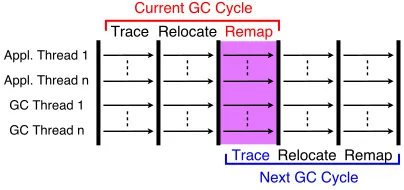
Figure 2: C4 GC cycle. Remapping and tracing are rolled into one traversal. (adapted from [10])
terms of Figure 1, the heap memory on top is used until after the remapping phase, but the physical memory below can be paired with a different virtual page and used immediately.
3.3
Concurrent Remapping
To maintain concurrency while updating all references to the now relocated objects, the C4 compaction algorithm uses two techniques [10]. The first islazy remapping. With this, mutator threads continue updating references as they trigger the LVB. In order for the remapping phase to end, all live references must be updated. However, remapping could go on indefinitely if lazy remapping alone is performed.
To finish remapping, a traversal of live references must be performed to ensure all are updated; this is like the trac-ing traversal used to determine which objects are garbage as discussed in Section 2.1. No physical resources are be-ing held due to quick release and lazy remappbe-ing does not severely impact mutator operations. As a result, the remap-ping traversal can wait until another GC cycle starts. C4 will perform the remapping of one GC cycle during the tracing of the next cycle since both tasks traverse the same references in memory. To visualize how this works, examine Figure 2. Upon remapping completion, all references to from-pages are now gone. Thus, the virtual addresses are freed and reclamation of memory is now complete.
3.4
C4 Results Summary
Experiments done with C4 evaluated improvements of us-ing an algorithm that is simultaneously generational and concurrent [10]. C4 is tested against a non-generational C4 algorithm as well as two algorithms that perform non-concurrent compaction. All garbage collectors were tested on the same hardware; for specifications, see [10]. The test exhibited live sets of objects on the heap consistently at a size of around 2.5 gigabytes (Gbs); the actual heap size was allowed to grow, indicating greater amounts of garbage on the heap. The applications were run long enough to ensure multiple full-heap GC cycles ran and at least one significant compaction event occurred.
multi-second worst-case response times for all heap sizes, which would cause noticeable pauses for a user.
4.
THE COLLIE COLLECTOR
We now look at the concurrent compaction technique used by the single-threaded Collie garbage collector described by Iynegar et al. [4]. This is the same research group that worked on C4, so Collie utilizes modified versions of sev-eral techniques from C4, such as: the tracing algorithm, the LVB, page-granularity compaction, and quick-release behav-ior. Only the LVB is modified in significant ways as dis-cussed below. Like C4, the Collie collector is designed with server environments and large heaps in mind. However, it is not commercially available. Collie is implemented and tested in the same production-quality Azul JVM the Pause-less GC algorithm is implemented in [2].
4.1
Transactional Memory
The Collie’s compaction algorithm sets itself apart due to its use of atransactional memory(TM) system as a concur-rency control alternative to barriers [4]. TM systems allow sections of code to function analogously totransactionsfrom database systems, which are a series of operations performed as one unit where they occur in an all-or-none manner.
For example, consider updating sale prices of items in a store; this requires ensuring the store price matches the sale price advertised. When updating the prices for an item, both the advertised price and the store price should be up-dated. Only updating the advertised price could lead to irate customers, and only updating the store price could lead to customers not knowing about the sale. A transaction en-sures an item’s prices are unchanged if the update process is started and then aborted before completion. Additionally, customers cannot see the prices mid-transaction; they only see the price from before the transaction began.
TM systems allow a series of operations modifying mem-ory to be placed in atransactional procedure, much like a database transaction. The TM system monitors access of concurrent threads totransactional variables, variables mod-ified by a transactional procedure. Concurrent threads will operate in parallel until they try to modify the same transac-tional variable. How the conflict should resolve can be speci-fied, but the general behavior would be for one transaction to be aborted and the other allowed to continue. When a trans-action is completed, its changes arecommitted; any changes made to memory by the transaction are finalized [12].
Each object on the heap has areferrer set [4]. This is the precise set of all references pointing to the object. Refer-rer sets are stored as transactional variables since they are used by a transactional procedure (simply referred to as a transaction) that relocates and remaps a single object. An object must maintain a stable referrer set throughout the GC process. That is, its referrer set cannot be modified or expanded, which ensures that all of the object’s references are correctly remapped.
4.2
The Collie Protocol
After a tracing phase at the start of GC, heap compaction happens during atransplantation phase[4]; transplantation is a term meaning the combination of relocation and remap-ping. Live objects and their referrer sets were determined
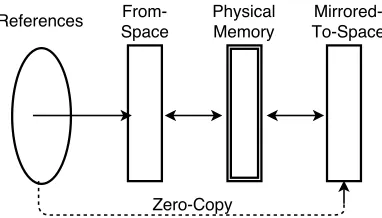
Figure 3: Mirrored-to-space and zero-copy trans-plantation in the Collie collector.
during tracing. As mentioned, the operations for object transplantation are stored as a transaction. Individual ob-ject transplantations are done only on obob-jects that main-tain stable referrer sets throughout the process. An object is deemednon-individually transplantable(NIT) if its trans-action is aborted or it fails to maintain a stable referrer set. Before performing the transactions to move individual ob-jects, the objects need to be checked for having stable refer-rer sets. To do this, threads’ stacks are checked for references to objects. An object with references to it from the stack of any active mutator thread will be marked NIT since the object is in use, which could cause referrer set modifications. This ensures GC does not interfere with mutator work. The LVB-style read barrier receives its first new purpose here. When a thread attempts to load a reference, and add it to its stack, the object the reference points to will be marked NIT as a mutator is using it.
The copying of an object actually occurs outside the trans-action since any mutator access of the object will trigger the LVB-style barrier, rendering the object NIT. Thus, only remapping by updating the referrer set is done in the trans-action, which looks like:
1. Transaction is started
2. Object is checked to not have been marked NIT
3. All references are changed to point to the object’s to-space location
4. Memory transaction is committed
If a transaction fails or is interrupted, as detected by the TM system, the object is rendered NIT.
4.3
Aborting Compactor
After all individually transplantable objects are trans-planted, we are left with unmoved NIT objects. [4]. How-ever, compaction cannot terminate with objects in from-space. The additions of a mirrored-to-space andzero-copy transplantationare necessary to terminate compaction with-out disrupting mutators.
Zero-copy transplantation gets the compactor to believe it has finished a cycle. Mirrored-to-space holds the same ob-jects in physical memory as from-space. Thus, if references are remapped to mirrored-to-space from from-space, the ob-jects appear to be relocated without physically moving. This technique is zero-copy transplantation. In Figure 3, all ref-erences are to from-space for NIT objects. After zero-copy transplantation, they point to mirrored-to-space.
Zero-copy transplantation is performed on all NIT objects. The LVB-style barrier receives a second purpose here. As mutators access references to NIT objects before they are updated to mirrored-to-space, the barrier will cause the mu-tators to correct the references before using the object. Also like C4, entirely finishing zero-copy transplantation, which is just remapping, is rolled up into the next GC cycle’s tracing phase. In the end, NIT objects are not actually compacted; for this reason, Collie is said to have anaborting compactor. It will cease moving objects to allow mutator threads to continue working uninterrupted.
4.4
Collie Results Summary
The main goal of the Collie collector is to decrease latency during compaction [4]. Collie was tested against a modified variant of the Pauseless GC algorithm [2]. Accordingly, both collectors were implemented within the same JVM. For ex-act testing specifications, refer to [4]. Collie utilizes several aspects of C4, which in turn builds upon the Pauseless col-lector. This provides an effective comparison to see how use of transactional memory and an aborting compactor affect application performance.
To examine latency,minimum mutator utilization(MMU) is measured. MMU is the minimum percentage of mutators being utilized over a period of time. Ideally, MMU would al-ways be at 100% so all mutators are being used. MMUs were taken from various time periods during which compaction was running and was compared between the two algorithms. Comparisons were done with a 128 megabyte (Mb) heap and a 512 Mb heap. For all time windows, the Collie compactor had higher MMUs than Pauseless. Collie did not go below a 70% mutator utilization level whereas Pauseless averaged between 40% and 70%. This shows that the aborting na-ture of Collie lends itself to ensuring mutator response time, and thus decreasing latency, despite potentially limiting the amount of memory compacted.
5.
FIELD PINNING PROTOCOL
Last, we examine concurrent compaction in GC through a Field Pinning Protocol (FPP), designed by ¨Osterlund and L¨owe [8]. FPP describes a barrier-free process for perform-ing the relocation aspect of concurrent compaction. The remapping phase and other portions of GC are left up to the host garbage collector. FPP is compliant with the Java Native Interface to allow for integration into a JVM. For pur-poses of testing, FPP is implemented within the Garbage-First GC algorithm in the HotSpot JVM of OpenJDK 9 [3], which lacks concurrent relocation.
5.1
Hazard Pointers
The key component driving FPP is the hazard pointer (HP) [8]. In FPP, all mutator threads contain a list of HPs. The HPs point to objects in memory a thread is accessing, or pin them. When a thread finishes using an object, it drops the HP. So long as an object is pinned by a mutator, it
can-not be relocated as it is still in use. Once all threads have unpinned the object, it can safely be relocated. When dis-cussing the theoretical construction of the algorithm, a gran-ularity of pinning individual fields is used, thus the name Field Pinning Protocol.
While it is explained in more detail below, an example of how HPs work on a high-level is useful. Imagine a pot of coffee at work. Anyone wanting coffee must make it known to others by having a cup, otherwise the coffee is liable to be moved to another break room. The people are effectively pinning the coffee. Once everyone has had their share of caffeine, it should be moved. This can be done safely when no one has cups any longer, so the coffee is not pinned.
5.2
Collaborative Copying and Blame
HPs prevent premature relocation of objects by serving as a distributed counter. Threads cannot relocate objects with a non-zero HP count. A mutator threadimpedesa copying thread if its HP prevents the copying. The impeding thread isblamedfor the interruption [8]; it becomes responsible for ensuring the object is relocated. GC threads cannot receive blame as they will not impede copy attempts.
The process followed by mutator threads during the relo-cation phase when accessing an object is as follows:
1. Pin the object by adding a HP
2. Determine whether the object has already been copied
3. Mutate/use the object. Since the object is pinned, the thread can do so without worry
4. Unpin the object when no longer needed
5. If the thread was blamed due to impeding another thread’s copy attempt, attempt to copy the object:
(a) Check other threads for HPs before copying. If HPs found, blame all the threads and move along
(b) Proceed to copy the object with new pins to the object impeding the copy attempt
Mutators will continually bounce blame around until no threads have the object pinned. At this time, the last thread to attempt to copy the object will succeed.
Reconsider the coffee example. Suppose someone is in charge of moving the coffee to the other room, much like how a GC thread must relocate objects. They can try, but others could still have cups and want more coffee. The inter-rupted person has other tasks they could be doing, so they tell everyone with a cup to move the coffee when finished drinking it; they blame the others for not finishing the task and make them responsible for it. When those blamed finish their coffee, they will try to move it as well. If interrupted by others with coffee cups, HPs, they pass the blame along. This continues until a last person finishes their coffee and moves it to another room.
or another GC cycle starts. If objects have not relocated when another cycle begins, they are automatically marked for relocation again. Allowing mutators to continue passing blame works in G1 because, like C4 and Collie, the algo-rithm will roll up remapping into the next GC cycle’s trac-ing phase. Possible alternative approaches include setttrac-ing a max number of impediments or setting a timer; after such a threshold is reached, the mutator threads pinning the object will be stopped and the object will be relocated.
5.3
FPP Results Summary
As mentioned, FPP was implemented in the G1 garbage collector for testing purposes [8]. Appropriately, the mod-ified G1 collector that uses FPP for relocation is tested against the unmodified G1 collector. Tests were run in a MacBook Pro; for the hardware details, see [8]. We focus on the tests comparing latency of the two garbage collectors. For other tests performed and their results, see [8].
For examining latency, the h2 benchmark from DaCapo is used [1]. The benchmark was chosen due to being mem-ory intensive, which makes latency issues apparent. Latency is measured using the jHiccup tool developed by Azul Sys-tems. Compared to its host garbage collector, G1 with FPP improved latency for all time intervals examined. On aver-age, latency was improved by around 50%; application pause times were about half as long. Latency was shown to mostly come from host garbage collector activities such as tracing and remapping rather than delay from dealing with pins.
6.
CONCLUSIONS
We have examined three techniques for concurrent com-paction that all effectively reduce latency of GC. The full GC algorithms were tested for latency in distinct environments, with different benchmarks, and against various algorithms, so it is difficult to compare them to one another. Addi-tionally, direct comparisons are especially difficult since the algorithms were not all designed for the same environment. The algorithms we have looked at achieved concurrency while maintaining low latency in various ways. C4 and Col-lie use read barriers differently. C4 uses a barrier to control mutator behavior, and Collie uses one to allow mutators to work without interruption. FPP takes a largely differ-ent approach by focusing on performing solely relocation without barriers; it avoids standard synchronization meth-ods by using HPs and thread collaboration instead. Overall, the transition from barrier to mostly barrier-free concurrent compaction shows advancements in the field. Regardless of approach, concurrent compaction is necessary for efficient GC with growing heaps and increasing environmental de-mands. Ultimately, the approach for compaction used will depend on its intended environment.
Acknowledgments
Thank you Elena Machkasova, Jeff Lindblom, and Jeremy Eberhardt for the great advice and feedback.
7.
REFERENCES
[1] S. M. Blackburn, R. Garner, C. Hoffmann, A. M. Khang, K. S. McKinley, R. Bentzur, A. Diwan, D. Feinberg, D. Frampton, S. Z. Guyer, M. Hirzel,
Dincklage, and B. Wiedermann. The DaCapo benchmarks: Java benchmarking development and analysis. InProceedings of the 21st Annual ACM SIGPLAN Conference on Object-oriented
Programming Systems, Languages, and Applications, OOPSLA ’06, pages 169–190, New York, NY, USA, 2006. ACM.
[2] C. Click, G. Tene, and M. Wolf. The Pauseless GC algorithm. InProceedings of the 1st ACM/USENIX International Conference on Virtual Execution Environments, VEE ’05, pages 46–56, New York, NY, USA, 2005. ACM.
[3] D. Detlefs, C. Flood, S. Heller, and T. Printezis. Garbage-First garbage collection. InProceedings of the 4th International Symposium on Memory
Management, ISMM ’04, pages 37–48, New York, NY, USA, 2004. ACM.
[4] B. Iyengar, G. Tene, M. Wolf, and E. Gehringer. The Collie: A wait-free compacting collector. In
Proceedings of the 2012 International Symposium on Memory Management, ISMM ’12, pages 85–96, New York, NY, USA, 2012. ACM.
[5] J. Lindblom. Modern considerations of garbage collection in the Java HotSpot Virtual Machine. In UMM CSci Senior Seminar Conference, VEE ’05, Morris, MN, USA, 2011. UMM.
[6] Oracle. Understanding memory management, 2014. docs.oracle.com/cd/E13150_01/jrockit_jvm/ jrockit/geninfo/diagnos/garbage_collect.html, [Online; accessed 24-October-2015].
[7] Oracle. Processes and threads, 2015.
docs.oracle.com/javase/tutorial/essential/ concurrency/procthread.html, [Online; accessed 24-October-2015].
[8] E. ¨Osterlund and W. L¨owe. Concurrent compaction using a Field Pinning Protocol. InProceedings of the 2015 ACM SIGPLAN International Symposium on Memory Management, ISMM 2015, pages 56–69, New York, NY, USA, 2015. ACM.
[9] W. Puffitsch. Hard real-time garbage collection for a Java chip multi-processor. InProceedings of the 9th International Workshop on Java Technologies for Real-Time and Embedded Systems, JTRES ’11, pages 64–73, New York, NY, USA, 2011. ACM.
[10] G. Tene, B. Iyengar, and M. Wolf. C4: The Continuously Concurrent Compacting Collector. In Proceedings of the International Symposium on Memory Management, ISMM ’11, pages 79–88, New York, NY, USA, 2011. ACM.
[11] Wikipedia. Memory barrier — Wikipedia, The Free Encyclopedia, 2015.en.wikipedia.org/w/index.php? title=Memory_barrier&oldid=663234890, [Online; accessed 24-October-2015].