A SURVEY ON VARIOUS CLASSIFICATION AND
NOVEL CLASS DETECTION APPROACHES FOR
FEATURE EVOLVING DATA STREAM
Ms. Najneen Momin
1, Prof. Nitin Hambir
2Computer Dept.
Dr. D. Y. Patil School Of Engineering, (Affiliated to Savitribai Phule Pune University)
Pune, India
1
[email protected],
2[email protected]
Abstract:The classification of data stream is challenging task for data mining community. Dynamic changing nature of data stream has some difficulties such as feature evolution, concept evolution, concept drift and infinite length. As we know that the data streams are huge in amount, it is impractical to store and use all the data for training. Concept drift occurs when underlying concept changes. Concept-evolution occurs as a result of new classes evolving in the stream. Another important characteristic of data streams, namely, feature evolution, in data stream new features emerge as stream advancement. In this paper we discuss the stream data classification processes and method of these classification techniques. Different authors used different method such as data miner and tree based approach for reduced such types of issues. Ensemble of classifier is used to detect novel classes for feature evolving data stream.
Keywords: data stream, novel class, classification technique, outlier.
1. INTRODUCTION
Data stream classification is more difficult due to its dynamic changing nature as compared
to stationary data. First data streams are in infinite length so it is not feasible to use all the
historical data for training. For this issue multi-pass learning algorithms are not applicable.
Incremental learning approach is well suited for this problem. Second concept drift, when
underlying concept changes over time, concept drift occurs. Various techniques have been
proposed to address this problem. In order to deal with concept drift, classification model
must be updated with recent data. Another characteristic of data stream is concept evolution,
when new classes evolve in data concept evolution occurs. In order to deal with this problem Journal homepage: www.mjret.in
classification model must be able to detect novel classes when they appear. For example
intrusion detection in a network traffic. Most important characteristic is feature evolution in
which new features (words) emerge and old features fade away.
Ensemble techniques have been more popular than single model [1]. In this technique more
than one classifier is used for classification with higher efficiency. Each classifier in the
classification model is trained on different data chunks. With the help of advanced data
streaming technologies [2], we are now able to collect large volume of data for different
application domains. For example credit card transaction, network traffic monitoring etc. the
presence of irrelevant and redundant data slows down the learning algorithms [3] [4]. By
removing or ignoring irrelevant and redundant feature, prediction performance and
computational efficiency can be improved. Multiclass miner works with dynamic feature
vector and detects novel classes. It is a combination of OLINDDA and FAE approach.
OLINDDA and FAE are used to detect novel classes and to classify data chunks
respectively. MCM detects outliers as well as recognize novel class instances. It uses
dynamic thresholding and Gini coefficient analysis. It is considered as fastest method for
classification of dynamic feature data stream. It filters out majority of outliers and reduces the
cost of finding a novel class because cost is proportional to the number of outliers. These
approaches fall into two categories: single model classification and ensemble of model
classification.
The remainder of the paper is organized as follows: Section II describe related work of
stream data classification. Section III describes data stream classification and finally
concludes our approach in section IV.
2. RELATED WORK
The challenges of data stream classification are addressed by different researchers in
different ways.
2.1 Incremental Learning Approach
Most of the existing data stream classification is addressed to handle concept drift and
infinite length problem [5], [6], [7], [8]. Each of these techniques follows some sort of
incremental technique. There are two variations of this technique: Single-model incremental
approach and hybrid batch incremental approach. In single model incremental approach,
model is dynamically maintained with new data. For example, incrementally modifies a
decision tree with new data [9]. Second approach is hybrid batch incremental approach, in
which batch learning technique is used to build each model. When older models become
obsolete, they are replaced by newer models [10], [11]. The hybrid approaches require much
2.2 Cluster Based Approach
Another category of data-stream classification technique is cluster based approach which
addresses the problem of concept evolution in addition to infinite length and concept drift to
detect novel classes in data streams [12]. It defines hyper-sphere for all clusters and
continuously updated with stream progression. If any cluster found out of this hyper-sphere
and if that cluster have some density then novel class is declared. This approach assumes
only one ‘normal’ class and all other classes as ‘novel’, so it is not useful for multiclass data
stream classification.
2.3 Feature Selection For Data Streams Having Dynamic Feature Space
It consists of an incremental feature ranking method in which whenever new document
arrives, first check for new word, if found it is added to library and according to its frequency
statistics are updated. Based on these statistics new ranking of words are computed and top
N words are selected to update classifier (Navie Bayes or kNN). [13] FAE, which applies
incremental feature selection. Classification is done by voting among different models in
ensemble. This approach has better performance than above approaches. But this approach
uses Lossy-L conversion and doesn’t detect novel class.
2.4 Multiclass Classifier And Novel Class Detector
To classify unlabeled data, it uses ensemble of models. During training phase decision
boundaries are build. If any instance of test found outside the boundary considered as
outliers. If enough outliers are found and if they satisfy cohesion and separation property
then considered as novel class. But this approach does not consider feature evolution
problem. [14] If more than one novel class found at the same time, it cannot distinguish
among them.
3. APPROACHES OF DATA STREAM CLASSIFICATION
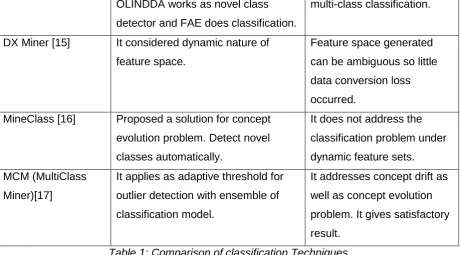
This section describes the comparative study of different approaches. Table 1 shows various
approaches, methods used in that approach and its demerits.
Methods Techniques Demerits
SVSTREAM
(Support Vector
stream clustering)
In this method cluster labeling
approach is used.
Boundary values and outlier
noise degrades the
performance of clustering.
O-F Miner [12], [13] It is a combination of OLINDDA and
FAE.
It assumes only one normal
OLINDDA works as novel class
detector and FAE does classification.
multi-class classification.
DX Miner [15] It considered dynamic nature of
feature space.
Feature space generated
can be ambiguous so little
data conversion loss
occurred.
MineClass [16] Proposed a solution for concept
evolution problem. Detect novel
classes automatically.
It does not address the
classification problem under
dynamic feature sets.
MCM (MultiClass
Miner)[17]
It applies as adaptive threshold for
outlier detection with ensemble of
classification model.
It addresses concept drift as
well as concept evolution
problem. It gives satisfactory
result.
Table 1: Comparison of classification Techniques
4. CONCLUSION AND FUTURE SCOPE
There are various approaches for data stream classification and to address its problems
such as infinite length, concept drift, concept evolution and feature evolution. We describe
advantages and disadvantages of various existing approaches to address these four
problems. Existing classification techniques do not address feature evolution problem very
well or experienced from high false alarm rate and false detection rate in many scenario. In
the future we would like to extend these techniques to reduce the risk of false alarm and
missed novel classes.
ACKNOWLEDGEMENT
I wish to express my sincere thanks to the guide Prof. Nitin Hambir and Head of Department,
Prof. Soumitra Das, also Grateful thanks to our PG Coordinator Prof. Pankaj Agarkar and
last but not least, the departmental staff members for their support.
REFERENCES
[1]. Mohammad M. Masud,Qing Chen,Latifur Khan,Charu C. Aggarwal “Classification and Adaptive Novel Class Detection of Feature-Evolving Data Streams” TRANSACTIONS ON KNOWLEDGE AND DATA ENGINEERING, IEEE 2011. pp. 1-14.
[2]. Mohammad M. Masud, Qing Chen, Jing Gao, Latifur Khan, Jiawei Han, and Bhavani Thuraisingham “Classification and Novel Class Detection of Data Streams in a Dynamic Feature Space” springer 2010. pp. 337-352.
[4]. Salvador Garcıa, Joaquın Derrac “Prototype Selection for Nearest Neighbor Classification: Taxonomy and Empirical Study” IEEE TRANSACTIONS ON PATTERN ANALYSIS AND MACHINE INTELLIGENCE, VOL. 34, 2012. pp. 417-435.
[5]. C.C. Aggarwal, J. Han, J. Wang, and P.S. Yu, “A Framework for On-Demand Classification of Evolving Data Streams,” IEEE Trans. Knowledge and Data Eng., vol. 18, no. 5, pp. 577-589, May 2006.
[6]. C.C. Aggarwal, “On Classification and Segmentation of Massive Audio Data Streams,” Knowledge and Information System, vol. 20, pp. 137-156, July 2009.
[7]. S. Hashemi, Y. Yang, Z. Mirzamomen, and M. Kangavari, “Adapted One-versus-All Decision Trees for Data Stream Classification,” IEEE Trans. Knowledge and Data Eng., vol. 21, no. 5, pp. 624-637, May 2009. [8]. P. Zhang, X. Zhu, and L. Guo, “Mining Data Streams with Labeled and Unlabeled Training Examples,” Proc.
IEEE Ninth Int’l Conf. Data Mining (ICDM), pp. 627-636, 2009.
[9]. G. Hulten, L. Spencer, and P. Domingos, “Mining Time-Changing Data Streams,” Proc. ACM SIGKDD Seventh Int’l Conf. Knowledge Discovery and Data Mining, pp. 97-106, 2001.
[10]. A. Bifet, G. Holmes, B. Pfahringer, R. Kirkby, and R. Gavalda`, “New Ensemble Methods for Evolving Data Streams,” Proc. ACM SIGKDD 15th Int’l Conf. Knowledge Discovery and Data Mining, pp. 139-148, 2009. [11]. J. Gao, W. Fan, and J. Han, “On Appropriate Assumptions to Mine Data Streams,” Proc. IEEE Seventh Int’l
Conf. Data Mining (ICDM), pp. 143-152, 2007.
[12]. E.J. Spinosa, A.P. de Leon F. de Carvalho, and J. Gama, “Cluster- Based Novel Concept Detection in Data Streams Applied to Intrusion Detection in Computer Networks,” Proc. ACM Symp. Applied Computing (SAC), pp. 976-980, 2008.
[13]. B. Wenerstrom and C. Giraud-Carrier, “Temporal Data Mining in Dynamic Feature Spaces,” Proc. Sixth Int’l Conf. Data Mining (ICDM), pp. 1141-1145, 2006.
[14]. M.M. Masud, J. Gao, L. Khan, J. Han, and B.M. Thuraisingham, “Integrating Novel Class Detection with Classification for Concept-Drifting Data Streams,” Proc. European Conf. Machine Learning and Knowledge Discovery in Databases (ECML PKDD), pp. 79-94, 2009.
[15]. M.M. Masud, Q. Chen, J. Gao, L. Khan, J. Han, and B.M. Thuraisingham, “Classification and Novel Class Detection of Data Streams in a Dynamic Feature Space,” Proc. European Conf. Machine Learning and Knowledge Discovery in Databases (ECML PKDD), pp. 337-352, 2010.
[16]. M.M. Masud, J. Gao, L. Khan, J. Han, and B.M. Thuraisingham, “Classification and Novel Class Detection in Concept-Drifting Data Streams under Time Constraints,” IEEE Trans. Knowledge and Data Eng., vol. 23, no. 6, pp. 859-874, June 2011.