80
DEVELOPMENT OF A MODIFIED CLONAL SELECTION ALGORITHM FOR
FEATURE LEVEL FUSION OF MULTIBIOMETRIC SYSTEMS
Adedeji1 O. T., Falohun2 A. S., Alade3 O. M.,Omidiora4 E. O., and Olabiyisi5 S. O.
1,2,3,4,5
Department of Computer Science and Engineering, Ladoke Akintola University of Technology, Ogbomoso, Nigeria.
Corresponding Authors: [email protected]; [email protected]2; [email protected]3.
ABSTRACT
Feature level fusion is the combination of biometric information contained in the extracted features of biometric images. However, feature-balance maintenance and high computational complexity are one of the major problems encountered when fusion is done at feature level. Therefore, in this paper, a Modified Clonal Selection Algorithm (MCSA) which is characterized by feature-balance maintenance capability and low computational complexity was developed for feature level fusion of multibiometric systems.The standard Tournament Selection Method (TSM) was modified by performing tournaments among neighbours rather than by random selection to reduce the between-group selection pressure associated with the standard TSM. Clonal Selection algorithm was formulated by incorporating the Modified Tournament Selection Method (MTSM) into its selection phase. The modified algorithm could be employed for feature level fusion of multibiometric systems.
Keywords: Tournament Selection Method, Clonal Selection Algorithm, Fusion, Multibiometric System.
INTRODUCTION
A biometric system is basically a pattern recognition system that recognizes a person based on a set of features derived from specific physiological or behavioural characteristics that the person possesses (Prabhakar, Pankanti and Jain, 2003; Jain and Ross, 2004; Omidiora, 2006; Omidiora et. al., 2008). Biometric systems are advantageous because they do not require a person to carry cards or remember information unlike conventional authentication systems, which are either possession-based or knowledge-possession-based (Omidiora, 2006; Kim, Shin, Lee and Park, 2012). These conventional methods are unreliable because keys and cards can be lost or stolen, likewise passwords can be compromised, forged or hacked (Omidiora, 2006; Falohun, 2012). Therefore, biometric system has been adopted in many applications (Kim et. al., 2012). However, these systems still have to contend with a variety of problems such as noisy data, inter-class similarities, intra-inter-class variations to mention a few. It is therefore apparent that unibiometrics is not sufficient to achieve the desired performance in real world applications especially those that demands strong authentication (Sanjekar and Patil, 2013). This problem can be resolved using multibiometric system (Nahdeen and Poornima, 2013).
Multibiometrics is the practice of using more than one sources of biometric information to achieve recognition. These sources can be multiple modality, sample, sensor, algorithm, instances.
Multibiometrics is expected to be more robust to noise, address the problem of non-universality, improve the matching accuracy and provide reasonable protection against spoof attacks, increases system robustness, and have capability to lower Failure-to-enroll (FTE) rates (Mane and Jadhav, 2000; Jain and Ross, 2004). Fusion is the integration of multiple sources of biometric information (Mishra, 2010) and feature level fusion has been shown to provide higher-performance accuracy and provide a more secure recognition system (Jain and Ross, 2004; Awang, Yusof, Zamzuri and Arfa, 2013; Shreya and Ephin, 2013).
Biometric fusion is the term used to describe the mechanism for integrating data from two or more traits. It refers to the consolidating of information or evidences presented by multiple biometric sources (Shanthini and Swamynathan, 2012). Based on this, Sanderson and Paliwal (2002) classified information fusion into pre-mapping fusion, midst-mapping fusion and post-mapping fusion. In pre-mapping fusion, information is combined before the use of classifier or expert; in midst-mapping fusion, information is combined during mapping from sensor/feature space into opinion/decision space, while in post-mapping fusion, information is combined after mapping from sensor/feature space into opinion/decision space.
81
comparison with fusion at score level and decision level since feature set contains richer information about the raw biometric data (Delac and Grgic, 2004; Sanderson and Paliwal, 2004). Feature level fusion also increases the reliability of the system by preventing the biometric template from modification, and reduces the response time than score level fusion (Nahdeen and Poornima, 2013). However, feature level fusion is not widely adapted because of incompatibility between different feature vectors and high dimension of the resulting composite feature vector.
Clonal Selection Algorithm (CSA), a special class of the artificial immune algorithm was inspired by clonal selection principles of the natural immune system. CSA performs its search through the mechanisms of somatic mutation and receptor editing, balancing the exploitation of the best solutions with the exploration of the search space. CSA has ability to maintain good population diversity and strong global search capability which qualifies it as a preferred choice in solving multi-modal and combinatorial optimization problem (De Castro and Von Zuben, 2000). In addition, CSA inherits the memory property of human immune systems to build a memory-cell population and can recognize the same or similar antigen quickly at different times (De Castro and Timmis, 2002).
Tournament selection selects a group of individuals randomly from the population. The performance of the selected individuals is compared and the best individual from this group is selected and returned by the operator. Tournament selection can be used when the population size is very large or distributed in some way such as a parallel system and obtaining information is time consuming or not possible. Even though tournament selection uses fitness information to select the best individual of a tournament, random selection of the individuals that make up the tournament reduces selective pressure compared to proportional selection. Tournament selection is simple to implement, has efficient time complexity (linear time complexity), preserves diversity by giving equal chance to all to be selected. Despite all these, tournament selection suffers from high between-group selective pressure and is unable to tune selection pressure automatically. In addition, it does not give guarantee to reproduction of best solution because some members of the population may not get sampled at all for tournament (Alabsi and Naoum, 2012) and the convergence speed may also degrade (Razali and Geraghty, 2011).
Many attempts have been made to address these problems which include fusion at feature extraction level using weighted summation, concatenation followed by data reduction technique (Mishra and Pathak, 2009; Nahdeen and Poornima, 2013). Some others used meta-heuristics such as genetic algorithm (Awang et.al.), particle swarm optimization (Krishneswari and Arumugam, 2012b), ant colony optimization.
Research Methodology
In this paper, CSA and MTSM were proposed for feature level fusion of Multibiometric Systems. The modification of the standard clonal selection algorithm (CSA) was in two phases. The modification was in terms of the encoding scheme used and the selection method used.
Formulation of Modified Tournament Selection Method
The proportional selection method used in the standard clonal selection algorithm (CSA) usually introduces a bias in the beginning of the search which leads to high selection pressure, loss of diversity and premature convergence. Also, the standard tournament selection method though has a reduced selection pressure, does not guarantee that all antibodies in a population will be sampled. At the same time, it suffers from high between-group selection pressure which can also make it difficult for the algorithm to achieve good result. Therefore for this work, the standard tournament selection method was modified in terms of how the candidates for tournament were selected.
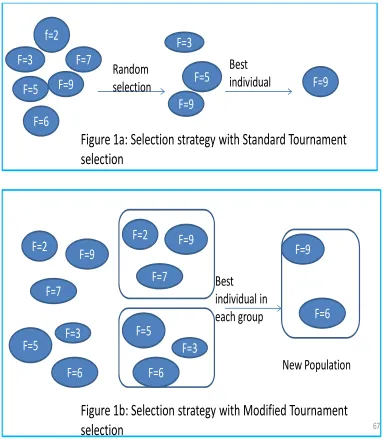
Instead of selecting the candidates randomly as in the case of the standard tournament selection method, the individuals are grouped not based on their fitness values but rather by neighbourhood concept. That means, individuals were grouped together not because they have similar fitness but because they are close to one another in a population. Therefore, the grouping was done for both high fitted antibodies and the low-fitted ones. Then, tournaments were performed among the members of each group. The best individual in each group was then selected to form the new population to be cloned. Selection strategy with standard tournament selection method is shown in fig.1a while that of the modified tournament selection is shown in fig.1b. This modification has the following advantages:
82
ii) Both the strong individuals and the weak ones were considered for selection, thus increases population diversity while reducing the selection pressure.
iii) The exploratory ability of the algorithm is enhanced because considering the weak individuals
can lead the search to regions that only mutation may not lead the search to. This also increases the algorithm’s ability for global search.
iv) The fact that participants in the tournament were not selected randomly has a reducing effect on the between-group selection pressure.
67
f=2
F=3
F=9
F=6
F=5
F=7
F=9
F=5
F=3
F=9
Random
selection
Best
individual
Figure 1a: Selection strategy with Standard Tournament
selection
F=2
F=9
F=5
F=7
F=3
Best
individual in
each group
Figure 1b: Selection strategy with Modified Tournament
selection
New Population
F=6
F=2
F=7
F=9
F=5
F=3
F=6
F=9
F=6
Modified Tournament Selection Method (MTS)
The MTS method can be described as follows: Step 1: Start
Step 2: Group population S into a set of N groups. Step 3: For y = 1 to N do
Step 4: Return the best individual from each group to form the new population.
Step 5: End.
Development of Modified Clonal Selection Algorithm (MCSA)
The modification of the standard clonal selection algorithm (CSA) was in two phases. The modification was in terms of the encoding scheme used and the selection method used.
83
In order to ensure balance among the features selected for fusion in the multibiometric system, the antibody was partitioned into n logical segments where n represents the number of biometric traits involved in the fusion. Each segment of the antibody corresponds to a biometric trait and is managed independently. That means mutation and cloning were performed on each segment independently. This is as shown in Fig.2. This is necessary to ensure that each biometric trait contributes equally to the performance of the multibiometric system.
Step 1: Initialize the algorithm parameters of MCSA
Step 2: Generate Initial antibody population Step 3: Selection Phase
Group population S into a set of N groups. For y = 1 to N
Return the best individual from each group to form the new population.
Step 4: Clone the selected antibodies segment by segment.
Step 5: Mutate the cloned antibodies segment by segment.
Step 6: Evaluate the affinity of the mutated antibodies.
Step 7: Repeat steps 3 to 6 until the stopping criteria is satisfied.
. . . . .
Logical
Segment 1
Logical
Segment 2
Logical
Segment n
Biometric trait 1 Biometric trait 2
Biometric trait
n
Biometric trait 1
Biometric trait 2
Biometric trait n
Implementation of the formulated algorithm
The implementation of the developed algorithm will be programmed in the MATLAB 8.1 (R2013a) environment with a system specification of 1.80GHz processor, 500GB of HDD (hard disk drive), 4GB of RAM, and 64 bit operating system on window 7 platforms. Central Composite Design
(CCD) of design expert 6.0.8. will be used to optimize the composition of the three parameters of MCSA. The parameters are antibody population size, Clonal factor and Mutate factor.
84
In this paper, we have been able to develop a Modified Clonal Selection algorithm for feature level fusion of multibiometric systems. In the developed algorithm, segmented antibody management scheme was used for solution encoding to ensure feature-balance maintenance while selection was based on modified tournament selection method to reduce between-group selection pressure and at the same time improve the quality of the solution. It is recommended that future research may be geared towards implementing and analyzing the performance of the developed algorithm for feature level fusion of multimodal biometric systems.
References
1. Alabsi F. and Naoum R. (2012): “Comparison of Selection Methods and Crossover Operations using Steady State Genetic Based Intrusion Detection System”, Journal of Emerging Trends in Computing and Information Sciences, 3(7): 1053-1058.
2. Awang S., Yusof R., Zamzuri M. F. and Arfa R. (2013): “Feature Level Fusion of Face and Signature using a Modified Feature Selection Technique”, International Conference on Signal-Image Technology and Internet-Based Systems, (IEEE-Computer Society): 706-713. 3. De Castro L.N. and Von Zuben F.J. (2000): “The Clonal Selection algorithm with Engineering Applications”, Proceeding of GECCO’00 Workshop on Artificial Immune systems and Their Applications.:36-37.
4. De Castro, L. N. and Timmis, J. (2002). Artificial immune systems: a novel paradigm to pattern recognition. Artificial Neural networks in pattern Recognition, 1, 67-84.
5. Delac K. and Gurgic M. (2004): “A survey of Biometric Recognition Methods”, 46th International symposium of Electronics in marine, ELMAR-2004 Zadar Croatia.
6. Falohun, A. (2012). Development of a Feature Extraction Method for Iris Recognition using Enhanced Inverse Analytical Fourier-Mellin Transform. Unpublished Ph. D. Thesis. Ladoke Akintola University of Technology, Ogbomoso, Nigeria.
7. Jain A. K and Ross A. (2004): “Multibiometric systems”, Communications of the ACM, Special issue on Multimodal Interfaces, 47(1):34-40.
8. Kim Y. G., Shin K. Y., Lee E. C. and Park K. R., (2012): “Multimodal Biometric Sytem based on the Recognition of faces and Both Irises”,
International Journal of Advanced Robotic Systems, 9(65):1-6.
9. Mane, M. and Jadhav, D (2009): “Review of multimodal Biometrics: applications, challenges and research areas”, International Journal of Biometrics and Bioinformatics (IJBB), 3(5): 90-95.
10. Mishra A. (2010): “Multimodal Biometrics it is: Need for future systems”, International journal of Computer Application, 3(4): 28-33. 11. Nahdeen F. M. and Poornima S. (2013): “Feature Level Fusion in Multimodal Biometric Authentication System”, International Journal of Computer Applications, 69(18): 36 – 40. of Computation and Modelling, 2(3): 17-29. 12. Omidiora E. O. (2006): “A Prototype of
Knowledge-based System for Black Face Recognition System using Principal Component Analysis and Fisher Discriminant Algorithms”, Unpublished Ph. D. Thesis, Ladoke Akintola University of Technology, Ogbomoso, Nigeria.
13. Omidiora, E., Fakolujo, O., Ayeni, R., Olabiyisi, S., & Arulogun, O. (2008). Quantitative evaluation of principal component analysis and fisher discriminant analysis techniques in face images. Journal of Computer and its Applications, 15(1), 22-37.
14. Prabhakar S., Pankanti S. and Jain A. K. (2003): “Biometric Recognition Security and Privacy concerns” IEEE Security & Privacy, :33-42. 15. Razali N. M. and Geraghty J. (2011): “Genetic
Algorithm Performance with Different Selection Strategies in Solving TSP”, Proceedings of the World Congress on Engineering 2(1): 1-6.
16. Sanderson, C., and Paliwal, K. K. (2004). Identity verification using speech and face information. Digital Signal Processing, 14(5), 449-480.
17. Sanjeka, P.S. and Patil, J.B. (2013); “An overview of multimodal Biometrics”, Signal and Image Processing: An International Journal (SIPIJ), 4(1):57-64.
18. Shanthini B. and Swamynathan S. (2012): “A Novel Multimodal Biometric Fusion Technique for Security”, International Conference on Information and Knowledge management. 45(1):143-147.