Single-piece all-solid-state Co(II) ion-selective electrode for cobalt monitoring
in real samples**
Cecylia Wardak* and Małgorzata Grabarczyk
Department of Analytical Chemistry and Instrumental Analysis, Maria Curie-Skłodowska University, Maria Curie-Skłodowska Sq. 3, 20-031 Lublin, Poland
Received August 30, 2018; accepted April 11, 2019
*Corresponding author e-mail: [email protected] Abstract. A novel single-piece all-solid-state ion-selective
electrode for Co2+ determination has been prepared. The PVC
membrane was modified by the addition of ionic liquid. The effect of various ionic liquids was studied in detail and improved performance was observed. The best performance exhibited by the electrode was achieved with a membrane containing 1-ethyl-3-methyl imidazolium chloride, having a slope of 31.8 mV/ decade in a wide concentration range of 1×10⁻⁷ – 1×x10-1 mol L-1.
The limit of detection was 5.6×10⁻⁸ mol L-1. The response time
of the proposed sensor was less than 10 s and the lifetime was at least three months. The proposed sensor showed good selectivi-ty towards the Co2+ ion in comparison with some alkali, alkaline
earth, transition and heavy metal ions. It was successfully applied for the direct determination of cobalt ions in real sample solution. K e y w o r d s: cobalt(II) ion-selective electrode, ionic liquids,
solid contact, potentiometry
INTRODUCTION
Cobalt is an environmentally ubiquitous element. It is a component of more than 70 naturally occurring miner
-als and it has been found in every part of the environment including air, surface water, groundwater, soil, and sedi
-ment (Kim et al., 2006). The presence of cobalt in the environment is also connected with the wide application of its compounds in many industrial processes, fertilizers, paint products, batteries, feeds and disinfectants. Cobalt is an element, which is essential for life as it is a component of vitamin B12 and enzymes such as carbonic anhydrases
and alkaline phosphatases (Pais and Jones, 1997; Arinola
et al., 2008). A cobalt deficiency may cause the inhibition of the synthesis of thymidine, anaemia, the degeneration of nerve cells and the impairment of metabolic processes (Barceloux, 1999). On the other hand, large doses of this
metal may lead to erythraemia, cancers, and hypertrophy
of the thyroid gland, as well as damage to the veins, liver and heart (Fisher and Rystedt, 1985; Moulin et al., 1993). Cobalt is one of the trace elements which are necessary for the methanogenesis performed by microorganisms (Kida
et al., 2001). It is known that a deficiency of trace ele
-ment such as cobalt may result in process instability and decreased biogas production. Hence the addition of cobalt, nickel and other trace elements to bioreactors is used to create optimal conditions for the microorganisms present in the digester and improve the capacity of biogas plants. On the other hand supplementation with trace metals could
lead to an increase in the amounts of these metals released
into the environment. Concentrations of cobalt in surface water and groundwater are usually low, about 1-10 μg L-1
in populated areas. Nevertheless, the cobalt content in such locations may be much higher in mining and agricultural areas, even up to hundreds of mg L-1 (Kim et al., 2006).
In water samples cobalt is generally present in the form of inorganic Co2+,which can be detected easily and deter
-mined by cobalt ion-selective electrodes.
Potentiometry, with an ion-selective electrode is a quick, simple and economic analytical method facilitating the
direct determination of many elements in their ionic forms
in various samples including environmental, industrial and clinical ones (Pięk et al., 2015; Wardak and Grabarczyk, 2016; Lenik and Lyszczek, 2016; Maj-Zurawska and Lewenstam, 2011). In order to obtain accurate results, the use of a sensor with an appropriate detection limit is required, it is also beneficial if it displays selectivity towards interfering ions, which may potentially occur in the tested
sample. From a practical point of view, it is also impor -tant for the electrode to feature a short response time as
well as stability and potential reproducibility (Lindner and Umezawa, 2008). Solid-contact ion-selective electrodes, with a polymer membrane without an internal electrolyte, have aroused increasing interest in recent years. In com
-parison with classic electrodes with an internal filling solution, this type of sensor has a significantly lower cost, and is simpler to use and transport, as well as being more mechanically resistant. Moreover, they can work in any position, in special pressure conditions and within a wide range of temperatures. Unfortunately, the direct connection between the electronic conductors and ionically conducting membranes may lead to a large potential drift due to the high resistance of the charge transfer (Hauser et al., 1995). The most popular solution to the elimination of these prob
-lems was the application of an intermediate layer of various conducting polymers with mixed ionic and electronic con
-ductivity (Cadogan et al., 1992; Paczosa-Bator et al., 2006;
Michalska et al., 2009; Guziński et al., 2013). However, conducting polymer-based electrodes may exhibit disad
-vantages such as CO2, pH or light sensitivity (Bobacka et
al., 2008; Lindfors, 2009), as well as a water layer forming at the interface (Fibbioli et al.2000; Lindfors et al., 2009).
In recent years it was found that ionic liquids (ILs) may be used to replace commonly used lipophilic ionic additives (phenyl borates) in the membrane phase (Wardak, 2009; Wardak, 2012a; Wardak, 2015). They lower the resistance of the membrane and reduce anion interference, thereby improving certain analytical parameters of the electrode, such as the detection limit, measuring range, working pH range and selectivity. Therefore, we have decided to prepare a single-piece solid-contact cobalt ion-selective electrode with a membrane modified by IL. As a cobalt ionophore, 2-amino-5(Hydroxy-1-naphthylazo)-1,3,4 –thi
-adiazole was used. This compound forms stable complexes with cobalt, which are soluble in membrane solvents. For membrane modification, various alkylmethylimidazolium ionic liquids with chloride anions were used. The proposed electrode is based on the concept of a second kind of Ag/ AgCl electrode. Thus, the addition of an ionic liquid in chloride form to the membrane covering this internal Ag/ AgCl electrode will eliminate the blocked membrane/inter
-nal electrode interface.
Electrodes containing a membrane with a traditional composition without ionic liquid were prepared and stud
-ied in order to serve as a comparison with the proposed electrode.
MATERIALS AND METHODS
The following reagents were used: Ionic liquids:
1-ethyl-3-methylimidazolium chloride (EMImCl), 1-butyl-3-methylimidazolium chloride (BMImCl), 1-hexyl-3-methylimidazolium chloride (HMImCl),
1-methyl-3-octylimidazolium chloride (OMImCl), 1-decyl-3-methylimidazolium chloride (DMImCl),
were obtained from Sigma-Aldrich. Poly(vinyl chloride) low molecular weight (PVC) was purchased from Aldrich. As PVC plasticizers: 2-Nitrophenyl octyl ether (NPOE) (Fluka), tributyl phosphate (TBP) (Merck) and tris(2-ethylhexyl) phosphate (TEHP)(K&K laboratories ICN) were used. The ionophore 2-amino-5(Hydroxy-1-na-phthylazo)-1,3,4 –thiadiazole (I) was synthesized at the Department of Medical Chemistry, Medical University of Lublin. As a traditional lipophilic additive, potassium tetrakis (p-chlorophenyl) borate (KTpClB) (Fluka) was used. Other reagents were purchased from Fluka. All aqueous solutions were prepared with compounds of the highest purity available (pure pro analysis) using freshly deionized water.
Ion-selective electrodes were constructed using an Ag/AgCl electrode as the internal electrode which was obtained in the electrolysis process. The electrode mem-brane covering the internal Ag/AgCl electrode was pre-pared by the gelation of the mixture of membrane com-ponents placed in the Teflon holder. The method of mem-brane preparation was described in detail in our earlier papers (Wardak, 2009; Wardak and Lenik, 2013). After preparation, the electrodes were soaked for at least 12 h, in a 1×10⁻³ mol L-1 Co(NO
3)2 solution to saturate the PVC
membrane in the primary ions. In order to optimize the electrode detection limit before measurements were carried out, the electrodes were conditioned for at least 24 h, in an appropriate conditioning solution. The concentrations of the conditioning solutions were as follows: a) 1×10⁻³ mol L-1,
b) 1×10⁻⁵ mol L-1, c) 1×10⁻⁷ mol L-1 and d) 1×10⁻⁹ mol L-1.
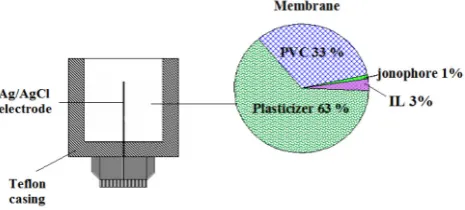
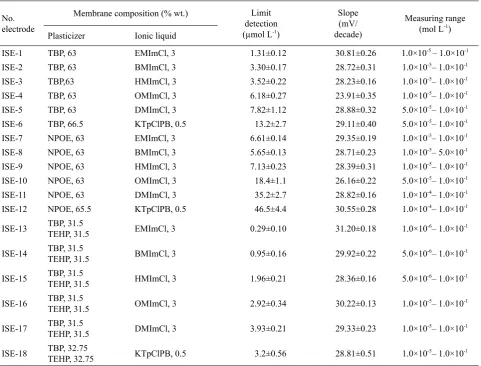
The scheme of sensor construction is shown in Fig. 1. The membrane composition is listed in Table 1.
The measurement of the electromotive force (EMF) of the system: the cobalt ion-selective electrode – reference electrode Orion 90-02 was carried out at room temperature in a solution stirred with a magnetic stirrer by means of a potentiometric system consisting of a 16-channel data acquisition system (Lawson Labs. Inc., USA) and IBM PC computer. Sequential dilutions of stock solutions were performed using the 700 Dosino and 711 Liquino pump systems (Metrohm, Switzerland).
The potentiometric responses of the studied electrodes were determined in cobalt nitrate solutions with a concentra-tion of 1×10⁻¹ – 1×10⁻⁸ mol L-1. The calibration curves were
determined four times in an alternating fashion, from low to high and high to low concentrations. The sensor perfor-mance of individual electrodes such as the limit of detection, the working concentration range, and the slope of the linear section of the response curve, were determined from the results of these measurements and are summarized in Table 1. The detection limit given in Table 1 was taken as the bulk activity when the measured potential begins to deviate on both sides, by (RT/ziF)ln2 from the linear Nernstian
response (Sokalski et al., 1999).
The selectivity of the studied sensors wereas evaluat
-ed by determining the selectivity coefficient values using the separate solution method, which is known as Bakker’s method (Bakker et al., 2000).
The response times of the examined electrodes was determined from the dynamic response obtained by inject
-ing concentrated standard solutions into a stirred sample solution and simultaneously recording EMF changes with time. The response time was determined as the elapsed time
from the moment when the studied cobalt-selective elec
-trode and reference elec-trode are brought into contact with a sample solution with a changed activity of the Co2+ ions
to the time when the ∆E/∆t becomes equal to 0.5 mV min-1
(Buck and Lindner, 1994).
In order to evaluate the reversibility of the potential, the studied electrodes were immersed repetitively in Co(NO3)2
solutions at two different concentrations (1×10⁻⁵ and 1×10⁻⁶
mol L-1) and electrode response was measured.
The long-term stability and reproducibility of the elec
-trode potentials were studied over a 90-day period. The measurements were conducted using three identical elec
-trodes in 0.1 mol L-1 Co(NO
3)2 solutions. The potentials
were measured daily during the first three days and then every five days. The electrodes were stored in air without sunlight between measurements. The potential readings of particular electrodes obtained after 60 min were used to calculate the mean potential values and standard deviations of each measurement.
Electrochemical impedance spectroscopy (EIS) measu-rements were performed in 0.01 mol L-1 Co(NO
3)2 by using
an AUTOLAB electrochemical analyser controlled by
Table 1. Composition of electrode membranes and sensors performance
No.
electrode
Membrane composition (% wt.) Limit
detection
(µmol L-1)
Slope
(mV/ decade)
Measuring range (mol L-1)
Plasticizer Ionic liquid
ISE-1 TBP, 63 EMImCl, 3 1.31±0.12 30.81±0.26 1.0×10⁻⁵ – 1.0×10⁻¹
ISE-2 TBP, 63 BMImCl, 3 3.30±0.17 28.72±0.31 1.0×10⁻⁵– 1.0×10⁻¹
ISE-3 TBP,63 HMImCl, 3 3.52±0.22 28.23±0.16 1.0×10⁻⁵– 1.0×10⁻¹
ISE-4 TBP, 63 OMImCl, 3 6.18±0.27 23.91±0.35 1.0×10⁻⁵– 1.0×10⁻¹
ISE-5 TBP, 63 DMImCl, 3 7.82±1.12 28.88±0.32 5.0×10⁻⁵– 1.0×10⁻¹
ISE-6 TBP, 66.5 KTpClPB, 0.5 13.2±2.7 29.11±0.40 5.0×10⁻⁵– 1.0×10⁻¹
ISE-7 NPOE, 63 EMImCl, 3 6.61±0.14 29.35±0.19 1.0×10⁻⁵– 1.0×10⁻¹
ISE-8 NPOE, 63 BMImCl, 3 5.65±0.13 28.71±0.23 1.0×10⁻⁵– 5.0×10⁻¹
ISE-9 NPOE, 63 HMImCl, 3 7.13±0.23 28.39±0.31 1.0×10⁻⁵– 1.0×10⁻¹
ISE-10 NPOE, 63 OMImCl, 3 18.4±1.1 26.16±0.22 5.0×10⁻⁵– 1.0×10⁻¹
ISE-11 NPOE, 63 DMImCl, 3 35.2±2.7 28.82±0.16 1.0×10⁻⁴– 1.0×10⁻¹
ISE-12 NPOE, 65.5 KTpClPB, 0.5 46.5±4.4 30.55±0.28 1.0×10⁻⁴– 1.0×10⁻¹
ISE-13 TBP, 31.5TEHP, 31.5 EMImCl, 3 0.29±0.10 31.20±0.18 1.0×10⁻⁶– 1.0×10⁻¹
ISE-14 TBP, 31.5TEHP, 31.5 BMImCl, 3 0.95±0.16 29.92±0.22 5.0×10⁻⁶– 1.0×10⁻¹
ISE-15 TBP, 31.5TEHP, 31.5 HMImCl, 3 1.96±0.21 28.36±0.16 5.0×10⁻⁶– 1.0×10⁻¹
ISE-16 TBP, 31.5TEHP, 31.5 OMImCl, 3 2.92±0.34 30.22±0.13 1.0×10⁻⁵– 1.0×10⁻¹
ISE-17 TBP, 31.5TEHP, 31.5 DMImCl, 3 3.93±0.21 29.33±0.23 1.0×10⁻⁵– 1.0×10⁻¹
ISE-18 TBP, 32.75TEHP, 32.75 KTpClPB, 0.5 3.2±0.56 28.81±0.51 1.0×10⁻⁵– 1.0×10⁻¹
GPES software, ver. 4.9 (Eco Chemie Utrecht Netherlands) with a conventional three-electrode system, where the stu-died electrode was used as the working electrode, the ref
-erence electrode was Ag/AgCl (3 mol L-1 KCl), and the
auxiliary electrode was a platinum wire. The impedance spectra were recorded at open circuit potential with an am-plitude of 0.1 V and in the frequency range 100 Hz-100 kHz.
All water samples were collected in the village of Siedliszczki in eastern Poland in April 2018. Three kinds of water samples were analysed: water taken from the riv
-er Gielczew was slightly turbid and had a conductivity of 0.55mS cm-1; water from a small unnamed lake was slight
-ly turbid and had a conductivity of 0.68 mS cm-1; ground
water taken from a well was clear and had a conductivity of 0.30 mS cm-1. Directly after sampling, the water samples
were acidified with 0.1 mol L-1 HNO
3 to reach a stable pH
of 5.0. Portions of 100 mL were spiked with cobalt ions to obtain final concentrations of 5×10⁻⁷, 8×10⁻⁷, 1×10⁻⁶, 3×10⁻⁶
mol L-1 in order to perform recovery measurements. One
half of each sample was analysed with Co-SPISE and the other by adsorptive stripping voltammetry (AdsSV). The 1.0× 10⁻³ mol L-1 NaNO
3 solution was used as a background
solution in potentiometric measurements.
RESULTS AND DISCUSSION
In this paper single-piece solid-contact cobalt-selective electrodes with a polymeric membrane containing various imidazolium-based ionic liquids with chloride anions were studied. The effect of the ionic liquid used on sensor performance was evaluated by comparing it to a sensor having a membrane based on conventional ionic additive KTpClPB without ionic liquid.
It may be seen in Table 1 that all of the studied elec
-trodes exhibited sensitivity to Co2+ ions but their parameters
were different for particular electrodes. It all depends on the membrane components used, both the plasticizer and ionic additive. The plasticizer is an important component of the ion-selective membrane which affects both the selectivity and measuring range of the ISEs. Among the three plasti
-cizers used, the TBP+TEHP (mixture 1:1) turned out to be the best membrane solvent. The electrode with membranes based on this membrane solvent exhibited a lower detec
-tion limit and a wider measuring range in comparison with electrodes having membranes plasticized by NPOE or TBP. The lipophilic ionic additive performs some impor
-tant functions in the membrane. First of all, it inhibits the interfering effect of anions from the aqueous phase, which may undergo coextraction with the cation into the membrane in the form of ionic pairs. Secondly, it reduces membrane resistance, which favourably affects the time required to generate a stable electrode potential. The effect of ionic additives of various ionic liquids and KTpClPB on the potential response of the studied cobalt electrodes is shown in Fig. 2, where it can be seen that ionic liquids act more effectively as the ionic membrane component than
KTpClPB. The best response was exhibited by ISE 13, it is based on EMImCl and a plasticizer TBP+TEHP (mixture 1:1): therefore this electrode was selected for further studies. In our previous papers, we demonstrated that the prop -erties of solid-contact electrodes, such as the detection limit
and selectivity also depend on the procedure used for elec
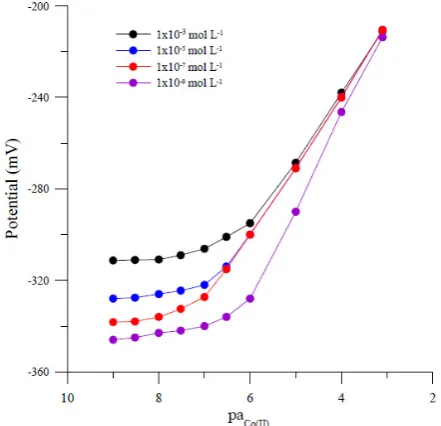
-trode conditioning (Wardak, 2012b; Wardak, 2014, 2015). Therefore the next step of the study was the optimization of cobalt concentration in the conditioning solution. The calibration curves of ISE-13 obtained for four conditioning procedures are presented in Fig. 3. As expected, lowering the cobalt concentration in the conditioning solution down
Fig. 2. Effect of ionic additive to the membrane phase on cobalt electrode response.
to 1×10⁻⁷ mol L-1 led to an improvement in the detection
limit. The detection limit of ISE-13 was improved from 2.9×10⁻⁷ to 5.6×10⁻⁸ mol L-1, as a result of the optimization
of the conditioning solution. This effect may be explained by the limitation of ion leaching from the membrane to the sample solution after conditioning in more diluted solutions. Further decreasing the cobalt content in the conditioning solution did not have the expected effect on electrode response which was super-Nernstian at low concentrations after soaking the electrode in a 1×10⁻⁹ mol L-1 solution.
The most important parameter of any ion-selective elec -trode is its response to the primary ion in the presence of
interfering ions. This factor is expressed by potentiomet
-ric selectivity coefficients. A comparison of the selectivity coefficients obtained for ISE 18 based on KTpClPB and ISE 13 based on EMImCl are presented in Fig. 4. Both electrodes had the same membrane components except for the ionic additive. The introduction of EMImCl to the membrane phase caused a notable improvement in elec
-trode selectivity. Similar results were observed in the case of other electrodes based on ionic liquids. Better values of selectivity coefficients obtained for the electrodes based on ionic liquids as compared with those of the electrodes based on KTpClPB are due to differences in ion-exchang
-ing properties. Ionic liquids present in the membrane have very weak ion-exchanging properties (Wardak 2012a; Wardak and Lenik, 2013) and because of that they do not increase the possibility of the extraction of interfering ions, however, they increase ionic strength in the membrane and thereby facilitate primary ion extraction. The level of ionic liquid in the membrane may largely exceed the ionophore concentration, which, however, does not cause any loss of selectivity. On the other hand, a lipophilic salt such as KTpClPB, possessing ion-exchanging properties, increas
-es the extraction of all cations and thus reduc-es electrode selectivity (Wardak and Lenik, 2013). Certainly, this effect
depends on the concentration of the lipophilic salt in the
membrane, which must be carefully selected. Too much salt added as an ionic exchanger can cause a loss of selectivity toward the primary ion (Armstrong and Horvai, 1990). This effect has not been observed in the case of ionic liquid.
The response time of the electrodes being studied depends on the cobalt concentration in the sample solu
-tion and it is longer in diluted solu-tions. In all cases the response time of the electrodes based on ionic liquid was shorter than the response time of the electrodes based on KTpClPB. For ISE -13 the maximum value of the response time in 1×10⁻⁷ mol L-1 was 10 s but in more concentrated
solutions up to 1×10⁻⁵ mol L-1 it was shorter by 5 s. For
ISE-18 the response time was about two times longer, 20-25 s in 1×10⁻⁶ – 1×10⁻⁵ mol L-1 solutions and 10 s in the range of
1×10⁻⁴ – 1×10⁻¹mol L-1.
The reversibility, stability and reproducibility of the
electrode response are important parameters from the
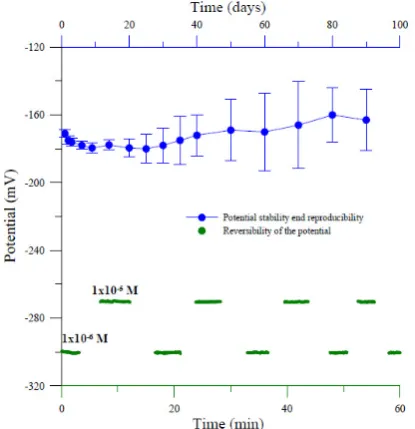
ana-lytical application point of view. The green curve in Fig. 5
shows the potential of ISE-13 recorded alternately in solu
-tions at two different concentra-tions. The mean potential values obtained from four measurements were -300.23 ± 0.19 and -269.39 ± 0.13 mV in solutions of 1×10⁻⁶ M and
1×10⁻⁵ M, respectively. These results are evidence of the
full reversibility of the tested sensor. The long-term sta
-bility and reproduci-bility of the electrode potential were also studied. The results obtained for ISE-13 are presented
Fig. 4. Comparison of selectivity coefficients values for the stud
-ied sensors: ISE-18 based on KTpClPB (1st column) and ISE-13 based on BMImCl (2nd column).
Fig. 5. Reversibility of the response of ISE-13 based on EMImCl (curve green) and changes in electrode potential with time determined in 0.1 mol L-1 Co(NO
3)2 (curve blue). The standard
in Fig. 5 (blue curve) where it may be observed that the proposed electrode exhibited a stable and reproducible potential. The potential drift calculated from ΔE/Δt was 1.23 mV day-1 durin g the first three days and 0.15 mV day-1
over the remainder of the study (3-90 days).
Electrochemical impedance spectroscopy is a very sen-sitive technique that allows for the study of electrode pro
-cesses. Regarding ion-selective electrodes, this technique
makes it possible to determine membrane resistance and charge transfer processes at the membrane/internal elec
-trode interface.
Exemplary impedance spectra of ISE-13 based on EMImCl and ISE-18 based on KTpClPB are shown in Fig. 6. They are in the form semicircles related to the bulk resistance Rb of the ion-selective membrane and its geo
-metric capacitance (Radu et al., 2010). It may be seen in Figure 6 that the bulk resistance decreased from 1680 kΩ (ISE-18) to 383 kΩ (ISE-13). This was obviously due to the presence of ionic liquid in the membrane phase. The obtained results showed that IL more effectively decreases membrane resistance than phenylborate derivatives.
In order to demonstrate the practical usefulness of the
proposed Co-ISE, the cobalt concentrations in real water samples including river, lake and ground water were detected by direct potentiometry. The water samples were collected from a river, a lake and a well located near a bio-gas plant. The addition of cobalt and other trace elements to bioreactors is used to create optimal conditions for the microorganisms present in the digester and improve the capacity of the biogas plant. However, supplementation with trace metals could lead to an increase in the release of these metals into the environment. The analysis was per
-formed using the standard addition technique. Adsorptive stripping voltammetry was the control method used for the determination of cobalt in the water samples. The results are summarized in Table 2. It may be seen that the results obtained using the potentiometric method are comparable with those obtained by AdSV analysis. Thus, the proposed single-piece Co-selective electrode provides a good alter
-native for the determination of Co2+ in real samples. Fig. 6. Impedance spectra of ISE-13 (red) and ISE-18 (blue)
recorded in 0.01 mol L-1 Co(NO
3)2. The spectra were recorded at
the open circuit potential in the frequency range 100 Hz-1000 kHz.
Table 2. Determination of cobalt in river water, lake water and groundwater samples (unspiked and spiked) by direct potentiometry and comparison with analyses by adsorptive striping voltammetry
Sample Co-SPISECobalt detected by a (µg L-1) (n = 4) Recovery (%) Cobalt detected by AdSV (µg L-1) (n = 3)
River water
River water +29.5 (µg L-1 ) Co2+
River water +47.2 (µg L-1) Co2+
River water +59.0 (µg L-1) Co2+
River water +177.0 (µg L-1) Co2+
17.8±0.8 46.3±2.2 65.8±2.5 77.8±3.0 193.0±6.0
–
98.0 101.3 101.3 98.8
18.4±1.3 47.3±3.0 64.2±4.2 79.3±5.4 199.0±11.0
Lake water
Lake water +29.5 (µg L-1) Co2+
Lake water +47.2 (µg L-1) Co2+
Lake water +59.0 (µg L-1) Co2+
Lake water +177.0 (µg L-1) Co2+
27.1±1.2 57.8±2.0 74.2±3.4 86.8±4.5 204.0±7.0
–
102.1 99.9 100.8 99.7
29.1±2.0 59.5±3.5 72.6±5.6 86.4±5.4 210.0±11.0
Groundwater
Groundwater +29.5 (µg L-1) Co2+
Ground water +47.2 (µg L-1) Co2+
Groundwater +59.0 (µgL-1) Co2+
Groundwater +177.0 (µg L-1) Co2+
34.5±3.5 64.7±3.9 79.1±5.2 96.3±6.4 221.0±10.0
–
101.2 96.9 102.9 104.6
36.2±5.4 68.1±5.0 79.2±9.1 98.7±10.0 218.0±12.0
aSPISE was conditioned in 1.0×10⁻⁷ Co(NO
CONCLUSIONS
1. Modification of membrane composition by ionic liquid allows one to obtain single-piece Co-sensitive ion-selective electrodes in a simple and fast way.
2. Among the studied imidazolium-based ionic liquids, the most suitable for the preparation of cobalt sensitive membranes is 1-ethyl-3-methyl imidazolium chloride.
3. The presence of ionic liquid in the polymeric membra-ne phase results in a decrease in membramembra-ne resistance and has a valuable effect on sensor performance i.e. lowering the detection limit, shortening response time, enhancing selectivity and improving long-term stability.
4. The electrode response depends on the cobalt con-tent in the conditioning solution. The optimal cobalt concentration in the conditioning solution was found to be 1.0×10⁻⁷ mol L-1.
5. The proposed SPISE is a simple and economic analytical device for monitoring cobalt content in surface and ground water samples.
Conflict of interest: The Authors do not declare con
-flict of interest.
REFERENCES
Arinola O.G., Nwozo S.O., Ajiboye J.A., and Oniye A.H., 2008. Evaluation of trace elements and total antioxidant status in Nigerian cassava processors. J. Nutr., 7, 770-772.
https://doi.org/10.3923/pjn.2008.770.772
Armstrong R.D. and Horvai G., 1990. Properties of PVC based membranes used in ion-selective electrodes. Electrochim. Acta, 35, 1-7. https://doi.org/10.1016/0013-4686(90)85028-l Bakker E., Pretsch E., and Bühlman P., 2000. Selectivity of
potentiometric ion sensors. Anal. Chem., 72, 1127-1133. https://doi.org/10.1021/ac991146n
Barceloux D.G. and Barceloux D., 1999. Cobalt. Clin. Toxicol., 37, 201-216.
Bobacka J., Ivaska A., and Lewenstam A., 2008. Potentiometric ion sensors. Chem. Rev., 108, 329-351.
https://doi.org/10.1021/cr068100w
Buck R.P. and Lindner E., 1994. Recommendations for nomen
-clature of ion-selective electrodes Pure Appl. Chem., 66, 2527-2536. https://doi.org/10.1351/pac199466122527 Cadogan A., Gao Z., Lewenstam A. and Ivaska A., 1992.
All-solid-state sodium-selective electrode based on a calixarene ionophore in a poly(viny1 chloride) membrane with a poly-pyrrole solid contact. Anal. Chem., 64, 2496-2501. https://doi.org/10.1021/ac00045a007
Fibbioli M., Morf W.E., Badertscher M., De Rooij N.F., and Pretsch E., 2000. Potential drifts of solid-contacted ion-selective electrodes due to zero-current ion fluxes through the sensor membrane. Electroanalysis, 12, 1286-1292. https://doi.org/10.1002/1521-4109(200011)12: 16%3C1286::AID-ELAN1286%3E3.0.CO;2-Q
Fisher T. and Rystedt I., 1985. Hand eczema among hard-metal workers. Am. J. Ind. Med., 8, 381-394.
https://doi.org/10.1002/ajim.4700080419
Guziński M., Lisak G., Sokalski T., Bobacka J., Ivaska A.,
Bocheńska M., and Lewenstam A., 2013. Solid contact
Ion-selective electrodes with highly selective thioamide derivatives of p-tetr-butylcalix[4]arene for the determina
-tion of lead(II) in environmental samples. Anal. Chem., 85, 1555-1561. https://doi.org/10.1021/ac302772v
Hauser P.C., Chiang D.W.L. and Wright G.A., 1995. A potassium-
ion selective electrode with valinomycin based poly(vinyl chloride) membrane and a poly(vinyl ferrocene) solid con
-tact. Anal. Chim. Acta, 302, 241-248.
https://doi.org/10.1016/0003-2670(94)00472-x
Kida K., Shigematsu T., Kijima J., Numaguchi M., Mochinaga Y., Abe N., and Morimura S., 2001. Influence of Ni2+ and Co2+ on methanogenic activity and the amounts of
coenzy-mes involved in methanogenesis. J. Biosci. Bioeng., 91, 590-595. https://doi.org/10.1263/jbb.91.590
Kim J. H., Gibb H. J., and Howe P.D., 2006. Cobalt and inorganic cobalt compounds, p.4, WHO Press, Geneva, Switzerland. Lenik J. and Lyszczek R., 2016. Functionalized β-cyclodextrin
based potentiometric sensor for naproxen determination. Mat. Sci. Eng. C-Mater., 61, 149-157.
https://doi.org/10.1016/j.msec.2015.12.011
Lindfors T., 2009. Light sensitivity and potential stability of elec
-trically conducting polymers commonly used in solid contact ion-selective electrodes. J. Solid State Electrochem., 13, 77-89. https://doi.org/10.1007/s10008-008-0561-z Lindfors T., Sundfors F., Höfler L., and Gyurcsányi R.E., 2009.
FTIR-ATR study of water uptake and diffusion through ion-selective membranes based on plasticized poly(vinyl chloride). Electroanalysis, 21, 1914-1922.
https://doi.org/10.1002/elan.200904609
Lindner E. and Umezawa Y., 2008. Performance evaluation cri -teria for preparation and measurement of macro- and
microfabricated ion-selective electrodes (IUPAC Technical Report). Pure. Appl. Chem., 80, 85-104.
https://doi.org/10.1351/pac200880010085
Maj-Zurawska M. and Lewenstam A., 2011. Selectivity coeffi
-cients of ion-selective magnesium electrodes used for simul-taneous determination of magnesium and calcium ions. Talanta, 87, 295-301.
https://doi.org/10.1016/j.talanta.2011.09.023
Michalska A., Wojciechowski M., Jędral W., Bulska E., and
Maksymiuk K., 2009. Silver and lead all-plastic
sensors-polyaniline vs. poly(3,4- ethyledioxythiophene) solid contact. J. Solid State Electrochem., 13, 99-106.
https://doi.org/10.1007/s10008-008-0563-x
Moulin J.J., Wild P., Mur J.M., Fournier-Betz M., and Mercier-Gollay M., 1993. A mortality study of cobalt production workers: An extension of the follow-up. Am. J. Ind. Med., 23, 281-288. https://doi.org/10.1002/ajim.4700230205 Paczosa-Bator B., Migdalski J., and Lewenstam A., 2006.
Conducting polymer films as model biological membranes: Electrochemical and ion-exchange properties of poly(pyrrole) films doped with asparagine and glutamine. Electrochim. Acta, 51, 2173-2181.
https://doi.org/10.1016/j.electacta.2005.03.084
Pięk M., Piech R., and Paczosa-Bator B., 2015. Improved nitrate sensing using solid contact ion selective electrodes based on TTF and its radical salt. J. Electrochem. Soc., 162, B257- B263. https://doi.org/10.1149/2.0631510jes
Radu A., Antrasova-Ivanowa S., Paczosa-Bator B., Danielewski M., Bobacka J., Lewenstam A., and Diamond D., 2010. Diagnostic of functionality of polymer membrane – Based ion selective electrodes by impedance spectroscopy. Anal. Methods, 2, 1490-1498. https://doi.org/10.1039/c0ay00249f Sokalski T., Zwickl T., Bakker E., and Pretsch E., 1999.Lowering
the detection limit of solvent polymeric ion-selective elec
-trodes. 1. Modeling the Influence of Steady-State Ion Fluxes Anal. Chem., 71, 1204-1209. https://doi.org/10.1021/ac980944v Wardak C., 2009. Ionic liquids as new lipophilic additives to the
membrane of lead opn-selective electrodes with solid con
-tact. Int. J. Environ. Anal. Chem., 89, 735-748. https://doi.org/10.1080/03067310902887642
Wardak C., 2012a. Ionic liquids improve analytical parameters of cadmium ion-selective electrodes with solid contact. Sensor Lett., 10, 1000-1006. https://doi.org/10.1166/sl.2012.2330
Wardak C., 2012b. A comparative study of cadmium ion-selec
-tive electrodes with solid and liquid inner contact. Electro-analysis, 24, 85-90. https://doi.org/10.1002/elan.201100362 Wardak C., 2014. Solid contact Zn2+ – selective electrode with
low detection limit and stable and reversible potential. Centr. Eur. J. Chem., 12, 354-364.
https://doi.org/10.2478/s11532-013-0390-5
Wardak C., 2015. Solid contact cadmium ion-selective electrode based on ionic liquid and carbon nanotubes. Sens. Actuators B: Chem., 209, 131-137.
https://doi.org/10.1016/j.snb.2014.11.107
Wardak C. and Grabarczyk M., 2016. Analytical application of
solid contact ion-selective electrodes for determination of copper and nitrate in various food products and drinking water. J. Environ. Sci. Heal. B, 51, 519-524.
https://doi.org/10.1080/03601234.2016.1170545
Wardak C. and Lenik J., 2013. Application of ionic liquid to the construction of Cu(II) ion-selective electrode with solid contact. Sens. Actuators B: Chem., 189, 52-59.