Research Article
Combining ability studies in okra (
Abelmoschus esculentus
L. Moench)
M.M. Wakode1, S.G. Bhave2, V.C. Navhale2, V.V. Dalvi2, J.P. Devmore2 and S.G. Mahadik2 1
Department of Agril. Botany, College of Agriculture, Nagpur 440001, Maharashtra.
2
Dr. Balasaheb Sawant Konkan Krishi Vidyapeeth, Dapoli 415712, Maharashtra.
E-mail: [email protected]
(Received: 27 Jan 2016; Accepted: 02 Dec 2016)
Abstract
The experiments was undertaken to study the combining ability for yield and its attributing traits in okra. The experimental material consisted of seven parents and 42 F1s produced from diallel mating design including reciprocals. Analysis of
variance for combining ability was carried out for eleven characters. The mean squares due to gca, sca and reciprocal effects were significant for all the characters, indicating substantial genetic variations for all the characters studied. The genotypes VRO-6, Pusa A-4 and Arka Anamika were identified as good general combiners for most of the characters including yield per plant and can be exploited well in future breeding programme. Similarly, Ajeet Dhanlaxmi 2-4-2 sel x VRO-6, Pusa A-4 x VRO-6 and VRO-6 x Arka Anamika were the good specific combinations and could be used as a heterotic hybrids. For traits viz., nodal position for fruit, days to first flowering, first picking and number of branches additive gene action was observed for governing these traits. However, for other traits 2 D was greater than 2
A indicating the non-additive gene action for the expression of those traits
Key words
Okra, combining ability, gene action, reciprocal effect, diallel analysis
Introduction
Okra (Abelmoschus esculentus L. Moench), is known by many local names in different parts of the world. It is called as lady’s finger in England, gumbo in the United States of America, guino-gombo in Spanish, guibeiro in Portuguese and bhendi in India. Mainly grown in India, Turkey, Iran, Western Africa, Yugoslavia, Bangladesh, Afghanistan, Pakistan, Burma, Japan, Malayasia, Brazil, Ghana, Ethiopia, Cyprus and the Southern United States. Okra fruits are nutritionally rich. Its 100 g edible part contains 89.6 g moisture, 1.9 g protein, 0.2 g fibre, 6.4 g other carbohydrates, 66 mg calcium, 53 mg magnesium, 56 gm phosphorus, 0.35 mg iron, 6.98 mg sodium, 103 mg potassium, 0.19 mg copper, 30 mg sulphur, 88 IU vitamin A, 0.07 mg thiamine, 0.1 mg riboflavin, 0.6 mg nicotine acid, 13 mg vitamin C and 0.7 g mineral (Chaudhary, 2003). It is grown commercially in most of the states of India as Kharif as well as summer crop in the area of 532.66 thousand hectare and production of 6346 thousand metric tonnes with the productivity of 12 tonnes/ha (Anonymous, 2014).
In any sound breeding programmes, the proper choice of parents based on their combining ability is a prerequisite. The studies intended to determine the combining ability is not only for information regarding the choice of parents but also for the production of superior lines or hybrids. The general combining ability and specific combining ability effects are the foundation for any fruitful breeding programme. Allard (1960) pointed out that the common approach of selecting the parents on the basis of per se performance is not a good indicator of their superior combining ability. The choice of parents in any breeding programme has
to be based on complete genetic information and knowledge of combining ability of the parents. Hence, the present investigation was carried out to identify the gene action, best general combiners and specific cross combinations for increasing the yield and its components in okra.
Materials and methods
Seven parents viz Pusa A-4, Akola Bahar, Ajeet Dhanlakshmi 2-4-2 Sel, Shegaon Local, VRO-6, Arka Anamika, PB-236 were selected for diallel mating involving reciprocals, to generate 42 F1
hybrids. The seven parents and the 42 F1S were
evaluated in randomized block design with three replications at Department of Botany Farm, College of Agriculture, Dr. Balasaheb Sawant Konkan Krishi Vidyapeeth, Dapoli in the year Kharif 2012. The Parbhani Kranti was used as standard check. The spacing of 60 between row to row and 30 cm between plants to plant was adopted. The observations on five randomly selected plants in each genotype of three replications were recorded for nodal position for first flowering, days to first flowering, days to first picking, plant height, number of branches per plant, fruit length, fruit weight, number of fruits per plant, number of fruiting nodes per plant, internode length and yield per plant (g). The procedure outlined by Griffing, 1956 method 1, model 2 was used to estimate the combining ability.
Results and discussion
combination against the expectations from the gca of the parents. On the contrary, the reciprocal effect gives an idea about which parent could be used as female or which as male so as to maximize performance of the crop that was predicted on the basis of gca of parent and sca of the cross. The analysis of variance for the combining ability was carried out for all the observed eleven characters (Table 1).The mean squares due to gca, sca and reciprocal effects were significant for all the characters, indicating substantial genetic variations for gca, sca and reciprocal effect for all the characters studied.
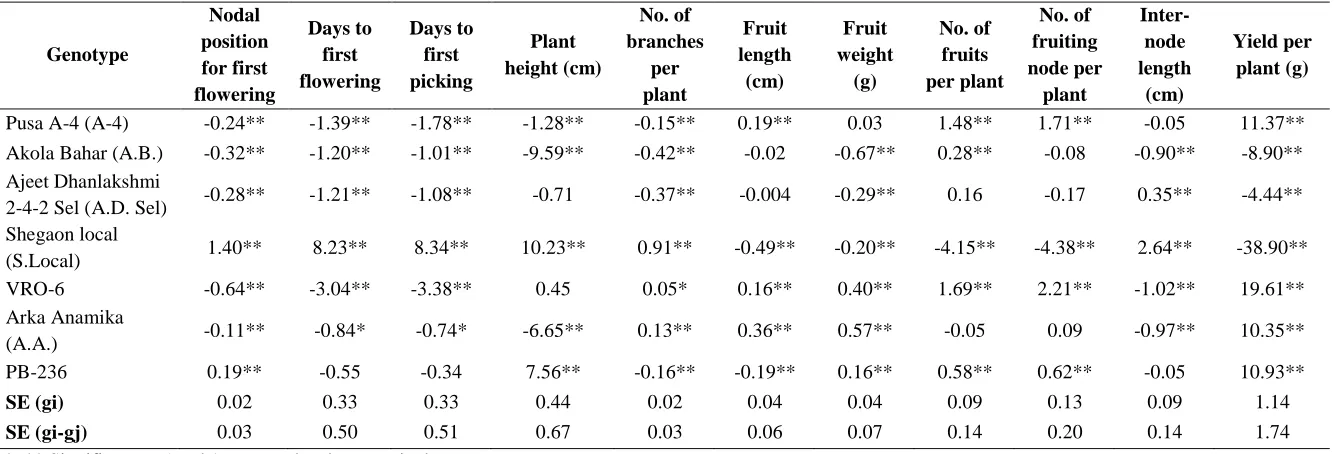
The parents, VRO-6, Pusa A4 are the best general combiner for yield per plant along with seven other component characters (Table 2). Arka Anamica had shown significant gca effects for seven characters including yield. Thus the four parents viz., VRO-6, Pusa A4, Arka Anamika, PB 236 can be considered as good general combining parents for yield per plant and its component characters like number of branches, number of fruits, number of fruiting nodes, fruit weight . Raghuvanshi et al. (2011) reported VRO-6 as a good general combiner for days to first flowering, number of fruits per plant, fruit weight, and yield per plant. Singh et al. (2006) and Balakrishnan et al. (2009) identified Arka Anamika as best general combiner for days to first flowering. Pusa A-4 was identified as good general combiner for days to first fruit harvesting, number of fruits per plant, fruits weight and yield per plant which was also reported by Ramya and Kumar (2010).VRO-6 and Arka Anamika were identified as best general combiners for most of the character by Singh et al (2012).
Specific combining ability effects are indicative of heterosis. Similarly they represent both dominant and epistatic gene actions. The promising F1 hybrids
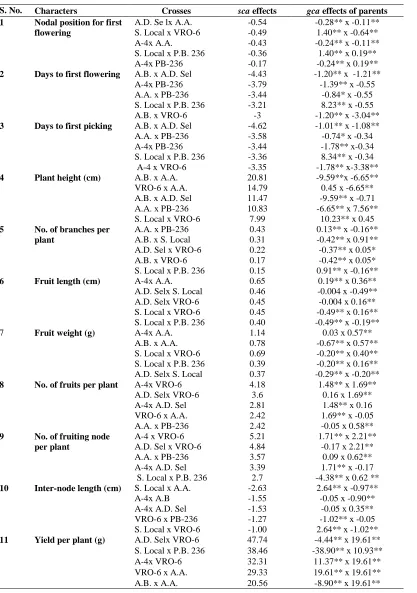
based on specific combining ability effect for yield and its components are presented in Table 3.
The highest sca effect for yield per plant in F1
generation was recorded by the cross Ajeet Dhanlaxmi 2-4-2 sel x VRO-6. This cross also showed significant sca effect for seven other component characters in F1viz. days to flowering,
number of fruit length, fruit weight, number of fruits and fruiting nodes per plant, number of branches per plant, and internode length. The cross Shegaon Local x PB-236 exhibited significant sca effect for yield per plant and also for nine other characters. Along with significant sca effect for yield, the cross Pusa A-4 x VRO-6 had showed the effect for six other characters viz., days to first picking, plant height, fruit length, number of fruits and fruiting nodes per plant and internode length. Cross VRO-6 x Arka Anamika recorded significant sca effect for yield, plant height, number of fruits and number of fruiting node per plant. The five top ranking crosses on the basis of
sca effect were, Ajeet Dhanlaxmi 2-4-2 sel x VRO-6, Shegaon Local x PB-236 , Pusa A4 x VRO-6, VRO-6 x Arka Anamika and Akola Bahar x Arka Anamika. These crosses also ranked top on the basis of mean yield per plant except cross Shegaon Local x PB-236 and Akola Bahar x Arka Anamika. Pal and Sabesan (2009) and Javia et al. (2009) reported similar kind of results. Significant sca effect for yield per plant reflected in hybrids may be due to high x high and high x low gca effect of the parents indicating pre-dominant role of additive x additive and additive x dominance gene action in these crosses. The crosses showing high x high gca effect for fruit yield per plant were Arka Anamika x PB-236, Pusa A-4 x PB-236, VRO-6 x Arka Anamika and Pusa A-4 x VRO-6 and their reciprocals indicating the additive type of interaction. But the performance of reciprocals of crosses Arka Anamika x PB-236 and Pusa A-4 x PB-236 declines significantly over their direct crosses. However, for cross Ajeet Dhanlaxmi 2-4-2 sel x VRO-6, the low x high gca parents were involved indicating that high performance of cross mostly due to dominant gene action in this cross.
may throw up the desirable transgressive segregants (Singh and Kumar, 2010 and Hazem et al., 2013).
Similarly, with respect to specific combining ability effects, none of the cross combination exhibited consistently high sca effect for all the characters studied. The crosses exhibiting high sca effect for yield per plant may or may not have high sca effect for its contributing characters. These findings are in line with the earlier findings of Poshiya and Shukla (1986), Vijay and Manohar (1986), Kalpande (2003) and Balakrishnan et al. (2009).
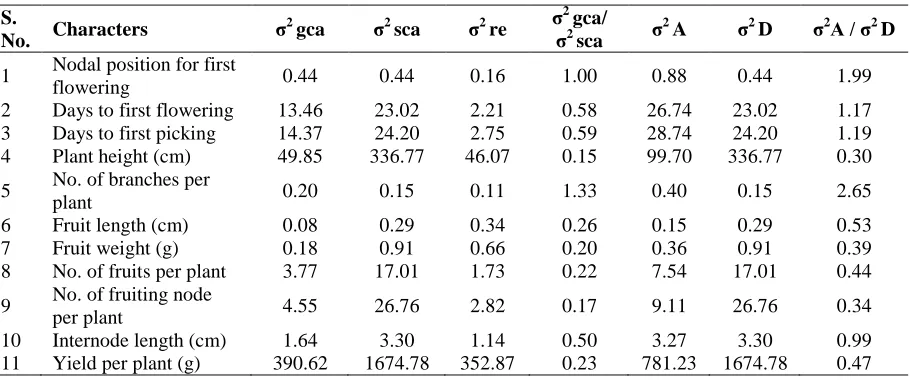
The ratio of 2gca/2sca was less than unity for nodal position for first flowering, days to first flower, days to first picking, plant height, fruit length, fruit weight, number of fruits, number of fruiting nodes per plant, internodal length and yield per plant indicating the pre-dominance of non-additive gene action in inheritance of these characters which may be exploited by hybrid development while number of branches indicated the 2gca/2sca ratio more than unity which indicated the presence of additive gene action in inheritance of these characters. Higher magnitude of additive gene action was recorded for traits viz., nodal position for fruit, days to first flowering, first picking and number of branches indicating major role of additive gene action for governing these traits, however, for other traits 2 D was greater than 2 A indicating the non-additive gene action (Dhankar and Dhankar 2001). The preponderance of non-additive gene action for most of the characters was reported by Adiger et al. (2013) for all the characters studied. However, additive gene action was reported by Sivagama et al. (1992), for days to first flowering and plant height and Singh and Kumar (2010) for days to first flowering, plant height, number of branches per plant, fruit length, no. of fruits and yield per plant.
Thus, it appears that the selection of crosses merely on the basis of per se performance and sca effects may not be helpful, but gca effects of the parents should be considered. An ideal combination to be exploited is one with higher degree of sca with higher per se performance and at least one parent with good general combining ability. From the study it reveals that the parents Pusa A-4, VRO-6, Arka Anamika and PB 236 were best parents for yield per plant. The crosses viz. Arka Anamika x PB 236, Pusa A-4 x PB 236, VRO-6 x Arka Anamika and Ajeet Dhanlaxmi 2-4-2 Sel were identified as best crosses for yield per plant.
References
Adiger, S., Shanthakumar, G. and Salimath, P.M. 2013. Selection of parents based on combining ability studies in okra (Ablemoschus
esculentus (L.) Moench). Karnataka J. Agric. Sci., 26(1): 6-9
Allard, R.W. 1960. Principles of Plant Breeding, John Willey and Sons. Inc. London.
Anonymous, 2014, Indian Horticultural Database http://nhb.gov.in/PDFViwer.aspx?enc=3ZO O8K5CzcdC/Yq6HcdIxC0U1kZZenFuNVXac DLxz28=
Balakrishnan, D., Sreenivasan, E., Radhakrishnan, V.V., Sujatha, R. and Suresh Babu, K.V. 2009. Combining ability in Bhindi (Abelmoschus spp.). Elect. J. Plant Breed., 1: 52-55
Chaudhary, B. 2003. Vegetables. National Book Trust, New Delhi: 2.
Dhankar, B.S. and Dhankar, S.K. 2001. Heterosis and combining ability studies for some economic characters in okra. Haryana J. Hort. Sci. 30: 230-233
Griffing, B. 1956. Concept of general and specific combining ability in relation to diallel crossing systems. Aust. J. Biol. Sci., 9: 463-493 Hazem, A., Obiadalla-Ali, Eldekashy, M.H.Z. and
Helaly, A.A. 2013. Combining Ability and Heterosis Studies for Yield and its Components in Some Cultivars of Okra (Abelmoschus esculentus L. Moench). Am-Euras. J. Agric. & Environ. Sci., 13(2): 162-167
Javia, R.M., Patel, N.B., Vaddoria, M.A., Mehta, D.R. and Chovatia, V.P. 2009. Combining ability analysis for fruit yield and its attributes in okra (Ablemoschus esculentus(L.) Moench). Crop Improv., 36(1): 88-94
Kalpande, V.V. 2003. Studies on heterosis and combining ability in F1 and F2 generations of
okra (Abelmoschus esculentus (L.) Moench). Ph.D. Thesis, Unpublished. Submitted to Dr. Balasaheb Sawant Konkan Krishi Vidyapeeth, Dapoli.
Kumar, S.P. and Sreeparvathy, S. 2010. Studies on heterosis in okra (Ablemoschus esculentus (L.) Moench). Elect. J. Plant Breed., 1(6): 1431-1433
Pal, A.K and Sabesan, T. 2009. Combining ability through diallel analysis in okra (Ablemoschus esculentus (L.) Moench). Elect. J. Plant Breed.,1: 84-88
Poshiya, V.K. and Shukla, P.T. 1986. Heterosis studies in okra (Abelmoschus esculentus (L.) Moench). GAU Res. J., 11(2): 21-25
Raghuvanshi, M., Singh, T.B., Singh, A.P., Singh, U., Singh, V.P. and Singh, B. 2011. Combining ability analysis in okra (Abelmoschus esculentus (L.) Moench). Veg. Sci.,38(1): 26-29
Rajani, B., Manju, P., Manikantan Nair and Saraswathy, P. 2001. Combining ability in okra (Abelmoschus esculentus (L.) Moench). J. Tropical Agric., 39: 98-101
Ramya, K. and Senthil Kumar, N. 2010. Heterosis and combining ability for fruit yield in okra (Ablemoschus esculentus (L.) Moench). Crop Improv. 37(1): 41-45
Rani, M. and Arora, S.K. 2003. Combining ability studies in okra (Abelmoschus esculentus (L.) Moench). J. Res. Punjab Agric. Univ. 40: 195-199
yield and its contributing characters in okra (Abelmoschus esculentus (L.) Moench). Prog. Agric., 5(1-2): 56-59
Singh, A.K., Singh, M.C. and Pandey, S. 2012. Line x Tester analysis for combining ability in okra (Ablemoschus esculentus (L.) Moench). Agric. Sci. Digest, 32(2): 91-97
Singh, S., Singh, B. and Pal, A.K. 2006. Line x Tester analysis of combining ability in okra. Indian J. Hort., 63(4): 397-401
Singh, B. and Kumar, V. 2010. Studies on combining ability analysis in okra. Indian J. Hort., 67
(Special issue): 154-159
Sivagama S.S., Irulappan, I., Arumugam, R. and Sankar, S.J. 1992. Heterosis in bhindi. South Indian Hort., 40(2): 79-82
Udengwu, O.S. 200). Studies on heterosis in Abelmoscus esculentus L. Moench and A. callei (A. chev) Stevels cultivars during shorter day photoperiod in South Eastern Nigeria. Pak. J. Bot. Sci.,12(21): 1388-1398
Table 1. Analysis of variance for combining ability effects of F1s in 7x7 diallel in okra
Source df
Nodal position for first flowering
Days to first flowering
Days to first picking
Plant height
(cm)
No. of branches per plant
Fruit length
(cm)
Fruit weight
(g)
No. of fruits per
plant
No. of fruiting node per
plant
Inter-node length (cm)
Yield per plant (g)
GCA 6 6.17** 190.14** 202.99** 701.06** 2.81** 1.09** 2.53** 52.94** 64.03** 23.03** 5489.90**
SCA 21 0.45** 24.76** 26.01** 339.94* 0.16** 0.31** 0.94** 17.15** 27.03** 3.44** 1696.05**
Reciprocal 21 0.33** 6.16** 7.31 ** 95.31** 0.24** 0.70** 1.35** 3.60** 5.90** 2.43** 727.01**
Error 96 0.01 1.74 1.80 3.17 0.01 0.02 0.03 0.14 0.27 0.14 21.27
GCA / SCA 0.99 0.58 0.59 0.15 1.33 0.26 0.20 0.22 0.17 0.49 0.23 *, ** Significant at 5 and 1 per cent level, respectively
Table 2. Estimates of general combining ability effects of parents in okra
Genotype
Nodal position for first flowering
Days to first flowering
Days to first picking
Plant height (cm)
No. of branches
per plant
Fruit length
(cm)
Fruit weight
(g)
No. of fruits per plant
No. of fruiting node per
plant
Inter-node length
(cm)
Yield per plant (g)
Pusa A-4 (A-4) -0.24** -1.39** -1.78** -1.28** -0.15** 0.19** 0.03 1.48** 1.71** -0.05 11.37**
Akola Bahar (A.B.) -0.32** -1.20** -1.01** -9.59** -0.42** -0.02 -0.67** 0.28** -0.08 -0.90** -8.90**
Ajeet Dhanlakshmi
2-4-2 Sel (A.D. Sel) -0.28** -1.21** -1.08** -0.71 -0.37** -0.004 -0.29** 0.16 -0.17 0.35** -4.44** Shegaon local
(S.Local) 1.40** 8.23** 8.34** 10.23** 0.91** -0.49** -0.20** -4.15** -4.38** 2.64** -38.90**
VRO-6 -0.64** -3.04** -3.38** 0.45 0.05* 0.16** 0.40** 1.69** 2.21** -1.02** 19.61**
Arka Anamika
(A.A.) -0.11** -0.84* -0.74* -6.65** 0.13** 0.36** 0.57** -0.05 0.09 -0.97** 10.35**
PB-236 0.19** -0.55 -0.34 7.56** -0.16** -0.19** 0.16** 0.58** 0.62** -0.05 10.93**
SE (gi) 0.02 0.33 0.33 0.44 0.02 0.04 0.04 0.09 0.13 0.09 1.14
SE (gi-gj) 0.03 0.50 0.51 0.67 0.03 0.06 0.07 0.14 0.20 0.14 1.74
Table 3: Promising hybrids based on sca effects in the desired direction for yield and yield components
S. No. Characters Crosses sca effects gca effects of parents 1 Nodal position for first
flowering
A.D. Se lx A.A. -0.54 -0.28** x -0.11** S. Local x VRO-6 -0.49 1.40** x -0.64**
A-4x A.A. -0.43 -0.24** x -0.11**
S. Local x P.B. 236 -0.36 1.40** x 0.19**
A-4x PB-236 -0.17 -0.24** x 0.19**
2 Days to first flowering A.B. x A.D. Sel -4.43 -1.20** x -1.21**
A-4x PB-236 -3.79 -1.39** x -0.55
A.A. x PB-236 -3.44 -0.84* x -0.55
S. Local x P.B. 236 -3.21 8.23** x -0.55
A.B. x VRO-6 -3 -1.20** x -3.04**
3 Days to first picking A.B. x A.D. Sel -4.62 -1.01** x -1.08**
A.A. x PB-236 -3.58 -0.74* x -0.34
A-4x PB-236 -3.44 -1.78** x-0.34
S. Local x P.B. 236 -3.36 8.34** x -0.34
A-4 x VRO-6 -3.35 -1.78** x-3.38**
4 Plant height (cm) A.B. x A.A. 20.81 -9.59**x -6.65**
VRO-6 x A.A. 14.79 0.45 x -6.65**
A.B. x A.D. Sel 11.47 -9.59** x -0.71
A.A. x PB-236 10.83 -6.65** x 7.56**
S. Local x VRO-6 7.99 10.23** x 0.45
5 No. of branches per plant
A.A. x PB-236 0.43 0.13** x -0.16**
A.B. x S. Local 0.31 -0.42** x 0.91**
A.D. Sel x VRO-6 0.22 -0.37** x 0.05*
A.B. x VRO-6 0.17 -0.42** x 0.05*
S. Local x P.B. 236 0.15 0.91** x -0.16**
6 Fruit length (cm) A-4x A.A. 0.65 0.19** x 0.36** A.D. Selx S. Local 0.46 -0.004 x -0.49**
A.D. Selx VRO-6 0.45 -0.004 x 0.16**
S. Local x VRO-6 0.45 -0.49** x 0.16** S. Local x P.B. 236 0.40 -0.49** x -0.19** 7 Fruit weight (g) A-4x A.A. 1.14 0.03 x 0.57**
A.B. x A.A. 0.78 -0.67** x 0.57**
S. Local x VRO-6 0.69 -0.20** x 0.40** S. Local x P.B. 236 0.39 -0.20** x 0.16** A.D. Selx S. Local 0.37 -0.29** x -0.20**
8 No. of fruits per plant A-4x VRO-6 4.18 1.48** x 1.69**
A.D. Selx VRO-6 3.6 0.16 x 1.69**
A-4x A.D. Sel 2.81 1.48** x 0.16
VRO-6 x A.A. 2.42 1.69** x -0.05
A.A. x PB-236 2.42 -0.05 x 0.58**
9 No. of fruiting node per plant
A-4 x VRO-6 5.21 1.71** x 2.21**
A.D. Sel x VRO-6 4.84 -0.17 x 2.21**
A.A. x PB-236 3.57 0.09 x 0.62**
A-4x A.D. Sel 3.39 1.71** x -0.17
S. Local x P.B. 236 2.7 -4.38** x 0.62 **
10 Inter-node length (cm) S. Local x A.A. -2.63 2.64** x -0.97**
A-4x A.B -1.55 -0.05 x -0.90**
A-4x A.D. Sel -1.53 -0.05 x 0.35**
VRO-6 x PB-236 -1.27 -1.02** x -0.05
S. Local x VRO-6 -1.00 2.64** x -1.02**
11 Yield per plant (g) A.D. Selx VRO-6 47.74 -4.44** x 19.61** S. Local x P.B. 236 38.46 -38.90** x 10.93**
A-4x VRO-6 32.31 11.37** x 19.61**
VRO-6 x A.A. 29.33 19.61** x 19.61**
Table 4. Estimates of components of variance in F1 generation in okra
S.
No. Characters σ
2 gca σ2 sca σ2 re σ2 gca/
σ2
sca σ
2 A σ2 D σ2A / σ2 D
1 Nodal position for first
flowering 0.44 0.44 0.16 1.00 0.88 0.44 1.99
2 Days to first flowering 13.46 23.02 2.21 0.58 26.74 23.02 1.17 3 Days to first picking 14.37 24.20 2.75 0.59 28.74 24.20 1.19
4 Plant height (cm) 49.85 336.77 46.07 0.15 99.70 336.77 0.30
5 No. of branches per
plant 0.20 0.15 0.11 1.33 0.40 0.15 2.65
6 Fruit length (cm) 0.08 0.29 0.34 0.26 0.15 0.29 0.53
7 Fruit weight (g) 0.18 0.91 0.66 0.20 0.36 0.91 0.39
8 No. of fruits per plant 3.77 17.01 1.73 0.22 7.54 17.01 0.44
9 No. of fruiting node
per plant 4.55 26.76 2.82 0.17 9.11 26.76 0.34
10 Internode length (cm) 1.64 3.30 1.14 0.50 3.27 3.30 0.99