Construction an innovative separator sunflower grain with new methods
Esmaeil Chavoshgoli
*, Shmsollah Abdollahpour, Hmidreza Ghasemzadeh
(Department of biosystem enginnering, Faculty of Agriculture, University of Tabriz, 51368 Tabriz, Islamic Republic of Iran)
Abstract:
The sunflower grain is very popular due to fresh and nutty consumption in some countries such as Iran, Turkey and many Arabic countries which is usually harvested without high capacity harvester at high moisture content in Iran. Also, the available methods have low efficiency for segregation the grains from sunflower head. Therefore, this study was conducted to design, construct and evaluate an innovative separator apparatus using the properties of nutty sunflower and applying kinematic equations. This apparatus includes the threshing and cleaning unit that the variables of its components are adjustable. So, with these capabilities, these variables can be optimized for any variety of sunflowers and this information can be used to develop suitable combine harvester. The experiments of evaluation and optimization designed using Response Surface Methodology (RSM) modeling method. The effects of rotational drum speed (380, 280, 180 rpm), feed rates (2000, 3000, 4000 (kg (head) h-1), moisture content (60%, 45%, 30%w.b) for threshing unit, slope of sieves (0.12, 0.07, 0.02) oscillating frequency (7.6, 5.6, 3.6 Hz) and amplitude (25, 17.5, 10 mm) for cleaning unite were studied. Maximum and minimum threshing efficiency, separation efficiency and grain damage for threshing unit obtained 98.94% and 96.90%, 70% and 60.04%, 1.12% and 0.49% respectively. These results for cleaning efficiency and grain loss of cleaning unite reported 94.14% and 87.95%, 2.63% and 1.23% respectively. The result of ANOVA tables showed that the models were statistically significant at the 95% confidence level. The perturbation plots demonstrated that the moisture content had the greatest effect on threshing efficiency and grain damage followed by drum speed and feed rate. With decreasing the moisture content, threshing and separation efficiency increased and grain damage reduced. The oscillating frequency had more effect than other factors on cleaning efficiency, which with reducing it, the amount of cleaned grains increased. The optimized points were determined at the drum speed 376.634, feed rate 2000.06, moisture content 30, frequency 5.153, amplitude 25 and slope 0.02.
Keywords:
nutty sunflower, separator apparatus, threshing and cleaning, RSM methodCitation: Chavoshgoli, E., S. Abdollahpour, and H. Ghasemzadeh. 2020. Construction an innovative separator sunflower grain with new methods. Agricultural Engineering International: CIGR Journal, 22 (2):76-85.
1 Introduction
Sunflower (Helianthus annuus L.) is one of the most important oil crops in the world and is ranked 5th in oil production in the world (Chavoshgoli et al., 2015). Also, the edible sunflower is very popular due to fresh and nutty
Received date: 2019-08-06 Accepted date: 2019-12-30
*Corresponding author: Esmaeil Chavoshgoli , Ph.D., Associate Professor of Department of biosystem enginnering, Faculty of Agriculture, University of Tabriz, Islamic Republic of Iran, 51368 Tabriz, Islamic Republic of Iran. Email: [email protected], Tel: +9809148422763.
consumption in some countries such as Iran, Turkey and many Arabic countries. The nutty sunflower is harvested without combine or high capacity harvester at high moisture content in Iran (Mirzabe et al., 2014). It takes a lot of time and requires a large man power labour for removing the seeds from sunflower head. In general, there are two methods for removing sunflower seeds from the sunflower head, including 1) traditional manual method, and 2) mechanical mechanized methods (Mirzabe et al., 2016). The efficiency of the traditional manual methods is very low (Chavoshgoli, 2012; Mirzabe et al., 2016). The mechanical methods of removing sunflower seeds are based
on beating, friction and combination of them. Bansal and Dahiya (2001) studied the effect of threshing techniques on the quality of sunflower seeds. Sudajan et al. (2003) studied the effects of feed rate, type of drum and drum speed on sunflower threshing, they investigated power requirements and performance factors of a sunflower thresher and studied the effect of a number of drum characteristics on rasp-bar drum performance for threshing sunflowers (Sudajan et al., 2005). A local device for separating sunflower that would utilize both centrifugal and gravitational force was developed by Lotfy (2009). Ismail et al. (2009) optimized machine parameters of a pedal-operated sunflower threshing using friction drum. Aerodynamic and seed size, density, shape properties and friction coefficient are crucial properties in design and adjustment of combine harvesters, where usually a winnowing and sieving system is the first cleaning operation, followed by several (Munder et al. 2017). Fracture characteristics such as rupture force are dependent on most of the above named properties and are crucial for the design of threshing equipment (Thasaiya et al., 2014). Mirzabe et al. (2016) determined some physical properties of sunflowers head and studied effect of air-jet impingement parameters on the removing of sunflower seeds from the heads in static conditions. Azharuddin et al. (2016) designed and fabricated a machine which will separate the seeds from the head sunflower machine using peg tooth with an open threshing rotor and the performance of threshing machine is evaluated for its threshing efficiency, cleaning efficiency, visible damage seed, threshing capacity and specific energy consumption. According to researches, methods and devices developed in the field of separating and cleaning nutty sunflower grains from the point of view harvest capacity, separation efficiency and labor force have not been effective. Also, it is essential that apparent quality and marketability of this crop be desirable. Therefore, this study was conducted to design an innovative separator apparatus using the mechanical and physical properties of sunflower and applying the kinematic equations.
2 Materials and methods
2.1 Theory of Designing
For designing, the kinematic and dynamic studying on the components of apparatus and properties of crop was suitable method (Abdollahpour, 1998). For threshing of grain agriculture with drum thresher a power Pth (kW) is
needed (Popov et al., 1986).
𝑃𝑡ℎ= [𝑞 ((𝑎𝑉1−−𝑓𝑉1) )] 𝑉 + 𝐴𝑉 + 𝐵𝑉3 (1)
Where: q=feed rate (kg s-1), V=linear speed of the drum (m s-1), V1=input speed of crop (m s
-1
), f= the coefficient of friction, the A and B are coefficients of resistance that Popov et al. (1986) stated.
According to Sale et al. (2016) power required Pcl (kW)
by oscillation mechanism is calculated as:
Pcl=Ws4500×w×2y+Ws×w4500×2µ×2x (2)
Where, 𝑊𝑠=weight of sieve component along with threshed material (N), w=frequency of sieve oscillation (rad s-1), 𝜇=coefficient of friction of the moving component, x
and y are horizontal and vertical displacement of the sieve (m).
With considering, that each beater of thresher receives equal mass of crop Q (kg) and rotational drum speed n (rpm), the number of beater Nb obtains as Equation 3
(Abdollahpour, 1998).
𝑁𝑏=60𝑞𝑛𝑄 (3)
inclined to the horizontal plane with the angle of α that should be smaller than the friction angle between the
particles and the surface of sieve (φ) (𝛼 ≤
φ
).
Figure 1 Forces action on a particle lying on a moving sieve and condition of sieves
𝑟𝑤12
𝑔 𝑐𝑜𝑠𝜔1𝑡=𝑘1𝑐𝑜𝑠𝜔1𝑡>
𝑠𝑖𝑛(𝜑±𝛼)
𝑐𝑜𝑠(𝜑±𝛼−𝜀)−
𝑅 𝐺
𝑐𝑜𝑠(𝜑±𝛼−𝛾)
𝑐𝑜𝑠(𝜑±𝛼−𝜀) (4)
𝑟𝑤22
𝑔 𝑐𝑜𝑠𝜔2𝑡=𝑘2𝑐𝑜𝑠𝜔2𝑡>
𝑠𝑖𝑛 (𝜑±𝛼)
𝑐𝑜𝑠 (𝜑±𝛼+𝜀)+
𝑅 𝐺
𝑐𝑜𝑠 (𝜑±𝛼+𝛾)
𝑐𝑜𝑠 (𝜑±𝛼−𝜀) (5)
𝑟𝑤32
𝑔 𝑐𝑜𝑠𝜔3𝑡=𝑘3𝑐𝑜𝑠𝜔3𝑡>
𝑐𝑜𝑠𝛼
𝑠𝑖𝑛 (𝜀±𝛼)−
𝑅 𝐺
𝑠𝑖𝑛 (𝛾±𝛼)
𝑠𝑖𝑛 (𝜀±𝛼) (6)
K (
𝑟𝑤𝑔2)
, defines as a kinematic index and Iqbal
(2006) stated that the normal working conditions for
cleaner sticks as follows:
K3>K>K1>K2K=2.2-3, r=23-30 mm, ε=12º 25º, α=1º-3º (few 7-8º),
w=200-350 rpm.
The holes size using the geometric dimensions
of the grains is calculated as (Chavoshgoli, 2012):
𝑎𝑐≥ 𝑀𝑎𝑣+ 3𝜎 (7)
Where, 𝑎𝑐=the holes size (mm), Ma=average of geometric dimension (including length, width and thickness), σ =the standard deviation of grain dimension.
2.2 Properties of crop
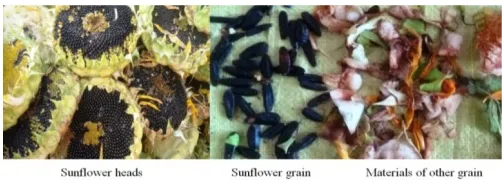
The nutty Sunflower heads with locale name of GALAMI variety were procured from sunflower farms of the Khoy city-Iran at moisture content of harvesting (Figure 2).
Figure 2 Grain and materials of other grain (MOG)
The energy required to rupture grain under quasi-static, which predicted grain behavior in dynamic loading and crucial impact velocity, estimated with an Instron Testing Machine (Model HOUNSFIELD-H5KS) (Selvam et al., 2014). Physical properties were calculated by methods of several other researchers (Chavoshgoli et al., 2015; Munder et al., 2017).
2.3 Description and designing of apparatus
The main components of apparatus for this research include the threshing unit (threshing drum and concave) and cleaning unit (sieves) that indicate in the Figure 3. The power required for applying the apparatus calculated from sum of Equations 1 and 3 that supplied by the tractor PTO (Model MF 285 with 55 kW power). The variables of performance are adjustable for any experiment. The factors that are considered for designing, Includes: diameter and rotational speed of drum thresher, length of thresher, structure, type and scale of concave (separator of threshing).
Threshing unit: (1) Input channel, (2) Feeder, (3) Beaters, (4) Concave or separator, (5) Thresher shaft, (6) Covering of drum thresher, -Cleaning unit: (7) set of sieves, (8) Crank of oscillation (9)
Power transmission
Figure 3 Schematic of the apparatus for separating sunflower grain
and considering the capacity of feed rate. The soft and flexible material is selected for plates of beaters to prevent from grain damage (Qian et al., 2017). Angular position of plates is adjustable toward the shaft thresher which causes to progress the crops in the length of thresher. Diameter D
(m) and rotational speed value n (rpm) determined using crucial impact velocity of grains and study of other researchers. In this study diameter of drum thresher is adjustable and maximum amount of it is regulated 0.6 m. The length of thresher was estimated by determining capacity and number of beater (Abdollahpour, 1998). The concave or separator was made of metal beams and the distance between these wires (separation grid) was determined by measuring the size of sunflower grains and MOG that were threshed. The feed rate of cleaning unit depends on the working capacity of thresher and length and
width of the sieve was determined using method of Abdollahpour (1998), per centimeter of drum thresher length, Surface area of the sieve is considered about 150-110 cm2. For determining oscillation amplitude and frequency, the Kinematic Index (𝑟𝑤2
𝑔 ) was used. The size of
sieve holes using Equation 7 and the slope of sieve (α) plate according to (𝛼 ≤ 𝜑) was estimated.
2.4 Testing and evaluation of the apparatus
The variables, that have the greatest influence on efficiency, were determined for studying. The following performance indicators were used for the evaluation of thresher and cleaning unit (RNAM Test code, 1995): threshing efficiency%, separation efficiency%, cleaning efficiency%, grain damage% and grain losses% that calculated with method of Sudajan et al. (2005).
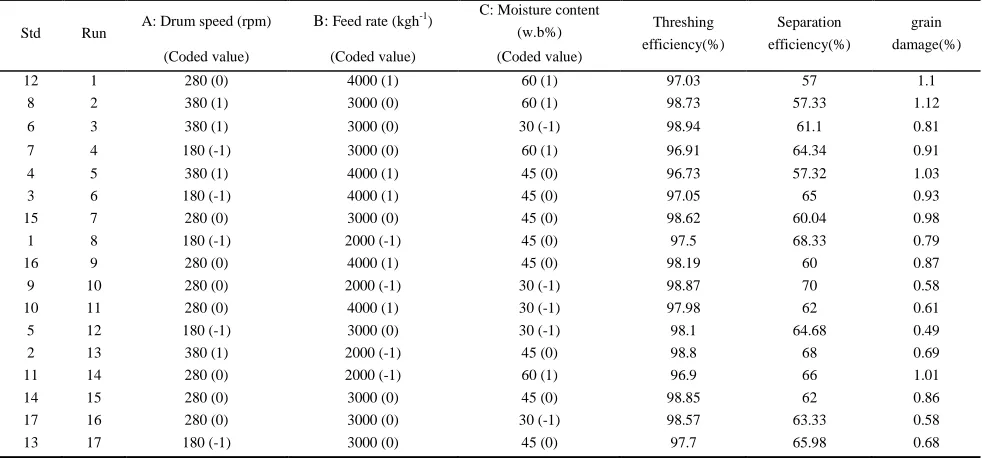
Table 1 Experimental design proposed by RSM for threshing unite
Std Run A: Drum speed (rpm) B: Feed rate (kgh
-1
) C: Moisture content
(w.b%) Threshing
efficiency(%)
Separation efficiency(%)
grain damage(%) (Coded value) (Coded value) (Coded value)
12 1 280 (0) 4000 (1) 60 (1) 97.03 57 1.1
8 2 380 (1) 3000 (0) 60 (1) 98.73 57.33 1.12
6 3 380 (1) 3000 (0) 30 (-1) 98.94 61.1 0.81
7 4 180 (-1) 3000 (0) 60 (1) 96.91 64.34 0.91
4 5 380 (1) 4000 (1) 45 (0) 96.73 57.32 1.03
3 6 180 (-1) 4000 (1) 45 (0) 97.05 65 0.93
15 7 280 (0) 3000 (0) 45 (0) 98.62 60.04 0.98
1 8 180 (-1) 2000 (-1) 45 (0) 97.5 68.33 0.79
16 9 280 (0) 4000 (1) 45 (0) 98.19 60 0.87
9 10 280 (0) 2000 (-1) 30 (-1) 98.87 70 0.58
10 11 280 (0) 4000 (1) 30 (-1) 97.98 62 0.61
5 12 180 (-1) 3000 (0) 30 (-1) 98.1 64.68 0.49
2 13 380 (1) 2000 (-1) 45 (0) 98.8 68 0.69
11 14 280 (0) 2000 (-1) 60 (1) 96.9 66 1.01
14 15 280 (0) 3000 (0) 45 (0) 98.85 62 0.86
17 16 280 (0) 3000 (0) 30 (-1) 98.57 63.33 0.58
13 17 180 (-1) 3000 (0) 45 (0) 97.7 65.98 0.68
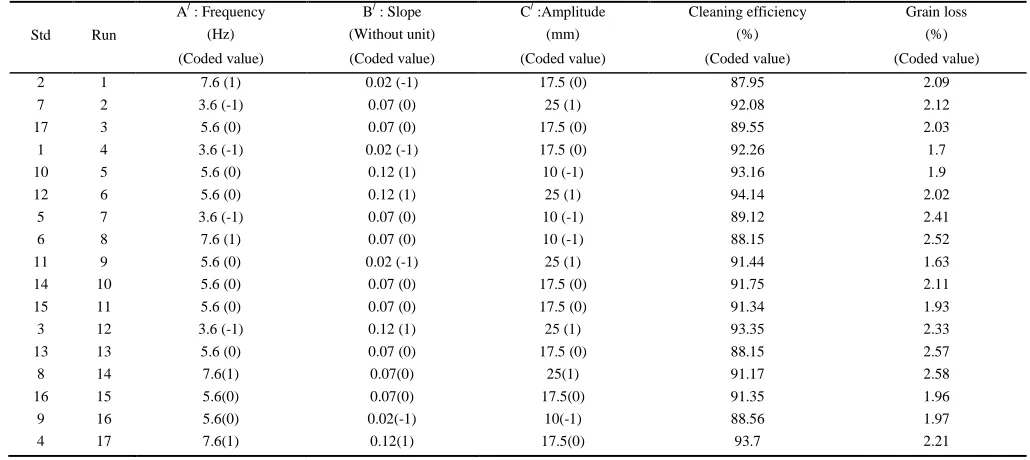
The developed threshing unit was evaluated against three threshing drum speeds of 380, 280, and 180 rpm, feed rates 2000, 3000, 4000 kg (head) h-1 and average moisture contents of 60% (moisture harvesting), 45% and 30% (w.b%). The testing of the cleaning unite was carried out to determine cleaning efficiency% and the grain loss% based on the slope of sieves (tanαº) at levels of 0.12, 0.07, 0.02, frequency and amplitude of oscillation
Table 2 Experimental design proposed by RSM for cleaning unite
Std Run
A/ : Frequency (Hz)
B/ : Slope (Without unit)
C/ :Amplitude (mm)
Cleaning efficiency (%)
Grain loss (%)
(Coded value) (Coded value) (Coded value) (Coded value) (Coded value)
2 1 7.6 (1) 0.02 (-1) 17.5 (0) 87.95 2.09
7 2 3.6 (-1) 0.07 (0) 25 (1) 92.08 2.12
17 3 5.6 (0) 0.07 (0) 17.5 (0) 89.55 2.03
1 4 3.6 (-1) 0.02 (-1) 17.5 (0) 92.26 1.7
10 5 5.6 (0) 0.12 (1) 10 (-1) 93.16 1.9
12 6 5.6 (0) 0.12 (1) 25 (1) 94.14 2.02
5 7 3.6 (-1) 0.07 (0) 10 (-1) 89.12 2.41
6 8 7.6 (1) 0.07 (0) 10 (-1) 88.15 2.52
11 9 5.6 (0) 0.02 (-1) 25 (1) 91.44 1.63
14 10 5.6 (0) 0.07 (0) 17.5 (0) 91.75 2.11
15 11 5.6 (0) 0.07 (0) 17.5 (0) 91.34 1.93
3 12 3.6 (-1) 0.12 (1) 25 (1) 93.35 2.33
13 13 5.6 (0) 0.07 (0) 17.5 (0) 88.15 2.57
8 14 7.6(1) 0.07(0) 25(1) 91.17 2.58
16 15 5.6(0) 0.07(0) 17.5(0) 91.35 1.96
9 16 5.6(0) 0.02(-1) 10(-1) 88.56 1.97
4 17 7.6(1) 0.12(1) 17.5(0) 93.7 2.21
3 Result and discussions
3.1 Properties of sunflower
The minimum and maximum energy required for grain rupture was recorded 26.26 and 35.1 mJ respectively. Also, the critical impact velocity according to Jafari et al. (2011), were calculated 12.48 and 14.77 m s-1.
Table 3 Physical properties of nutty sunflower grain
properties Minimum Maximum Mean Standard deviation
Length, mm 18.4 35.46 25.84 0.14
Width, mm 6.12 13 9.3 0.06
Thickness, mm 2.9 9.19 4.99 0.047
Equivalent
diameter, mm 18.14 14.16 10.93 0.055
Sphericity% 29.17 54.69 41.2 0.23
Mass, g 0.16 0.59 0.32 0.057
Project area,
mm2 91 239 137 0.29
Table 4 Physical properties of nutty sunflower grain and MOG
Properties Minimum Maximum Mean Standard deviation True density, kg m-3 Grain 554 580 565 7.1
MOG 802 831 822 4.31
Bulk density, kg m-3 Grain 196 212 208 6.1
MOG 81 99 89 3.08
Porosity% Grain 62.3 65.1 63.3 1.01
MOG 88.76 89.81 89.12 0.53
Dynamic angle of repose
Grain 21.1 22.7 21.9 0.4
MOG 25.2 28.1 27.01 0.71
Coefficient friction on steel surface
Grain 0.52 0.55 0.53 0.016
MOG 0.68 0.71 0.7 0.021
Terminal velocity, m s-1
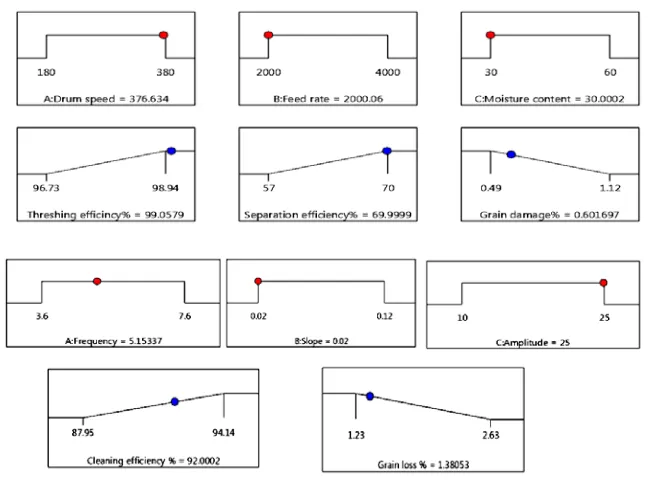
Grain 6.57 9.82 8.1 0.71
MOG 2.1 5.25 3.65 0.9
Drag coefficient Grain 0.64 1.03 0.85 0.12
MOG 0.44 1.22 0.78 0.21
Table 3 and 4 shows the result of physical properties of grain and MOG at the moisture content of harvesting which it is need for designing and adjusting of apparatus variable in the condition of working.
3.2 Apparatus constructed for separation of nutty
sunflower
The Figure 4 indicates constructed apparatus which has the ability to thresh, separate and clean the nutty sunflower crops and segregate grain from sunflower heads. It is an important step at development of sunflower combine harvester.
Figure 4 The constructed apparatus in the condition of working
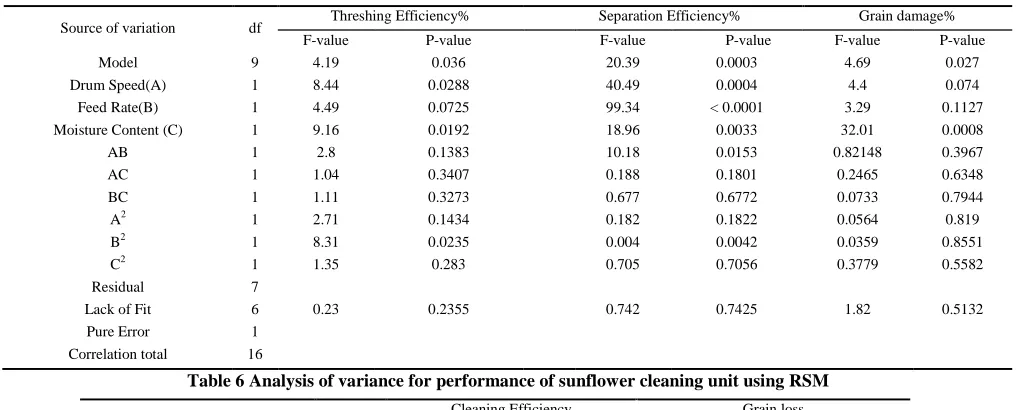
becomes smaller (Safary and Chayjan, 2016). The ANOVA results, summarized in Table 5 and 6, showed that the model was statistically significant at the 95% confidence level. Statistical significance of the model, individual factors, their squares and interactions were estimated from their F-and p-values. The lack of fit was not significant relative to the pure error and meaning that the model was adequate for predicting performance of thresher and cleaner within the applied ranges of the process factors. The amount of F-value and P-value demonstrated more individual factors are statistically significant at the 95% confidence level for performance of apparatus, whereas interaction factor was not effective.
The perturbation plots compare the effects of all the factors at a particular point in the design space (Figures 5 and 6). A steep slope or curvature in a factor shows that the response is sensitive to that factor. As shown in Figure 5, the threshing efficiency, separation efficiency and grain damage are influenced by drum speed, feed rate and moisture content. Investigation the slope of plots (a and c) indicates that the moisture content had greatest influence in threshing efficiency and grain damage, as with increasing
the moisture content percentage of unthreshed and damaged grains increases. In high moisture contents, low threshing efficiency is due to more adhesion of grains on the sunflower heads which extra energy required for threshing, also the husk of grains is fragile in this condition that cause damaged grain. The Figure 5(b) illustrates which the separation efficiency increases with reducing of the factors. The sunflower heads with high moisture content are fragile and brittle, also in high drum speeds the number and amount of impact force applied to the crop rises, therefore the extra MOG that is produced and passes from separator, increases. Similar result was also reported by Goel et al. (2009). It is observed that curve slope of feed rate is steeper compared to other factors and has greater effect on the output of separator. The separation efficiency decreased by increasing feed rate, it is due to more and excessive collisions of heads with each other and rising the ratio of MOG to grain in the output of thresher. Maximum amount of the threshing efficiency, separation efficiency and grain damage 98.94%, 70% and 1.12% and minimum value 96.90%, 60.04% and 0.49% reported respectively.
Table 5 Analysis of variance for performance of threshing unit using RSM
Source of variation df Threshing Efficiency% Separation Efficiency% Grain damage%
F-value P-value F-value P-value F-value P-value
Model 9 4.19 0.036 20.39 0.0003 4.69 0.027
Drum Speed(A) 1 8.44 0.0288 40.49 0.0004 4.4 0.074
Feed Rate(B) 1 4.49 0.0725 99.34 < 0.0001 3.29 0.1127
Moisture Content (C) 1 9.16 0.0192 18.96 0.0033 32.01 0.0008
AB 1 2.8 0.1383 10.18 0.0153 0.82148 0.3967
AC 1 1.04 0.3407 0.188 0.1801 0.2465 0.6348
BC 1 1.11 0.3273 0.677 0.6772 0.0733 0.7944
A2 1 2.71 0.1434 0.182 0.1822 0.0564 0.819
B2 1 8.31 0.0235 0.004 0.0042 0.0359 0.8551
C2 1 1.35 0.283 0.705 0.7056 0.3779 0.5582
Residual 7
Lack of Fit 6 0.23 0.2355 0.742 0.7425 1.82 0.5132
Pure Error 1
Correlation total 16
Table 6 Analysis of variance for performance of sunflower cleaning unit using RSM
Source of variation df Cleaning Efficiency Grain loss
F-value P-value F-value P-value
Model 9 3.75 0.0415 6.67 0.0102
Frequency(A/) 1 10.74 0.0135 10.04 0.0158
Slope(B/ ) 1 6.05 0.0435 16.55 0.0048
Amplitude(C/) 1 4.63 0.0483 10.79 0.0134
A
D
f A
h
A/ C/ 1 0.3476 0.574 6 0.0442
B/C/ 1 0.0023 0.9627 2.06 0.1943
A/2 1 0.5915 0.467 0.2978 0.6022
B/2 1 3.31 0.1117 5.87 0.0458
C/2 1 0.8065 0.399 0.4259 0.5348
Residual 7
Lack of Fit 6 0.1843 0.9019 0.2193 0.8785
Pure Error 1
Correlation total 16
(A) drum speed on the threshing efficiency; (B) feed rate on separation efficiency; (C) moisture content Figure 5 The perturbation plots: effect of all the factors in thresher unite
(A/): frequency; (B/): Slope; (C/): Amplitude of Oscillation Figure 6 The perturbation plots: effect of all the factors in cleaning unite
The perturbation plots in Figure 6(a) showed that the slope of frequency curve was steeper than the slope of other factors and had more effect in cleaning grains on sieve. Also, with investigation the kinematic index (𝑟𝑤2
𝑔 ), this
conclusion is anticipated. According to Figure 6(a), the cleaning efficiency value increased with reduction of the frequency and increasing the slope of sieve and amplitude. The difference between the physical properties of grain and MOG (especially their density) is major reason in this result
a b
that is effective in the movement and velocity of materials layers on the sieves. The Figure 6(b) illustrated the slope of the sieve had a greater effect on grain loss and with increasing it, the percentage of grains that removed from cleaner increased because the grains delivery to end sieve early and out with MOG. The increasing of frequency and amplitude of oscillation according to this study caused the reducing the percentage of grain loss, as the interaction of the grains increased and have further chance to pass through the holes. But excessive frequency increase is not recommended that causes grains being thrown on the sieve surface and do not through the holes. Maximum and minimum value for cleaning efficiency and grain loss reported 94.14% and 87.95%, 2.63% and 1.23% respectively.
3.3 Optimization of separator apparatus of grain
sunflower
The multiple responses of design expert 11 used for finding the optimal point of the test variables, the desired goals (maximize or minimize) for each variable and response were chosen and different weights were assigned to each goal to adjust the shape of its particular desirability functions. Figure 7 display software generated optimum conditions of independent variables with the predicted values of responses for thresher and cleaner unite respectively. The goal of optimization is maximizing threshing and separation efficiency and minimizing of grain damage that the optimized values of variables such as drum speed 376.634 rpm, feed rate 2000.06 kg (head) h-1 and moisture content 30% (w.b) were determined. Also the goal of optimization of cleaner is maximizing cleaning efficiency and minimizing of grain loss which the frequency 5.153 Hz, slope 0.02 and amplitude 25 mm were estimated.
Figure 7 Optimized variables of cleaning unite
4 Conclusion
The separator apparatus of grain from sunflower head using properties of crops and kinematic equation was designed and constructed which had the capability of separation high capacity with adjustable variable as well as the development of machine harvesting. The ANOVA results of thresher and cleaner unites, showed that the
frequency and slope of sieve. With decreasing the moisture content, threshing and separation efficiency increased and grain damage reduced. Decreasing the slope of sieve and oscillating frequency cause to rising cleaning efficiency and reducing grain loss. The optimized points were determined at the drum speed of 376.634 rpm, feed rate of 2000.06 kg (head) h-1, moisture content of 30 (w.b), frequency of 5.153 Hz, amplitude of 25 mm and slope of sieve 0.02.
Acknowledgements
The authors thanks to Dr. Abdollahpour. Sh. for reading and correcting the English.
Reference
Abdollahpour, S. H. 1998. Studying the type of grains combine and presentation a suitable design for condition of Iran. M.S.
thesis. Tehran, Iran: Graduate Studies Office in Mechanic of Agricultural Machinery.
Azharuddin, K., S. Mir, M. M. Narasimhan, and G. P. Kumar. 2016. Design and fabrication of sunflower seed extracting machine.
International Journal of Latest Technology in Engineering, Management and Applied Science (IJLTEMAS), 5(6): 90-97. Bansal, N., and B. Dahiya. 2001. Effect of threshing techniques on
quality of sunflower seed. Seed Research-New Delhi, 29(1): 52-57.
Chavoshgoli, Es. 2012. Determination of physical and aerodynamic properties of grain and MOG in order to design suitable mechanisms in separation and cleaning systems. M.S. thesis. Tabriz, Iran: Graduate Studies Office in Mechanic of Agricultural Machinery.
Chavoshgoli, Es., Sh. Abdollahpour, R. Abdi, and A. Babaie. 2015. Engineering properties of sunflower seeds and materials other grain as moisture content for equipment of separator. CIGR Journal, 17(1): 10-21.
Iqbal, M. 2006. Harvesting Crops. University of Agriculture, Faisalabad: Department of Farm Machinery and Power. Goel, A., D. Behera, S. Swain, and B. Behera. 2009. Performance
evaluation of a low-cost manual sunflower thresher. Indian Journal of Agricultural Research, 43(1): 37-41.
Ismail, Z. E., and M. N. Elhenaway. 2009. Optimization of machine parameters for a sunflower thresher using friction drum.
Mansoura University Journal of Agricultural Science, 34(10): 10293-10304.
Jafari, S., J. Khazaei, A. Arabhosseini, J. Massah, and M. H. Khoshtaghaza. 2011. Study on mechanical properties of
sunflower seeds. Electronic Journal of Polish Agricultural Universities (EJPAU), 14(1): 6-15.
Jamshidpouya, M., G. Najafi, and T. T. Hashjin. 2018. Design, fabrication and evaluation of electric forage chopper with adjustable helix angle. Journal of Agricultural Science and Technology, 19(1): 923-938.
Lotfy, A. 2009. Construction and performance evaluation of a local device for separating sunflower seeds and environment preservation. Agricultural Mechanization in Asia Africa and Latin America, 40(4): 73-79.
Mirzabe, A. H., G. R. Chegini, J. Khazaei, and J. Massah. 2014. Design, construction and evaluation of preliminarily machine for removing sunflower seeds from the head using air-jet impingement. CIGR Journal, 16(1): 294-302.
Mirzabe, A. H., and G. R. Chegini. 2016. Effect of air-jet impingement parameters on the removing of sunflower seeds from the heads in static conditions. CIGR Journal, 18(2): 43-59.
Munder, S., D. Argyropoulos, and J. Muller. 2017. Class-based physical properties of air-classified sunflower seeds and kernels. Biosystems Engineering, 164(1): 124-134.
Myhan, R., and E. Jachimczyk. 2016. Grain separation in a straw walker unit of a combine harvester. Biosystems Engineering, 145(1): 93-107.
Popov, I. F., N. I. Kienen, and V. Asakun. 1986. Agricultural Machine, Russian Translations Series31, eds. A. A. Balkema, Roterdam, 433–451. Printed in India, New Delhi.
Qian, J., C. Jin, and D. Zhang. 2017. Multiple frictional impact dynamics of threshing process between flexible tooth and grain kernel. Computer and Electronics in Agriculture, 141(1): 276-285.
RNAM. 1995. Test Codes and Procedures for Farm Machinery. 2nd ed. Thailand: Economic and Social Commission for Asia and the Pacific.
Safary, M., and R. A. Chayjan. 2016. Optimization of almond kernels drying under infrared-vacuum condition with microwave pretreatment using response surface method and genetic algorithm. Journal of Agricultural Science and Technology, 18(6): 1543-1556.
Sale, N. A., U. S. Muhammed, I. B. Dalha, and S. I. Idris. 2016. An improved IAR sorghum thresher. CIGR Journal, 18(3): 119-126.
Salari, K., R. A. Chayjan, J. Khazaeiand, and J. A. Parian. 2013. Optimization of independent parameters for chickpea threshing using response surface method (RSM). Journal of Agricultural Science and Technology,15(3): 467-477.
Seerangurayar. 2014. Compression loading behavior of sunflower seeds and kernels. International Agrophysics, 28(4): 543-548.
Sudajan, S., V. M. Salokhe, and S. Chusilp. 2005. Effect of concave hole size, concave clearance and drum speed on rasp-bar drum performance for threshing sunflower. Agriculture Mechanization in Asia, Africa and Latin America, 36(1): 52-60.
Sudajan, S., V. M. Salokhe, S. Chusilp, and V. Plermkamon. 2003. Power requirement and performance factors of a sunflower thresher. Journal of Agricultural Science, 34(1): 4-6.