Corruption as an Agency Problem – Currency Hedging in Corrupt
Countries
David M. Simmonds1, Sanjib Guha2 & Carl B. McGowan, Jr.2 1
Miami University, Athens Ohio, USA 2
School of Business, Norfolk State University, Norfolk, VA 23507, USA
Correspondence: Carl B. McGowan, Jr., School of Business, Norfolk State University, Norfolk VA, 23504, USA
Received: November 23, 2015 Accepted: December 9, 2015 Online Published: December 14, 2015 doi:10.5430/afr.v5n1p38 URL: http://dx.doi.org/10.5430/afr.v5n1p38
Abstract
Risk management should not be the primary concern of a firm operating in an efficient stock market (Modigliani and Miller, 1958). Shareholders can manage their individual risk by holding well-diversified portfolios (Fama, 1980). But managers sometimes operate on the basis that their future earning opportunities will be affected by the continued existence and not necessarily profitability of the firms which they manage, thereby exhibiting agency problems (Coase, 1937; Fama, 1980). In this paper, it is argued that managers operating in corrupt countries will exhibit greater agency problems by acting contrary to shareholders interest and by seeking less risk at the expense of lower returns (Habib and Zurawicki, 2001). We seek to establish the extent of the agency problem based on the level of currency hedging in which managers engage and we argue that in corrupt countries, all other things equal, more hedging will take place, acting counter to (Modigliani and Miller, 1958), as managers act to preserve their personal wealth, in the form of annual salaries, which is closely tied to firm longevity, rather than firm profitability.
Keywords: Political Corruption, Agency Theory, Currency Hedging 1. Introduction
Looking at the firm as a set of contracts, the justification for separating managing from shareholding can be seen as the efficient separation of the contracts for provision of capital as being separate from the ongoing control of the firm (Fama, 1980). This is actualized through the hiring of managers to run the firms owned by shareholders. But this comes with its own set of problems which might eventually reduce the return to the shareholders. Jensen and Meckling (1976) defined Agency Cost as the cost to shareholders of a company as a result of the separation of ownership and management. It comes about since the manager will seek to protect and advance his own interest, which will have maximization of firm-value as only one facet. Modern stock markets require ownership of stocks to be spread across several owners so that there is reduced concentration of ownership. This allows shareholders to spread their capital across several firms so that they do not need to be overly concerned with risk management at the individual firm level (Fama, 1980). However, managers often pursue risk reducing strategies, even if these risk reducing strategies are implemented at the expense of increasing shareholder wealth and this adverse behavior will only desist when managers are controlled by those who oversee them (Denis, Denis, and Sarin, 1997). For example, in contrast to investors, managers will take actions such as mergers in order to reduce their chances of losing their jobs (Amihud and Lev, 1981). Of relevance to this particular study, managers in a firm will pursue strategies and engage in a set of activities which will not necessarily result in the best value for shareholders. Shareholders will prefer the firm to follow maximum-risk/maximum return strategies. In order to reduce their risk, shareholders will hold shares in several companies. However, management’s wealth is tied to one firm in the form of salaries which they get in return for the talent and time they invest, so their current and future earnings are closely tied to the success or failure of the firm which they manage, leading them to engage in less-aggressive value-increasing strategies which carry lower-risk (Jensen and Meckling, 1976).
this regard (Stulz, 1984). And so it is to be expected that Shareholders will give management some latitude to pursue the set of strategies that management prefers.
Most companies issue both stocks (shares) and bonds. The difference between stocks and bonds represents varying levels of responsibility for bearing the risk of invested capital within a firm. The financial securities are then sold with different promises of return on investment coupled with different levels of risk, stocks being the riskier form of capital with a greater promise of potential return on investment (Fama, 1980). Because many times they are not the principal shareholders, managers within companies will tend to have personal goals which are not necessarily aligned with those of the shareholders. Shareholders’ primary goal might be achieving the maximum possible return on investment for shareholders, at the current risk level (Doukas, Kim, and Pantzalis, 2000). Shleifer and Vishny (1989) examine the way in which managers might secure their positions within the firm by making investments which only the managers themselves understand and can control.
An agency relationship can be seen as an agreement between the principal (the owner of the firm) and an agent (the person who manages the firm) where the principal gives over control of the firm to the agent with the agreement and understanding that the agent will do all in their power to increase firm value based on the circumstances within which the firm operates. Unfortunately because the personal wealth structures of both sets of people are different because the principal seeks maximum wealth accumulation while the agent desires a steady salary, the actions which maximize the value of either do not run totally parallel to each other. It is therefore to be expected that the actions of managers who run the firm on a day-to-day basis will not necessarily be fully in line with maximization of shareholder value. (Coase, 1937; Denis, et al., 1997; Fama, 1980; and Jensen and Meckling, 1976).
Berger, Ofek, and Yermack (1997) defined entrenchment as the level of freedom or latitude which managers have to make decisions which run counter to maximization of firm value. This manifests in decisions which are not in line with the increase of shareholder value. These actions and decisions, when made in a firm which is actively being monitored by shareholders should hold the threat of dismissal of the manager. But it is a fairly costly endeavor for the principal to monitor the agent to guarantee that the agent always acts in a manner which secures and guarantees maximum benefit to the shareholder. As a result, managers have been known to be successful in entrenching themselves to withstand tremendous pressure from punishment by corporate governance (Berger, et al., 1997). However, in the case of managers who coincidentally are also total owners of their firms, management will voluntarily make decisions which are more in line with maximization of firm value (Jensen and Meckling, 1976). 2. Literature Review
2.1 Literature Review – Agency Issues
Management is responsible for overseeing those actions which are undertaken in the process of converting the firm's inputs to create the maximum possible value for customers and by extension, for shareholders. Even though management exists and operates at a higher level, management can be seen as a specific type of labor which is available on the labor market (Fama, 1980). The manager’s position is different from the shareholders. Whereas the shareholders can diversify their wealth maximizing strategy by investing in several firms, the manager’s labor is more committed to one firm through development of specific talents and skill sets over years of working in a particular firm. And therefore their employment risk is not diversifiable. Therefore the managers future employability is closely tied to the ongoing success of whichever firm they are employed to (Amihud and Lev, 1981).
Managers within a firm make a substantial commitment of their human capital in the form of their skill sets as a manager, and their future earning power on the labor market will be determined largely by the success or failure which they make of the firm they currently manage (Fama, 1980). Therefore the value of the manager’s talent on the labor market is largely affected by her management skills as signaled by performance of the firms in which she works – itself signaled somewhat by profitability but much more importantly, by the ongoing operation of the firm. Therefore some of the strategies and actions pursued by managers which result in lowering of firm value will be traceable back to agency problems (Denis, et al., 1997)
may involve the use of funds which are used to guarantee survival of the firm instead of the cpursuit of returns which directly increase shareholder value (Amihud and Lev, 1981)
2.2 Literature Review – Corruption Issues
Corruption has been defined by the UN as improbity, a combination of illegal and/or improper activities (Habib and Zurawicki, 2002). The Committee of Ministers (1994) in their report to the 19th Conference of European Justice Ministers point out that corruption is multidisciplinary, not limited to criminal law but also affecting civil law and administrative laws and stretching to the financial arena. Corruption occurs in private organizations and for individuals both in terms of accessing favors from the government as well as in hiring and contracting practices (Coase, 1979; Habib and Zurawicki, 2002) .
Greater economic hardship causes greater corruption (Robertson and Watson, 2004). As soon as a few firms buy into corrupt practices, it makes it easier for other firms to engage in corrupt practices, and makes it more difficult for other firms to avoid corrupt practices, based on the way the pricing structure is changed by the corrupt practices. This forces stakeholders to accommodate corruption (Brouthers, Gao, and McNicol, 2008). Corruption tends to reward less-productive firms with incentives by awarding them contracts—which should have gone to more productive and efficient firms in the absence of corruption. This acts as a penalty of sorts for firms who strive to be competitive through greater productivity and value maximization. Many studies have indirectly addressed corruption as being part of a package of economic and political risk of foreign countries (Habib and Zurawicki, 2001).
Microsoft in their 7/30/09 SEC 10K filing points out that the Foreign Corrupt Practices Act (FCPA) acts as an inhibitor of corruption and is a constraining factor in their overseas operations. Jensen and Meckling, (1976) in developing Agency Theory, demonstrate that the interests of bondholders—who desire stability and a safe investment—run counter to shareholders who want risk and the possibility of higher returns which come with greater risk. This sets the stage for conflict between risk seeking shareholders and corrupt managers, acting on a corrupt desire by redirecting money to support operational stability instead of the profit maximization which shareholders employ them to pursue (Jensen and Meckling, 1976; Rose-Ackerman, 1997).
2.3 Literature Review - Currency Hedging Issues
The level of hedging is the amount of Foreign currency derivatives required to reduce the risk inherent in currency exposure from a future foreign currency transaction (Adler and Dumas, 1984). Currency exposure is defined as sensitivity of operations to foreign currencies which affects the real or market value of a physical or financial asset or causes changes in the purchasing power of the company using that particular currency (Adler and Dumas, 1984). Currency exchange rate risk is a function of the percentage of sales which the US multinational company has in overseas territories with various exchange rates and is directly related to foreign sales (Jorion, 1990). Multinational entities operating outside of the United States must contend with foreign exchange risk and actively deal with it as part of their operating strategy (Adler and Dumas, 1984). However, there is some level of disagreement as to whether hedging of currency exchange risk is necessary (Glen and Jorion, 1993) and several studies have approached hedging from alternative perspectives.
Allayannis, Ihrig, and Weston (2001) found that geographically dispersed firms are more likely to use financial hedges to protect themselves from exchange rate risk. Firms that are more wide spread geographically, have a greater level of exposure to foreign currency risk, so that operational hedging cannot replace currency hedging The authors showed a negative relationship between financial hedges and exchange-rate risk (Allayannis, et al., 2001). However, the ability of multinationals to move their production from one region to another could be seen as decreasing their exchange-rate risk (Jorion, 1990)
Stulz (1984) examined the derivation of optimal levels of hedging for firms which are risk-averse. He shows that it is likely to be the managers within a firm who determine the levels of hedging and not the shareholders. When evaluating whether to hedge or not, managers will tend to take into account the ease with which they can diversify their own personal portfolios compared to the level of risk associated with the company they manage (Géczy, Minton, and Schrand, 1997).
3. Testable Hypotheses
The interests of shareholder are best served by having shares in several companies, each of which is focused on profit maximization (Allayannis, et al., 2001). Since corruption is a form of principal-agent problem, In corrupt countries, managers are more likely to take actions which are affected by the principal agent dilemma (Rose-Ackerman, 1997; Shleifer and Vishny, 1993). This is likely to include greater hedging to ensure their own job security, even if it is at the expense of maximizing company profits.
Whenever managers gain benefits from actions which exceed the personal cost to them, agency theory predicts that the manager will be inclined to take the action even if affects the shareholder negatively (Denis, Denis, and Sarin, 1999). Agency theory tells us that an agent, who acts on behalf of a principal (in this case the shareholder) in controlling the assets of the principal, will take actions which will not necessarily benefit the principal in all situations. Within the company as we know it, there is a separation of ownership between shareholders (principals) and the people who manage the on-going affairs of the firm (the manager). Because of the principal-agent dilemma, the manager will not always act in a manner which maximizes shareholder interest (Denis, et al., 1999; Jensen and Meckling, 1976).
In this case, we expect that managers with greater personal wealth invested in the company (in the form of years of experience and salary) to hedge more (Knopf, Nam, and Thornton Jr, 2002). We also expect that the CEO’s propensity to hedge should increase with age and closeness to retirement since their ability to start over at a new company or in a new career decreases as they approach retirement age, increasing the imperative to keep their current company alive.
Hypothesis 1ai: CEO salaries are positively related to hedging
Hypothesis 1aii: In corrupt countries, CEO salaries are more positively related to hedging.
Hypothesis 2ai: Number of years CEO has spent on the board is positively related to hedging
Hypothesis 2aii: In corrupt countries, Number of years CEO has spent on the board is more positively related to hedging.
Hypothesis 2b: CEO’s number of years from retirement age is negatively related to hedging
In a free and competitive labor market, firms come under more pressure to compensate high performance managers adequately, since the higher performance managers can move and will be able to receive the compensation which their talent deserves (Fama, 1980). Most managers are compensated for their services by ongoing receipt of a regular salary. This represents a sizable portion of the wealth they receive from their association with the firm. Therefore to a large extent, the manager’s greatest concern is not that the firm should make extraordinary profits in any one period, but that the firm should be viable on an ongoing basis. One way to help move the thinking of management from survival mode (barely keeping the firm going) to profit making mode, is through the introduction of bonuses and stock options. This approach redistributes some of the risk; not just for survival, but also for wealth creation, to the manager (Amihud and Lev, 1981).
Hypothesis 3: CEO Bonus payouts are negatively related to currency hedging
Knopf, Nam and Thornton (2002) found that managers who have investments in a corporation in the form of value of expertise tied to the firm, are inclined to eliminate firm risk by hedging. If a CEO has expertise in only one area, then the labor market in which he can participate is limited to that one field. It means that failure in that field will affect employability in two ways A) The capital market on which the CEO can sell his skills is limited to that one field, therefore failure at any firm in that field will hint at likely future failure at any other firm in the field. B) On the other hand, if the CEO has expertise in many areas, then the efficiency with which knowledge of failure is transmitted to all possible labor markets in which the CEO may sell his labor, may not be as efficient.
Hypothesis 4a: CEO board diversity is negatively related to currency hedging
Hypothesis 4b: In corrupt countries, CEO board diversity is more negatively related to currency hedging than in non-corrupt countries.
4.1 Data collection - Hedging Data
was collected in the 1990s and since then some companies have either shut down, changed name or been taken over by other companies, making it difficult and sometimes impossible to find their 1996 to 1998 filings.
The dataset is based on nonfinancial firms in the Compustat database with assets greater than $500 million. Hedging data was recorded by the authors between 1996 and 1998 for companies which had data present for assets and market-value. Amount of hedging was recorded from the 10K – year-end gross notional value and forward-contract values. No financial firms were included in their sample since their decision to hedge is based not only on currency exchange rate risk, but also on the fact that financial institutions offer foreign currency hedges as a financial product. The authors also left out public utilities due to the heavy regulation public utilities experience which restricts their ability to make some financial decisions (Allayannis, et al., 2001).
4.2 CEO Data
The CEO is the person studied as being representative of managers who rely on their job in order to maintain their lifestyle. Admittedly, it could and should apply to any of the top managers who have invested their career in the ongoing viability of the firm and whose livelihood depends on the continued success of the firm (Shleifer and Vishny, 1989). Management-Agency Data (proxies for entrenchment levels) were collected from SEC Company’s proxy statements SEC def14A: http://www.sec.gov/edgar/searchedgar/companysearch.html as per (Adam-Müller, 1997; Bartov and Bodnar, 1994; Stulz, 1990). Several variables were collected from the def14A filing including number of boards on which the CEO sits, number of different types of boards (estimated based on the industry within which the company-boards operate), CEO Salary, CEO Bonus, CEO Stock Awards, Number of years the CEO has spent at the company, number of years as CEO and CEO’s Age. For the cases where the CEO’s data could not be found on the def14a, the data was taken from Execucomp’s research Insight database for CEO compensation. A quick check was made of 10 CEO’s Bios to ensure that the same data (between the def14a and Execucomp) was being collected and they were in fact consistent.
4.3 Corruption
Corruption Levels were derived from Transparency International, (Robertson and Watson, 2004) http://www.transparency.org/content/download/2913/18025/file/cpi1997.pdf. However in the case of some data points belonging to no clear country (such as Asia or Pacific region, the country with dominant population figures was used as representative of the region. Of course this is very approximate since corruption will actually vary across regions.
4.4 Currency Risk
The likelihood and certainty of devaluation is not what makes a currency risky. If the level of devaluation which a currency will experience over a period can be foretold with a good level of accuracy, then it is not really risky. A currency is risky if it is hard to predict if, or how, the value will change over time (Adler and Dumas, 1984). Using the exchange rate movements over the year: http://www.x-rates.com/d/USD/BRL/hist1996.html, Country-Currency exchange risk data is measured as suggested in (Amihud and Lev, 1981). For each country-year, a visual estimation was made—of the number of changes in the direction of the currency exchange rate, as one measure of its vulnerability. The overall percentage change which took place over the course of the year was also calculated ((Highest Exchange-Rate to USD – Lowest Exchange-Rate)/Highest Exchange-Rate). Please see Appendix A for an example.
4.5 Company Size
In order to put Notional Values in the context of company size, several variables were collected from the Thomson One Banker databases. This includes Total International Sales, International Assets, Segment sales, Segment assets and Segment Operating Income. In order to relate the segment to a region/country in Transparency International’s country listing, the Segment Name was also pulled in.
5. Empirical Results
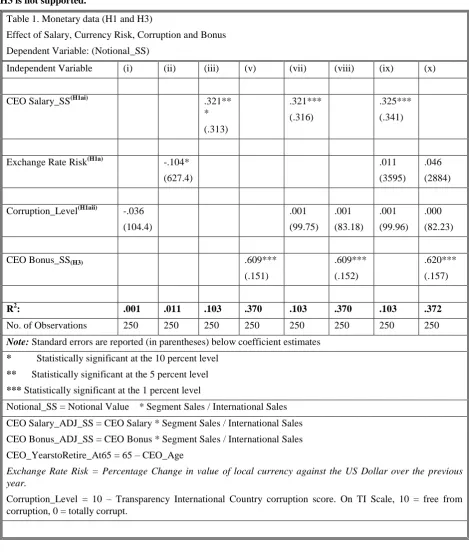
With an R2 of .219, the relationship between hedging and Bonus payouts is surprising on several levels. It is not only going in the opposite direction to that predicted, but it also has a much stronger relationship with hedging than Salary. H3 is not supported.
Table 1. Monetary data (H1 and H3)
Effect of Salary, Currency Risk, Corruption and Bonus Dependent Variable: (Notional_SS)
Independent Variable (i) (ii) (iii) (v) (vii) (viii) (ix) (x)
CEO Salary_SS(H1ai) .321**
* (.313)
.321*** (.316)
.325*** (.341)
Exchange Rate Risk(H1a) -.104* (627.4)
.011 (3595)
.046 (2884)
Corruption_Level(H1aii) -.036 (104.4)
.001 (99.75)
.001 (83.18)
.001 (99.96)
.000 (82.23)
CEO Bonus_SS(H3) .609***
(.151)
.609*** (.152)
.620*** (.157)
R2: .001 .011 .103 .370 .103 .370 .103 .372
No. of Observations 250 250 250 250 250 250 250 250
Note: Standard errors are reported (in parentheses) below coefficient estimates * Statistically significant at the 10 percent level
** Statistically significant at the 5 percent level *** Statistically significant at the 1 percent level
Notional_SS = Notional Value * Segment Sales / International Sales
CEO Salary_ADJ_SS = CEO Salary * Segment Sales / International Sales CEO Bonus_ADJ_SS = CEO Bonus * Segment Sales / International Sales CEO_YearstoRetire_At65 = 65 – CEO_Age
Exchange Rate Risk = Percentage Change in value of local currency against the US Dollar over the previous year.
Corruption_Level = 10 – Transparency International Country corruption score. On TI Scale, 10 = free from corruption, 0 = totally corrupt.
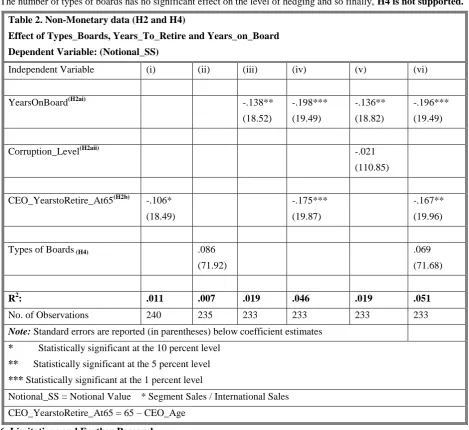
The number of years the CEO has before retirement does indeed affect the level of hedging and to a sizable extent. As can be seen it is negative, indicating that the more time the CEO has to go before retirement is the less they hedge. Therefore, H2b is supported.
The number of types of boards has no significant effect on the level of hedging and so finally, H4 is not supported. Table 2. Non-Monetary data (H2 and H4)
Effect of Types_Boards, Years_To_Retire and Years_on_Board Dependent Variable: (Notional_SS)
Independent Variable (i) (ii) (iii) (iv) (v) (vi)
YearsOnBoard(H2ai) -.138**
(18.52)
-.198*** (19.49)
-.136** (18.82)
-.196*** (19.49)
Corruption_Level(H2aii) -.021
(110.85)
CEO_YearstoRetire_At65(H2b) -.106* (18.49)
-.175*** (19.87)
-.167** (19.96)
Types of Boards(H4) .086
(71.92)
.069 (71.68)
R2: .011 .007 .019 .046 .019 .051
No. of Observations 240 235 233 233 233 233
Note: Standard errors are reported (in parentheses) below coefficient estimates * Statistically significant at the 10 percent level
** Statistically significant at the 5 percent level *** Statistically significant at the 1 percent level
Notional_SS = Notional Value * Segment Sales / International Sales
CEO_YearstoRetire_At65 = 65 – CEO_Age
6. Limitations and Further Research
In this paper, it is assumed that foreign sales are measured in the same way across all the companies in the study. But in reality, the FASB allows companies a latitude in interpreting the difference between foreign and domestic sales (Chow, Lee, and Solt, 1997). Therefore the way in which we derive the ratio of Segment Sales to International Sales—a measure which drives many of the relationships in the study may be a factor in limiting the accuracy of the results derived in this study. The authoritative measurement of currency risk uses the MERM model (Jorion, 1990) but unfortunately this data was not readily available and so this necessitated a less rigorous approach to currency risk data collection. This represents a large limitation of the study, especially with respect to measurement errors.
There is an inadequate level of research on multinational corruption due to a) the difficulty in deriving definitions of corruption b) the delicate nature of conducting research on the topic, and c) data collection problems. This forces us to use country data relating to public sector corruption instead of what would be ideal, which is private sector country data (Sandholtz and Koetzle, 1998; Svensson, 2003).
capital among stocks, then it means that shareholders are may face inadequate liquidity and hold stocks for a long time and therefore currency risk management may be necessary at the firm level. In such a situation, hedging would be less associated with selfish, corrupt management and would simply be good management practice. Apart from the fact that smaller firms have less currency risk, smaller firms also have less manpower and less in-house financial wizardry with which to engage in fancy financial instruments. So the bigger a firm is, the more likely it is to hedge since it will have the financial infrastructure—including CEOs and CFOs adept at and experienced in hedging (Géczy, et al., 1997) Larger companies should give senior executives scope for movement within the company, laterally and vertically, so that CEOs should be more likely to stay at a larger company since there is more stability, more to do, more to learn and more ways to grow and progress. For this reason, it should be expected that esoteric activities like hedging would come more naturally to a CEO in a large company who has been around longer. Therefore the relationship of company size and CEO track record of hedging, to the level of hedging practiced should also be worth looking into.
The assumption is made that managers can always exercise a level of power over the running of the firm which is based on their own self-interest. However this is not always true since there are many ways in which manager effectiveness and by extension firm performance can be measured and controlled. One of the factors determining level of control of shareholders over management is the level of concentration of ownership, with highly concentrated ownership giving shareholders a greater ability to control managers and ensure that their actions are aligned with shareholder value (Amihud and Lev, 1981). So that a more exhaustive study which time did not permit, would also measure hedging as a function of the concentration of share ownership outside the firm. Another aspect which is neglected here is the extent of product and geographic diversification of the company. Product diversity allows for some level of operational hedging (Allayannis, et al., 2001). We cannot really make claims of corruption driven hedging without putting the level of currency hedging in the context of the amount of operational hedging and financial hedging.
Doukas, Kim and Pantzalis (2000) show that security analysts are better able to perform a monitoring function which provides a check-and-balance against managers acting totally in their own self-interest, in a manner which is not aligned with the maximization of market value. So a more complete examination of the motivations for hedging should examine the efficacy of security analysts and the stock market in general, for various country markets. Adler and Dumas (1984) point to the following requirements for adequate currency risk measurement: a) it should be measured in currency units, b) it should be based on the a financial or physical asset or liability within the investor’s portfolio, and c) it should be measurable in a realistic way – through available techniques and also in a way that it can be covered through hedging. This calls into question the validity of the method used here to measure exchange rate risk, especially in light of the non-significant results obtained. We assume that currency-exchange risk is being dealt with for only one currency, whereas in reality, assets and operating income can be affected by several currencies at the same time since the factors of production may come from several markets which trade in different currencies as well as products which may be sold in different markets which again trade in different currencies (Adler and Dumas, 1984) – there needs to be further Study to see whether currency hedging is less or greater when exposure is experienced across several currencies.
7. Discussion and Conclusions
It would be erroneous to paint a picture of corporate executives as being totally selfish and uninterested in shareholder value just because corporate executives engage in hedging which may limit profitability. There is nothing inherently bad in taking steps to ensure the firm’s on-going survival—quite apart from the shareholders, there are other important stakeholders who rely on the continued operation of the firm, such as members of the supply chain in which they participate, employees and other members of the community (Stulz, 1984). Certainly, a firm which establishes a reputation for all-out profiteering at the risk of sustainability would not last long, simply because it would lose the confidence of its stakeholders, severely crippling its ability to operate effectively. Apart from the fact that foreign exchange risk is a real risk which can cripple a company, several studies have shown that foreign currency hedging can afford firms the ability to grow and expand (Allayannis, et al., 2001; Géczy, et al., 1997). Also, the market has been shown to reward firms which hedge their foreign currency risk with higher firm values (Allayannis, et al., 2001).
the directorship data collected in the SEC’s proxy statements (def14a), is that the CEOs being studies are in fact, all American company CEOs. Therefore, the only corruption value which truly applies is the level of Corruption within America. The assumption made going into the study was that the culture and thought process of the various country managers would have a strong impact on the decisions by the CEO, whether or not to hedge. So that even though the CEO is of an American company, the level of corruption of the regions in which the firm operates or sells its product should have an impact if CEOs act on the advice and guidance of their country managers and Financial Officers.
The relationship between Salary and hedging was certainly what was predicted based on Agency Theory. The greater the manager’s stake in the company, the more likely he is to take measures to keep the company going. What is surprising is not that the effect of Bonus on hedging is significant, but that it is positively related to level of hedging. Bonuses are supposed to be used by the board to reward CEOs for good performance (Donaldson and Davis, 1991). However the understanding and subsequent measurement of good performance gets murky very fast. A big issue here is whether the shareholders who are the ultimate bosses are A) as inclined to pursue high-risks strategies as (Modigliani and Miller, 1958) suggested they should be—it is after all, quite possible that along with a sense of risk, they may want management to demonstrate some recognition of the risks involved and to take reasonable steps to mitigate those risks B) truly in control based on the concentration of outside ownership which should manifest in shareholders being appointed to the board and taking an active part in overseeing management’s decision C) have freedom in reassigning their capital to the financial-vehicles with the greatest returns (in this case, companies with a high-risk/high-return strategy).
All of this requires further study of hedging in the context of i) Risk profile of investors in the market ii) percentage of operating income used to hedge (which could conceivably be used to turn a profit instead of keeping the company alive) and ii) freedom of capital in the local stock markets.
So since some risk management may be necessary on the part of management, it is not too surprising that Bonus payout is related to level of hedging, since hedging is considered in some circles as good management, undertaken by managers who are simply exercising due-diligence (Allayannis and Weston, 2001, Géczy, et al., 1997).
The longer a CEO spends on the board is the less they appear to hedge. This small (1.9%) but significant result, goes against the logic of Agency theory which suggests that a CEO who has committed more of their time and energy in developing the highly focused set of skills required to develop and run a company, should take more steps to keep that company alive and should therefore hedge more. This result suggests that their motivation to hedge reduces, as more time is invested in the company. A possible explanation is that the more time the CEO invests in the running of the company, the more familiar they become with the operations and the currency risks. So that the longer they stay on, the more confident they feel in their management team’s ability along with their operational practices, to keep the company afloat without having to commit precious resources to currency hedging. So it is possible that the small reduction is more significant than it seems, since a CEO should arguably hedge much less as time goes by. Again, corruption has no interacting effect with the time spent on the board.
as they spend more time with the company, may be a manifestation of Agency theory. That is, is we consider the possibility of the CEO seeking selfish non-monetary gains such as job-satisfaction and a sense of self-worth from being in charge of a large corporation. Therefore, the conclusion of the study is that Agency theory should be examined in a broader context to include the pursuit of non-monetary rewards by agents, where such rewards may be at the expense of the principal.
References
Adam-Müller, A. (1997). Export and hedging decisions under revenue and exchange rate risk: A note. European Economic Review, 41(7), 1421-1426. http://dx.doi.org/10.1016/S0014-2921(96)00029-3
Adler, M., & Dumas, B. (1984). Exposure to currency risk: Definition and measurement. Paper presented at the Financial Management. http://dx.doi.org/10.2307/3665446
Allayannis, G., Ihrig, J., & Weston, J. (2001). Exchange-rate hedging: Financial versus operational strategies.
American Economic Review, 91(2), 391-395. http://dx.doi.org/10.1257/aer.91.2.391
Allayannis, G., & Weston, J. (2001). The use of foreign currency derivatives and firm market value. Review of Financial Studies, 14(1), 243. http://dx.doi.org/10.1093/rfs/14.1.243
Amihud, Y., & Lev, B. (1981). Risk reduction as a managerial motive for conglomerate mergers. The Bell Journal of Economics, 12(2), 605-617. http://dx.doi.org/10.2307/3003575
Bartov, E., & Bodnar, G. (1994). Firm valuation, earnings expectations, and the exchange-rate exposure effect.
Journal of Finance, 49(5), 1755-1785. http://dx.doi.org/10.1111/j.1540-6261.1994.tb04780.x
Berger, P., Ofek, E., & Yermack, D. (1997). Managerial entrenchment and capital structure decisions. Journal of Finance, 52(4), 1411-1438. http://dx.doi.org/10.1111/j.1540-6261.1997.tb01115.x
Brouthers, L., Gao, Y., & McNicol, J. (2008). Corruption and market attractiveness influences on different types of FDI. Strategic Management Journal, 29(6), 673-680. http://dx.doi.org/10.1002/smj.669
Chow, E., Lee, W., & Solt, M. (1997). The exchange-rate risk exposure of asset returns. Journal of Business, 70(1), 105-123. http://dx.doi.org/10.1086/209710
Coase, R. (1937). The nature of the firm. Economica, 4(16), 386-405. http://dx.doi.org/10.1111/j.1468-0335.1937.tb00002.x
Coase, R. (1979). Payola in radio and television broadcasting. Journal of Law and Economics, 22(2), 269-328. http://dx.doi.org/10.1086/466944
Denis, D., Denis, D., & Sarin, A. (1997). Agency problems, equity ownership, and corporate diversification. Journal of Finance, 52(1), 135-160. http://dx.doi.org/10.1111/j.1540-6261.1997.tb03811.x
Denis, D., Denis, D., & Sarin, A. (1999). Agency theory and the influence of equity ownership structure on corporate diversification strategies. Strategic Management Journal, 20(11), 1071-1076. http://dx.doi.org/10.1002/(SICI)1097-0266(199911)20:11<1071::AID-SMJ70>3.0.CO;2-G
Donaldson, L., & Davis, J. H. (1991). Stewardship theory or agency theory: CEO governance and shareholder returns. Australian Journal of Management, 16(1), 49. http://dx.doi.org/10.1177/031289629101600103
Doukas, J., Kim, C., & Pantzalis, C. (2000). Security analysis, agency costs, and company characteristics. Financial Analysts Journal, 56(6), 54-63. http://dx.doi.org/10.2469/faj.v56.n6.2403
Fama, E. (1980). Agency Problems and the Theory of the Firm. The Journal of Political Economy, 88(2), 288-307. http://dx.doi.org/10.1086/260866
Géczy, C., Minton, B., & Schrand, C. (1997). Why firms use currency derivatives. Journal of Finance, 52(4), 1323-1354. http://dx.doi.org/10.1111/j.1540-6261.1997.tb01112.x
Glen, J., & Jorion, P. (1993). Currency hedging for international portfolios. Journal of Finance, 48(5), 1865-1886. http://dx.doi.org/10.1111/j.1540-6261.1993.tb05131.x
Habib, M., & Zurawicki, L. (2001). Country-level investments and the effect of corruption — some empirical evidence. Inernational Business Review, 10. http://dx.doi.org/10.1016/S0969-5931(01)00038-5
Hendry, J. (2005). Beyond Self Interest: Agency Theory and the Board in a Satisficing World. British Journal of Management, 16, S55-S63. http://dx.doi.org/10.1111/j.1467-8551.2005.00447.x
Jensen, M., & Meckling, W. (1976). Theory of the firm: Managerial behavior, agency costs and ownership structure.
Journal of financial economics, 3(4), 305-360. http://dx.doi.org/10.1016/0304-405X(76)90026-X
Jorion, P. (1990). The exchange-rate exposure of US multinationals. Journal of Business, 63(3), 331-345. http://dx.doi.org/10.1086/296510
Knopf, J., Nam, J., & Thornton Jr, J. (2002). The volatility and price sensitivities of managerial stock option portfolios and corporate hedging. The Journal of Finance, 57(2), 801-813. http://dx.doi.org/10.1111/1540-6261.00442
Ministers, C. o. (1994). Report by the Secretary General of the Council of Europe. 19th Conference Of European Ministers Of Justice. Valletta.
Modigliani, F., & Miller, M. (1958). The cost of capital, corporation finance and the theory of investment. The American Economic Review, 48(3), 261-297.
Robertson, C. J., & Watson, A. (2004). Corruption And Change: The Impact Of Foreign Direct Investment. Strategic Management Journal, 25. http://dx.doi.org/10.1002/smj.382
Rose-Ackerman, S. (1997). The political economy of corruption. Corruption and the global economy, 31, 60. Sandholtz, W., & Koetzle, W. (1998). Accounting for corruption: Economic structure, democratic norms, and trade. Shleifer, A., & Vishny, R. W. (1989). Management entrenchment:: The case of manager-specific investments.
Journal of financial economics, 25(1), 123-139. http://dx.doi.org/10.1016/0304-405X(89)90099-8
Shleifer, A., & Vishny, R. W. (1993). Corruption: National Bureau of Economic Research Cambridge, Mass., USA. http://dx.doi.org/10.2307/2118402
Stulz, R. (1984). Optimal hedging policies. Journal of Financial and Quantitative Analysis, 19(02), 127-140. http://dx.doi.org/10.2307/2330894
Stulz, R. (1990). Managerial discretion and optimal financing policies. Journal of financial economics, 26(1), 3-27. http://dx.doi.org/10.1016/0304-405X(90)90011-N
Appendix A
Exchange Rate Risk Calculation