R E V I E W
Open Access
Day-to-day and short-term variabilities in
the equatorial plasma bubble/spread F
irregularity seeding and development
Mangalathayil Ali Abdu
1,2Abstract
The background ionospheric conditions shaped by sunset electrodynamic processes are responsible for the development of equatorial plasma bubble (EPB)/equatorial spread F (ESF) irregularities of the post-sunset ionosphere. Distinct conditions exist for the EPB/ESF development also at later hours of the night. The plasma instability growth leading to EPB generation is dependent on the basic precursor conditions defined by the well-known parameters: the evening prereversal enhancement in vertical plasma drift (PRE), wave structure in plasma density and polarization electric field required to initiate/seed the instability, and the F layer bottom side density gradient, as a significant factor in controlling the growth rate. Competing roles of the zonal versus meridional thermospheric winds additionally control their development. Statistical as well as case studies have addressed aspects of the EPB development and occurrence under different geophysical conditions, generally focusing attention on any one of the above specific parameters. Little is known regarding the relative importance of concurrent presence of the precursor parameters (mentioned above) in shaping a given event. A large degree of day-to-day variability in these parameters arise from different sources of forcing, such as upward propagating atmospheric waves, and magnetic disturbance time electric fields in the form of prompt penetration and disturbance dynamo electric fields that often contribute to the widely observed short-term variabilities in EPB development and dynamics. In this paper, we will present and discuss some important aspects of the EPB/ ESF short-term variability, focusing attention on their enhanced development, or suppression and, wherever possible, highlighting also the relative roles of the precursor parameters in such variability.
Keywords: Equatorial ionosphere, Plasma bubbles/spread F irregularities, Prereversal vertical drift, Prompt penetration electric field, Gravity waves, Trans-equatorial wind, Planetary/Kelvin waves, ESF/EPB short-term variability
Introduction
The nighttime equatorial ionospheric plasma structur-ing manifests itself in the form of geomagnetic field-aligned plasma irregularities, also known by its generic name as equatorial spread F (ESF) or equatorial plasma bubble (EPB) irregularities. The ESF/EPB irregularities occur in a wide spectrum of scale sizes (from few centimeters to a few hundreds of kilometers); the shortest scale measured being
11 cm (Tsunoda 1980) and the outer scale size reaching
800–1000 km. They also present a large degree of variability with wide-ranging time scales. The long-term variability in
their development and occurrence is dependent largely on solar activity cycle defined by the variations in solar EUV flux and/or sunspot number. The medium-term variability is dependent on the season as well as solar flux, and it is by far relatively better understood and therefore more easily predictable. There are also short-term variabilities in the form of changes occurring on a day-to-day basis, as well as of a more transient nature in response to their driving sources with corresponding time scales. Upward propagat-ing atmospheric waves, such as, gravity waves, and planet-ary waves, produce variabilities on time scales vplanet-arying from short-term to several days of quasi periods. It is reasonable to consider that the shorter term and day-to-day variabil-ities could be largely controlled by gravity waves, whereas Correspondence:[email protected]
1Instituto Tecnológico de Aeronáutica (ITA), São Jose dos Campos, Brazil 2
Instituto Nacional de Pesquisas Espaciais (INPE), São Jose dos Campos, Brazil
the variability on time scale of a few to several days could be largely driven by planetary/Kelvin waves through their modulation of tidal winds. The variabilities arising from magnetospheric (and high latitude) forcing can also be of transient nature with time scales varying from minutes to hours, or of several days. Little is known about the different drivers of these short-term and day-to-day variabilities, which therefore are the least predictable component of the ESF variability. Investigations on the sources and character-istics of the variabilities are important due, primarily, to the impacts of these irregularities and the background iono-spheric conditions on the different space application systems of practical interest to us. Further, a better un-derstanding of the possible drivers of such variabilities is a primary requirement for advancing our knowledge on the science of the coupling processes that govern their development as well as to make continuing pro-gress towards developing predictive capability on their occurrences.
The irregularities originate from plasma instability process that may develop in the nighttime ionosphere when conditions of the background ionosphere are fa-vorable for their development. In the most typical sce-nario, the instability may develop through the
Rayleigh-Taylor interchange mechanism (Dungey 1956) acting
on the seed perturbations in density and polarization electric field produced by gravity waves at the bottom side of a rapidly rising post-sunset F layer. The rapid post-sunset rise of layer (PSSR) occurs through the en-hanced vertical plasma drift arising from the evening prereversal enhancement in the zonal electric field (the PRE). The PRE is generated through the action of the F layer dynamo under sunset electrodynamics processes. The thermospheric zonal wind, which is eastward in the evening, produces vertical polarization electric field in the F region that has strong longitudinal gradient across the sunset terminator due to the decay in the E layer conductivity towards the nightside. This situation leads to the development of the PRE as explained by
Rishbeth (1971) (see also Heelis et al.1974; Farley et al.
1986; Eccles et al. 2015). Based on a TIECGM simula-tion study, a candid explanasimula-tion of the PRE develop-ment was recently presented by Heelis et al. (2012). During low solar flux years, the PRE vertical drift vel-ocity is relatively small, when therefore the role of an instability seed source may become relatively more im-portant for the ESF development. The instability seed-ing through perturbations in electron density and polarization electric field is believed to be provided by gravity waves propagating upward from sources of their likely generation in the tropospheric convective regions
(see for example, Rottger 1981; Huang et al. 1993; Mc
Clure et al. 1998; Fritts and Vadas 2008; Abdu et al.
2009a; Tsunoda 2010; Li et al. 2016). Once initiated at
the F layer bottom side gradient region under suffi-ciently large linear growth rate condition, the instability may grow nonlinearly to topside ionosphere in the form of plasma-depleted magnetic field-aligned structures. These structures may cascade into a wide spectrum of
scale sizes of irregularities (Haerendel 1973), the
com-posite form of which is known by the generic name, the ESF irregularities, that are observable by a wide variety of diagnostic techniques. Being part of the coupled atmosphere-ionosphere-thermosphere system, they suffer variabilities due to different sources of forcing related to magnetospheric disturbances and lower atmospheric wave activities. As a result, large degrees of day-to-day and short-term variabilities mark the development and occur-rence of the EPB/ESF irregularities, which constitute the prime focus of this paper.
Plasma bubble/ESF generation mechanism
The EPB/ESF irregularity development takes place in se-quential phases, the observed details of which can vary depending upon the diagnostic techniques. The earliest
observation by ionosondes (Booker and Wells 1938)
showed that the rise of the post-sunset F layer to higher altitudes was a precondition for the occurrence of range spread F echoes in ionogram. The observations also re-vealed that the presence of satellite traces adjacent to the main F layer trace in ionogram was often a
precur-sor to the spread F (SF) development (Lyon et al. 1961;
Abdu et al. 1981; Tsunoda 2008). The
range-time-intensity (RTI) map obtained by the Jicamarca VHF radar showed that the generation of 3-m irregularities was initiated at the F layer bottom side. Their upward growth to the topside ionosphere provided the first in-dication that the ESF irregularities are associated with magnetic field-aligned plasma depletions, that is, plasma bubbles, that rise upward from the F layer bottomside fol-lowing their generation through the Rayleigh-Taylor (R-T) interchange instability mechanism (Woodman and La Hoz 1976; Woodman 2009; Scannapieco and Ossakow 1976; Hanson and Sanatani1971). Diagnostics by the AL-TAIR fully steerable incoherent scatter radar (at UHF) has provided important information on the characteristics of the two-dimensional background conditions propecious for the irregularity growth and evolution. A notable pre-cursor condition was identified as the post-sunset upwell-ing of the F layer havupwell-ing characteristics of a large-scale
wave structure (LSWS) (e.g., Tsunoda et al.1979; Tsunoda
and White1981). From east-west scan measurements in
instruments (such as ionosondes and optical imagers), Tsunoda (2015) further characterized the EPB gener-ation process as occurring in three phases: (1) amplifi-cation of the upwelling during the post-sunset rise of
the F layer (due to prereversal vertical drift, PRE), (2)
launching of the EPB from the crest of the upwelling, and (3) structuring of the plasma within the upwelling. The ALTAIR observations further revealed that EPBs occurred often in clusters that are connected with the ESF patches in the bottom side F layer and that their zonal widths were comparable to those of the upwell-ing. Considerations on the day-to-day variability in the background conditions and on the drivers that contrib-ute to the phases defining the EPB/ESF development, especially those related to the phases (1) and (2) above, constitute the key elements of the discussion to follow in this paper. Central to the discussion to begin with is the basic plasma instability mechanism responsible for the generation of the EPB/ESF irregularities, that is, the Rayleigh-Taylor (R-T) interchange mechanism. A com-prehensive picture of the EPB generation mechanism and the different sources of forcing that can modify the coupled processes leading to the EPB short-term
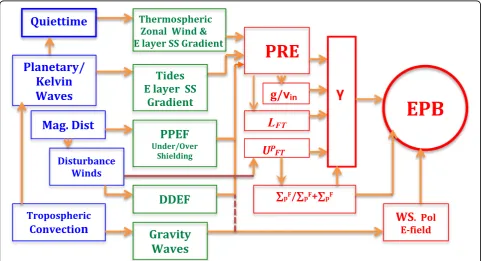
vari-ability is presented schematically in Fig.1. The red
col-ored blocks represent the parameters that play direct roles in the processes leading to the EPB generation. Their relationship contributing to the instability linear
growth rate (γFT) through the generalized
Rayleigh-Taylor mechanism can be expressed through field line
integrated parameters as given by Eq.1(Sultan1996)
γFT¼ð1=LFTÞ ΣPF=ΣPFþΣPE
E=BUP
FTþg=νin−βFT ð1Þ
Each of terms in Eq.1 is represented as a
correspond-ing box in Fig. 1. The term E/B represents the evening
prereversal vertical drift marked as PRE in Fig.1;gis the
gravitational acceleration; νinis the ion-neutral collision
frequency, with the gravity term g/νinalso shown in the
figure; andLFTis theFlayer flux tube integrated bottom
side gradient scale length, shown in the figure box also as such, (which has its simplified local form expressed as Ni/(ΔNi/Δh), whereNiis the ion density).The ratio of F region field line integrated conductivity to the sum of the E and F region-integrated conductivities, (ΣPF/(ΣPF +ΣP)), in Eq.1is shown as such in the figure box.βFTis
the recombination rate (not shown in the Figure).UPFT is
the meridional wind in the vertical plane marked as such in the figure box, which can also be part of a trans-equatorial wind (TEW). We may further note that (1)
the conductivity ratio (in Eq.1) increases from a fraction
of one before sunset to one as the E layer conductivity decays into the night, (2) the linear growth rate increases with decrease in gradient length, and (3) both the PRE
vertical drift and the gravity terms contribute positively to the linear growth rate while the meridional wind term
contributes mostly negatively to γFT. It is to be noted
further that the contribution toγFTarising from the PRE
vertical drift has additional aspects: (a) an increase inE/
Bcan result in an increase in the gravity term (g/νin) due to the decrease in the ion-neutral collision frequency as the F layer height rises due to the PRE, the gravity term
thereby further raising theγFT, and (b) the gradient scale
length has been found to increase with increase in F
layer height, so that an increase inE/B(that raises the F
layer height) can contribute to an increase in the gradient
scale length (LFT) that, in turn, could contribute to slow
down the growth rate. We may point out that the linear growth rate is derived from one-dimensional perturbation analysis in which the seed perturbation is assumed not to perturb the background conditions represented as field line-integrated quantities. Therefore, if the linear growth rate so obtained is found to be above a threshold value, in-stability growth could occur (in the form of structure amplitude growth) along the entire field line. Considering the equatorial plane two-dimensional situation, such growth should be favored at the crest of the upwelling de-pending upon the degree to which the LSWS may modu-late the larger scale upwelling of evening F layer produced by the PRE (to be further commented later). Even when the linear growth rate is large enough, the instability may develop only if a seed perturbation of sufficient amplitude is present. The seed perturbation can be in the form of a wave structure in density and polarization electric field (indicated in the fig. box as WS. Pol E-field), which may be induced by gravity waves, as depicted in the figure. An-other form of seeding process has been suggested as that arising from instability growth in the shear flow region of the post-sunset plasma vortex. As discussed by Kudeki and Bhattacharyya (1999) and Hysell and Kudeki (2004), the westward plasma flow in the presence of eastward neutral wind in the bottomside/valley region of the F layer (below the plasma vortex focus) can be an important en-ergy source for creating an instability that may provide the seed perturbation capable of initiating EPB development by the R-T mechanism. Nonlinear growth of the instability (from a background condition already distorted by the lin-ear growth process) may lead to a more rapid rise of bub-ble structures to topside ionosphere. However, such nonlinear growth can be retarded/limited by the field line integrated conductivity that is controlled (mostly in-creased) by meridional/trans-equatorial winds. It should be pointed out that the linear growth rate expression stated above was derived on assumption of small pertur-bations, with higher order terms discarded (see Sultan 1996, for details) so that it represents only a tendency for the instability growth. As a result, discrepancy may be ex-pected between a specific ESF observation and the linear growth rate that predicted its development.
The parameters indicated in the top green box of Fig.1, namely, the thermospheric zonal wind and the E layer conductivity sunset (SS) gradient in the evening hours, are the ones directly responsible for the develop-ment of the evening prereversal vertical drift enhancedevelop-ment (the PRE). The other green boxes indicate the parameters that may, directly or indirectly, modify the intensity of the PRE and thereby the factors (or terms) that determine the linear and nonlinear growth rates for the EPB. These
pa-rameters, which we call as“modifying parameters”are (1)
prompt penetration electric fields (PPEF), (2) disturbance dynamo electric field (DDEF), (3) tidal winds modifying the sunset gradient in the E layer conductivity, and (4) gravity waves. They can suffer large degrees of short-term changes as a result of the variabilities in the sources driv-ing them (drivdriv-ing sources), represented in blue boxes in Fig.1. These drivers are magnetospheric disturbances and upward propagating wave disturbances originating from the lower atmosphere. The latter is dominated by upward propagating atmospheric waves in the form of gravity waves and planetary/Kelvin waves originating from tropo-spheric convection processes. The planetary waves (PWs) are very large horizontal scale atmospheric oscillations in neutral wind, density, and pressure that propagate zonally and also vertically from their sources in the tropospheric-stratospheric regions. They have periodicity varying from 2 to 20 days and propagate globally, mostly westward, with significant meridional and zonal velocity
compo-nents (e.g., Forbes 1996). They have zonal wave length of
several thousands of kilometers, with small vertical wave length (of a few tens of kilometers), which limits their up-ward propagation to middle atmosphere and lower thermo-sphere and perhaps up to the dynamo region. Kelvin waves are one type of PWs (generated in the troposphere) that are trapped in the equatorial region and propagate eastward (e.g., Salby and Garcia1987; Liu et al.2012). The ultra-fast
Kelvin (UFK) wave that has a period of 3–4 days and
verti-cal wave length of 30–50 km is of particular interest to us
since it can propagate upward to even higher altitude into the thermosphere with significant amplitude dominated by zonal wind component. The atmospheric tides, espe-cially the diurnal and semidiurnal waves (due to their larger vertical wave lengths), reach ionospheric heights where they produce dynamo electric fields that drive the regular ionospheric dynamics including the current systems and the plasma drifts. Nonlinear interaction can occur between planetary/UFK waves and tidal
waves (Pancheva et al. 2003), and the resulting
modu-lated tidal winds interacting with the dynamo region is believed to control the PRE vertical drift and F layer
in these driving sources when they are imposed on the
“modifying parameters”mentioned above constitute the
basic drivers of the day-to-day and short-term variabil-ities in the development and occurrence of the EPB/ EFS irregularities.
The main paths by which the short-term variability in the EPB can occur are through changes in the following param-eters: (1) The PRE vertical drift that mainly controls the lin-ear growth rate. It can undergo large variations through superposition of vertical drifts due to disturbance electric fields, in the form of prompt penetration electric field (PPEF) and disturbance wind dynamo electric field (DDEF), when they occur in the evening hours. The PRE can undergo changes also through planetary/Kelvin wave modulation of the tides (as mentioned above) that modify the longitudinal gradient in the E layer Pedersen conductiv-ity at sunset that controls the PRE. To understand this process better, we may consider, for example, the zonal component of a modulated tidal wind interacting with the E region plasma in the environment of large height gradient in the ratio of ion-neutral collision-to-gyro frequency. The zonal wind can cause vertical motion of ions (both the mo-lecular and atomic ions) that may modify the E layer dens-ity, to different degrees, on the day- and nightside of the terminator. Thus, the evening time zonal wind can cause significant modification in the sunset longitudinal gradient in plasma density and hence in the E layer Pedersen
con-ductivity. As indicated in Fig. 1, the PRE can be modified
also by gravity waves induced oscillations in the evening F layer heights. (2) Variability in the seed perturbations in the form of precursor wave structure (with associated perturba-tions in polarization electric field), possibly induced by gravity waves, is another source of the short-term variabil-ity. When the PRE vertical drift has relatively smaller ampli-tudes, its modulation by gravity waves may also become significant as will be discussed later. (3) Meridional/trans-e-quatorial winds (UPFT) that can modify the field line inte-grated conductivity that controls the instability linear growth rate as well as the nonlinear growth of the plasma
bubble. The (UPFT) arises from the north-south asymmetry
in the thermospheric heating during quiet time (as also by the storm time asymmetric heating of the high latitude thermospheres). We will briefly discuss below some new and recent results on the short-term variabilities in EPB ir-regularities arising from the various sources mentioned above, highlighting their important characteristics and the electrodynamics conditions in which they occur.
EPB/ESF variability operating through changes in PRE
Observationally, the dependence of EPB/ESF develop-ment on the PRE vertical drift has been investigated
ex-tensively (e.g., Abdu et al.1983,2009c; Fejer et al.1999;
Huang and Hairston2015). The PRE can suffer
variabil-ity in two ways: (1) superposition of the vertical drift due to penetration electric field and disturbance dynamo electric field on the PRE which will be discussed in
Section 2.1and (2) changes in the two basic parameters
responsible for its normal development mentioned earl-ier, that is, (a) the thermospheric zonal wind in the even-ing and (b) the longitudinal gradient in the E layer conductivity across the terminator. Item 2(a) will not be discussed specifically. Item 2(b) on conductivity gradient
that involves the role of E layer winds (due to upward
propagating atmospheric waves) will be discussed in
Section 2.2. When the PRE is of weak intensity, it may
suffer significant modification also due to gravity waves,
which will be discussed in Section 3. We may further
note that the PRE vertical drift is known to be part of the post-sunset plasma vortex flow, in which the E layer zonal wind has a contribution to the vertical shear in the zonal plasma, as studied using the thermosphere iono-sphere electrodynamics - general circulation model (TIE-GCM) by Rodrigues et al. (2012). We will not be discussing here the specific role of this process in the PRE variability. Another question concerns the identifi-cation of threshold levels in the PRE vertical drift and in the associated post-sunset F layer height required for the EPB/ESF development. Such threshold levels can vary significantly depending upon the longitude, season, and solar flux conditions of the analyzed data (for more
de-tails see, for example, Farley et al. 1970; Abdu et al.
1983; Fejer et al. 1999; Manju et al. 2007; Smith et al. 2016). It should be kept in mind that the degree of vari-ability in the ESF occurrence, to result from a change in the PRE or from an imposed disturbance electric fields to be described below, should depend inevitably upon the threshold conditions for their development prevail-ing at the time of the occurrence of the disturbances.
Short-term variability in PRE due to penetration electric fields and disturbance dynamo electric field
The magnetospheric electric fields penetrating to low and equatorial latitudes under disturbed conditions can cause drastic modifications in the ionospheric currents
and plasma structuring (see, for example, Nishida1971;
Kikuchi et al. 1996; Basu et al.2001; Fejer 2011; Abdu
et al.2003; Abdu2012). Under the interplanetary
field, promptly penetrates to equatorial latitudes as an under-shielding (dawn-dusk) prompt penetration elec-tric field (PPEF) that has eastward polarity in the dayside-evening sector and westward polarity in the night sector
(Fejer and Scherliess1995; Kikuchi and Hashimoto2016).
A shielding layer due to the region-2 FAC (field aligned
current) develops in time scale of 20–30 min to balance
the convection electric field so that a subsequent north-ward turning of the Bz marking an auroral electrojet (AE) recovery may result in equatorward penetration of an over-shielding electric field (OSEF). The OSEF polarity is dusk-to-dawn, (opposite to that of the PPEF), that is, west-ward in the dayside-evening sector and eastwest-ward in the
night sector (Kelley et al. 1979; Fejer et al. 2008). The
OSEF is typically followed by disturbance wind dynamo (arising from auroral heating) with the associated electric field (DDEF) dominating the equatorial latitudes. The DDEF becomes active with a time delay of a few hours
(3–4 h) from the storm development, often coinciding
with the recovery phase of the storm (Blanc and Rich-mond 1980; Richmond et al. 2003). The polarity of the penetration electric field in the sunset sector, with its asso-ciated vertical drift complementing the PRE vertical drift, is a very crucial factor for the post-sunset EPB
develop-ment (Abdu et al.2003,2009b; Li et al.2010). An example
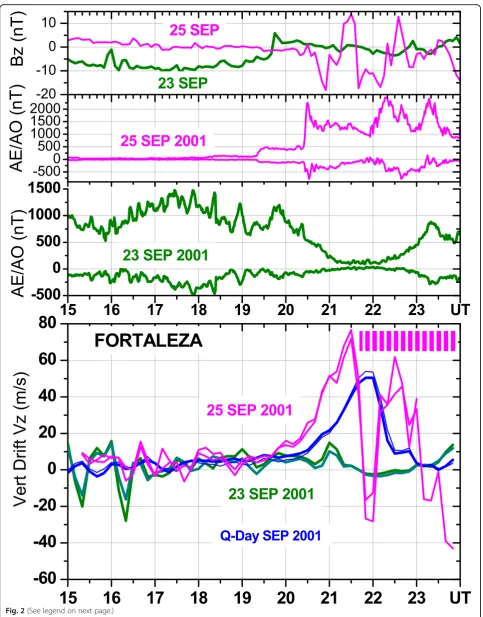
of the contrasting effects due to under-shielding and over-shielding electric fields occurring in the evening over
Fortaleza (3.9° S, 38.45° W, dip angle−9°), Brazil, is
pre-sented in Fig.2 (Abdu et al. 2009b, see also Abdu et al.
2012). On 25 September, the Bz turning south (with weak
amplitude) at ~ 1930 UT (LT = UT–2 h 28 min at
Forta-leza) initiated an AE activity, also of weak amplitude, that soon intensified at ~ 20:30 (~ 1800 LT) marking a sub-storm. At this time, the PRE was already under develop-ment over Fortaleza longitude. The under-shielding PPEF of eastward polarity associated with the AE intensifica-tions and the (eventual) substorm development caused an enhancement in the evening vertical drift that was super-posed on PRE vertical drift. The PRE vertical drift so en-hanced attained a peak value of ~ 75 m/s at 21:30 UT (1902 LT) as compared to the 50 m/s peak drift of the quiet time PRE (shown in blue curve, bottom panel) that usually occurs at ~ 22:00 UT (19:32 LT). The large en-hancement in the PRE vertical drift due to the PPEF caused prompt development of EPB (indicated by vertical pink bars) half hour earlier than its typical quiet time on-set. In contrast to this, on 23 September, the Bz was southward with the AE activity (and the Dst decrease not shown here) prevailing several hours prior to the evening. The subsequent Bz turning north at 19:40 UT (17:12 LT) caused a rapid recovery in the AE activity that approached zero by ~ 21 UT/18:32 LT, (panel 3). The associated over-shielding electric field of westward polarity appears to be largely responsible for the near total suppression of
the PRE on this evening (green curve in bottom panel). In view of the disturbance condition prevailing several hours (at least 6 h) prior to sunset, the role of a DDEF of west-ward polarity may also have contributed to this PRE sup-pression, as a result of which the usual post-sunset EPB did not develop on this evening.
Regarding the PRE enhancement due to under-shielding PPEF, we note that its intensity could depend upon the strength of the penetration electric fields as illustrated by
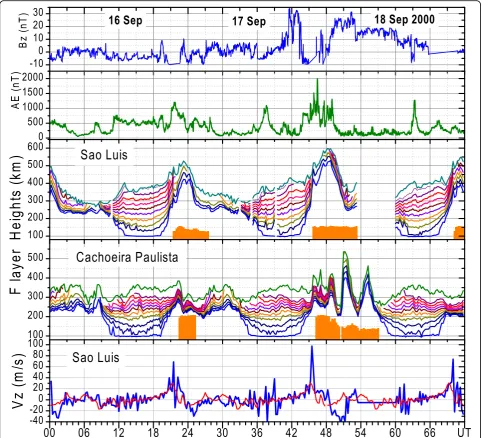
the example of an event sequence presented in Fig. 3
(Abdu et al. 2018). On 16 September, the Bz southward
fluctuations were present starting from ~ 10 UT, which was followed by an AE intensification (still under Bz south condition) starting at ~ 21 UT (18 LT) that coincided with PRE development time over Sao Luis (2.33° S, 44.2° W,
dip angle −.5°) (SL). A PPEF of eastward polarity
associ-ated with the AE intensification appears to have caused an increase in F layer heights plotted at sequential plasma frequencies (panel 3) as well as in the enhanced PRE verti-cal drift that peaked at ~ 60 m/s over Sao Luis (bottom panel). The quiet day value of the peak PRE vertical drift was about 27 m/s (red curve), which is normally below the threshold value required for ESF development in Septem-ber. The enhancement in the PRE vertical drift on this evening corresponded to an eastward penetration electric field of 0.6 mV/m. As a result, ESF developed promptly over Sao Luis having onset at 21:30 UT (18:30 LT) (panel 3) followed by its delayed onset at 22:30 UT (19:30 LT)
over Cachoeira Paulista (CP) (22.6° S, 315° E; dip angle:−
28°) (panel 4). The time delay of 60 min corresponds to the vertical growth time for the EPB observed over Cachoeira Paulista. Thus, the enhanced vertical drift due to an under-shielding PPEF of eastward polarity appears indeed to be responsible for the EPB generation mani-fested in the form of the ESF development observed se-quentially at SL and CP. The approximate bubble rise velocity in this case may be estimated as 150 m/s. A more intense disturbance activity marked the evening of 17 Sep-tember when a large Bz southward turning, accompanied by a large AE intensification, which occurred at ~ 20:00 UT. The Dst decrease starting at this time (not shown
here) dipped to−180 nT at 23:30 UT marking an intense
occurrence on the previous day which was 60 min. For this case of shorter time delay, the bubble rise velocity can be estimated as ~ 300 m/s. The SF is found to be of longer duration (and perhaps more intense as well) in this case than it was on the previous evening. These re-sults clearly show that an under-shielding PPEF occurring during the evening (at the time of PRE development) may enhance the vertical drift due to the PRE, resulting in the generation of EPB. The larger the intensity of the PPEF the more intense will be the PRE vertical drift and the resulting EPB rise velocity (as judged from Digisonde ob-servations). The increases in the intensity of the PRE and in EPB/ESF with increasing intensity of the penetration electric field as verified in these results might suggest an apparent proportionality in the observed caueffect se-quence. However, such a proportionality sequence does not seem to hold for abnormally large intensity of the dis-turbance electric field. For example, from analysis of radar and Digisonde data during the October 2003 magnetic
super storm, Abdu et al. (2008a,2008b) found that a large
uplift of the F layer at a velocity approaching 1000 m/s over Brazil that was driven by an intense eastward electric field of ~ 30 mV/m did not produce any UHF (GPS) scin-tillation or enhanced spread F in ionogram. The observa-tion was made in a region strongly influenced by the South Atlantic (or South American) Magnetic Anomaly (SAMA) wherein enhanced ionization by storm-induced energetic particle precipitation is believed to produce a large-scale gradient in the E layer conductivity that could be responsible for the development of polarization electric field superposed on the primary PPEF. It was intriguing, however, that the resulting abnormally large electric field did not support instability growth at the bottom side of the very rapidly rising F layer. Under normal conditions, the bubble rise velocity as modeled by the R-T mechanism
is of the order of 200 m/s (e.g., Zalesak et al. 1982).
AL-TAIR observation showed a rise velocity of the order of
130 m/s (as inferred from Fig.5of the paper by Tsunoda
2015). It is not clear to what degree this rise in velocity may increase through modification of the instability growth parameters by the effect of an additional disturb-ance penetration eastward electric field occurring in the post-sunset hours. It needs to be investigated by detailed modeling studies. For the present discussion, we believe that the abnormally large intensity of the PPEF caused an F layer uplift at a rate (~ 1000 m/s) that was significantly higher than an instability vertical growth rate (rise vel-ocity) possibly attainable under the R-T instability control
parameters (see Eq.1) that were also modified by the same
strong PPEF. It is likely that the large uplift of the layer might have caused a large increase in the bottom side
gra-dient length parameterLFTthat could cause a decrease in
the growth rate to a larger degree than an increase in it that could occur by corresponding increases in the other
terms (of Eq.1). It appears that such a situation could be
a key factor in causing the breakdown of the R- T instabil-ity growth process under the extreme situation that existed. As a result, an enhanced development of EPB did not occur on this night. It is not clear what should be the limiting value of the F layer uplift rate at which the EPB instability growth by R-T mechanism may become inop-erative as we normally understand the process.
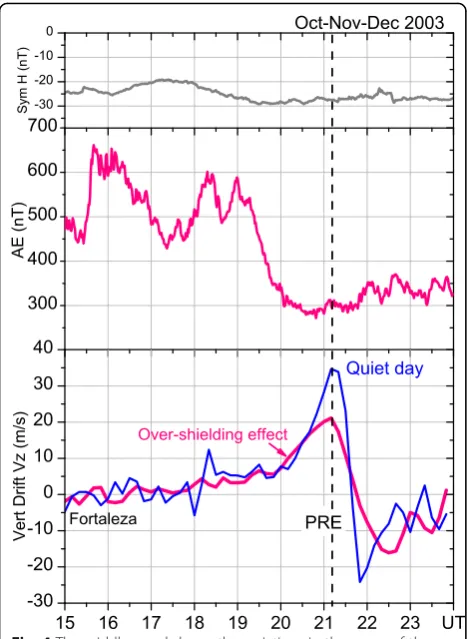
As regards the PRE vertical drift suppression by an over-shielding westward electric field, it is possible to identify the unique role of this electric field in specific cases without the possibility of concurrent contribu-tions to them arising from the DDEF that also has west-ward polarity in the evening. For this purpose, it is necessary to consider cases of AE activity decay phase (normally indicative of northward turning of the IMF Bz) occurring just prior to sunset hours that are pre-ceded by weak, or insignificant, Dst decrease so that the westward electric field occurring at sunset could be dominantly, if not exclusively, due to over-shielding conditions. The result of a statistical analysis of 18 cases of AE decay prior to sunset that occurred during the
period of October to December 2003 is presented in Fig.4.
The Sym-H/Dst index variation shown in the top panel of the figure represents the mean of its superposed variations corresponding to all the cases of AE variations that pre-sented decay in activity just preceding the evening PRE development. The corresponding mean AE variation is shown in the middle panel. The mean of the Vz variations for the same group of days (pink curve) is compared with that of the 10 quietest days of the same period (blue curve) in the bottom panel. The comparison shows a sig-nificant suppression in the PRE vertical drift due to the over-shielding westward electric field associated with the rapid AE decay/recovery that just preceded the sunset (that is, the PRE vertical drift). The quiet day PRE vertical drift peaked at 35 m/s, and the PRE decreased to 20 m/s as a result of the AE decay that just preceded it. The weak intensity of the Dst variations that characterized the sam-pled days, especially during several hours prior to sunset, may clearly rule out the possibility of any DDEF effect, also of westward polarity, influencing the PRE suppression
(See figure on previous page.)
effect attributed to the over-shielding westward electric field. The weakened PRE vertical drift caused corres-pondingly weakened EPB development on the different days studied (not shown here).
In a typical sequence of magnetic disturbance phases the disturbance dynamo electric field occurs with a
delay of a few hours (usually 4–5 h) from the onset of
the storm disturbance (Sastri1988; Fejer and Scherliess
1995; Scherliess and Fejer 1997). In the case of a clear/ isolated substorm event, the DDEF if present should be easily observable within a few hours after the over-shielding
electric field. During a typical global storm event character-ized by a significant Dst decrease, the DDEF should be ob-servable during the Dst recovery phase. The DDEF, with its westward polarity in the evening, may cause reduction in the PRE vertical drift leading to suppression of the post-sunset EPB development (as mentioned before). At later hours, its eastward polarity produces upward drift (layer rise), which may result in EPB development
dur-ing post-midnight hours (Carter et al.2016; Abdu2012).
range of longitude, during the 17 March 2015 storm. Cal-culation of the Rayleigh-Taylor linear growth rate based
on coupled thermosphere –ionosphere modeling
(TIE-GCM) results during an event sequence showed that post-sunset inhibition, or post-midnight development, of scintillation could be caused by disturbance dynamo elec-tric field contributing, respectively, to decrease or increase the instability growth rate.
Short-term variability through PRE modifications by atmospheric waves
The PRE vertical drift and post-sunset F layer heights can be modified significantly by upward propagating at-mospheric waves originating from the sources of their generation in the lower atmosphere. These waves are, as mentioned before, the gravity waves, planetary/Kel-vin waves and tidal waves. The results of such modifica-tions constitute an important component of the ESF/
EPB variability to be considered under magnetically quiet conditions. The planetary- and Kelvin- waves
(es-pecially the ultra-fast Kelvin waves; UFK) of 3–5 days of
periodicity in their upward propagation have been ob-served to produce oscillations in the PRE vertical drifts
(Abdu et al.2006a,2015a) and in post-sunset equatorial
F layer heights (see, for example, Takahashi et al. 2006,
2007; Fagundes et al. 2009). Manifestations of these waves in the post-sunset F region have been established through studies comparing the oscillations characteris-tics of mesospheric winds with concurrent oscillations in the evening PRE vertical drift and post-sunset F layer
heights. Good correlation was found between the 3–5
day periodicity in the mesospheric zonal wind over a low-latitude station, Cachoeira Paulista (22.6° S, 315° E), and the PRE vertical drift over an equatorial site, Cachimbo (9.46° S, 54.83° W), as demonstrated by Abdu et al. (2006a). Takahashi et al. (2006) showed that the
planet-ary wave oscillations at 3–6 day period in mesospheric
zonal wind (near 90 km) over the equatorial sites, Cariri (7.4° S, 36.5° W) and Ascension Island (7.9° S, 14.4° W), were well correlated with such oscillations in the
post-sunset F layer heights (h’F) at 20:00 LT over Fortaleza
(3.9° S, 38.4° W, Geomag. 2.1° S). Takahashi et al. (2007)
found also 3–4 day oscillations in the meteor radar zonal
wind over Cariri and in foF2 and h’F at 20:00 LT over
For-taleza correlating with the upward propagating TIMED/ SABER temperature wave of the same period, which sug-gested the process of UFK wave modulation of the equa-torial nighttime ionosphere. The above results may point to the presence of planetary/UFK wave-induced variability also in the ESF/EPB irregularity development that are ba-sically controlled by the PRE vertical drift or the post-sunset F layer heights that are modified by these waves. Modulation of the PRE vertical drift, accompanied by cor-responding modulation in the post-sunset ESF develop-ment, by UFK and FK waves was demonstrated by Abdu
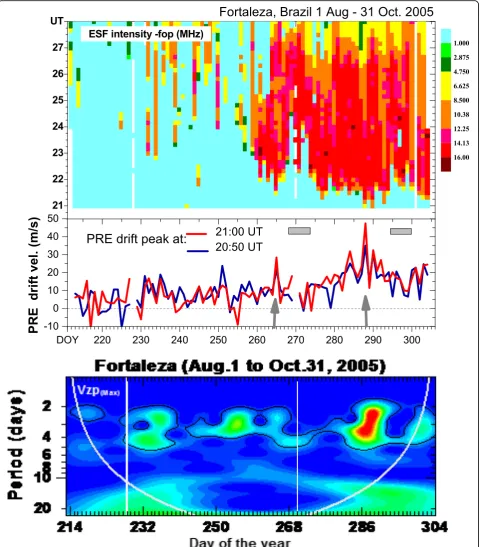
et al. (2015a). As an example, Fig. 5 shows a wavelet
spectrum of the PRE vertical drift (bottom panel) with corresponding variations in ESF intensity (top panel) in response to a UFK wave episode that occurred in October 2005 as corroborated from observations of upward propa-gating temperature wave (seen in TIMED/SABER data) and mesospheric winds over Tirunelveli (8.7° N, 77.8° E)
and Cariri (not shown here, but see Abdu et al. 2015a).
We may note that increases in PRE vertical drift (such as those indicated by vertical arrows in the middle panel)
due to the 3–4-day UFK wave were responsible for the
earlier onset and higher intensity of the spread F on these days. As explained in Abdu et al. (2015a), the peak UFK wave activity at mesospheric heights occurred some 10 days earlier to its manifestation as PRE vertical drift at the F layer heights. From this time delay in the PRE verti-cal drift (with respect to the UFK activity at mesospheric Fig. 4The middle panel shows the variations in the mean of the
superposed values of 18 cases (on 18 days) of AE decay that occurred just prior to sunset during the period October, November, and December 2003. The top panel shows the corresponding mean variation in the Sym-H/Dst values, and the bottom panel shows the corresponding variation in the vertical drift velocity (pink curve) and the mean of ten quiet days of vertical drift (blue curve),
heights), the vertical propagation velocity of the UFK waves was estimated as ~ 5 km/day, which is in
agree-ment with previous results (e.g., Pancheva et al. 2003).
In this way, it was possible to conclude that the waves
a corresponding modulation of the longitudinal/local time gradient in the E layer conductivity around sunset that may be shaped by the E layer zonal wind (Abdu
et al. 2006a). As explained by Abdu et al. (2006a), the
tidal modes of the E layer winds could be modified by nonlinear interaction with upward propagating UFK waves (similar to the cases of planetary wave modula-tion of the tides through nonlinear interacmodula-tion as
ex-plained by Pancheva et al.2003). The E layer winds so
modified could in turn cause changes in the longitu-dinal gradient in E layer conductivity (as was explained
in Section 1.1), which could lead to the PRE
modula-tion by the UFK waves (Abdu et al. 2006a; Abdu and
Brum 2009). This cause-effect sequence highlights the important role of E layer winds in causing the variabil-ities in PRE and ESF/EPB developments, a point we will be discussing again. It is relevant to point out in this context that the ability by the TIE-GCM to predict real-istic PRE vertical drift depended on the adjustments in the night E region density and in the amplitude and
phase of atmospheric tides (Fesen et al.2000).
We may note here that the upward propagating waves in the form of tidal modes and planetary/Kelvin waves are of global scale and therefore their modulation of the PRE vertical drift and ESF may not present any perceiv-able zonal (longitude) variation as such. In contrast to this, the typical gravity wave scales are of the order of a few hundred kilometers. For example, the large-scale wave structure (LSWS) in which the EPB seeding may take place, and which can also be associated with (or identified as) the seeding gravity waves, have local scales of the order of a few hundreds of kilometers, typically
400–600 km, (e.g. Tsunoda and White1981), which may
suffer significant zonal variation depending upon the lo-cations of the wave generation source. As a result, we may expect significant zonal variation in the EPB seed-ing process due to gravity waves, whereas such zonal variation due to the modulation effects by tidal and planetary/Kelvin waves appears to be absent.
Gravity waves and EFS/EPB variability
An instability seed perturbation is an important require-ment for initiating the EPB developrequire-ment although its diagnostics based on observational data has been a chal-lenging task. Gravity waves originating from sources in lower atmosphere were invoked to explain the spatial structures observed in HF radar maps of the ESF
irregu-larities (Rottger1981). On a statistical basis, the role of
gravity waves in the longitudinal and seasonal distribu-tion of spread F has been in part attributed to gravity wave generation at the inter-tropical convergence zone (ITCZ) and to its geographical and seasonal migration
(McClure et al. 1998; Tsunoda 2010). From analyses of
the seasonal/global distribution of plasma irregularities
observed by the ROCSAT-1 and from the OLR/ITCZ data, Su et al. (2014) found that the role of gravity waves was recognizable mainly in South American and African longitude sectors, and not over all longitudes. More re-cently, from comparison of bubble irregularity occur-rences at close-by locations in Asian sector, Li et al. (2016) found that enhanced plasma bubble generation was associated with more active ITCZ sector. On a case study basis, the role of gravity waves in seeding the ESF irregularities has been investigated for different
longi-tude sectors (see, for example, Abdu et al.2009a, Sreeja
et al. 2009). Based on ionosonde and radar data, it was
found that for smaller (larger) PRE vertical drift veloci-ties a larger (smaller) amplitude of the gravity wave per-turbations (in density and polarization electric field) was required to produce a given instability growth rate for
the ESF development (Abdu et al.2009a). In other words,
an evaluation of the role of gravity waves (in the form of a precursor seed perturbation) in a given EPB irregularity development would also require a simultaneous assess-ment primarily of the prevailing PRE vertical drift ampli-tude and possibly other related parameters as well.
The precursor condition for ESF development has been identified also in the form of large-scale wave structures (LSWS) in the background electron density as observed by east-west scan incoherent scatter radar (Tsunoda and
White1981). It has been observed also in the form of
lon-gitudinal wave structures in the sub-ionospheric total elec-tron content (TEC) as measured from C/NOFS satellite
passes (for example, Thampi et al. 2009; Tsunoda et al.
2011) and Tulasi Ram et al.2014). It may also appear as an additional F layer trace (satellite trace) in ionograms
(e.g., Abdu et al. 2014; Tsunoda 2008; Li et al. 2012).
These wave structures have scale sizes of a few hundreds
of kilometers (400–800 km), and they are present in the F
region well before sunset. They may resemble the wave structures represented by gravity wave-induced F layer
height oscillations analyzed by Abdu et al.2009a.
Statisti-cally, their amplitude may grow towards sunset and can be maintained by polarization electric field whose susten-ance under daytime/afternoon conditions and amplifica-tion towards sunset have been explained by Abdu et al.
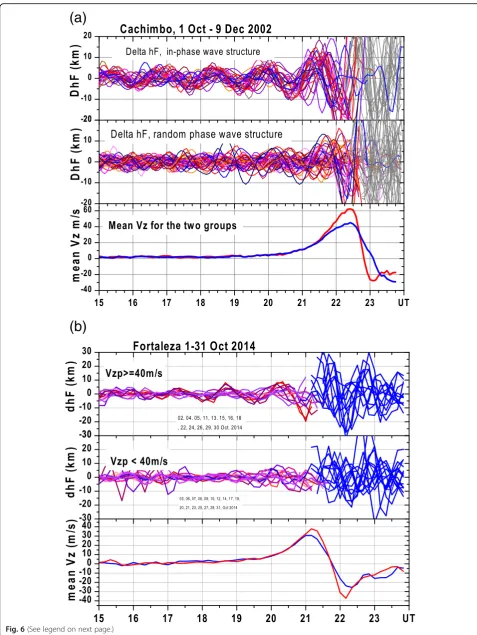
(2015b). These features are illustrated in Fig. 6, which
shows two sets of examples presented for two solar
activ-ity maximum epochs: (a) October–December 2002 (F10.7:
170) and (b) October 2014 (F10.7: 155). Figure 6a shows
in the upper two panels the F layer height oscillations in
the period range 0.5–1.5 h, as superposed plots, for two
(a)
(b)
curves (top panel). The other group (middle panel) shows
nearly random phase (non “coherent”) oscillations that
also present amplification towards sunset (to a smaller de-gree than in the top panel) and evolve into spread F on most of the days. These results clearly demonstrate the presence of precursor seed perturbations that evolve into post-sunset ESF development. The precise nature of the competing roles of these precursor oscillations vis-à-vis the amplitude of the PRE vertical drift required for any specific ESF development has not been evaluated in these groups (as was evaluated in the case studies presented in
Abdu et al. 2009a). The vertical drift on individual days
was calculated as dhF/dt using the procedure described by Abdu et al. (1983). The variations in the mean vertical drift for the two groups are plotted in the bottom panel, which show that the peak of the PRE vertical drift for the first group of days (red curve) is significantly larger (by about 18 m/s) than for the second group of days (blue
curve). In other words, the days of “coherence” in the
gravity wave-induced F layer height oscillation during the afternoon pre-sunset hours corresponds to the same set of days during which the PRE vertical drift is larger than on
the days of smaller height oscillations that are in“random
phase”(lack of coherence). Similar relationship appears to
hold also during the epoch (b) of solar maximum (plotted
in Fig. 6b). In this case, however, the data sample is
smaller (31 days only) and the PRE vertical drift velocities are also generally smaller than during the epoch (a). We
may note that the day groups with“coherence” and“non
coherence” in oscillations are apparent in this sample as
well (but to a smaller degree). The difference between the PRE vertical drift velocity peaks in the two groups of days during this epoch is about 8 m/s only. It should be pointed out here that the grouping was based on whether the PRE vertical drift peak values were < 40 m/s or > 40 m/s, but possible displacements in the vertical drift peak times on different days must have caused some reduction/smear-ing in the mean values of the drift peak calculated at fixed local times. The amplification of the oscillation amplitude towards sunset evolving into spread F
devel-opment is clearly brought out even though the“
coher-ence”characteristics of the oscillations is less conspicuous in this case (of smaller group of days) than it was during the previous solar maximum epoch. What appears to be an apparent connection between the PRE vertical drift and
the oscillation wave structure might indicate a possible interaction between the upward propagating gravity waves and the tidal modes of winds (as was suggested by Abdu
et al.2015b) since it is known that the tidal winds in the E
layer could modify the E layer conductivity longitudinal gradient that controls the PRE development (Abdu et al. 2006a).
When the PRE vertical drift is relatively weaker, its peak value may suffer modification (even becoming fur-ther suppressed) by a gravity waves of strong enough amplitude depending upon its propagation phase. As a result, the post-sunset ESF may become weaker, delayed
in development, or even suffer total suppression. Figure7
shows (in top panel) the F layer height variations at se-quential plasma frequencies, ranging from 3 MHz up to 12 MHz, (recorded by a Digisonde at Fortaleza) during a 3-day period in October 2008, an epoch of the extended solar minimum of the cycle 23. On 10 October, a very quiet day, the evening PRE vertical drift (second panel) peaked around 12 m/s (typical for this epoch), which is normally below the threshold value for ESF develop-ment, but spread F developed by 20:15 LT (as indicated in panel 3). We may point out here that the ESF devel-opment under such low PRE vertical drift could be oc-curring due to a relatively large amplitude of the gravity wave seed perturbation and/or very likely also due to an enhanced bottom side gradient (this aspect will be the subject of a separate study). Considering the evening of 12 October, which followed a moderate degree of mag-netic disturbances as indicated by the AE variations
(ac-companied by a weak storm with Dst peaking at−65 nT
at 11:30 UT on 11 October, not shown here), the PRE vertical drift was ~ 15 m/s and range spread F developed at 19:15 LT. In this case, a slight enhancement in the PRE vertical drift (compared to that of 10 October) may be noticed. The enhancement appears to be caused by a penetration electric field of eastward polarity and of rela-tively weak intensity associated with a rapid AE
intensifi-cation (see panel 4, Fig. 7) that occurred right at the
time of the PRE (18 LT) (see panel 2) also indicated by a dashed vertical line. Spread F onset in this case was at 19:45 LT, earlier in LT than on 10 October (a quiet day) when the onset was at 20:15 LT. In contrast to these two cases (of 10 and 12 October), the PRE vertical drift reached negative values on the evening of 11 October
(See figure on previous page.)
when the observed peak drift was approximately−3 m/s. But the real drift must be more negative than this if a correction is applied for recombination effect, which is not done, since we are comparing here only the relative behavior during these days. The post-sunset SF did not develop as a result, but SF did develop near midnight (around 23 LT), which may be related to the F layer height increase due likely to the AE activity that intensi-fied around this time. An important point to note about this evening is that the suppression/reversal of the PRE vertical drift did not result from the magnetic disturb-ance that was present at this time as can be verified from the fact that the phase of the Vz variation did not conform to that of AE variation. (For example, the AE activity decreased from 15 LT to 17 LT when the F layer heights and the Vz increased contrary to their expected response, which is predicted to be a decrease in their values due to the over-shielding westward electric field expected to be associated with the AE decrease at this
time.) The only clear case of an F layer height response to the AE activity on this day can be noticed near 11 LT (14 UT) when the height reached a peak value in associ-ation with the AE intensificassoci-ation that occurred at this time. The small decrease in the heights of the plasma frequency isolines around 18 LT (indicated by a dashed vertical line on 11 October) cannot be in response to the AE activity that was on a minor rising trend during this
period (17–19 LT). A careful examination of the F layer
quantitative evaluation of this effect will be the topic of separate paper).
Variability in ESF due to disturbance trans-equatorial winds
The role of trans-equatorial (or meridional) winds in ESF/ EPB development operates through the effect of these winds in modifying the field line integrated conductivity and the F layer bottom side gradient, as was shown from model study by Maruyama (1988). The ratio of the F
region—to the total—field line-integrated conductivity
should control the instability linear growth rate as
rep-resented by the Eq. 1. Further, a trans-equatorial wind
(TEW) lifts up the F layer on the upwind side of the magnetic equator while bringing it down on the down-wind side thereby producing correspondingly opposing (but unequal) effects on the bottomside density gradi-ents. The field line perpendicular (meridional) compo-nents of the TEW on either sides of the equator are also in opposite directions. The net result is that the ratio UP
FT=LFT always contributes negatively to Eq. 1 thereby
causing a decrease in the net growth rate. The conse-quence of such reduction in the growth rate has been invoked by Su et al. (2017) to explain the longitude-dependent solstice minimum in post-midnight irregu-larity occurrence observed in ROCSAT-1 data. Add-itionally, while a TEW may cause an increase in the
field line-integrated conductivity (∑P) on the upwind
side (where the layer is raised), it may cause decrease in
∑P on the downwind side where the layer is lowered.
But the latter effect is stronger than the former due to the height-dependent molecular ion composition, so that a net increase can occur in the total (field line
inte-grated) value of ∑P (Maruyama 1988). As a result, the
nonlinear growth of the bubble to topside ionosphere can be retarded or even suppressed. Observational re-sults corroborating the effect of TEW in suppressing the ESF/EPB growth during quiet time have been pre-sented by, e.g., Abdu et al. (2006b), Maruyama et al. (2009), and Su et al. (2017). While the TEW can be more intense during the solstice seasons under quiet conditions, it can become intensified any time of the year during magnetic storm disturbances occurring under conditions of hemispheric asymmetry in auroral heating. We present below an interesting case of ESF suppression due to storm time TEW as inferred from conjugate point observations of hmF2 by Digisondes in Brazil.
Figure8shows in the upper panel the variations in the
F layer vertical drift velocity (Vz) at three plasma fre-quencies (6 MHz, 7 MHz, and 8 MHz) during the severe
magnetic storm event of 17–18 March 2017 together
with its variation on 16 March as a quiet time reference
curve (shown in the second panel). The vertical drift was calculated as dhF/dt from Digisonde ionograms. The spread F occurrence during the period is also shown
(plotted using the intensity parameter“fop”). The
varia-tions in the AE and Dst indices are shown in the bottom two panels. Following the storm onset at 06 UT (as per the AE index) on 17 March, a series of AE intensifica-tions occurred when it was mostly daytime over Forta-leza. This was accompanied by the Dst decrease that suggested a major category storm development. A few episodes of vertical drift enhancements (and reversals) due to the storm-associated prompt penetration electric field of eastward (and westward) polarity occurred dur-ing this period. Two of the major episodes in Vz peaked at ~ 13 UT and ~ 18 UT. Further, we may note in these cases that the drift enhancements varied with the plasma frequency, being larger for higher plasma frequency, that is, higher reflection height. This feature appears to be due to the height-dependent photo-chemistry (the ion production and recombination rates decreasing to higher altitudes) dominating the daytime ionosphere, whereby the vertical gradient in electron density becomes shal-lower as the layer rises under the penetration electric field. The next Vz enhancement occurred near 21:00 UT (18:00 LT) that coincided with the PRE vertical drift
(in-dicated by the vertical line“1”). The quiet time PRE
ver-tical drift (that of 16 March in panel 2) had a peak value of ~ 18 m/s, and spread F occurred on the evening of 16 March and continued till the morning hours of 17 March (as can be noted in panel 3). A PPEF of eastward polarity associated with an AE intensification occurred around 21:00 UT (of 17 March) that caused a large in-crease in the PRE vertical drift, which peaked at 40 m/s (twice higher than that of the quiet day), but unexpect-edly, spread F did not develop on this evening. Further, all the three plasma frequencies presented the same ver-tical drift at this time, thereby indicating that the F layer bottom side density gradient remained unaltered during the layer rise. This is an important feature to be noted
because it shows that the density gradient (1/LFT) did
not contribute to any alteration in the R-T instability
growth rate (as per in Eq.1) that could occur during the
layer rise. The large increase in Vz resulted in a large in-crease in the F layer height (not shown here) whereby
the reducedνincould result in an enhanced contribution
to the linear growth rate arising from the gravity term
(g/νin) in Eq.1. Thus, we note from Eq. 1 that increases
in both the vertical drift (E/B) term and the gravity term,
under the condition of an unchanging LFT, should have
contributed to increase the linear growth rate. However, spread F did not occur on this evening, which might suggest that other factors must be responsible for sup-pressing the development of the ESF. A possible
the ratio of F region—to total—field line-integrated
con-ductivity of the Eq.1is unlikely because there was no
indi-cation of any enhancement in the E region conductivity as may occur under disturbed conditions due to storm-associated enhancement in energetic particle precipitation, which can be assessed from Es layer data. No Es layer was present. Therefore, it looks possible to conclude that the only factor that could have caused a decrease in the growth rate on this evening must be that arising from the
term in trans-equatorial/meridional wind in Eq.1.
We examined the possible role of a TEW during this event by analyzing the hmF2 variations measured by the Digisondes operated at the conjugate sites, Campo
Grande (Lat. −20:26:34; Long. 54:38:47, dip −22° 19′)
and Boa Vista (Lat. 02:49:11; Long. 60:40:24, dip 22°),
(see also Abdu et al.2009c). We have used the variation
in the parameter, dhmF2(CG−BV), obtained by
subtract-ing the hmF2 over Boa Vista (BV) from that of Campo Grande (CG), to represent the variation in the TEW. It was shown by Abdu et al. (2009c), that a change of 1 km in this parameter corresponded to a change in TEW of ~ 1.5 m/s in the evening hours of our interest
here. Panel 4 in Fig.8shows the variation in dhmF2(CG
−BV) during 17 and 18 March 2015 (see also, Batista
et al. 2017). Positive values in dhmF2 correspond to a
TEW directed northward across the equator. We may note that on 17 March the dhmF2 that was mildly posi-tive (for most of the time) turned negaposi-tive starting at 18:00 UT (~ 14:30 LT) and remained so for the next few hours. This indicated that the TEW that was mostly northward turned southward to attain a value of around
90 m/s (corresponding to the dhmF2(CG−BV): −60 km)
Fig. 8Variations during 17–18 March 2015 (intense storm) plotted in panels from top to bottom in: (1) F region vertical drift over Fortaleza obtained as dhF/dt at plasma frequencies 6 MHz, 7 MHz, and 8 MHz (top panel); (2) the vertical drift obtained as mean of the drift at the same three plasma frequencies on 16 March, a quiet day, as reference (panel 2); (3) spread F intensity represented by the fop parameter (the top frequency of the range spreading F trace (panel 3); (4) the difference between the hmF2 values at the conjugate Digisonde stations, Campo Grande, and Boa Vista, denoted as hmF2(CG)–hmF2(BV), or dhmF2(CG−BV), marked only as dhmF2 on they-axis as dhmF2 (panel 4); the auroral
at 21:00 UT (~ 17:30 UT). We believe that this south-ward increase in the TEW could be responsible for de-creasing the instability growth rate that caused the suppression of the ESF development, which otherwise was strongly favored by a PRE vertical drift that was enhanced by the disturbance eastward electric field. Numerical simulation of plasma bubble development was realized by Maruyama et al. (2009) in which trans-equatorial wind inferred from conjugate point iono-sonde observations in Asian longitude (around 100° E) was incorporated. It was found that the growth time of the bubble increased by a factor two (meaning a slower growth) when the TEW velocity increased from 10 to 40 m/s. The result of Maruyama et al. (2009) corre-sponded to the conditions of quiet time equinoctial asymmetry in irregularity development. But it appears to be relevant to the present case of irregularity sup-pression under disturbed conditions as well, since the central question concerns the role of a TEW in effect-ing such suppression. In the present case, however, the TEW appears to require a relatively larger intensity due to the fact that the evening PRE vertical drift (accom-panied by an additional vertical drift due to the PPEF) was larger (being twice that of its quiet time value) when the irregularity development was suppressed. Here, we have evoked the role of a TEW based on
consider-ations of the terms in Eq. 1 that apply to linear growth
phase of the R-T process. The role of a TEW to slow down the nonlinear growth towards suppressing the bubble ver-tical growth is not clear from this analysis, because there was no evolution to topside bubble to be monitored start-ing from an SF onset at the bottom side which did not occur to begin with.
Discussion
We have presented results above illustrating the differ-ent paths through which the short-term and day-to-day variabilities may occur in the development of the EPB/ ESF irregularities. The range of time scales defining such variabilities was discussed in the introduction section. It is possible to consider the sources driving these variabil-ities as belonging to two broad categories (types): cat-egory 1: upward propagating atmospheric wave activity associated with tropospheric and/or stratospheric wea-ther disturbances and category 2: magnetic activity that is typically associated with space weather disturbances. In both of the cases, different degrees of modifications are imposed on the specific parameters that are directly re-sponsible for the instability growth leading to EPB/ESF development, as summarized below: (a) The PRE vertical drift (which perhaps is the most widely discussed param-eter in the literature) that may suffer modification through (i) the penetrating magnetospheric electric field and the disturbance dynamo electric field as was described in
Section2.1 (category 2), (ii) the changes in E layer
con-ductivity longitudinal gradient at sunset due to changes in tidal winds originating from PW/UFK wave modulation of the tides as discussed in Section2.2, (category 1), and (iii) gravity wave modulation of the PRE vertical drift (when it is weak) as was described in the last paragraph of
Section 3 (category 1); (b) the instability seed in the
form of wave structure in density and polarization elec-tric field, which is shaped by upward propagating gravity waves believed to be originating mostly from tropospheric convective activity associated with the ITCZ, as described
in Section 3(category 1); and (c) the total field line
inte-grated conductivity of the E and F region as well as the ra-tio of the F region conductivity to the total field line integrated conductivity that can be modified by the TEW/ meridional wind, during storm time (category 2) as well as under“quiet”conditions.
Regarding the item (a) above, we have shown that en-hanced development, or suppression, of post-sunset EPB can arise from vertical drift velocity modifications that may occur under magnetic disturbances (in the form of sub-storm or storm) occurring right at the evening local time of the PRE development. When disturbances occur in the form of AE intensification under Bz south condi-tions, often accompanied by a Dst decrease indicating a storm development phase, the PRE vertical drift may be-come enhanced leading to EPB generation. The disturb-ance intensity may vary from that of a weak substorm to one of an intense storm, or may even be representative of an unidentifiable storm condition. It was shown that the PRE vertical drift as well as the associated plasma bubble rise velocity could increase with increase in the intensity of the under-shielding eastward PPEF. How-ever, as was pointed out based on previous studies, an increase in the bubble rise velocity in a way proportional to the intensity of the PPEF will not be operative for ab-normally large vertical drifts such as that may occur dur-ing some super storms. It was also discussed that while a DDEF of westward polarity in the evening hours may suppress the PRE vertical drift and, thereby, also the post-sunset bubble growth, such effects may also be pro-duced by an over-shielding electric field of westward po-larity associated with a substorm/storm recovery phase occurring just prior to sunset. Results of a statistical study based on a few cases of AE recovery phase occur-ring just prior to sunset hours clearly showed that the over-shielding westward electric field associated with such recovery phases could result in significant suppres-sion of the PRE vertical drift, which may lead to a drastic decrease in EPB development, a detailed evaluation of which needs to be realized in future investigations.
Previous studies (see, e.g., Abdu2012) have pointed out
by AE activity as low as ~ 100 nT and higher, and the probability of occurrence of such disturbances in the sun-set sector over Brazil could vary on an average from 20% during solar minimum to 60% during solar maximum. For this reason, the short-term variability arising from space weather-related disturbance electric fields should be con-sidered to be an important component of the overall vari-ability in the ESF/EPB occurrence.
Another important component of the PRE/ESF vari-ability may operate through the E region. In this case, the longitudinal gradient in the E layer conductivity across the sunset terminator is modified by E layer
winds (as explained in Section1.1) that may be modified
by nonlinear interaction between the planetary/UFK waves and tides. The E layer conductivity longitudinal gradient so modified has been shown to be a critical par-ameter in controlling the amplitude and phase of the
PRE vertical drift (Abdu and Brum 2009). The results
presented in Section2.2(supported by results from
pre-vious studies) have shown that the PRE vertical drift, and hence the ESF/EPB development, can be signifi-cantly modified through such E layer processes. Another path of a potential E layer role is through the association observed between the PRE vertical drift and the wave structure represented by the F layer height oscillations
(as in Fig.6). These oscillations present a certain degree
of phase coherence on a day-to-day basis, and getting amplified towards sunset as was consistently observed in
different solar activity epochs (as discussed in Section3).
The possibility of interaction between upward propagat-ing tides and gravity waves may be thought of as a pos-sible link in the connection observed between the F layer wave structures and the PRE vertical drift, which possibly has important consequences for the ESF/EPB variability. On these bases, the variability in the evening sector E layer, arising from nonlinear interaction involv-ing tidal wind modes on one side and the planetary/UFK waves and gravity waves on the other side, should be considered to be an important source of ESF/EPB short-term variability, and merits added attention for fu-ture research.
As regards the item (b) above concerning the ESF/EPB variability arising from the seed perturbations, important progress has been made as discussed (though in a
lim-ited way) in Section 3. There is increasing evidence on
statistical as well as case study bases that the role of up-ward propagating gravity waves from sources in tropo-sphere is an important factor in the ESF/EPB variability. In case studies for evaluating the gravity wave effect on EPB generation, an important consideration should be the phasing of the gravity wave oscillations relative to the peak in the PRE vertical drift that is used to deter-mine the maximum linear growth rate in a given situ-ation for the R-T instability to evolve. This question is a
parallel one to the two-dimensional narrative in which EPB may develop from the crest region of the upwelling
due to LSWS, as pointed out in Section1.1. The phasing
of the gravity wave/LSWS with respect to the peak of PRE vertical drift appears to gain importance for EPB generation especially when the PRE vertical drift is rela-tively small. This situation is illustrated in the results
presented in Section 3 (and mentioned in item a-iii)
showing an example of ESF suppression due to the posi-tioning in anti-phase of the PRE vertical drift peak and gravity wave oscillations that occurred on 11 October
(Fig. 7). Such a situation of ESF suppression was the
re-sult of a weak PRE vertical drift whose modulation by a
relatively“stronger”gravity wave amplitude was possible.
On this basis, we may expect the contribution from gravity wave dynamics to the overall ESF short-term variability to depend also upon the degree of the vari-ability in the PRE vertical drift that is known to depend also upon season, longitude, and solar activity. The ITCZ/OLR parameters (that is, the Outgoing Long Wave Radiation from Inter-Tropical Convergence Zone) have been used to represent the tropospheric convective ac-tivity as a source of gravity wave seed perturbation. It has been noted that the degree of statistical correlation between the ITCZ/OLR parameters and the irregularity distribution on global or regional scale is not always uni-formly conclusive for all longitudes/seasons (see, for
ex-ample, Tsunoda2010, Su et al.2014). It appears possible
that simultaneous considerations on the associated verti-cal drift information (wherever available) could help understand better the observed degrees of correlations in such statistical comparisons.
The nature of the ESF short-term variability due to the TEW/meridional winds (item c) appears to have been poorly investigated. Under quiet conditions, a few stud-ies have established their role in suppressing the ESF as
mentioned in Section 4. We presented what appears to
be a clear case of ESF suppression by TEW during a
magnetic storm event (Fig. 8). In this respect, we need