Abstract
The search for influencing factors and new pathways in aseptic loosening of arthroplasties is a major focus of recent studies. Analyses of polymorphisms of genes revealed a correlation between a specific allele variant and aseptic loosening. TheBCL2 gene encod-ing Bcl-2 with its BCL2 -938C>A polymorphism is a crucial factor of cell cycle control and cell survival. The CALCA -1786T>C polymorphism belongs to the CALCA gene encoding alpha-Calcitonin Gene Related Peptide (CGRP) and Calcitonin. Both proteins are important in bone metabolism and capable to in-fluence the process of aseptic loosening. To date, no studies are reported for aseptic loosening with these two single nucleotide polymorphisms (SNPs). In a ret-rospective study we determined the distribution of the
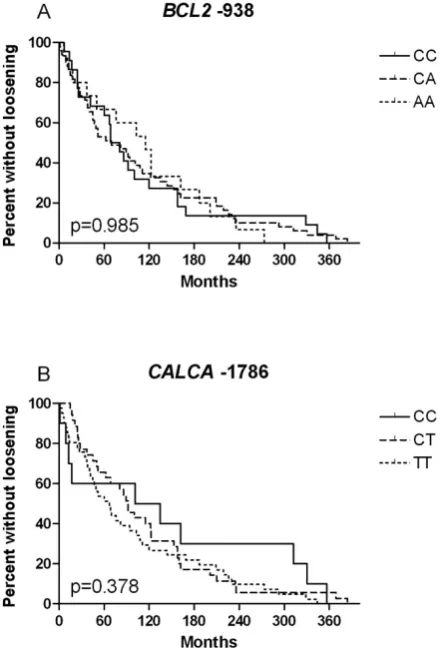
BCL2-938C>A and theCALCA-1786T>C polymor-phisms in 87 subjects with aseptic loosened hip arthroplasties using RFLP and pyrosequencing analy-sis. Genotype distribution with prognosis of the hip arthroplasty showed neither an association with clini-cal characteristics of the patients nor the implantation technique. We were unable to detect any influence of these polymorphisms on time to aseptic loosening.
I
NTRODUCTIONAseptic loosening of total joint replacement is one of the major reasons for long term failure of arthroplasty (Silva and Sandell 2002). Various studies have been performed to understand the mechanisms of aseptic loosening. The local osteolysis surrounding the pros-thesis is initiated by an aseptic inflammatory response after incorporation of wear particles by macrophages. Via cytokines macrophages stimulate the proliferation and differentiation of precursor osteoclasts into ma-ture osteoclasts and fibroblasts producing a benign lo-cal granulomatous tissue. This process results in im-plant instability requiring expensive revision surgery. We have recently published two articles about the in-fluence of apoptosis (Landgraeber, Toetsch et al. 2006; Landgraeber, von Knoch et al. 2008) and neu-ropeptides (i.e. alpha - Calcitonin-Gene Related Pep-tide (CGRP) (Wedemeyer, Neuerburg et al. 2007) in aseptic loosening.
Firstly, apoptosis is an important process to regulate homeostasis in tissue. The proliferation and apoptosis in normal tissue is controlled by a variety of proteins of the Bcl-2 family (Chao and Korsmeyer 1998)
con-sisting of different regulators which can block or accel-erate the apoptosis (Kroemer 1997). The founding member of this family, Bcl-2 itself, is an inhibitor of apoptotic cell death and can act in both antiapoptotic and antiproliferative manners (Cory and Adams 2002). Recently we showed a slight reaction using Bcl-2 anti-bodies in immunochemistry with macrophages and gi-ant cells in granulomatous tissue in loosened arthro-plasties and concluded that it is most likely that wear debris induced apoptotic reactions (Landgraeber, Toetsch et al. 2006). The BCL2 gene is located on chromosome 18q21.3 (Seto, Jaeger et al. 1988; Young and Korsmeyer 1993). It consists of three exons and two promoters. These two promoters have distinct functions. Activation of the promoter P2 decreases the activity of the other promoter P1, therefore acting as a negative regulatory element (Bredow, Juri et al. 2007). Park et al. have identified a common single nucleotide polymorphism (SNP, –938C>A (rs 2279115)) in the in-hibitory P2 promoter of theBCL2gene (Park, Kim et al. 2004). Nückel et al. showed that this polymorphism has functional properties and alters the promoter activ-ity of P2 and inversely the activactiv-ity of P1 (Nuckel, Frey et al. 2007). Furthermore this SNP has been repeatedly associated with different diseases (Bachmann, Otter-bach et al. 2007; Chen, Hu et al. 2007).
Secondly, a possible influence of the nervous sys-tem on particle induced osteolysis was shown by Ahmed et al.. They found alpha-CGRP-immunoreac-tive nerve fibres at the interface membrane of arthro-plasty. Alpha-CGRP is a neurotransmitter produced by the central and peripheral nervous system and can be found in all tissues surrounding joints and close to the epiphyseal plate, indicating that alpha-CGRP has a function in bone remodelling (Irie, Hara-Irie et al. 2002). Our study group recently demonstrated the im-pact on particle induced osteolysis in alpha-CGRP knock-out mice (Wedemeyer, Neuerburg et al. 2007). Therefore we focused on theCALCAgene (11p15.2-p15.1), encoding both alpha-CGRP and Calcitonin. Calcitonin is nearly exclusively produced by thyroid cells (Jacobs, Goodman et al. 1981; Amara, Jonas et al. 1982; Rosenfeld, Mermod et al. 1983). This polypep-tide consisting of 32 amino acids plays a role in calci-um haemostasis by the inhibition of osteoclasts. How-ever, its physiological function is not clarified in all de-tails (Huebner, Schinke et al. 2006). The CALCA
gene consists of one promoter and six exons. CAL-CA polymorphisms have been examined in many
dif-Eur J Med Res (2009) 14: 250-255 © I. Holzapfel Publishers 2009
BCL2
-938C>A
AND
CALCA
-1786T>C P
OLYMORPHISMS IN
A
SEPTIC
L
OOSENED
T
OTAL
H
IP
A
RTHROPLASTY
C. Wedemeyer1, M. D. Kauther1, S. Hanenkamp1, 2, H. Nückel3, M. Bau2, W. Siffert2, H. S. Bachmann2 1Department of Orthopaedic Surgery, Medical Faculty,2Institute of Pharmacogenetics, Medical Faculty,3Department of Haematology,
ferent diseases (Shipman, Schraml et al. 1993; Buer-venich, Xiang et al. 2001; Hink, Hokanson et al. 2003; Goodman, Ferrell et al. 2005; Morita, Nakayama et al. 2007). Two common polymorphisms – CALCA -1786T>C (rs3781719) and –1752C>G (rs1553005) – in complete linkage are located in the promoter re-gion. Goodman et al. showed a strong association of theseCALCApolymorphism with the risk of ovarian cancer among some subgroups (Goodman, Ferrell et al. 2005).
The aim of this study was to investigate the possi-ble influence of the functionalBCL2(-938 C>A) and
CALCA(-1786T>C) polymorphisms on aseptic loos-ening of total hip replacement.
M
ATERIALS ANDM
ETHODSPATIENTS
Our collective consisted of 87 Caucasian patients of German ancestry operated for aseptic loosening of prosthetic hip joints at the Department of Or-thopaedic Surgery (Medical Faculty, University of Duisburg-Essen, Germany). For all patients strict in-clusion and exin-clusion criteria were applied. Entry cri-teria for this study were the clinical, radiological and intra-surgical diagnosis of aseptic loosening after total hip arthroplasty due to primary osteoarthritis. Exclu-sion criteria were any deep infection or the suspicion of implant infection, traumatic loosening, inflammato-ry diseases or intake of immunosuppressant agents af-ter total hip arthroplasty in the patient’s history. In 36 of 87 cases we performed a revision of the stem and the cup, in 24 of 87 cases only the stem and in 27 cas-es of 87 only the cup. The prcas-esent study was per-formed according to the Declaration of Helsinki and approved by the local Ethics Committee of the Uni-versity Hospital of Essen.
DETERMINATION OFBCL2ANDCALCA
GENOTYPES
DNA was extracted from routinely excised granuloma-tous scared tissue surrounding the prosthesis. Isolation of genomic DNA was performed using a commercial-ly available kit (QIAamp, Qiagen, Hilden, Germany) following the manufacturer’s instructions. Genotypes of BCL2 -938C>A were determined by Slowdown PCR and pyrosequencing as previously described (Goodman, Ferrell et al. 2005; Nuckel, Frey et al. 2007). CALCA -1786T>C genotypes were deter-mined by PCR using the following primers: forward primer 5’-CGCTGGGCTGTTTCTCACAATAT-3’; reverse primer, 5’-GTTAGACAGGAGTTCAATTAC AGTTGGC -3’. After an initial denaturation at 94 °C, 38 cycles of DNA amplification were done using Taq PCR Mastermix (Eppendorf, Hamburg, Germany) at 94 °C for 45 seconds, 62 °C for 40 seconds, and 72 °C for 45 seconds. The 144 bp PCR products were digest-ed using the restriction enzyme BsmAI (NEB, Ip-swich, MA) and analyzed on a 2.5% agarose gel. Unre-stricted products (144 bp) represent the TT genotype, completely restricted products (115 + 29 bp) represent the CC genotype.
STATISTICALANALYSIS
Kaplan-Meier plots and the log-rank test were used to retrospectively evaluate the time to loosening, depen-dent on BCL2 and CALCA genotypes, respectively. Kruskal-Wallis test was used for comparison of non-parametric variables where appropriate. Contin-gency tables and Pearson’s χ2-test were used to
compare categorical variables using BCL2 and
CALCA genotypes as indicated. ANOVA was used for comparison of continuous variables. The impact of age, BMI, and BCL2 and CALCA genotypes as prognostic factors for time to aseptic loosening were analysed by univariate Cox regression models. Hazard ratios (HR) and 95% confidence intervals (95% CI) were calculated from these Cox regression models. Control for deviation from the Hardy-Weinberg equilibrium was conducted with the public domain program Hardy-Weinberg equilibrium by J. Ott (http://www.genemapping.cn/util.htm). Differences were regarded significant at p < 0.05. Statistical analy-sis was performed using SPSS 15.0 (SPSS, Chicago, IL, USA) and GraphPad Prism 4.0 (GraphPad Software, San Diego, CA, USA).
R
ESULTSIn our cohort genotype distributions of BCL2 -938C>A (CC:22 CA:49 AA:16) as well as CALCA -1786T>C (TT:42 TC:35 CC:10) were not significantly different from Hardy–Weinberg equilibrium. Clinico-pathological characteristics are shown in Tables 1 and 2. Age at the first implantation, age at the revision, gender, body weight, body height, Body Mass Index, Paprosky`s score (Paprosky, Bradford et al. 1994) (a classification system in grades, based on preoperative x-rays of the bone loss surrounding a loosened im-plant), first cup with or without cement and first stem with or without cement were not associated with
BCL2andCALCAgenotypes, respectively.
Table 1.Clinical characteristics and genotype distribution in patients with aseptic loosening. BCL-2 genotype
All p-value
CC CA AA
n (%) 87 22 (25.28) 49 (56.32) 16 (18.4)
Age at implantation (y) 60.18 ± 13.14 58.14 ± 14.06 60.94 ± 13.72 60.69 ± 10.08 0.703 Age at replantation (y) 69.31 ± 10.27 67.41 ± 12.77 70.04 ± 9.81 69.69 ± 7.79 0.605 Gender
Female (%) 60 (68.97) 12 (20.0) 35 (58.33) 13 (21.66) 0.182 Male (%) 27 (31.03) 10 (37.04) 14 (51.86) 3 (0.11)
Weight (kg) 75.11 ± 17.11 75.88 ± 19.59 76.1 ± 16.65 71.13 ± 15.18 0.592 Height (cm) 166.80 ± 8.35 168.09 ± 6.91 166.77 ± 9.13 165.13 ± 7.95 0.563 BMI (kg/m_) 26.86 ± 5.07 26.74 ± 6.04 27.25 ± 4.92 25.9 ± 4.15 0.655 First cup with cement (n = 83)
no 34 (40.96) 6 (17.65) 19 (55.88) 9 (26.47) 0.280
yes 49 (59.04) 14 (28.57) 28 (57.14) 7 (14.29)
First stem with cement (n = 80)
no 30 (37.5) 4 (13.33) 19 (63.33) 7 (23.33) 0.147
yes 50 (62.5) 16 (32.0) 27 (54.0) 7 (14.0)
Acetabular defects (Paprosky) n = 60
I 6 (10) 3 (50.0) 2 (33.33) 1 (16.66) 0.479
II 23 (38.83) 5 (21.74) 12 (52.17) 3 (13.04)
III 31 (51.66) 7 (22.58) 17 (54.84) 7 (22.58)
Femoral defects (Paprosky) n = 52
1 4 (7.69) 4 (100) 0 0 0.377
2 23 (44.23) 5 (21.74) 14 (60.87) 4 (17.39)
3 25 (48.08) 8 (32.0) 12 (48.0) 5 (20.0)
Data are numbers with percentages given in brackets and numbers with standard deviation, respectively. Categorical variables were analyzed byχ2statistics. P values were calculated using ANOVA for continuous variables.
Table 2.Clinical characteristics and genotype distribution in patients with aseptic loosening. CALCAgenotype
All p-value
CC CT TT
n (%) 87 10 (11.49) 35 (40.22) 42 (48.3)
Age at implantation (y) 60.18 ± 13.14 54.3 ± 23.17 59.46 ± 10.47 62.19 ± 11.85 0.215 Age at replantation (y) 69.31 ± 10.27 66.3 ± 13.27 69.0 ± 9.74 70.29 ± 10.02 0.535 Gender
Female (%) 60 (68.97) 8 (13.33) 27 (45.0) 25 (41.66) 0.182 Male (%) 27 (31.03) 2 (7.41) 8 (29.63) 17 (62.96)
Weight (kg) 75.11 ± 17.11 72.36 ± 15.92 72.91 ± 16.83 77.45 ± 17.61 0.781 Height (cm) 166.80 ± 8.35 164.5 ± 8.17 166.00 ± 8.31 167.9 ± 8.45 0.828 BMI (kg/m_) 26.86 ± 5.07 26.69 ± 5.04 26.29 ± 4.86 27.37 ± 5.30 0.437 First cup with cement (n = 83)
no 34 (40.96) 2 (5.88) 17 (50.0) 15 (44.12) 0.171
yes 49 (59.04) 8 (16.33) 16 (32.65) 25 (51.02)
First stem with cement (n = 80)
no 30 (37.5) 2 (6.66) 13 (43.33) 15 (50.0) 0.510
yes 50 (62.5) 7 (14.0) 17 (34.0) 26 (52.0)
Acetabular defects (Paprosky) n = 60
I 6 (10) 1 (16.66) 2 (33.33) 3 (50.0) 0.880
II 23 (38.83) 2 (8.7) 13 (56.52) 8 (34.78)
III 31 (51.66) 5 (16.13) 11 (35.48) 15 (48.39)
Femoral defects (Paprosky) n = 52
1 4 (7.69) 0 2 (50.0) 2 (50.0) 0.723
2 23 (44.23) 4 (17.39) 9 (39.13) 10 (43.48)
3 25 (48.08) 2 (8.0) 10 (40.0) 13 (52.0)
for genotype dependent early aseptic loosening (≤ 10 years) and gender differences showed no significant association with genotypes (Data not shown).
D
ISCUSSIONDespite multiple studies to understand and treat aseptic loosening, it is still one of the major problems of arthroplasty. The number of potential replace-ments is limited due to continued loss of bone sub-stance. In contrast to septic loosening or material fail-ure no specific measfail-ures are available to reduce the in-cidence of aseptic implant loosening until now. Several studies aimed to determine risk factors to detect pa-tients at higher risk who may benefit from prophylac-tic regimens before implantation, e.g. weight reduc-tion, or pharmacological prophylaxis after implanta-tion. More precise prediction of the individual risk would facilitate to make clinical decision. Unfortunate-ly, clinical parameters for aseptic loosening have yield-ed partly inconclusive results, e.g. age (Berry, Harmsen et al. 2002; Flugsrud, Nordsletten et al. 2007). It is commonly believed that genetic host factors can influ-ence the incidinflu-ence and course of aseptic loosening. Recent in-vivo studies of our research group showed the genetic influence on aseptic loosening in knock out mice (Wedemeyer, Neuerburg et al. 2007). There-fore, the aim of the present study was to investigate whether a genetic host factor can be found in humans.
The common BCL2 -938 and CALCA -1786 poly-morphisms in the genesBCL2 andCALCA may in-fluence time to aseptic loosening in patients with hip joint replacement and could be used as prediction for time of loosening. Firstly,BCL2was found in the key cells of particle induced osteolysis (macrophages, lym-phocytes) in loosened arthroplasties (Landgraeber, Toetsch et al. 2006) and may have an impact in bone metabolism.
Secondly, theCALCAgene is of great importance for the bone metabolism obviously seen in the phaenotype of increased bone formation rate in
CALCA knock out mice. Furthermore we could show higher rates of particle induced osteolysis in al-pha-CGRP knock out mice.
All in all, we could not find any significant correla-tion between time and median time to aseptic loosen-ing and BCL2 -938 as well as CALCA -1786 geno-types. We were not able to compare the genotype dis-tributions of BCL2 -938 and CALCA -1786 with a population of patients with total hip replacement not suffering from aseptic loosening. Therefore we explo-ratively compared the genotype distributions with a collective of healthy controls witch were comparable with our cohort in age and gender distribution (Nuck-el, Frey et al. 2007). Interestingly, BCL2 -938 geno-types showed a significantly different distribution (CC: 21, CA 63, AA 36, p = 0.0416). The BCL2 -938CC genotype was at highest risk for aseptic loosening, Odds Ratio (OR) CC vs. AA 2.357, 95%CI 1.02-5.46, p = 0.0434 with heterozygous at intermediate risk with OR 1.750, 95%CI 0.87-3.52, p = 0.1138 for CA vs. AA. Although it is too early for conclusions about this association, the detected association would be in line with functional data of this SNP. The A-allele of this polymorphism is associated with increased Bcl-2 ex-pression (Nuckel, Frey et al. 2007) causing less apop-tosis around the implant which would explain the sig-nificance for less aseptic loosing in patient homozy-gous and heterozyhomozy-gous for the A-allele of theBCL2 -938 SNP. Therefore, this result suggests the BCL2 -938 SNP as an interesting candidate for further stud-ies.
Unfortunately, statistic analysis did not show signifi-cances for theCALCASNP in contrast to our previ-ous mammalian study with alpha CGRP knockout mice (Buervenich, Xiang, et al. 2001). On the one hand, this might be mainly due to the control collective and the small number of patients in our study. A larger more homogenous collective might show significant changes and can detect effect from very low pene-trance genes. Moreover, conclusions drawn from this study may not be generalised to all patients undergo-ing hip replacement - because genetic polymorphisms often vary between ethnic groups of patients. On the other hand, it has to be emphasized that theCALCA
SNP has shown some significant associations in other studies, but - in contrast to theBCL2 SNP - its func-tional properties have not been evaluated until now. Caused by our retrospective collective we could not in-fluence slight differences in physical parameters such as implant design, quality of implantation and stress. Aseptic loosening is a multifactorial process caused by foreign body reaction, allergic reaction, particles, cell
to cell interaction, hydrostatical pressure, micro move-ment, body weight, failure of implantation and im-plant (Silva and Sandell 2002; Drees, Eckardt et al. 2007). As different types of arthroplasty show a dif-ferent extent of osteolysis a genetic analysis should be prospectively undertaken with the same implant type. Asymptomatic patients with the same implant and im-plantation technique would be a better collective for comparison. Furthermore it can not be ruled out the possibility that other, not yet identified, alterations in genes involved in cell cycle, apoptosis, receptor ex-pression, DNA replication and gene expression may increase the risk of aseptic loosening after total hip re-placement.
Therefore prospective, independent studies with strict inclusion criteria have to be undertaken in the future to rule out all factors uncorrelated to genetics. Furthermore, the inclusion criteria for a prospective study should aim at the bone quality. Although, pa-tients with septic and traumatic loosening, rheuma-tism, intake of immunosuppressants were excluded in our study we did not measure the exact bone quality at implantation and revision, e.g. osteomalacia, osteo-porosis, sclerosis and osteopetrosis.
The genetic influence on humans in this multifacto-rial process could be shown in this analysis.
Until now the outstanding number-one-reason for particle induced osteolysis has not been found and will possibly not be found in the genes either. Definitely, further polymorphisms have to be analysed as a genet-ic impact on aseptgenet-ic loosening was obviously and sig-nificantly shown in alpha-CGRP knock out mice in our calvarian model. It bears the chance to analyse a genetic impact on particle induced osteolysis.
All in all, this study combined with our results in the mammalian model support the concept of a role of BCL2 -938 genotypes in aseptic loosening. Further independent and prospective replication studies are necessary to confirm the general validity of our find-ings, and deduced hypotheses and aim at theCALCA
-1786 polymorphism for a second time. Additionally, other genes and genetic polymorphisms could play a major role in the interaction of biomaterials and the environment. Research in this field could lead to better understanding of pathomechanisms and secondary improve the results of arthroplasty.
Conflicts of interest:The authors state that they have not any conflicts of interest.
Acknowledgements: The study was supported by the German Research Foundation (DFG), Bonn, Germany (WE 3634/ 1-1).
R
EFERENCESAmara, S. G., V. Jonas, et al. (1982). "Alternative RNA pro-cessing in calcitonin gene expression generates mRNAs encoding different polypeptide products." Nature 298(5871): 240-4.
Bachmann, H. S., F. Otterbach, et al. (2007). "The AA geno-type of the regulatory BCL2 promoter polymorphism ( 938C>A) is associated with a favorable outcome in lymph node negative invasive breast cancer patients." Clin Can-cer Res 13(19): 5790-7.
Berry, D. J., W. S. Harmsen, et al. (2002). "Twenty-five-year survivorship of two thousand consecutive primary
Charn-ley total hip replacements: factors affecting survivorship of acetabular and femoral components." J Bone Joint Surg Am 84-A(2): 171-7.
Bredow, S., D. E. Juri, et al. (2007). "Identification of a novel Bcl-2 promoter region that counteracts in a p53-depen-dent manner the inhibitory P2 region." Gene 404(1-2): 110-6.
Buervenich, S., F. Xiang, et al. (2001). "Identification of four novel polymorphisms in the calcitonin/alpha-CGRP (CALCA) gene and an investigation of their possible as-sociations with Parkinson disease, schizophrenia, and manic depression." Hum Mutat 17(5): 435-6.
Chao, D. T. and S. J. Korsmeyer (1998). "BCL-2 family: regu-lators of cell death." Annu Rev Immunol 16: 395-419. Chen, K., Z. Hu, et al. (2007). "Single-nucleotide
polymor-phisms at the TP53-binding or responsive promoter re-gions of BAX andBCL2genes and risk of squamous cell carcinoma of the head and neck." Carcinogenesis 28(9): 2008-12.
Cory, S. and J. M. Adams (2002). "TheBcl2family: regulators of the cellular life-or-death switch." Nat Rev Cancer 2(9): 647-56.
Drees, P., A. Eckardt, et al. (2007). "Mechanisms of disease: Molecular insights into aseptic loosening of orthopedic implants." Nat Clin Pract Rheumatol 3(3): 165-71. Flugsrud, G. B., L. Nordsletten, et al. (2007). "The effect of
middle-age body weight and physical activity on the risk of early revision hip arthroplasty: a cohort study of 1,535 individuals." Acta Orthop 78(1): 99-107.
Goodman, M. T., R. Ferrell, et al. (2005). "Calcitonin gene polymorphism CALCA-624 (T/C) and ovarian cancer." Environ Mol Mutagen 46(1): 53-8.
Hink, R. L., J. E. Hokanson, et al. (2003). "Investigation of DUSP8 and CALCA in alcohol dependence." Addict Biol 8(3): 305-12.
Huebner, A. K., T. Schinke, et al. (2006). "Calcitonin defi-ciency in mice progressively results in high bone turnover." J Bone Miner Res 21(12): 1924-34.
Irie, K., F. Hara-Irie, et al. (2002). "Calcitonin gene-related peptide (CGRP)-containing nerve fibers in bone tissue and their involvement in bone remodeling." Microsc Res Tech 58(2): 85-90.
Jacobs, J. W., R. H. Goodman, et al. (1981). "Calcitonin mes-senger RNA encodes multiple polypeptides in a single precursor." Science 213(4506): 457-9.
Kroemer, G. (1997). "The proto-oncogene Bcl-2 and its role in regulating apoptosis." Nat Med 3(6): 614-20.
Landgraeber, S., M. Toetsch, et al. (2006). "Over-expression of p53/BAK in aseptic loosening after total hip replace-ment." Biomaterials 27(15): 3010-20.
Landgraeber, S., M. von Knoch, et al. (2008). "Extrinsic and intrinsic pathways of apoptosis in aseptic loosening after total hip replacement." Biomaterials 29(24-25): 3444-3450. Morita, A., T. Nakayama, et al. (2007). "Association between the calcitonin-related peptide alpha (CALCA) gene and essential hypertension in Japanese subjects." Am J Hyper-tens 20(5): 527-32.
Nuckel, H., U. H. Frey, et al. (2007). "Association of a novel regulatory polymorphism (-938C>A) in the BCL2 gene promoter with disease progression and survival in chronic lymphocytic leukemia." Blood 109(1): 290-7.
Paprosky, W. G., M. S. Bradford, et al. (1994). "Classification of bone defects in failed prostheses." Chir Organi Mov 79(4): 285-91.
Park, B. L., L. H. Kim, et al. (2004). "Identification of vari-ants in cyclin D1 ( CCND1) and B-Cell CLL/lymphoma 2 (BCL2)." J Hum Genet 49(8): 449-54.
Seto, M., U. Jaeger, et al. (1988). "Alternative promoters and exons, somatic mutation and deregulation of the Bcl-2-Ig fusion gene in lymphoma." Embo J 7(1): 123-31.
Shipman, R., P. Schraml, et al. (1993). "Loss of heterozygosi-ty on chromosome 11p13 in primary bladder carcinoma." Hum Genet 91(5): 455-8.
Silva, M. J. and L. J. Sandell (2002). "What's new in or-thopaedic research." J Bone Joint Surg Am 84-A(8): 1490-6.
Wedemeyer, C., C. Neuerburg, et al. (2007). "Polyethylene particle-induced bone resorption in alpha-calcitonin gene-related peptide-deficient mice." J Bone Miner Res 22(7): 1011-9.
Young, R. L. and S. J. Korsmeyer (1993). "A negative regula-tory element in the bcl-2 5'-untranslated region inhibits expression from an upstream promoter." Mol Cell Biol 13(6): 3686-97.
Received: October 27, 2008 / Accepted: March 31, 2009
Address for correspondence: Dr. med. Christian Wedemeyer Department of Orthopaedics, University of Duisburg-Essen Pattbergstr. 1-3
45239 Essen Germany
Phone +49(0)201/4089-0 Fax +49(0)201/4089-2722