_____________________________________________________________________________________________________
EdDSA Over Galois Field GF(
) for Multimedia Data
Y. N. Shivani
1, A. Srinivas
1*, B. K. Thanmayi
1, V. Vignesh
1and B. V. Srividya
11
Department of TCE, Dayananda Sagar College of Engineering, Bengaluru, Karnataka, India.
Authors’ contributions
This work was carried out in collaboration among all authors. Author YNS designed the study and performed the statistical analysis. Author VV wrote the protocol and wrote the first draft of the manuscript. Author AS managed the analyses of the study. Author BKT managed the literature searches. All authors read and approved the final manuscript.
Article Information
DOI: 10.9734/JERR/2019/v4i416911
Editor(s):
(1)Dr. Heba Abdallah Mohamed Abdallah, Associate Professor, Department of Chemical Engineering, Engineering Research Division, National Research Centre, Egypt. (2)Dr. Djordje Cica, Associate Professor, Faculty of Mechanical Engineering, University of Banja Luka, Bosnia and Herzegovina.
Reviewers:
(1)Anthony Spiteri Staines, University of Malta, Malta. (2)Mudasir M. Kirmani, Sher-e-Kashmri Unviersity of Agricultural Sciences and Technology of Kashmir, J&K, India. (3)Pasupuleti Venkata Siva Kumar, Vallurupalli Nageswara Rao Vignana Jyothi Institute of Engineering &Technology, India. Complete Peer review History:http://www.sdiarticle3.com/review-history/48655
Received 17 February 2019 Accepted 24 April 2019 Published 30 April 2019
ABSTRACT
The Edwards-curve Digital Signature Algorithm (EdDSA) was proposed to perform fast public-key digital signatures and thus replace the Elliptic-Curve Digital Signature Algorithm. Its key advantages over the latter include higher performance and straightforward, secure implementation for embedded devices. EdDSA algorithm is implemented over Galois Field. The operations like addition and multiplication in Galois field are different compared to normal addition and multiplication. Hence implementing EdDSA over Galois field provides more security compared to the conventional EdDSA signature. The basics of Galois Field and its application to store data is introduced. The finite field GF (pm) is an indispensable mathematical tool for some research fields such as information coding, cryptology, theory and application of network coding.
Shivani et al.; JERR, 4(4): 1-7, 2019; Article no. JERR.48655
1. INTRODUCTION
The digital signature is a digital code which is computed and authenticated by a public key encryption (like RSA, EcDSA) and is then attached to an electronically transmitted document for verification of its contents and also the identity of the sender [1].
The Edwards-curve Digital Signature Algorithm is a variant of Schnorr’s signature system with Edwards’s curves that may possibly be twisted [2]. The public-key signature algorithm EdDSA is similar to ECDSA which was proposed by Bernstein. EdDSA is defined for two twisted Edwards’s curves which are edwards25519 and edwards448 [3]. EdDSA needs to be instantiated with certain parameters. Creation of signature is deterministic in EdDSA and it has higher security due to intractability of some discrete logarithm problems. Thus, it is safer than DSA and also ECDSA which require high quality randomness for each and every signature computed [4].
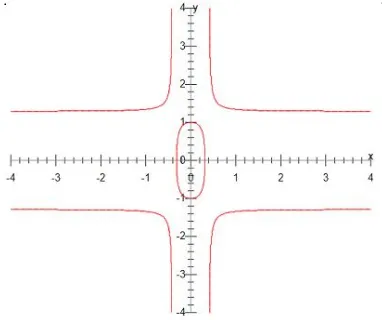
Generally, a point P= (x, y) lies on E, a twisted Edwards curve if it verifies the following formula: ax2 + y2 =1+dx2y2 where a, d are two distinct, non-zero elements of the field M over which E is defined. It is untwisted in the special case where a=1, because the curve reduces to an ordinary Edwards curve. Consider ‘a’ and ‘d’ values in the above equation as 10 and 6 respectively. The equation becomes → 10x2+y2=1+6x2y2 [5]. For which the plot of Edward curves is shown below:
Fig. 1. Plot of Edward curves for a=10 and d=6
Galois Field, named after Evariste Galois, also known as finite field, refers to a field in which there exist a finite number of elements [6]. It is
very useful in translating computer data so that they are represented in binary forms. That is, computer data which is limited to a combination
of two numbers, 0 and 1 are the components in Galois field with number of elements being two.
By representing data as a vector in a Galois Field, we can easily perform scrambled mathematical operations [7]. The elements of Galois Field GF ( ) can be defined as:
GF( ) = (0,1,2,...,p−1) ∪(p,p+1,p+2,...,p+p−1) ∪( , +1, +2,..., +p−1) ∪...∪( , +1,
+2,..., +p−1)
Where p∈Pand m∈Z+. The order of the field is given by while p is called the characteristic of the field. GF refers to Galois Field. Also, the degree of polynomial of each element is at most m−1. For example GF(4) = (0, 1, 2, 3) which consists of 4elements in which each of them is a polynomial of degree ‘0’ (a constant) while GF(2 ) = (0, 1, 2, 3…..15)and consists of 2 = 16elements where each of them is a polynomial of degree at most 2. GF (24) defines the basic arithmetic operations over the finite set of bytes.
2. METHODOLOGY
2.1 Key Pair Generation Process
For the EdDSA authenticator to function, it needs to know its own private key. The public key is obtained from the private key and the parameters specified over domain. The private key is not accessible to any third party. The public key must be openly read accessible. The public and private key pair ensures data is protected during transmission. A random integer is used to generate the private key which is known only to sender. The random number is passed to EdDSA algorithm which computes public key.
2.2 Signature Computation Process
Fig. 2. For generation of private and public keys
Fig. 3. Generation of
Fig. 4. Verification of
2. For generation of private and public keys [9]
3. Generation of digital signature [9]
Shivani et al.; JERR, 4(4): 1-7, 2019; Article no. JERR.48655
2.3 Signature Verification Process
The signature verification is the counterpart of the signature computation. Its purpose is to verify
the message’s authenticity using the
authenticator’s public key. In order to reduce frauds, signature verification is very important. It increases accuracy and efficiency. This is performed at the message receiver end. The algorithm requires public key, received versions of digital signature and message digest.
Output determines the validity of the signature based on correct key given as input. If receiver enters matching key, then signature is verified. Else, signature verification fails.
2.4 Edwards-Curve Digital Signature Algorithm
EdDSA is a public-key signature algorithm similar
to ECDSA proposed by Bernstein et al. [10]. In the paper RFC 8032, EdDSA has been
defined for two twisted Edwards curves edwards25519 and edwards448; but, the EdDSA can also be instantiated over other curves.
In practice the public key and the signatures are output according to the encoding defined in [3]. Since there is a one-to-one relation between
curve elements and encoded values, we do not detail the encoding in our description. The
signature (R, S) of a message M is computed according to following algorithm [5].
2.4.1 EdDSA signature algorithm
Requires: Message (M), hash digest values of message (h0, h1,………, h2b-1), Private key (B) and Public key (A) derived from B
1: a ← 2 + ∑ 2 ℎ
2: h ← H (ℎ ,..., ℎ , M) 3: r ← h mod GF(l) 4: R ← r · B
5: h ← H (R, A, M) 6: S ← (r + ah) mod GF(l)
7: return (R, S)
EdDSA uses a private key that is b-bit long and a hash function H that produces a 2b - bit
output. One common instance is to use SHA-512 for b = 256 bits. Current popular hashes produce hash values of length n = 128 (MD4 and MD5) and n = 160 (SHA-1) [11].
An n-bit hash is a map from arbitrary length messages to n-bit hash values. An n- bit cryptographic hash is an n-bit hash which is one-way and collision-resistant. Such functions are important cryptographic primitives used for such things as digital signatures and password protection.
In this paper, Hash algorithm used is SHA-1.Length of Hash, of 2b bit length is 20 bits. So, private key is of 10 bits.
An integer ‘a’ is determined from H(k) =
( ℎ , ℎ ,..., ℎ ) with “a = 2 +
∑ 2 ℎ”.The public key A is then computed from the base point B ≠ (0, 1) of order l, chosen as per the EdDSA specifications [2], such that A = a·B. Where l can be any abstract algebraic equation, for example, l = + ,which is defined over Galois field . ‘p’ is a positive prime number raised to value ‘m’.
For this algorithm, using Galois field for the calculation of value ‘l’ gives more security and reduces computational time.
Even if multiple signatures are computed for an identical message, same signature is obtained. Thus, EdDSA is deterministic in nature.
2.4.2 Verification of EdDSA signature
A signature is considered valid if it satisfies the following equation, 8S·B mod l = (8·R + 8H (R, A, M)·A) mod l. Verification without the cofactor 8 is a stronger way to verify a signature. Since the algorithm has good performance, ease of implementation, small key and signature sizes, it is rapidly being adopted in security of embedded devices also.
2.5 Software Requirements
MATLAB version 9.5 [R2018b].
Toolboxes required: Symbolic math toolbox and Communications Toolbox.
3. RESULTS
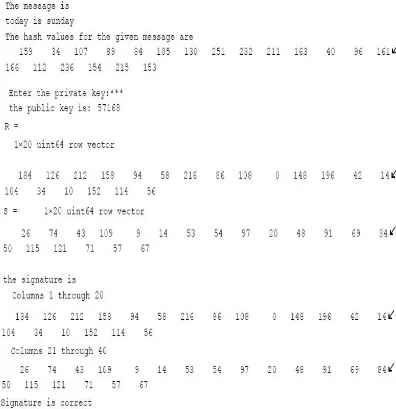
Computed signature for text data is obtained as below.
Value of R which is the ephemeral public key is obtained by computing abstract algebraic expression over Galois Field. S is got by calculating modulus involving order of Galois field.
Case 1: The private key given as input at receiver end matches with key set by sender of the message. Thus, signature is verified as being correct.
Case 2: The private key given as input at receiver end does not match with key set by
sender of the message. Thus, signature is incorrect.
3.1 Differences between Proposed and Existing System
DSA (Digital Signature Algorithm) is a Federal Information Processing Standard for digital signatures. It's security relies on a discrete logarithmic problem. Compared to RSA, DSA is faster for signature generation but slower for
Shivani et al.; JERR, 4(4): 1-7, 2019; Article no. JERR.48655
Fig. 6. Results for incorrect signature
Table 1. Performance comparison of EdDSA with ECDSA
Parameters ECDSA[12] Proposed EdDSA over GF( )
Key length 384 10
Key generation (sec) 0.799 0.0006
Signature generation(sec) 0.0016 0.0002
Signature verification(sec) 0.0082 0.0007
validation. Security can be broken if bad number generators are used.
ECDSA (Elliptical curve Digital Signature Algorithm) is an Elliptic Curve implementation of DSA (Digital Signature Algorithm). ECDSA was
ECDSA is a cryptographic scheme based on ECC. The Elliptic Curve Digital Signature Algorithm (ECDSA) is the elliptic curve analogue of the DSA. Signature computation is deterministic in EdDSA and its security is based on the intractability of some discrete logarithm problems. Thus it can be concluded that, though key length is very small, it is safer than DSA and ECDSA which require high quality randomness for each and every signature [10].
In the proposed system, EdDSA is implemented over Galois Field in which the operations are different from normal arithmetic operations. Hence it is more secure than the existing EdDSA system. Confidentiality and integrity for multimedia data like text and image also increases.
Several parameters of ECDSA and proposed EdDSA over Galois Field are compared and tabled in Table 1.
4. CONCLUSION
Nowadays, digital signatures are being used all over the Internet. Digital signature schemes are also used in electronic transactions over block chain. Several digital signature schemes like DSA, ECDSA are in existence. But, they have limitations like large key length, high computational time for generation of signature, security compromisation. An algorithm to give a digital signature that authenticates text data and provides non-repudiation is designed. It is faster than existing digital signature schemes and has a relatively small key length. Yet, it does not compromise on the data integrity and security it offers. Implementation of certain calculations over Galois field reduces computation time and size of the signature. This algorithm can be extended to verify integrity of multimedia like image, video, etc.
COMPETING INTERESTS
Authors have declared that no competing interests exist.
REFERENCES
1. National Institute of Standards and Technology. Entity Authentication using Public Cryptography. FIPS Publication; 1996-1997.
2. Housley R. Vigil Security; 2018. ISSN: 2070-1721.
3. Ilari Liusvaara, Simon Josefsson.
Edwards-Curve Digital Signature Algorithm (EdDSA). RFC 8032; 2017.
4. Daniel J. Bernstein, Peter Birkner, Marc Joye, Tanja Lange, Christiane Peters. Twisted edwards curves. In Cryptology ePrint Archive, Report 2008/013; 2008. 5. Yolan Romailler, Sylvain Pelissier.
Practical fault attack against the Ed25519
and EdDSA signature schemes. In
Workshop on Fault Diagnosis and
Tolerance in Cryptography; 2017.
6. Sakshi Samaiya, Anupreksha Jain. An implementation of GA based FPGA ALU unit. International Journal of Engineering Sciences & Research Technology. ISSN: No. 2277-9655.
7. Janardan Mahanta. Construction of
balanced incomplete block design: An application of Galois field. Open Science Journal of Statistics and Application; 2018. 8. Gregory Neven, Nigel P. Smart, Bogdan
Warinschi. Hash function requirements for
Schnorr signatures. Journal of
Mathematical Cryptology. 2009;3. 9. Available:https://www.maximintegrated.co
m/en/app-notes/index.mvp/id/5767
10. Daniel J. Bernstein, Simon Josefsson, Tanja Lange, Peter Schwabe, Bo-Yin Yang. EdDSA for more curves. Cryptology ePrint Archive, Report 2015/677; 2015. 11. Secure Hash Standard (SHS). National
Institute of Standards and Technology (NIST); 2012.
12. Daniel J. Bernstein, Tanja Lange. eBACS: ECRYPT Benchmarking of Cryptographic Systems; 2011.
© 2019 Shivani et al.; This is an Open Access article distributed under the terms of the Creative Commons Attribution License (http://creativecommons.org/licenses/by/4.0), which permits unrestricted use, distribution, and reproduction in any medium, provided the original work is properly cited.
Peer-review history:
![Fig. 2. For generation of private and public keys2. For generation of private and public keys [9]](https://thumb-us.123doks.com/thumbv2/123dok_us/9832315.1969400/3.612.172.444.515.681/fig-generation-private-public-keys-generation-private-public.webp)