International Journal of Current Research in
Biosciences and Plant Biology
ISSN: 2349-8080 (Online) ●
Volume 3 ●
Number 11 (November-2016)
Journal homepage: www.ijcrbp.comOriginal Research Article doi: http://dx.doi.org/10.20546/ijcrbp.2016.311.010
Impact of Zero-tillage on Environment and Farmers’ Livelihood
Sustainability in Western Plain Agro-Climatic Zone of Uttar Pradesh,
India
O. P. Singh*
Assistant Professor, Department of Agricultural Economics, Institute of Agricultural Sciences, Banaras Hindu University, Varanasi – 221005, Uttar Pradesh, India
*Corresponding author.
A b s t r a c t A r t i c l e I n f o
Zero-tillage playing an important role in enhancing wheat productivity and it leads to enhance economic and environmental benefits. Looking the importance of technology, present study was an attempt to find out the impact of zero-tillage on environment and farmers’ livelihood sustainability in Western plain agro-climactic zone of Uttar Pradesh. Present study was based on primary data and it was conducted in two villages of Ghaziabad district. Study suggests that after adoption of zero-tillage, the cost of cultivation of wheat crop was reduced as compared to conventional method of wheat cultivation. After adoption of zero-tillage, the incremental wheat yield i.e. grain and bhusa was found to be 6.21 and 6.18 quintal respectively. The economic benefit due to the adoption of zero-tillage was estimated to be Rs.18662.96 per hectare. Due to adoption of zero-tillage carbon emission was reduced by 23.93 kg per hectare and irrigation water was saved by 1347.50 m3 per hectare.
Accepted: 16 October 2016
Available Online: 06 November 2016
K e y w o r d s Cost of cultivation Economic benefits Environmental benefits Logit model
Resource conservation technologies Zero-tillage
Introduction
Rice and wheat are the two important stable food-grains which consumed by larger population of the South Asia. The irrigated rice-wheat cultivation system provides employment, income and livelihoods of millions of population residing in the region (Ladha et al., 2003). The sustainable production and productivity of both rice and wheat crops are threatened by insufficient use of inputs, increasing scarcity of natural resources viz., land and water, climate change, changing cropping pattern towards water efficient high valued crop and changing food consumption basket (IRRI, 2009). The conventional method of rice-wheat cultivation needs to be improved or replaced by resource conservation technology (RCTs).
The resource conserving technologies are those that enhance the crop productivity and profitability by making more efficient use of inputs of crop production, reducing cost of inputs and escalating crop yield per unit of scare resources and inputs. RCTs assist farmers to enhance input-use efficiency and farm profitability on a sustainable basis (Gupta and Seth, 2006).
crop using zero-till-drill-seeded wheat machine is more popular in those areas where soils are heavy (clay loam, loam) low land and high water retention capacity. These soils required relatively more time to dry-up for land preparation for sowing of wheat crop. In such situation farmers were using zero-till-drill-seeded wheat machine for sowing wheat crop just in one pass after harvesting of rice crop. Sowing of wheat crop using zero-till-drill-seeded machine helps farmers to reduce the cost of land preparation, reduction in use of other inputs and timely sowing of wheat crop. Sowing of wheat by using zero-till-drill seeded machine with crop residue management in the soil helps farmers to overall reduction in cost of cultivation and enhance wheat yield on sustainable basis. Many past researchers reported that after adoption of zero-tillage, the cost of cultivation of wheat crop was reduced and enhanced wheat yield as compared to conventional method of wheat cultivation (Laxmi et al., 2007; Kumar et al., 2005; Singh et al., 2011; Pal et al., 2010; Singh and Meena, 2013). Present study was an attempt to find out the impact of zero-tillage on environment and farmers’ livelihood sustainability in Western plain agro-climactic zone of Uttar Pradesh. The specific objectives of the present study was: [a] to compare cost of cultivation of wheat crop under zero-tillage and conventional method; [b] to estimate the economic and environmental benefits of zero-tillage; [c] to determine the factors influencing adoption of zero-tillage; and [d] find out the constraints associated with adoption of zero-tillage.
Data and analytical procedure
Sampling procedure
Western plain agro-climatic zone of Uttar Pradesh consists of seven districts viz., Saharanpur, Muzaffarnagar, Meerut, Bagpat, Ghaziabad, Gautam Budha Nagar and Buland Shahar. Out of these districts, Ghaziabad district was purposively selected on the basis of highest adoption of zero-tillage. District has four development blocks viz., (1) Muradnagar, (2) Bhojpur, (3) Rajapur, and (4) Hapur. Out of these development blocks, two development blocks viz., Rajapur and Bhojpur was selected purposively on the basis of highest and lowest adoption of zero-tillage, respectively. From selected development block, Matiyala village from Rajapur and Tahlata village from Bhojpur development block was selected purposively on the basis of availability of zero-tillage adopters and non-adopters. From each village, 10 zero-tillage adopters and 10 non-adopters were selected using snowball sampling method.
Thus, altogether, 40 respondents were finally selected from two villages.
Analytical procedure
Cost of cultivation: The cost of cultivation was estimated by using methodology developed by the Commission for Agricultural Cost and Prices. The different cost was calculated as:
Cost A1: All the input cost + depreciation on implements
and farm buildings+ land revenue, cesses and other taxes+ interest on working capital+ miscellaneous expenses.
Cost B1: Cost A1 + interest on value of owned fixed
capital assets (excluding land).
Cost C1: Cost B1 + rental value of owned land+ rent paid
for leased-in land.
Cost C2: Cost C1 + imputed value of family labour. Cost C3: Cost C2 + 10 per cent of cost C2 as account for
managerial input of the farmer.
Economic and environment benefits
The economic benefits of RCTS were worked out using
economic surplus model as suggested by the Alston et al. (2005). The model is given below:
Where,
Z = K ε/ (ε+ η); K is vertical shift in supply function as proportion of initial price; η is elasticity of demand (absolute); and ε is elasticity of supply.
The environmental benefits realized by adoption of zero tillage are reduction in carbon emission. To find out the reduction of carbon emission, first of all diesel saving on farm operations was quantified and multiplied by the one litre equal to 2.6 kg of CO2 (Jat et al., 2006) and one kg
CO2 is 0.27 kg of carbon (Paustian et al., 2006).
Where,
Pd is pump discharge rate measured in m3 per hour; HP is the pump capacity; Pe is the pump efficiency; and DW is depth to water level plus head of delivery pipe measured in meter.
Factors influencing adoption of zero-tillage
For identification of relative importance of various factors influencing adoption of RCTS in different
Agro-climatic zone was worked out by using binary logit model (Mallada, 1992). The algebraic form of model is given below:
Where, pi is a probability of adoption of conservation
tillage technology for the ith farmer and ranges from 0 to 1. e-Zi represents the base of natural logarithms and Zi is
the function of a vector of n explanatory variables and expressed as follows.
Where β0 is the intercept and βi is a vector of the
relationship between pi and Xi, which is non-linear, can
be written as follows:
Finally, the logit model is obtained by using the logarithm.
Identification of constraints
The Garret Ranking was used to rank the constraints associated with the zero tillage adoption. The percentage of each rank thus obtained was converted into scores by referring to the table given by Henry Garret. The score of all the factors were arranged in order of their ranks.
Where,
Rij is the rank given for i th
item jth individual and Nj is the
number of items ranked by jth individuals.
Results and discussion
Socio-economic profile of respondents
The respondents of the study area were doing crop production along with livestock rearing. In case of zero-tillage adopters, 75 per cent sample farmers were engaged in crop production and remaining 25 per cent farmers were involved in crop and livestock production, whereas in case of zero-tillage non-adopters, 50 per cent sample farmers were involved in crop production only and remaining 50 per cent involve in crop and livestock production. The average age of zero-tillage adopters was less (52.15 years) than the zero-tillage non-adopters (53.15 years). The average farming experience for zero-tillage adopters was found to be 27.55 years which was quite higher than zero-tillage non-adopters (27.00 years). The educational level of zero-tillage adopters was almost similar as zero-tillage non-adopters.
The average size of family member for zero-tillage adopter was 10.15 persons per family which were larger than the zero-tillage non-adopter (9.85 persons). Out of total family members, about 42.86 and 39.59 per cent family members for zero-tillage adopters and non-adopters respectively were belonging to children having age of less than 18 years and remaining family members were belonging to group of adult. The average size of land holding for zero-tillage adopter and non-adopter in Ghaziabad district was found to be 6.09 and 4.76 hectares respectively. All the agricultural land posed by the sample farmers in the study area were irrigated in all the season and major source of irrigation was groundwater.
Cost of cultivation
Per hectare cost of cultivation for wheat crop for zero-tillage adopter was lower (Rs.51315.21) than the zero-zero-tillage non-adopter (Rs.57269.99) in the study area. The share of inputs cost for zero-tillage adopters and non-adopters were estimated to be 84.64 and 88.96 per cent respectively of total cost of cultivation (Table 1). Per hectare contribution of rental value of own land and leased-in land to total cost of cultivation (Cost C3) was estimated to be 10.28 and 5.78
per cent for zero-tillage adopter and non-adopter respectively in the study area. The share of imputed value of family labour was 6.74 and 7.57 per cent for zero-tillage
n n i
i i n
i Z X X X
p p L
L
...
adopters and non-adopters to cost of cultivation respectively. The contribution of chemical fertiliser to total cost of cultivation was estimated to be 6.95 and 6.95 per cent for zero-tillage adopters and non-adopters respectively.
The share of expenditure on irrigation water for wheat crop was estimated to be 4.73 and 7.06 per cent to total cost of cultivation for zero-tillage adopters and non-adopters respectively.
Table 1. Cost of cultivation of wheat (`/Ha).
Particulars
RCTs adopter RCTs non-adopter
Physical unit
Amount
(Rs.) % to (C3)
Physical unit
Amount
(Rs.) % to (C3) 1. Human labour
a. Family labour – Male 11.53 3458.78 6.74 14.45 4334.09 7.57
c. Hired labour – Male 4.57 1372.34 2.67 6.61 1984.09 3.46
c. Hired labour - Female 1.44 430.85 0.84 1.08 322.73 0.56
2. Machine labour (Hrs) 5.01 2506.65 4.88 11.83 5914.77 10.33
3. Seed (Kg) 124.92 3997.45 7.79 145.98 4671.52 8.16
4. Manure (Qts) 244.02 7320.48 14.27 229.55 6886.36 12.02
5. Fertilizer (Kg) 3565.86 6.95 3977.47 6.95
a. Nitrogen 152.33 1066.29 2.08 115.98 811.89 1.42
b. Phosphetic 94.41 2157.38 4.20 125.00 3000.00 5.24
c. Potassic 6.74 88.99 0.17 9.21 95.81 0.17
d. NPK 12.23 244.68 0.48 1.21 2.91 0.01
e. Zn 2.13 8.51 0.02 5.97 66.86 0.12
6. Insecticides and pesticides - 307.50 0.60 - 335.00 0.58
7. Irrigation (Hrs) 63.07 2428.26 4.73 101.09 4043.64 7.06
8. Harvesting and threshing 14470.74 28.20 14500.00 25.32
Sub-Total 43424.76 84.62 50947.14 88.96
9. Interest on working capital 1519.87 2.96 1783.15 3.11
10. Total Working Capital 44944.63 87.59 52730.29 92.07
11. Land revenue - - - -
12. Rental value of own land 4241.37 8.27 2639.70 4.61
13. Rental Value of leased-in land 1030.05 2.01 671.11 1.17
14. Cost A1 37920.00 73.90 44418.73 77.56
15. Cost B1 37920.00 73.90 44418.73 77.56
16. Cost C1 43191.42 84.17 47729.54 83.34
17. Cost C2 46650.19 90.91 52063.63 90.91
18. Cost C3/ Cost of cultivation 51315.21 100.00 57269.99 100.00
Income from crop production
Per hectare average yield of main and by-product (wheat bhusa) of wheat crop for zero-tillage adopters was worked out to be 49.88 and 49.88 quintal respectively, whereas in case of zero-tillage non-adopters it was 43.67 and 43.70 quintal per hectare for main and by-product respectively. The average market price received by the sample farmers in the study area was found to be Rs.1442.50 and Rs 348.50 per quintal for wheat (grain) and by-product (wheat bhusa) respectively (Table 2). Per hectare average gross income obtained by the zero-tillage adopter and non-adopters was estimated to be Rs.89335.65 and Rs.78217.56 respectively. In case of zero-tillage adopters, per hectare net income over cost C3 was
estimated to be Rs.38020.44, whereas in case of zero-tillage non-adopter it was Rs.20947.57. Per hectare net
income over cost C2 (cost of all the inputs including
imputed value of family labour) was found to be Rs.42685.46 and Rs.26153.93 for zero-tillage adopters and non-adopter respectively.
The benefit cost ratio (B-C ratio) for wheat production for zero-tillage adopters was estimated to be 1.74 over cost C3 which was higher than the zero-tillage
non-adopter i.e. 1.37. The B-C ratio over cost C2 was found
plus imputed value of family labour and rental value of own land) was estimated to be Rs.935.24 and Rs.1192.30 for zero-tillage adopters and non-adopter respectively. It
is clear from the above discussion that the zero-tillage adopter was fetching more income as compared to zero-tillage non-adopter.
Table 2. Income from wheat production.
Particulars Zero-tillage adopter Zero-tillage non-adopter
1. Crop yield (Qts/Ha) a. Main product (Wheat grain) 49.88 43.67
b. By-product (Wheat bhusa) 49.88 43.70
2. Market price (Rs./Qt) a. Main product (Wheat grain) 1442.50 1442.50
b. By-product (Wheat bhusa) 348.50 348.50
3. Gross income (Rs./Ha) 89335.65 78217.56
4. Net income over (Rs.) a. Cost A1 51415.65 33798.84
b. Cost B1 51415.65 33798.84
c. Cost C1 46144.24 30488.02
d. Cost C2 42685.46 26153.93
e. Cost C3 38020.44 20947.57
5. Input-output ratio over (Rs.) a. Cost A1 2.36 1.76
b. Cost B1 2.36 1.76
c. Cost C1 2.07 1.64
d. Cost C2 1.92 1.50
e. Cost C3 1.74 1.37
6. Cost of production (Rs./Qt) a. Cost A1 760.22 1017.22
b. Cost B1 760.22 1017.22
c. Cost C1 865.90 1093.04
d. Cost C2 935.24 1192.30
e. Cost C3 1028.77 1311.53
Economic benefit of zero-tillage
After adoption of zero-tillage sample farmers in the study area was getting higher yield of main and by-product of wheat crop. Per hectare average wheat grain and Bhusa for zero-tillage adopters was 49.88 and 49.88 quintal respectively, whereas in case of non-adopters it was 43.67 and 43.70 quintal respectively. The incremental grain yield benefit due to adoption of zero-tillage was estimated to be 6.21 quintal per hectare over
non-adopters. Per hectare incremental yield of by-product of wheat was found to be 6.18 quintal per hectare.
The prevailing price of haring labour in the study area was Rs.300 per day, tractor charges was Rs.500.00 per hour, cost of seed was Rs.32 per kg and market price of main and by-product was Rs.1442.50 and Rs.348.50 per quintal. Per hectare economic benefits due to adoption of zero-tillage was estimated to be Rs.18662.96 (Table 3).
Table 3. Economic benefit of RCTs (Rs./Ha).
Sl. No. Particulars Amount (Rs.)
1. Due to reduction in cost of labour 1378.94
2. Due to reduction in cost of machine labour 3408.12
3 Due to reduction in cost of seed 674.07
4 Due to reduction in cost of fertilizer 411.61
5 Due to reduction in cost of pesticide 27.50
6 Due to save in irrigation cost 1615.37
7 Due to reduction in cost of harvesting 29.26
8 Due to yield benefits (main and by-product) 11118.09
Environmental benefit of zero-tillage
The one litre burning of diesel fuel generates 2.6 kg of CO2 (Jat et al., 2006) and one kg CO2 is equal to 0.27 kg
of carbon (Paustian et al., 2006). Per hectare total diesel used for land preparation and sowing of wheat crop was estimated to be 25.07 and 59.15 litres for zero-tillage adopter and non-adopter respectively. Per hectare CO2
emission from zero-tillage and conventional method of wheat cultivation was estimated to be 65.17 and 153.78 kg respectively and carbon emission was 17.60 and 41.52 kg respectively. After adoption of zero-tillage, per hectare carbon emission was reduced by 23.93 kg.
Sample farmers of the study area were using groundwater to irrigate their wheat crop. Total water used for irrigating wheat crop by zero-tillage adopters and non-adopters were estimated to be 2235.44 and 3582.95 m3 per hectare respectively. After adoption of zero-tillage, sample farmers were using less groundwater for irrigating their wheat crop. Reduction in irrigation water was estimated to be 1347.50 m3 per hectare. Due to reduction in pumping of groundwater, there was saving in energy also i.e. electricity or diesel.
Factors influencing adoption of zero-tillage
Factors influencing adoption of zero-tillage in Ghaziabad district was estimated using binary logit model and results is displayed in Table 4. In case of dependent variable zero-tillage adopters and non-adopters, the binary value was used i.e. one for adopters and zero for non-adopters. Independent variables were family size in number, farming experience in year, land holding size (both own land and leased-in land minus leased-out land) in hectare and age of respondents. Results showed that
“B” coefficients for farming experience, land holding size, age of respondents and education level of the respondents were statistically significant. It is clear from the results that farming experience and land holding size has positive impact on adoption of RCTs in the study area. It means if farming experience and land holding size of the farmers’ increases, than there is better chance of RCTs adoption. The age of respondents and education level has negative impact on the adoption of RCTs in the study area. Beside above mentioned factors, natural factors viz., soil types and water availability are playing an important role in adoption of zero-tillage. In case of Ghaziabad district is characterised as water scarce district and major soil types of the district are black and clay soil. Both factors were playing an important role in adoption of zero-tillage.
Constraints associated with adoption of zero-tillage
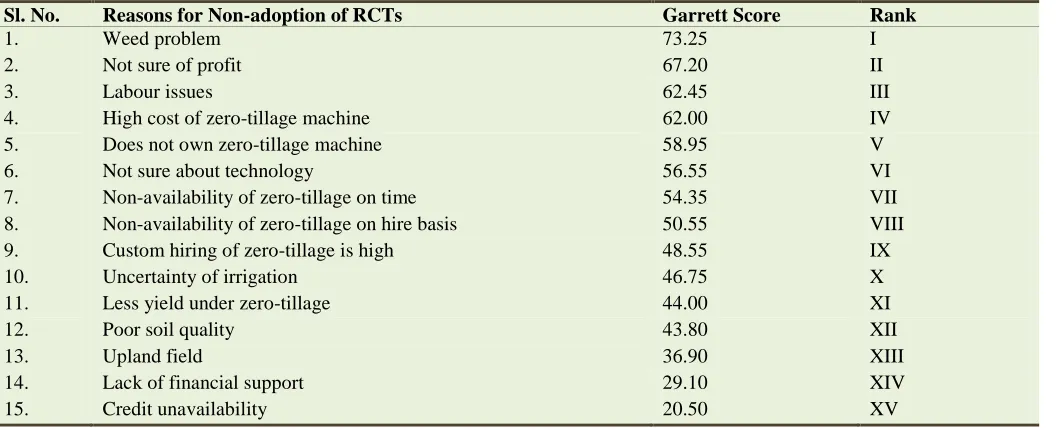
The most important factor that influenced farmers for non-adoption of zero-tillage in the study area was weed problem in the agricultural field and farmers were not sure of profit after adoption of zero-tillage and its rank was estimated to be first and second (Table 5). Other important reasons that inhibiting the adoption of zero-tillage in the study area were non-availability of skilled labour, high cost of the zero-till-drill machine and farmer doesn’t own zero-tillage machine and its rank was third, fourth and fifth respectively. The six, seventh and eight ranks are given by the farmers for not sure about the zero-till technology, non-availability of zero-tillage machine on time and on hiring basis respectively. Other reasons for non-adoption of zero-tillage in the study area were custom hiring of zero-tillage is high, uncertainty of irrigation, less yield under zero-tillage, poor soil quality, upland field, lack of financial support and credit unavailability.
Table 4. Factors influencing adoption of RCTs.
Variables B S.E. Wald df Sig. Exp (B)
a. Constant “a” 10.177* 4.976 4.183 1 0.041 26285.040
b. Family size (No) -0.074** 0.229 0.105 1 0.746 0.928
c. Farming experience (Year) 0.149** 0.089 2.827 1 0.093 1.161
d. Land holding size (Ha) 0.532* 0.175 9.256 1 0.002 1.702
e. Age of respondents (Year) -0.233* 0.117 3.955 1 0.047 0.792
f. Education level (Years) -0.301* 0.172 3.054 1 0.081 0.740
Model Summery
-2 Log likelihood 39.221
Cox and Snell R Square 0.334
Nagelkerke R Square 0.445
Table 5. Constraints for non-adoption of RCTs.
Sl. No. Reasons for Non-adoption of RCTs Garrett Score Rank
1. Weed problem 73.25 I
2. Not sure of profit 67.20 II
3. Labour issues 62.45 III
4. High cost of zero-tillage machine 62.00 IV
5. Does not own zero-tillage machine 58.95 V
6. Not sure about technology 56.55 VI
7. Non-availability of zero-tillage on time 54.35 VII
8. Non-availability of zero-tillage on hire basis 50.55 VIII
9. Custom hiring of zero-tillage is high 48.55 IX
10. Uncertainty of irrigation 46.75 X
11. Less yield under zero-tillage 44.00 XI
12. Poor soil quality 43.80 XII
13. Upland field 36.90 XIII
14. Lack of financial support 29.10 XIV
15. Credit unavailability 20.50 XV
Conditions for adoption of zero-tillage
The most important condition for adoption of zero-tillage in the study area was if zero-tillage machine is available on subsidised rate (Table 6). The sample farmers told that if they convinced of yield benefit then they adopt it on their own farm and its rank was second. The third and
fourth condition for adoption of zero-tillage in the study area was if custom hiring rate of the zero-tillage machine is reduced and more observation on there’s farmers’ field. The least important condition for adoption of zero-tillage was availability of better repair service and availability of skilled labour for operating RCTs machine.
Table 6. Condition for adoption of zero-tillage.
Sl. No. Condition for adoption of RCTs Garrett Score Rank
1. If zero-tillage machine is available on subsidy 66.70 I
2. If convinced of yield benefit 62.80 II
3. If custom hiring rate is low 56.40 III
4. More observation on other field 52.40 IV
5. If better repair service is available 31.70 V
6. Availability of skilled labour 30.00 VI
Summary and policy implications
Zero-tillage playing important role in reduction on cost of land preparation and sowing, saving time and reduction in overall cost of cultivation of wheat crop. It helps farmers to enhance crop production with less inputs use (Laxmi et al., 2007; Kumar et al., 2005; Singh et al., 2011; Pal et al., 2010; Singh and Meena, 2013). It also helps to reduce the carbon emission from land preparation and sowing of wheat crop. Per hectare cost of cultivation of wheat crop under zero-tillage was lower by Rs.5954.78 as compared to conventional method of wheat cultivation. The benefit cost ratio for zero-tillage adopters was 1.74. The economic benefit of zero-tillage adoption was Rs.18662.96 per hectare. The
on purchase of zero-tillage machine and provide training to farmers related to the use and benefits of machine. Increase in number of zero-tillage machine in study area will help farmers in adoption of technology and it will also augment the available machine on hiring basis on time and lower price.
Conflict of interest statement
Authors declare that they have no conflict of interest.
Acknowledgement
Authors are thankful to UP Council of Agricultural Research (UPCAR), Lucknow for providing research grant to carryout research project on “Economic and Environmental Benefits of Resource Conservation Technologies in Different Agro-climatic Zones of Uttar Pradesh, India.
References
Alston, J.M., Norton, G.W., Pardey, P.G., 1995. Science under Scarcity: Principles and Practice for Agricultural Research Evaluation and Priority Setting. Cornell University Press, Ithaca.
Gupta, R., Seth, A., 2006. A review of resource conserving technologies for sustainable management of the rice-wheat cropping system of the Indo-Gangetic Plain (GCP). Crop Prod. 26, 436-447.
IRRI (International Rice Research Institute), 2009. Enhancing Farmers’ Income and Livelihoods through Integrated Crop and Resource Management in Rice-wheat System in South Asia. Terminal Project Report (IRRI Ref. No. DPPC 2004-02/RETA 6208), Report submitted to Division of Agriculture, Natural Resources and Social Services Division, South Asia Department, Asian Development Bank.
Jat, M.L., Sharma, S.K., Singh, K.K., 2006. Conservation Agriculture for Sustainable Farming in India. Paper Presented in Winter School Training at Department of
Agronomy, Tamil Nadu Agricultural University,
Coimbatore.
Kumar, U., Gautam, U.S., Singh, S.S., Subhash, N., Singh, K., Kumar, R., 2005. Zero Tillage Technology in Wheat Cultivation. Proceedings of the Project Workshop on Accelerating the Adoption of Resource Conservation Technologies in Rice-Wheat Systems of the Indo-Gangetic Plains, Hisar, India. pp.239-244.
Ladha, J.K., Hill, J.E., Duxbury, J.D., Gupta, R.K., Buresh, R.J., 2003. Improving the Productivity and Sustainablity of Rice-wheat Systems: Issues and Impact. American Society of Agronomy Special Publication 65, Madison, Wis. (USA),ASA, CSSA, SSSA.
Laxmi, V., Erenstein, O., Gupta, R.K., 2007. Impact of Zero Tillage in India’s Rice-Wheat Systems. CIMMYT and the Rice-Wheat Consortium for the Indo-Gangetic Plains, New Delhi, India. pp.1-32.
Mallada, G.S., 1992. Introduction to Econometrics. 2nd Edn. MacMillan Publishing Company, New York.
Pal, S., Shekar, I., Kar, A., 2010. Environmental Impact of Resource Conservation Technology: The Case of Zero-tillage in the Rice -wheat System of South Asia. Report to the CGIAR Standing Panel on Impact Assessment, Division of Agricultural Economics, Indian Agricultural Research Institute, New Delhi. pp.1-23.
Paustian, K., Antle, M., Sheehan, J., Eldor, P.,
2006. Agriculture’s Role in Greenhouse Gas
Mitigation. Pew Center on Global Climate Change, Washington, DC.
Singh, K.M., Meena, M.S., 2013. Economics of Conservation Agriculture: An Overview, Munich Personal RePEc Archive. pp.1-18.
Singh, N.P., Singh, R.P., Kumar, R., Vashist, A.K., Khan, F., Varghese, N., 2011. Adoption of resource conservation technologies in Indo-Gangetic Plains of India: Scouting for profitability and efficiency. Agric. Econ. Res. Rev. 24(1), 15-24.
How to cite this article:
Singh, O. P., 2016. Impact of zero-tillage on environment and farmers’ livelihood sustainability in western plain agro-climatic zone of Uttar Pradesh, India. Int. J. Curr. Res. Biosci. Plant Biol. 3(11), 61-68.