ISSN: 2306-9007 Munusamy & Arumugam (2017) 244
I
www.irmbrjournal.com March 2017I
nternationalR
eview ofM
anagement andB
usinessR
esearchVol. 6 Issue.1
R
M
B
R
Influence of Cognitive Style on Usage of Online Knowledge
Sharing Technology
KOMATHI MUNUSAMY
Universiti Tunku Abdul Rahman
Email: [email protected]
THILAGESWARY ARUMUGAM
Asia Pacific University of Technology and Innovation
Email: [email protected]
Abstract
The aim of this study is to investigate the influence of cognitive style as a moderator, on the factors that affect academic staffs’ adoption and usage of online knowledge sharing technology in the context of research universities in Malaysia. To do so, the study integrated technology acceptance model, hedonic consumption model and cognitive style theory as the theoretical model in understanding the acceptance and usage of online knowledge sharing technology. The study was empirically evaluated using quantitative data from a sample of 321 academics from five research universities. Relevant information were collected through online survey submitted to all the chosen academics from the five research universities. In this study, cognitive style was used to explain its moderation effect on academics usage of online knowledge sharing technology. The result indicates that cognitive style failed to influence the relationship between perceived usefulness, perceive ease of use and usage of online knowledge sharing technology. However, the findings of the study showed that cognitive style is a moderator for the relationship between arousal and usage of online knowledge sharing technology. The finding of the study contribute both to the academic research, by making available to scholars on the empirical evidence on the moderating effect of cognitive style on factors that influence the usage of online knowledge sharing technology. To practice some guidelines to management team of research universities in particular and in general all universities on how to encourage academics to engage in using knowledge sharing technologies.
Key Words: Usage of Knowledge Sharing Technology, Knowledge Sharing, Cognitive Style, Tam, and Research Universities.
Introduction
ISSN: 2306-9007 Munusamy & Arumugam (2017) 245
I
www.irmbrjournal.com March 2017I
nternationalR
eview ofM
anagement andB
usinessR
esearchVol. 6 Issue.1
R
M
B
R
The revolution of technology is seen in various sectors, including the education field. Malaysia has significantly transformed itself from an input-driven growth strategy to one that is increasingly driven by the knowledge based thus leading towards a knowledge society and stable economy. In this situation, the widespread diffusion of ICT and enhances networking capabilities have significantly modified learning and teaching activities within the institutions of higher learning (Wagner et al, 2008). Nevertheless, the incorporation of ICT in the field of education has considerably changed academic involvement in teaching, as well as research activities. The progress of educational technology infrastructure and facilities has provided an opportunity for academics around the world to collect and share valuable knowledge, information, and ideas across functions, divisions and geographical boundaries, consequently transforming the country education sector into a knowledge based- society.
Many knowledge-sharing initiates rely on information technology as an important enabler (Zailani et. al, 2006; Wang & Noe, 2010, Hislop, 2003; Ipe, 2003; Osterloh & Frey, 2000; Liebowitz, 2007). The progress of educational technology infrastructure and facilities has provided an opportunity for academics around the world to collect and share valuable knowledge, information, and ideas across functions, divisions and geographical boundaries.
This effort consequently transforms the country education sector into a knowledge-based society. Thus, to enhance the application and accessibility of knowledge that was shared, research universities (RUs) use various repositories as enabler for online knowledge sharing. These online repository technologies help academics to create systematically, store, apply and manage knowledge within the institutions and the society (Ramachandran et al., 2013). With a use of a technology, academics can engage with a range of external partners through research and publication activities. Hence, a successful adoption and usage of online knowledge technology will facilitate the intensity and knowledge exchange undertaken by universities.
Five universities in Malaysia have obtained RU status. These universities are Universiti Malaya (UM), Universiti Kebangsaan Malaysia (UKM), Universiti Putra Malaysia (UPM, Universiti Sains Malaysia (USM) and Universiti Technology Malaysia (UTM). RUs hold a prominent task to enhance further and strengthen research and development activities. Thus, academicians in RUs are required to contribute new ideas, knowledge, and concepts or theories leading to new discoveries and innovations in a range of disciplines, which subsequently produce a knowledge-based society. Sue-Chen (2014) said that most of the RUs in Malaysia are still lacking in terms of knowledge sharing behaviour and needed major change. With a radical change, it is believed that RUs will lead among others in research and publications (Sirajuddin et. al., 2006).
Given the importance on technology as enabler, technology acceptance and rejection has been the focus of many information system (IS) researchers. The advancement in information and communication technologies (ICT) has attracted many IS researchers to examine the individual acceptance or rejections of a technology. Thus, a number of theories have been developed over the last few decades to understand users acceptance and usage of a technology in various fields (Lee & Lehto, 2013; Farahat, (2012); Lee, Yiong & Hu, 2012; Son, Parl, Kim & Chao, 2012; Hsia & Yang, 2011; Venkatesh et al. 2007; Venkatesh 2003; Bagozzi, 2007; Adam, Nelson & Tood, 1992; Szajna, 1996; Venkatesh, 1999).
ISSN: 2306-9007 Munusamy & Arumugam (2017) 246
I
www.irmbrjournal.com March 2017I
nternationalR
eview ofM
anagement andB
usinessR
esearchVol. 6 Issue.1
R
M
B
R
Literature Review
A well-researched model and theory that has been proven successful in predicting users acceptance or rejection against the use of a technology is the Technology Acceptance Model (TAM) proposed by Davis (1989) (Marangunic & Granic, 2015; Chau & Hu, 2001; Gefen, 2000). TAM is accepted widely and have been applied extensively in predicting employees‟ adoption, acceptance and actual usage of a technology (Marangunic & Granic, 2015; Agarwal & Karahanna, 2000; Chen & Tseng, 2012; Schepers & Wetzels, 2006; Sumak, Hericko & Pusnik, 2011; Hassanzadeh, Kanaani & Elahi, 2012). Derived from the theory of reasoned action (assumes that a person has complete control over behavior) and theory of planned behavior, TAM takes the leading role to explain the antecedents that influence technology acceptance or rejection. At large, TAM researchers have empirically proven it as a successful model in predicting about 40% of a system use (Lee & Lehto, 2013; King & He, 2006; Hu, Chau, & Seng, 2002). In fact, the model has been used extensively over the decades, as it was powerful in predicting a particular behaviour towards technology adoption and usage (Cheung & Vogel, 2013; Lee & Lehto, 2013; Chow, Herold, Choo & Chan, 2012; Davis, 1989; Agarwal & Prasad, 1999; Mathieson, 1991). In fact, all the existing TAM constructs are well researched and are the most influential ones in explaining technology adoption and usage behaviour (Mathieson, 1991).
Perceived Ease of Use (PEOU) and Perceived Usefulness (PU) are the two most important construct in the TAM that is more likely increases users‟ willingness to utilize a technology (Rosen, Whaling, Rab, Carrier & Cheever, 2013). Perceived usefulness (PUE) and perceived ease of use (PEOU) are also known as behavioral beliefs that predict technology adoption or actual usage (Adams et al., 1992; Davis, 1993). PUE is defined as “the extent to which a person believes that using a system would enhance his or work productivity. PEOU, on the other hand, is defined as “the extent to which a person believes that using a system would be free of mental effort”. Jogiyanto (2007) described that perceived usefulness is the value that the user has on the system. Here, when the user perceived a high value of the system, the decision to use the technology is higher; whereas, perceived ease of use can be interpreted as, “no compulsion for the user to use the technology”. Here, it describes how the user becomes attracted to the system just because it‟s easy to use it. However, understanding on the online usage of technology cannot be accomplished just by examining PEOU and PU (Edwards et al, 2003; Handzic, Lazaro and Torn,, 2004). Moreover, Holsapple and Wu (2007) mentioned that there is a need to examine the element of emotion in relation to behavior. Studies have shown that the role of emotion has a constant effect on decision making and behavior (Ding, Chai & Hin, 2015; Han, Lerner, Keltner, 2007). Here, the research responds by adapting the perspective of hedonic theory as the potential theory to improve the viability and predictive nature of TAM. This is because the hedonic theory is very much relevant in explaining behaviour from the perspective of human factors; furthermore, the users of IT are not only technology users but also consumers of that technology (Holsapple & Wu, 2007).
Furthermore, individual differences plays an important role in influencing a behaviour. Chen, Chen & Kinshuk, (2009) state that there is a need to examine the potential impact of user‟s cognitive traits to understand its influence on technology usage behavior. The statement is based on the evidence from past researchers who argued that the extent to which individual make a decision on technology acceptance, and usage might vary depending on individual characteristics like personality, cognitive ability/style and individual motivation (Kim, Shin, Shin & Miller, 2016). However, less is understood, on how the above mentioned individual traits may have a potential impact on user‟s interpretation of technology usage (Chakraborty, Hu & Cui, 2007). Conceivably, individual vary in their cognitive style and such differences can affect their technology acceptance and usage decision. Therefore, the researcher argued that it is important to investigate the influence of cognitive style on the usage of online knowledge sharing technology.
ISSN: 2306-9007 Munusamy & Arumugam (2017) 247
I
www.irmbrjournal.com March 2017I
nternationalR
eview ofM
anagement andB
usinessR
esearchVol. 6 Issue.1
R
M
B
R
person‟s preferences differ from another‟s and it was applied widely in various settings (Buffington, Jablokow & Martib, 2002; Butterner & Gryskiewicz 1993; Carland, Casland & Stewart, 2000). In fact, cognitive style is a specific psychometric component, which helps researchers and practitioners to understand and explain the differences on how individuals accept and use a particular technology. Thus, these cognitive characteristics of individuals may affect their behaviour towards accepting and using the technology to the greatest benefit. Kirton‟s cognitive style theory predicts that individuals can be positioned on a continuum that ranges from a more adaptor cognitive style to a more innovative cognitive style (Kirton, 2003). The theory described high adoption as those individuals who prefer to do things better, very focused on the details of the task at hand, and prefer to work within a highly defined structure. As such, individuals who are categorized as adaptors choose to integrate change systematically with the intention that they can adapt their current paradigm to fit the new circumstances, while, high innovators are those individuals who are more divergent than adapters. These people will prefer to „do things differently‟, as such, they tend to accept a new change just because the change is something new and different.
From the above discussion, the researchers argued that there is a need to study on arousal and cognitive style as one of the determinants in the technology acceptance model, which was identified as the limitation of previous studies. To bridge this gap, the study extends the technology acceptance model by incorporating the emotion contracts of arousal to predict the usage of online knowledge sharing technology. Furthermore, the technology acceptance model is further extended by examining the moderating effect of cognitive style on the relationship between PEU, PEOU, arousal and usage of online knowledge sharing technology. Based on these issues, the researcher proposed the following research questions.
(a) Is there any moderating effect of cognitive style on the relationship between perceived usefulness, perceived ease of use, arousal, and usage of online knowledge sharing technology?
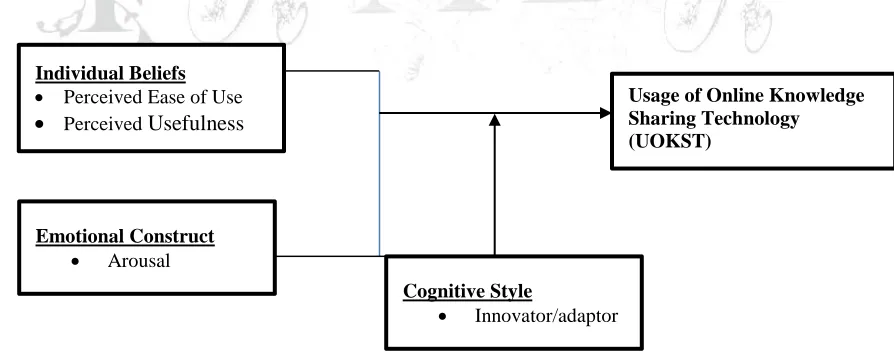
The conceptual framework of this study is derived from the theories reviewed above. Based on the above, the interconnectivity between the concepts of individual beliefs, emotion, knowledge sharing technology, and individual differences are drawn in order to provide a clear understanding of the nature of this study. Figure 1 below illustrates the dependent, the independent, and moderating variable of this study.
Figure 1: Conceptual Framework of the Study
Methodology
The target population of this study comprises of the academic staff that is currently employed in RUs. According to the National Education Statistics (2013) data, the total number of academic staff employed in research universities in Malaysia is 11,190. This sample was calculated based on Hair et al. (2010)
Individual Beliefs
Perceived Ease of Use
PerceivedUsefulness
Emotional Construct
Arousal
Usage of Online Knowledge Sharing Technology (UOKST)
Cognitive Style
ISSN: 2306-9007 Munusamy & Arumugam (2017) 248
I
www.irmbrjournal.com March 2017I
nternationalR
eview ofM
anagement andB
usinessR
esearchVol. 6 Issue.1
R
M
B
R
suggestion. Hair et al. (2010) explained that a minimum sample size of 300 is required if the research model of the study consists of seven or less latent constructs, where some constructs have less than three items. As per the conceptual model of this research, as seen in Figure 1, the study consist of five constructs (PUE, PEOU, Arousal, cognitive style and UOKST); thus the minimum sample size required is 300 samples. Further, this study employed a multistage cluster sampling technique. The data was collected from selected faculties, from the research universities listed in Malaysia. A multistage cluster sampling was more appropriate for the current study because it involves two levels of sample selection; and this particular sampling technique suits well to a large scaled sampled survey (Preston, 2009). A self-administrated questionnaire was used as a tool for data collection. In this study, data was generated from a structured questionnaire comprising items from five constructs. The constructs measured in this study are Perceived Usefulness (PU), Perceived Ease Of Use (PEOU), Arousal (Aro), cognitive style and Usage of Online Knowledge Sharing Technology (UOKST). The items of this questionnaire were adapted from previous validated items to suit the needs of this study. The questionnaires were administrated to the respondents in English, as all the respondents were academic staff who are proficient in the language.
Analysis
In Structural Equation Modeling (SEM), there are three levels of analysis namely: Confirmatory Factor Analysis (CFA), Measurement Model and Structural Model. The first two are for data preparation while the last one is for full pledge SEM. Thus, CFA and Measurement Model were analyzed.
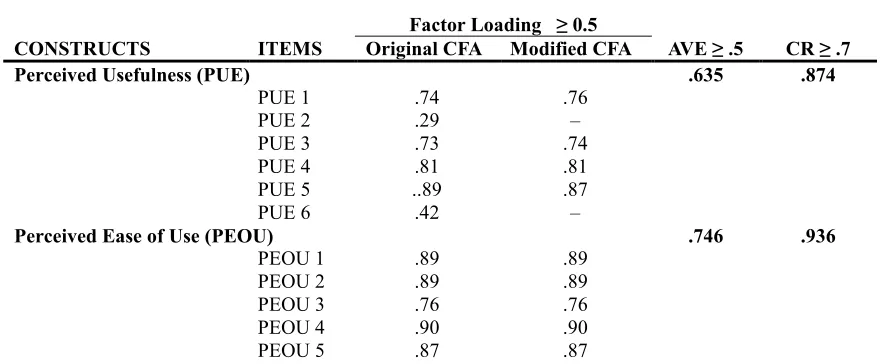
The CFA is more or less a prerequisite for Measurement Model in which both the number of factor loadings and their corresponding indicators are clearly defined (Kline, 2011). To test for convergent validity and construct relativity, Confirmatory Factor Analysis (CFA) was assessed. Therefore, Table 1 below illustrates the first and the modified CFAs of the construct‟s items in which all the items that did not meet the cut-off point of 0.5 were cut off from the path diagrams of CFAs, and the Average Variance Extracted (AVEs) and Construct Reliability (CRs) were also calculated. As shown in Table 1 below, from the beginning, Perceived Usefulness (PUE) has six items, and after the first order CFA, however, the items were cut down to four with AVE = .635 and CR = .874. Perceived Ease of Use (PEOU) has six items, and after conducting first order CFA, one item was eliminated which reduced the items to five with AVE = .746 and CR = .936. However, Usage of Online Knowledge Sharing Technology (UOKST) has eight items and after the first order CFA seven items were retained with AVE = .628 and CR = .920. Lastly, Arousal (ARO) has six items and after the original CFA all the six items were maintained with AVE = .555 and CR = .882.
Table 1: Convergent Validity and Construct Reliability
Factor Loading ≥ 0.5
CONSTRUCTS ITEMS Original CFA Modified CFA AVE ≥ .5 CR ≥ .7
Perceived Usefulness (PUE) .635 .874
PUE 1 .74 .76
PUE 2 .29 –
PUE 3 .73 .74
PUE 4 .81 .81
PUE 5 ..89 .87
PUE 6 .42 –
Perceived Ease of Use (PEOU) .746 .936
PEOU 1 .89 .89
PEOU 2 .89 .89
PEOU 3 .76 .76
PEOU 4 .90 .90
ISSN: 2306-9007 Munusamy & Arumugam (2017) 249
I
www.irmbrjournal.com March 2017I
nternationalR
eview ofM
anagement andB
usinessR
esearchVol. 6 Issue.1
R
M
B
R
Note: AVE: Average Variance Extracted; CR: Critical Ratio
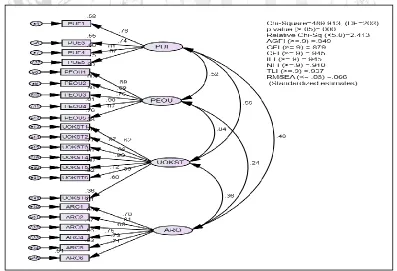
Therefore, the proposed Measurement Model of the study after several adjustments had been made; the researcher came up with modified Measurement Model in Figure 2. Therefore, Goodness-of-Fit indices for the modified Measurement Model are as follows; Chi-Square (2) = 489.913, df =203, p = .000, Relative 2
(2/df) = 2.413, AGFI = .849, GFI = .879, CFI = .945, IFI = .945, NFI, .910, TLI = .937, RMSEA = .066.
From these Goodness-of-Fit indices, the researcher concluded that the Measurement Model fits the data because, Hair et al. (2009) suggested that, if any 3 – 4 of the Goodness-of-Fit indices meets the requirement, then the model is acceptable as measurement model or structural model.
Figure 2: Modified Measurement Model
PEOU 6 .48 –
Usage of Online Knowledge Sharing Technology (UOKST)
.628 .920
UOKST 1 .61 .62
UOKST 2 .87 .87
UOKST 3 .88 .88
UOKST 4 .89 .90
UOKST 5 .88 .89
UOKST 6 .74 .72
UOKST 7 .69 –
UOKST 8 63 .60
Arousal (ARO) .555 .882
ARO 1 .78 –
ARO 2 .81 –
ARO 3 .68 –
ARO 4 .75 –
ARO 5 .73 –
ISSN: 2306-9007 Munusamy & Arumugam (2017) 250
I
www.irmbrjournal.com March 2017I
nternationalR
eview ofM
anagement andB
usinessR
esearchVol. 6 Issue.1
R
M
B
R
Next, the study performs a structural model analysis to examine the moderating effect of cognitive style on the relationship between perceived usefulness, perceived ease of use, arousal, and usage of online knowledge sharing technology. By default, AMOS has the facility of estimating the moderating effect through Multi-Group Analysis (Arbuckle, 2013). Therefore, in this case, the moderator variable must be a categorical variable. In this regard, cognitive style is the moderating variable which happens to be a continuous variable. This variable (cognitive style) was categorized into two groups namely; Adaptor Category and Innovative Category. Adaptor Category is assumed to be group „1‟ and Innovator is assumed to be group „2‟ respectively.
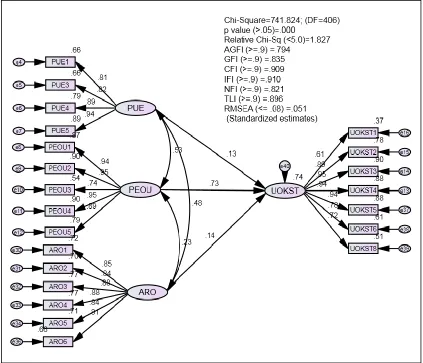
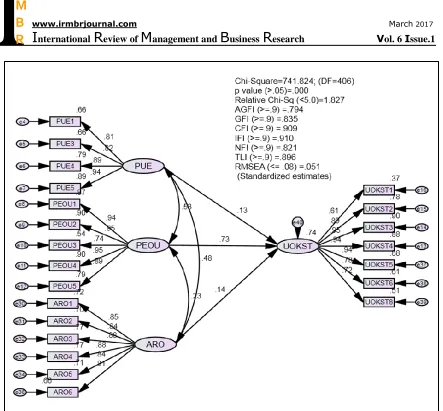
In order to test for the moderating effect of cognitive style on the relationship between perceived usefulness, perceived ease of use, arousal and usage of online knowledge sharing technology, the model fit has to be tested. Therefore, Figure 5 and 6 below, illustrates the Goodness-of-Fit indices of the Structural Models for testing the moderating effect of cognitive style on the relationship between perceived usefulness, perceived ease of use, arousal and usage of online knowledge sharing technology. Therefore, for estimating the moderating effect using AMOS, one has to test for a moderating role in the entire model. The Goodness-of-Fit indices for the Unconstrained Model for both groups (Adaptor and Innovator) are; Chi – Square 2 (CMIN) = 741.824 (df = 406), Relative 2 (CMIN/df) = 1.827, AGFI = .794, GFI = .835,
CFI = .909, IFI = .910, NFI = .821, TLI = .896, RMSEA = .051. According to Hair et al., (2010) if any 3 or 4 of the Goodness-of-Fit indices are within the threshold, then the entire model is fit. Therefore based on this reason, both the Structural Models for testing the moderating effect of the role of cognitive style, fit the data.
The following hypothesis were tested in this study:
HC1: Cognitive style moderates the relationship between perceived usefulness and usage of online
knowledge sharing technology usage among the respondents.
The Structural Model showed that the standardized regression weight of perceived usefulness in relation to usage of online knowledge sharing technology was inconsistent with the hypothesis by indicating the moderating effect of cognitive style on the relationship between perceived usefulness and usage of online knowledge sharing technology. This means the relationship between perceived usefulness and usage of online knowledge sharing technology was not moderated by cognitive style [Adaptor (β = .128, p > .05) and Innovator (β = .081, p > .05)], so, HC1 is not supported.
HC2: Cognitive style moderates the relationship between perceived ease of use and usage of online
knowledge sharing technology among the respondents.
Similarly, the analysis indicated that cognitive style did not moderate the relationship of perceived ease of use and usage of online knowledge sharing technology [Adaptor (β = .733, p < .05) and Innovator (β = .552, p < .05)]. This means that standardized regression weight of perceived ease of use in relation to usage of online knowledge sharing technology were both significant across the two categories which is no consistent with the Hair‟s et.al (2010) rule of thumb. Thus, HC2 is not supported.
HC3: Cognitive style moderates the relationship between arousal and usage of online knowledge sharing
technology among the respondents.
ISSN: 2306-9007 Munusamy & Arumugam (2017) 251
I
www.irmbrjournal.com March 2017I
nternationalR
eview ofM
anagement andB
usinessR
esearchVol. 6 Issue.1
R
M
B
R
Table 2: Result of Moderating Test of Cognitive style on Relationship between Perceived Usefulness, Perceived Ease of Use, Arousal, and Usage of Online Knowledge Sharing technology
Constructs B β p
Perceived Usefulness (PUE)
Adaptor .139 .128 .082
Innovator .053 .081 399
Perceived Ease of Use (PEOU)
Adaptor .726 .733 .000
Innovator .417 .552 .000
Arousal (ARO)
Adaptor .230 .138 .028
Innovator .043 .053 .531
Note: B:- Unstandardized Regression Weight Estimate; β:- Standardized Regression Weight Estimate; p:- p – value.
Figure 3: Unconstrained Model explaining the moderating effect of cognitive style (Adaptor Category) on the relationship between perceived usefulness, perceived ease of use, arousal and usage of online
ISSN: 2306-9007 Munusamy & Arumugam (2017) 252
I
www.irmbrjournal.com March 2017I
nternationalR
eview ofM
anagement andB
usinessR
esearchVol. 6 Issue.1
R
M
B
R
Figure 4: Unconstrained Model explaining the moderating effect of cognitive style (Innovator Category) on the relationship between perceived usefulness, perceived ease of use, arousal and usage of online
knowledge sharing technology (UOKST)
Discussion
Firstly, the model comparison which tested the two separate models (innovator and adaptor category) as in Figure 5 and 6 showed that there is a form of moderating effect of cognitive style in the overall model.
Secondly, moderating effect on the individual paths was tested. Here, hypothesis HC1, HC2, and HC3 were
developed to test the moderating effect of cognitive style on the relationship between PUE, PEOU, ARO, and UOKST.
Table 3 showed that hypothesis HC3 was supported and cognitive style was found to moderate the
ISSN: 2306-9007 Munusamy & Arumugam (2017) 253
I
www.irmbrjournal.com March 2017I
nternationalR
eview ofM
anagement andB
usinessR
esearchVol. 6 Issue.1
R
M
B
R
Table 3: Hypothesis and Summary of the Results for Cognitive style as a Moderator. Relationship
between IVs and DV
Hypothesis Results
HC1
HC2
HC3
Cognitive style moderates the relationship between PUE and UOKST among the respondents
Cognitive style moderates the relationship between PEOU and UOKST among the respondents
Cognitive style moderates the relationship between ARO and UOKST among the respondents
Not Supported
Not Supported
Supported
The findings of the study are in line with most of the studies on technology usage and cognitive style. For instance, Kirton (2003); Armstrong (2000); Cools and Sadler-Smith (2012) have highlighted that the differences in cognitive style will have significant influence on technology adoption and usage. Similarly, their findings were also consistent with Saeed, Yang, and Sinnappan, (2009) Chakraborty, Hu, and Cui (2008), and, Zamzuri, Shahrom, Kasim, Nasir and Mamat (2011). In fact, Hong, Thong, Wong, and Tam (2002); Nov and Ye‟s (2008) stress that individual cognitive style and its influences on users‟ individual beliefs and technology usage is significant in technology research as individuals think and behave differently towards different situations due to differences in personality. However, it is important to note that the influence of cognitive style as moderator is only on arousal and UOKST. Cognitive style that moderate the relationship between arousal and knowledge repository usage, shows that the relationship between technology usage and arousal is strengthen by cognitive differences. Therefore, it can be said that feelings or emotional states do predict or explain why such behaviour occurs. However, influence of cognitive style as a moderator on the relationship between PUE, PEOU and UOKST could not be established in this study. Academic staff in general showed a cognitive style that does not influence the function effect of the technology when they have to make a decision to use the technology. Here, although the academic staff possessed some individual differences, these differences failed to affect the way they responded to the usage of technology for knowledge sharing.
Conclusion
The present study shows that cognitive style moderates the relationship between arousal and usage of online knowledge sharing technology. Therefore, here, cognitive style adds strength to the relationship. It is not surprising then to say that the emotional state of the academic staff influences the knowledge sharing behaviour and individual differences within them to a certain extent affects the relationship. As the findings of the study suggested that cognitive differences to certain extent affects the relationship between PEU, PEOU and arousal and usage behaviour, as such, by following up the possibility of investigating whether an academic position and ranking in university could determine or influence their knowledge sharing behaviour could lit to a new findings. This could possibly shed a better understanding on knowledge sharing behaviour as academics staffs in universities hold different positions and rankings.
References
Adams, D. A., Nelson, R. R., & Todd, P. A. (1992). Perceived Usefulness, Ease of Use, and Usage of Information Technology: A Replication. MIS Quarterly, 16(2), 227–247.
Agarwal, R., & Karahanna, E. (2000). Time flies when you're having fun: Cognitive absorption and beliefs about information technology usage. MIS quarterly, 665-694.
ISSN: 2306-9007 Munusamy & Arumugam (2017) 254
I
www.irmbrjournal.com March 2017I
nternationalR
eview ofM
anagement andB
usinessR
esearchVol. 6 Issue.1
R
M
B
R
Arbuckle, J. L. (2013). Amos (Version 22.0). Computer Program]. Chicago: SPSS/IBM.
Armstrong, S. J. (2000). The influence of individual cognitive style on performance in management education. Educational Psychology, 20(3), 323-339.
Armstrong, S. J., Cools, E., & Sadler‐Smith, E. (2012). Role of cognitive styles in business and management: Reviewing 40 years of research. International Journal of Management Reviews, 14(3), 238-262.
Bagozzi, R. P. (2007). The legacy of the technology acceptance model and a proposal for a paradigm shift. Journal of the association for information systems, 8(4), 3.
Buffington, K. W., Jablokow, K. W., & Martin, K. A. (2002). Project team dynamics and cognitive style. Engineering Management Journal, 14 (3), 25-33.
Buttner, E. H., & Gryskiewicz, N. (1993). Entrepreneurs' problem-solving styles: an empirical study using the Kirton adaption/innovation theory. Journal of Small Business Management, 31(1), 22.
Byrne, B. M. (2013). Structural equation modeling with AMOS: Basic concepts, applications, and programming. (2nd Ed.). Routledge.
Chakraborty, I., Hu, P. J. H., & Cui, D. (2008). Examining the effects of cognitive style in individuals‟ technology use decision making. Decision Support Systems, 45(2), 228–241.
Chau, P. Y., & Hu, P. J. H. (2001). Information technology acceptance by individual professionals: A model comparison approach*. Decision sciences,32(4), 699-719.
Chen, F. F., Sousa, K. H., & West, S. G. (2005). Teacher's corner: Testing measurement invariance of second-order factor models. Structural equation modeling, 12(3), 471-492.
Chen, H. R., & Tseng, H. F. (2012). Factors that influence acceptance of web-based e-learning systems for the in-service education of junior high school teachers in Taiwan. Evaluation and program planning, 35(3), 398-406.
Chen, I. Y., Chen, N. S., & Kinshuk. (2009). Examining the factors influencing participants' knowledge sharing behavior in virtual learning communities. Journal of Educational Technology & Society, 12(1), 134-148.
Cheung, G. W., & Rensvold, R. B. (2002). Evaluating goodness-of-fit indexes for testing measurement invariance. Structural equation modeling,9(2), 233-255.
Cheung, R., Vogel, D. (2013). Predicting user acceptance of collaborative technologies: an extension of the technology acceptance model for e-learning. Computer. Educ. 63, 160–175
Chow, M., Herold, D. K., Choo, T. M., & Chan, K. (2012). Extending the technology acceptance model to explore the intention to use Second Life for enhancing healthcare education. Computers & Education, 59(4), 1136-1144.
Davis, F. D. (1989). Perceived usefulness, perceived ease of use, and user acceptance of information technology. MIS quarterly, 319–340.
Davis, Fred D. (1993). User acceptance of information technology: system characteristics, user perceptions and behavioral impacts. Int. J. Man-Machine Studies, 38, 457–487.
Ding, Y., ; Chai, Kah, H. (2015). Emotions and continued usage of mobile applications. Industrial Management & Data Systems 115.5 . 833-852.
Edwards, J. S., Handzic, M., Carlsson, S., & Nissen, M. (2003). Knowledge management research & practice: visions and directions. Knowledge Management Research & Practice, 1(1), 49-60.
Farahat, T. (2012). Applying the technology acceptance model to online learning in the Egyptian universities. Procedia-Social and Behavioral Sciences, 64, 95-104.
Gefen, D. (2000). E-commerce: the role of familiarity and trust. Omega,28(6), 725-737.
Gong, M., Xu, Y., & Yu, Y. (2004). An enhanced technology acceptance model for web-based learning. Journal of Information Systems Education,15(4), 365.
Hair, J. F., Black, W. C., Babin, B. J., Anderson, R. E., & Tatham, R. L. (2010). Multivariate data analysis (7th Ed) . Upper Saddle River, Pearson Prentice Hall.
Han, S., Lerner, J.S. & Keltner, D. (2007). Feelings and consumer decision making: the appraisal-tendency framework. Journal of Consumer Psychology. 17( 3), 158-168.
ISSN: 2306-9007 Munusamy & Arumugam (2017) 255
I
www.irmbrjournal.com March 2017I
nternationalR
eview ofM
anagement andB
usinessR
esearchVol. 6 Issue.1
R
M
B
R
Hassanzadeh, A., Kanaani, F., & Elahi, S. (2012). A model for measuring e-learning systems success in universities. Expert Systems with Applications,39(12), 10959-10966.
Hislop, D. (2003). Linking human resource management and knowledge management via commitment: A review and research agenda. Employee relations, 25(2), 182-202.
Holsapple, C. W., & Wu, J. (2007). User acceptance of virtual worlds: the Hedonic framework. ACM SIGMIS Database, 38(4), 86-89.
Hong, W., Thong, J. Y., & Wai-Man Wong, K. Y. T. (2002). Determinants of user acceptance of digital libraries: an empirical examination of individual differences and system characteristics. Journal of Management Information Systems, 18(3), 97-124.
Hu, P. J. H., Chau, P. Y., & Sheng, O. R. L. (2002). Adoption of telemedicine technology by health care organizations: An exploratory study. Journal of organizational computing and electronic commerce, 12(3), 197-221.
Hsiao, C.H., Yang, C. (2011)The intellectual development of the technology acceptance model: a co-citation analysis. Int. J. Inf. Manag. 31 , 128–136.
Ipe, M. (2003). Knowledge sharing in organizations: A conceptual framework.Human Resource Development Review, 2(4), 337-359.
Jogiyanto, (2007), Sistem Informasi Keperilakuan, Penerbit Andi Yogyakarta,
Jöreskog, K. G., & Sörbom, D. (1993). LISREL 8: Structural equation modeling with the SIMPLIS command language. Scientific Software International.
Kirton, M. (1976). Adaptors and innovators: A description and measure. Journal of applied psychology, 61(5), 622.
Kirton, M. (Ed.). (1994). Adaptors and innovators: Styles of creativity and problem solving. London: Routledge.
Kline, R. B. (2015). Principles and practice of structural equation modeling. Guilford publications.
Lee, D. Y., & Lehto, M. R. (2013). User acceptance of YouTube for procedural learning: An extension of the Technology Acceptance Model. Computers & Education, 61, 193-208.
Lee, M. K., & Turban, E. (2001). A trust model for consumer internet shopping. International Journal of electronic commerce, 6(1), 75-91.
Leibowitz, J. (2007). Social networking: The essence of innovation. Lanham, MD:Scarecrow Press. Marangunić, N., & Granić, A. (2015). Technology acceptance model: a literature review from 1986 to
2013. Universal Access in the Information Society, 14(1), 81-95.
Mathieson, K. (1991). Predicting user intentions: comparing the technology acceptance model with the theory of planned behavior. Information systems research, 2(3), 173–191.
Nov, O., & Ye, C. (2008). Users' personality and perceived ease of use of digital libraries: The case for resistance to change. Journal of the American Society for Information Science and Technology, 59(5), 845-851.
Osterloh, M., & Frey, B. S. (2000). Motivation, knowledge transfer, and organizational forms. Organization science, 11(5), 538-550.
Park, N., Lee, K.M., Cheong, P.H. (2008). University instructors‟ acceptance of electronic courseware: an application of the technology acceptance model. J. Comput. Mediat. Commun.13,163–186
Park, Y., Son, H., & Kim, C. (2012). Investigating the determinants of construction professionals' acceptance of web-based training: An extension of the technology acceptance model. Automation in Construction, 22, 377-386.
Pavlou, P. A. (2003). Consumer acceptance of electronic commerce: Integrating trust and risk with the technology acceptance model. International journal of electronic commerce, 7(3), 101–134.
Perangkaan Pendidikan Negara: Sektor Pengajian Tinggi.
http://www.mohe.gov.my/web_statistik/Perangkaan-2013.
Preston, J. (2009). Rescaled bootstrap for stratified multistage sampling.Survey Methodology, 35(2), 227-234.
ISSN: 2306-9007 Munusamy & Arumugam (2017) 256
I
www.irmbrjournal.com March 2017I
nternationalR
eview ofM
anagement andB
usinessR
esearchVol. 6 Issue.1
R
M
B
R
Ramayah, T., Yeap, J. A., & Ignatius, J. (2013). An empirical inquiry on knowledge sharing among academicians in higher learning institutions. Minerva, 51(2), 131-154.
Rosen, L. D., Whaling, K., Rab, S., Carrier, L. M., & Cheever, N. A. (2013). Is Facebook creating “iDisorders”? The link between clinical symptoms of psychiatric disorders and technology use, attitudes and anxiety. Computers in Human Behavior, 29(3), 1243-1254.
Saeed, N., Yang, Y., & Sinnappan, S. (2009). Effects of cognitive style on user acceptance of blogs and podcasts. In Advanced Learning Technologies, 2009. ICALT 2009. Ninth IEEE International Conference.293–297.
Schepers, J. J. L., & Wetzels, M. G. M. (2006, May). Technology acceptance: a meta-analytical view on subjective norm. In Proceedings of the 35th European Marketing Academy Conference, Athens, Greece.
Sirajuddin. S., Ahmad, Z., Abu, B., & Rose, A., A. (2006). Knowledge Sharing Culture in Malaysian Public Institution of Higher Education : An Overview
Sue-Chern. (2014, September 16). 5 Malaysian universities ranked higher this year in global survey. The Malaysian Insider. Retrieved from http://www.themalaysianinsider.com/malaysia/article/5-malaysian-universitiesranked-higher-this-year-in-global-survey
Sumak, B., Hericko, M., & Pusnik, M. (2011). A meta-analysis of e-learning technology acceptance: The role of user types and e-learning technology types. Computers in Human Behavior, 27(6), 2067-2077. Szajna, B. (1996). Empirical evaluation of the revised technology acceptance model. Management science,
42(1), 85-92.
Venkatesh, V. (1999). Creation of favorable user perceptions: Exploring the role of intrinsic motivation. MIS quarterly, 239-260.
Venkatesh, V. (2000). Determinants of perceived ease of use: Integrating control, intrinsic motivation, and emotion into the technology acceptance model. Information systems research, 11(4), 342–365.
Venkatesh, V., Croteau, A. M., & Rabah, J. (2014, January). Perceptions of effectiveness of instructional uses of technology in higher education in an era of Web 2.0. In System Sciences (HICSS), 2014 47th Hawaii International Conference on (pp. 110-119). IEEE.
Wang, J. (2012). Human Resource Development and Technology Integration.
Wang, S., & Noe, R. A. (2010). Knowledge sharing: A review and directions for future research. Human Resource Management Review, 20(2), 115-131.
Wagner, N. L., Hassanein, K., & Head, M. M. (2008). Who is Responsible for E-Learning Success in Higher Education? A Stakeholders' Analysis.Educational Technology & Society, 11(3), 26-36.
Zailani, S., Ong, H. K., & Shahnon, S. (2006). The adoption of information and communications technology (ICT) for effective knowledge management in the small and medium industry in Malaysia. Asian Journal of Information Technology, 5(1), 28-33.
Zaiţ, A., & Bertea, P. S. P. E. (2011). Methods for testing discriminant validity. Management & Marketing Journal, 9(2).
Zamzuri, N. H., Shahrom, M., Kasim, E. S., Nasir, H. M., & Mamat, M. N. (2012). The Role of Cognitive Styles in Influencing the users‟ Satisfaction on E-Learning System. Procedia - Social and Behavioral Sciences, 67, 427–435.
Zawawi, A. A., Zakaria, Z., Kamarunzaman, N. Z., Noordin, N., Sawal, M. Z. H. M., Junos, N. M., & Najid, N. S. A. (2011). The study of barrier factors in knowledge sharing: A case study in public university. Management Science and Engineering, 5(1), 59.