V.G.Muralishankar et al, International Journal of Computer Science and Mobile Applications, Vol.2 Issue. 3, March- 2014, pg. 18-24 ISSN: 2321-8363
©2014, IJCSMA All Rights Reserved, www.ijcsma.com 18
Routing Protocols for MANET:
A Literature Survey
V.G.Muralishankar
#1, Dr. E. George Dharma Prakash Raj
*2#1
School of Computer Science and Engineering, Bharathidasan University, Trichy
*2
School of Computer Science and Engineering, Bharathidasan University, Trichy
#1
*2
Abstract
Mobile ad hoc networks (MANETs) are autonomously self-organized networks without infrastructure support. In a mobile ad hoc network, nodes move arbitrarily; therefore the network may experience rapid and unpredictable topology changes. Because nodes in a MANET normally have limited transmission ranges, some nodes cannot communicate directly with each other. Hence, routing paths in mobile ad hoc networks potentially contain multiple hops, and every node in mobile ad hoc networks has the responsibility to act as a router. This paper is a survey of active project work on routing protocols for MANET.
Keywords- MANETs, Proactive and Reactive Routing Protocols, Unicasting, Multicasting
1. INTRODUCTION
Active research work for MANETs is carrying on mainly in the fields of Medium Access Control (MAC), routing, resource management, power control, and security. Because of the importance of routing protocols in dynamic multihop networks, a lot of MANET routing protocols have been proposed in the last few years. Considering the special properties of MANET, when thinking about any routing protocol, generally the following properties are expected, though all of these might not be possible to incorporate in a single solution.
nal links because wireless medium may cause a wireless link to be opened in unidirection only due to physical factors.
-efficient.
be much more reactive than proactive to avoid overhead.
V.G.Muralishankar et al, International Journal of Computer Science and Mobile Applications, Vol.2 Issue. 3, March- 2014, pg. 18-24 ISSN: 2321-8363
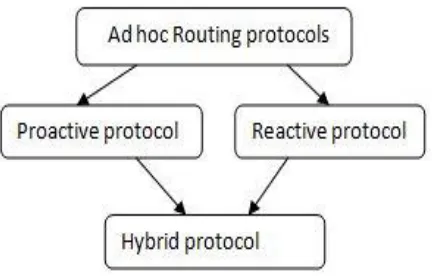
©2014, IJCSMA All Rights Reserved, www.ijcsma.com 19 Fig. 1 : Classification of Routing protocols
Evolution of MANET
In 1970, Normanl Abramson and his fellow researchers at the University of Hawaii invented ALOHAnet. In 1972 DARPA Packet Radio Network (PRNet) In 1980 Survivable Radio Networks (SURAN). During 1980 emergence of Internet Emerging Task Force (IETF), termed the mobile ad hoc networking group. A Mobile Ad Hoc Network (MANET) is a collection of wireless mobile nodes forming a temporary/short-lived network without any fixed infrastructure where all nodes are free to move about arbitrarily and where all the nodes configure themselves. In MANET, each node acts both as a router and as a host & even the topology of network may also change rapidly. Some of the challenges in MANET include:
1) Unicast routing 2) Multicast routing
3) Dynamic network topology 4) Speed
5) Frequency of updates or Network overhead 6) Scalability
7) Routing
8) Quality of Service
2. CLASSIFICATION OF ROUTING PROTOCALS FOR MANET
MANET routing protocols could be broadly classified into two major categories: Proactive and Reactive. Proactive Routing Protocols: Proactive protocols continuously learn the topology of the network by exchanging topological information among the network nodes. Thus, when there is a need for a route to a destination, such route information is available immediately. If the network topology changes too frequently, the cost of maintaining the network might be very high. If the network activity is low, the information about actual topology might even not be used.
V.G.Muralishankar et al, International Journal of Computer Science and Mobile Applications, Vol.2 Issue. 3, March- 2014, pg. 18-24 ISSN: 2321-8363
©2014, IJCSMA All Rights Reserved, www.ijcsma.com 20
Hybrid Routing Protocols: Often reactive or proactive feature of a particular routing protocol might not be enough; instead a mixture might yield better solution. Hence, in the recent days, several hybrid protocols are also proposed.
Based on the method of delivery of data packets from the source to destination, classification of MANET routing protocols could be done as follows:
from a single source.
s: Multicast is the delivery of information to a group of destinations simultaneously, using the most efficient strategy to deliver the messages over each link of the network only once, creating copies only when the links to the destinations split.
Multicast routing protocols for MANET use both multicast and unicast for data transmission. Multicast routing protocols for MANET can be classified again into two categories: Tree-based multicast protocol and Mesh-based multicast protocol. Mesh-based routing protocols use several routes to reach a destination while the tree-based protocols maintain only one path.
2.1 PROACTIVE ROUTING PROTOCOLS
A. Dynamic Destination-Sequenced Distance-Vector Routing Protocol (DSDV)
DSDV[1] is developed on the basis of Bellman–Ford routing[2]algorithm with some modifications. In this routing protocol, each mobile node in the network keeps a routing table. Each of the routing table contains the list of all available destinations and the number of hops to each. Each table entry is tagged with a sequence number, which is originated by the destination node. Periodic transmissions of updates of the routing tables help maintaining the topology information of the network. If there is any new significant change for the routing information, the updates are transmitted immediately. So the routing information updates might either be periodic or event driven. DSDV protocol requires each mobile node in the network to advertise its own routing table to its current neighbors. The advertisement is done either by broadcasting or by multicasting. By the advertisements, the neighboring nodes can know about any change that has occurred in the network due to the movements of nodes
B. Wireless Routing Protocol (WRP)
WRP[3] belongs to the general class of path-finding algorithms [2,4,5], defined as the set of distributed shortest path algorithms that calculate the paths using information regarding the length and second-to-last hop of the shortest path to each destination. WRP reduces the number of cases in which a temporary routing loop can occur. For the purpose of routing, each node maintains four things: 1. A distance table 2. A routing table 3.A link-cost table 4. A message retransmission list (MRL). WRP uses periodic update message transmissions to the neighbors of a node. The nodes in the response list of update message (which is formed using MRL) should send acknowledgments. If there is no change from the last update, the nodes in the response list should send an idle Hello message to ensure connectivity. A node can decide whether to update its routing table after receiving an update message from a neighbor and always it looks for a better path using the new information.
C. Global State Routing (GSR)
V.G.Muralishankar et al, International Journal of Computer Science and Mobile Applications, Vol.2 Issue. 3, March- 2014, pg. 18-24 ISSN: 2321-8363
©2014, IJCSMA All Rights Reserved, www.ijcsma.com 21
2.2 REACTIVE ROUTING PROTOCOLS
A. Associativity-Based Routing (ABR)
ABR [9] protocol defines a new type of routing metric‚ degree of association stability‛ for mobile ad hoc networks. In this routing protocol, a route is selected based on the degree of association stability of mobile nodes. Each node periodically generates beacon to announce its existence. Upon receiving the beacon message, a neighbor node updates its own associativity table. For each beacon received, the associativity tick of the receiving node with the beaconing node is increased. A high value of associativity tick for any particular beaconing node means that the node is relatively static. Associativity tick is reset when any neighboring node moves out of the neighborhood of any other node.
B. Dynamic Source Routing (DSR)
DSR [10] allows nodes in the MANET to dynamically discover a source route across multiple network hops to any destination. In this protocol, the mobile nodes are required to maintain route caches or the known routes. The route cache is updated when any new route is known for a particular entry in the route cache. Routing in DSR is done using two phases: route discovery and route maintenance. When a source node wants to send apacket to a destination, it first consults its route cache to determine whether it already knows about any route to the destination or not. If already there is an entry for that destination, the source uses that to send the packet. If not, it initiates a route request broadcast.
C. Ad Hoc On-Demand Distance Vector Routing (AODV)
AODV [11] is basically an improvement of DSDV. But, AODV is a reactive routing protocol instead of proactive. It minimizes the number of broadcasts by creating routes based on demand, which is not the case for DSDV. When any source node wants to send a packet to a destination, it broadcasts a route request (RREQ) packet. The neighboring nodes in turn broadcast the packet to their neighbors and the process continues until the packet reaches the destination. During the process of forwarding the route request, intermediate nodes record the address of the neighbor from which the first copy of the broadcast packet is received. This record is stored in their route tables, which helps for establishing a reverse path.
2.3 HYBRID ROUTING PROTOCOLS
V.G.Muralishankar et al, International Journal of Computer Science and Mobile Applications, Vol.2 Issue. 3, March- 2014, pg. 18-24 ISSN: 2321-8363
©2014, IJCSMA All Rights Reserved, www.ijcsma.com 22
3. COMPARISON OF PROTOCOLS
3.1 The Comparison of the different types of Routing Protocols is shown in Table.1.
Parameters Reactive
Protocol Proactive Protocol Hybrid protocol Routing Philosophy
Flat Flat/Hierarchical Hierarchical
Routing Scheme
On Demand
Table driven Combination
of both
Routing overhead
Low High Medium
Latency High due
to flooding
Low due to routing tables Inside zone low outside similar to Reactive protocols Scalability Level Not suitable for large networks Low Designed for large networks Availability of routing information Available when required Always available stored in tables
Combination of both
Periodic Updates Not needed as route available on demand Yes. Whenever the topology of the network changes Yes needed inside the zone Storage Capacity LowgenerallyDepends upon thenumber of routes
High ,due to the routing tables
Depends on the size of Zone,inside the Zonesometimes high asproactive protocol Mobility Support Route maintenance Periodical Updates
V.G.Muralishankar et al, International Journal of Computer Science and Mobile Applications, Vol.2 Issue. 3, March- 2014, pg. 18-24 ISSN: 2321-8363
©2014, IJCSMA All Rights Reserved, www.ijcsma.com 23
3.2 Summary of protocols on the basis of advantages and disadvantages is shown in Table.2.
Protocol Advantages Disadvantages
Proactive Information isalways available.
Latency is reducedin the network
Overhead ishigh, Routinginformation is flooded in thewhole network
Reactive Path available whenneeded overhead is
low and free fromloops.
Latency isincreased in thenetwork
Hybrid Suitable for largenetworks and up to
date informationavailable
Complexityincreases
4. CONCLUSION
This paper presents a number of routing protocols for MANET, which are broadly categorized as proactive and reactive. Proactive routing protocols tend to provide lower latency than that of the on-demand protocols, because they try to maintain routes to all the nodes in the network all the time. But the drawback for such protocols is the excessive routing overhead transmitted, which is periodic in nature without much consideration for the network mobility or load. On the other hand, though reactive protocols discover routes only when they are needed, they may still generate a huge amount of traffic when the network changes frequently. Depending on the amount of network traffic and number of flows, the routing protocols could be chosen.
REFERENCES
[1] Perkins CE, Bhagwat P (1994) Highly Dynamic Destination-Sequenced Distance-Vector Routing (DSDV) for Mobile Computers. Proceedings of ACM SIGCOMM 1994:234–244
[2] Cheng C, Riley R, Kumar SPR, Garcia-Luna-Aceves JJ (1989) A Loop- Free Extended Bellman-Ford Routing Protocol Without Bouncing Effect. ACM SIGCOMM Computer Communications Review, Volume 19, Issue 4:224– 236
[3] Murthy S, Garcia-Luna-Aceves JJ (1996) An Efficient Routing Protocol for Wireless Networks. Mobile Networks and Applications, Volume 1, Issue 2:183–197
[4] Humblet PA (1991) Another Adaptive Distributed Shortest-Path Algorithm. IEEE Transactions on Communications, Volume 39, Issue 6:995–1003
[5] Rajagopalan B, Faiman M (1991) A Responsive Distributed Shortest- Path Routing Algorithm Within Autonomous Systems. Journal of Internetworking Research and Experiment, Volume 2, Issue 1:51–69
V.G.Muralishankar et al, International Journal of Computer Science and Mobile Applications, Vol.2 Issue. 3, March- 2014, pg. 18-24 ISSN: 2321-8363
©2014, IJCSMA All Rights Reserved, www.ijcsma.com 24
[7] Ji L, Corson MS (2001) Differential DestinationMulticast-A MANETMulticast Routing Protocol for Small Groups. Proceedings of IEEE INFOCOM 2001, Volume 2:1192–1201
[8] Jiang M, Li J, Tay YC (1999) Cluster Based Routing Protocol (CBRP). IETF Draft, August 1999, available at http://tools.ietf.org/html/draftietf- manet-cbrp-spec-01. Accessed 21 February 2008
[9] Broch J, Johnson DB, Maltz DA (1999) The Dynamic Source Routing Protocol for Mobile Ad Hoc Networks. IETF Draft, October, 1999,available at http://tools.ietf.org/id/draft-ietf-manet-dsr-03.txt. Accessed 21 February 2008
[10] Perkins CE, Royer EM, Chakeres ID (2003) Ad hoc On-Demand Distance Vector (AODV) Routing. IETF Draft, October, 2003, availableat http://tools.ietf.org/html/draft-perkins-manet-aodvbis-00. Accessed 21 February 2008
[11] Sisodia RS, Karthigeyan I, Manoj BS, Murthy CSR (2003) A Preferred Link Based Multicast Protocol for Wireless Mobile Ad Hoc Networks. Proceedings of IEEE ICC 2003, Volume 3:2213–2217