Jstacs: A Java Framework for Statistical Analysis and Classification of
Biological Sequences
Jan Grau∗ [email protected]
Institute of Computer Science
Martin Luther University Halle–Wittenberg D-06099 Halle (Saale), Germany
Jens Keilwagen∗ [email protected]
Leibniz Institute of Plant Genetics and Crop Plant Research (IPK) Corrensstraße 3
D-06466 Stadt Seeland, OT Gatersleben, Germany
Andr´e Gohr [email protected]
Institute of Computer Science
Martin Luther University Halle–Wittenberg D-06099 Halle (Saale), Germany
Berit Haldemann [email protected]
Department of Computer Science Humboldt University of Berlin
Unter den Linden 6, D-10099 Berlin, Germany
Stefan Posch [email protected] Ivo Grosse [email protected]
Institute of Computer Science
Martin Luther University Halle–Wittenberg D-06099 Halle (Saale), Germany
Editor:Antti Honkela
Abstract
Jstacs is an object-oriented Java library for analysing and classifying sequence data, which emerged from the need for a standardized implementation of statistical models, learning principles, classi-fiers, and performance measures. In Jstacs, these components can be used, combined, and extended easily, which allows for a direct comparison of different approaches and fosters the development of new components. Jstacs is especially tailored to biological sequence data, but is also applicable to general discrete and continuous data. Jstacs is freely available athttp://www.jstacs.deunder the GNU GPL license including an API documentation, a cookbook, and code examples.
Keywords: machine learning, statistical models, Java, bioinformatics, classification
1. Introduction
During the last years, machine learning techniques have gained an increasing importance in many fields of science including bioinformatics and computational biology. A plethora of new or im-proved statistical models, learning principles, and classification approaches has evolved.
One critical step in assessing their relevance is the comparison to existing methods. Such direct comparisons are hampered, if the approaches compared are implemented in stand-alone applications or web-servers or if different performance measures are being used. In addition, the same building blocks, such as statistical models or evaluation of performance measures, are implemented repeat-edly, which induces an unnecessary implementation overhead slowing down scientific progress.
These observations lead to the development of Jstacs as an object-oriented open-source library. In contrast to other libraries like JavaML (Abeel et al., 2009) or Shogun (Sonnenburg et al., 2010), Jstacs focuses on statistical models and statistical learning principles. Similar to JavaML, Jstacs is mainly targeted at developers who want to use the library in their own code.
In a typical Jstacs application for sequence classification, a user first chooses appropriate statis-tical models for the data of the different classes. One then combines these models to a classifier, chooses a learning principle for learning the parameters of this classifier, and learns this classifier on training data. Finally, one uses the classifier for predicting class labels for previously unseen data. For assessing the performance of the classifier, one can choose an evaluation schema like cross-validation and choose different performance measures.
At each of these steps, one may use a statistical model, classifier, learning principle, evaluation schema, or performance measure existing in Jstacs, or implement and use new ones. At each level, Jstacs defines interfaces and abstract classes to standardize and ease development, and to achieve modularity. Thus, a replacement of one component does not require a modification of other parts.
Jstacs has been applied to diverse biological problems such as prediction of transcription factor binding sites and splice sites, de-novo motif discovery, analysis of gene expression and Array-CGH data, and classification based on flow cytometry data.
In the following section, we describe the general structure, essential interfaces, and abstract classes of Jstacs. In a case study, we show how these can be used for building a problem-specific application.
2. The Jstacs Library
In Jstacs, data representation is organized at three levels: alphabets, sequences, and data sets. The most prevalent alphabet in Jstacs is theDNAAlphabet, while more general implementations can be used for instance to define a three-letter amino acid alphabet. Sequences are defined using such alphabets, whileDataSets comprise a collection of sequences over the same alphabet. DataSets are constructed either from an existing array of sequences or from a file. The latter is the standard way of loading data into Jstacs. In addition,DataSets can be sampled from statistical models.
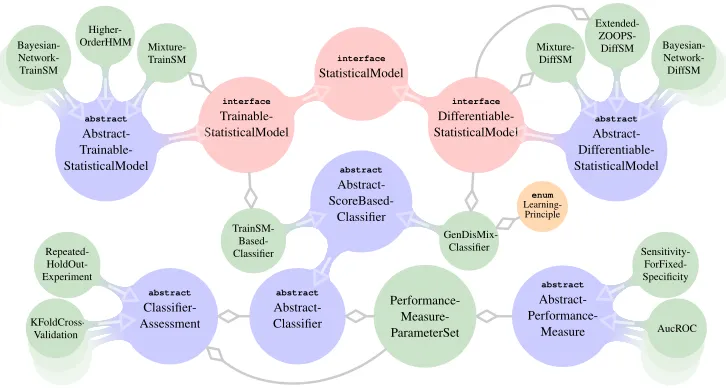
On the algorithmic side, Jstacs is organized around two central types depicted in Figure 1: the abstract classAbstractClassifierand the interfaceStatisticalModel, including two sub-interfaces TrainableStatisticalModel and DifferentiableStatisticalModel abbreviated
asTrainSM and DiffSM, respectively. For these interfaces, Jstacs provides abstract classes with
standard implementations of many of the specified methods to reduce implementation effort as well as factory classes enabling user-friendly creation of many standard models.
TrainableStatisticalModels provide methods for training the parameters of the model from
one data set. For example, this can be accomplished generatively by analytic parameter estimation. Current implementations include inhomogeneous and homogeneous Markov models, Bayesian net-works, hidden Markov models, and mixture models accepting anyTrainableStatisticalModel
abstract Abstract-Classifier abstract Abstract- ScoreBased-Classifier TrainSM- Based-Classifier GenDisMix-Classifier enum Learning-Principle abstract Classifier-Assessment KFoldCross-Validation Repeated- HoldOut-Experiment interface StatisticalModel interface Trainable-StatisticalModel abstract Abstract- Trainable-StatisticalModel Bayesian- Network-TrainSM Higher-OrderHMM Mixture-TrainSM interface Differentiable-StatisticalModel abstract Abstract- Differentiable-StatisticalModel Bayesian- Network-DiffSM Extended- ZOOPS-DiffSM Mixture-DiffSM Performance- Measure-ParameterSet abstract Abstract- Performance-Measure AucROC Sensitivity- ForFixed-Specificity
Figure 1: Part of the class structure of Jstacs. Theinterfaces are colored red,abstractclasses blue, enums orange, and concrete classes green without preceeding modifier. Continu-ous transitions represent inheritance, where arrows indicate the direction of inheritance. Arrows with diamond heads represent usage of a type in the class at the arrow head.
In contrast,DifferentiableStatisticalModels provide methods tailored to numerical opti-mization like the computation of gradients with respect to their parameters. Jstacs provides several
DifferentiableStatisticalModels including Markov models, Bayesian networks, and
mix-tures ofDifferentiableStatisticalModels. In addition, a ZOOPS1 model for de-novo motif discovery is implemented inExtendedZOOPSDiffSM, which will be the topic of the case study.
AbstractClassifiers provide methods for learning internal StatisticalModels on
train-ing data from different classes and for classifytrain-ing new input sequences. The
TrainSMBased-Classifier trains each of the providedTrainableStatisticalModels separately on the data
set for the corresponding class. TheGenDisMixClassifierperforms a simultaneous numerical parameter estimation for the enclosedDifferentiableStatisticalModel, for instance by max-imum supervised posterior (MSP) (Gr¨unwald et al., 2002; Cerquides and de M´antaras, 2005), or a unified learning principle (GenDisMix) (Keilwagen et al., 2010).
ClassifierAssessments can be used for assessing the performance of any
AbstractClassifier, for example byk-fold cross validation or repeated holdout sampling. Here,
the user may choose one or multiple performance measures such as sensitivity, precision, or the areas under the receiver operating characteristic and precision-recall curve.
3. Case Study
In this section, we describe how we used Jstacs for developing Dispom, a new application for de-novo motif discovery (Keilwagen et al., 2011). Existing approaches for de-de-novo motif discovery
ExtendedZOOPSDiffSM motif
model flanking
model
position distribution
background model
GenDisMix Classifier
learning principle
⇒
ExtendedZOOPSDiffSM Strand
DiffSM Markov Model DiffSM
Homoge-neousMM DiffSM
Mix-tureDDSM
Uniform DDSM Skew Normal LikeDDSM
Homoge-neousMM DiffSM
GenDisMix Classifier maximum supervised posterior
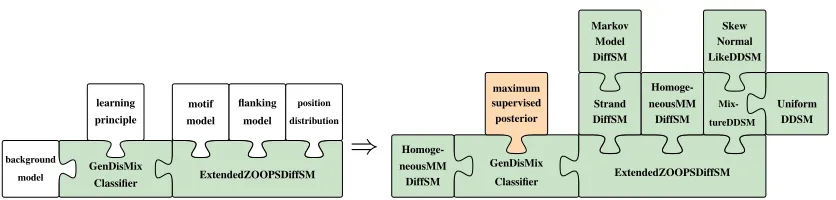
Figure 2: Structure of Dispom within Jstacs. The left side illustrates, how modules can be plugged into the core structure. The right side shows the concrete classes used in the application.
differ in the employed learning principle and in the capability of learning the positional preference of motif occurrences. However, prior to Dispom, no approach existed for learning the motif and the positional preference simultaneously using a discriminative learning principle. The general structure of Dispom in Jstacs is depicted on the left side of Figure 2, where each white piece represents a slot that can be filled with implementations of interfaces defined in Jstacs.
The motif, flanking, and background model areDifferentiableStatisticalModels, the po-sition distribution is aDurationDiffSM, and the learning principle is a value from anenumtype. In the Dispom application illustrated on the right side of Figure 2, we use an inhomogeneous Markov model of order 0 with a mixture over the DNA-strands as motif model. We use homogeneous Markov models of order 0 for both the flanking and background model. All of these models existed before we started developing Dispom. We use a mixture of a skew normal and a uniform distribution as position distribution, and the discriminative MSP learning principle.
This modular structure allowed for an easy adaption to other problems like challenge 2 of DREAM52on protein binding microarray data, where we simply increased the orders of the motif, flanking, and background model, and extended the learning principle to a weighted variant of the MSP principle. These minimal changes were all that was needed for developing a novel application for the analysis of protein binding microarrays and a successful performance in the challenge.
4. Author Contributions
JG, AG, SP and IG initiated the project and JG and AG were main developers. Later, JK joined as a main developer, and AG contributed occasionally. BH contributed to parts of Jstacs and to documentation. All authors contributed to writing and approved the final manuscript.
Acknowledgments
We thank Michael Scharfe and Michael Seifert for their contributions to Jstacs, and Ralf Eggeling, Martin Gleditzsch, Michaela Mohr, Birgit M¨oller, Martin Porsch, and Marc Strickert for valuable discussions. This work was supported by grant 0312706A by the German Ministry of Education and Research (BMBF) and grant XP3624HP/0606T by the Ministry of Culture of Saxony-Anhalt.
References
Thomas Abeel, Yves Van de Peer, and Yvan Saeys. Java-ML: A machine learning library. Journal of Machine Learning Research, 10:931–934, June 2009.
Jes´us Cerquides and Ramon L´opez de M´antaras. Robust Bayesian linear classifier ensembles. In Proceedings of the 16th European Conference on Machine Learning, volume 3720 of Lecture Notes in Computer Science, pages 72–83. Springer, 2005.
Peter Gr¨unwald, Petri Kontkanen, Petri Myllym¨aki, Teemu Roos, Henry Tirri, and Hannes Wet-tig. Supervised posterior distributions. Presented at the Seventh Valencia International Meet-ing on Bayesian Statistics, 2002. URL http://homepages.cwi.nl/˜pdg/presentations/
Valencia2.pdf.
Jens Keilwagen, Jan Grau, Stefan Posch, Marc Strickert, and Ivo Grosse. Unifying generative and discriminative learning principles. BMC Bioinformatics, 11(1):98, 2010.
Jens Keilwagen, Jan Grau, Ivan A. Paponov, Stefan Posch, Marc Strickert, and Ivo Grosse. De-novo discovery of differentially abundant transcription factor binding sites including their positional preference. PLoS Computational Biology, 7(2):e1001070, 02 2011.