IJBCP
International Journal of Basic & Clinical Pharmacology
Original Research Article
Comparing the efficacy of 7%, 5% hypertonic saline and 0.9% normal
saline in acute bronchiolitis: a randomized controlled trial
Adel Ahadi, Manouchehr Barak*, Fatemeh Amani
INTRODUCTION
Acute viral bronchiolitis is one of the most common causes of lower respiratory tract infection during infancy and also the most common cause of hospital admission among infants and young children in many countries. Bronchiolitis is most common in the first 2 years of life.1,2
Usually, the child first experiences colds, such as cough, runny nose, and after two or three days, a sudden onset of breathing, wheezing, swollen and superficial breathing (up to 60 times per minute), interstitial spaces and abdomen (Swirling movements), coughing, fever, wheeze and
crackle in the lungs, nasal sprains, the use of subcutaneous muscles and increased heart rate, decreased oxygen saturation.3
For disease diagnosis, laboratory and radiologic check is not usually needed. Diagnosis of bronchiolitis is a clinical diagnosis and is done based on patient history, physical examination and exclusion of other causes of respiratory distress. For bronchiolitis no short-term or long-term treatment has ever been confirmed and the treatment is still supportive and oxygen prescription, fluid and suction secretions from the upper airway and mechanical ventilation if necessary. In cases where the pathogen is a
ABSTRACT
Background: The study aimed to investigate the effect of nebulized 5% and 7% Hypertonic Saline (HS) versus Normal Saline (NS) in acute viral bronchiolitis. Methods: This is a prospective, randomized controlled trial study that has been done on 90 infants presenting with acute bronchiolitis. All infants divided randomly in three equal size and matched groups (n=30). Subjects received 4ml nebulized 5% and 7% HS along with 0.15mg/kg Adrenaline or 4 ml 0.9%NS every 6 hours from enrolment until hospital discharge. For all patients, clinical symptoms such as sputum, wheezing, retraction rate, heart rate, fever, crackle, irritability, week nutrition and breathing were recorded in baseline and length of wheezing, cough, and crackle, length of stay (LOS), fever and sputum based on days in the end of study. Collected data analyzed by statistical methods in SPSS.19.
Results: At baseline, study groups were similar in demographic and clinical characteristics. The mean age of all patients was 5.5±3.6 months, and 59 (65.6%) were male. The length of cough and crackle, and the length of LOS in 5% and 7% HS groups was significantly lower than NS group.
Conclusions: Among infants admitted to the hospital with viral bronchiolitis, treatment with nebulized 5% HS and 7% HS had significant effect on decreasing clinical symptoms length and LOS when compared with NS.
Keywords: Acute bronchiolitis, Hypertonic saline, Infants DOI: http://dx.doi.org/10.18203/2319-2003.ijbcp20181450
Department of Paediatrics, Faculty of Medicine, Ardabil University of Medical Science Ardabil, Iran
Received: 09 January 2018 Accepted: 31 January 2018
*Correspondence to: Dr. Manouchehr Barak, Email: manouchehrbarak@ gmail.com
virus, antibiotic treatment is not necessary and only the
symptoms such as fever and wheezing are treated.4-7
Currently the inhalation of HS as a treatment option has been proposed and the conducted limited studies in this area have shown that the use of HS has been useful in improving severity scores and the reduction of LOS.7-13 Adrenaline inhalation as a common routine treatment used for bronchiolitis, in addition to expanding the bronchi, may reduce mucosal edema. Considering the limited number of studies and the lack of similar trials in this country Iran, this study was aimed to investigate the effect of nebulized 5% and 7% Hypertonic Saline (HS) versus Normal Saline (NS) in acute viral bronchiolitis.
METHODS
Authors conducted a prospective, randomized controlled trial in 90 infants presenting with acute bronchiolitis.
Patient selection
[image:2.595.50.549.268.369.2]Informed consent was obtained from a parent or legal guardian of each infant enrolled in the study. Patients age 8 weeks to ≤24 months admitted to the children hospital between April 2016 to Sep 2016 with bronchiolitis (defined as first episode of respiratory distress with wheezing and viral) and a bronchiolitis severity score (BSS) more than 4 were eligible for the study (Table 1).14
Table 1: Assessment of bronchiolitis severity in infants based on RDAI scale.
Score symptoms 0 1 2 3
Wheezing
While exhaling None Exhale end Half an Exhale Three quarters of an exhale
While respire None Incomplete Complete -
Number of lobes involved in the
lung 0 1 or 2 3 or 4 -
Retraction
Supraclavicular None Mild Moderate Severe
Between the ribs None Mild Moderate Severe
below the rib cage None Mild Moderate Severe
Inclusion criteria included age ≤24 months, diagnosis of bronchiolitis by pediatrician by clinical examination of wheezing and viral detection and CXR. We excluded infants who had pulmonary and heart disease, Down syndrome, immune deficiency, metabolic disease, inhaled brunch dilator uses or previous episodes of wheezing.
Study protocol
All eligible patients were randomized to 1 of 3 groups. The study groups received 0.15 mg/kg Adrenaline with 4 ml nebulized 5% and 7% HS, respectively and the control group received 0.15 mg/kg Adrenaline with 4 ml 0.9% NS every 6 hours from enrolment until hospital discharge.
LOS and recovery time of clinical symptoms such as cough, wheezing and sputum and other symptoms for all groups were recorded in following days (end of study) objectively by clinical examination by pediatrician. Also, infants were systematically monitored for adverse events during the hospitalization and followed with a phone call by research personnel two weeks after hospital discharge.
Statistical analysis
Authors compared patient demographic and clinical characteristics between groups by using chi-square test for categorical variables and t-test and ANOVA for compare the means between two and three groups. The significant level was set as p<0.05.
This study was approved in ethics committee of Ardabil University of medical sciences with number of arums.rec.1394.19 and registered in Iran clinical trials web pages with code IRCT2015090717843N5.
RESULTS
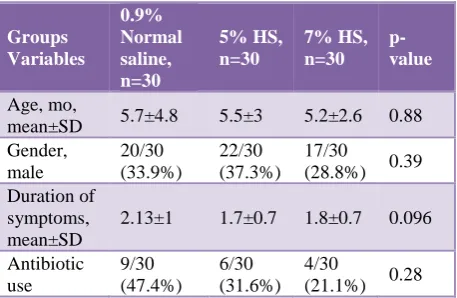
The mean age of the total patients was 5.5 ±3.6 months and most of them were in the age group of 2 to 6 month (58.9%). Of all patients, 59 (65.6%) were male and 19 (2.1%) had taken antibiotics before admission to study. All three groups are similar in-Patient characteristics and clinical symptoms in the admission to study (Tables 2 and Table 3).
Table 2: Characterized of patients in the start of study before intervention.
Groups Variables
0.9% Normal saline, n=30
5% HS, n=30
7% HS, n=30
p-value
Age, mo,
mean±SD 5.7±4.8 5.5±3 5.2±2.6 0.88 Gender,
male
20/30 (33.9%)
22/30 (37.3%)
17/30
(28.8%) 0.39 Duration of
symptoms, mean±SD
2.13±1 1.7±0.7 1.8±0.7 0.096
Antibiotic use
9/30 (47.4%)
6/30 (31.6%)
4/30
[image:2.595.315.544.610.759.2]Table 3: Frequency of clinical symptoms in patients in baseline by three groups.
Symptoms 0.9% Normal Saline, n=30 5% HS, n=30 7% HS, n=30 p-value
Sputum 5 /30 (16.7%)
7/30 (23.3%)
4/30
(13.3%) 0.58
Wheezing 30 /30 (100%)
30/30 (100%)
30/30 (100%) 1
Crackle 25/30 (83.3%)
27/30 (90%)
27/30
(90%) 0.78
Retraction 9/30 (30%)
15/30 (50%)
13/30
(43.3%) 0.28 Increased breathing 23/30 (76.7%) 24/30 (80%) 27/30
(90%) 0.37
Fever 11/30
(36.7%)
17/30 (56.7%)
12/30
(40%) 0.25
Irritability 4/30 (13.3%)
5/30 (16.7%)
5/30
(16.7%) 1 Week nutrition 21/30 (70%) 14/30 (46.7%) 16/30
(53.3%) 0.17 Increased hearth rate 3/30 (10%) 4/30 (13.3%) 6/30
(20%) 0.65
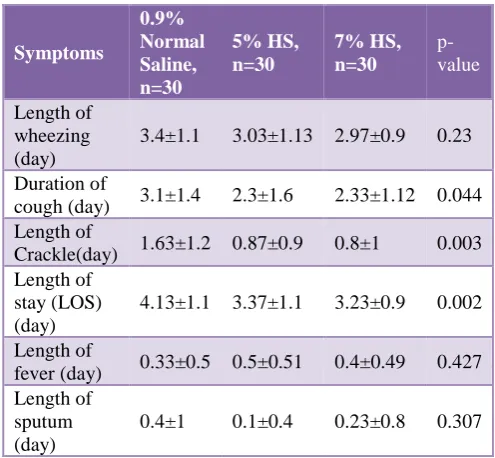
There was significant difference in the mean length of cough, Crackle and LOS between three groups. But there wasn’t significant difference between three groups in terms of Wheezing, fever, and sputum (Table 4).
Table 4: Compare the clinical symptoms in three groups in the end of study.
Symptoms 0.9% Normal Saline, n=30 5% HS, n=30 7% HS, n=30 p-value Length of wheezing (day)
3.4±1.1 3.03±1.13 2.97±0.9 0.23
Duration of
cough (day) 3.1±1.4 2.3±1.6 2.33±1.12 0.044 Length of
Crackle(day) 1.63±1.2 0.87±0.9 0.8±1 0.003 Length of
stay (LOS) (day)
4.13±1.1 3.37±1.1 3.23±0.9 0.002
Length of
fever (day) 0.33±0.5 0.5±0.51 0.4±0.49 0.427 Length of
sputum (day)
0.4±1 0.1±0.4 0.23±0.8 0.307
The mean of LOS in two interventional groups within age groups of 2 to 6 months (P=0.003) and 6 to 12 months (P=0.004) was significantly lower than control group.
In the age group 2 to 6 months, the mean length of crackle in patients receiving hypertonic saline 5% and 7% was significantly lower than control group. But another symptoms such as length of wheezing, cough, fever, sputum, need for oxygen therapy in two age groups 2 to 6 months and 6-12 months was similar between three groups.
DISCUSSION
In this study we showed that infants receiving 7% HS (P=0.004) and 5% HS (P=0.016) considerably recovered and discharged in a shorter period of time compared to infants receiving NS, but among two nebulized 7% HS and 5% HS there was no difference in this regard.
Most of previous studies showed that 3% HS is better than NS in the treatment of viral bronchiolitis in children which was in line with our study results but some studies showed it is not better than 0.9% NS.8-19
Many studies showed that 5% HS in treatment of bronchiolitis in children is better than 0.9% NS.8,20,21
Jacobs et al, conducted a clinical trial and showed that use of 7% HS with epinephrine did not have a considerable effect on the severity and LOS of the infants under 18 months with viral bronchiolitis which not in line with our study results.22 All children in this study well tolerated the treatment and it was predictable because previous studies had shown that 7% and 5% HS are well tolerated by patients.23,24
Also in a study conducted by Goss and Ratjn, it was shown that 7% HS use in the treatment of cystic fibrosis in children under 6 years old is perfectly safe.22 Regarding the safety of 5% HS, the study of Tinsa et al, showed that using it even without bronchodilator in infants under 12 months is well tolerated and had no significant complication.20
Like many similar studies, in this study, along with 7% HS, 5% HS, and NS, 0.15mg/kg adrenaline was used in all three groups.8,10,19,20,24-28 Hypertonic saline was shown to be more effective than NS in improving bronchiolitis clinical scores in 5 studies in both outpatient and inpatient settings.29-33
Five studies noted that LOS for patients who received hypertonic saline was shorter than for those given NS, which is consistent with the results of our study.11,12,31-33
[image:3.595.43.291.470.699.2]the contrary, the study of Tinsa et al, did not show any
significant difference in LOS between two groups of 5% HS and NS.20 In the study of Jacobs et al, there was no difference in LOS of infants with bronchiolitis receiving 7% HS with NS.24 Our study did not reveal a difference between 7% and 5% HS in terms of cough length, crackles length or LOS but in compared with NS the difference was significant.
CONCLUSION
This study showed that using 5% and 7% HS in compare with NS have significant effect on the Reducing the recovery time, discharge from the hospital and also duration of coughing and crackle in 2-24 month infants with viral bronchiolitis. Also authors found that using each of 5% HS or 7% HS was similar affect in treatment of viral bronchiolitis and hadn’t any significant side-effects in infants and well tolerated by them. Authors recommended that doing multi-center studies with bigger sample size and more systematic review studies for better response to arisen contradictions of this study with other studies in future is necessary.
ACKNOWLEDGEMENTS
The results of this study financially supported by Ardabil University of Medical Science and authors would like to thank all infant’s parents for their corporations.
Funding: No funding sources Conflict of interest: None declared
Ethical approval: The study was approved by the Institutional Ethics Committee of Ardabil University of Medical Sciences (arums.rec.1394.19)
REFERENCES
1. Nagakumar P, Doull I. Current therapy for bronchiolitis. Arch Dis Child. 2012;97:827-30. 2. Zorc JJ, Hall CB. Bronchiolitis: recent evidence on
diagnosis and management. Pediatrics. 2010;125:342-9.
3. Wright AL, Taussig LM, Ray CG, Harrison HR, Holberg CJ. The Tucson Children's Respiratory Study. II. Lower respiratory tract illness in the first year of life. Am J Epidemiol. 1989;129:1232-46.
4. Kellner JD, Ohlsson A, Gadomski AM, Wang EE. Bronchodilators for bronchiolitis. Cochrane Database Syst Rev. 2000;2:CD001266.
5. American Academy of Pediatrics Subcommittee on Diagnosis and Management of Bronchiolitis. Diagnosis and management of bronchiolitis. Pediatrics. 2006;118:1774-93.
6. Yanney M, Vyas H. The treatment of bronchiolitis. Arch Dis Child. 2008;93:793-8.
7. Al-Ansari K, Sakran M, Davidson BL, El Sayyed R, Mahjoub H, Ibrahim K. Nebulized 5% or 3% hypertonic or 0.9% saline for treating acute
bronchiolitis in infants. The Journal of Pediatrics. 2010;157:630-4.e1.
8. Kuzik BA, Al-Qadhi SA, Kent S. Nebulized hypertonic saline in the treatment of viral bronchiolitis in infants. J Pediatr. 2007;151:266-70.
9. Mandelberg A, Tal G, Witzling M, Someck E, Houri S, Balin A, et al. Nebulized 3% hypertonic saline solution treatment in hospitalized infants with viral bronchiolitis. Chest. 2003 Feb 1;123(2):481-7. 10. Tal G, Cesar K, Oron A, Houri S, Ballin A,
Mandelberg A. Hypertonic saline/ epinephrine treatment in hospitalized infants with viral bronchiolitis reduces hospitalization stay: 2 years experience. Isr Med Assoc J. 2006;8(3):169-73. 11. Luo Z, Fu Z, Liu E, Xu X, Fu X, Peng D, et al.
Nebulized hypertonic saline treatment in hospitalized children with moderate to severe viral bronchiolitis. Clinical Microbiology and Infection. 2011 Dec 1;17(12):1829-33.
12. Luo Z, Liu E, Luo J, Li S, Zeng F, Yang X, et al. Nebulized hypertonic saline/salbutamol solution treatment in hospitalized children with mild to moderate bronchiolitis. Pediatrics International. 2010 Apr 1;52(2):199-202.
13. Del Giudice MM, Saitta F, Leonardi S, Capasso M, Niglio B, Chinellato I, et al. Effectiveness of nebulized hypertonic saline and epinephrine in hospitalized infants with bronchiolitis. International journal of immunopathology and pharmacology. 2012 Apr;25(2):485-91.
14. Corneli HM, Zorc JJ, Holubkov R, Bregstein JS, Brown KM, Mahajan P, et al. Bronchiolitis Study Group for the Pediatric Emergency Care Applied Research Network. Bronchiolitis: clinical characteristics associated with hospitalization and length of stay. Pediatric emergency care. 2012 Feb 1;28(2):99-103.
15. Zhang L, Mendoza-Sassi RA, Wainwright C, Klassen TP. Nebulised hypertonic saline solution for acute bronchiolitis in infants. Cochrane Database Syst Rev 2008;4:CD006458.
16. Zamani MA, Nourbakhsh MK, Rafieian M, Keyvani Hafshejani Z, Heidari SS. Comparison of Effect of Ventolin and Hypersaline 3% on Recovery Course of Acute Bronchiolitis in Hajar Hospital, Shahrekord in 2013-2014. ZUMS. 2015;24:1-9.
17. Silver AH, Esteban-Cruciani N, Azzarone G, Douglas LC, Lee DS, Liewehr S, et al. 3% Hypertonic Saline Versus Normal Saline in Inpatient Bronchiolitis: A Randomized Controlled Trial. Pediatrics. 2015 Dec;136(6):1036-43.
18. Hatami G, Motamed N, Ilkhani Pak H. Effect of nebulized 3% hypertonic saline in the treatment of acute viral bronchiolitis in children. ISMJ. 2015;18:334-43.
20. Tinsa F, Abdelkafi S, Bel HI, Hamouda S, Brini I, Zouari B, et al. A randomized, controlled trial of nebulized 5% hypertonic saline and mixed 5% hypertonic saline with epinephrine in bronchiolitis. La Tunisie medicale. 2014;92:674-7.
21. Ater D, Shai H, Bar BE, Fireman N, Tasher D, Dalal I, et al. Hypertonic saline and acute wheezing in preschool children. Pediatrics. 2012;129:e1397-e403. 22. Jacobs JD, Foster M, Wan J, Pershad J. 7% Hypertonic
saline in acute bronchiolitis: a randomized controlled trial. Pediatrics. 2014;133:e8-13.
23. Dellon EP, Donaldson SH, Johnson R, Davis SD. Safety and tolerability of inhaled hypertonic saline in young children with cystic fibrosis. Pediatr Pulmonol. 2008;43:1100-6.
24. Goss CH, Ratjen F. Update in cystic fibrosis 2012.Am J Respir Crit Care Med. 2013;187:915-9.
25. van Woensel JB, van Aalderen WM, de Weerd W, Jansen NJ, van Gestel JP, Markhorst DG, et al. Dexamethasone for treatment of patients mechanically ventilated for lower respiratory tract infection caused by respiratory syncytial virus. Thorax. 2003;58:383-7. 26. Plint AC, Johnson DW, Patel H, Wiebe N, Correll R, Brant R, et al. Pediatric Emergency Research Canada (PERC): Epinephrine and dexamethasone in children with bronchiolitis. N Engl J Med. 2009;360:2079-89. 27. Grewal S, Ali S, McConnell DW, Vandermeer B,
Klassen TP. A randomized trial of nebulized 3% hypertonic saline with epinephrine in the treatment of acute bronchiolitis in the emergency department. Archives of pediatrics and adolescent medicine. 2009;163:1007-12.
28. Hom J, Fernandes RM. When should nebulized hypertonic saline solution be used in the treatment of
bronchiolitis? Paediatrics and Child Health. 2011;16:157.
29. Sarrell EM, Tal G, Witzling M, Someck E, Houri S, Cohen HA, Mandelberg A. Nebulized 3% hypertonic saline solution treatment in ambulatory children with viral bronchiolitis decreases symptoms. Chest. 2002 Dec 1;122(6):2015-20.
30. Al-Ansari K, Sakran M, Davidson BL, El Sayyed R, Mahjoub H, Ibrahim K. Nebulized 5% or 3% hypertonic or 0.9% saline for treating acute bronchiolitis in infants. The Journal of pediatrics. 2010 Oct 1;157(4):630-4.
31. Mandelberg A, Tal G, Witzling M, Someck E, Houri S, Balin A, et al. Nebulized 3% hypertonic saline solution treatment in hospitalized infants with viral bronchiolitis. Chest. 2003 Feb 1;123(2):481-7. 32. Tal G, Cesar K, Oron A, Houri S, Ballin A,
Mandelberg A. Hypertonic saline/epinephrine treatment in hospitalized infants with viral bronchiolitis reduces hospitalization stay: 2 years experience. IMAJ-RAMAT GAN. 2006 Mar 1;8(3):169.
33. Miraglia Del GM, Saitta F, Leonardi S. Effectiveness of nebulized hypertonic saline and epinephrine in hospitalized infants with bronchiolitis. Int J Immunopathol Pharmacol. 2012;25(2):485-91.