R E S E A R C H A R T I C L E
Open Access
Developmental trajectories of paediatric
headache
–
sex-specific analyses and
predictors
Corinna Isensee
1,2*, Carolin Fernandez Castelao
1and Birgit Kröner-Herwig
1Abstract
Background:Headache is the most common pain disorder in children and adolescents and is associated with diverse dysfunctions and psychological symptoms. Several studies evidenced sex-specific differences in headache frequency. Until now no study exists that examined sex-specific patterns of change in paediatric headache across time and included pain-related somatic and (socio-)psychological predictors.
Method:Latent Class Growth Analysis (LCGA) was used in order to identify different trajectory classes of headache across four annual time points in a population-based sample (n= 3 227; mean age 11.34 years; 51.2 % girls). In multinomial logistic regression analyses the influence of several predictors on the class membership was examined. Results:For girls, a four-class model was identified as the best fitting model. While the majority of girls reported no (30.5 %) or moderate headache frequencies (32.5 %) across time, one class with a high level of headache days (20.8 %) and a class with an increasing headache frequency across time (16.2 %) were identified. For boys a two class model with a‘no headache class’(48.6 %) and‘moderate headache class’(51.4 %) showed the best model fit. Regarding logistic regression analyses, migraine and parental headache proved to be stable predictors across sexes. Depression/anxiety was a significant predictor for all pain classes in girls. Life events, dysfunctional stress coping and school burden were also able to differentiate at least between some classes in both sexes. Conclusions:The identified trajectories reflect sex-specific differences in paediatric headache, as seen in the number and type of classes extracted. The documented risk factors can deliver ideas for preventive actions and considerations for treatment programmes.
Keywords:Paediatric headache, Developmental trajectories, LCGA, Sex-specific analyses
Background
The aim of the current study was to identify develop-mental courses of headache in a longitudinal study in-cluding a population-based sample of children and adolescents aged between 9 and 14 years at first assess-ment. Besides the analysis of trajectories that differ significantly with regard to their starting level and aver-age growth, we also wanted to identify predictors that influence the class membership of the individuals.
Headache is the most common pain disorder in chil-dren and adolescents [1, 2]. In an epidemiological study by van Gessel, Gaßmann and Kröner-Herwig [3] chil-dren between 9 and 14 years reported a six-month prevalence that ranged from 56.6 to 75.1 %, depending on the age and sex of the child. A systematic review of population-based studies found an overall prevalence
rate of 58.4 % (95 % CI = 58.1–58.8 %) in children and
adolescents younger than 20 years [4].
Various studies indicate sex differences in headache prevalence, with girls suffering more often from headache than boys [5, 6]. However, this sex discrepancy seems to become significant only from adolescence on [7, 8].
Among different primary headache types, migraine and tension-type headache are most common in childhood
* Correspondence:[email protected] 1
Georg-Elias-Müller-Institute of Psychology, Department of Clinical Psychology and Psychotherapy, University of Göttingen, Gosslerstraße 14, 37073 Göttingen, Germany
2Department of Child and Adolescent Psychiatry and Psychotherapy, University Medical Center of Göttingen, Göttingen, Germany
and adolescence, with the latter being most frequent [2]. In the study by van Gessel et al. [3] 17.6 % of the exam-ined children were diagnosed with a tension-type head-ache, whereas only 13.1 % reported to suffer from migraine.
Correlates of headache
Headache cannot be understood in terms of a pure som-atic phenomenon, but is associated with diverse dysfunc-tions and psychological symptoms [9, 10]. Especially internalising symptoms like depression and anxiety were
repeatedly found to be associated with headache [11–13].
In a study by Stanford, Chambers, Biesanz & Chen [14], a higher level of depressive symptoms at first panel was as-sociated with a higher headache frequency over the course of the assessment.
Also, various studies found a positive association be-tween headache and dysfunctional stress coping [15, 16]. In a study by Saile and Scalla [17], children with chronic headache showed more dysfunctional stress coping strat-egies (rumination, resignation, aggression) and reported less positive self-instructions compared to children with-out headache.
Moreover, genetic factors were repeatedly discussed in the context of paediatric headache [18, 19]. In a study by Kröner-Herwig and Gaßmann [20] an almost four times higher risk of suffering from migraine was found when one parent suffered from migraine as well. For tension-type headache the authors found an Odds Ratio (OR) of 2.50.
Additionally, studies indicate that being diagnosed with migraine at baseline may influence the course of headache and the headache frequency at a later time point. Several studies report different remission rates. Whereas, in the study by Kienbacher et al. [21] only 26 % of patients diagnosed with migraine at baseline
were headache-free at follow-up (6.6 +/−1.6 years after
baseline), Guidetti and Galli [22] found a percentage of 51 % headache-free children after six years.
Besides psychological and genetic factors, several cross-sectional and prospective studies indicate that the family climate, school burden, as well as the number of life events also increase the probability of developing
and maintaining headache [23–29].
Other studies point to the risk of developing a chronic state of headache [30, 31]. Bille [32] showed that 53 % of children reporting migraine at first assessment (between 7 and 13 years old) still suffered from it after 30 years. This underlines the relevance of systematically examin-ing the development of headache across childhood and adolescence and identifying predictors for favourable and unfavourable developmental courses of headache in order to analyse the determinates of differences in indi-vidual development.
Previous research on paediatric headache and longitudinal studies
The majority of longitudinal studies concerning paediat-ric headache only analysed two assessment points, with the aim of identifying predictors for headache at a single later date. However, these kinds of studies do not detect trajectories over time and cannot describe intraindivi-dual and interindiviintraindivi-dual changes in development.
Until now, only few studies focused on the description of paediatric headache courses over more than two as-sessment points with appropriate statistical methods.
Stanford et al. [14] utilised structural equation model-ling to identify trajectories for headache, abdominal, and back pain in Canadian adolescents between 10 and
11 years at first assessment (n= 2 488). The assessment
was conducted every two years over a 10-year period. Results showed increasing headache frequencies over
time. Moreover, the mother’s headache as well as the
child’s depression/anxiety were predictors for high
head-ache prevalence over all assessment points. Again, the finding of higher headache prevalence over the whole of adolescence in girls compared to boys was confirmed. However, with the selected statistical method the au-thors were only able to identify one single trajectory for every pain type and could not consider the potential het-erogeneity in the population.
In the study by Dunn, Jordan, Mancl, Drangsholt and Resche [33], different trajectory clusters of facial, back, and abdominal pain as well as headache in
ado-lescents between 11 and 14 years (n= 1 136) were
ex-amined. The data were collected every three months over three years in a population-based sample.
Pain-related psychological and somatic variables were
included as predictors in order to identify potential differences between the classes of a pain type. The authors utilised a subtype of Growth Mixture
Model-ing (GMM), the Latent Class Growth Analysis
A study that analysed adults (mean age = 41.8 years,
SD= 14.61) focused on migraine as a pain type [35]. In a
ten-year follow-up study (with eight assessment points), the authors investigated the number of trajectory classes concerning the severity, frequency and duration of mi-graine. The examined adults were outpatients with a
diagnosis of migraine (n= 1 048). The authors used
GMM as the statistical method. Results showed that for the headache frequency three different trajectories, i.e., classes could be identified (low, medium, high). In spite of previous results concerning associations between mi-graine and other somatic dysfunctions as well as psycho-logical symptoms, the authors only included co-morbid symptoms of migraine like e.g., vomiting, aura, and nau-sea as potentially influencing the trajectories. Further-more, they did not execute sex-specific analyses, which however seem important in the analysis of headache tra-jectories over time [8]. Although, this study focused on adults and not children, the methods and analytic proce-dures used are very similar to the current study and present a working model for our work.
In summary, the data base concerning trajectories of headache in childhood and adolescence is very limited. First, only two studies are known of that included the in-teresting sample of children and adolescents. However, only one of these studies was able to consider the possible heterogeneity in the population by using the adequate statistical method (LCGA) when analysing lon-gitudinal data [35, 36]. Second, prior studies disregarded the important role of risk factors when examining devel-opmental courses of paediatric headache. Third, an ana-lysis of possible sex differences concerning patterns of change in paediatric headache was not considered, al-though a very convincing data base exists that reports gender effects in the prevalence of headache.
Methodological considerations: Latent Class Growth Analysis (LCGA)
LCGA allows the consideration of unobserved hetero-geneity in trajectories and permits the analysis of multiple developmental courses in a given population. Whereas conventional growth models (Growth Curve Modeling, e.g., Structural Equation Modeling) [37] con-sider a single (mean) trajectory as sufficient to represent the whole population, LCGA permit variations of trajec-tories in longitudinal data, leading to the description of latent classes that differ in terms of their intercept (ini-tial level), as well as their slope (average growth) [34]. As a result, individuals are assigned to distinct subgroups. In LCGA, variances of the growth parameters are fixed at zero and are not randomly estimated. In consequence, there is no covariance between intercept and slope and thus there are fewer parameters to estimate. This can
avoid unstable solutions and problems in model conver-gence [34, 38].
In order to determine the appropriate number of clas-ses/ subgroups, i.e., to find the best model for the exam-ined data, analyses with different numbers of classes are carried out, and fit indices are used to support the
deci-sion on the optimal model. Besides Bayes’ Information
Criterion (BIC) and Akaike’s Information Criterion
(AIC), also Entropyas well as the Posterior Class
Prob-ability can be used to extract the correct number of
classes [35]. ConcerningBICandAIC, lower values
indi-cate a better model fit. In contrast, forEntropy, ranging
from 0.00 to 1.00, higher values indicate a better fit. The Posterior Class Probabilityranges from 0.00 to 1.00 and refers to the probability with which a child is correctly classified in one class as compared to the other classes. Here again, higher scores indicate good categorisation. Another criterion to support the extraction process is theBootstrapped Likelihood Ratio Test(BLRT). This test allows the comparison of a k class model with a k-1 class
model. Smallpvalues (<0.05) indicate the rejection of a
k-1 model [36, 39].
Besides statistical criteria supporting the decision on the best fitting model, content-related considerations and theoretical implications must also guide the decision process [40, 41]. The usefulness of the latent classes must have face validity. For example, classes must be distinguishable from each other and of sufficient size, otherwise the stability and reliability of the estimates is questionable [42]. Additionally, the added class should prove to provide results that add to the understanding and meaning of the data [43]. Moreover, prior studies with comparable populations, research questions and methodical preconditions should be referred to as indi-cators of validity.
In order to support the identification of different clas-ses in LGCA, predictors that are expected to correlate with the outcome variable can be included in the model. It is assumed that these predictors exert influence on the class membership.
Hypotheses
of risk factors as well as factors maintaining unfavour-able courses of headache is of high interest, especially regarding the potential of preventive action and consid-erations for the indication of treatment.
Taking account of the convincing data bases on sex-specific differences in headache prevalence and headache frequency, we conducted separate analyses for boys and girls. We expected to find different trajectories of head-ache in boys and girls enabling us to describe differences in courses across these classes.
Due to the deficient evidence on sex-specific courses of headache, no concrete hypotheses concerning the exact number of classes for boys and girls could be in-ferred. However, we did not expect more than four clas-ses for both sexes, respectively.
As a population-based sample was analysed, one large class with no or a very low headache frequency over the whole assessment time, for both boys and girls was
expected. This class would be larger in the boys’
subsample.
Moreover, a class with a high level of headache across time, in both boys and girls should be identified. This class would be larger in the subsample of girls and chil-dren belonging to this class would already have a moder-ate to high headache frequency at the first assessment.
Concerning the trajectories of the other classes, we ex-pected that they would be defined by a low to moderate number of headache days across all four assessment points, with small changes in slope across time.
Furthermore, various headache related predictors that are associated with headache prevalence and its main-tenance [11, 12, 17, 23, 24] were used in order to evalu-ate their influence on the class membership. The diagnosis of migraine, parental headache, internalising symptoms, dysfunctional stress coping, stressful life events, school burden, as well as a negative family cli-mate at wave one were expected to significantly increase the risk of belonging to the highly or at least moderately affected headache groups.
Methods
Participants and procedure
The study sample was drawn from a large longitudinal population study. At first assessment in 2003, 8800 fam-ilies (with children from 7 to 14 years) were randomly drawn from community directories in Southern Lower Saxony and the city of Hannover (Germany) and were asked to report on headache and other relevant psycho-logical variables via postal surveys. For this wave we
re-ceived a response rate of 63.5 % (n= 5586). These families
were again contacted for the three following annual panels (2004, 2005, 2006). For every wave, participating children and parents received separate questionnaires and were in-formed about the anonymous analysis of the data. Due to
difficulties of young children in responding to the ques-tions, only children of nine years and older received a child questionnaire [46].
For the current study, data from all four waves of this large population study were included. For our analyses we first had to exclude families with children younger than 9 years since we drew on the self-reported head-ache frequency of the questioned children. Secondly, for our study sample, we had to exclude cases with more than 50 % missing data. These two steps led to a
reduc-tion of the sample size (n= 3985). Additionally, for our
longitudinal analyses we only included those children that reported on their headache frequency in at least two of the four waves, resulting in a further reduction
(n= 3227), with a relatively equal distribution of boys
(48.8 %) and girls (51.2 %). For our final study sample, including children of all four waves, the mean age at
wave one was 11.34 years (SD= 1.71; boys: M= 11.35,
SD= 1.68; girls:M= 11.33,SD= 1.74). Concerning
socio-economic status 45.7 % belonged to the middle and 38.1 % to the upper status group [47].
The ethics committee of the German Association of Psychology approved the study protocol [44]. More de-tails about the study procedure can be found in Kröner-Herwig et al. [44].
Measures
Outcome variable: number of headache days
In order to assess paediatric headache, children were asked at all four waves if they had experienced headache in the last six months at least once a week, at least once a month or less than once a month. Depending on their answer they were asked to specify the frequency of expe-rienced headache in the chosen period. This information was extrapolated with corresponding loading for the last six months, so that the variable could reach values be-tween 0 and 182. Higher values indicated more days of headache in the last six months. The outcome variable relates to all headaches and is not limited to migraine. It focuses on headache frequency in general.
Predictors
Migraine
In the interest of diagnosing migraine, our questions
concerning the child’s headache symptoms were defined
in accordance with the International Classification of Headache Disorders, 2nd edition (ICHD-II) [48]. An al-gorithm was used to categorise the children based on their self-report. This procedure was validated in prior studies [49, 50] and can be considered as sufficiently equate in diagnosing headache types in children and ad-olescents. We built a binary variable to assess migraine
Parental headache
At the first assessment, the parent (in 75.2 % of cases mothers) reported on his/her own headache frequency in the last six months and was also questioned about the
partner’s headache. A four category frequency variable
for both parents each (‘no headache’ (0), ‘less than
monthly’ (1),‘at least monthly’ (2),‘at least weekly’ (3))
was used. Again, the rank data were transformed into a dichotomous variable for maternal and paternal
head-ache, respectively, (‘no recurrent headache’(0),‘recurrent
headache’(1)). To facilitate later analyses, we decided to
include the information of both parents’ headache into
one single variable (‘no headache in either parent’ (0),
‘headache in one or both parents’(1)).
Depression/anxiety
Depression/anxiety, often denoted as ‘Internalising
Symptoms’, were assessed by eight selected items from
the Youth Self Report at the first assessment point (YSR;
example: ‘I feel guilty’) [51], referring to the last three
months. In order to achieve a better comparability with other scales of the questionnaire, the originally three-point-scale was transformed into a five-point scale
(‘never’ (1) to ‘always’ (5)). The items were selected on
the basis of strong item-scale correlations in the original YSR [52]. Higher scores indicated a higher level of inter-nalising symptoms. The shortened scale showed a good
homogeneity (Cronbach’sα= 0.84) and correlated highly
with the comprehensive scale (r> 0.80) [52].
Stressful life events
The occurrence of critical life events was assessed according to the procedure of Kröner-Herwig and Gaßmann [20]. We utilised the parental report of eight
critical events in the child’s life (loss of a family member,
financial burden, new person in the family, chronic ill-ness or accident in the family, nursing of a family mem-ber, change of school, attendance at boarding school) at the first wave. The items were extracted from the Mannheimer Parent Interview (MEI) [53] and referred to stressful events in the last five years before the assess-ment. The sum of the eight events with scores ranging from 0 to 8 was used as the predictor variable. Higher scores indicated more life events. According to Esser et al. [53] content and face validity can be expected.
Dysfunctional stress coping
Dysfunctional Stress Coping was assessed at the first wave by five items from the Stress Coping Inventory
[54] (example:‘When I am under stress…. I tent to
pre-tend I am sick’), with a five-point rating scale from
‘never’ (1) to ‘always’ (5). The items were chosen with
regards to strong correlation with the comprehensive
scale (0.74≤r≤0.96) [55, 56]. The mean of the scale
was used for every child, higher scores indicated a more
dysfunctional stress coping. The shortened scale
showed a good homogeneity (Cronbach’sα= 0.76) [20].
School burden
Questions assessing potential school burden were concep-tualised according to the studies of Anttila, Metsähonkala, Helenius and Sillanpää [57] as well as Karawautz and col-leagues [58]. The children had to report on eight items in-cluding conflict with peers and a poor performance in
school (example: ‘I get bullied or tormented by peers at
my school’), on a five-point-rating scale from‘never’(1) to
‘always’ (5). The mean of the items was used for every
child (Cronbach’s α= 0.67). A higher score indicated a
higher school burden. The variable was assessed at the first wave.
Negative family climate
The family climate was measured by three items, derived and adapted from the Mannheimer Parent Interview at the first time point (MEI) [53]. The items assessed the
child’s satisfaction concerning the amount and kind of
family activities and the perceived possibility to talk
about conflicts within the family (‘Do you have enough
time for each other?’;‘Do you like the activities your
par-ents are doing with you?’; ‘Do you talk about your
sor-rows and problems with your family members?’) with a
five-point scale from ‘never’ (1) to ‘always’ (5)). For the
current study the mean score was used for every child. Higher scores indicated a more negative climate.
Cron-bach’s alpha was satisfactory (Cronbach’sα= 0.66).
Statistical analyses
In accordance with the recommendation of Muthén [59], a conditional model was used, including the pre-dictors in our analyses, trying to analyse their influ-ence on the class membership (multinomial logistic regression) and to identify the best fitting model for the data.
When estimating models with LCGA in Mplus (Mplus 6.1 software) [60], the algorithm of robust maximum likelihood estimation (MLR) is used. This technique is appropriate for non-normal data. In order to estimate missing data, Mplus uses full information maximum likelihood (FIML) for the dependent variables. However, this procedure cannot be used for the predictors [60]. This led to a reduced sample size for the multinomial lo-gistic regression analyses. However, because of the high covariance coverage (ranging from 0.68 to 1.00) we still received reliable and valid model estimation.
solution) and were increased for more classes
accord-ingly. For model selection, we used the BIC, values of
EntropyandPosterior Class Probability, theBLRTas well as theoretical implications.
Results
Headache frequency and predictors: differences in sex and time
On average, the analysed total sample showed a rather low number of headache days in the last six months, in
all four waves. Means ranged from M= 13.21 (SD=
24.92) at first assessment to M= 14.96 (SD= 26.02) at
the fourth period. A significant increase in headache
fre-quency from wave one to two (p= 0.004; d= 0.06) was
observed, a slight and insignificant decrease in wave
three (p= 0.073) was found as well as another significant
enhancement in wave four (p= 0.010;d= 0.06).
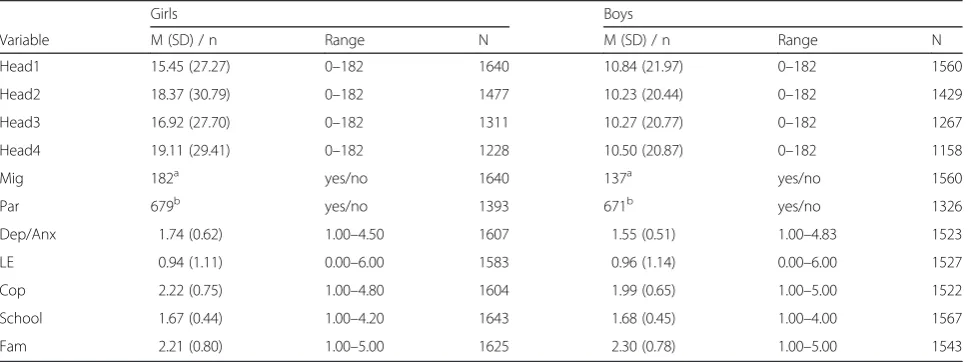
Across all four time points, significant sex differences were seen, with girls showing higher headache
frequen-cies across all four waves (p< 0.001; Table 1). In
addition, the girls’ subsample showed a significant
increase of headache frequency from wave one to two
(p< 0.001; d= 0.12), with an insignificant decrease in
wave three (p= 0.104) and another significant increase
in wave four (p= 0.004; d= 0.45). In contrast, for the
boys’subsample no significant changes of headache
fre-quency across time were identified (allp> 0.05).
Moreover, at first assessment, girls and boys differed significantly with respect to their level of depressive/
anxiety symptoms (p< 0.001; d= 0.33), their stress
coping (p< 0.001; d= 0.33) as well as the perception
of the family climate (p= 0.002; d= 0.10). Moreover,
more girls reported to suffer from migraine at wave
one than boys (p= 0.029, d= 0.08). No significant sex
differences in the children’s school burden, the
num-ber of life events, or the parent’s headache reports
(all p> 0.05) were identified.
Conditional model for girls
For the subsample of the girls, we identified the four-class
solution as the best fitting model. TheBICdecreased until
a four-class model and increased again with a five-class
solution (BIC1= 74369.548; BIC2= 36233.008; BIC3=
34360.569;BIC4= 33965.944;BIC5= 34017.236). The
clas-sification accuracy proved to be satisfying (Entropy=
0.863) withPosterior Class Probabilitiesranging from 0.86
to 0.98. A significant value of theBLRT (p< 0.001)
indi-cated that the four-class model was favoured as compared to the three-class solution. Including a quadratic growth factor improved the model fit. Stable means of growth factors as well as the same distributions and class sizes across different starting values indi-cated a stable and reliable solution.
The largest class in the girls’subsample (32.5 %; Fig. 1)
showed a moderate headache frequency at the starting level. Also, a significant decreasing trend that accelerated
over time (s=−6.270, p< 0.001; q= 1.651, p< 0.001; class
3:‘moderate decreasing pain class’) was identified. The sec-ond largest class (30.5 %) displayed a very low level of mean headache days across all four waves, without significant
changes in slope (s= 0.148, p= 0.287; q= 0.025, p= 0.581;
class 4:‘no pain class’). The third group of girls (20.8 %)
started with a rather high level of headache as compared to all other classes without significant changes of headache
Table 1Descriptive statistics of outcome variables and predictors
Girls Boys
Variable M (SD) / n Range N M (SD) / n Range N
Head1 15.45 (27.27) 0–182 1640 10.84 (21.97) 0–182 1560
Head2 18.37 (30.79) 0–182 1477 10.23 (20.44) 0–182 1429
Head3 16.92 (27.70) 0–182 1311 10.27 (20.77) 0–182 1267
Head4 19.11 (29.41) 0–182 1228 10.50 (20.87) 0–182 1158
Mig 182a yes/no 1640 137a yes/no 1560
Par 679b yes/no 1393 671b yes/no 1326
Dep/Anx 1.74 (0.62) 1.00–4.50 1607 1.55 (0.51) 1.00–4.83 1523
LE 0.94 (1.11) 0.00–6.00 1583 0.96 (1.14) 0.00–6.00 1527
Cop 2.22 (0.75) 1.00–4.80 1604 1.99 (0.65) 1.00–5.00 1522
School 1.67 (0.44) 1.00–4.20 1643 1.68 (0.45) 1.00–4.00 1567
Fam 2.21 (0.80) 1.00–5.00 1625 2.30 (0.78) 1.00–5.00 1543
Head1-4days of headache in the last six months for wave 1–4,Migmigraine,Parparental headache,Dep/Anxdepressive/ anxiety symptoms,LElife events,Cop dysfunctional stress coping,Schoolschool burden,Famnegative family climate
a
number of children in subgroup reporting to have migraine b
days across time (s= 3.882,p= 0.386;q=−1.557,p= 0.262;
class 1:‘high pain class’). With regard to the possible range
of the outcome variable (0–182), the mean level of
head-ache days of this class cannot be classified as‘high’.
How-ever, in relation to the mean number of headache days of the other classes, this class clearly differs concerning the
level of headache frequency and is therefore named as‘high
pain class’. The fourth class of girls (16.2 %) was defined by
a low headache frequency at first wave, with a significant acceleration that stabilised by the time of the fourth wave
(s= 19.143, p< 0.001, q=− 3.303, p= 0.005; class 2: ‘
in-creasing pain class’).
For the multinomial logistic regression analyses, we
used the ‘no pain class’ as reference class (Table 2).
Results revealed that migraine (OR= 6.59), parental
headache (OR= 1.78) as well as depressive/anxiety
symptoms (OR= 2.12) significantly increased the risk
of belonging to the ‘moderate decreasing pain class’ as
compared to the class without any pain across time.
Con-cerning the‘high pain class’migraine (OR= 10.39), parental
headache (OR= 2.67), depressive/anxiety symptoms (OR=
2.72), life events (OR= 1.27) and dysfunctional stress coping
(OR= 1.41) discriminated between this class and the
refer-ence class. For the‘increasing pain class’, depressive/anxiety
symptoms (OR= 1.73) as well as school burden (OR= 1.74)
were significantly associated with a higher risk of belonging
to this class as compared to the‘no pain class’.
Conditional model for boys
In the boys’subsample, theBICdecreased from the
one-class to the two-one-class solution (BIC1= 66528.129;BIC2=
30048.525). Adding a quadratic slope led to an improve-ment of the model fit. The two-class model showed very
good classification accuracy (Entropy= 0.964; Posterior
Class Probability= 0.994–0.987). The BLRTalso signifi-cantly preferred the two-class solution over the
one-class model (p< 0.001). Variation of starting values led
to the same results for class proportions and patterns of change which indicated a stable and reliable model.
Fig. 1Trajectories for girls (n= 1298) and boys (n= 1236)
Table 2Results from multinomial logistic regression analyses for girls (n= 1298) and boys (n= 1236)
Girls: odds ratios (95 % CI) Boys: odds ratios (95 % CI)
Predictors no vs. moderate decreasing pain no vs. high pain no vs. increasing pain no vs. moderate stable pain
Mig 6.59*** (2.98–14.57) 10.39*** (4.59–23.48) 1.85 (0.58–5.94) 6.73*** (3.45–13.08)
Par 1.78*** (1.30–2.44) 2.67*** (1.84–3.86) 1.36 (0.91–2.03) 1.80*** (1.40–2.32)
Dep/Anx 2.12*** (1.40–3.21) 2.72*** (1.76–4.22) 1.73* (1.05–2.85) 1.12 (0.80–1.57)
LE 1.01 (0.86–1.18) 1.27** (1.07–1.51) 1.13 (0.93–1.36) 1.12* (1.02–1.26)
Cop 1.12 (0.83–1.52) 1.41* (1.00–1.98) 1.00 (0.69–1.46) 1.58** (1.22–2.05)
School 1.01 (0.66–1.55) 1.35 (0.85–2.17) 1.74* (1.02–2.96) 1.22 (0.89–1.66)
Fam 0.93 (0.75–1.16) 1.29 (0.99–1.68) 1.07 (0.82–1.40) 0.96 (0.81–1.13)
Migmigraine,Parparental headache,Dep/Anxdepressive/ anxiety symptoms,LElife events,Copdysfunctional stress coping,schoolschool burden,Famnegative family climate,CIconfidence interval
In contrast to this, varying starting values in the
three-class model led to differing BICs and changes in class
distributions and class sizes. The model results indicated convergence problems and lower values for model fit in-dicators as compared to the two-class model. Therefore, we chose the two-class solution as best fitting model for
the boys’subsample.
The larger class in the boys’ subsample (51.4 %)
showed a moderate level of headache at the first wave without any significant changes across time (class 1:
‘moderate stable pain class’; s=− 1.955, p= 0.167; q=
0.596,p= 0.184; Fig. 1).
Boys of the second class (48.6 %) showed a very low
starting level, a significant decrease (s=−0.537,p< 0.001)
and another significant acceleration from wave three to
four (q= 0.174,p< 0.001). Although we found an increase
in headache days, the highest estimated mean value of days was 1.05 at wave four. Therefore, we categorised this class as the‘no pain class’.
Concerning multinomial logistic regression analyses,
we again used the ‘no pain class’as our reference class
(Table 2). For the boys’subsample, migraine (OR= 6.73),
parental headache (OR= 1.80) as well as life events (OR
= 1.12) and dysfunctional stress coping (OR= 1.58)
in-creased the risk of belonging to the ‘moderate stable
pain class’as compared to the‘no pain’class.
Discussion
The present study was conducted with the aim of identifying sex-specific trajectories of paediatric head-ache in a longitudinal study with a population-based sample. The statistical method of LCGA was used in order to classify children according to their initial headache level and their pathways across time. The identification of genetic, somatic and (socio-)psycho-logical predictors can be the first step for planning ef-fective preventive actions and considering possible treatment programmes. This is the first study to con-duct sex-specific longitudinal analyses in a paediatric headache sample of children and adolescents (9 to 14 years old at first wave) using this kind of method and a combination of predictors.
Results from LCGA
Concordant to our hypotheses we did not find more than four classes for either subsample. For girls a four-class solution was identified. This is in line with Dunn et al. [33]. Here also four classes were extracted.
In accordance with our hypotheses, one class was found with girls reporting no headache across all four
assessment points (‘no pain class’; 30.5 %). The ‘
mod-erate decreasing pain class’ (32.5 %) was comprised of
girls showing moderate to rather low headache fre-quencies across time, with significant changes.
Post-hoc tests revealed that the majority of girls belonging
to the ‘no pain class’ and the ‘moderate decreasing
pain class’ were not disabled by headache in their
daily or school activities and were able to pursue their school or occupational tasks. This result corre-sponds to comparable prior studies that found no or a low incidence of paediatric headache in the majority of children of population-based samples [33, 56, 61].
Consistent with our hypotheses, we also identified one group of girls with a high headache frequency at
first wave and across all other time points (‘high pain
class’; 20.8 %). In post-hoc analyses, we carried out
several t-tests to compare the headache-related func-tional disability between the extracted classes at wave
four. As compared to the ‘no pain class’ and the
‘moderate decreasing pain class’girls of the ‘high pain
class’ showed significantly higher impairments in daily
and school activities due to headache (all p< 0.001).
The ‘increasing pain class’ (16.2 %) was defined by
a very low starting level and a significant increase across time. In this respect this class differed from the other classes with rather stable trajectories and
only slight changes. As compared to the ‘no pain
class’ and the ‘moderate decreasing pain class’ this
group of girls reported significantly higher
impair-ments in daily (all p< 0.05) and school activities (all
p< 0.001) and suffered from significantly more
disabil-ity days due to headache (all p< 0.01).
Whereas for most of the cases belonging to the ‘no
pain class’and‘moderate decreasing pain class’,
prevent-ive or therapeutic interventions would probably not be
necessary, girls of the ‘increasing pain class’ and ‘high
pain class’seem to be in special need of attention.
In the boys’ subsample, a two-class solution was
identified as best-fitting model. In accordance with
our hypotheses the ‘no pain class’ (48.6 %) included
boys that reported to have had no headache across all time points. In this way, this class is comparable to
the ‘no pain class’ of the girls’ subsample.
Addition-ally, we found one class with a moderate headache frequency and significant but small changes across
time (‘moderate stable pain class’; 51.4 %). Post-hoc
analyses showed that the majority of boys of both classes negated headache-related disability concerning school or social activities at wave four. Referring to the observed time period of four years, there seems to be no need of involving boys from the current study in preventive programs.
Results from multinomial logistic regression analyses
In the girls’subsample, migraine, parental headache and
depression/anxiety were significant predictors for the
categorisation in the ‘moderate decreasing pain class’
and ‘high pain class’as compared to the ‘no pain class’.
The relevance of these three predictors in the develop-ment and maintenance of headache was repeatedly con-firmed in several prior studies [21, 63, 64]. Hence, it seems a stable and reliable finding. Furthermore, several studies showed that being diagnosed with migraine is in general associated with diverse somatic, psychological, behavioural and social impairments [11, 63, 65, 66].
Moreover, prior studies reported the importance of parental headache in the development and maintenance of paediatric headache [23, 67]. Besides a familial trans-fer of a genetic disposition for headache, pain-associated learning mechanisms have repeatedly been discussed [68]. It is assumed that pain-related modelling, i.e., the parental perception of and coping with pain, influence
the child’s cognitive, emotional, and behavioural coping
with pain and thus can exert an influence on the child’s
pain intensity, frequency, and pain-related disability [68].
Furthermore, the probability of belonging to the‘
mod-erate decreasing pain class’, the ‘high pain class’and the
‘increasing pain class’as compared to the‘no pain class’
was significantly elevated for girls that showed depres-sive/anxiety symptoms at the first wave. It can be assumed that the reported depressiveness/anxiety is as-sociated with a higher sensitivity for pain symptoms, a biased attention towards pain and a rather dysfunctional evaluation of pain (pain catastrophizing) [69, 70]. The association between headache and depression/anxiety was repeatedly confirmed in several studies [11, 71].
Life events and dysfunctional stress coping turned out
to be significant predictors for the ‘high pain class’ but
not for the ‘moderate decreasing pain class’ in girls.
Post-hoc analyses revealed significantly higher mean values for life events as well as dysfunctional stress
cop-ing in the‘high pain class’as compared to the‘moderate
decreasing pain class’(all p< 0.001). It may be assumed
that girls of the ‘high pain class’ were more often
con-fronted with stressful life events without being able to use functional coping strategies. This interpretation is supported by former studies [72, 73].
Because of the steady increase of headache frequency
in the‘increasing pain class’it may be hypothesised that
these children will suffer from a further increase of headache frequency during their adolescence. Thus, es-pecially for this group, it is necessary to identify risk factors which can explain this course of symptoms. Migraine did not turn out to be a significant predictor
for belonging to the ‘increasing pain class’. This may
easily be explained by the non-existence of headache at first wave. Moreover, not being affected by headache
may explain the irrelevance of a potential parental pain model [68]. Only if headache symptoms are relevant
as-pects of the child’s daily life a parental pain model can
come into effect. However, internalising symptoms as well as school burden significantly increased the risk of
belonging to the ‘increasing pain class’. It may be
as-sumed that this group describes girls being especially sensitive for the beginning puberty with increased psycho-social stressors and somatic symptoms. This enhanced sensitivity may result in depressive/anxious symptoms, a biased attention towards pain and increased stress experi-enced in school. These variables are all associated with headache symptoms [11, 24]. However, since most of the included variables are not significantly associated with this trajectory class, further research is necessary in order to define additional risk factors in an adequate methodo-logical manner. Referring to the assumption of a higher sensitivity for psychosocial processes and changes in this group of girls, it may be hypothesised that variables like a lack of social support, stress in the peer group or psycho-social experiences of loss (e.g., break-up with friends or ro-mantic partners) may be relevant factors for an increase of headache in that specific group [58, 74].
For boys, again, migraine and parental headache were able to differentiate between the classes. In contrast to
the girls’subsample, depression/anxiety was not
signifi-cantly associated with a pain class in the boys’data set.
Our results show higher depression/anxiety scores for girls as compared to boys. This supports former studies [9, 39]. It may be possible that the general low level of depression/anxiety in boys explains the lacking
signifi-cance of this variable in the boys’headache trajectories.
However, as for girls, life events and dysfunctional stress coping turned out to be significant predictors for a pain
class in the boys’subsample. Post-hoc analyses revealed
significantly higher mean values for life events (p= 0.005)
and dysfunctional stress coping strategies (p< 0.001) in
the ‘moderate stable pain class’ as compared to the ‘no
pain class’. Just as for the girls’ subsample, this
find-ing may also be explained by a lack of effective cop-ing strategies when becop-ing confronted with stressful situations, i.e., life events.
with headache as well as depressive cognitive styles, both associated with negative self-instructions, a ra-ther anxious-negative and biased attention towards pain, an increased sensitivity for pain, and tendency to ruminate about pain seem to heighten the prob-ability of increased headache frequency and a corre-sponding pain-associated disability [70, 75].
Strengths and limitations of the study
One of the main strengths of the current work is the large sample size and the random choice that allowed insight into paediatric headache trajectories in a population-based sample. Moreover, by using a special statistical method, conducting sex-specific analyses and including various relevant predictors, the scope in this study field could be extended. Insight into genetic, somatic and (socio-)psychological variables that need to be considered in preventive plans and treatment programs could be facilitated.
Another advantage of our study is the self-report that was used in order to assess paediatric headache. Several
studies showed that the inclusion of the child’s perception
of pain symptoms is crucial and cannot be substituted by the parental report, since there is a systematic
differ-ence between children’s and parents’ estimation, i.e.,
an underestimation of the child’s headache prevalence
by parents [76, 77].
One limitation that needs to be considered is the
as-sessment of headache frequency. Our question
demanded the classification of headache days in rela-tion to a specific period of time (either the last week, the last month or the last six months) depending on the precedent answer of the respondents. Especially for younger children, it may have been difficult to give a correct estimate of the number of headache days, par-ticularly for the categories that included a greater time period. Moreover, in order to be able to extrapolate the answers of the questioned children and adolescents to the last six months, the answers were weighted corres-pondingly. This resulted in great intra-individual differ-ences over the assessment points, especially for the
‘high pain class’since this class was comprised of girls
with significant intraindividual changes across time. Fu-ture studies should avoid the necessity of weighting by creating a scale for a differentiated and valid assessment of very low as well as very high headache levels, so that the valid assessment of severely affected patients can also be considered. One possible type of assessment would be the use of a pain diary. However, the effort that would be necessary (personal contact, filling out the diary over at least four weeks) would not be com-patible with the type of study and the study sample (postal survey, high number of respondents, children).
The type of assessment and the chosen sample influ-ence possible interpretations of our results. At each
measurement point a cohort of a specific age range (9–
14 years at wave one) was examined. Hence, we can make statements about changes in headache across the course of the study, but not particularly concerning changes across childhood or adolescence.
In our study we used migraine as a predictor and disregarded tension-type headache (TTH). This deci-sion was mainly based on studies revealing a higher long-term psychosocial disability due to migraine in contrast to TTH [11]. However, future studies should compare the influence of the two headache types on paediatric headache and related disabilities over time. Moreover, we used the ICHD-II criteria to diagnose migraine since the classification of headache was based on the ICHD-II at the time of the conduction of the study. Future studies should rely on ICHD-III beta when diagnosing migraine. It is unmistakably evident that a clinical relevant diagnosis of headache has to rely on a comprehensive set of instruments for clinical examination of patients. Our method of ana-lysis rather served to describe and differentiate head-ache in the general population.
Conclusion
By utilising a highly complex statistical method we were able to take into account the heterogeneity of paediatric headache in a population-based sample of children and adolescents and to consider potential risk factors that are associated with unfavourable courses of headache. Our findings support prior work in that only a minority of chil-dren and adolescents suffered from recurrent headache and associated disability. As expected these groups were
existent only in the girls’ subsample. In general,
sex-specific analyses revealed a higher incidence of headache as well as a higher heterogeneity in girls as compared to
boys. In the girls’subsample, we identified two classes that
seem to be in special need of attention. For these groups of girls, the acquisition of effective stress coping strategies together with the treatment of depressive, catastrophising and anxious cognitions should be in focus. Moreover, the diagnosis of migraine seems to be a valid indication for a higher headache frequency or a stability of headache over time, respectively. This result supports the necessity of adequately diagnosing headache types and providing ef-fective treatment options. Concerning the relevance of parental headache, parents in pain as well as their children should be made aware of potential modelling mechanisms and be offered adequate treatment strategies for their own headache symptoms.
Ethical statements
The ethics committee of the German Association of Psychology approved the study protocol. Data safety procedures were checked and approved by the university data protection representative. The surveyed households were informed of data protection regulations and pro-cedure, the aims of the study, and the voluntary nature of the participation.
Competing interest
The authors declare that there are no issues relating to journal policies. The authors declare that they have no competing interests.
The content of the manuscript has not been published or submitted for publication elsewhere.
Authors’contributions
CI has made substantial contributions to conception and design of the study and performed analyses and interpretation of data. CI also drafted the manuscript. BK-H participated in the design of the study. BK-H also helped to draft the manuscript. CFC has made contributions to analysis and interpretation of data and helped in drafting the manuscript. Moreover, all three authors (CI, BK-H and CFC) have been involved in revising the article critically and have given final approval of the published version. They have agreed to be accountable for all aspects of the work.
Acknowledgments
We thank York Hagmayer, Christopher Hautmann and Heinz Holling who were very helpful in analyzing the data.
Support
The research project has been supported by a grant from the German Ministry of Education, Research and Science as part of the German Headache Consortium.
We acknowledge support by the German Research Foundation and the Open Access Publication Funds of the Göttingen University.
Received: 3 February 2016 Accepted: 7 April 2016
References
1. Hershey AD (2012) Pediatric headache: update on recent research. Headache 52(2):327–332
2. Kröner-Herwig B (2014) Kopfschmerz bei Kindern und Jugendlichen. Epidemiologie, biopsychosoziale Korrelate und psychologische Behandlung. Bundesgesundheitsblatt 57:928–934
3. Van Gessel H, Gaßmann J, Kröner-Herwig B (2011) Children in pain: recurrent back pain, abdominal pain, and headache in children and adolescents in a four-year-period. J Pediatr 158:977–983
4. Abu-Arafeh I, Razak S, Sivaraman B, Graham C (2010) Prevalence of headache and migraine in children and adolescents: a systematic review of population-based studies. Dev Med Child Neurol 52(12):1088–1097 5. Fendrich K, Vennemann M, Pfaffenrath V, Evers S, May A, Berger K, Hoffmann W (2007) Headache prevalence among adolescents–the German DMKG headache study. Cephalalgia 27(4):347–354 6. King S, Chambers CT, Huguet A, MacNevin RC, McGrath PJ, Parker L,
MacDonald AJ (2011) The epidemiology of chronic pain in children and adolescents revisited: a systematic review. Pain 152:2729–2738 7. Laurell K, Larsson B, Eeg-Olofsson O (2004) Prevalence of headache in
Swedish schoolchildren, with a focus on tension-type headache. Cephalalgia 24(5):380–388
8. Slater S, Crawford MJ, Kabbouche MA, LeCates SL, Cherney S, Vaughan P, Segers A, Manning P, Burdine D, Powers SW, Hershey AD (2009) Effects of gender and age on paediatric headache. Cephalalgia 29:969–973 9. Margari F, Lucarelli E, Craig F, Petruzzelli MG, Lecce PA, Margari L (2013)
Psychopathology in children and adolescents with primary headaches: categorical and dimensional approaches. Cephalalgia 33(16):1311–1318 10. Kröner-Herwig B, Hechler T, Zernikov B (2013) Chronischer Schmerz. In: Lohaus A, Heinrich N (eds) Chronische Erkrankungen im Kindes- und Jugendalter. Beltz, Weinheim, pp 174–186
11. Arruda MA, Bigal ME (2012) Migraine and behavior in children: influence of maternal headache frequency. J Headache Pain 13:395–400
12. Anttila P, Sourander A, Metsähonkala L, Aroma M, Helenius H, Sillanpää M (2004) Psychiatric symptoms in children with primary headache. J Am Acad Child Adolesc Psychiatry 43:412–419
13. Barone L, Lionetti F, Dellagiulia A, Galli F, Molteni S, Balottin U (2015) Behavioural problems in children with headache and maternal stress: is children’s attachment security a protective factor? Infant Child Dev. doi: 10.1002/icd.1950
14. Stanford E, Chambers CT, Biesanz JC, Chen E (2008) The frequency, trajectories and predictors of adolescent recurrent pain: a population-based approach. Pain 138(1):11–21
15. Hassinger HJ, Semenchuk EM, O’Brien WH (1999) Appraisal and coping responses to pain and stress in migraine headache sufferers. J Behav Med 22:4 16. Materazzo F, Cathcart S, Pritchard D (2000) Anger, depression, and coping
interactions in headache activity and adjustment: a controlled study. J Psychosom Res 49:69–75
17. Saile H, Scalla P (2006) Chronische Kopfschmerzen und Stress bei Kindern. Z Klin Psychol Psychother 35(3):188–195
18. Bener A, Uduman SA, Quassimi EMA, Khalaily G, Sztriha L, Kilpelainen H, Obineche E (2000) Genetic and environmental factors associated with migraine in schoolchildren. Headache 40:152–157
19. Bugdayci R, Ozge A, Sasmaz T, Kurt AO, Kaleagasi H, Karakelle A, Tezcan H, Siva A (2005) Prevalence and factors affecting headache in Turkish schoolchildren. Pediatr Int 47(3):316–322
20. Kröner-Herwig B, Gaßmann J (2012) Headache disorders in children and adolescents: their association with psychological, behavioral, and socio-environmental factors. Headache 52:1387–1401
21. Kienbacher C, Wöber C, Zesch HE, Hafferl-Gattermayer A, Posch M, Karwautz A, Wöber-Bingöl C (2006) Clinical features, classification and prognosis of migraine and tension-type headache in children and adolescents: a long-term follow-up study. Cephalalgia 26(7):820–830
22. Guidetti V, Galli F (1998) Evolution of headache in childhood and adolescence: an 8-year follow-up. Cephalalgia 18:449–454
23. Aromaa M, Sillanpaa M, Rautava P, Helenius H (2000) Pain experience of children with headache and their families: a controlled study. Pediatrics 106:270–275
24. Hjern A, Alfven G, Östbeg V (2008) School stressors, psychological complaints and psychosomatic pain. Acta Paediatr 97:112–117 25. Liakopoulou-Kairis M, Alifieraki T, Protagora D, Korpa T, Kondyli K,
Dimosthenous E, Kovanis T (2002) Recurrent abdominal pain and headache-psychopathology, life events and family functioning. Eur Child Adolesc Psychiatry 11(3):115–122
26. Breuner CC, Smith MS, Womack WM (2004) Factors related to school absenteeism in adolescents with recurrent headache. Headache 44:217–222 27. Reynolds DJ, Hovanitz CA (2000) Life event stress and headache frequency
revisited. Headache 40:111–118
28. Waldie KE (2000) Childhood headache, stress in adolescence, and primary headache in young adulthood. Headache 41:1–10
29. Gini G, Pozzoli T, Lenzi M, Vieno A (2014) Bullying victimization at school and headache: a meta-analysis of observational studies. Headache 54:976–986 30. Brattberg G (2004) Do pain problems in young school children persist into
early adulthood? A 13-year follow-up. Eur J Pain 8:187–199
31. Monastero R, Camarda C, Pipia C, Camarda R (2006) Prognosis of migraine headaches in adolescents: a 10-year follow-up study. Neurology 67:1353– 1356
32. Bille B (1989) Migraine in childhood: a 30 years’follow-up. In: Lanzi G, Balottin U, Cernibori A (eds) Headache in children and adolescents. Elsevier, Amsterdam, pp 19–26
33. Dunn KM, Jordan KP, Mancl L, Drangsholt MT, Resche LL (2011) Trajectories of pain in adolescents: a prospective cohort study. Pain 152(1):66–73 34. Jung T, Wickrama AS (2008) An introduction to latent class growth analysis
and growth mixture modeling. Soc Personal Psychol Compass 2(1):302–317 35. Tasdelen B, Ozge A, Kaleagasi H, Erdogan S, Mengi T (2011) Determining of migraine prognosis using latent growth mixture models. Chin Med J (Engl) 124(7):1044–1049
36. Tofighi D, Enders CK (2008) Identifying the correct number of classes in growth mixture models. In: Hancock GR, Samuelsen KM (eds) Advances in latent variable mixture models. Information Age, Charlotte, pp 317–341 37. Bollen KA, Curran PJ (2006) Latent curve models: a structural equation
38. Berlin KS, Parra GR, Williams NA (2014) An introduction to latent variable mixture modeling (Part 2): longitudinal latent class growth analysis and growth mixture modeling. J Pediatr Psychol 39(2):188–203
39. Fernandez Castelao C, Kröner-Herwig B (2013) Different trajectories of depressive symptoms in children and adolescents: predictors and differences in girls and boys. J Youth Adolesc 42(8):1169–1182 40. Feng X, Shaw DS, Silk JS (2008) Developmental trajectories of anxiety
symptoms among boys across early and middle childhood. J Abnorm Psychol 117(1):32–47
41. Muthén B, Muthén L (2000) Integrating person-centered and variable-centered analyses: growth mixture modeling with latent trajectory classes. Alcohol Clin Exp Res 24(6):882–891
42. Feldman BJ, Masyn KE, Conger RD (2009) New approaches to studying problem behaviors: a comparison of methods for modeling longitudinal, categorical adolescent drinking data. Dev Psychol 45(3):652–676 43. Connell AM, Frye AA (2006) Growth mixture modeling in developmental
psychology: overview and demonstration of heterogeneity in developmental trajectories of adolescent antisocial behavior. Infant Child Dev 15:609–621
44. Kröner-Herwig B, Heinrich M, Morris L (2007) Headache in German children and adolescents: a population-based epidemiological study. Cephalalgia 27:519–527
45. Ostkirchen GG, Andler F, Hammer F, Pöhler KD, Snyder-Schendel E, Werner NK, Diener HC (2006) Prevalences of primary headache symptoms at school-entry: a population-based epidemiological survey of preschool children in Germany. J Headache Pain 7:331–340
46. Gaßmann J (2009) Kopfschmerzen bei Kindern und Jugendlichen: Verlauf und Risikofaktoren; Ergebnisse der epidemiologischen Längsschnittstudie “Kinder, Jugendliche und Kopfschmerz”(“KiJuKo”). Dissertation, Georg-August-University Göttingen
47. Winkler J, Stolzenberg H (2009) Adjustment of the social class index for application in the german health interview and examination survey for children and adolescents (KiGGS). Hochsch, Wismar, Wismarer Diskussionspapiere 2009, 07
48. Society HCCotIH (2004) Classification and diagnostic criteria for headache disorders, cranial neuralgia and facial pain. 2nd ed. Cephalalgia 24:1–160 49. Hershey AD, Winner P, Kabbouche MA, Gladstein J, Yonker M, Lewis D,
Pearlman E, Linder SL, Rothner AD, Poswers SW (2005) Use of the ICHD-II criteria in the diagnosis of pediatric migraine. Headache 45(10):1288–1297 50. Lima MMF, Padula NAMR, Santos LCA, Oliveira LDB, Agapejev S, Padovani C
(2005) Critical analysis of the international classification of headache disorders diagnostic criteria (ICHD I-1988) and (ICHD II-2004), for migraine in children and adolescents. Cephalalgia 25:1042–1047
51. Achenbach TM (1991) Manual for the child behaviour checklist/4–18 and 1991 Profile. Department of Psychiatry, University of Vermont, Burlington 52. Kröner-Herwig B, Morris L, Heinrich M (2008) Biopsychosocial correlates
of headache: What predicts pediatric headache occurrence? Headache 48(4):529–544
53. Esser G, Blanz B, Geisel B, Laucht M (1989) Mannheimer Elterninterview MEI: Strukturiertes Interview zur Erfassung von kinderpsychiatrischen
Auffälligkeiten [Mannheimer interview for parents (MEI): Structured interview to assess psychiatric problems of children]. Beltz, Weinheim 54. Hampel P, Petermann F, Dickow B (2003) Stressverarbeitungsfragebogen
von Janke und Erdmann angepasst für Kinder und Jugendliche (SVF-KJ). Diagnostica 49(3):136–145
55. Gaßmann J, Barke A, van Gessel H, Kröner-Herwig B (2012) Sex-specific predictor analyses for the incidence of recurrent headaches in German schoolchildren. Psychosoc Med 9:Doc03.
56. Kröner-Herwig B, Heinrich M, Vath N (2010) The assessment of disability in children and adolescents with headache: adopting PedMIDAS in an epidemiological study. Eur J Pain 14:951–958
57. Anttila P, Metsähonkala L, Helenius H, Sillanpää M (2000) Predisposing and provoking factors in childhood headache. Headache 40:351–356 58. Karawautz A, Wöber C, Lang T, Böck A, Wagner-Ennsgraber C, Vesely C,
Wöber-Bingöl C (1999) Psychosocial factors in children and adolescents with migraine and tension-type headache: a controlled study and review of the literature. Cephalalgia 19:32–43
59. Muthén B (2004) Latent variable analysis: growth mixture modeling and related techniques for longitudinal data. In: Kaplan D (ed) Handbook of quantitative methodology for the social sciences. Sage Publications, Newbury Park, pp 345–368
60. Muthén B, Muthén L (1998–2010) Mplus User's Guide, 6th edn. Muthén & Muthén, Los Angeles
61. Akyol A, Kiylioglu N, Aydin I, Erturk A, Kaya E, Telli E, Akyıldız U (2007) Epidemiology and clinical characteristics of migraine among school children in the Menderes region. Cephalalgia 27:781–787
62. Pothmann R, von Frankenberg S, Müller B, Sartory G, Hellmeier W (1994) Epidemiology of headache in children and adolescents: evidence of high prevalence of migraine among girls under ten. Int J Behav Med 1:76–89 63. Evans S, Keenan TR (2007) Parents with chronic pain: are children equally
affected by fathers as mothers in pain? A pilot study. J Child Health Care 11(2):143–157
64. Casucci G, Terlizzi R, Cevoli S (2014) Headache in school age. Neurol Sci 35(1):31–35
65. Balottin U, Poli PF, Termine C, Molteni S, Galli F (2012) Psychopathological symptoms in child and adolescent migraine and tension-type headache: a meta-analysis. Cephalalgia 33(2):112–122
66. Blaauw BA, Dyb G, Hagen K, Holmen TL, Linde M, Wentzel, Larsen T, Zwart J-A (2015) The relationship of anxiety, depression and behavioral problems with recurrent headache in late adolescence–a Young-HUNT follow-up study. J Headache Pain 16:10
67. Palermo TM, Valrie CR, Karlson CW (2014) Family and parent influences on pediatric chronic pain. A developmental perspective. Am Psychol 69:142–152 68. Isensee C, Kröner-Herwig B (2015) Influence of social modeling and learning
on somatic, emotional and functional disability in children with headache. Internet J Pain Symptom Control Palliat Care 10(1):1–14
69. Sullivan MJ, Neish NR (1998) Catastrophizing, anxiety and pain during dental hygiene treatment. Community Dent Oral Epidemiol 26(5):344–349 70. Sullivan MJL, Thorn B, Haythornthwaite JA, Keefe F, Martin M, Bradley LA,
Lefebvre JC (2001) Theoretical perspectives on the relation between catastrophizing and pain. Clin J Pain 17:52–64
71. Fichtel Å, Larsson B (2002) Psychosocial impact of headache and comorbidity with other pains among Swedish school adolescents. Headache 42:766–775
72. Luka-Krausgrill U, Reinhold B (1996) Headache in children: prevalence and relationship to stress, coping, depression, and social support. Zeitschrift für Gesundheitspsychologie 4(2):137–151
73. Saile H, Hülsebusch T (2006) Coping with daily hassles in children with chronic headache: dependence on the controllability of situations and relationship to coping with pain. Zeitschrift für Gesundheitspsychologie 14(1):21–27
74. Waldie KE, Thompson JMD, Mia Y, Muphy R, Wall C, Mitchel EA (2014) Risk factors for migraine and tension-type headache in 11 year old children. J Headache Pain 15(60):1–9
75. Börsbo B, Peolsson M, Gerdle B (2009) The complex interplay between pain intensity, depression, anxiety and catastrophising with respect to quality of life and disability. Disabil Rehabil 31(19):1605–1613
76. Kröner-Herwig B, Morris L, Heinrich M, Gassmann J, Vath N (2009) Agreement of parents and children on characteristics of pediatric headache, other pains, somatic symptoms, and depressive symptoms in an
epidemiological study. Clin J Pain 25(1):58–64
77. Nakamura EF, Cui L, Lateef T, Nelson KB, Merikangas KR (2012) Parent–child agreement in the reporting of headaches in a national sample of adolescents. J Child Neurol 27(1):61–67
Submit your manuscript to a
journal and benefi t from:
7Convenient online submission
7Rigorous peer review
7Immediate publication on acceptance
7Open access: articles freely available online 7High visibility within the fi eld
7Retaining the copyright to your article