R E S E A R C H
Open Access
Cyclic admissible contraction and
applications to functional equations in
dynamic programming
Huseyin Isik
1, Bessem Samet
2*and Calogero Vetro
3*Correspondence:
2Department of Mathematics,
College of Science, King Saud University, P.O. Box 2455, Riyadh, 11451, Saudi Arabia
Full list of author information is available at the end of the article
Abstract
In this paper, we introduce the notion ofT-cyclic (α,
β)-contraction and give some
common fixed point results for this type of contractions. The presented theorems extend, generalize, and improve many existing results in the literature. Several examples and applications to functional equations arising in dynamic programming are also given in order to illustrate the effectiveness of the obtained results.MSC: Primary 47H10; secondary 54H25; 65Q20
Keywords: common fixed point; point of coincidence;T-cyclic (α,β)-admissible mapping; weakly compatible mappings; functional equations
1 Introduction and preliminaries
Fixed point theorems play a crucial role to constructing methods for solving problems in applied mathematics and the majority of other sciences. Thus, a large number of mathe-maticians have focused on this interesting topic. The Banach contraction mapping prin-ciple [] is one of the pivotal results in fixed point theory. It is widely considered as the source of metric fixed point theory. Also its significance lies in its vast applicability in a number of branches of mathematics.
A new category of contractive fixed point problems was addressed by Khanet al.[]. In this study they introduced the notion of altering distance function which is a control function that alters distance between two points in a metric space. This function and its extensions have been used in several problems of fixed point theory, some of which are noted in [–].
Definition ([]) A functionϕ: [,∞)→[,∞) is called an altering distance function if the following properties are satisfied:
(i) ϕis nondecreasing and continuous, (ii) ϕ(t) = if and only ift= .
Recently, Sametet al.[] presented the notions ofα-ψ-contractive andα-admissible mappings. The results obtained by Sametet al.[] extended and generalized many existing fixed point results in the literature, in particular the Banach contraction principle. After
that, several authors considered the generalizations of this new approach (see [–]). Very recently, Alizadehet al.[] offered the concept of a cyclic (α,β)-admissible mapping and proved some new fixed point results which generalize and modify some recent results in the literature.
Definition ([]) Letf :X→Xandα,β:X→[,∞). We say thatf is a cyclic (α,β )-admissible mapping if
(i) α(x)≥for somex∈Ximpliesβ(fx)≥; (ii) β(x)≥for somex∈Ximpliesα(fx)≥.
The purpose of this paper is to formulate the above definition in terms of two map-pings so that we can prove existence and uniqueness of common fixed points for these mappings on a complete metric space. Our results improve and extend the results of [, , ] and many others. Several examples and interesting consequences of our theorems are also given. As a consequence of the presented results, we discuss the existence and uniqueness of the common bounded solution of a functional equation arising in dynamic programming.
Definition ([]) LetXbe a nonempty set andf,T:X→X. The pair (f,T) is said to be weakly compatible iff andTcommute at their coincidence points (i.e. fTx=Tfxwhenever
fx=Tx). A pointy∈Xis called a point of coincidence off andT if there exists a point
x∈Xsuch thaty=fx=Tx.
Following the direction in [], we denote bythe family of all functionsψ:R +→R+ such that:
(ψ) ψis nondecreasing in each coordinate and continuous;
(ψ) ψ(t,t,t,t)≤t,ψ(t, , ,t)≤tandψ(, ,t,t)≤tfor allt> ;
(ψ) ψ(t,t,t,t) = if and only ift=t=t=t= .
2 Main results
Before proceeding with our results, let us give the following definitions which will be used efficiently in the proof of main results.
Definition Letf,T :X→Xandα,β:X→[,∞). We say thatf is aT-cyclic (α,β )-admissible mapping if
(i) α(Tx)≥for somex∈Ximpliesβ(fx)≥; (ii) β(Tx)≥for somex∈Ximpliesα(fx)≥.
Example Letf,T:R→Rbe defined byfx=xandTx= –x. Suppose thatα,β:R→R+ are given byα(x) =e–xfor allx∈Randβ(y) =eyfor ally∈R. Thenf is aT-cyclic (α,β) admissible mapping. Indeed, ifα(Tx) =ex≥, thenx≥ which impliesfx≥ and so
β(fx) =efx≥. Also, ifβ(Ty) =e–y≥, theny≤, which impliesfy≤ and soα(fy) =
e–fy≥.
Definition Let (X,d) be a metric space and letf be aT-cyclic (α,β)-admissible map-ping. We say thatf is aT-cyclic (α,β)-contractive mapping if
for allx,y∈X, where
M(x,y) =ψ
d(Tx,Ty),d(Tx,fx),d(Ty,fy),
d(Tx,fy) +d(Ty,fx),
ψ∈,ϕis an altering distance function andη: [,∞)→[,∞) is a nondecreasing func-tion and continuous from the right with the condifunc-tionϕ(t) >η(t) for allt> .
Theorem Let(X,d)be a complete metric space and let f and T be self-mappings on X such that fX⊂TX.Let f be a T -cyclic(α,β)-contractive mapping.Assume that TX is a closed subset of X and the following conditions are satisfied:
(i) there existsx∈Xsuch thatα(Tx)≥andβ(Tx)≥;
(ii) if{xn}is a sequence inXsuch thatxn→xandβ(xn)≥for alln,thenβ(x)≥;
(iii) α(Tu)≥andβ(Tv)≥wheneverfu=Tuandfv=Tv.
Then f and T have a unique point of coincidence in X.Moreover,if f and T are weakly compatible,then f and T have a unique common fixed point.
Proof Letx∈Xsuch thatα(Tx)≥ andβ(Tx)≥. Define the sequences{xn}and{yn} inXby
yn=fxn=Txn+, n∈N∪ {}. (.)
If yn=yn+, then yn+ is a point of coincidence of f and T. Suppose that yn=yn+ for all n∈N. Since f is a T-cyclic (α,β)-admissible mapping and α(Tx) ≥ then
β(fx) =β(Tx)≥, which implies α(Tx) =α(fx)≥. By continuing this process, we get α(Txn)≥ and β(Txn+)≥ for all n∈N∪ {}. Similarly, since f is a T-cyclic (α,β)-admissible mapping andβ(Tx)≥, we haveβ(Txn)≥ andα(Txn+)≥ for all n∈N∪ {}, that is, α(Txn)≥ and β(Txn)≥ for all n∈N∪ {}. Equivalently,
α(Txn)β(Txn+)≥ for alln∈N∪ {}. Therefore by (.) and using (.), we get
ϕd(yn,yn+)
=ϕd(fxn,fxn+)
≤ηM(xn,xn+)
<ϕM(xn,xn+)
. (.)
Sinceϕis nondecreasing, we have
d(yn,yn+) <M(xn,xn+), (.)
where
M(xn,xn+)
=ψ
d(Txn,Txn+),d(Txn,fxn),d(Txn+,fxn+),
d(Txn,fxn+) +d(Txn+,fxn)
=ψ
d(yn–,yn),d(yn–,yn),d(yn,yn+),
d(yn–,yn+) +d(yn,yn)
≤ψ
d(yn–,yn),d(yn–,yn),d(yn,yn+),
Thus, from (.), we obtain
d(yn,yn+) <M(xn,xn+)
≤ψ
d(yn–,yn),d(yn–,yn),d(yn,yn+),
d(yn–,yn) +d(yn,yn+).
Ifd(yn–,yn)≤d(yn,yn+) for somen∈N, then
d(yn,yn+) <ψ
d(yn–,yn),d(yn–,yn),d(yn,yn+),
d(yn–,yn) +d(yn,yn+)
≤ψd(yn,yn+),d(yn,yn+),d(yn,yn+),d(yn,yn+)
≤d(yn,yn+),
which is a contradiction, and henced(yn,yn+) <d(yn–,yn) for alln∈N. Therefore, the sequence{d(yn,yn+)}is decreasing and bounded below. Thus, there existsr≥ such that limn→∞d(yn,yn+) =r. Assumer> . Also, from (.), (.) and using the properties ofψ, we deduce
ϕd(yn,yn+)
≤ηM(xn,xn+)
≤η
ψ
d(yn–,yn),d(yn–,yn),d(yn,yn+),
d(yn–,yn) +d(yn,yn+)
≤ηψd(yn–,yn),d(yn–,yn),d(yn–,yn),d(yn–,yn) ≤ηd(yn–,yn)
. (.)
Considering the properties ofϕandη, lettingn→ ∞in (.), we get
ϕ(r) = lim n→∞ϕ
d(yn,yn+)
≤ lim n→∞η
d(yn–,yn)=η(r) <ϕ(r),
which impliesr= and so
lim
n→∞d(yn,yn+) = . (.)
Now, we prove that{yn}is a Cauchy sequence. Suppose, to the contrary, that{yn}is not a Cauchy sequence. Then there exists anε> for which we can find two subsequences {ymk}and{ynk}of{yn}such thatmkis the smallest index for whichmk>nk>kand
d(ymk,ynk)≥ε and d(ymk–,ynk) <ε. (.)
Using the triangular inequality and (.), we have
ε≤d(ynk,ymk)≤d(ynk,ymk–) +d(ymk–,ymk)
By takingk→ ∞in the above inequality and using (.), we obtain
lim
k→∞d(ynk,ymk) =ε. (.)
By using (.), (.), and the triangular inequality, we deduce
lim
k→∞d(ynk–,ymk) =ε, lim
k→∞d(ymk–,ynk) =ε, lim
k→∞d(ymk–,ynk–) =ε.
(.)
From (.), we get
ϕd(ynk,ymk)
=ϕd(fxnk,fxmk)
≤ηM(xnk,xmk)
, (.)
where
M(xnk,xmk) =ψ
d(Txnk,Txmk),d(Txnk,fxnk),d(Txmk,fxmk),
d(Txnk,fxmk) +d(Txmk,fxnk)
≤ψ
maxε,d(ynk–,ymk–) ,d(ynk–,ynk),d(ymk–,ymk),
max
ε,
d(ynk–,ymk) +d(ymk–,ynk)
.
Now, from the properties ofϕ,ψ, andηand using (.), (.), (.), and the above inequality, ask→ ∞in (.), we have
ϕ(ε)≤ηψ(ε, , ,ε)≤η(ε) <ϕ(ε),
which implies thatε= , a contradiction withε> . Thus{yn}is a Cauchy sequence inX. From the completeness of (X,d), there existsz∈Xsuch that
lim
n→∞yn=z. (.)
From (.) and (.), we obtain
fxn→z and Txn+→z. (.)
Since TX is closed, by (.),z∈TX. Therefore, there exists u∈X such that Tu=z. As yn →z and β(yn) =β(Txn+)≥ for all n∈ N, by (ii), β(z) =β(Tu)≥. Thus,
Now, applying inequality (.), we get
ϕd(fxn,fu)≤ηM(xn,u), (.)
where
M(xn,u)
=ψ
d(Txn,Tu),d(Txn,fxn),d(Tu,fu),
d(Txn,fu) +d(Tu,fxn)
≤ψ
d(Txn,Tu),d(Txn,fxn),d(Tu,fu), max
d(Tu,fu),d(Txn,fu) +d(Tu,fxn) .
Takingk→ ∞in the inequality (.) and using the properties ofϕ,ψ,η, and the above inequality we have
ϕd(z,fu)≤η
ψ
, ,d(z,fu), d(z,fu)
≤ηd(z,fu)<ϕd(z,fu),
which impliesd(z,fu) = , that is,z=fu. Thus, we deduce
z=fu=Tu, (.)
and sozis a point of coincidence forf andT. The uniqueness of the point of coincidence is a consequence of the conditions (.) and (iii), and so we omit the details.
By (.) and using the weak compatibility off andT, we obtain
fz=fTu=Tfu=Tz (.)
and sofz=Tz. Uniqueness of the point of coincidence impliesz=fz=Tz. Consequently,
zis a unique common fixed point off andT.
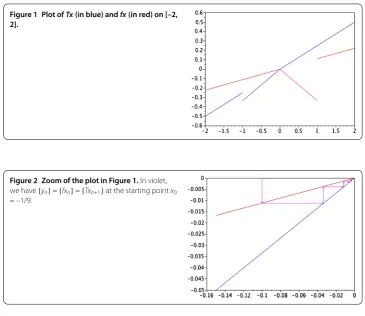
Example LetX=Rbe endowed with the usual metricd(x,y) =|x–y|for allx,y∈X. Also, let ϕ(t) =tandη(t) =
tfor allt≥, andψ(t,t,t,t) =max{t,t,t,t} for all
t,t,t,t≥.
Now, define the self-mappingsf andTonXby
fx=
⎧ ⎨ ⎩
–x
ifx∈[, ], x
ifx∈R\[, ]
and Tx=
⎧ ⎨ ⎩
x
ifx∈[–, ], x
ifx∈R\[–, ].
Then it is clear thatfX⊂TX. Also, define the mappingsα,β:X→[,∞) by
α(x) =
⎧ ⎪ ⎪ ⎨ ⎪ ⎪ ⎩
ex ifx∈(–∞, –),
e–x ifx∈[– , ],
Figure 1 Plot ofTx(in blue) andfx(in red) on [–2, 2].
Figure 2 Zoom of the plot in Figure 1.In violet, we have{yn}={fxn}={Txn+1}at the starting pointx0
= –1/9.
and
β(x) =
⎧ ⎨ ⎩
e–x ifx∈[– , ], ifx∈R\[–, ].
Letx∈Xsuch thatα(Tx)≥ so thatTx∈[–, ] and hencex∈[–, ]. By the definitions off andβ, we havefx∈[–, ] and soβ(fx)≥.
Similarly, one can show that if β(Tx)≥ thenα(fx)≥. Thus,f is aT-cyclic (α,β )-admissible mapping. Moreover, the conditions α(Tx)≥ andβ(Tx)≥ are satisfied withx= –.
Now, let{xn}be a sequence inXsuch thatβ(xn)≥ for alln∈Nandxn→xasn→ ∞. Then, by the definition ofβ, we havexn∈[–, ] for alln∈Nand sox∈[–, ], that is,
β(x)≥.
Next, we prove thatf is aT-cyclic (α,β)-contractive mapping. Letα(Tx)β(Ty)≥, then
Tx∈[–, ],Ty∈[–, ] and sox∈[–, ],y∈[–, ]. Thus, we get
ϕd(fx,fy)=|fx–fy|= |x–y|
≤
|x–y|=
|Tx–Ty|
≤
M(x,y) =η
Obviously, assumption (iii) of Theorem is satisfied. Consequently, all conditions of The-orem hold, and hencefandThave a unique common fixed point. Here is the common fixed point off andT; see Figures and .
Corollary Let(X,d)be a complete metric space and let f and T be self-mappings on X such that fX⊂TX.Let f be a T -cyclic(α,β)-admissible mapping such that
α(Tx)β(Ty)ϕd(fx,fy)≤ηM(x,y), (.)
for all x,y∈X,whereϕis an altering distance function andη: [,∞)→[,∞)is a nonde-creasing function and continuous from the right with the conditionϕ(t) >η(t)for all t>
and
M(x,y) =max
d(Tx,Ty),d(Tx,fx),d(Ty,fy),
d(Tx,fy) +d(Ty,fx).
Assume that TX is a closed subset of X and the following conditions are satisfied:
(i) there existsx∈Xsuch thatα(Tx)≥andβ(Tx)≥;
(ii) if{xn}is a sequence inXsuch thatxn→xandβ(xn)≥for alln,thenβ(x)≥;
(iii) α(Tu)≥andβ(Tv)≥wheneverfu=Tuandfv=Tv.
Then f and T have a unique point of coincidence in X.Moreover,if f and T are weakly compatible,then f and T have a unique common fixed point.
Proof Letα(Tx)β(Ty)≥ forx,y∈X. If we takeψ(t,t,t,t) =max{t,t,t,t}in Theo-rem , then from (.), we have
ϕd(fx,fy)≤ηM(x,y).
This implies that the inequality (.) holds. Therefore, the proof follows from
Theo-rem .
If we chooseT=IXin Theorem , we have the following corollary.
Corollary Let (X,d) be a complete metric space and f :X→X be a cyclic (α,β) -admissible mapping such that
α(x)β(y)≥ ⇒ ϕd(fx,fy)≤ηMf(x,y)
, (.)
for all x,y∈X,whereψ∈,ϕis an altering distance function andη: [,∞)→[,∞)is a nondecreasing function and continuous from the right with the conditionϕ(t) >η(t)for all t> and
Mf(x,y) =ψ
d(x,y),d(x,fx),d(y,fy),
d(x,fy) +d(y,fx).
Assume that the following conditions are satisfied:
(i) there existsx∈Xsuch thatα(x)≥andβ(x)≥;
(iii) α(u)≥andβ(v)≥wheneverfu=uandfv=v.
Then f has a unique fixed point.
If we takeη(t) =ϕ(t) –η(t) in Corollary , we have the following corollary.
Corollary Let (X,d) be a complete metric space and f :X→X be a cyclic (α,β) -admissible mapping such that
α(x)β(y)≥ ⇒ ϕd(fx,fy)≤ϕMf(x,y)
–ηMf(x,y)
, (.)
for all x,y∈X,whereψ∈,ϕis an altering distance function andη: [,∞)→[,∞)
is such thatϕ(t) –η(t)is nondecreasing andη(t)is continuous from the right,with the conditionϕ(t) >η(t)for all t> .
Assume that the following conditions are satisfied:
(i) there existsx∈Xsuch thatα(x)≥andβ(x)≥;
(ii) if{xn}is a sequence inXsuch thatxn→xandβ(xn)≥for alln,thenβ(x)≥;
(iii) α(u)≥andβ(v)≥wheneverfu=uandfv=v.
Then f has a unique fixed point.
If we takeϕ(t) =tin Corollary , we have the following corollary.
Corollary Let (X,d) be a complete metric space and f :X→X be a cyclic (α,β) -admissible mapping such that
α(x)β(y)≥ ⇒ d(fx,fy)≤Mf(x,y) –η
Mf(x,y)
, (.)
for all x,y∈X,whereψ∈andη: [,∞)→[,∞)is such that t–η(t)is nondecreasing
andη(t)is continuous from the right,with the conditionη(t) > for all t> .
Assume that the following conditions are satisfied:
(i) there existsx∈Xsuch thatα(x)≥andβ(x)≥;
(ii) if{xn}is a sequence inXsuch thatxn→xandβ(xn)≥for alln,thenβ(x)≥;
(iii) α(u)≥andβ(v)≥wheneverfu=uandfv=v.
Then f has a unique fixed point.
We denote by the family of all functionsφ:R
+→R+such that
(φ) φis nondecreasing in each coordinate and continuous;
(φ) φ(t,t,t,t)≤t,φ(t,t,t, )≤tandφ(,t, ,t)≤tfor allt> ;
(φ) φ(t,t,t,t) = if and only ift=t=t=t= .
Definition Let (X,d) be a metric space and letf be aT-cyclic (α,β)-admissible map-ping. We say thatf is aT-cyclic (α,β)-rational contractive mapping if
α(Tx)β(Ty)≥ ⇒ ϕd(fx,fy)≤ηN(x,y), (.)
for allx,y∈X, where
N(x,y) =φ
d(Tx,Ty),
d(Tx,fy),d(Ty,fx),
[ +d(Tx,fx)]d(Ty,fy) +d(Tx,Ty)
φ∈ ,ϕis an altering distance function andη: [,∞)→[,∞) is a nondecreasing func-tion and continuous from the right with the condifunc-tionϕ(t) >η(t) for allt> .
Theorem Let(X,d)be a complete metric space and let f and T be self-mappings on X such that fX⊂TX.Let f be a T -cyclic(α,β)-rational contractive mapping.Assume that TX is a closed subset of X and the following conditions are satisfied:
(i) there existsx∈Xsuch thatα(Tx)≥andβ(Tx)≥;
(ii) if{xn}is a sequence inXsuch thatxn→xandβ(xn)≥for alln,thenβ(x)≥;
(iii) α(Tu)≥andβ(Tv)≥wheneverfu=Tuandfv=Tv.
Then f and T have a unique point of coincidence in X.Moreover,if f and T are weakly compatible,then f and T have a unique common fixed point.
Proof Similar to the proof of Theorem , we define sequences{xn}and{yn}inXbyyn=
fxn=Txn+and note thatα(Txn)β(Txn+)≥ for alln∈N∪ {}. Also we assume thatyn=
yn–for alln∈N. Then by (.), we have
ϕd(yn,yn+)=ϕd(fxn,fxn+)≤ηN(xn,xn+)<ϕN(xn,xn+). (.)
Sinceϕis nondecreasing, we get
d(yn,yn+) <N(xn,xn+), (.)
where
N(xn,xn+) =φ
d(Txn,Txn+),
d(Txn,fxn+),d(Txn+,fxn), [ +d(Txn,fxn)]d(Txn+,fxn+)
+d(Txn,Txn+)
=φ
d(yn–,yn),
d(yn–,yn+),d(yn,yn),
[ +d(yn–,yn)]d(yn,yn+) +d(yn–,yn)
≤φ
d(yn–,yn),
d(yn–,yn) +d(yn,yn+), ,d(yn,yn+)
. (.)
Thus, from (.), we deduce
d(yn,yn+) <N(xn,xn+)
≤φ
d(yn–,yn),
d(yn–,yn) +d(yn,yn+), ,d(yn,yn+)
.
Ifd(yn–,yn)≤d(yn,yn+) for somen∈N, then
d(yn,yn+) <φ
d(yn–,yn),
d(yn–,yn) +d(yn,yn+)
, ,d(yn,yn+)
≤φd(yn,yn+),d(yn,yn+),d(yn,yn+),d(yn,yn+)
which is a contradiction, and henced(yn,yn+) <d(yn–,yn) for alln∈N. Therefore, the sequence {d(yn,yn+)}is decreasing and bounded from below. Thus, there existsδ≥ such thatlimn→∞d(yn,yn+) =δ. Also, from (.), (.) and using the properties ofϕ andη, we obtain
ϕd(yn,yn+) ≤ηN(xn,xn+)
≤η
φ
d(yn–,yn),
d(yn–,yn) +d(yn,yn+), ,d(yn,yn+)
≤ηφd(yn–,yn),d(yn–,yn),d(yn–,yn),d(yn–,yn)
≤ηd(yn–,yn)<ϕd(yn–,yn). (.)
Consider the properties ofϕandη, lettingn→ ∞in (.), we get
ϕ(δ) = lim n→∞ϕ
d(yn,yn+)
≤ lim n→∞η
d(yn–,yn)=η(δ) <ϕ(δ),
which impliesδ= and so
lim
n→∞d(yn,yn+) = . (.)
Now, we want to show that{yn}is a Cauchy sequence. Suppose, to the contrary, that {yn}is not a Cauchy sequence. Then there exists anε> for which we can find two sub-sequences{ynk}and{ymk}of{yn}such thatnkis the smallest index for whichnk>mk>k
and
d(ynk,ymk)≥ε and d(ynk–,ymk) <ε. (.)
Using the triangular inequality and (.), we have
ε≤d(ymk,ynk)≤d(ymk,ynk–) +d(ynk–,ynk)
< ε+d(ynk–,ynk).
By takingk→ ∞in the above inequality and using (.), we obtain
lim
k→∞d(ymk,ynk) =ε. (.)
By using (.), (.), and the triangular inequality, we deduce
lim
k→∞d(ynk–,ymk) =ε, lim
k→∞d(ymk–,ynk) =ε, lim
k→∞d(ymk–,ynk–) =ε.
From (.), we get
ϕd(ynk,ymk)
=ϕd(fxnk,fxmk)
≤ηN(xnk,xmk)
, (.)
where
N(xnk,xmk) =φ
d(Txnk,Txmk),
d(Txnk,fxmk),d(Txmk,fxnk),
[ +d(Txnk,fxnk)]d(Txmk,fxmk)
+d(Txnk,Txmk)
=φ
d(ynk–,ymk–),
d(ynk–,ymk),d(ymk–,ynk),
[ +d(ynk–,ynk)]d(ymk–,ymk)
+d(ynk–,ymk–)
≤maxε,N(xnk,xmk)
=φ
maxε,d(ynk–,ymk–) ,
max
ε,d(ynk–,ymk) ,
maxε,d(ymk–,ynk) ,
[ +d(ynk–,ynk)]d(ymk–,ymk)
+d(ynk–,ymk–)
.
Thereforelimk→∞max{ε,N(xnk,xmk)}=φ(ε, ε
,ε, )≤ε.
Now, from the properties ofϕandηand using (.), (.), (.), and the previous inequality, ask→ ∞in (.), we have
ϕ(ε) = lim n→∞ϕ
d(yn,yn+)
≤ lim n→∞η
maxε,N(xnk,xmk) ≤η(ε) <ϕ(ε),
which implies thatε= , a contradiction withε> . Thus{yn}is a Cauchy sequence inX. From the completeness of (X,d), there existsw∈Xsuch that
lim
n→∞yn=w (.)
and so by (.), we obtain
fxn→w and Txn+→w. (.)
SinceTXis closed, by (.),w∈TX. Therefore, there existsv∈Xsuch thatTv=w. As yn→ w and β(yn) =β(Txn+)≥ for all n ∈N, by (ii), β(w) =β(Tv)≥. Thus,
α(Txn)β(Tv)≥ for alln∈N.
Now, applying inequality (.), we get
ϕd(fxn,fv)≤ηN(xn,v), (.)
where
N(xn,v)≤φ
d(Txn,Tv), max
d(v,fv),d(Txn,fv) ,d(Tv,fxn),
d(Tv,fv)max
[ +d(Txn,fxn)] +d(Txn,Tv) ,
Takingk→ ∞in the inequality (.), using the properties ofϕ,ηand the previous in-equality we have
ϕd(w,fv)≤η
φ
,
d(w,fv), ,d(w,fv)
≤ηd(w,fv)<ϕd(w,fv),
which impliesd(w,fv) = , that is,w=fv. Thus, we deduce
w=fv=Tv, (.)
and sowis a point of coincidence forf andT. The uniqueness of the point of coincidence is a consequence of the conditions (.) and (iii), and so we omit the details.
By (.) and using the weak compatibility off andT, we obtain
fw=fTv=Tfv=Tw. (.)
The uniqueness of the point of coincidence impliesw=fw=Tw. Consequently,wis the
unique common fixed point off andT.
Corollary Let(X,d)be a complete metric space and let f and T be self-mappings on X such that fX⊂TX.Let f be a T -cyclic(α,β)-admissible mapping such that
α(Tx)β(Ty)ϕd(fx,fy)≤ηN(x,y),
for all x,y∈X,whereϕis an altering distance function andη: [,∞)→[,∞)is a nonde-creasing function and continuous from the right with the conditionϕ(t) >η(t)for all t>
and
N(x,y) =max
d(Tx,Ty),
d(Tx,fy),d(Ty,fx),
[ +d(Tx,fx)]d(Ty,fy) +d(Tx,Ty)
.
Assume that TX is a closed subset of X and that the following conditions are satisfied:
(i) there existsx∈Xsuch thatα(Tx)≥andβ(Tx)≥;
(ii) if{xn}is a sequence inXsuch thatxn→xandβ(xn)≥for alln,thenβ(x)≥;
(iii) α(Tu)≥andβ(Tv)≥wheneverfu=Tuandfv=Tv.
Then f and T have a unique point of coincidence in X.Moreover,if f and T are weakly compatible,then f and T have a unique common fixed point.
If we takeT=IXandη(t) =ϕ(t) –η(t) in Theorem , we have the following corollary.
Corollary Let (X,d)be a complete metric space and f :X→X be a cyclic (α,β) -admissible mapping such that
α(x)β(y)≥ ⇒ ϕd(fx,fy)≤ϕNf(x,y)
–ηNf(x,y)
,
for all x,y∈X,whereφ∈ ,ϕis an altering distance function andη: [,∞)→[,∞)
conditionϕ(t) >η(t)for all t> ,and
Nf(x,y) =φ
d(x,y),
d(x,fy),d(y,fx),
[ +d(x,fx)]d(y,fy) +d(x,y)
.
Assume that the following conditions are satisfied:
(i) there existsx∈Xsuch thatα(x)≥andβ(x)≥;
(ii) if{xn}is a sequence inXsuch thatxn→xandβ(xn)≥for alln,thenβ(x)≥;
(iii) α(u)≥andβ(v)≥wheneverfu=uandfv=v.
Then f has a unique fixed point.
If we takeϕ(t) =tin Corollary , we have the following corollary.
Corollary Let (X,d) be a complete metric space and f :X→X be a cyclic (α,β) -admissible mapping such that
α(x)β(y)≥ ⇒ d(fx,fy)≤Nf(x,y) –η
Nf(x,y)
,
for all x,y∈X,whereη: [,∞)→[,∞)is such that t–η(t)is nondecreasing andη(t)
is continuous from the right,with the conditionη(t) > for all t> .
Assume that the following conditions are satisfied:
(i) there existsx∈Xsuch thatα(x)≥andβ(x)≥;
(ii) if{xn}is a sequence inXsuch thatxn→xandβ(xn)≥for alln,thenβ(x)≥;
(iii) α(u)≥andβ(v)≥wheneverfu=uandfv=v.
Then f has a unique fixed point.
3 Cyclic results
The mappingsf,T:A∪B→A∪Bare called cyclic iffA⊆TBandfB⊆TA, whereA,Bare nonempty subsets of a metric space (X,d). Moreover,f andTare called cyclic contraction if there existsk∈(, ) such thatd(fx,fy)≤kd(Tx,Ty) for allx∈Aandy∈B. For more results see [–].
In this section we give some fixed point results involving cyclic mappings which can be regarded as consequences of the theorems presented in the previous section.
Theorem Let A and B be two closed subsets of complete metric space(X,d)such that
A∩B=∅and f,T:A∪B→A∪B be mappings such that fA⊆TB and fB⊆TA.Assume that T(A∪B)is a closed subset of X such that
ϕd(fx,fy)≤ηM(x,y), (.)
for all x∈A and y∈B,whereϕis an altering distance function andη: [,∞)→[,∞)is a nondecreasing function and continuous from the right with the conditionϕ(t) >η(t)for all t> .
(i) IfT is one to one then there existsz∈A∩Bsuch thatfz=Tz.
(ii) Iff andT are weakly compatible,thenf andT have a unique common fixed point
Proof Defineα,β:X→[,∞) by
α(x) =
, ifx∈TA,
, otherwise and β(x) =
, ifx∈TB, , otherwise.
Letα(Tx)β(Ty)≥. ThenTx∈TAandTy∈TB. SinceT is one to one, we havex∈Aand
y∈B. Hence, from (.) we obtain
ϕd(fx,fy)≤ηM(x,y).
Letα(Tx)≥ for somex∈X, soTx∈TAand thenx∈A. Hence,fx∈TBand soβ(fx)≥. Again, letβ(Tx)≥ for somex∈X. ThenTx∈TBand sox∈B. Hence,fx∈TAand then
α(fx)≥. Therefore,f is aT-cyclic (α,β)-admissible mapping.
There exists anx∈A∩B, asA∩Bis nonempty. This implies thatTx∈TAandTx∈
TBand soα(Tx)≥ andβ(Tx)≥.
Let{xn}be a sequence inXsuch thatβ(xn)≥ for alln∈Nandxn→xasn→ ∞. Then
xn∈TBfor alln∈Nand sox∈TB. This implies thatβ(x)≥.
Then the conditions (i) and (ii) of Theorem hold. So there existu,z∈A∪Bsuch that
u=fz=Tz. On the other hand, sinceT is one to one, there existz∈A,z∈Bsuch that
Tz=Tz=uimpliesz=z=z. Therefore,u=Tzforz∈A∩B. Iff andT are weakly compatible, following the proof of Theorem , we haveu=fu=Tu. The uniqueness of the
common fixed point follows from (.).
Similarly, we can prove the following theorem.
Theorem Let A and B be two closed subsets of complete metric space(X,d)such that A∩B=∅and f,T:A∪B→A∪B be mappings such that fA⊆TB and fB⊆TA.Assume that T(A∪B)is a closed subset of X such that
ϕd(fx,fy)≤ηN(x,y), (.)
for all x∈A and y∈B,whereϕis an altering distance function andη: [,∞)→[,∞)is a nondecreasing function and continuous from the right with the conditionϕ(t) >η(t)for all t> .
(i) IfT is one to one then there existsz∈A∩Bsuch thatfz=Tz.
(ii) Iff andT are weakly compatible,thenf andT have a unique common fixed point
z∈A∩B.
4 Application to functional equations
The existence and uniqueness of solutions of functional equations and system of func-tional equations arising in dynamic programming have been studied by using different fixed point theorems (see [–]).
Throughout this section, we assume thatUandVare Banach spaces,W⊆Uis a state space,D⊆Vis a decision space. Now, we apply our results in order to prove the existence and uniqueness of the common solution of the following functional equations:
P=sup y∈D
and
Q=sup y∈D
q(x,y) +Kx,y,Qτ(x,y) , x∈W, (.)
whereτ:W×D→W,p,q:W×D→RandG,K:W×D×R→R. It is well known that equations of the type (.) and (.) provide useful tools for mathematical optimization, computer programming, and in dynamic programming (see [, ]).
LetB(W) denote the space of all bounded real-valued functions defined on the setW. Meanwhile, B(W) endowed with the sup metricd(h,k) =supx∈W|hx–kx|for allh,k∈ B(W) is a complete metric space.
We consider the operatorsf,T:B(W)→B(W) given by
fh(x) =sup y∈D
p(x,y) +Gx,y,hτ(x,y) , x∈W,h∈B(W),
Th(x) =sup y∈D
q(x,y) +Kx,y,hτ(x,y) , x∈W,h∈B(W).
Suppose that the following conditions hold:
(A) For anyh∈B(W), there existsk∈B(W)such that
fh(x) =Tk(x), x∈W.
(A) There existsh∈B(W)such that
fh(x) =Th(x) implies Tfh(x) =fTh(x), x∈W.
(A) p,q:W×D→RandG,K:W×D× R→Rare bounded. (A) ξ(Th)≥for someh∈B(W)impliesξ(fh)≥.
(A) |G(x,y,h(x)) –G(x,y,k(x))| ≤ln( +M(h,k))whereh,k∈B(W),ξ(Th)≥, and
ξ(Tk)≥,(x,y)∈W×D,t∈W and
M(h,k) =max
dTh(t),Tk(t),dTh(t),fh(t),dTk(t),fk(t),
dTh(t),fk(t)+dTk(t),fh(t).
(A) If{hn}is a sequence inB(W)such thatξ(hn)≥for alln∈N∪ {}andhn→h∗
asn→ ∞, thenξ(h∗)≥.
(A) There existsh∈B(W)such thatξ(Th)≥.
Theorem Assume that conditions(A)-(A)are satisfied and T(B(W))is a closed and bounded subspace of B(W).Then the functional equations(.)and(.)have a unique common bounded solution in W.
Proof Letλbe an arbitrary positive number andx∈h,h∈B(W) such thatξ(Th)≥ andξ(Th)≥. Then there existy,y∈Dsuch that
fh(x) <p(x,y) +Gx,y,h
fh(x) <p(x,y) +Gx,y,h
τ(x,y)+λ, (.)
fh(x)≥p(x,y) +G
x,y,h
τ(x,y)
, (.)
fh(x)≥p(x,y) +Gx,y,h
τ(x,y). (.)
Next, by using (.) and (.), we have
fh(x) –fh(x) <Gx,y,h
τ(x,y)–Gx,y,h
τ(x,y)+λ
≤Gx,y,h
τ(x,y)–Gx,y,h
τ(x,y)+λ
≤ln +M(h,h)+λ. (.)
Analogously, by using (.) and (.), we obtain
fh(x) –fh(x) <ln
+M(h,h)
+λ. (.)
Therefore, from (.) and (.), we deduce
fh(x) –fh(x)<ln +M(h,h)+λ
or, equivalently,
d(fh,fh)≤ln +M(h,h)+λ.
Sinceλ> is arbitrary, we get
d(fh,fh)≤ln +M(h,h).
Now, defineα,β:B(W)→[,∞) by
α(h) =β(h) =
, ifξ(h)≥ whereh∈B(W), , otherwise.
Also, defineϕ,η: [,∞)→[,∞) byϕ(t) =tandη(t) =ln( +t). Therefore, using the last inequality, we have
α(Th)β(Th)ϕd(fh,fh)
≤ηM(h,h).
One easily shows that all the hypotheses of Corollary are satisfied. Thereforef andT
have a unique common fixed point, that is, the functional equations (.) and (.) have a
unique bounded common solution.
Now, we give the following condition to use in the next theorem:
(A) |G(x,y,h(x)) –G(x,y,k(x))| ≤ln( +N(h,k)) where h,k ∈B(W), ξ(Th)≥, and
N(h,k) =max
dTh(t),Tk(t), d
Th(t),fk(t),dTk(t),fh(t),
[ +d(Th(t),fh(t))]d(Tk(t),fk(t)) +d(Th(t),Tk(t))
.
Theorem Let all the conditions of Theorembe fulfilled.If we write the condition(A)
instead of the condition(A)in Theorem,then functional equations(.)and(.)have a unique common bounded solution in W.
Proof Following similar arguments to the proof of Theorem , one can easily show that all the hypotheses of Corollary hold. Then the functional equations (.) and (.) have
a unique bounded common solution.
Competing interests
The authors declare that they have no competing interests. Authors’ contributions
All authors contributed equally to the writing of this paper. All authors read and approved the final manuscript. Author details
1Department of Mathematics, Gazi University, Ankara, Turkey.2Department of Mathematics, College of Science, King
Saud University, P.O. Box 2455, Riyadh, 11451, Saudi Arabia.3Department of Mathematics and Computer Sciences,
University of Palermo, Via Archirafi 34, Palermo, 90123, Italy. Acknowledgements
The second author would like to extend his sincere appreciation to the Deanship of Scientific Research at King Saud University for its funding of this Prolific Research Group Project No. PRG-1436-10.
Received: 24 April 2015 Accepted: 21 August 2015 References
1. Banach, S: Sur les opérations dans les ensembles abstraits et leur application aux équations intégrales. Fundam. Math.3, 133-181 (1922)
2. Khan, MS, Swaleh, M, Sessa, S: Fixed point theorems by altering distances between the points. Bull. Aust. Math. Soc. 30(1), 1-9 (1984)
3. Alber, YI, Guerre-Delabriere, S: Principles of weakly contractive maps in Hilbert spaces. Oper. Theory, Adv. Appl.98, 7-22 (1997)
4. Rhoades, BE: Some theorems on weakly contractive maps. Nonlinear Anal.47(4), 2683-2693 (2001)
5. Dutta, PN, Choudhury, BS: A generalization of contraction principle in metric spaces. Fixed Point Theory Appl.2008, 406368 (2008)
6. Yan, F, Su, Y, Feng, Q: A new contraction mapping principle in partially ordered metric spaces and applications to ordinary differential equations. Fixed Point Theory Appl.2012, 152 (2012)
7. Samet, B, Vetro, C, Vetro, P: Fixed point theorems forα-ψ-contractive type mappings. Nonlinear Anal.75, 2154-2165 (2012)
8. La Rosa, V, Vetro, P: Common fixed points forα-ψ-ϕ-contractions in generalized metric spaces. Nonlinear Anal., Model. Control19(1), 43-54 (2014)
9. Kumam, P, Vetro, C, Vetro, F: Fixed points for weakα-ψ-contractions in partial metric spaces. Abstr. Appl. Anal.2013, 986028 (2013)
10. Cho, SH, Bae, JS: Fixed points of weakα-contraction type maps. Fixed Point Theory Appl.2014, 175 (2014) 11. Salimi, P, Vetro, C, Vetro, P: Fixed point theorems for twisted (α,β)-ψ-contractive type mappings and applications.
Filomat27(4), 605-615 (2013)
12. Alizadeh, S, Moradlou, F, Salimi, P: Some fixed point results for (α,β)-(ψ,ϕ)-contractive mappings. Filomat28(3), 635-647 (2014)
13. Moradlou, F, Salimi, P, Vetro, P: Fixed point results forr-(η,ξ,ψ)-contractive mappings of type (I), (II) and (III). Filomat 27(2), 403-410 (2013)
14. Su, Y: Contraction mapping principle with generalized altering distance function in ordered metric spaces and applications to ordinary differential equations. Fixed Point Theory Appl.2014, 227 (2014)
15. Jungck, G, Rhoades, BE: Fixed points for set valued functions without continuity. Indian J. Pure Appl. Math.29, 227-238 (1998)
16. Kirk, WA, Srinavasan, PS, Veeramani, P: Fixed points for mapping satisfying cyclical contractive conditions. Fixed Point Theory4, 79-89 (2003)
17. Pacurar, M, Rus, IA: Fixed point theory for cyclicφ-contractions. Nonlinear Anal.72, 1181-1187 (2010)
18. Agarwal, RP, Alghamdi, MA, Shahzad, N: Fixed point theory for cyclic generalized contractions in partial metric spaces. Fixed Point Theory Appl.2012, 40 (2012)
20. Abbas, M, Ali, B, Vetro, C: A Suzuki type fixed point theorem for a generalized multivalued mapping on partial Hausdorff metric spaces. Topol. Appl.160(3), 553-563 (2013)
21. Imdad, M, Chauhan, S, Kadelburg, Z, Vetro, C: Fixed point theorems for non-self mappings in symmetric spaces under phi-weak contractive conditions and an application to functional equations in dynamic programming. Appl. Math. Comput.227, 469-479 (2014)
22. Aydi, H, Abbas, M, Vetro, C: Common fixed points for multivalued generalized contractions on partial metric spaces. Rev. R. Acad. Cienc. Exactas Fís. Nat., Ser. A Mat.108(2), 483-501 (2014)
23. Bellman, R, Lee, ES: Functional equations in dynamic programming. Aequ. Math.17, 1-18 (1978)