https://doi.org/10.5194/ars-16-35-2018
© Author(s) 2018. This work is distributed under the Creative Commons Attribution 4.0 License.
Modeling and Simulation of stochastically deformed Waveguides
using Schelkunoff’s Method
Hoang Duc Pham1, Soeren Ploennigs2, and Wolfgang Mathis1
1Institute of Theoretical Electrical Engineering, Leibniz Universitaet Hannover, 30167 Hannover, Appelstrasse 9A, Germany 2LUIS, Leibniz Universitaet Hannover, 30159 Hannover, Schlosswender Strasse 5, Germany
Correspondence:Hoang Duc Pham ([email protected])
Received: 28 January 2018 – Revised: 9 July 2018 – Accepted: 15 July 2018 – Published: 4 September 2018
Abstract. This paper deals with the propagation of electro-magnetic waves in cylindrical waveguides with irregularly deformed cross-sections. The general theory of electromag-netic waves is of high interest because of its practical use as a transmission medium. But only in a few special cases, an analytic solution of Maxwell’s equations and the appropri-ate boundary conditions can be found (Spencer, 1951). The coupled-mode theory, also known as Schelkunoff’s method, is a semi-numerical method for computing electromagnetic waves in hollow and cylindrical waveguides bounded by per-fect electric walls (Saad, 1985). It allows to calculate the transverse field pattern and the propagation constant. The aim of this paper is to derive the so-called generalized tele-graphist’s equations for irregular deformed waveguides. Sub-sequently, the method’s application will be used on a circular waveguide as an illustrating example.
1 Introduction
Rayleigh was the first to describe the transmission of elec-tromagnetic waves in hollow and perfect conducting waveg-uides (Rayleigh, 1897). Later on, a general transmission theory of plane electromagnetic waves taking attenuation into account was published by Carson et al. (1936) and Schelkunoff (1937). Since then, the analysis of electromag-netic wave propagation and the practical use of different kinds of waveguides were the subject of intensive research (Southworth, 1950; Miller and Beck, 1953; Miller, 1954a, b). The properties and behavior of electromagnetic waves in hol-low, cylindrical waveguides are completely described, when the cutoff frequency and the eigenfunctions are determined. So from a mathematical point-of-view, the problem of
elec-tromagnetic wave propagation reduces to determine the so-lution of Maxwell’s equations satisfying the boundary condi-tions along the waveguide (Schelkunoff, 1952). In fact, only for a few special cross-sections, in which the boundary can be described by an orthogonal coordinate system, the electro-magnetic field can be obtained by the method of separating the variables (Stratton, 1941).
However, practical waveguides are usually not uniform in their cross-section due to the manufacturing process. So in case of nonuniform waveguides the method of separa-tion does not work. Schelkunoff (1952, 1955) introduced a more general transmission theory of electromagnetic waves in waveguides by transforming Maxwell’s equation into a set of ordinary differential equations. By expanding the elec-tromagnetic field components into an orthogonal series of basis function, an infinite system of differential equation is derived, the so-called generalized telegraphist’s equation (GTEs). The approach of the transverse cross-section method is widely used in the analysis of waveguides with varying boundaries (Reiter, 1959; Hung-Chia, 1962; Botton et al., 1998; Zaginaylov et al., 2013).
Based on the earlier work of Schelkunoff (1952, 1955) and Unger (1958, 1961a, c), Maxwell’s equation will be con-verted into generalized telegraphist’s equations for an irregu-lar deformed waveguide. Simplifications of the problem were made by modeling the actual boundary of the waveguide by using the so-called impedance boundary condition (IBC) (Senior, 1960).
2 Generalized Telegraphist’s Equation
vector and a scalar potential. In 1889, Hertz showed that it is possible to define an electromagnetic field with a single vector function (Hertz, 1889). Such a vector function, called the Hertz vector, is simply related to the vector and scalar potential if the region is restricted to an isotropic and homo-geneous medium within which are no conduction currents or free electric charges(J=0, ρ=0). As a matter of fact, the Hertz vector is only one possible approach. There are two types, the electric and magnetic type (5E,5M), both satis-fying the same vector Helmholtz equation of the form
1+k25=0. (1)
In general, the vector Helmholtz Eq. (1) is still too compli-cated for an analytic solution (Moon and Spencer, 1952). Therefore, it is necessary to take appropriate simplifying steps, so that a particular solution can be easily determined without mathematical difficulties. As common in waveguide analysis, we introduce orthogonal circular curvilinear coordi-nates(u, v, z), with metrical coefficients(hu, hv, hz). In the
case of straight and uniform waveguides, the metrical coef-ficients of the relevant coordinate system satisfy (Huang and Hung-Chia, 1984)
∂hu ∂z =0,
∂hv
∂z =0 and hz=1. (2)
Thus, in a source free region, the boundary problem is re-duced to solving the scalar 2-dimensional Helmholtz equa-tion, which together with the appropriate boundary condition associated with the differential equation is satisfied by the longitudinal component of the Hertz vector
1+k2M
5M,z =0 5M,z
∂S =0
for TM-modes,
1+k2E5E,z =0 ∂5E,z
∂n
∂S
=0
for TE-modes.
(3)
The reduction of the vector Helmholtz Eq. (1) to the scalar Helmholtz Eq. (3) is a significant step in simplifying the mathematics. For the sake of brevity, we use5to represent
5E,z, 5M,z. In the following we will use the method of
sep-aration of variables, we assume
5(u, v, z)=5z,⊥(u, v)·W (z) (4)
whereW (z)is a function of the longitudinal coordinate and
5⊥(u, v)a function of the transverse coordinates. The sepa-ration of variables yields
1⊥+k2⊥
5z,⊥(u, v)=0, d2
dz2−k 2
z
W (z)=0 (5) in which kz2=k2−k⊥2, k2:=ω2µε. It is apparent that the second Eq. (5) has solutions of the form exp(±kzz),
repre-senting forward and backward traveling waves in the longi-tudinal direction. The transverse pattern of these waves is de-scribed independently by the solutions of the 2-dimensional
Helmholtz equation. Once5 is found, the electromagnetic field can be derived by simple differentiation according to (Stratton, 1941)
EE = 1+k2E5E, HE =jωε∇ ×5E EM= −jωµ∇ ×5M, HM= 1+kM2
5M
(6) The concept of the so-called generalized telegraphist’s equa-tions starts with the separation of the electromagnetic field components and Nabla operator
E(r) =E⊥(r)+Ez(r)ez,
H(r) =H⊥(r)+Hz(r)ez,
∇ = ∇⊥+ez ∂ ∂z
(7)
whereE⊥,H⊥ are the transverse and Ez, Hz are the
lon-gitudinal components of the total field. The time depen-dence exp(−jωt )is omitted. Substituting these fields into the source free Maxwell’s equation, we obtain
∂E⊥
∂z = −jωµ (H⊥×ez)+ ∇⊥Ez ∂H⊥
∂z = −jωε (ez×E⊥)+ ∇⊥Hz
(8)
for the transvers fields and
Ez=
1
jωε∇⊥·(H⊥×ez) Hz=
1
jωµ∇⊥·(ez×E⊥)
(9)
for the longitudinal components. In the next step, the trans-verse field components will be expanded into series of or-thogonal functions of the following form
E⊥= P
n
VM,n(z)·eM,n(u, v)+VE,n(z)·eE,n(u, v) H⊥=P
n
IM,n(z)·hM,n(u, v)+IE,n(z)·hE,n(u, v) (10) in whicheM,n,hM,nare the vector fields of the eigenmodes
of the TM-mode, while those with the index E refer to the eigenmodes of the TE-mode (Reiter, 1959). There are vari-ous approaches to the expansion of the electromagnetic field components. A more detailed treatment of the field expan-sion can be found in the work of Huang and Hung-Chia (1984). The coefficientsVn, Inare called the complex voltage
and current amplitudes. It should be mentioned that the phys-ical dimensions of the coefficients are not those of voltage and current. The eigenmodes are simply related to the pre-viously mentioned Hertz functions (Huang and Hung-Chia, 1984)
TM-modes:eM,n = −∇⊥5⊥,M,n
TE-modes: eE,n =ez× ∇⊥5⊥,E,n
hE,n =ez×eE,n. (12)
These vector functions en,hn have certain orthogonality
properties which can be expressed as RR
S
(en×hm)·ezdS=δnm, δnm=
1, n=m
0, n6=m (13)
The Hertz functions of the various modes are determined by Eq. (5) and the boundary conditions Eq. (3) except for arbi-trary factors related to the power of the modes. If we choose these constants in such a way that
Z Z
S
(∇5⊥· ∇5⊥)dS=k⊥2 Z Z
S
52⊥dS=1 (14)
where S is the cross-section of the waveguide, then the complex power carried by the modes is described by (Schelkunoff, 1952)
P =1
2 X
n
VM,nIM∗,n+VE,nIE∗,n
. (15)
In this case, the complex voltage and current coefficients correspond to voltages and currents. In order to derive the GTE’s, the series expansion Eq. (10) of the transverse field will be substituted into the Eqs. (8) and (9). Subsequently, these equations will be multiplied with orthogonal functions and integrated over the waveguide cross-section S. Using the orthogonal condition Eq. (13) (Schelkunoff, 1952) and Green’s second identity (Schelkunoff, 1951), the GTE’s for the basis coeffcientsVn, Inof the series expansion of the
TM-and TE-Modes are derived dVM,m
dz =
X n I ∂S h v hu Ez,n
∂5⊥,M,m ∂u
r
dv +kM2,mP
n
RR
S
Ez,n5⊥,M,mdS−jωµIM,m,
dIE,m
dz =
X n I ∂S h v hu Hz,n
∂5⊥,E,m ∂u
r
dv +kE2,mP
n
RR
S
Hz,n5⊥,E,mdS−jωεVE,m,
(16)
dVE,m
dz +jωµIE,m=
X n I ∂S Ez,n
∂5⊥,E,m ∂v
r
dv,
dIM,m
dz +jωεVM,m=
X
n
I
∂S
5⊥,M,m ∂Hz,n ∂v r dv. (17)
The set of GTE’s is equivalent to the equations in Unger (1961b). A more detailed derivation of the equation above can be found in Weiss and Mathis (1998). For a further anal-ysis of the GTE’s, the field components in the integral kernel of the line integral need to be determined.
2.1 Boundary Conditions
There are different kinds of boundary conditions to model the actual boundary of a waveguide. One of the most commonly used boundary conditions is the perfect electric conductor (PEC)
n×E=0, n·B=0, n= ∂r ∂φ× ∂r ∂z ∂r ∂φ× ∂r ∂z . (18)
wherenis the outward unit normal vector to the boundary
∂S. In case of a circular waveguide, we obtain of Eq. (18) for the tangential electric and normal magnetic components
Eφ
∂S=0, Ez|∂S=0 and Br|∂S=0. (19)
The equations above specify the relations which must be sat-isfied by the electric and magnetic field at the boundary∂S.
In case of small irregular deformations of the cross-section, it is appropriate to use the perturbation theory. The surface of the waveguide can be represented in cylindrical coordinates(r, φ, z). The radius r of the cross-section is a function ofφ,zand a parameterω
r (ξ (φ, z, ω))=r0·(1+ξ (φ, z, ω)) , (20) wherer0 is the waveguide mean radius and the function ξ describes the irregular deformation of the cross-section. For convenience the deformation functionξ will only be a func-tion ofφandω. So instead of the usual boundary conditions Eq. (19), the field components have additional terms
Eφ=0, Ez=
∂r(φ, ω)
∂φ Er and Br =
∂r(φ, ω)
∂φ Bφ. (21)
The next task is to express the field components at a mean surfacer0(regular boundary) and this is done by expanding the field components in a Taylor series inξ (Senior, 1960; Unger, 1961a). Since the field is finite and continuous within the boundary, we have the following form
Eφ(r (ξ ) , φ) =Eφ(r0, φ)+r0ξ
∂
∂rEφ(r0, φ) +r02ξ
2 2
∂2
∂r2Eφ(r0, φ)+. . .,
(22)
where the differentiation must be carried out beforer is put equal tor0. In this paper, we will use the first order approxi-mation of the boundary condition and all higher order terms will be neglected (Unger, 1961a). Substituting the Taylor se-ries into Eq. (21), we obtain
Eφ
∂S = −r0ξ
∂Eφ
∂r , Ez|∂S =
∂r(φ, ξ ) ∂φ
Er+r0ξ
∂Er ∂r
−r0ξ
∂Ez ∂r ,
Br|∂S =
∂r(φ, ξ ) ∂φ
Bφ+r0ξ
∂Bφ ∂r
−r0ξ
∂Br ∂r .
Figure 1. X1(φ, ω1) and X2(φ, ω2) are two realizations of the stochastic process. Parameters for simulations:N=60,r0=1 and
δmax=1.
For a more general approach the IBC will be used (Katsene-lenbaum, 1998)
n×E=Z·n×(n×H) , Z= k
κ−jµε. (24)
It can be shown that the PEC Eq. (18) is only a special case of the IBC Eq. (24)(Z=0). Using the same method as above, we obtain two equations for the tangential electric field com-ponents
Ez =Z·
Hφ+
∂r(φ, ξ ) ∂φ Hr
,
Eφ = −Z Hz+
∂r(φ, ξ )
∂φ
2
Hz
!
−∂r(φ, ξ ) ∂φ Eφ,
(25)
which can be substituted in the line integral of Eqs. (16) and (17).
2.2 Stochastic Process
In the previous section, the boundary condition for an irreg-ular deformed waveguide was modeled. The imperfections on the surface∂S, where we assume that there is no rule for these deformations, were described by the functionξ (φ, ω). Therefore, it is useful to interpret the perturbation termξ as a random variable X (φ, ω). For this purpose, an appropri-ate probability space(,A, P )with a sample space, aσ -algebraAand a probability measureP has to be constructed
Figure 2.Change of transverse field pattern of the electric and magnetic field along thez-axis.Parameters for simulation:N=60, r0=1 andδmax=0.1.
Table 1.Coupling modes in the irregularly deformed waveguide.
TM-modes TE-modes
TM01 TM02 TE01 TE02 TM11 TM12 TE11 TE12
whereω∈(Mathis and Mathis, 2015). For computational and mathematical reasons, the stochastic process has the fol-lowing form
X (φ, ω)=
ξ1(φ, ω) , 0≤φ≤ 2π
N , ω∈
..
. ... ...
ξn(φ, ω)
2π (n−1) N < φ≤
2π n
N ω∈
..
. ... ...
ξN(φ, ω) ,
2π (N−1)
N < φ≤2π, ω∈
(26)
with
ξn=cn,3(ω)·φ3+cn,2(ω)·φ2+cn,1(ω)·φ+cn,0(ω) . With this specific form of the stochastic processX (φ, ω), the randomness is contained in the coefficients cn,i(ω) of
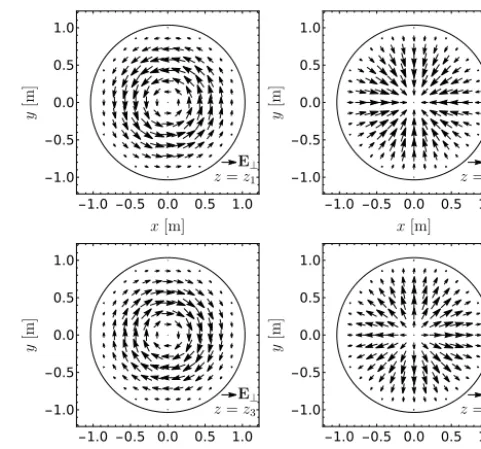
Figure 3. Change of transverse field pattern of the electric and magnetic field along thez-axis. Parameters for simulation:N=60, r0=1 andδmax=1.
As an illustrating example, two realizations of the stochastic processX (φ, ω)are shown in Fig. 1.
3 Numeric Results
In this section, we will present the method of computing the stochastic GTE’s. After substituting the field components of the IBC Eq. (25) into each integrand of the line integrals of Eqs. (16) and (17), the coupling coefficients on the right side of the equations will be divided into a deterministic and stochastic part. Combining the Eqs. (16) and (17) into the form of state space equations we obtain
Figure 4.All the basis coefficientsVE,n andIE,n. Parameters for
simulation:N=60,r0=1 andδmax=1.
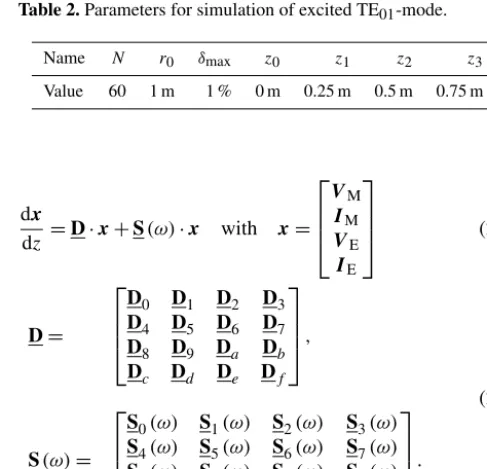
Table 2.Parameters for simulation of excited TE01-mode. Name N r0 δmax z0 z1 z2 z3
Value 60 1 m 1 % 0 m 0.25 m 0.5 m 0.75 m
dx
dz =D·x+S(ω)·x with x=
VM IM VE IE
(27)
D=
D0 D1 D2 D3 D4 D5 D6 D7 D8 D9 Da Db Dc Dd De Df
,
S(ω)=
S0(ω) S1(ω) S2(ω) S3(ω)
S4(ω) S5(ω) S6(ω) S7(ω)
S8(ω) S9(ω) Sa(ω) Sb(ω)
Sc(ω) Sd(ω) Se(ω) Sf(ω)
.
(28)
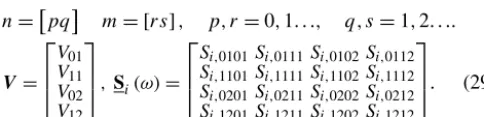
scription for the designation of various modes has been sub-stituted by a single subscription, but in order to consider all possible couplings the double subcription is useful. We will substitute the single subscription n andmwith the double subscription
pq
and [rs]
n=pq m=[rs], p, r=0,1. . ., q, s=1,2. . ..
V =
V01 V11 V02 V12
,Si(ω)=
Si,0101Si,0111Si,0102Si,0112 Si,1101Si,1111Si,1102Si,1112 Si,0201Si,0211Si,0202Si,0212 Si,1201Si,1211Si,1202Si,1212
. (29)
In the case of the introduced stochastic process X (φ, ω)
(Eq. 26), the matricesDandS(Eq. 28) become sparse matri-ces
D =
0 D1 0 D3
0 0 0 0
0 D9 0 Db
0 0 De 0
,
S(ω) =
0 S1(ω) 0 S3(ω)
0 0 0 0
0 S9(ω) 0 Sb(ω)
0 0 Se(ω) 0
.
(30)
As an example, we will calculate the basis coefficientsVn, In
for an excited TE01-mode. The simulation parameters are shown in Table 2. δmax describes the maximum deviation from the mean radiusr0, while zi characterizes four
differ-ent cross-sections of the waveguide. The associated voltage and currents coefficientsVn, Inare shown in Fig. 4. In Fig. 3,
there are the transverse patterns of the electric and mag-netic field at four different cross-sections. There are obvious changes of the transverse pattern due to the variation of the radius (see Fig. 1). In the case of a TE01-mode, the electric and magnetic field components are
Er =0, Eφ6=0, Ez6=0 Hr6=0, Hφ=0, Hz=0. (31)
The deformation causes other field components to arise, which can be seen in the changes of the transverse pattern of the electric and magnetic field (see Fig. 3). According to the results of the simulation for the voltage and current co-efficients, there is an attenuation toVM,01andIM,01, besides
the excited TE01-mode there are other spurious modes (see Fig. 4). If the maximal deviation become less than 0.1 % of the mean radiusr0, the transverse pattern of the electric and magnetic field show no significant changes along the propa-gation direction (see Fig. 2). It is also important to mention that the impedance factorZ(Eq. 24) is restricted to small val-ues close toZ=0 (Botton et al., 1998; Vlasov and Anton-sen, 2001). The effect of mode conversion and attenuation of the excited wave will not be discussed in this work and need further investigation.
4 Conclusions
In this paper it was shown, that it is possible to derive stochastic generalized telegraphist’s equation for irregular deformed waveguides for a specific random process. In the case of the impedance boundary condition from Leontovich (IBC), the mathematical derivation and first numeric results were presented. The changes of the transverse field pattern of a circular electric wave (TE01) in the direction of propagation was determined. Effects of mode conversion and attenuation due to the surface roughness and finite conductivity need fur-ther investigation. Especially, the choice of the model of the boundary condition as well as the stochastic process is essen-tial. In consequence of non-uniform convergence of the basis function, the impedance has to be close to zero (Botton et al., 1998). In a recent work from Zaginaylov and Shcherbinin (2016) a new approach was given for that problem.
Data availability. There are no underlying research data for the presented work. All results can be reproduced with the equations and parameters given directly in the paper.
Competing interests. The authors declare that they have no conflict of interest.
Special issue statement. This article is part of the special issue “Kleinheubacher Berichte 2017”. It is a result of the Klein-heubacher Tagung 2017, Miltenberg, Germany, 25–27 September 2017.
The publication of this article was funded by the open-access fund of Leibniz Universität Hannover.
Edited by: Thomas Eibert
Reviewed by: two anonymous referees
References
Botton, M., Antonsen, T. M., Levush, B., Nguyen, K. T., and Vlasov, A. N.: MAGY: A time-dependent code for simulation of slow and fast microwave sources, IEEE T. Plasma Sci., 26, 882–892, 1998.
Carson, J. R., Mead, S. P., and Schelkunoff, S.: Hyper-frequency wave guides – mathematical theory, Bell Labs Tech. J., 15, 310– 333, 1936.
Hertz, H.: Die Kräfte electrischer Schwingungen, behandelt nach der Maxwell’schen Theorie, Ann. Phys., 272, 1–22, 1889. Huang, H. and Hung-Chia, H.: Coupled Mode Theory: As
Ap-plied to Microwave and Optical Transmission, Taylor & Francis, Utrecht, the Netherlands, 1984.
Katsenelenbaum, B. Z.: Theory of nonuniform waveguides: the cross-section method, The Institution of Electrical Engineers, London, UK, 44, 1998.
Mathis, W. and Mathis, R.: On the derivation of generalized trans-mission line equations of cylindrical waveguides with irregu-lar deformed surfaces, in: 2015 IEEE International Symposium on Electromagnetic Compatibility (EMC), Vol. 2015-September, 830–833, IEEE, Dresden, Germany 2015.
Miller, S. and Beck, A.: Low-loss waveguide transmission, P. IRE, 41, 348–358, 1953.
Miller, S. E.: Coupled wave theory and waveguide applications, Bell Labs Tech. J., 33, 661–719, 1954a.
Miller, S. E.: Waveguide as a communication medium, Bell Labs Tech. J., 33, 1209–1265, 1954b.
Moon, P. and Spencer, D. E.: Separability conditions for the Laplace and Helmholtz equations, J. Frankl. Inst., 253, 585–600, 1952. Rayleigh, L.: XVIII. On the passage of electric waves through tubes,
or the vibrations of dielectric cylinders, The London, Edinburgh, and Dublin Philosophical Magazine and Journal of Science, 43, 125–132, 1897.
Reiter, G.: Generalized telegraphist’s equation for waveguides of varying cross-section, Proceedings of the IEE-Part B: Electronic and Communication Engineering, 106, 54–61, 1959.
Saad, S. M.: Review of numerical methods for the analysis of arbitrarily-shaped microwave and optical dielectric waveguides, IEEE T. Microw. Theory, 33, 894–899, 1985.
Schelkunoff, S. A.: Transmission theory of plane electromagnetic waves, P. IRE, 25, 1457–1492, 1937.
Schelkunoff, S. A.: Applied mathematics for engineers and scien-tists, van Nostrand, Princeton, New Jersey, 1951.
Schelkunoff, S. A.: Generalized telegraphist’s equations for waveg-uides, Bell Labs Technical Journal, 31, 784–801, 1952. Schelkunoff, S. A.: Conversion of Maxwell’s Equations into
Gen-eralized Telegraphist’s Equations, Bell Labs Tech. J., 34, 995– 1043, 1955.
Senior, T.: Impedance boundary conditions for statistically rough surfaces, Appl. Sci. Res. B-Elec., 8, 437–462, 1960.
Southworth, G. C.: Principles and applications of waveguide trans-mission, Bell Labs Tech. J., 29, 295–342, 1950.
Spencer, D. E.: Separation of variables in electromagnetic theory, J. Appl. Phys., 22, 386–389, 1951.
Stratton, J. A.: Electromagnetic theory, John Wiley & Sons, Inc., Hoboken, New Jersey, 1941.
Unger, H.-G.: Helix waveguide theory and application, Bell Labs Tech. J., 37, 1599–1647, 1958.
Unger, H.-G.: Noncylindrical helix waveguide, Bell Labs Tech. J., 40, 233–254, 1961a.
Unger, H.-G.: Mode conversion in metallic and helix waveguide, Bell Labs Tech. J., 40, 613–626, 1961b.
Unger, H.-G.: Regellose Störungen in Wellenleitern, Arch. Elektr. Übertrag., 393–401, 1961c.
Vlasov, A. N. and Antonsen, T. M.: Numerical solution of fields in lossy structures using MAGY, IEEE T. Electron Dev., 48, 45–55, https://doi.org/10.1109/16.892166, 2001.
Weiss, L. and Mathis, W.: Generalized telegraphist’s equations for deformed waveguides, Electromagnetics, 18, 353–365, https://doi.org/10.1080/02726349808908594, 1998.
Zaginaylov, G. I. and Shcherbinin, V. I.: Analysis and im-provement of convergence of transverse expansions in excitation problems of irregular impedance waveguides, in: 2016 IEEE International Conference on Mathematical Methods in Electromagnetic Theory (MMET), 228–231, https://doi.org/10.1109/MMET.2016.7544039, IEEE, Lviv, Ukraine, 2016.