Security Analysis of a Revocable
and Strongly Unforgeable
Identity-Based Signature Scheme
ITC 3/47Journal of Information Technology and Control
Vol. 47 / No. 3 / 2018 pp. 575-587
DOI 10.5755/j01.itc.47.3.18528 © Kaunas University of Technology
Security Analysis of a Revocable and Strongly Unforgeable Identity-Based Signature Schemes
Received 2017/07/04 Accepted after revision 2018/07/16
http://dx.doi.org/10.5755/j01.itc.47.3.18528
Corresponding author: [email protected]
Xiaodong Yang
College of Computer Science and Engineering, Northwest Normal University, Lanzhou 730070, Gansu, China; State Key Laboratory of Cryptology, Beijing 100878, China; e-mail: [email protected]
Tingchun Ma, Ping Yang, Faying An, Caifen Wang
College of Computer Science and Engineering, Northwest Normal University, Lanzhou 730070, Gansu, China; e-mails: [email protected], [email protected], [email protected], [email protected]
Revocation functionality is very important for an identity-based signature to revoke users efficiently and se-curely. Hung et al. proposed a revocable identity-based signature (RIBS) scheme in the standard model and proved that it was strongly unforgeable against chosen-message attacks. However, we find that their RIBS scheme is insecure. In this paper, we provide a security analysis of Hung et al.’s RIBS scheme by showing con-crete attacks. Our analysis shows that Hung et al.’s RIBS scheme does not satisfy the requirement of strong unforgeability, and thus, an adversary can forge a legal signature for a previously signed message. We also note serious flaws in their security proofs. The simulator of Hung et al.’s security argument cannot correctly an-swer the signing query in the security model, and the adversary can obtain any valid signature. Furthermore, we demonstrate that Hung et al.’s RIBS scheme is vulnerable to signing key exposure attack. To solve these problems, we construct an improved RIBS scheme with strong unforgeability and signing key exposure resist-ance in the standard model. Compared with previous RIBS schemes without random oracles, our scheme has advantages regarding computational cost and security.
KEYWORDS: Revocable identity-based signature, strong unforgeability, signing key exposure, standard mod-el, bilinear pairing, security.
1. Introduction
Identity-based cryptography avoids public key certif-icates and simplifies key management in traditional certificated-based cryptosystem [19, 25]. In an
of the user is computed by a trusted private key gen-erator (PKG). Due to its elimination of complicat-ed certificate management, IBS has attractcomplicat-ed great attention from researchers. Based on bilinear pair-ings, many IBS schemes in the random oracle model have been presented in [14, 20, 26, 27], but these IBS schemes could be insecure in the real world when random oracles are instantiated with specific hash functions [5]. Therefore, it is necessary to construct IBS schemes without random oracles in the standard model. The first IBS scheme in the standard model was presented by Paterson and Schuldt [15]. Since then, several IBS schemes without random oracles have appeared in [6, 7, 13].
However, all of the above-mentioned IBS schemes only satisfy existential unforgeability, in which an adversary is unable to forge a valid signature on a message that has not been signed before. Actually, the stronger security property, called strong unforge-ability, is required in some practical applications [4]. Strong unforgeability preserves the property of exis-tential unforgeability and prevents an adversary from forging signatures on previously signed messages. There are some transformation methods to convert existentially unforgeable IBS schemes to strongly un-forgeable ones [8, 21]. In particular, several efficient strongly unforgeable IBS schemes in the standard model were directly constructed without the use of any transformation, such as [10, 16, 23].
Practical IBS schemes need an efficient revocation mechanism to revoke compromised or unauthorized users. However, the public key in the IBS scheme can-not be revoked directly since the user’s identity is the user’s public key. To achieve revocation functionality, some methods of effectively revoking the user in an identity-based setting have been proposed [1, 3, 17, 18]. The main idea of these methods is that PKG needs to periodically update the signing key for each non-re-voked user. Sun et al. [22] presented a revocable iden-tity-based signature (RIBS) scheme, but its security depends on the random oracle model. To avoid ran-dom oracles, Tsai et al. [24] proposed an RIBS scheme in the standard model, but this scheme only covers existential unforgeability. Naturally, constructing a strongly unforgeable IBS scheme is very interest-ing. Liu et al. [12] presented an RIBS scheme with strong unforgeability in the standard model. Although their scheme reduces the workload of the PKG’s key
update, the size of a user’s secret key is very large. Meanwhile, the signing algorithm in Liu et al.’s RIBS scheme is based on the weakly secure Boneh-Boyen scheme [2], so it could not resist attack algorithms as presented in [11]. Hung et al. [9] presented a new RIBS scheme without random oracles in which the signing key of each non-revoked user is derived from a fixed secret key issued by the PKG via a secure channel and a dynamic update key sent by the PKG via a public channel. They also claimed that their RIBS scheme was strongly unforgeable under the computational Diffie-Hellma (CDH) assumption. Nevertheless, we find that their conclusion is incorrect.
In this paper, we first show that Hung et al.’s RIBS scheme is not strongly unforgeable by providing a concrete attack. Next, we show that the simulator of Hung et al.’s security proof cannot generate correct signatures to respond to the adversary’s signing que-ries. We also show that their scheme does not consid-er a signing key exposure attack and cannot withstand this attack. Furthermore, we propose an improved RIBS scheme that provides strong unforgeability and signing key exposure resistance in the standard mod-el. In addition, the analysis results indicate that our scheme has higher computational performance and security.
2. Preliminaries
In this section, we briefly review some preliminaries and security notions of strongly unforgeable RIBS scheme.
2.1. Bilinear Pairings and Security Assumption
Let p be a large prime, G and GT be two multiplicative cyclic groups of order p, and g be a generator of G. An efficiently computable map e: G×G→GT is said to be a bilinear pairing if it has the following properties:
_ Bilinearity: for any a, b∈Zp, e(ga, gb)= e(g, g)ab= e(gb, ga).
_ Non-degeneracy: e(g, g)≠1, where 1 is the identity element of GT.
_ Given a tuple (g, ga, gb)∈G3 with unknown a, b∈ Z
p, the CDH problem in G is to compute gab.
al-gorithm has a non-negligible probability of solving the CDH problem in G, we say that the CDH assump-tion holds in G.
2.2. Formal Definition and Security Model of RIBS Scheme
A strongly unforgeable RIBS scheme is defined by the following six algorithms:
Setup: On input of a security parameter λ, this algo-rithm outputs a PKG’s master secret key msk and the public parameters pp.
Extract: On input of pp, msk and a user’s identity ID, this algorithm outputs an ID’s secret key skID.
KeyUp: Taking as input pp, msk, a non-revoked user’s identity ID and a time period t, this algorithm outputs the user’s update key vkID t,.
SKGen: Taking as input pp, skID and vkID t,, this
algo-rithm outputs a signing key dkID t, for a non-revoked
user with identity ID.
Sign: On input of pp, a signing key dkID t, and a
mes-sage M, this algorithm outputs a signature σ on M . Verify: Taking as input pp, an identity ID, a time peri-od t, a message M and a signature σ , a verifier accepts σ if σ is a valid signature on M with respect to (ID, t); otherwise, the verifier rejects σ .
Liu et al. [12] and Hung et al. [9] gave the security model of strongly unforgeable RIBS scheme.
Definition 2.An RIBS scheme is said to be strongly unforgeable against adaptive chosen-message attacks if the probability that an adversary A wins the follow-ing game played with a challenger C is negligible. Setup: C runs the algorithm Setup to produce the master secret key msk and the public parameters pp. Then, C sends pp to A, and keeps msk secretly.
PKG queries: On receiving a secret key query on an identity ID, C runs the algorithmExtract(pp, msk, ID) to generate ID’s secret key skID and returns it to A. KeyUp queries: On receiving an update key query on an identity ID and a time period t, C runs the algo-rithmKeyUp(pp, msk, ID, t) to generate ID’s update key vkID t, and returns it to A.
SKGen queries: On receiving a signing key query on (ID, t), C returns ⊥ to A if ID has been revoked. Other-wise, C first asks for a secret key query on ID and an update key query on (ID, t) to get a secret key skID and
an update key vkID t, , respectively. Then, C runs the
al-gorithmSKGen(pp, skID,vkID t, ) to generate ID’s
sign-ing key dkID t, and returns it to A.
Signing queries: On receiving a signature query on a message M for an identity ID and a time period t, C first issues a SKGen query on (ID, t) to obtain a signing key
,
ID t
dk . Then, C runs the algorithmSign(pp, dkID t, ,M) to generate a signature σ on M and returns it to A. Forgery: A finally outputs a forged signature σ* on a message M*
for an identity ID* and a time period t* . We say A wins in the above the game if the following conditions hold:
1 σ* is a valid signature of M* with regard to (ID t* *, ). 2 ID* and (ID t* *, ) have not appeared in PKGqueries
and SKGen queries, respectively,
3 σ* is not outputted by Signing query on (M ID t*, * *, ) .
3. The Review of Hung et al.’s RIBS
Scheme
3.1. Hunget al.’sRIBS Scheme
For subsequent convenience, we define some nota-tions used in this paper. We let ID, t and M denote a user’s identity, a time period and a message to be signed, respectively. ID*, t* and M* denote a challenged user’s identity, time period and message, respectively. We also assume that all identities and messages are bit strings of fixed lengths m and l, respectively. In practice, we can achieve identities and messages that are bit strings of arbitrary length by using two cryp-tographic hash functions: HID: {0,1}*→{0,1}m and HM: {0,1}*→ {0,1}l.
The RIBS scheme of Hung et al. [9] consists of five al-gorithms: Setup, Extract, KeyUp, SignandVerify. The details of this scheme are described below. Setup: On input of a security parameter λ, PKG runs this algorithm to produce a master secret key msk and the public parameters pp.
1 Select two cyclic groups G and GT of prime or-der p>2λ, a generator g of G, a bilinear pairing e: G×G→GT and two random elements g2, g3 from G. 2 Pick two collision-resistant hash functions H1:
{0,1}*→{0,1}n and H
2: {0,1}*→Zp, where n is the fixed length of the output of H1. Further select random
3 Select two random integers α β ∈, Zp and compute
2
gα
,g2β and g1=gα β+ .
4 Publish the parameters pp=( , , , ,G G p eT
1 2 3 0 1 0 1 0 1
, , , , , ,..., , , ,..., , , ,m n
g g g g u u u v v v w w
1 2
..., , ,w H Hl ) and keep the master secret key
2
( , msk= gα
g2β) .
For an identity ID=(ID1,...,IDm) {0,1}∈ m, a string ( ,..., ) {0,1}1 n
n
T = T T ∈ and a message
1
( ,..., ) {0,1}l
l
M = M M ∈ , we define the following three functions, which will be used in all subsequent schemes:
,1 0 1
( ) m IDi
W i
i
F ID u u
=
=
∏
, ,2 01
( ) n Tj
W j
j
F T v v
=
=
∏
and,3 0 1
( ) l Mk
W k
k
F M w w
=
=
∏
.Extract: Given a user’s identity ID, the PKG runs the extraction algorithm to generate ID’s secret key skID.
Randomly select r Zs∈ p and compute ( ,1 2) ( 2 ,1( ) ,rs rs)
ID W
sk = sk sk = g Fα ID g
1 2 2 ,1
( , ) ( ( ) ,rs rs)
ID W
sk = sk sk = g Fα ID g .
Send skID to the user via a secure channel.
KeyUp: Given a time period t and a non-revoked us-er’s identity ID, the PKG runs the key update algo-rithm to generate the user’s update key vkID t,.
Compute T H ID t= 1( , ) ( ,..., ) {0,1}= T1 Tn ∈ n.
Select a random exponent r Zt∈ p and compute
, ( ,1 2) ( 2 ,2( ) , )rt rt
ID t W
vk = vk vk = g Fβ T g .
Send vkID t, to the user via a public channel.
After receiving skID =( ,sk sk1 2) and vkID t, =( ,vk1 2)
vk , a non-revoked user with identity ID computes
, ( ,1 2, 3) ( 1 1, 2, 2)
ID t
dk = dk dk dk = sk vk sk vk⋅ as the sign-ing key at time period t.
Sign: For a message M, a time period t and a signing key dkID t, =( ,dk dk dk1 2, 3), a signer with identity ID
runs the signature generation algorithm to create a signature σ on M.
Select a random integer rm∈Zp and compute
2( , rm)
h H M g= .
Compute σ =1 ( )dk F1 h W,3( )M rm, σ =2 (dk2)h, σ =3 (dk3)h
and σ =4 grm.
Output a signature σ =( , , , )σ σ σ σ1 2 3 4 on M.
Verify: Given an identity ID, a time period t, a mes-sage M and a signature σ =( , , , )σ σ σ σ1 2 3 4 , a verifier
runs the signature verification algorithm to check the validity of σ.
1 Compute T H ID t= 1( , ) and h= H M2( , )σ4 .
2 Verify the following equation
1
( , )
eσ g = e g g( , )2 1 h⋅e F( W,1( ), )ID σ2 ,2 3 ,3 4
( W ( ), ) ( W ( ), ).
e F T σ e F M σ
⋅ ⋅
If this equation holds, σ is a valid signature and the verifier accepts σ . Otherwise, the verifier rejects σ .
3.2. Hung et al.’s Security Proof
Hung et al. [9] proved that their RIBS scheme was strongly unforgeable against two types of adversar-ies. The first type of attacker is an external adversary who can request all queries except for the challenged user’s secret key query. The second type of attacker is a revoked user who can request all queries except for the challenged user’s update key query in the tar-get time period. In this subsection, to save space, we mainly describe the simulator in Hung et al.’s security proof, which uses a forgery of an external adversary to solve the CDH problem.
Suppose that an external adversary A1 makes qE se-cret key queries, qU update key queries and qS sign-ing queries and outputs a forged signature for Hung et al.’s RIBS scheme. By using A1, a simulator C solves
the CDH problem. Specifically, C is given a random instance ( , , )g g ga b ∈G3 of the CDH problem, and C’s
goal is to calculate gab. The details of the interaction between C and A1 are described as follows.
Setup: C sets lv=2(qE+qS) and lm =2qS satisfying
( 1)
v
l m+ <p and l lm( 1)+ < p. C picks three random
integers β ∈Zp, kv(0≤kv≤m) and km(0≤km ≤l), and sets g2=gb and g1=g ga β. This indicates that the
master secret key msk=( ,g2a g2β), but a is unknown
to C. Moreover, C chooses two collision-resistant hash functions H1: {0,1}* →{0,1}n and H2: {0,1}*→Zp. Then, C selects random elements x x0, ,...,1 xm∈Zlv,
0, ,...,1 l lm
c c c Z∈ , y y0, ,..., ,1 ym t t0 1, ,..., , , ,...,t z zn 0 1 zl∈Zp and computes 0
0 t
v =g , tj(1 )
j
v =g ≤ ≤j n,
0 0
0 2l k xv v y
u =g- + g ,
2xi yi
i
u =g g (1≤ ≤i m), 0 0
0 2l km m c z
w =g- + g
and 2ck zk(1 )
k
w =g g ≤ ≤k l . Finally, C sends the pub-lic parameters pp=( , , , , , , , , , ,G G p e g g g g u uT 1 2 3 0 1
0 1 0 1 1 2
..., , , ,..., , , ,..., , ,u v vm v w wn w H Hl ) to A1.
fol-lowing five functions
0 1
( ) v v m i i
i
F ID l k x x ID
= = - + +
∑
,( ) J ID = 0
1
m i i i
y y ID
= +
∑
,0 1
( ) n j j
j
E T t t ID
= = +
∑
,( ) m m
K M = -l k + 0 1
l k k k
c c M
= +
∑
,0 1
( ) l k k
k
L M z z M
=
= +
∑
.PKG queries: On receiving a secret key query on ID, C computes F(ID) and J(ID). If F ID( ) 0mod= p, C exits the simulation. Otherwise, C randomly selects r Zs∈ p, computes
( ) 1 ( ) ( ) 1 2 ,1
( , ) (( ) ( ) ,( )s s),
J ID
r r
a F ID a F ID
ID W
sk sk sk g F ID g g
-
-= =
and returns ID’s secret key skID to A1.
KeyUp queries: On receiving an update key query on (ID, t), C computes T H ID t= 1( , ). Then, C randomly
selects r Zt∈ p, uses the secret value β to compute
, ( ,1 2) ( 2 ,2( ) , )rt rt
ID t W
vk = vk vk = g Fβ T g , and returns the
update key vkID t, to A1.
Signing queries: On receiving a signature query on (M, ID, t), C answers this query in the following man-ner.
1 If F ID( ) 0mod≠ p, C computes a secret key skID
and an update key vkID t, by the secret key simulation
and the update key simulation, respectively. Then, C gets a signing key dkID t, at time period t by
com-bining skID and vkID t,, runs the algorithm Sign to produce a signature σ on M, and returns σ to A1. 2 If F ID( ) 0mod= p, C computes K M( ) and L M( ).
Based on K M( ) 0mod= p, it can be divided into two subcases.
_ If K M( ) 0mod= p, C aborts the simulation.
_ If K M( ) 0mod≠ p, C randomly selects rs,
,
t m p
r r ∈Z , and computes T H ID t= 1( , )
and h H M g= 2( , rm). Next, C computes
1
σ = ( )( )
2 ,1 ,2 ,3
(( ) ( )s ( ) ) ( )t ( ) ,m
L M h
r r h a K M r
W W W
g Fβ ID F T g F M
-2 gr hs
σ = , σ =3 gr ht and 4 ( ) ( ) m h
r a K M
g g
σ
-= , and
returns a signature σ = ( , , , )σ σ σ σ1 2 3 4 on M to A1.
Forgery: A1 eventually outputs a forged signature
* * * * * 1 2 3 4
( , , , )
σ = σ σ σ σ with regard to (M ID t*, * *, ). If *
( ) 0mod
F ID ≠ p or K M( *)≠ 0mod p, C aborts.
Otherwise, C computes T*= * * 1( , )
H ID t and
* * * 2( , )4
h =H M σ , and then outputs the CDH value
*
* * * * * *
* 1/ 1
* ( )/ * ( )/ * ( )/ 2 2 3 4
( )
( ) ( ) ( )
h ab
J ID h E T h L M h
g gβ
σ
σ σ σ
= .
4. Cryptanalysis of Hung
et al.
’s RIBS
Scheme
4.1. Hung et al.’s RIBS Vulnerability Against Strong Unforgeability
In [9], Hung et al. demonstrated that their RIBS scheme satisfies strong unforgeability in the stan-dard model. However, we find that their conclusion is not true. Concretely, given a message-signature pair (M,σ), there exists an adversary A that can always succeed in forging a new valid signature on the same message M as shown below.
A intercepts a valid signature σ =( , ,σ σ1 2 σ σ3, )4
on a message M of an identity ID at time period t, where T H ID t= 1( , ), h= H M2( , )σ4 , σ =2 gr hs ,
3 gr ht
σ = , ( )
1 g2α βhFW,1( )ID Fr hs W,2( )T r ht FW,3( )M rm
σ = + and σ =4 grm.
A randomly selects '
t p
r Z∈ , computes ' ' 1 1FW,2( )T rt
σ =σ and ' '
3 3grt
σ =σ = gr h rt +t', and sets '
2 2
σ =σ , ' 4 4
σ =σ . A outputs a signature ' ' ' ' '
1 2 3 4
( , , , )
σ = σ σ σ σ on M. It is obvious that σ' is a legal signature of ID on M at
time period t since σ' satisfies the following
verifica-tion equaverifica-tion in Hung et al.’s RIBS scheme:
'
'
1 1 ,2
( , ) ( ( ) , )rt W
eσ g =e Fσ T g
'
( )
2 ,1 ,2 ,3 ,2
( h ( )r hs ( )r ht ( )rm ( ) , )rt
W W W W
e gα β+ F ID F T F M F T g
=
'
( )
2 ,1 ,2 ,3
( h ( )r hs ( )r h rt t ( ) , )rm
W W W
e gα β+ F ID F T + F M g
=
'
( )
2 ,1 ,2
( h, ) ( ( ) , ) (r hs ( )r h rt t, )
W W
e gα β+ g e F ID g e F T + g
= ⋅ ⋅ ( ,3( ) , )rm
W
e F M g
⋅
' ' '
2 1 ,1 2 ,2 3 ,3 4
( , ) (h ( ), ) ( ( ), ) ( ( ), ).
W W W
e g g e F ID σ e F T σ e F M σ
=
que-ries on (ID, t), and σ' is not the output of the signing
queries on (M, ID, t). Therefore, Hung et al.’s RIBS scheme does not satisfy the requirement of strong un-forgeability. The main reason for the inability to resist the above attack is that the previous signature σ and the forged signature σ' have the same hash value h.
Hence, the adversary can easily re-randomize exist-ing signatures to forge new signatures on the same messages.
4.2. Analysis of Hunget al.’s Security Proof
In Subsection 3.2, we have reviewed the security proof of Hung et al.’s RIBS scheme against an external adversary. Here, we show that there are serious flaws in their proofs.
When an external adversary A1 issues a
signa-ture query on (M, ID, t), the simulator C of Hung et al. randomly selects r r rs t, , m∈Zp and com-putes T H ID t= 1( , ) and h H M g= 2( , rm). If
( ) 0mod
F ID = p and K M( ) 0mod≠ p, C computes a signature σ =( ,σ1 σ σ σ2, , )3 4 on M, where σ =2 gr hs ,
3 gr ht
σ = , ( ) ( ) '
4 ( )
m
m m
h r ah
r r
a K M K M
g g g g
σ
-
-= = = and σ =1
( ) ( ) 2 ,1 ,2 ,3
(( ) ( )s ( ) ) ( )t ( )m
L M h
r r h a K M r
W W W
g Fβ ID F T g F M
-. From the above simulation, we can see that the hash value h in σ1 is calculated by M and grm, just as h=
2( , rm)
H M g . However, in accordance with the verifi-cation algorithm Verify of Hung et al.’s RIBS scheme, the hash value h' in the verification equation is
calcu-lated by M and σ4, just as h'=H M2( , )σ4 . Because
of '
( )
m m ah
r r
K M
= - , we have '
m m
r ≠r . Furthermore, we get h'=
2( , )4
H M σ =H M g2( , rm/)≠
2( , rm)
H M g =h since
2
H is collision-resistant. Then, we have
1
( , )
eσ g = e g g( , )2 1 h⋅e F( W,1( ), ) (ID σ2 ⋅e FW,2( ), )T σ3
'
,3 4 2 1 ,1 2
( ( ), ) ( , )h ( ( ), )
W W
e F M σ e g g e F ID σ
⋅ ≠ ⋅
,2 3 ,3 4
( W ( ), ) ( W ( ), )
e F T σ e F M σ
⋅ ⋅ .
Due to h'≠ h, the simulated signature σ computed
by C cannot satisfy the verification equation of Hung et al.’s RIBS scheme. Therefore, the simulator C of Hung et al. is unable to correctly answer the signing queries defined in the security model, and the adversary A1
cannot obtain any valid signature for F ID( ) 0mod= p
and K M( ) ≠0mod p. Moreover, based on the wrong simulation, it is not correct that the security of Hung et al.’s RIBS scheme is directly reduced to the hard-ness of the CDH assumption by using A1 against their
scheme. Thus, their conclusion of Theorem 1 in [9] is wrong. Note that a similar security analysis applies to an internal adversary. Furthermore, we could con-clude that Theorem 2 in [9] is also wrong.
4.3. Hunget al.’s RIBS Vulnerability Against Signing Key Exposure
Hung et al.’s RIBS scheme does not consider a real-istic threat known as signing key exposure [1,3,12]. That is, if a RIBS scheme is secure against signing key exposure attack, the exposure of a user’s signing key in the current time period does not reveal any infor-mation on subsequent signing keys of the user in oth-er time poth-eriods. More concretely, let t* be a target time period and ID* be a target user’s identity who is not re-voked at times t and t*. An adversary is allowed to get a signing key dkID t*, and two update keys vkID t*, and
* *,
ID t
vk at time t and t*, respectively. Then, the adver-sary could not obtain a secret key skID* from dkID t*,
and vkID t*, , and could not get a signing key dkID t* *, at
time t* from
*,
ID t
dk and vkID t* *, .
In this subsection, we show that Hung et al.’s RIBS scheme is unable to withstand signing key exposure attack as follows.
1 The adversary A obtains a compromised signing key
*,
ID t
dk on time period t. In Hung et al.’s RIBS scheme,
*, ( ,1
ID t
dk = dk dk dk2, 3) * *
1 1 2 2
(sk vk sk vk, , )
= ⋅ is
com-puted by a secret key skID* =(sk sk1*, 2*) and an
up-date key vkID t*, =( ,vk vk1 2)at time period t. Note
that A can get vkID t*, and vkID t* *, , since all update
keys are transmitted by a public channel.
2 A who has dkID t*, =( ,dk dk dk1 2, 3) and vkID t*, =
1 2
( ,vk vk ) can easily recover the target user’s secret key skID* =(sk sk1*, 2*) such that sk1* = dk vk1/ 1 and
* 2 2
sk =dk .
3 A computes the signing key dkID t* *, =
* * * * * * * 1 2 3 1 1 2 2
(dk dk dk, , ) (= sk vk sk vk⋅ , , ) from
* ( ,1*
ID
sk = sk *
2)
sk and vkID t* *, =(vk vk1*, 2*) at time
period t*.
5. An improved RIBS Scheme with
Strong Unforgeability
5.1. Our Construction
Based on Hung et al.’s RIBS scheme [9], we construct a secure RIBS scheme that is strongly unforgeable in the standard model. To resist attacks presented in Section 4, we add a probabilistic signing key algo-rithm (SKGen) and modify the signing algoalgo-rithm in our improved scheme. Our IBS scheme is described as follows.
The algorithms Setup, Extract and KeyUp are the same as those of Hung et al.’s RIBS scheme described in Section 3.1.
SKGen: After receiving a secret key skID =( ,sk1 sk2)
and an update keyvkID t, =( ,vk1 vk2) at time period t
from the PKG, a non-revoked user with identity ID outputs a signing key via the following steps:
Select two random integers r s Z, ∈ p and compute
1( , )
T H ID t= .
Compute the signing key dkID t, =( ,dk dk dk1 2, 3) 1 ,1 1 ,2
( ( )s ( ) ,r
W W
sk F ID vk F T
= ⋅ ⋅ ⋅ sk g2 s,
2 r)
vk g . Sign: Given a message M and a signing key dkID t,
1 2 3
( ,dk dk dk, )
= on time period t, a signer with identity ID performs the following steps:
1 Select a random exponent rm∈Zp and compute
4 grm
σ = .
2 Set σ =2 dk2 and σ =3 dk3.
3 Compute h H ID M t= 2( , , , , , )σ σ σ2 3 4 and σ1 1 ( ,3( ) )3h rm W
dk F M g
= ⋅
1 ( W,3( ) )3h rm
dk F M g
= ⋅ .
4 Output a signature σ =( , , , )σ σ σ σ1 2 3 4 on M. Verify: Given a signature σ =( , , , )σ σ σ σ1 2 3 4 of an
identity ID on a message M at time period t, a verifier checks the validity of σ as follows:
1 Compute T H ID t= 1( , ) and h H ID M t= 2( , , ,σ σ σ2, , )3 4 2, , )3 4
σ σ σ .
2 Verify the following equation
1
( , )
eσ g = e g g e F( , ) (2 1 ⋅ W,1( ), )ID σ2
,2 3 ,3 3 4
( ( ), ) ( ( ) , ).h
W W
e F T σ e F M g σ
⋅ ⋅
If this equation holds, the verifier accepts σ. Other-wise, the verifier rejects σ.
Note that we introduce an algorithm SKGen to re-randomize the signing key in our scheme, but the signing key in Hung et al.’s RIBS scheme has the same random numbers used in the secret key and the up-date key. For a signing key dkID t, = ( ,dk dk dk1 2, 3)=
2 ,1 ,2
( ( )r ss ( ) ,r rt r ss , r rt )
W W
gα β+ F ID + F T + g + g + and an up-date key vkID t, =( ,vk vk1 2) =(g F2β W,2( ) , )T rt grt at
time period t, it is infeasible to recover the secret key
1 2 2 ,1
( , ) ( ( ) ,rs rs)
ID W
sk = sk sk = g Fα ID g from
,
ID t
dk and
,
ID t
vk . Hence, our scheme is secure against signing key exposure attack. In the signing algorithm of our scheme, the hash value h H ID M t dk dk= 2( , , , 2, 3, grm)
is hashed by a signer’s identity ID, a message M, a time period t, a part ( , ) (σ σ =2 3 dk dk2, 3) of a signing
key dkID t, and an element for the randomness of M.
Due to the collision resistance of H2, it is difficult to
re-randomize our RIBS scheme to forge a new signa-ture without a signing key. Therefore, our scheme is resistant to the attack presented in Section 4.1.
5.2. Security Proof
In this subsection, we reduce the security of our RIBS scheme to the CDH assumption. Our proof approach is similar to that of Hung et al.’s security proof [9]. To simplify the security analysis, we also classify attacks into two categories: type-1 adversary and type-2 ad-versary. The type-1 adversary A1 models an external
attacker who cannot request the secret key query on ID* and the signing key query on (ID*, t*). The type-2
adversary A2 models an internal attacker (or a revoked
user) who cannot issue the update key and signing key queries on (ID*, t*). By presenting the following
lem-mas, we prove that our RIBS scheme is strongly un-forgeable against two types of adversaries.
Lemma 1. If there exists a type-1 adversary A1
break-ing strong unforgeability of our RIBS scheme, then the CDH problem can be solved.
Proof. Suppose that A1 forges a valid signature for our
RIBS scheme after making qE secret key queries, qU update key queries, qK signing key queries and qS sign-ing queries. Then, we are able to construct a simulator C that solves the CDH problem by using A1. C is given
a random instance ( , , )g g ga b ∈G3 of the CDH
prob-lem, and the goal of C is to calculate gab.
Setup: Let lv =2(q q1+ S) and lm =2qS satisfying
( 1)
v
l m+ <p and l lm( 1)+ <p, where q1=max{ ,qE
}
K
3 d
g =g . C sets other parameters ( , , , , , , , ,..., , , ,..., , , ,...,G G p g g g u uT 1 2 0 1 u v vm 0 1 v w wn 0 1 1 2 0 1 0 1 0 1
( , , , , , , , ,..., , , ,..., , , ,...,G G p g g g u uT u v vm v w wn w H Hl, ,1 2) as described
in Section 3.2, where g1=g ga β andg2=gb. Note
that the master secret key msk=( ,g2a g2β), but a is
unknown to C. Meanwhile, C sends the public param-eterspp to A1.
To make the expression simpler, we also define five functions: F ID( ), J ID( ), E T( ), K M( ) and L M( ). Accordingly, we have the following equations
( ) ( ) ,1( ) 2F ID J ID
W
F ID =g g , ( )
,2( ) E T
W
F T =g and ( ) ( ) ,3( ) 2K M L M
W
F M = g g
( ) ( ) ,3( ) 2K M L M
W
F M =g g .
Please refer to Section 3.2 for the detailed description of these functions.
PKG queries: C maintains an initially empty list Lsk that consists of tuples in the form of (ID, rs). When A1
requests a secret key query on ID, C computes F(ID) and J(ID). If F ID( ) 0mod= p, C terminates the sim-ulation. If F ID( ) 0mod≠ p, C first recalls rs from Lsk if there is a tuple (ID, rs) in Lsk. Otherwise, C ran-domly selects r Zs∈ p and adds (ID, rs) to Lsk. Then, C computes skID
( ) ( ) 1 2 ,1
( , ) (( ) ( ) ,s
J ID
r a F ID
W
sk sk g F ID
-= =
1 ( )
( )ga F ID grs)
and returns ID’s secret key skID to A1.
KeyUp queries: C maintains an initially empty list Lvk that consists of tuples in the form of (ID, t, rt). When A1 requests an update key query on (ID, t), C
computes T H ID t= 1( , ). Next, C recalls rt from Lvk if there is a tuple (ID, t, rt) in Lvk. Otherwise, C randomly selects r Zt∈ p and adds (ID, t, rt) to Lvk. Then, C uses the secret value β to compute vkID t, =( ,vk vk1 2)=
2 ,2
( ( ) , )rt rt W
g Fβ T g and returns an ID’s update key
,
ID t
vk to A1.
SKGen queries: C maintains an initially empty list Ldk that consists of tuples in the form of (ID, t, r, s). On receiv-ing a signreceiv-ing key query on (ID, t), C returns ⊥ to A1 if ID
has been revoked. Otherwise, C simulates the signing key generation algorithm by executing the following steps:
1 Recall ( , )r s from Ldk if there is a tuple (ID, t, r, s) in Ldk. Otherwise, select random elements r s Z, ∈ p and add (ID, t, r, s) to Ldk.
2 Ask for a secret key query on ID and an update key
query on (ID, t) to get a secret key skID =( ,sk sk1 2)
and an update key vkID t, =( ,vk1 vk2), respectively.
3 Compute T H ID t= 1( , ) and dkID t, =( ,dk dk1 2, dk3)
1 ,1 1 ,2 2
( ( )s ( ) ,r s,
W W
sk F ID vk F T sk g
= ⋅ ⋅ ⋅ ⋅ vk g2⋅ r). 4 Return a signing key dkID t, =( ,dk dk1 2, dk3) to A1.
Note that C cannot compute a secret key and aborts simulation in case of F ID( ) 0mod= p.
Signing queries: On receiving a signature query on (M, ID, t), C answers this query in the following way. Case 1: If F ID( ) 0mod≠ p, C makes the signing key query on (ID, t) to get a signing key dkID t,, and then runs
the algorithm Sign to produce a signature σ on M. Case 2: If F ID( ) 0mod= p, C computes K M( ) and
( )
L M , and considers the following two subcases:
_ Case 2.1: If K M( ) 0mod= p, C aborts the simulation.
_ Case 2.1: If K M( ) 0mod≠ p, C recalls r r r ss t, ,( , )
from Lsk, Lvk and Ldk, respectively, if there were defined. Otherwise, C selects random elements r r r s Zs t, , , ∈ p and adds (ID, rs), (ID, t, rt), (ID, t, r, s) to Lsk, Lvk and Ldk, respectively. Then, C randomly selects rm∈Zp, and computes T H ID t= 1( , ), σ2 =gr ss+, σ3=gr rt+ ,
4
σ =
1 ( )
( )ga K M grm
-,h H ID M t= 2( , , , , , )σ σ σ2 3 4 and 1 FW,1( )ID r ss ( )g F2β W,2( )T r rt
σ = + ⋅ + ⋅ ( )( )
( )ga L M hdK M -
-⋅
,3 3
( ( ) )h rm W
F M g . Finally, C returns a signature
1 2 3 4
( , , , )
σ = σ σ σ σ on M to A1.
Let ' ,
s s
r = +r s '
t t
r = +r r and ' ,
( )
m m a
r r
K M
= - we have
'
2 gr ss grs,
σ = + = '
3 gr rt grt,
σ = + = ( )1 ( )
4 ( )
m m
a r r
a K M K M
g g g
σ
-
-= =
1
( ) ( )
4 ( )
m m
a r r
a K M K M
g g g
σ
-
-= = =grm',
2( , , , , , )= ( , , ,2 3 4 2
h H ID M t= σ σ σ H ID M t
=g g grs', ,rt' rm' ) and
( ) ( ) 1 ,1( )s ( )2 ,2( )t ( )
L M hd
r s r r a K M
W W
F ID g Fβ T g
σ
-
-+ +
= ⋅ ⋅
,3 3
( ( ) )h rm W
F M g
⋅
' ' ( )( )
2 ,1 ,2 2 2
( ) ( )s ( )t
aL M
r r a a K M
W W
gβ F ID F T g g g
-= ⋅ ⋅ ⋅ ⋅ ⋅
( )
,3 3
( ( ) )m
ahd
r h K M
W
g F M g
-⋅ ⋅
' ' ( ) ( ) ( )
2 ,1 ,2 2
( ) ( )s ( ) (t ( ) )
a
r r
a K M L M d h K M
W W
g β F ID F T g g g
-+
=
,3 3
( ( ) )h rm W
F M g
⋅
' ' ( )
2 ,1 ,2 ,3 3
( ) ( )s ( ) (t ( ) )
a
r r
a h K M
W W W
g β F ID F T F M g
-+
= ⋅ ⋅ ⋅
,3 3
( ( ) )h rm W
F M g
⋅
' ' '
2a W,1( )rs W,2( ) (rt W,3( ) )3h rm
g +βF ID F T F M g
=
It is easy to verify that the signature σ =( , ,σ σ1 2
3, )4
σ σ generated by the simulator C is valid since
1
( , )
eσ g =e g( 2a+βFW,1( )ID Frs' W,2( ) (T rt' FW,3( ) ) , )M g3h rm' g
' '
2 ,1 ,2
( , a ) ( ( ), rs) ( ( ), )rt
W W
e g g +β e F ID g e F T g
= ⋅ ⋅
'
,3 3
( ( ) ,h rm)
W
e F M g g
⋅
2 1 ,1 2 ,2 3
( , ) ( W ( ), ) ( W ( ), )
e g g e F ID σ e F T σ
= ⋅ ⋅
,3 3 4
( ( ) , )h
W
e F M g σ
⋅ .
Forgery: A1 eventually outputs a forged signature
* * * * * 1 2 3 4
( , , , )
σ = σ σ σ σ with regard to (M ID t*, * *, ),
where ID* and (ID t* *, ) have not appeared in the
secret key and signing key queries, and σ* is not
generated by signing queries on (M ID t*, * *, ). If *
( ) 0mod
F ID ≠ p or K M( *) 0mod≠ p, C aborts the
simulation. Otherwise, C computes * * * 1( , )
T =H ID t
and * * * * * * *
2( , , , , , )2 3 4
h =H ID M t σ σ σ , and uses the
se-cret value β to calculate the CDH value gab in the following manner:
* * * *
* 1
* ( ) * ( ) * ( ) * 2( )2 J ID ( )3 E T ( )4 L M ( )4 h d
gβ
σ
σ σ σ σ
* * * *
* * * * * * * *
* * * 2 ,1 ,2 ,3 3
( ) ( ) ( ) 2
( ) ( ) ( ( ) )
( ) ( ) ( ) ( )
s t m
s t m m
r r r
a h
W W W
r J ID r E T r L M r h d
g F ID F T F M g
g g g g g
β
β + =
* * *
* * * * * *
* * * *
* * * *
( ) ( ) ( ) ( ) ( )
2 2 2 3
( ) ( ) ( ) 3
( ) ( ) ( )
( ) ( ) ( ) ( )
s t m
s t m m
r r r
a F ID J ID E T K M L M h
r r r r
J ID E T L M h
g g g g g g g
g g g g
=
2a
g
= (since F ID( *)=K M( *) 0mod= p) ab
g
= .
We now analyse the probability that C does not abort in the above simulation. If C completes the entire sim-ulation, the following events must occur.
1 All secret key and signing key queries on an
identi-ty ID satisfy F ID( ) 0mod≠ p.
2 All signing queries on an identity ID and a message
M satisfy F ID( ) 0mod≠ p or K M( ) 0mod≠ p.
3 The forged signature σ*of identity ID* on message M* satisfies F ID( *) 0mod= p and
*
( )=0mod
K M p.
To simplify the analysis, we define the events as fol-lows:
: ( ) 0mod
i i
A F ID ≠ p for i=1,...,q q1+ S,
*: ( *) 0mod
A F ID = p,
: ( ) 0mod
j j
B K M ≠ p for j=1,...,qS,
*: ( *) 0mod
B K M = p.
Thus, the probability that C does not abort is
1
* *
1 1
Pr[ ] Pr[q qS i qS j ]
i j
abort + A A B B
= =
¬ ≥
1
* *
1 1
= Pr[q qS i ]Pr[qS j ]
i j
A A B B
+
= =
1
* * * *
1 1
= Pr[ ]Pr[q qS i| ]Pr[ ]Pr[qS j| ]
i j
A + A A B B B
= =
.Since l lm( 1)+ <p, we have that
* *
Pr[ ]= Pr[ (A F ID ) 0mod ]= p
* *
Pr[ (F ID ) 0modp F ID( ) 0mod ]lv
≥ = =
*
Pr[ (F ID ) 0mod ]lv
= = ⋅
* *
Pr[ (F ID ) 0mod | (= p F ID) 0mod ]= lv
1 1 1
v
l m
=
+ ,
1 1
* *
1 1
Pr[q qS i| ] 1 Pr[q qS i| ]
i i
A A A A
+ +
= =
= - ¬
1
* 1
1 q qSPr[ i| ]
i
A A
+
= ≥ -
∑
¬1
1 S
v
q q l
+
= - .
Since l mv( + <1) p, we have that
* *
Pr[ ]= Pr[ (B K M ) 0mod ]= p
* *
Pr[ (K M ) 0modp K M( ) 0mod ]lm
≥ = =
*
Pr[ (K M ) 0mod ]lm
* *
Pr[ (K M ) 0mod | (= p F M ) 0mod ]= lm
1 1 1
m
l l
=
+ ,
* *
1 1
Pr[qS j| ] 1 Pr[qS j| ]
j j
B B B B
= =
= - ¬
* 1
1 qS Pr[ j| ]
j
B B
= ≥ -
∑
¬1 S
m
q l
= - .
As lv =2(q q1+ S) and lm =2qS, we can obtain the re-sulting probability
1
1 1 1 1
Pr[ ]= 1 1
1 S 1 S
v v m m
q q q
abort
l m l l l l
+
¬ - -
+ +
1
1 1
1 1 1 1
= 1 1
2( S) 1 2( SS) 2 S 1 2SS
q q q
q q m q q q l q
+
-
-
+ + + +
1
1 =
16(m+1)( 1) (l+ q q qS + S).
Therefore, if A1 breaks the strong unforgeability
of our IBS scheme with probability ε, then C can solve the CDH problem with probability at least
1
16 (q q q mS S)( 1)( 1)l
ε
+ + + .
Lemma 2. If there exists a type-2 adversary A2
break-ing strong unforgeability of our RIBS scheme, then the CDH problem can be solved.
Proof. Suppose that A2 makes qE secret key queries, qU update key queries, qK signing key queries and qS sign-ing queries, and forges a valid signature for our RIBS scheme with probability ε. Then, we show that a sim-ulator C can solve the CDH problem by using A2. C is
given ( , , )g g ga b ∈G3, and C’s goal is to output gab. Setup: C sets lt=2(q2+qS) and lm =2qS satisfying
( 1)
t
l n+ <p and l lm( 1)+ <p, where q2=max{ , }q qU E . C randomly selects d,χ ∈Zp, kt(0≤kt≤n) and
(0 )
m m
k ≤k ≤l . Additionally, C selects random elements
' ' ' ' ' ' 0, ,..., , , ,...,1 m 0 1 n p,
x x x t t t ∈Z ' ' '
0, ,...,1 n lt
y y y ∈Z , and sets
1 a= a
g =g g gχ χ + ,
2 b
g =g , 0'
0 x
u =g , xi'(1 )
i
u =g ≤ ≤i m ,
' ' 0 0
0 2l k yt t t
v =g- + g ,
j
u = g g2y'j t'j(1≤ ≤j n) and
3 d
g =g .
Note that the master secret key msk=( , )g g2χ 2a , but a
is unknown to C. Then, C constructs other parameters
0,
w wk(1≤ ≤k l), H1 and H2 in the same manner as
in Lemma 1. Finally, C sends public parameters pp to the adversary A2.
Given an identity ID, a string T and a message M , we also define the following five functions :
' ' 2 0
1
( ) m i i
i
E ID x x ID
=
= +
∑
,' ' 2 0
1
( ) t t n j j
j
F T l k y y T
= = - + +
∑
,2( )
J T = ' '
0 1
n j j j
t t T
= +
∑
,0 1
( ) m m l k k
k
K M l k c c M
=
= - + +
∑
,0
( )
L M =z +
1
l k k k
z M
=
∑
.Consequently, we have three equations FW,1( )ID 2( )
E ID
g
= , 2( ) 2( )
,2( ) 2F T J T
W
F T =g g and FW,3( )M =
( ) ( ) 2K M L M
g g .
PKG queries: C maintains an initially empty list Lsk in the same manner as PKG queries in Lem-ma 1. On receiving a secret key query on ID, C recalls rs from Lsk. Then, C computes skID =
1 2 2 ,1
( , ) ( ( ) ,rs rs)
W
sk sk = g Fχ ID g , and returns
ID
sk to A2.
KeyUp queries: C maintains an initially emp-ty list Lvk in the same manner as KeyUp queries in Lemma 1. On receiving an update key que-ry on (ID, t), C computes T H ID t= 1( , ), F T2( )
and J T2( ). If F T2( ) 0mod= p, C aborts. If
2( ) 0mod
F T ≠ p, C recalls rt from Lvk, computes
2
2 2
( ) 1 ( ) ( )
, ( ,1 2) (( ) ,2( ) ,( )t t),
J T
r r
F T F T
a a
ID t W
vk vk vk g F T g g
-
-= = ⋅
and returns vkID t, to A2.
SKGen queries: On receiving a signing key query on (ID, t), C performs the same as SKGen queries in Lemma 1 to return a signing key dkID t, to A2.
Similar-ly, C aborts the simulation when C cannot generate an update key with F T2( ) 0mod= p.
Signing queries: On receiving a signature query on (M, ID, t), C computes T H ID t= 1( , ), F T2( ) and J T2( ),
and then responds to this query as follows.
Case 1: If F T2( ) 0mod≠ p, C performs the same as in
Case 2: If F T2( ) 0mod= p, C computes K M( ) and
( )
L M , and considers the following two subcases:
_ Case 2.1: If K M( ) 0mod= p, C terminates the simulation.
_ Case 2.2: If K M( ) 0mod≠ p, C returns a signature σ on M to A2 as in Case 2.2 in Lemma 1.
Forgery: A2 eventually outputs a forged signature
* * * * * 1 2 3 4
( , , , )
σ = σ σ σ σ with regard to (M ID t*, * *, ), where * *
(ID t, ) has not appeared in the update key and sign-ing key queries, and σ* is not generated by signing
queries on (M ID*, *, t*). C computes * * * 1( , )
T =H ID t
and * * * * * * *
2( , , , , , )2 3 4
h =H ID M t σ σ σ . If *
2( )
F T ≠
0mod p or K M( *) 0mod≠ p, C terminates
simula-tion. Otherwise, C uses the secret value χ to calculate the CDH value gab as below:
* * * *
2 2
* 1 ( ) ( )
* * * ( ) * 2( )2 E ID ( )3 J T ( )4 L M ( )4 h d
gχ
σ
σ σ σ σ
* * * *
* * * * * * * *
2 2
* * * 2 ,1 ,2 ,3 3
( ) ( ) ( ) 2
( ) ( ) ( ( ) )
( ) ( ) ( ) ( )
s t m
s t m m
r r r
a h
W W W
r E ID r J T r L M r d h
g F ID F T F M g
g g g g g
χ
χ + =
* * *
* * * * * *
2 2 2
* * * *
* * * *
2 2
( ) ( ) ( ) ( ) ( )
2 2 2 3
( ) ( ) ( ) 3
( ) ( ) ( )
( ) ( ) ( ) ( )
s t m
s t m m
r r r
E ID F T J T
a K M L M h
r r r r
E ID J T L M h
g g g g g g g
g g g g
=
2
a
g
= (since * *
2( ) ( ) 0mod
F T =K M = p)
ab
g
= .
The probability analysis is similar to Lemma 1. The probability that C completes the simulation not aborting is at least
2 1
16 (q qS +q nS)( 1)( 1)+ l+
, and C
can solve the CDH problem with probability at least
2
16 (q qS q nS)( 1)( 1)l
ε
+ + + .
Combining Lemma 1 and Lemma 2, we can obtain the following theorem.
Theorem 1. In the standard model, our RIBS scheme is strongly unforgeable against adaptive chosen-message attacks under the CDH assumption.
5.3. Comparison
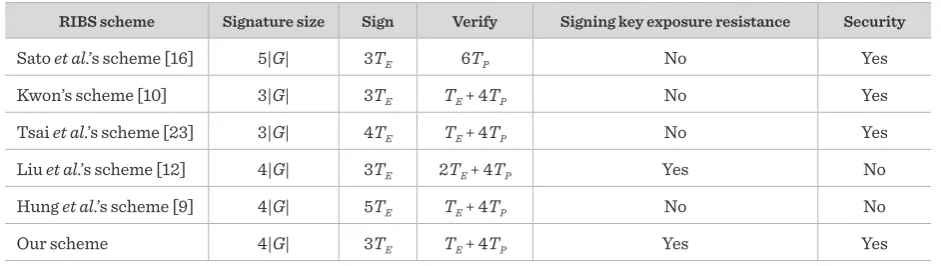
We give a comparison between our scheme and the previous RIBS schemes in the standard model. In Ta-ble 1, |G| denotes the bit-length of an element in group G, and TP and TE denote a pairing operation and an ex-ponentiation operation, respectively. We do not take into account relatively efficient operations, such as hash operations, multiplication, etc.
As shown in Table 1, among the three strong unforge-able IBS schemes [10,16,23], the signature length and signature verification cost of Sato et al.’s IBS scheme are the largest, while Tsai et al.’s IBS scheme has the largest signature cost. However, none of three schemes [10,16,23] support key revocation mechanism.
Three RIBS schemes have the same signature size, but our RIBS scheme is more efficient than Liu et al.’s scheme [12] and Hung et al.’s scheme [9] in terms of computational costs of the signing and verifying phases. It is noteworthy that Hung et al.’s scheme is vulnerable to signing key exposure and that our scheme and Liu et al.’s scheme can resist signing key exposure attack. However, there are some flaws in Liu et al.’s security proof as presented in [11], and the size of each user’s secret key increases logarithmically with the number of total users involved in Liu et al.’s
Table 1
Comparisons of computational costs and security with previous RIBS schemes
RIBS scheme Signature size Sign Verify Signing key exposure resistance Security
Sato et al.’s scheme [16] 5|G| 3TE 6TP No Yes
Kwon’s scheme [10] 3|G| 3TE TE + 4TP No Yes
Tsai et al.’s scheme [23] 3|G| 4TE TE + 4TP No Yes
Liu et al.’s scheme [12] 4|G| 3TE 2TE + 4TP Yes No
Hung et al.’s scheme [9] 4|G| 5TE TE + 4TP No No
scheme. In addition, Hung et al.’s scheme does not sat-isfy strong unforgeability, but our scheme is strongly unforgeable in the standard model.
6. Conclusions
In this paper, we revisit Hung et al.’s RIBS scheme and its security proof [9]. Unfortunately, we find that their scheme does not possess strong unforgeability and that its security proof has serious flaws. Moreover, their scheme is insecure against signing key exposure attack. To resolve these problems, we propose an
im-proved RIBS scheme in the standard model. The analy-sis results show that our RIBS scheme satisfies strong unforgeability and signing key exposure resistance.
Acknowledgements
This work was partially supported by the National Natural Science Foundation of China under Grant No. 61662069, China Postdoctoral Science Foundation under Grant No. 2017M610817, Science and Technol-ogy Project of Lanzhou City of China under Grant No. 2013-4-22, Foundation for Excellent Young Teachers by Northwest Normal University under Grant No. NWNU-LKQN-14-7.
References
1. Boldyreva, A., Goyal, V., Kumar, V. Identity-Based En-cryption with Efficient Revocation. Proceedings of the 15th ACM Conference on Computer and Com-munications Security (CCS 2008), Alexandria, Vir-ginia, USA, October 27-31, 2008, 417-426. https://doi. org/10.1145/1455770.145 5823
2. Boneh, D., Boyen, X. Efficient Selective-ID Secure Iden-tity -Based Encryption without Random Oracles. Pro-ceedings of International Conference on the Theory and Applications of Cryptographic Techniques (EUROC-RYPT’04), Interlaken, Switzerland, May 2-6, 2004, 223-238. https://doi.org/10. 1007/978-3-540-24676-3_14 3. Boneh, D., Franklin M. Identity-Based Encryption
from the Weil Pairing. SIAM Journal on Computing, 2003, 32(3), 586-615. https://doi.org/10.1137/S00975 39701398521
4. Boneh, D., Shen, E., Waters, B. Strongly Unforgeable Signatures Based on Computational Diffie-Hellman. Proceedings of International Workshop on Public Key Cryptography (PKC 2006), New York, USA, April 24-26, 2006, 229-240. https://doi.org/10.1007/ 11745853_15 5. Canetti, R., Goldreich, O., Halevi, S. The Random Oracle
Methodology, Revisited. Journal of the ACM, 2004, 51(4), 557-594. https://doi.org/10.1145/1008731.1008734 6. Hu, X. M., Wang, J., Xu, H. J., Yang, Y., Xu, X. An Improved
Efficient Identity-Based Proxy Signature in the Stan-dard Model. International Journal of Computer Math-ematics, 2017, 94(1), 22-38. https://doi.org/10.1080/ 00207160.2015.1086759
7. Hu, X., Zhang, X., Wang, J., Xu, H., Tan, W., Yang, Y. Secure and Efficient Identity-Based Proxy Signature
Scheme in the Standard Model Based on Computation-al Diffie–Hellman Problem. Arabian JournComputation-al for Sci-ence and Engineering, 2017, 42(2), 639-649. https://doi. org/10.1007/s13369-016-2280-6
8. Huang, Q., Wong, D. S., Li, J., Zhao, Y. M. Generic Trans-formation from Weakly to Strongly Unforgeable Signa-tures. Journal of Computer Science and Technology, 2008, 23(2), 240-252. https://doi.org/10.1007/s11390-008-9126-y
9. Hung, Y. H., Tsai, T. T., Tseng, Y. M., Huang, S. S. Strongly Secure Revocable ID-Based Signature without Random Oracles. Information Technology and Control, 2014, 43(3), 264-276. http://dx.doi.org/ 10.5755/j01.itc.43.3. 5718
10. Kwon, S. An Identity-Based Strongly Unforgeable Sig-nature Without Random Oracles from Bilinear Pair-ings. Information Sciences, 2014, 276, 1-9. https://doi. org/10.1016/j.ins.2014.02.041
11. Lee, K., Lee, D. H. Security Analysis of an Identity-Based Strongly Unforgeable Signature Scheme. Information Sciences, 2014, 286, 29-34. https://doi. org/10.1016/j. ins. 2014.07.022
12. Liu, Z., Zhang, X., Hu, Y., Takagi, T. Revocable and Strongly Unforgeable Identity-Based Signature Scheme in the Standard Model. Security and Commu-nication Networks, 2016, 9(14), 2422-2433. https://doi. org/10.1002/ sec.1513