Journal on Today’s Ideas - Tomorrow’s Technologies Vol. 1, No. 1 June 2013 pp. 45–50
©2013 by Chitkara University. All Rights Reserved.
DOI: 10.15415/jotitt.2013.11004
Image Compression using an efficient
hybrid algorithm
Sandhya Sharma, Urvashi Bhat Electronics and Communication Department, Chitkara University, Himachal Pradesh, India Email: [email protected]
Abstract
This research paper proposes a method for the compression of medical images using an efficient hybrid algorithm. The objective of this hybrid (DWT,DCT and Huffman quantization) scheme is to calculate the compression ratio, peak signal to noise ratio and mean square error by changing the DWT level and Huffman quantization factor. The goal is to achieve higher compression ratio by applying different compression thresholds for the wavelet coefficient of each DWT band and then DCT with varying Huffman quantization factor while preserving the quality of reconstructed image. First DWT and DCT is applied on individual components RGB. After applying this image is quantized using Huffman quantization to calculate probability index for each unique quantity so as to find out the unique binary code for each unique symbol for their encoding.
Keywords: Image compression, hybrid, quantization, DWT, DCT, CR, PSNR, MSE, Huffman encoding, medical image.
I. INTRODUCTION
Sharma, S. Bhat, U
46
has been performed on the RGB parts of the extracted input image separately. Once the DWT is performed on the image then next is to apply DCT by dividing the image into 60X60 blocks to make the components of frequency of the image which are greater than 60 as 0[1]. After this histogram probability reduction function for all RGB components are calculated using Mean intensities. Then Image quantization is performed using ‘q’ factor which calculates probability index for each unique quantity. After applying quantization, Huffman code for each unique symbol is calculated so as to compress the image using Huffman compression[1]. At the end the Compression ratio, Peak-signal-to-noise ratio and mean square error is calculated reducing the amount of data required to represent a given quantity of information
II. PROPOSED ALGORITHM STEPS
First Image is to be loaded in MATLAB using Image Acquisition. i.
Apply DWT Compression on individual RGB components using different ii.
wavelets on all the levels of the image.
Apply DCT compression on individual RGB components on each and iii.
every block.
Apply histogram probability reduction function on RGB components iv.
using Mean intensities.
Calculate probability index for each unique quantity to calculate the v.
occurrence of each quantity.
Calculate unique binary code of Huffman code for each unique symbol. vi.
Apply Huffman compression using Huffman tree. vii.
Calculate CR, PSNR and MSE. viii.
III.MAJOR STEPS IN DETAIL
In this section all the steps which are required for the medical image compression are proposed.
A. Image loading & resizing of image: In order to compress the image,the foremost step is to load the image and then the loaded image is resized into 256x256 format so to reduce the compression time.
Image Compression Using an Efficient Hybrid Algorithm
47 C. Discrete Cosine Transform: DCT is applied separately on R,G and B
components of the image .Discrete cosine transform is applied on the compressed image to further compress the image by selecting the DCT threshold value to 200. We have fixed this value otherwise we can also vary this value to change the results. Then IDCT is applied on every component of the image[1].
D. Huffman compression for R, G and B: In the proposed compression method before applying Huffman compression, quantization is applied as it will give better results. In quantization, compression is achieved by compressing a range of values to a single quantum value[6]. When the given number of discrete symbols in a given stream is reduced, the stream becomes more compressible. After the image is quantized, Huffman compression is applied. The Huffman has used a variable-length code table for the encoding of each character of an image where the variable-length code table is derived from the estimated probability of occurrence for each possible value of the source symbol. Huffman has used a particular method for choosing the representation for each symbol which has resulted in a prefix codes[1]. These prefix codes expresses the most common source symbols using shorter strings of bits than are used for less common source symbols. In this way, we have achieved a compressed image.
E. Calculation of CR, PSNR and MSE: After the image is compressed, last step is to calculate the CR, PSNR and MSE on different medical images.
F. To calculate CR Compression ratio is defined as the ratio of an original image to the compressed image
CR=((original size-compressed size)/original size) * 100;
G. To calculate PSNR
Peak Signal –to-noise ratio is the ratio between the maximum possible power of a signal to the power of corrupting noise that affects the fidelity of its representation.
PSNR MAX
MSE MAX MSE
I
I
= ⋅
= ⋅
10
20
10
10
2
log
log
Sharma, S. Bhat, U
48
IV. TEST RESULTS
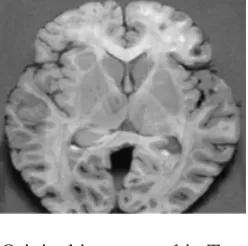
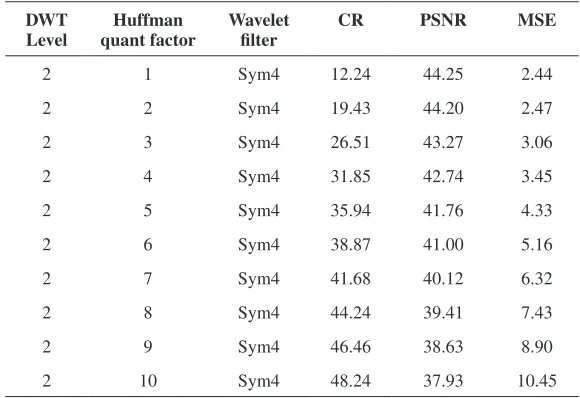
Below tables are showing the results obtained from the selected brain image using different DWT level with the varying Huffman quantization factor and selected wavelet filter which is taken as Symlet4.The test is performed on medical image of size (256x256) . To show the results of involved parameters on the compression ratio, peak signal-to-noise ratio and mean squared error, different values of scaling factor (q) are used which affects the quantization steps for Huffman compression. Below tables are showing the varying CR ,PSNR and MSE with the varying Huffman quantization factor. We can also obtain the results on different images. We can also take different parameters to obtain the results.
Below image is the selected image which is taken for compression.
Original image used in Test
Table I: Brain image results with the varying Huffman quantization factor at DWL level as 2.
DWT Level Huffman quant factor Wavelet filter CR PSNR MSE
1 1 Sym4 12.41 48.75 0.86
1 2 Sym4 19.41 48.78 0.86
1 3 Sym4 26.47 46.59 1.42
1 4 Sym4 37.84 45.45 1.85
1 5 Sym4 35.88 43.77 2.72
1 6 Sym4 38.84 42.60 3.56
1 7 Sym4 41.66 41.40 4.70
1 8 Sym4 44.21 40.46 5.84
1 9 Sym4 46.44 39.53 7.23
Image Compression Using an Efficient Hybrid Algorithm
49
As we can observe from the results that compression ratio is increasing with the decreasing peak signal to noise ratio and increasing mean squared error.
Table II: Brain image results with the varying Huffman quantization factor at DWL level as 2
DWT
Level quant factorHuffman Wavelet filter CR PSNR MSE
2 1 Sym4 12.24 44.25 2.44
2 2 Sym4 19.43 44.20 2.47
2 3 Sym4 26.51 43.27 3.06
2 4 Sym4 31.85 42.74 3.45
2 5 Sym4 35.94 41.76 4.33
2 6 Sym4 38.87 41.00 5.16
2 7 Sym4 41.68 40.12 6.32
2 8 Sym4 44.24 39.41 7.43
2 9 Sym4 46.46 38.63 8.90
2 10 Sym4 48.24 37.93 10.45
V. CONCLUSION AND FUTURE SCOPE
In this paper a new hybrid scheme for medical image compression is proposed using hybrid of DWT, DCT and Huffman coding algorithm. This technique is tested against different medical images using different values of Huffman quantization factor. As the quantization factor increases the compression ratio increases and the quality measurement (PSNR) decreases.
REFERENCES
[1]. Sandhya Sharma and Sarabjeet Kaur,Image Compression using hybrid of DWT, DCT and Huffman Coding in “International Journal of Science and Emerging Technologies with Latest Trends” 5(1): 19-23 (2013)
[2]. Mahmoud A. Mofaddel et al, “Object based hybrid image and video coding scheme” IEEE 2011.
http://dx.doi.org/10.1109/ICCES.2011.6141051
Sharma, S. Bhat, U
50
[4]. XiHong ZHOU,” Research on DCT-base Image Compression Quality” Cross Strait Quad-Regional Radio Science and Wireless Technology Conference, IEEE 2011
http://dx.doi.org/10.1109/CSQRWC.2011.6037249
[5]. Suchitra Shreshtha et al,”Hybrid DWT-DCT Algorithm for Biomedical image and video compression applications.” 10th International Conference on Information Science, Signal Processing and their Applications (ISSPA 2010) IEEE, 2010.
http://dx.doi.org/10.1109/ISSPA.2010.5605474
[6]. Sunil Bhooshan,” An efficient and selective image compression scheme using Huffman and adaptive Interpolation” 24th International Conference Image and Vision Computing New Zealand (IVCNZ 2009) IEEE 2009 http://dx.doi.org/10.1109/IVCNZ.2009.5378413
[7]. Chong Fu,” A DCT based Fractal Image Compression method” International workshop on chaos-fractals theories & Applications, IEEE 2009 http://dx.doi.org/10.1109/IWCFTA.2009.99