
Developing Web-Based Online Advertisement
Targeting System for 3D Models
Hiba A. Abu-Alsaad
1*, Rana Riad K. AL-Taie
2and Hazim M. Alkargole
31Computer Engineering Department, Collage of Engineering, Mustansiriyah University, Baghdad, Iraq. 2Computer Engineering Department, Collage of Engineering, Mustansiriyah University, Baghdad, Iraq. 3Computer Engineering Department, Collage of Engineering, Mustansiriyah University, Baghdad, Iraq.
Date of publication (dd/mm/yyyy): 10/09/2019
Abstract – The paper presents a strategy for implementing a hybrid recommender system to a 3D online marketplace to realize a more efficient funneling of 3D models recommendations. The 3D models’ marketplace is an ever-growing medium which supplies to movies, commercial or video games, production quality finished assets ready to be included in their project. A robust targeted advertising mechanism leads to a better browsing experience for the end user and a more efficient monetization campaign. The following research also reveals a strategy for elevating the user experience for visualizing 3D models in an online marketplace. The targeted approach proposes the implementation of a web-based engine which allows full interaction with the 3D model, rather than browsing a series of renders or scrolling a through a 360 animation, the standard approach used by current marketplaces. The system will contain an extra layer of recommendations targeting the vendors, and presents a strategy to dynamically adjust the prices of the 3D models existing in the online marketplace based on prediction algorithms.
Keywords –Online Advertising, CG Graphics, Regression Statistics, 3D Online Marketplace, Unity Engine.
I.
I
NTRODUCTIONRecommender systems have been developed to overcome the problem of information overload for online applications such as e-commerce, e-learning, and social networks. Their ultimate goal is to create meaningful recommendations to the end user for items that might be of interest to him.
The main advantages when someone exploiting this technology includes [1]:
The number of sold products / services will be increased. This is the main goal, where the number of sold
items with recommendation is larger than that without recommendations. The goal is established because recommended items are more likely meet the user’s needs, thus increasing the odds of making a purchase.
User satisfaction will be increased. The system with effective recommender can help in improving the user
experience with the web application. Incorporating accurate and effective recommendations in a clear interface will increase the user’s subjective evaluation of the system. Hence, the system usage will increase and also the chances for successful recommendations will rise.
Increase user fidelity. A user should be loyal to a platform. When the customer returns, the system will
recognize and treat him as a valued visitor. The user appreciates the recommendations tailored to its taste; hence, when the user interacted longer with the system, the user model will be refined more with more recommender output can be effectively customized to match the user’s interesting.
Categories of the recommender systems are as follows, taking into account upon what the recommendations will be given [2]:
-red in the past.
Collaborative recommendations – the user receives recommended items that people with similar preferences had liked in the past.
Hybrid approaches – these methods combine content-based and collaborative methods.
The standard format for 3D objects is .OBJ, a geometry definition file format developed by Wave front Technologies. In addition .MTL file format is usually a companion which describes the surface shading properties of objects in .OBJ files. An .OBJ file may reference one or more .MTL files depending on its complexity.
The OBJ file format will be used for representing the position of each vertex, the UV position of each texture coordinate vertex, vertex normal, and the faces which used for declaring each polygon as a list of vertices and texture vertices.
CG for Graphics (CG) is open-source and considered as high-level shading language running cross-API (OpenGL & DirectX) and cross-platform (Windows, Linux, Mac OS), CG usually used to control the appearance of objects which had been drawn by programmable graphics hardware.
Fig. 1. CG's Technology Heritage [3].
CG bases its syntax and semantic on the general-purposes C programming languages. Secondly, it incorporates many concepts from shading languages such as the Render Man Shading Language, as well as prior shading languages developed by the academia. Finally, CG bases its graphics functionality on the OpenGL and Direct 3D programming interfaces for real-time [3].
Data mining is defined as extracting patterns from large data sets by using statistical algorithms. It helps business analysts to generate hypotheses, but it does not validate the hypotheses [4].
For prediction analysis, linear regression models commonly used are known to outperform fancier nonlinear models in situations with small numbers of training cases, low signal-to-noise ratio or sparse data [5].
Classical assumptions for regression analysis imply that [6]:
- The error is assumed to be a random variable with a mean of zero conditional on the explanatory variables.
- The predictors must be linearly independent (i.e. it must not be possible to express any predictor as a linear combination of others).
- The variance of the error is constant across observations.
Regression Statistics.
The quality of a regression model will be evaluated by statistics the Root Mean Squared Error and the Mean Absolute Error [7].
Root Mean Squared Error
The RMSE is the square root of the average squared distance of a data point from the fitted line.
RMSE= √𝒏 𝟏 ∑𝒏𝒋=𝟏(𝒚𝒋− 𝒚̂ )𝒋 𝟐 [7]
Mean Absolute Error
The average of the absolute value of residuals will be represented by MAE.
MAE= 𝒏 𝟏 ∑𝒏𝒋=𝟏 |𝒚𝒋− 𝒚̂ |𝒋 [7]
II. S
TATE OF THEA
RTThe apex of the 3D online marketplace is represented by Turbosquid, an online platform that allows artists to display their work and sell them to potential buyers.
A 3D model is sold along with a specific agreement towards the royalty rights. Standard agreements include: Royalty Free License, Corporate License, and New Uses.
Fig. 2. Turbosquid Website.
Current advertising solutions include recommendations depending on the current product being visualized such as products from the same category and other models from the same publisher.
Another platform that promotes the selling of assets for computer generated productions is 3D Ocean. It part of the Envato network which comprises the entire Tuts+ Empire and has reached more than 1.4 million registered members.
Fig. 3. D Ocean Website.
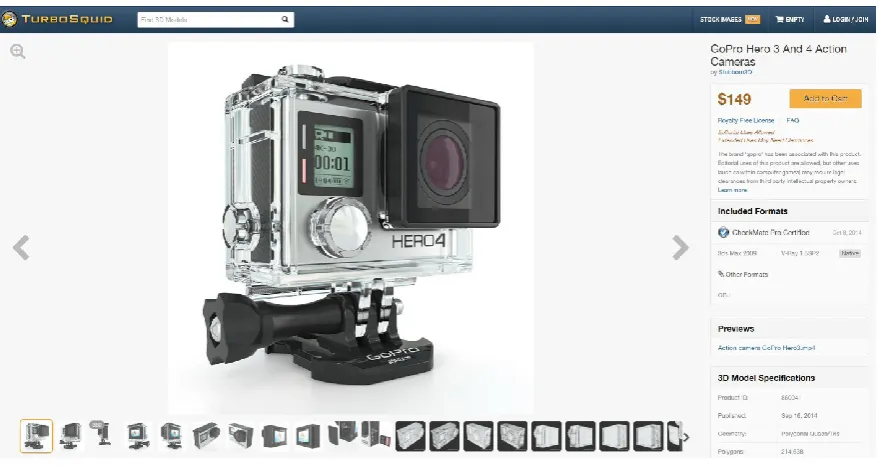
Turbosquid, the benchmark in for 3D models’ marketplace typically offers a series of beauty renders and wireframe views, pre-uploaded by the user on the system upon publishing. The potential buyer can form an erroneous opinion on the model based only on the 2D representations.
Fig. 4. Turbosquid Model Presentation.
Fig. 5. Sketchfab Website.
Sketchfab allows users to publish and find 3D content and also share it on other platforms like Tumblr, WordPress, Behance, Facebook by using the embed functionality.
The online marketplaces offer the liberty to users to charge their desired price for their products.
In a highly dynamic market, a system should be devised where the buyers are also notified about the market trends and they receive recommendations regarding their prices.
III. M
ATERIAL ANDM
ETHODSThe system proposes a solution involving a hybrid recommendation technique using both content-based and collaborative filtering with a mixed hybridization technique for channeling advertisements of recommended 3D models.
Collaborative Filtering.
A user is able to rate a 3D model after a purchase was made, to express his satisfaction level from 1 to 5. High rates increase the reliability of the quality of the 3D model, hence the reputation of its publisher [9].
Table 1. Utility Matrix [9].
Model 1 Model 2 Model 3 Model 4 Model 5
User 1 5 4 - 4 -
User 2 - - 4 - -
User 3 5 3 - - 5
User 4 3 - - 4 -
User 5 4 - - 2 5
In order to best match a product to its potential clients, the Pearson Correlation Coefficient is used.
r = ∑ (𝑥𝑖 𝑖− 𝑥̅ ) (𝑦𝑖 − 𝑦̅ )
Table 2. User Similarity [9].
Model 1 Model 2 Model 3 Model 4 Model 5
User 1 - -0.6035 0.1323 0.6816 -0.0273
User 2 -0.6035 - -0.5791 -0.4015 -0.5393
User 3 0.1323 -0.5791 - -0.1635 0.7163
User 4 0.6816 -0.4015 -0.1635 - 0.2587
User 5 -0.0273 -0.5393 0.7163 0.2587 -
The system selects the users which score a positive correlation coefficient and recommends the models rated above average that was not visualized by the targeted user.
For example, User 4 has similar tastes with User 1 and User 5. Hence, the system recommends Model 2 (from User 1) and Model 5 (from User 5).
Content-Based Filtering.
Our content-based filtering algorithm matches the 3D model’s keywords to the user profile. The user profile is constructed based on his previous purchases, respectively on their descriptive tags.
In order to have a 3D model published on the platform, the author has to complete its descriptive profile. It includes the following features:-
- Price
- Format (.max, .obj, .fbx)
- Category (sports, characters, vehicles, architecture)
- Tags
- Description
- Specifications (number of polygons, number of vertices, textures yes/no, materials yes/no, rigged yes/no, animated yes/no, UV mapped yes/no).
To compute the degree of similarity between the 3D model’s profile and the keywords in the user’s profile, we use the Szymkiewicz-Simpson Coefficient.
Overlap(X, Y) =𝐦𝐢𝐧(|𝑿|,|𝒀|)|𝑿 ⋂ 𝒀| (2)
Everything above a certain threshold will be recommended to the end user.
Hybrid Recommender.
Multiple recommender approaches are combined with a mixed hybridization method to obtain better recommendations, to enhance the marketplace profitability. Hybridization can diminish some of the problems associated with collaborative filtering, content-based filtering and other recommendation techniques [10].
User Experience.
viewer. The current workflow adopted by online marketplaces requires a tedious process for the user which has to render different views of the models as well as wireframe shots. Moreover, to increase the credibility one can realize a 360 animation of the model. From the publisher’s point of view it is extra work which is time consuming and does not reflect 100% their models. From the buyer’s point of view, he can make the decision of purchasing only by browsing the predefined views, not very comprehensive for a model which may be viewed from any angle in a game engine or a movie shot [11].
By repurposing the Unity engine, generally used for creating video games, and developing custom shaders, setting a studio lighting setup, input controllers and adding functionalities to load the objects and materials on runtime one can obtain a model viewer that can be easily embedded into a web page.
Fig. 6. Unity Engine.
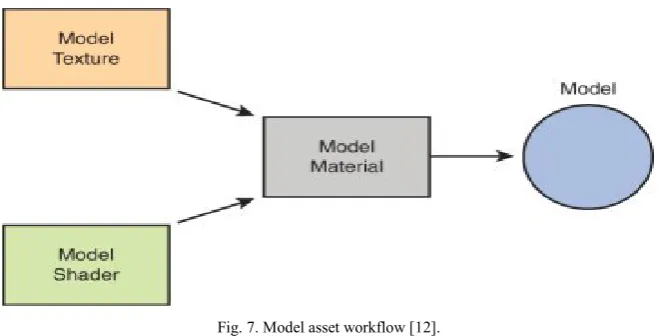
The engine should allow the visualization of 3D models without a polygon number limit and supporting texture maps such as diffuse, specular and normal:
- Diffuse map: contains the color information; it usually contains the ambient occlusion baked into it.
- Normal map: contains information about the surface normal; which used for adding details without more polygons to the geometry.
- Specular map: represents the amount of light reflectivity a surface has.
Fig. 7. Model asset workflow [12].
The custom shader is developed in Unity using CG (C for Graphics). For programming vertex and pixel shaders, a high-level shading language had been developed by both NVIDIA and Microsoft.
The custom shader has integrated the following properties:
- _Color – Sets the color tint of the model in RGBA space.
- _MainTex – Accepts a 2D Texture and sets the color information to the model based on its UV mapping.
- _BumpMap – Accepts a 2D Texture and sets how the surface reacts to light to fake additional details in the mesh.
- _BumpDepth – A float value representing the intensity of the bump effect.
- _SpecColor – Sets the color of the reflected light in RGBA space.
- _Shininess – A float value representing how sharp the specular reflections are.
- _RimColor – Sets the color of a falloff effect in RGBA space.
- _RimPower – Sets the spread of a falloff effect.
The interaction with the model viewer will allow the following operations: zooming, rotating the object, switching between textured and wireframe views. These operations are available on by using mouse events on desktops and by using touch inputs on mobile devices.
IV. R
ESULTSData Mining:
Linear regression is a prediction technique used when the class and all its attributes are numeric.
Fig. 8. Supply and Demand [10].
In an online market where the main commodities are 3D models, the supply is infinite. Hence the price variation will only depend on the demand fluctuation.
The system will provide two layers of recommendations:
1. Per Product Recommendation
Regression Statistics.
The system approximated the regression line having the equation of 12.36 * X – 9.14, and gave the prediction that in the 8th day the sales will increase to a number of 89.7142.
Intercept -9.1428
Slop 12.3571
R2 0.7387
Intercept Standard Error 14.6962
Slop Standard Error 3.2861
To impose a unit-elastic demand, the system will also recommend a new price for the product. Unit elastic describes a demand curve which is perfectly responsive to changes in price. That is, the quantity demanded changes according to the same percentage as the change in price.
In our case, the system will recommend a drop in price to a value of 91.4013.
2. Recommendations Regarding General Tendencies
For each product category the system will retrieve its sales count during the last seven days and will predict which category will have an increase in popularity and the users will be endorsed to create 3D models for that category [14].
The system approximated the regression line having the equation of 29.96 * X – 55.14, which have a positive slope of 29.9642. If the system finds a slope greater than 0 (stagnation) then it recommends the category as popular.
Regression Statistics
Intercept -55.1428
Slop 29.9642
R2 0.7004
Intercept Standard Error 39.1907
Slop Standard Error 8.7633
V.
C
ONCLUSIONSby using either mouse events on a personal computer or touch inputs on handheld devices. Linear regression as prediction technique had been used for providing two layers of recommendations: per product recommendation (for predicting the number of units may be sold today) and recommendations based on general tendencies (for predicting the product with the highest popularity of each category).
R
EFERENCES[1] F. Ricci, L. Rokach, B. Shapira, “Introduction to Recommender Systems Handbook”, Recommender Systems Handbook, 2011, pp. 1-3.
[2] G. Adomavicius, A. Tuzhilin, “Toward the Next Generation of Recommender Systems: A Survey of the State-of-the-Art and Possible Extensions”, IEEE Transactions of Knowledge and Data Engineering, Volume 17, 2005.
[3] F. Randima, M. Kilgard, “The Cg Tutorial: The Definitive Guide to Programmable Real-Time Graphics”, Addison-Wesley, Boston, Massachusetts, 2003.
[4] C. Rygielski, J.-C. Wang, D. Yen, “Data mining techniques for customer relationship management”, Technology in Society, 2002. [5] T. Hastie, R. Tibshirani, J. Friedman, “The Elements of Statistical Learning: Data Mining, Inference, and Prediction”, Second Edition,
Springer, 2009.
[6] D. Sarna, “Implementing and Developing Cloud Computing Applications”, CRC Press, 2011.
[7] Regression. 2016. Regression. [ONLINE] Available at: https: //docs.oracle.com/cd/B28359_01/datamine.111/b28129/regress.htm. [Accessed 03 February 2016].
[8] P. Lops, M. de Gemmis, G. Semeraro, “Content-based Recommender Systems: State of the Art and Trends”, Recommender Systems Handbook, 2011, pp. 73-105.
[9] M. Exstrand, J. Riedl, J. Konstan, “Collaborative Filtering Recommender Systems”, Foundations and Trends in Human-Computer Interaction, Volume 4, 2010, pp. 81-173.
[10] R. Burke, “Hybrid Recommender Systems: Survey and Experiments”, Journal of User Modelling and User-Adapted Interaction, Volume 12, 2002, pp. 331-370.
[11] J. Bobadilla, F. Orgega, A. Hernando, A. Gutierrez, “Recommender systems survey”, Journal of Knowledge-Based Systems, Volume 46, 2013, pp. 109-132.
[12] M. Geig, “Sams Teach Yourself Unity Game Development in 24 Hours”, Pearson Education Inc., 2014.
[13] Price Elasticity of Demand | Economics | tutor2u. 2016. [ONLINE] Available at:http://www.tutor2u.net/economics/reference/price-elasticity-of-demand. [Accessed 03 February 2016].
[14] Yu, Z., Zhou, X., Hao, Y., Gu, J.: Tv program recommendation for multiple viewers based on user profile merging. User Modeling and User-Adapted Interaction 16(1), 63–82 (2006).
A
UTHORSP
ROFILE’
Hiba A. Abu-Alsaad was born in Baghdad, Iraq, in 1983. She received the B.S. degree from the University of Mustansiriyah of Iraq, Baghdad, in 2005 and the M.S. degree from the University of Politehnica (UPB), Bucharest, in 2016, both in Computer & Software Engineering. She is working as an Assistant Lecturer at the Computer Engineering Department / Collage of Engineering, Mustansiriyah University, Baghdad-Iraq.
email id: [email protected]
Rana Riad K. AL-Taie Lecturer in Computer Engineering Department, College of Engineering, Mustansiriyah University, Baghdad, Iraq. MSc in Information and communication Engineering, University of AL-Nahrain, Baghdad, Iraq (2014). BSc in Computer and Software Engineering, University of Mustansiriyah, Baghdad, Iraq (2005).
email id: [email protected]
Hazim M. Alkargole was born in Baghdad at 1978, is an engineering Department /Faculty of Engineering AlRahdain Assistant lecturer at the technical computer Universe'. Baghdad-Iraq, Iraq, in 2017, and M.Sc. communication technologies and communication system and BSc. Technical computer engineering he had worked as nuclear and electrical engineer for several years at Iraqi Atomic Energy Commission, Iraq. Currently he is with department of computer engineering, Mustansiriyiah University, Iraq. His research interests include computer communication networks, digital communications, analogue and digital electronics, digital signal processing, and biomedical engineering.
email id: [email protected]
![Fig. 1. CG's Technology Heritage [3].](https://thumb-us.123doks.com/thumbv2/123dok_us/8785359.1763733/2.595.139.457.350.563/fig-cg-s-technology-heritage.webp)

![Table 1. Utility Matrix [9].](https://thumb-us.123doks.com/thumbv2/123dok_us/8785359.1763733/5.595.75.522.49.316/table-utility-matrix.webp)
![Table 2. User Similarity [9].](https://thumb-us.123doks.com/thumbv2/123dok_us/8785359.1763733/6.595.79.518.46.211/table-user-similarity.webp)
![Fig. 8. Supply and Demand [10].](https://thumb-us.123doks.com/thumbv2/123dok_us/8785359.1763733/8.595.184.411.438.614/fig-supply-and-demand.webp)
![Fig. 9. Unit Elastic Demand [13].](https://thumb-us.123doks.com/thumbv2/123dok_us/8785359.1763733/9.595.82.528.57.292/fig-unit-elastic-demand.webp)
