This is an open access journal, and articles are distributed under the terms of the Creative Commons Attribution-Non Commercial-ShareAlike 4.0 License, which allows others to remix, tweak, and build upon the work non-commercially, as long as appropriate credit is given and the new creations are licensed under the identical terms.
© 2019 Journal of Advanced Pharmacy Education & Research | Published by SPER Publication 44
Effect of Aerobic exercises on Blood coagulation and
Fibrinolysis factors in Elderly Hypertensive patients
Hisham A. Abd Elwahaab
1*, Aisha A. Hagag
2, Awny F. Rahmy
2, Hany M. Fares
3, Shawky A. Fouad
41Department of physical Therapy for internal medicine, Chest and cardiology, Faculty of physical therapy, Deraya University, Egypt, 2Department of physical therapy for
cardiovascular/Respiratory Disorder and Geriatrics, Faculty of Physical Therapy, Cairo University, Egypt, Department of physical therapy for internal medicine and surgery, Faculty of physical therapy ,Ahram Canadian University,Egypt., 4Department of internal medicine, Faculty of Medicine, Cairo University, Egypt. Correspondence: Hisham A. AbdElwahaab. Department of physical therapy for internal diseases, Faculty of physical therapy, Deraya University, Egypt.
ABSTRACT
Background & purpose: Hypertension is a common, chronic, age-related disease, which often leads to cardiovascular complications. The purpose of this study was to investigate the effect of moderate intensity aerobic exercises on blood coagulation and fibrinolysis factors in elderly hypertensive patients. Methods: fifty hypertensive male patients participated in the study with age range(55-65 years old), body mass index from 25 to 34.9 kg/m2. The patients divided into study group and control group randomly.
The study group performed moderate intensity aerobic exercises in the form of walking on electronic treadmill for 30 to 40 min., 3 session per week for 8 consecutive weeks plus medical treatment with fixed dose throughout the study period. while the control group took the medical treatment only without exercises. Laboratory investigation for measuring clotting time, plasminogen activator inhibitor-1 pre and post study, also recording systolic & diastolic blood pressure pre and post the study. Results: there was significant increase in the clotting time of both groups in favor of the study group by 5.22% post study and there was significant decreasing effect in PAI-1 (P<0.05) in study and control groups in favor of the study group by 19.32%. while the study group had significant reduction of systolic and diastolic blood pressure compared with the control group (p<0.05). Conclusion: there is a beneficial effect of moderate intensity aerobic exercises in improving fibrinolysis process via reducing the plasminogen activator inhibitor-1, and increasing the clotting time as well as moderate aerobic exercises had a significant effect in lowering arterial blood pressure in elderly hypertensives.
Keywords: Aerobic exercises, Plasminogen activator inhibitor -1, Fibrinolysis, Hypertension
Introduction
Hypertension is defined as bringing up the blood vessel pulse, ordered into three phases as indicated by the patient's level of systolic and diastolic circulatory strain. Stage one is the mildest regular type of hypertension (systolic from 140 to 159 mmHg and diastolic from 90 to 99 mmHg). Stage two hypertension
incorporate those with systolic pulse from 160 to 179 mmHg and diastolic circulatory strain from 100 to 109 mmHg. Stage three hypertension incorporates those with systolic circulatory strain >180 mmHg or diastolic pulse >110mmHg. Secluded systolic hypertension is characterized as systolic circulatory strain >140 mmHg and diastolic pulse < 90 mmHg [1].
Essential or primary hypertension is the most widely recognized type of hypertension, it represents 90 to 95% of all instances of hypertension. In every contemporary society, circulatory strain ascending with maturing and the danger of getting to be hypertensive in later life is significant [2].
Elevated blood pressure, is a critical hazard factor for the cardiac accident which incorporate coronary artery diseases (CAD), stroke, congestive heart failure, cerebro-vascular accident, peripheral arterial insufficiency and end-stage renal disease [3].
Aging is associated with an inflated level of the natural process system proteins, such as clotting factor, factors VIII and IX,
Access this article online
Website:www.japer.in E-ISSN: 2249-3379
How to cite this article: Hisham A. AbdElwahaab, Awny F. Rahmy, Aisha
A. Hagag, Hany M. Fares, Shawky A. Fouad. Effect of Aerobic exercises on Blood coagulation and Fibrinolysis factors in Elderly Hypertensive patients. J Adv Pharm Edu Res 2019;9(1):44-48.
Journal of Advanced Pharmacy Education & Research | Jan-Mar 2019 | Vol9 | Issue 1 45
without a proportional increase in decoagulant proteins; it is conjointly related to an inflated levels of prothrombotic markers (e.g., thrombin), and to important alterations in the fibrinolysis system ensuing in a decrease in fibrin lytic activity
[4].
Regular physical activity is expounded to significantly decrease causes of mortality upset. Exercise promotes a healthy system. Regular exercise improves epithelial tissue functions by reducing avoirdupois, force per unit space, inherited disorder incidence, and dyslipidemia [5].
Therefore, the current study was carried out to investigate the effect of aerobic exercises on blood coagulation and fibrinolysis in elderly hypertensive patients.
Materials and Methods
Subjects:
This study is a randomized controlled study which included Fifty old male patients with mild primary hypertension (five years ago) participated in this study. Their age rang was from 55 to 65 years old with BMI from 25 to 34.9 kg/m2 [6]. All patients were medically examined and diagnosed
by the physicians of the Samaloute central hospital and Samaloute medical insurance outpatient clinic. All patients with cardiac instability, autonomic neuropathy, chest diseases, musculoskeletal problems, and patients with serious problems as renal failure were excluded from this study. All patients signed on an informed consent before starting the program (Appendix 1), and the study was approved by the ethical committee of Faculty of physical therapy Cairo University, with Approval number: P.T. REC/012/001567. The study was conducted in Deraya University Centre of physical therapy from November 2017 to July2018.
All patients were divided randomly into two groups of equal number, study group, and control group as follows:
The study group which included twenty-five hypertensive patients were medically controlled. They participated in moderate continuous aerobic exercise in the form of walking on electronicl treadmill for 30-40 minutes per session, three sessions a week for eight consecutive weeks plus their traditional medical treatment (anti-hypertensive drugs as described by physician which would be taken by a fixed dose throughout the study in addition to one tablet aspirin daily). Control group included twenty five hypertensive patients who received traditional medical treatment (anti-hypertensive drugs as described by physician which would be taken by a fixed dose throughout the study as the study group in addition to aspirin by one tablet daily).
Evaluation procedures:
Each patient in both groups passed through the following steps of measurements by a physician and a physical therapist. The parameters were recorded at the beginning and at the end of the practical study period (8 weeks) are:
1. Physiological measurements:
• Patients resting heart rate (HR) was taken by pulseoximeter. Systolic and diastolic blood pressures were monitored from the right arm using the stethoscope (Letmen, made in Germany) and sphygmomanometer (Richter, made in Germany) prior to the beginning of the study, and the arterial blood pressure was measured from the brachial artery of the right arm of each patient. In order to have accurate measurement and to avoid any factor affecting the accuracy, the cuff of the sphygmomanometer (mercury type) was fixed and left the patient for five minutes, then measurement was applied for 3 times. Eventually the average was recorded to ensure reliability.
• Measurement and calculation of maximum heart rate:
Firstly, the resting heart rate of each patient was detected by applying pulsoximeter, maximum heart rate and target heart rate were calculated for each patient according to the Karvonen method as follows: Target HR= 60% -70% (maximum HR-resting HR) + HR-resting HR [7].
Note: HR: Heart rate.
Maximum heart rate = 220- age [8].
2. Anthropometric measurements:
Patients’ physical characteristics such as weight [kg] and height [m] using weight and height scale (floor type, RGT-200, made in China) and body mass index [BMI] (kg/ m2) were calculated.
Assessment was done in accordance with the standardized anthropometric protocol described using the following formula: body mass index = weight (kg) / (height (m2)) [9].
3. Laboratory investigation:
The chemical analysis was performed in the biochemistry department of the faculty of medicine, Cairo University. The laboratory investigation was obtained before the beginning and after the end of the study (8 weeks) for patients of both groups. Fasting venous blood sample (after 8-hour overnight fast) collected by 5ml antiseptic syringe. The plasminogen activator inhibitor-1(PAI-1) and clotting time of each patient both pre and post whole study period (8 weeks) was measured by Stat fax2100 Micro plate Reader.
Exercises prescription for the study group
The patients of this group performed continuous (moderate intensity) aerobic exercise in the form of walking on a treadmill. The exercise session started with warming up for 5 min., in the form of slow walking [7], with gradually increasingthe intensity to prepare the muscles and heart to the training phase in which the patient is jogging on the treadmill for 20-30 min. The training phase gradually increased from 20 min. at the beginning of the exercise program (first week) till reach 30 min in the last week [10]. The cooling down phase in the form of slow
walking for 5 min. was the last component of each exercise session [7].
46 Journal of Advanced Pharmacy Education & Research | Jan-Mar 2019 | Vol9 | Issue 1 Dependent (t) test: To compare between the means of
variables pre and post study of the same group; and independent (t) test: To compare between the means of variables pre and post study of both groups.
- Level of significance (p-value) was set at p < 0.05 using
SPSS version 19.
Results
Data obtained from both groups regarding systolic and diastolic blood pressure, clotting time and plasminogen activator inhibitor-1 (PAI-1) were statistically analyzed and compared.
General characteristics of both groups
Comparing the general characteristics of the subjects of both groups revealed that there was no significant difference between both groups in the mean age, weight, height and BMI (p > 0.05).Table 1: Descriptive statistics and t-test for the mean of general characteristics of both groups.
Study group Control group
MD value t- value p- Sig
Χ± SD Χ± SD
Age (years) 61.24 ± 1.73 60.52 ± 2.81 0.72 1.08 0.28 NS Weight (kg) 77.65 ± 4.09 79.18 ± 4.6 -1.53 -1.24 0.22 NS Height (cm) 162.92 ± 2.97 163.08 ± 3.43 -0.16 -0.17 0.86 NS BMI (kg/m²) 29.27 ± 1.78 29.79 ± 1.94 -0.52 -0.98 0.32 NS
Χ: Mean, SD: Standard deviation, MD: Mean difference, t value: Unpaired t value, p value: Probability value, NS: Non significant
Blood pressure
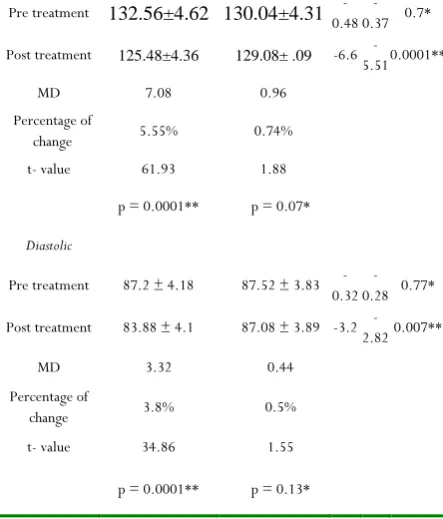
• Descriptive statistics and t-test for the means of arterial blood pressure of study and control groups (table 2):
There was no significant difference in the systolic blood pressure between the study and control groups pre-treatment (p = 0.7). There was no significant difference in the diastolic blood pressure between the study and control groups pre-treatment (p = 0.77). There was a significant decrease in the systolic blood pressure in the study group post treatment compared with pre-treatment (p = 0.0001). There was a significant decrease in the diastolic blood pressure in the study group post treatment compared with pre-treatment (p = 0.0001). There was no significant difference in systolic and diastolic blood pressure between pre and post treatment (p = 0.13) in control group. There was a significant decrease in the systolic and diastolic blood pressure in the study group compared with that of the control groups post-treatment (p = 0.007). (Table 2).
Table 2:Descriptive statistics and t-test for the mean arterial blood pressure of study and control groups.
Study
group Control group Blood pressure
(mmHg) Χ±SD Χ±SD MD t- value
p value
Systolic
Pre treatment 132.56±4.62 130.04±4.31 0.48 - 0.37 - 0.7*
Post treatment 125.48±4.36 129.08± .09 -6.6 5.51 - 0.0001**
MD 7.08 0.96 Percentage of
change 5.55% 0.74% t- value 61.93 1.88
p = 0.0001** p = 0.07*
Diastolic
Pre treatment 87.2 ± 4.18 87.52 ± 3.83 0.32 - 0.28 - 0.77*
Post treatment 83.88 ± 4.1 87.08 ± 3.89 -3.2 2.82 - 0.007**
MD 3.32 0.44 Percentage of
change 3.8% 0.5% t- value 34.86 1.55
p = 0.0001** p = 0.13*
x̄, Mean; SD, Standard deviation; MD, Mean difference; χ2; p value,
Probability value; *, Non-significant; **, Significant.
Clotting time:
• Descriptive statistics and t-test for the mean clotting time of study and control groups (table 3):
There was no significant difference in the clotting time between the study and control groups pre-treatment (p = 0.58). There was a significant increase in the clotting time of the study group post treatment compared with pre-treatment (p = 0.0001). There was a significant increase in the clotting time of the control group post treatment compared with pre-treatment (p = 0.0001). There was a significant increase in the clotting time of the study group compared with that of control group post treatment (p = 0.03) (Table 3).
Table 3:Descriptive statistics and t test for the mean clotting time of study and control groups
Study group Control group
Clotting time
(sec) x̄±SD x̄±SD MD t- value
P value
Pre treatment 333.32 ± 22.81 329.92 ± 20.49 3.4 0.55 0.58*
Post treatment 350.72 ± 23.15 337.16 ± 19.85 13.56 2.22 0.03**
MD -17.4 -7.24 Percentage of
change 5.22% 2.19% t- value -14.5 -12.52
p = 0.0001** p = 0.0001**
x̄, Mean; SD, Standard deviation; MD, Mean difference; χ2; p value, Probability
Journal of Advanced Pharmacy Education & Research | Jan-Mar 2019 | Vol9 | Issue 1 47
Plasminogen activator inhibitor-1(PAI-1):
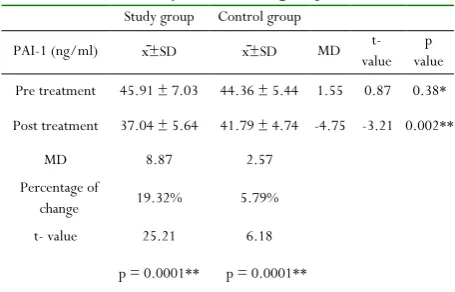
• Descriptive statistics and t test for the mean PAI-1 of study and control groups(tablde 4)
There was no significant difference in the PAI-1 between the study and control groups pre-treatment (p = 0.38). There was a significant decrease in the PAI-1 of the study group post treatment compared with pre-treatment (p = 0.0001). There was a significant decrease in the PAI-1 of the control group post treatment compared with pre-treatment (p = 0.0001). There was a significant decrease in the PAI-1 of the study group compared with that of control group post treatment (p = 0.002).
Table 4:Descriptive statistics and t test for the mean PAI-1 of study and control groups.
Study group Control group
PAI-1 (ng/ml) x̄±SD x̄±SD MD value t- value p
Pre treatment 45.91 ± 7.03 44.36 ± 5.44 1.55 0.87 0.38*
Post treatment 37.04 ± 5.64 41.79 ± 4.74 -4.75 -3.21 0.002**
MD 8.87 2.57 Percentage of
change 19.32% 5.79% t- value 25.21 6.18
p = 0.0001** p = 0.0001**
x̄, Mean; SD, Standard deviation; MD, Mean difference; χ2; p value, Probability
value; *, Non-significant; **, Significant.
Discussion
Hypertension is a typical, endless, age-related sickness, which frequently prompts cardiovascular and renal complexities. So hypertension management requires proceeding with medical consideration and self-administration instruction, supporting to decrease intense and long term complications [11].
The purpose of this study was to investigate the effect of moderate- intensity aerobic exercises on blood coagulation and fibrinolysis factors in hypertensive elderly patients.This study was conducted on fifty uncomplicated hypertensive male patients (with mild controlled hypertension for five years). All patients with cardiac instability, autonomic neuropathy, chest diseases, musculoskeletal problems, and patients with serious problems such as a renal failure were excluded from this study. The variables were measured and discussed in an effort to explain the results of the current study. These variables were plasminogen activator inhibitor-1(PAI-1), clotting time, systolic blood pressure and diastolic blood pressure.
Final results of this study revealed that there was a significant reduction in PAI-1 in both groups but more reduction in the study group. There was a significant increase in the clotting time of both groups but more in the study group. Furthermore, a significant reduction in systolic and diastolic was noticed,
while there was no significant difference between them in the control group.
These results come in agreement with studies of Mohamed et al., (2016)[12], Lamina and Okoye (2012) [8], as well as
Guimaraes et al. (2010)[13] who investigated effects of
continuous exercise training on hypertensive patients. All the findings verified the recommendations of using moderate intensity (continuous) training program in blood pressure reduction.
Also, Mahmoud et al. (2012) suggested that moderate exercise intensity is followed by activation of blood fibrinolysis without concomitant hyper-coagulability[14]. The
current study comes in agreement with Camarillo-Romero et al. (2012), who said that there are some data suggesting that moderate–intensity continuous exercises effectively reduces PAI-1 in patients with metabolic syndrome [15]. This is in
agreement with Borham (2013) who investigated the response of aerobic training on patients with ischemic heart disease under oral anti- coagulant drug [16]. Thirty male patients were divided
into two groups, the study group who received moderate intensity aerobic exercises on electronic treadmill plus oral anticoagulant drug and the control group who received oral anticoagulant drugs only. Results showed that using moderate intensity aerobic leads to significant changes on fibrinolysis coagulation profile. Esmat et al. (2010) also assigned that moderate intensity exercise induces favorable changes in metabolic syndrome in lowering lipid profile and PAI-1 levels and may reduce risk of cardiovascular diseases [17].
On the other hand, the present study results are contradicted with Guimaraes et al. (2010) as they studied the effects of continuous versus interval exercise training on blood pressure and arterial stiffness in treated hypertension [13]. Sixty-five
sedentary patients with controlled hypertension were randomly assigned to three different regimens for 16 weeks: continuous exercise (26 patients), intervals (26 patients), or a sedentary control routine (13 patients). It was concluded that interval exercise has a better effect on blood pressure control than continuous exercise. This may be due to prolonged total program time (16 weeks) more than this study as total program time was 8 weeks. J E Smith (2003), also reported that there was a reduction in whole blood clotting time of samples drawn before and after exercise. Both the coagulation and fibrinolytic cascades are stimulated by strenuous exercise, but the temporal relation between the two and its clinical significance have yet to be clarified. Unfavourable haemostatic changes at the extremes of exercise intensity may predispose to the formation of intravascular thrombus and may contribute to the phenomenon of sudden cardiac death after exercise [18].
Conclusion
48 Journal of Advanced Pharmacy Education & Research | Jan-Mar 2019 | Vol9 | Issue 1 clotting time. Moderate aerobic exercises also had a significant
effect in down-regulation of arterial blood pressure.
References
1. Jam Chin Tay, Ashish A. Sule, Daniel C., Jeannie T., Titus L., Simon L., Sze H. L., Choon K. Leong,Soo T. L., Lip P. Low, Vernon M. S. , Ian P., Kenneth K. W., Akira W. and Loo S. Y.,(2018):Hypertension. Ministery of Health clinical practical guide lines,Singaporamed.J, 59 (1): 17-27.
2. Operil S.; Zaman A. and Calhoun A. (2009): Pathogenesis of Hypertension. Ann intern Med, 139: 761-776.
3. Elis M., Maria D., Angela T., Leila M., Juliana P. and Taisa T., (2016): Proposal of a scale with predictive factors of complications arising from systemic arterial hypertension and actions for management of care. Athens Journal of Health, vol.3, No.3.
4. Kazachkova N., (2016): Aging and Thrombosis: The role of genetic factor. Journal of blood disorders, vol.(3) issue 2 :1040.
5. Walid B., Thomas V., Elise S., Georges K., Bernard G. and Pierre O., (2017): Health benefits of aerobic training programs in adult aged 70 and over: Asystematic Review. Archives of Gerontology and Geriatrics., vol. (69), 110-127.
6. Hirofumi Tanaka, Kevin D Monahan and Douglas R Seals., (2001): Age-predicted maximal heart rate revisited, Journal of the American College of Cardiology, (37),issues 1.
7. American college of sports medicine (ACSM), (2014): Guidelines for exercise prescriptions 9th edition 296-298.
8. Lamina S. and Okoye C. (2012): Effects of aerobic exercise training on psychosocial status and serum uric acid in men with essential hypertension. Annals of Medicine and Health science research,2 (2),161-168.
9. Jae M.; Luscher T. and Cosentio F. (2008): Obesity. The lancet, 306 (9492):119-127.
10. Shiwei S.; Huajin Q.; Xingxian H.; Yun L.; Chengjian Y.; Feng L.; Ling W.; Dongachang Q.; Kedong S.; Lin Z.; Xiafeng W.; Zhenhai S. and Liuxin W. (2018): Aerobic exercise for a Duration of 90 min. or longer per week may reduce the Atherogenic Index of Plasma. A nature research journal, Scientific Reports 8.
11. Chris and Woolstone (2012): Hypertension and exercise. Medicine and science in sport exercise, volume (3): 533-53.
12. Mohamed R., Vijayamurugan, Rabiu M., Ahmed B., Norlaila A., and Mainul H., (2016): The effectiveness of Aerobic Exercises at Different Intensities of Managing Blood Pressure in Essential Hypertensive Information Technology Officers.J Young Pharm., vol 8 (4): 483-486.
13. Guimaraes V., Ciolac G., Carvalho O., D' Avila M., Bortolotto A. and Bocchi A., (2010): Effect of continuous vs interval exercise training in blood pressure and arterial stiffness in treated hypertension. Hypertension Research, 33(6): 627-632.
14. Mahmoud S. Elsayed, Zeinab E. Ali, Sajad A.,(2012): Exercise and Training Effects on Blood haemostasis in Health and Disease, Sports medicine, vol(34): 181-200. 15. Camarillo-Romero., Dominguez-Garcia, M.V., Amaya-Chavez A. et al. (2012): Effects of a Physical Activity Program on Markers of Endothelial Dysfunction, Oxidative Stress, and Metabolic Status in Adolescents with Metabolic Syndrome. ISRN Endocrinol. 970629. 16. Borham., (2013): Effect of Aerobic Exercise Training in
Patients with Ischemic Heart Disease under Anticoagulant drugs, master thesis, Cairo University. 17. Esmat, S., Abd Al Salam, R.F. and Rashed L. (2010):
Effect of Exercise on Plasminogen acivator inhibitor-1 (PAI-1) level in patients with metabolic syndrome. Journal of American Science. 6(12):1374-1380. 18. J E Smith, (2003): Effects of strenuous exercise on