Int. J. IndustrialMathematics (ISSN 2008-5621) Vol. 6, No. 3, 2014 Article ID IJIM-00385, 8 pages
Research Article
Variational iteration method for solving
n
th-order fuzzy
integro-differential equations
O. Sedaghatfar ∗ †, S. Moloudzadeh ‡, P. Darabi §
————————————————————————————————–
Abstract
In this paper, the variational iteration method for solvingnth-order fuzzy integro-differential equations (nth-FIDE) is proposed. In fact the problem is changed to the system of ordinary fuzzy integro-differential equations and then fuzzy solution of nth-FIDE is obtained. Some examples show the efficiency of the proposed method.
Keywords: Variational iteration method; nth-order fuzzy integro-differential equations (nth-FIDE); The system of ordinary fuzzy integro-differential equations.
—————————————————————————————————–
1
Introduction
M
ational iteration method (VIM), see [ny authors have been worked about varia-7,8,14,9] for more details. VIM is an iterative method
which used the Lagrange multipliers. Also several
modifications of VIM can be found in [3, 4, 6].
Because of facility and easy to use, VIM widely employed to various problems. Very recently Ab-basbandy et al. have been considered VIM for
solvingn-th order fuzzy differential equations [2].
In this manuscript, the VIM is extent to solve
nth-FIDE and obtain approximate fuzzy solution.
The VIM is proposed by He [9, 10] as a
modi-fication of a general Lagrange multiplier method
[11]. To illustrate its basic idea of the technique,
we consider following general nonlinear system
L[u(t)] +N[u(t)] =g(t),
∗Corresponding author. [email protected] †Department of Mathematics, Shahr-e-rey Branch, Is-lamic Azad University, shahr-e-rey, Iran.
‡Department of Mathematics, Faculty of Science, Uni-versity of Duhok, Kurdistan Region, Duhok, Iraq.
§Department of Mathematics, Borujerd Branch, Is-lamic Azad University, Borujerd, Iran.
whereLis a linear operator,N is a nonlinear
op-erator, andg(t) is a given construct a correction
functional for the system, which reads
u[k+1](t) =
u[k](t) + ∫ x
a
λ[Lu[k](s) +Nue[k](s)−g(s)]ds,
where λ is a general Lagrange multiplier which
can be identified optimally via variational theory
[9,10,11], the subscriptkdenotes the nth-order
approximation andue[k] denotes a restricted
vari-ation, i.e.,δue[k]= 0.
The structure of this paper is organized as
fol-lows. In Section 2, some basic definitions and
notations which will be used are brought. In
Sec-tion 3, the numerical method to solve nth-FIDE
is proposed. In Section 4, convergency of VIM
for this system is proved. In Section5, the
appli-cation of mentioned method VIM is brought by solving some numerical examples and finally the results are compared with exact solutions.
Con-clusion is drawn in Section6.
2
Basic Definitions and
Nota-tions
Definition 2.1 An arbitrary fuzzy number is represented by an ordered pair of functions
(u(α), u(α)) for all α ∈ [0,1], which satisfy the following requirements [5]
•u(α)is a bounded left continuous nondecreas-ing function over [0,1];
• u(α) is a bounded left continuous non-increasing function over [0,1];
• u(α)≤u(α), 0≤α ≤1.
Remark 2.1 [1] Let u(α) = (u(α), u(α)), 0 ≤
α≤1 be a fuzzy number, we take
uc(α) = u(α) +u(α)
2 , u
d(α) = u(α)−u(α)
2 .
It is clear that ud(α) ≥ 0 and u(α) = uc(α)−
ud(α) and u(α) = uc(α) + ud(α) also a fuzzy numberu∈E is said symmetric ifuc(α) is inde-pendent of α for all 0≤α≤1.
Remark 2.2 [1] Let u(α) =
(u(α), u(α)), v(α) = (v(α), v(α)) and also k, s
are arbitrary real numbers. If w=ku+sv then
wc(α) =kuc(α) +svc(α),
wd(α) =|k|ud(α) +|s|vd(α).
Let E be the set of all upper semi-continuous
normal convex fuzzy numbers with bounded α
-level intervals. This means that ifev∈Ethen the
α-level set
[v]α={s|v(s)≥α},
is a closed bounded interval which is denoted by
[v]α = [v(α), v(α)] for α ∈ (0,1], and [v]0 =
∪
α∈(0,1][v]α.
Two fuzzy numbers eu and ev are called equal,
e
u =ev, if u(s) =v(s) for all s∈R or [u]α = [v]α
for all α∈[0,1].
Lemma 2.1 [12] Ifu,e ev∈E, then for α∈(0,1],
[u+v]α= [u(α) +v(α), u(α) +v(α)],
[u.v]α = [minkα,maxkα],
where
kα ={u(α)v(α), u(α)v(α), u(α)v(α), u(α)v(α)}.
Lemma 2.2 [12] Let [v(α), v(α)], α ∈(0,1], be a given family of non-empty intervals. If
(i) [v(α), v(α)]⊃[v(β), v(β)] f or 0< α≤β,
and
(ii) [ lim
k→∞v(αk),klim→∞v(αk)] = [v(α), v(α)],
whenever (αk) is a nondecreasing sequence converging to α ∈ (0,1], then the family
[v(α), v(α)], 0 < α ≤ 1, represent the α-level sets of a fuzzy number v in E. Conversely if
[v(α), v(α)], 0 < α ≤ 1, are the α-level sets of a fuzzy number ev ∈ E, then the conditions (i) and (ii) hold true.
Definition 2.2 [13] Let I be a real interval. A mapping ev : I → E is called a fuzzy pro-cess and we denote the α-level set by [v(t)]α =
[v(t, α), v(t, α)]. The Seikkala derivative ev′(t) of
e
v is defined by
[v′(t)]α= [v ′
(t, α), v′(t, α)],
provided that is a equation defines a fuzzy number
e
v′(t)∈E.
Definition 2.3 [13] The fuzzy integral of fuzzy process ev, ∫abv(t)dt for a, b∈I, is defined by
[ ∫ b
a
v(t)dt]α = [ ∫ b
a
v(t, α)dt,
∫ b
a
v(t, α)dt],
provided that the Lebesgue integrals on the right exist.
Definition 2.4 Let ue = (u(α) , u(α)), ve = (v(α), v(α))be fuzzy numbers then the Hausdorff distance between ueand ev is
dH(eu,ev) =
supα∈[0,1]max{|u(α)−v(α)|,|u(α)−v(α)|}.
3
Variational iteration method
In this section, we are going to investigate
solu-tion ofnth-FIDE. Let
e
y(n)(x) =eg(x) +f(x)ye(x) +∫abk(x, t)ey(m)(t)dt,
e
y(a) =αe0,
e
y′(a) =αe1,
.. . e
y(n−1)(a) =αen−1,
a≤x≤b,
where αei, i = 0,1, ..., n−1 are fuzzy constant
numbers, m and n are integers and m < n, also
f(x) ≥ 0, k(x, t) are real known functions, and
e
g(x) is fuzzy known function, too. ye(x) is the
solution which to be determined. Using the following assumptions
e
y=ey1, ye
′
=ey2, ye
′′
=ye3, ..., ey(n−1)=eyn,
then equation (3.1) is transformed to the
follow-ing fuzzy integro-differential equations
e
y1′ =ye2,
e
y2′ =ye3,
e
y3′ =ye4,
.. . e
yn′ =eg(x) +f(x)ey1(x)
+∫abk(x, t)eym+1(t)dt,
a≤x≤b,
(3.2) with fuzzy initial conditions
e
y1(a) =αe0, ye2(a) =αe1, ..., yen(a) =αen−1.
Let (g(x;r), g(x;r)) ,(y1(x;r), y1(x;r))
,(y2(x;r), y2(x;r)),...,(yn(x;r), yn(x;r)) for,
0≤r ≤1 and a≤x ≤b are parametric form of
e
g(x),ey1(x),ye2(x), ...,eyn(x), respectively.
Then, parametric form of (3.2) is
y′1 =y2, y′2 =y3, y′3 =y4,
.. .
y′n=g(x) +f(x)y1(x) +∫abk(x, t)ym+1(t)dt,
y′1 =y2, y′2 =y3, y′3 =y4,
.. .
y′n=g(x) +f(x)y1(x) +∫abk(x, t)ym+1(t)dt,
(3.3)
where
k(x, t)ym+1(t)
= {
k(x, t)ym+1(t), k(x, t)≥0, k(x, t)ym+1(t), k(x, t)≤0,
k(x, t)ym+1(t)
= {
k(x, t)ym+1(t), k(x, t)≥0, k(x, t)y
m+1(t), k(x, t)≤0.
To solve this system by VIM the following formu-las are obtained:
y[k+1]
j (x) =y
[k]
j (x) +
∫ x
a
λj(x, t)[y ′ j
[k]
(t)
−ey[jk+1] (t)]dt, j= 1,2, ..., n−1,
y[nk+1](x) =y[nk](x) + ∫ x
a
λn(x, t)[y ′ n
[k]
(t)
−g(t)−f(t)ey[1k](t)− ∫ b
a
k(t, s)eym[k]+1(s)ds]dt,
y[jk+1](x) =y[jk](x) + ∫ x
a
λj(x, t)[y ′ j
[k]
(t)
−ey[jk+1] (t)]dt, j= 1,2, ..., n−1,
y[nk+1](x) =y[nk](x) + ∫ x
a
λn(x, t)[y ′ n
[k]
(t)
−g(t)−f(t)ey[1k](t)− ∫ b
a
k(t, s)eym[k]+1(s)ds]dt,
where λ(x, t) is a general Lagrangian multiplier
which can be identified optimally via variational
theory, ey[k],ey[k]denote a restricted variation, i.e.
δey[k]=δey[k]= 0, andk is iteration step.
The variation is calculated with respect to
y[jk] (j = 1,2, ..., n), respectively, and δey[k] = 0, then we have
δy[jk+1](x) =δy[jk](x) +δ
∫ x
a
λj(x, t)[y′j[k](t)
−ey[jk+1] (t)]dt=δy[jk](x) +λj(x, t)δyj[k](t)|t=x
− ∫ x
a
∂λj(x, t)
dt δy [k]
j (t)dt= (1 +λj(x, x)
δy[jk](x) + ∫ x
a
(−∂λj(x, t)
dt ) δy [k]
j (t)dt= 0,
j= 1,2, ..., n−1,
δy[nk+1](x) =δy[nk](x) +δ
∫ x
a
−g(t)−f(t)ey[1k](t)− ∫ b
a
k(t, s)eym[k]+1(s)ds]dt
=δy[k]
n (x) +λn(x, t)δy
[k]
n (t)|t=x−
∫ x
a
∂λn(x, t)
dt
δy[k]
n (t)dt= (1 +λn(x, x)δy
[k]
n (x)
+ ∫ x
a
(−∂λn(x, t)
dt )δy [k]
n (t)dt= 0.
F or j = 1,2, ..., n
−∂λ1(x, t) ∂t =−
∂λ2(x, t)
∂t =−
∂λn(x, t)
∂t = 0,
then
1 +λj(x, x) = 0, j= 1,2, ..., n,
and therefor we have
λj(x, t) =−1, j= 1,2, ..., n.
Similar to above we have
λj(x, t) =−1, j= 1,2, ..., n,
and we have following iteration formulas
yj[k+1](x) =yj[k](x)−∫ax[y′j[k](t)−ey[jk+1] (t)]dt, j= 1,2, ..., n−1,
yn[k+1](x) =yn[k](x)−∫ax[y′n[k](t)−g(t)−f(t) e
y[1k](t)−∫abk(t, s)ey[mk]+1(s)ds]dt,
yj[k+1](x) =yj[k](x)−∫ax[y′j[k](t)−ey[jk+1] (t)]dt, j= 1,2, ..., n−1,
y[nk+1](x) =y[nk](x)−
∫x a[y
′ n
[k]
(t)−g(t)−f(t) e
y[1k](t)−∫abk(t, s)ey[mk]+1(s)ds]dt.
(3.4)
4
Convergence Theorem
In this section we analyze the convergency of VIM
for (3.1). Similar to Remark (2.1), let
yc(r) = y(r) +y(r)
2 , y
d(r) = y(r)−y(r)
2 ,
then the fuzzy version of (3.1) can be written as
yj′c(x;r) =ycj+1(x;r), (1≤j≤n−1)
yn′c(x;r) =gc(x) +f(x)y1c(x) +∫abk(x, t)
ycm+1(t)dt,
yj′d(x;r) =yjd+1(x;r), (1≤j≤n−1)
yn′d(x;r) =gd(x) +f(x)yd1(x) +∫abk(x, t)
ydm+1(t)dt,
(4.5) and
yjc(a;r) = yj(a;r)+yj(a;r)
2 , (1≤j≤n)
yjd(a;r) = yj(a;r)−yj(a;r)
2 .
Similarly from (3.4) we can obtain the following
formula
yj[k+1]c(x, r) =yj[k]c(x, r)−∫ax[yj′[k]c(t, r)
−y[jk+1]c(t, r)]dt, j= 1,2, ..., n−1,
yn[k+1]c(x, r) =yn[k]c(x)−
∫x a[y
′ n
[k]c
(t, r)
−gc(t)−f(t)y1[k]c(t, r)−∫abk(t, s)
ym[k]+1c (s, r)ds]dt,
yj[k+1]d(x, r) =yj[k]d(x;r)−∫ax[y′j[k]d(t, r)
−y[jk+1]d(t, r)]dt, j= 1,2, ..., n−1,
yn[k+1]d(x, r) =yn[k]d(x)−
∫x a[y
′ n
[k]d
(t, r)
−gd(t)−f(t)y1[k]d(t, r)−∫abk(t, s)
y[mk]+1d (s, r)ds]dt.
(4.6) Let
ej[k]c(x, r) =yj[k]c(x, r)−ycj(x, r),
obviously
yjc(x, r) =yjc(x, r)−∫ax[y′jc(t, r)
−ycj+1(t, r)]dt, j= 1,2, ..., n−1,
ync(x, r) =ycn(x, r)−∫ax[y′nc(t, r)−g(t)
−f(t)y1c(t, r)−∫abk(t, s)ycm+1(s, r)ds]dt,
then
e[jk+1]c(x, r) =e[jk]c(x, r)−∫ax[e′j[k]c(t, r)
−e[jk+1]c(t, r)]dt, j = 1,2, ..., n−1,
e[nk+1]c(x, r) =e[nk]c(x)−
∫x a[e
′ n
[k]c
(t, r)
−f(t)e[1k]c(t, r)−∫abk(t, s)e[mk]+1c (s, r)ds]dt.
The Eqs. (4.7) can be written as follow
e[jk+1]c(x, r) =∫axe[jk+1]c(t, r)dt,
j = 1,2, ..., n−1,
e[nk+1]c(x, r) =
∫x a[f(t)e
[k]c
1 (t, r)
+∫abk(t, s)em[k]+1c (s, r)ds]dt.
Suppose
|e[jk]c|= max
a≤t≤b|e
[k]c j (t, r)|,
|e[k]c|= max
j |e
[k]c j |,
j= 1,2, ..., n, k = 0,1, ...,
and
K= max
a≤t,s≤b|k(s, t)|, F = maxa≤t≤x|F(t)|.
Then
|e[1]j c(x, r)|≤∫ax|ej[0]+1c(t, r)|dt≤(x−a)|e[0]c|, j = 1,2, ..., n−1,
e[1]nc(x, r)≤
∫x
a[|f(t)||e
[0]c
1 (t, r)|+
∫b
a|k(t, s)|
|e[0]m+1c (s, r)|ds]dt≤(x−a)|e[0]c|(F+K(b−a)),
also
|e[2]j c(x, r)|≤∫ax|e[1]j+1c(t, r)|dt≤ (x−2!a)2|e[0]c|, j = 1,2, ..., n−1,
e[2]nc(x, r)≤
∫x
a[|f(t)||e
[1]c
1 (t, r)|+
∫b
a|k(t, s)|
|e[1]m+1c (s, r)|ds]dt≤ (x−2!a)2|e[0]c|(F+K(b−a))2,
and similarly we can obtain
|e[jk]c(x, r)|≤ (x−ka!)k|e[0]c|, j= 1,2, ..., n−1,
e[nk]c(x, r)≤ (x−a)
k
k! |e
[0]c|(F+K(b−a))k.
Thus
e[jk]c(x, r)→0 as k→ ∞, j= 1,2, ..., n−1,
e[nk]c(x, r)→0 as k→ ∞.
(4.8)
In similar way, it can be proven that
e[jk]d(x, r)→0 as k→ ∞, j = 1,2, ..., n−1,
e[nk]d(x, r)→0 as k→ ∞,
(4.9)
and (4.8), (4.9) imply the convergency of method.
5
Numerical Examples
In this section, four numerical examples are solved by MATLAB for illustration and the ob-tained solutions are compared with the exact so-lutions.
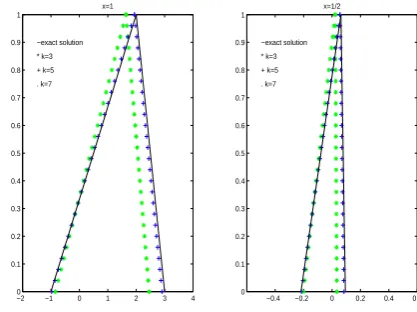
Example 5.1 Consider the following third-order Fuzzy integro-differential equation
e
y′′′(x) =eg(x) +∫01(x+t)ye′(t)dt,
e
g= (60x2(r+ 1) +x(1−3r) + (29/3)r
−34/3,−1/6(r−3)(360x2−6x−5)),
e
y(0) = (0,0),
e
y′(0) = (0,0),
e
y′′(0) = (0,0).
(5.10)
The exact solution for this problem is ye(x) =
((r + 1)x5 + (2r −2)x3 , (3−r)x5). See Fig.
1 and Table 1 for comparing the exact solution
and obtained solution by the variational iteration
method for differentk and x.
Example 5.2 Consider the following second-order Fuzzy integro-differential equation
e
y′′(x) =ge(x) +∫01(ex+et)ye(t)dt,
e
g= (6(r−1)x+ (1/4−(7/12)r)ex
+ (e−2)r+ 6−2e,1/3(r−2)
(−12 +ex+ 3e)),
e
y(0) = (0,0),
e
y′(0) = (0,0).
(5.11)
The exact solution for this problem is ye(x) =
((r−1)x3+rx2, (2−r)x2). See Fig. 2and Table2
K for comparing the exact solution and obtained solution by the variational iteration method for
Table 1: numerical result for Example5.1.
dH(ye(k),yeexact)
x k= 5 k= 10 k= 15
0.2 5.8611e-004 1.6689e-005 8.0161e-008
0.4 0.0050 1.4173e-004 6.8076e-007
0.6 0.0178 5.0607e-004 2.4308e-006
0.8 0.0444 0.0013 6.0776e-006
1 0.0913 0.0026 1.2487e-005
Table 2: numerical result for Example5.2.
dH(ye(k),yeexact)
x k= 10 k= 20 k= 30
0.2 0.0048 3.1510e-004 1.9237e-005
0.4 0.0198 0.0013 8.2562e-005
0.6 0.0457 0.0030 1.8732e-004
0.8 0.0836 0.0054 3.6093e-004
1 0.1346 0.0088 5.6461e-004
Example 5.3 Consider the following third-order Fuzzy integro-differential equation
e
y′′′(x) =eg(x) +∫01(x+t)2ye′(t)dt,
e
g= (−1/15(r+ 1)(15x2−366x+ 10),
1/15(r−3)(15x2−366x+ 10)),
e
y(0) = (0,0),
e
y′(0) = (0,0),
e
y′′(0) = (0,0).
(5.12)
The exact solution of this problem is ey(x) =
((r+ 1)x4 , (3−r)x4). See Fig. 3 and Table
3 for comparing the exact solution and obtained
solution by the variational iteration method for
different kand x.
Example 5.4 Consider the following third-order Fuzzy integro-differential equation
e
y′′′(x) =eg(x) +∫0π/2(xcos(t))ey′(t)dt
e
g= (1/2(r−1)(2 sin(x) +x),1/2(1−r)
(2 sin(x) +x))
e
y(0) = (r−1,1−r),
e
y′(0) = (0,0),
e
y′′(0) = (1−r, r−1).
(5.13)
The exact solution of this problem isey(x) = ((r−
1) cos(x) , (1−r) cos(x)). See Fig.4 and Table
4 for comparing the exact solution and obtained
solution by the variational iteration method for
different kand x.
−2 −1 0 1 2 3 4 0
0.1 0.2 0.3 0.4 0.5 0.6 0.7 0.8 0.9 1
−exact solution * k=3 + k=5 . k=7
x=1
−0.4 −0.2 0 0.2 0.4 0.6 0
0.1 0.2 0.3 0.4 0.5 0.6 0.7 0.8 0.9 1
−exact solution * k=3 + k=5 . k=7
x=1/2
Figure 1: Comparing of exact solution and obtained solution in Example 5.1.
6
Conclusions
In this paper, we used He’s variational iteration
method to obtain fuzzy solution of the nth-order
un-Table 3: numerical result for Example5.3.
dH(ye(k),yeexact)
x k= 5 k= 10 k= 15
0.2 5.5540e-004 1.9377e-005 1.2624e-007
0.4 0.0050 1.7442e-004 1.1363e-006
0.6 0.0189 6.6002e-004 4.2999e-006
0.8 0.0501 0.0017 1.1385e-005
1 0.1089 0.0038 2.4741e-005
Table 4: numerical result for Example5.4.
dH(ye(k),yeexact)
x k= 5 k= 10 k= 15
π/8 3.7242e-005 2.9794e-008 8.9369e-011
π/4 5.9587e-004 4.7671e-007 1.4299e-009
3π/4 0.0483 3.8613e-005 1.1582e-007
π/2 0.0095 7.6274e-006 2.2879e-008
−1 −0.5 0 0.5 1 1.5 2 0
0.1 0.2 0.3 0.4 0.5 0.6 0.7 0.8 0.9 1
−exact solution * k=5 + k=10 . k=15
x=1
−0.20 −0.1 0 0.1 0.2 0.3 0.4 0.5 0.1
0.2 0.3 0.4 0.5 0.6 0.7 0.8 0.9 1
−exact solution * k=5 + k=10 . k=15
x=1/2
Figure 2: Comparing of exact solution and obtained solution in Example 5.2.
known initial values were constructed. Conver-gency of VIM for this system is proved. The ef-fectiveness of the method was shown by different examples with separable and inseparable kernels.
References
[1] S. Abbasbandy, E. Babolian, M. Alavi,
Nunerical method for solving linear fredholm fuzzy integral equations of the second kind, Chaos, Solitons & Fractals 31 (2007) 138-146.
[2] S. Abbasbandy, T. Allahviranloo, P. Darabi,
O. Sedaghatfar,Variational iteration method
0 1 2 3 4 0
0.1 0.2 0.3 0.4 0.5 0.6 0.7 0.8 0.9 1
−exact solution * k=3 + k=5 . k=7
x=1
0 0.05 0.1 0.15 0.2 0
0.1 0.2 0.3 0.4 0.5 0.6 0.7 0.8 0.9 1
−exact solution * k=3 + k=5 . k=7
x=1/2
Figure 3: Comparing of exact solution and obtained solution in Example 5.3.
for solvingn-th order fuzzy differential equa-tions, Math. Comput. Appl., in press.
[3] T. A. Abassy, Modified variational iteration
method (nonlinear homogeneous initial value problem, Comput. Math. Appl. 59 (2010) 912-918.
[4] T. A. Abassy, M. A. El-Tawil, H. El-Zoheiry,
Modified variational iteration method for boussinesq equation, Comput. Math. Appl. 54 (2007) 955-965.
[5] M. Friedman, M. Ming, A. Kandel, Fuzzy
−1 −0.5 0 0.5 1 0
0.1 0.2 0.3 0.4 0.5 0.6 0.7 0.8 0.9 1
−exact solution * k=2 + k=3 . k=5
x=1
−1 −0.5 0 0.5 1 0
0.1 0.2 0.3 0.4 0.5 0.6 0.7 0.8 0.9 1
−exact solution * k=2 + k=3 . k=5
x=1/2
Figure 4: Comparing of exact solution and obtained solution in Example 5.4.
[6] A. Ghorbani, J. Saberi-Nadjafi, An
effec-tive modification of He’s variational iteration method, Nonlinear Anal. Real World Appl. 10 (2009) 2828-2833.
[7] J. H. He,Variational iteration method-a kind
of non-linear analytical technique:Some ex-amples, Int. J. Nonlinear Mech. 34 (1999) 699-708.
[8] J. H. He, Variational iteration method Some
recent result and new interpretations, J. Comput. Appl. Math. 207 (2007) 3-17.
[9] J. H. He, Variational iteration method for delay differential equations, Commun. Non-linear Sci. Numer. Simul. 2 (1997) 235-236.
[10] J. H. He, A new approach to nonlinear
par-tial differenpar-tial equations, Commun. Nonlin-ear Sci. Numer. Simul. 2 (1997) 230-235.
[11] M. Inokuti, H. Sekine, T. Mura,
Gen-eral use of the Lagrange multiplier in non-linear mathematical physics, in: Variational method in the Mechanics of solids, Pergamon press, New York 1978, 156-162.
[12] D. Ralescu,A survey of the representation of
fuzzy concepts and its applications, in: M.M. Gupta, R.K. Ragade, R.R. Yager, Eds., Ad-vances in Fuzzy Set Theory and Applications (North-Holland, Amsterdam (1979) 77-91.
[13] S. Seikkala, On the fuzzy initial value
prob-lem, Fuzzy Sets and Systems 24 (1987)
319-330.
[14] X. Shang, D. Han, Application of the
vari-ational iteration method for solving n th-order integro-differential equations, J. Com-put. Appl. Math. In press.
Omolbanin Sedaghatfar was born in the Tehran, Shahr-e-rey in 1982. She received B.Sc and M.Sc de-gree in applied mathematics from Zahedan Branch, Tehran - Science
and Research Branch, IAU,
re-spectively, and her Ph.D degree in applied mathematics from science and research Branch, IAU, Tehran, Iran in 2011. She is a As-sistant Prof. in the department of mathematics at Islamic Azad University, Shahr-e-rey, Tehran in Iran. She is research interests include numeri-cal solution of fuzzy integro-differential equations and fuzzy differential equation and similar topics.
Saeid Moloudzadeh was born in the Naghadeh-Iran in 1976. He re-ceived B.Sc degree in mathematics and M.Sc degree in applied mathe-matics from Payam-e-Noor Univer-sity of Naghadeh, science and
re-search Branch,IAU to Tehran,
re-spectively, and his Ph.D degree in applied math-ematics from Science and Research Branch, IAU, Tehran, Iran in 2011. He is research interests in-clude fuzzy mathematics, especially, on numerical solution of fuzzy linear systems, fuzzy differential equations and similar topics.
noindent Pejman Darabi was born
in Tehran-Iran in 1978. He
re-ceived B.Sc and M.Sc degrees in applied mathematics from Sabze-var Teacher Education University,
science and research Branch, IAU