142
LEARNING AND TEACHING IN THE
CONTEXT OF THE VALUE-BASED
APPROACH AT THE YOUNGER SCHOOL
LEVEL
Leida Talts, Airi Kukk
Tallinn University, Estonia E-mail: [email protected], [email protected]
Abstract
This study aims to ascertain primary school teachers’ views on learning and teaching in the context of the value-based approach and to explore the values teachers rely on in their daily work. The theoretical framework of the study draws on the principles of social constructivist approach to learning, which also constitutes the basis of the new National Curriculum for Basic Schools of the Republic of Estonia. The study is based on the survey of 359 primary school teachers. The analysis produced a five-factor model, showing satisfactory factor loadings for each. The study revealed that teachers’ beliefs about traditional and constructivist teaching styles are somewhat contradictory, expressing on the one hand support to the constructivist approach to learning, but admitting at the same time that for both themselves and their students the traditional teaching style is more convenient. However, the majority of teachers believe that adherence to social constructivist learning principles yields better knowledge and practical skills. In pri-mary school teachers’ approach to learning and teaching the most important key point is the acquisition of knowledge and useful skills, implemented through cooperation and favourable learning environment.
Key words:social constructivist and traditional approach to learning, value-centeredness, views on learning and teaching.
Introduction
throughout many decades the goal of the value-centred learning and teaching has been children’s natural, unhindered growth and development, experiential learning, play, self-ex-pression and moral education. the value-based approach is related to the development of social skills, which reflects the society’s attitude towards social values. Higgins (2007) argues, that socialisers’ views on what kind of person the child should turn out to be, have a strong influ -ence on the development of values, and influ-ence the person’s ideas about what appropriate end states are and how to reach them through the regulation of their behaviour.
Value-based learning is especially characteristic of the younger school level where learn-ing is intertwined with the development of ethical norms of behaviour and social skills. in the early years of school it is especially important to focus on introducing and following moral tenets and codes of conduct, but also shaping a positive attitude towards attending school and learning. developing learning habits and skills and acquiring cooperation skills is also essen-tial. Thereby, the most important task of the teacher is to support each child’s self-confidence and learning motivation.
in the 21 century Volume 57, 2013 143 inevitability or even an inescapable obligation for a child. trust between the teacher and student helps the child better to adjust to learning. the teacher has to show children that it is possible to overcome hardships, and to introduce the ways of adjusting to new situations (Fullan, 2005; Wisneski & Goldstein, 2004).
at the younger school level it is primarily the class teacher who helps students to under-stand the meaning of learning, because the class teacher is the key person who sees children and their development as a whole through different subjects and daily communication. the emphasis is on class management while teaching several subjects in the same class. the close daily contact with their students provides an opportunity to view the teacher’s role first of all as the role of a partner in the formation of children’s learning motivation and development path. the curriculum of class teacher aims to prepare teachers who teach not just individual subjects but above all students with different backgrounds and development potential. class teachers, being familiar with the abilities and social background of their students, can reduce inequality through the microclimate in the classroom, attaching value to individuality, social empathy and inclusion of all children.
several studies carried out in estonia have pointed out that already at preschool stage more importance is attached to children’s academic achievements than to their social skills (Kukk, 2010; Ruus, et.al, 2008; Talts, 2008). however, due to the ideological views adopted in the new national curriculum, an attempt is being made to change this and take ethical principles and social norms of behaviour more into consideration.
the educational foundation of the learning and teaching that are based on ethical and social values is formed by the principles of child-centred pedagogy, which are implemented through social constructivist approach to learning.
the purpose of this article is to ascertain what characterises primary school teachers’ views on learning and teaching in the context of the value-based approach, and what teachers rely on in their practical teaching work.
Social Constructivist Approach to Learning as a Bearer of Ethical and Social Values
the new national curriculum for basic schools of the republic of estonia attaches im-portance to the development of various competences, emphasising as the most essential 1) val-ue-related competence – an ability to evaluate human relationships and activities on the basis of universal moral standards; perceive and appreciate one’s own connection with other people and nature, 2) social competence – an ability to realise oneself, to know and follow the socially ac-cepted values and norms, to collaborate with people in different situations, to accept differences in people, 3) self-determination competence – an ability to understand and value oneself, one’s strengths and weaknesses, 4) learning competence – an ability to organise the learning environ-ment and obtain information needed for learning; to plan learning and impleenviron-ment the plan; to use what one has learned, including the learning skills and strategies, in various contexts and in problem solving, 5) communication competence – an ability to express oneself clearly and relevantly, taking into account the situation and the communication partners, to present and justify one’s points of view.
Volume 57, 2013
144 the social constructivist approach to learning, which is also the basis of the new nation-al curriculum of estonia, relies on the view that students are not passive receivers of knowledge but active participants in the creation of knowledge, in which an important role belongs to explo-ration and experimentation. the well-known representative of social constructivism Vygotsky (2005) emphasises the process of knowledge acquisition, in which interactive communication and knowledge mediated by community and cultural environment become important. active construction of the meaning of what is being learned is carried out by the student, which means that learning is more successful when it happens in social situations. regardless of schools and teachers’ approaches to sharing information about other students’ performance, all students use the information they receive about how others are doing to judge their own experiences. this kind of information source helps children calibrate their ability beliefs in different areas, and is one reason why children’s ability and expectancy beliefs elate more strongly to their perform-ance as they get older (Wigfield, et al., 2004). The social constructivist approach to learning considers that the teacher’s task is to inspire, encourage, challenge and advise students while guiding them in critical thinking, analysing what they are learning and creating associations. in addition to the subject taught, the teacher’s attention is on the ways of learning and how to teach so that all students would understand as well as possible.
What values related to learning and teaching are considered important by teachers from different countries was analysed by the international teacher survey teaching and learning in-ternational Survey – TALIS (TALIS, 2009). One of the starting points of the TALIS survey was also the comparison of teachers’ views on traditional and social constructivist approaches to the learning process. the study revealed that estonian teachers strongly believe in the constructiv-ist approach but do not contrast it to traditional beliefs.
Children’s own experience with various activities can influence how much they like or are interested in different activities. children are also likely to compare their interest in different activities to those of their peers, and these kinds of value-related social comparisons may influ -ence children’s own values of the activity. Wigfield (1994) discusses how the different compo -nents of value may develop across the childhood years. at the same time, this approach does not emphasise the importance of stability of situations and relationships, but rather, the chang-ing context of understandchang-ing and interpretchang-ing the surroundchang-ing environment (Boylan, 2010, 62; Daniels, 2008; Engeström, 2004, 150–152; McCulloch, 2008; Vygotsky, 2005).
Classroom can foster students’ motivation when: a) there is focus on learning and mas -tery rather than solely on performance outcomes; b) teachers hold the beliefs that all children can learn, and have high expectations of children’s learning; c) students have increasing control over their learning and many opportunities for making decisions about what they do in school; d) relationship between teachers and students is positive and emotionally supportive; e) rela -tionship among students is collaborative and cooperative; f) public information about student performance is minimised and g) the cognitive content of the curriculum is challenging, inter -esting, and focused on higher-order thinking for all children (Perry, et al., 2006; Wigfield, et al., 1998). Shared beliefs are an important source of value (Higgins, 2007).
according to social constructivist principles, both student and teacher are learners, and the learners’ coping depends on the conditions of the educational environment as well as on the extent the teacher is able to value students with different abilities and personalities. the aim is to develop an active and cooperative personality characterised by the ability to make meaning-ful choices and take responsibility for realising them. it is necessary on a daily basis to create new learning situations in which learners, through interpreting their experience, develop a sys-tem of attitudes and values guiding their perception and choices and allowing them to behave responsibly. at the younger school level it is crucial to notice and acknowledge children’s en-deavours and aspirations. therefore, the teacher’s role in giving feedback on students’ activity and through that developing their self-perception is highly responsible.
ex-in the 21 century Volume 57, 2013 145 perience and knowledge needed for the qualitative leap in independent thinking during the first years of school. even more important is the accompanying development of self-perception – a positive self-image retains children’s inherent interest in learning and exuberance, which allows them at the next stages of development to painlessly compensate for the possible backlog in the extent of knowledge caused by the slower pace of movement. in primary school it should be fully acknowledged: initially children’s enthusiasm and joy of participation in the learning process constitute a more important goal than subject-related outcomes.
Methodology of Research
The Description of the Sample and the Research Procedure
To find out about teachers’ views on learning and teaching in the context of the value-based approach, a national teachers’ survey was carried out in Estonia in 2011, in which along with teachers of various subjects 359 primary school teachers from different regions of Estonia participated, of whom 251 teachers worked in Estonian-medium and 108 in Russian-medium schools. the participating schools were selected by random sampling methods from every sec-ond county of estonia, representing both urban and rural schools, basic and secsec-ondary schools, estonian- and russian-medium schools. headteachers of the schools included in the sample were asked to coordinate the conducting of the survey at their school: to hand out to the teachers the questionnaires with envelopes for answers and later collect the sealed envelopes containing the filled-in questionnaires.
The age of the participating teachers ranged between 22 and 73, the length of their teach -ing experience was from 0 to 55 years, whereas the average teach-ing experience was 22.2 years and the average age 44.5 years. The overwhelming majority, 92 percent of the class teachers in the sample had the qualification required for teaching, i.e. they had completed teacher training and class teacher courses at university.
Measuring Instrument
this analysis is based on the modules of the questionnaire that most clearly revealed primary school teachers’ learning and teaching related values. firstly, two different approaches to learning and teaching were described to the teachers. the description a expresses a typical traditional view on teaching and was worded as follows: Teacher A led his/her lesson at a good pace, asking questions about the material dealt with the day before, to which students were ex-pected to give quick answers. After that he/she taught the class a new section, asking questions to keep students active and attentive.
the description b which expresses the social constructivist approach was the following: In teacher B’s lesson also a discussion took place, but several questions were asked by the stu-dents. Although teacher B interpreted students’ questions and recommended relevant material for finding answers, he/she did not offer ready-made answers to the majority of the questions.
The teachers rated these descriptions on a 5-point Likert-type scale, while answering the following questions: 1) Which of the two discussions would be more comfortable for you? 2) Which of the two descriptions do you think the majority of the students prefer? 3) Through which discussion do you think students gain more knowledge? 4) Through which discussion do you think students obtain more useful skills?
These four groups of opinions reflect teachers’ views on the efficiency of teaching: teacher’s convenience; students’ preferences; gaining knowledge; and obtaining useful skills.
Volume 57, 2013
146 Data Analysis
for data analysis the statistics package spss was used. to get an overview of what teachers value about learning and teaching, means and standard deviations of ratings given to statements were calculated. to structure statements describing teachers’ views factor analysis was carried out by means of the principal component method, varimax rotation. to assess in-ternal reliability of factors, the indicator of Cronbach’s alpha was applied. To find associations between teachers’ views and their background, correlation analysis was implemented, to illus-trate relevant results, conditional means were calculated.
The analysis revealed a five-factor model, showing satisfactory factor loadings for each.1) Learning (6 items, α = .579), for example: – pupils are interested in new knowledge; coping with a difficult task supports children’s internal motivation; children’s activeness is central to their learning; I use exploration and experimentation in the learning process; I favour creative solving of learning tasks. 2) Teaching (7 items, α = .738), for example: while teaching I support children’s individual characteristics; I differentiate teaching according to children’s interests and abilities; while teaching I rely on specific objectives of the curriculum; I associate learning with the surrounding physical environment; I rely on pupils’ prior knowledge and experience. 3) Environment (6 items, α = .430), for example: – I create a learning environment in which all children feel important and equal; teacher-child relationship is the main factor that shapes the learning environment; in my lessons there is a safe and cooperative atmosphere. 4) Cooperation (6 items, α = .588), for example: I have successfully involved parents in the life of the class; the parents of my class give me good advice in learning and teaching questions; I appreciate the feedback from appraisals. 5) Personality development (5 items, α = .564), for example: – I support each child’s balanced development; I give daily feedback on pupils’ activities; I take children’s opinion into account to find the right course of action; I practise and inspire students to reach common agreements and decisions.
Finally, correlation analysis was used to find how traditional and constructivist approach -es to learning are related to value-based teaching. Correlations (Spearman’s rho) between teach -ers’ classroom behaviour and attitudes towards teaching approaches (positive correlations refer to the constructivist bias) were found.
Results of Research
Traditional or Constructivist Approach
primary school teachers’ ratings on the scale of traditional and constructivist approaches to learning reveal the belief of the majority of the teachers that through constructivist approach to learning students acquire more useful knowledge and skills (Table 1). Obviously one of the reasons is that constructivist approach to learning entails active learning methods, like learning through play, using different means of information and communication, exploratory learning, etc. that help to bring learning closer to real life. at the same time, teachers admit that from both their and their students’ point of view the traditional approach is more convenient and routine, ensuring more reliable acquisition of the material learned in the process where the central role belongs to the questions asked by the teacher and the answers given by the students.
in the 21 century Volume 57, 2013 147
Table 1. Primary school teachers’ ratings on the scale of traditional and con-structivist approaches to learning.
Variable Traditional approach (%) Constructivist approach (%)
Teacher’s convenience (C1) 43.6 49.1
Students’ preferences (C2) 38.5 48.9
Gaining knowledge (C3) 14.5 78.0
Obtaining useful skills (C4) 7.5 85.3
therefore, teachers’ beliefs related to traditional and constructivist teaching methods are contradictory, expressing on the one hand their support to the constructivist approach, but admitting at the same time that the traditional teaching style is more convenient for both them-selves and their students.
The Highest and Lowest Rated Values
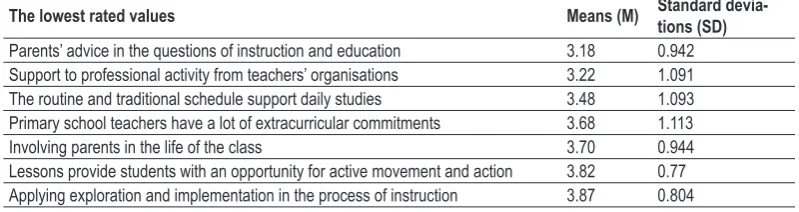
among the thirty statements addressing learning and teaching the ones rated highest and lowest by the teachers stand out. Below there are the highest rated statements (Table 2) with the average ratings on the 5-point scale higher than 4.5, and the lowest rated statements (Table 3) with the average ratings below 4 points.
Table 2. The highest rated values.
The highest rated values Means (M) Standard deviations (SD)
Developing learning to learn skills 4.67 0.501
Creative solution of learning tasks 4.65 0.564
Supporting each child’s balanced development 4.60 0.560
Encouraging students to reach common agreements and decisions 4.60 0.534
Coping with difficult tasks to support child’s internal motivation 4.59 0.628 The importance of playful techniques in the acquisition of new knowledge and
experience 4.58 0.634
Guiding students towards using different information tools 4.56 0.576
Creating a learning environment where all children feel important and equal 4.54 0.548
Integrating learning with the surrounding living environment 4.53 0.568
Relying on students earlier knowledge and experience 4.50 0.576
Table 3. The lowest rated values.
The lowest rated values Means (M) Standard devia-tions (SD)
Parents’ advice in the questions of instruction and education 3.18 0.942
Support to professional activity from teachers’ organisations 3.22 1.091
The routine and traditional schedule support daily studies 3.48 1.093
Primary school teachers have a lot of extracurricular commitments 3.68 1.113
Involving parents in the life of the class 3.70 0.944
Lessons provide students with an opportunity for active movement and action 3.82 0.77
Volume 57, 2013
148 it appears that the number of highest rated statements is higher and they are more related to social constructivist approach to learning and teaching, highlighting values that contribute to the development of general learning skills and involve aspirations to support individual chil-dren’s balanced development. teachers’ ability to develop a desire in students to cope with more difficult tasks and the creating of a safe and supportive learning environment also deserve high ratings. lower ratings have been given to statements supporting values that teachers feel indirectly contribute to their professional activity but are not directly related to it – for example, cooperation with parents and teachers’ organisations. the lower ratings do not allow us to con-clude that teachers do not support cooperation with parents or other organisations. they sooner rely on their actual experience that this cooperation does not always meet teachers’ expecta-tions, and, as indicated by the standard deviation (SD), fluctuation in their opinions is quite noticeable. many teachers do also not agree with the statement that a routine schedule supports daily studies, which shows that ideally they would like to break the routine and introduce more student involvement activities in the instruction.
Key Points of the Value-based Approach
We wanted to know to what extent teachers’ behaviour in the classroom correlates with their views on learning and teaching. The analysis revealed a five-factor model, showing satis -factory factor loadings for each: learning (6 items), teaching (7 items), environment (6 items), and personality development (5 items). Teachers’ different attitudes to learning were considered from the aspects of the description A (the traditional approach) and the description B (construc -tivist approach), on which basis the teachers’ responses to the given statements were grouped into four groups of opinions related to teachers’ convenience, students’ preferences, gaining knowledge and obtaining skills.
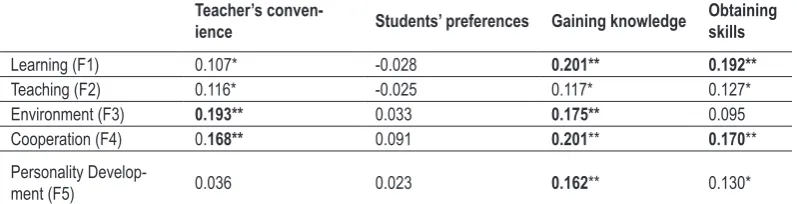
it appears that the strongest correlations occurred between the statements grouped under the factor learning (F1) and statements related to social constructivist approach. This means that teachers who believe that children acquire more knowledge and useful skills (r=0.201; r=0.191) through discussion and activities requiring students’ active participation, focus their activity more on learning than on teaching. teachers’ classroom behaviour is also related to physical and psychological factors of the environment (F3). Here we can see the relationship between environmental conditions and the teachers biased towards the traditional approach to learning as well as those supporting the constructivist approach to learning. thus teachers with a more routine approach find that good environmental conditions make their classroom work more convenient (r=0.193) and also the teachers with the constructivist bias see a positive link between the environment and the acquisition of knowledge (r=0.175).
the factor cooperation (F4) most strongly correlates with teachers’ belief that the most efficient way of knowledge acquisition is through active involvement of students and parents (r=0.201), but there is also a significant relationship between cooperation and the acquisition of useful knowledge (r=0.170). Teachers with a more traditional approach also find that coopera -tion makes teaching more convenient for them.
in the 21 century Volume 57, 2013 149
Table 4. Correlations (Spearman’s rho) between teachers’ classroom behaviour (F1-F5) and attitudes towards teaching approaches (positive correla-tions refer to the constructivist bias).
Teacher’s
conven-ience Students’ preferences Gaining knowledge Obtainingskills
Learning (F1) 0.107* -0.028 0.201** 0.192**
Teaching (F2) 0.116* -0.025 0.117* 0.127*
Environment (F3) 0.193** 0.033 0.175** 0.095
Cooperation (F4) 0.168** 0.091 0.201** 0.170**
Personality
Develop-ment (F5) 0.036 0.023 0.162** 0.130*
Notes: n = 346, ** Correlation is significant at the 0.01 level. * Correlation is significant at the 0.05
level.
it may be concluded that in the approach of primary school teachers to learning and teaching the most important key point is the acquisition of knowledge and useful skills, imple-mented through cooperation and favourable learning environment. learning is at the forefront, which indicates movement from the teacher-centred approach towards the approach that takes into account children’s development needs.
Discussion and Conclusion
the current study revealed teachers’ strong support to the constructivist approach to learning. the constructivism dominating in the beliefs of estonian teachers was also indicated by the TALIS survey (OECD, 2009). Over the last decade constructivist approach to learning has been widely promoted in pedagogical circles and in this respect teachers’ strong support to these ideas was predictable.
this study ascertained primary school teachers’ beliefs about learning and teaching in the context of the value-based approach. In the first years of school it is not possible to draw a clear line between teaching, learning and child’s personality development, because the objec-tives pursued at the younger school stage are clearly value based and the key person in achiev-ing these goals is the teacher. the theoretical framework of the study relied on the social con-structivist approach as an approach to learning that most emphasises modern values by bringing active learning methods and students’ active participation to the forefront. our aim was not to contrast the traditional and the constructivist approaches to learning, but rather explore them in the context of the value-based approach. the traditional approach to learning has several posi-tive traits, e.g. developing students’ skills needed for learning, such as acposi-tive listening skills, attention, exact formulation of responses, tidiness habits, sense of duty, etc. such method of teaching is more convenient for teachers, because it allows them to confine their teaching to the material they have provided, and the reproduction of this material by students. this method allows students to gain a wealth of factual knowledge. however, as proved by this study, teach-ers believe that the social constructivist approach to learning gives a better opportunity to link knowledge with students’ personal life experience and practical life (Wigfield, et al., 2004).
Volume 57, 2013
150 which some teachers are currently unable to sufficiently apply due to the intense curriculum and the absence of necessary skills.
the study revealed as an essential value people’s interaction in the learning process, which was also pointed out by Vygotsky (2005), who emphasised the process of knowledge ac -quisition in which interactive communication between people as well as knowledge exchange in the community and cultural environment gain importance. learning is more successful when it takes place in social situations. among cooperation-related values teachers highlighted the need to be informed about children’s extracurricular hobby activities, but admitted that in their daily instructional-educational work they do not always receive sufficient support from parents. these are usually the situations where parents of children who have learning and behaviour problems are not able for various reasons to collaborate with the teacher. the same point of view is also expressed by some other studies conducted in Estonia (Krull, 2008; Kukk, 2010; Ruus, et al., 2008).
among environment-related values safe and cooperative environment was considered important by the teachers. The international survey TALIS (TALIS, 2009) also revealed that estonian teachers value working peace and discipline in their lessons, which essentially relates to established traditions and routine. however, since the rapid changes in estonian educational life encourage teachers to seek more innovative child-centred approaches, some teachers may view routine and traditions as signs of the soviet school system.
Values related to child’s personality generally received high ratings (all statements were rated 4.0 or above). Teachers considered most important encouraging students to reach com -mon agreements and decisions, which several other researchers (Dewey, 1963; McLean, 2006) also view as significant. Somewhat lower ratings were given to considering students’ opinion in finding the right course of action.
the conception of teaching children is related to society’s conception of children and childhood and what we want our children to become. as the rest of the world, estonian primary education also aims to provide more space to educational strategies that involve discussion, group work and independent learning while using media and instructional materials, where teachers have autonomy and an opportunity to be involved in the decision making in educa-tion.
in the conditions of liberal market economy where schools are increasingly competing against each other and disproportionately great attention is given to academic performance used as the criterion for ranking schools, education which promotes humanist, social and ethical val-ues is under threat. our study indicated that at the younger school level these dangers do not yet considerably jeopardise pupils and teachers, because the perceptions of learning and teaching of the majority of the teachers equally support the transmission of knowledge and children’s ethical and social development. our research revealed teachers’ strong support to constructivist approach to learning.
since constructivist approach to learning has been widely promoted, it is relatively pre-dictable that teachers give their strong support to it. however, it should be stated that the result where a great proportion of teachers agreed with relevant statements indicates low differenti-ability of the scale used. In case the study is repeated, the relevant module should definitely be complemented with statements that would help to more clearly differentiate teachers who support constructivist approach to learning. another possibility is to use other research methods to explore the same topic, e.g. lesson observations, which would provide additional information about teaching and communication methods teachers actually use in their lessons to meet the principles of value-based learning.
in the 21 century Volume 57, 2013 151 approach to learning, which in addition to direct methods in the classroom is significantly sup -ported by cooperation between teachers, and psychological and physical environments.
Acknowledgements
The authors gratefully acknowledge the support from the European Social Fund (grant no 30.2–10.2/120).
References
Boylan, M. (2010). Ecologies of participation in school classrooms. Teaching and Teacher Education, 26 (1), 61-70.
Bracken, S. S., Fischel, J. (2007). Relationships between Social Skills, Behavioral Problems, and Readi -ness for head start children. NHSA dialogue: A Research to Practice Journal for the Early Intervention Field, 10 (2), 109-126.
Daniels, H. (2008). Vygotsky and Research. london and new york: routledge.
Dewey, J. (1963). Experience and Education. new york and london: collier macmillan.
Engeström, Y. (2004). The New Generation of Expertise: Seven Theses. Rainbird, H., Fuller, A. & Munro, A. (Eds): Workplace Learning in Context. London: Routledge, pp. 145-165.
Fullan, M. (2005). Leadership & sustainability: System thinkers in action. california: thousand oaks.
Hare, J. (2006). Understanding holistic education. Journal of Research in International Education, 5 (3), 301-322.
Higgins, E. T. (2007). Value. In A. W. Kruglanski & E. Tory Higgins (Eds.), Handbook of social psychol-ogy (2nd Ed., pp. 454-472). New York: Guilford.
Kukk, A. (2010). Meeting the objectives of the curriculum in the transfer from a pre-school institution into school and the first stage at school according to the assessments of teachers. Tallinn Univer -sity, [Dissertation on Social Sciences].
Krull, E. (2008). Models of instructions as tools for analysing lessons. In J. Mikk, M. Veisson, P. Luik (Eds.), Reforms and innovations in Estonian education (pp. 123–138). Frankfurt am Main: Peter
lang publishers.
McCulloch, G. (2008). The Routledge International Encyclopedia of Education. Ed by C. McCulloch; D.
crook. usa and canada: routledge.
McLean, A. (2006). The motivated school. london: p.c.p.
Perry, N. E., Turner I. C., Meyet, D. K. (2006). Classroom context for motivating learning. In P. A. Alexander & P. H. Wine (Eds.) Handbook of educational psychology. (2nd Ed. pp. 327-348).
mahwah n.y: erbaum.
Põhikooli riiklik õppekava [National Curriculum for Basic Schools]. (2011).
Ruus, V. R., Henno, I., Eisenschmidt, E., Loogma, K., Noorväli, H., Reiska, P., Rekkor, S. (2008). Re -forms, developments and trends in estonian education during recent decades. in J. mikk, m.
Veisson, P. Luik (Eds.), Reforms and innovations in Estonian education (pp. 95-107). frankfurt am main: peter lang.
TALIS (2009). Creating Effective Teaching and learning Environments: First results from TALIS [survey report]. url http://www.oecd.org/edu/talis/firstresults [June 30, 2011]
Talts, L. (2008). Transition process from kindergarten to school: an empirical analysis. International Views of Early Childhood Education, 1, 9–17.
Vygotsky, L. S. (2005). Psihologia razvitija t eloveka [psychology of human development]. moskva: smõsl.
Wigfild, A., Tonks, S., Eccles, J. S. (2004). Expectancy-value theory in cross-cultural perspective. In D. M. McInerne & S. Van Etten (Eds.), Research on sociocultural influences on motivation and learning, volume4: Big theories revisited (pp. 165-198). Greenwich, ct: information age.
Wigfield (1994). Expectancy-value theory of achievement motivation: A developmental perspective. Educational Psychology Review, 6, 49–78.
Wigfield A., Eccles J. S., Rodriguez, D. (1998). The development of children motivation in school con
-text. In: Iran-Nejad & P. D. Pearson (Eds). Review of research in education (Vol. 23, 73-118).
Washington dc: american educational research association.
Volume 57, 2013 152
Advised by Maria Tilk, Tallinn University, Estonia
received: September 22, 2013 accepted: December 01, 2013
Leida Talts PhD., Professor Emeritus , Department of Primary Education, Tallinn University, 25 Narva Street, 10120 Tallinn, Estonia.
E-mail: [email protected]
Airi Kukk PhD., Lecturer, Department of Primary Education, Tallinn University, 25 Narva Street, 10120 Tallinn, Estonia.