(UDC: 620.178.2)
Critical aspects of the mechanical behaviour and failure of dionysos
marble under direct tension
(*)S. K. Kourkoulis
National Technical University of Athens,
School of Applied Mathematical and Physical Sciences, Department of Mechanics, 5 Heroes of Polytechnion Avenue, Theocaris Building, 157 73 Zografou, Athens, Hellas Email: [email protected]
(*) The paper is dedicated to the memory of late Professor Ioannis Vardoulakis (1949-2009)
Abstract
The mechanical behaviour and failure of Dionysos marble under direct tension is explored both experimentally and numerically. Intact cylindrical ―dog-bone‖ specimens and also ―U-notched‖ plates were used in the experimental protocols. The components of the strain field were obtained with the aid of suitably positioned arrays of strain-gauge rosettes. The failure of the material was modelled within the frame of the Flow Theory of Plasticity. The experimental data were then used to validate a numerical model aiming at a thorough full-field study of the strain field in ―U-notched‖ marble plates. Moreover the applicability of a simple and easy-to-use single-parameter criterion (based on the concept of the critical Notch Opening Displacement) for the prediction of fracture of structural elements made of Dionysos marble was assessed. Finally the limitations imposed by the non-isotropic behaviour of marble were explored also.
Keywords: Dionysos marble, direct tension, ―dog-bone‖ specimens, notched plates, orthotropic materials, notch opening displacement, finite element method
1. Introduction
simplicity.
Obviously, the stress state during these tests is far from being characterized as uniaxial, and the results obtained are often subjected to serious criticism (Fairhurst, 1964). Moreover additional difficulties are introduced by the orthotropic nature of Dionysos marble (Vardoulakis and Kourkoulis, 1997). The latter renders the detailed experimental analysis expensive since the number of tests increases dramatically. On the other hand analytic solutions of the problem are very few and of complicated nature (Kotousov and Wang 2003). In this context it was decided to study here the problem experimentally, by carrying out a relatively small number of direct tension tests (using specially designed gripping systems) and then to use the data of these tests for the validation of a numerical model which will permit thorough exploration of the strain field developed all over the specimen for various values of the geometrical and mechanical parameters.
The numerical analysis permitted an in-depth study of the strain field and quantification of the influence of the orthotropy characterizing Dionysos marble. Moreover critical quantities like the Notch Opening Displacement (NOD) were determined. Based on these data it was possible to explore the applicability of a simple fracture criterion using a single mechanical parameter for the safety assessment of structural elements made of Dionysos marble. Such a flexible and easy-to-use criterion is of increased practical importance especially for engineers working in restoration projects of various stone monuments of the Cultural Heritage all over the world.
2.The material and the specimens. Experimental procedure and results
2.1Intact cylindrical “dog-bone” specimens under direct tension
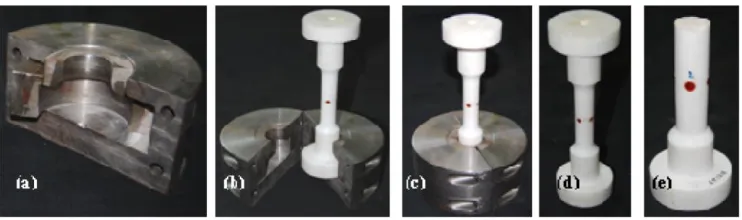
The mineralogical composition of Dionysos marble is analytically described by Tassogian-nopoulos (1986) and Perdikatsis et al. (2006). From the Strength of Materials point of view it is an orthotropic material. The values of its mechanical constants adopted were obtained from a long series of direct tension tests, implemented with the aid of specially designed grips transfer-ring the load from the frame to the specimen through shear instead through friction. The geometry of the grips and their assemblage are shown in Fig.1 together with typical specimens before and after they were tested. The axial and transverse strains were measured using four strain- gauge rosettes glued at the end-points of two diameters of the cross section normal to each other (Figs. 1(b-e)). The system of four strain measurement points permitted accurate quantification of the parasitic axial stresses developed due to bending moment generated by inevitable small misalignments between the loading axis and the geometric longitudinal axis of the specimens.
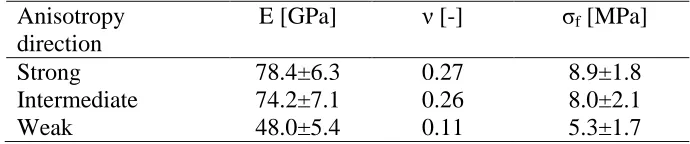
Characteristic experimental results can be seen in Fig.2a where the conventional axial stress is plotted versus the axial strain for a small number of loading-unloading-reloading loops of a typical specimen cut and loaded along the strong anisotropy direction. An isolated loop is shown in Fig.2b in order for the gradual accumulation of plastic strain to be clear. The average values of Young‘s modulus, E, Poisson‘s ratio, ν, and of the tensile strength, ζf, are recapitulated
in Table 1.
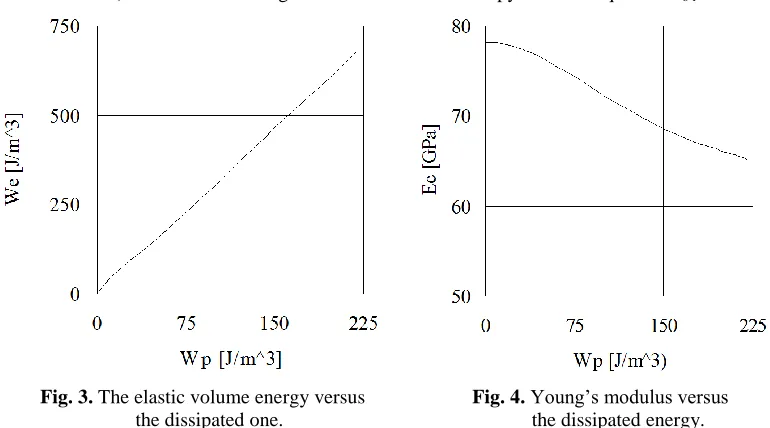
Analysis of the experimental data revealed that Dionysos marble is a slightly bimodular material (its elastic moduli in tension and compression are not equal) and also non-linear. What is perhaps more important is that the behaviour of the specific type of marble under direct tension is not purely elastic: Permanent deformation is observed upon unloading and as a result a portion of the total work is dissipated, as it is clearly shown in Fig.3, in which the elastically stored
Fig. 2. (a) The axial stress - axial strain curve for a typical specimen cut and loaded along the strong anisotropy direction. (b) An isolated loading - unloading loop and the technique adopted
for the determination of the current Young‘s modulus.
Table 1. Mechanical constants of Dionysos marble
volume energy, We, is plotted versus the dissipated one, Wp. The experimental data indicated
that almost one third of the elastic energy is dissipated. For simplicity in the analysis following all energy dissipation during the unloading-reloading loop is disregarded and the corresponding hysteresis loop is replaced by a straight line connecting the point of unloading on the primary loading curve with the intersection of the unloading path with the ε-axis (see Fig.2b). The slope (tanωc) of this simplified unloading-reloading axial stress-axial strain curve is considered as the
actual current Young‘s modulus. It was definitely concluded that the specific modulus decreases during the loading process, as it can be seen in Fig.4. Therefore one is forced to adopt a coupled model that could connect Young‘s modulus to the state of internal damage of the material.
In order to model the irreversible deformation within the framework of Flow Theory of Pla-sticity, the plastic work, Wp, was chosen as the most adequate plastic hardening parameter after
proper data regression. Accordingly, both elastic and plastic properties are expressed in terms of
Wp. Young‘s modulus was found to be accurately described by a decreasing function of Wp as:
n p c 0
p, ref
W
E E E 1
W
(1)
The numerical values of the parameters appearing in Eq.(1) were found equal to: E0=5.95x10⁴
MPa, Eℓ=1.87x10⁴ MPa, Wp,ref=1.46x10⁻⁴ MJ/m3 and n=-1.83. Concerning Poisson‘s ratio, ν, it
was also found to be a decreasing function of Wp. However the specific dependence is rather
Anisotropy
direction
E [GPa]
ν [-]
ζf [MPa]
Strong
78.4±6.3
0.27
8.9±1.8
Intermediate
74.2±7.1
0.26
8.0±2.1
weak and in a first approximation it can be ignored. Therefore an average value was assigned to Poisson‘s ratio, which for the strong and intermediate anisotropy axis was equal to s-i=0.265.
Fig. 3. The elastic volume energy versus Fig. 4. Young‘s modulus versus the dissipated one. the dissipated energy.
In the frame of the Flow Theory of Plasticity plastic deformation is modelled by utilising the concepts of the yield surface F(ζij,Wp)=0 and the plastic strain potential Q(ζij,Wp). The results
of the experimental protocol suggested a simple hyperbolic yield function of the form:
q po 2T c q p 1
q p
(2)
ij ji 1 kk
2s
s s I
p , J
3 3 2
(3)
where the conventional notation is adopted for the stress tensor, ζij, and the deviatoric stress
tensor, sij. Recall that ζij=sij+(ζkkδij)/3. In Eq.(2) q is a material constant while c and po are
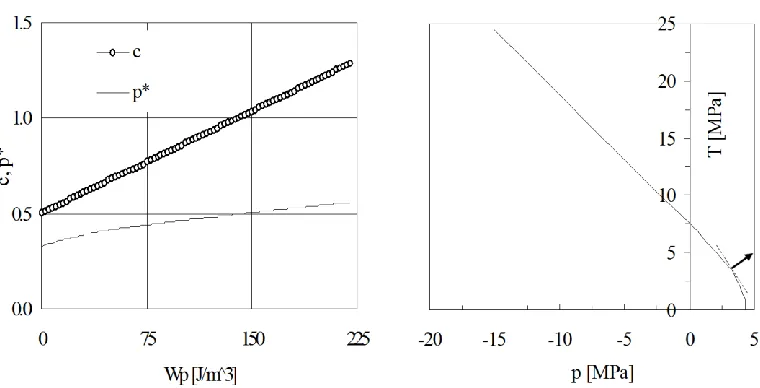
func-tions of the plastic work, Wp. After suitable curve fitting the experimental data suggested that:
1 p
*
p p
2 3 p
1 d W p
c a bW , p W
q d d W
(4)
Fig. 5. The dependence of constants Fig. 6. The yield envelope for Dionysos marble. c and p* on the dissipated energy.
Constant
a
b
κ
d
1d
2d
3Unit
---
[m
3/J]
x10
-2---
[m
3/J]
x10
-2[J/m
3]
x10
3x10
1Magnitude
0.504
0.356
0.325
0.497
0.339
0.744
Table 2. The numerical values of the constants of Eqs.(3,4) according to the curve fitting process
Concerning the tension limit, po, it can be determined through regression analysis of the plastic
dilatancy, in such a way that the experimentally measured plastic strain increment vector to be normal to the yield surface at the current state of the direct tension test, as it is shown sche-matically in Fig.6. In other words the yield surface is here used as plastic potential surface either (associate plasticity), i.e. F≡Q.
2.2U-notched “dog-bone” plates under direct tension
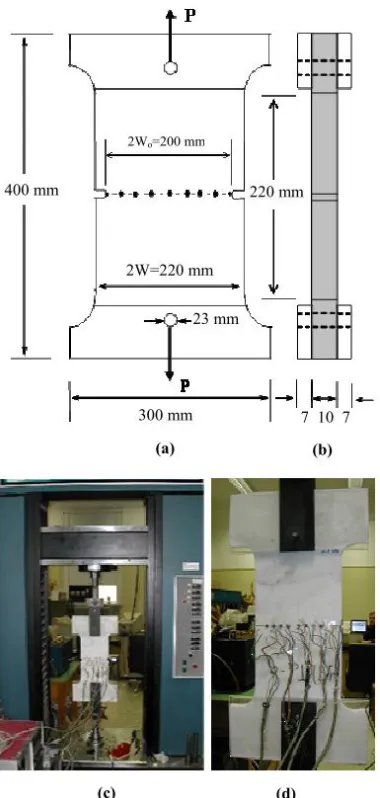
The specimens used in the second experimental protocol are shown schematically in
Figs.7(a,b). They were plates of overall dimensions 0.3x0.4 m2 properly machined to resemble
Fig. 7. (a, b) Sketch of the front and side-view of a typical specimen. (c) A wired specimen mounted in the loading frame. (d) Detailed view of the specimen showing the arrangement of
strain gauges.
The plates were cut from freshly quarried Dionysos marble and attention was paid for the loading direction to coincide with the strong anisotropy axis. The load was applied statically using a recently upgraded INSTRON/1126 servo-hydraulic loading frame of capacity 250 kN (Fig.7c). The displacement-control loading mode was chosen under a constant rate equal to 0.20 mm/min. The tensile force was measured using an INSTRON/2511-308 tension-compression load-cell properly calibrated with the aid of a verified Wykeham-Farrance load-ring.
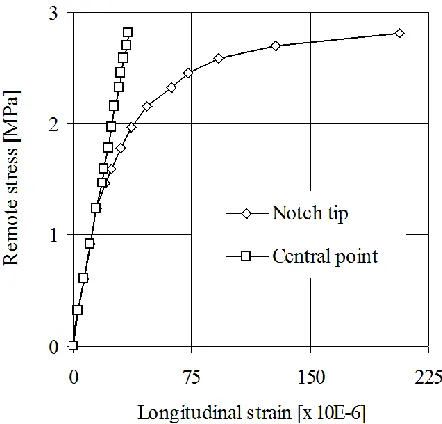
The variation of the axial strain (longitudinal) versus the nominal remote stress is plotted in Fig.8 using data from two strain rosettes: The one closest to the tip of the notch and the one at the geometric center of the specimen. The remote nominal stress is determined by dividing the load applied through the pins over the area of the effective (smallest) cross section, i.e. the one between the tips of the notches. It is seen from this figure that the response at the center of the specimen is almost perfectly linear, as it was expected, considering that the maximum stress level reached is equal to something less than one third of the fracture strength of Dionysos marble (see Fig.2). On the contrary, as one approaches the tip of the notch the behaviour of the material becomes strongly non-linear from almost the very first steps of the loading procedure, since the local stress field is amplified significantly due to the presence of the notch. This very strong non-linearity is attributed to the development of a process zone, i.e. a zone of intense micro-cracking, in the immediate vicinity of the notch tip. The extent of this zone for Dionysos marble was quantified by Kourkoulis et al. (1999) and was found of the order of 5 mm. Considering the size of the respective strain rosette it is concluded that indeed the point under study lies inside the process zone, justifying the strong non-linearity of the stress-strain curve.
Fig. 8. The remote stress versus the longitudinal strain at the central point and the tip of the notch.
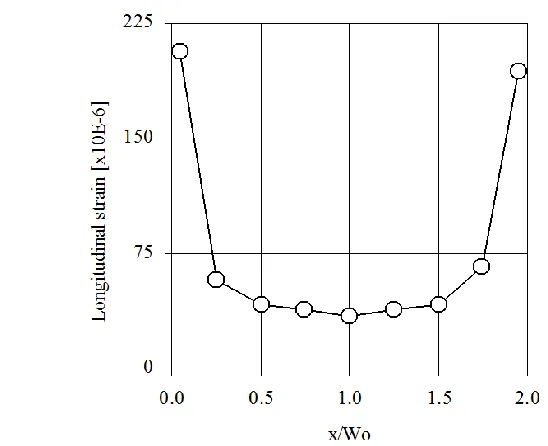
The variation of the longitudinal strain along the line connecting the tips of the notches is plotted in Fig.9. The strain close to the tip is almost six times that at the central portion of the
specimen. The mean of the maximum values attained approaches 2x10⁻⁴, almost equal to the
Fig. 9. The longitudinal strain along the line connecting the tips of the two notches.
Additional experimental data, concerning the Notch Mouth Opening Displacement (NMOD), will be presented in next Section 3 together with the respective results of the numerical analysis.
3. Numerical analysis
3.1The numerical model
Fig. 10. Detail of the mesh around the notch.
3.2Validation of the model
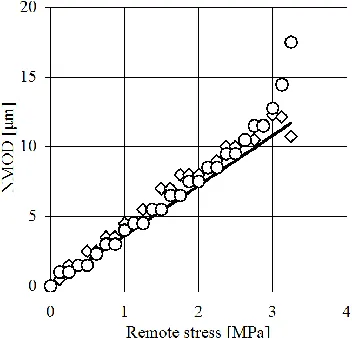
The validity of the numerical model was assessed by comparing its predictions for the Notch Mouth Opening Displacement (NMOD) against the respective data obtained from the two clip-gauges mounted on the specimens (Section 2.2). The comparison is shown in Fig.11. The agree-ment is very satisfactory almost for the whole range of the load applied. Discrepancies appear for loads approaching the ultimate one. Indeed as it was previously mentioned the stress field is inevitably slightly non-uniform. It is seen from Fig.11 that while the readings of one clip-gauge decrease the readings of the one mounted at the opposite notch increase abruptly. In any case the deviation between the experimental data for NMOD and those of the numerical model were below 8% (excluding the last two points).
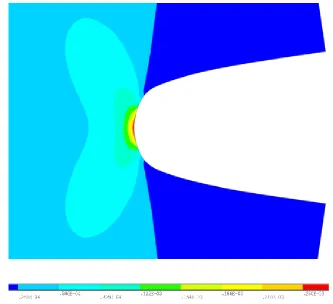
Fig. 12. The distribution of the axial (longitudinal) strain in the immediate vicinity of the notch.
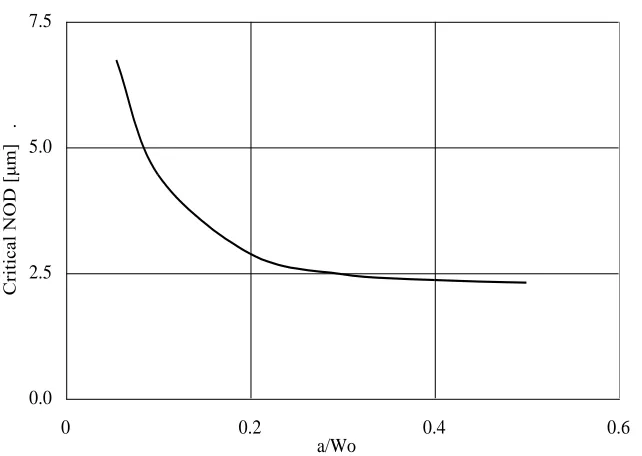
As a next step a single-parameter and easy-to-use fracture criterion was sought for the predict-ion of fracture of structural elements made of marble. In this directpredict-ion the applicability of the critical Notch Opening Displacement (NOD) concept was considered. Initially the NMOD was determined numerically (taking into account that the latter is easily measured experimentally even for structural elements already placed in their position or in service). A maximum tensile strain criterion was adopted and the critical NMOD was obtained numerically for various values of the notch length. As a last step the critical values of NMOD were reduced to the respective ones of the critical NOD by considering that the quantities for the case with a=10 mm are the reference values. The results of the above procedure are plotted in Fig.13 where the critical NOD is plotted versus the length of the notch, normalized with respect to the effective width of the plate, Wo (see Fig.7a). It is safely concluded from this figure that the critical NOD could be
Fig. 13. The dependence of the critical Notch Opening Displacement on the normalized (over the effective width of the plates) notch length.
As a final step the variation of the axial (longitudinal) and transverse normal strains (according to a Cartesian reference system with its axes parallel and normal to the loading direction) is
plotted in Figs.14(a,b) for two cases concerning the constitutive behaviour of Dionysos marble: (i) Isotropic and (ii) Orthotropic. Both plots are realized along a geometric locus similar to the boundary line of the notch at a distance equal to 5 mm from this boundary. For comparison reasons strains are normalized over their overall maximum value detected while the distance along the path was normalized over the length of the perimeter of the notch.
It is clear from Fig.14 that both strain components obtained in case marble is considered as orthotropic material systematically exceed the ones determined according to the isotropic model. The difference is much more pronounced for the transverse strains. For the line connecting the tips of the two notches the difference approaches 200%. At the same point the difference for the axial strains is about 15%. From the same figure it is again noted that the distribution of axial strains exhibits two distinct off-axis maxima, symmetric with respect to the axis of symmetry. These maxima exceed the corresponding value along the line of symmetry by about 27.5% and 25% for the isotropic and orthotropic models, respectively. The exact position of these two maxima is estimated at an angle equal to about 60owith respect to the line connect-ing the tips of the two notches.
0.0 2.5 5.0 7.5
0 0.2 0.4 0.6
a/Wo
Cr
it
ical
N
O
D
[
μm]
Fig. 14. The variation of the normalized transverse (a) and axial (b) strains along a contour similar to the boundary of the notch at a distance 5 mm from it. The graph is plotted only along
the lower half of the contour for obvious symmetry reasons.
4. Conclusions
The mechanical behaviour and fracture of Dionysos marble was studied both experimentally and numerically. Attention was focused to the behaviour under tension considering that due to
-0.5 0.0 0.5 1.0
0.0 0.1 0.2 0.3 0.4 0.5
Normalized arc length
N
o
rm
a
li
z
e
d
a
x
ia
l
st
ra
in
.
Isotropy
Orthotropy -0.50
-0.25
0.0 0.1 0.2 0.3 0.4 0.5
Normalized arc length
N
o
rm
(a)
the difficulties in the experimental implementation of direct tension tests the specific behaviour is up to now studied using substitute tests (like for example the Brazilian disc test). However the interpretation of the results of such tests is not always unique and therefore ambiguities enter often into the analysis (Markides and Kourkoulis, 2012).
Based on the results of long series of experiments with cylindrical ―dog-bone‖ specimens various critical aspects of the behaviour of Dionysos marble under tension were explored. It was concluded that this marble is of orthotropic nature with three distinct anisotropy directions, namely one along the grain plane, a second one along the head-grain plane and a third one along the rift plane (Kourkoulis et al., 1999). Therefore nine mechanical constants are required for the complete description of its mechanical behaviour (Lekhnitskii, 1977). However the mechanical properties along the strong and intermediate anisotropy directions are sufficiently close to each other and one could consider Dionysos marble as transversely isotropic material described with the aid of only five mechanical constants. In addition it was found that the axial stress - axial strain curve is non-linear from the early loading steps. Moreover if subjected to loading - unloading - reloading loops plastic strains are accumulated and the modulus of elasticity de-grades according to a more or less sigmoid law (Vardoulakis et al., 2002).
The failure of Dionysos marble was found to be rather accurately described within the frame of Flow Theory of Plasticity by utilizing the concepts of yield surface F(ζij,Wp)=0 and
plastic strain potential Q(ζij,Wp) in connection with a simple hyperbolic yield function.
In the presence of notches it was concluded that a zone of intense micro-processes is developed around the tip of the notch. Moreover the strain field is strongly amplified locally. For example the axial strain at a distance equal to a/2 from the tip of the notch is almost six times higher compared to the respective strain at the central region of the specimen. However this amplification is rapidly eliminated and at a distance higher than 2.5a the strain field becomes almost homogeneous.
For the prediction of fracture of Dionysos marble it was demonstrated that the critical NOD concept could be safely used assuming that the length of the notch exceeds a critical limit equal to about a=0.25Wo. Although it could be argued that a single-parameter fracture criterion based
on a critical length can hardly be a fracture criterion (with a sound basis from the physical point of view) for practical purposes it could be accepted, at least for structural elements already placed in their position.
Finally it was concluded that the commonly accepted assumption that Dionysos marble can be approximately described as an isotropic material should be critically reconsidered given that for the transverse strain component differences approaching 200% were detected between the isotropic and orthotropic versions of a plate with a notch under direct tension.
Acknowledgements:
Извод
У овом раду је испитивано механичко понашање и лом Дионисовог мермера под директним оптерећењем како експериментално тако и нумерички. У протоколу експеримената коришћени су интактни цилиндрични ―dog-bone‖ узорци епрувета као и плоче са „U–зарезом―. Компоненте поља оптерећења добијене су уз помоћ одговарајуће позицинираних низова розета за мерење оптерећења. Лом материјала моделиран је у оквиру Теорије течења пластичности („Flow Theory of Plasticity―). Експериментални подаци су затим коришћени за валидацију нумеричког модела са циљем темељног проучавања целог поља оптерећења у мермерним плочама са „U–зарезом―. Додатно, процењивана је применљивост једноставног и лаког за коришћење једнопараметарског критеријума (заснованог на концепту Notch Opening Displacement критичног померања зареза) за предвиђање прелома структурних елемената направљених од Дионисовог мермера. Коначно, испитивана су и ограничења која настају услед анизотропног понашања мермера.
Кључне речи: Дионисов мермер, директно оптерећење, ―dog-bone‖ узорци епрувета, плоче са „U–зарезом―, ортотропни материјали, критично померање зареза, Метода коначних елемената
References
Akazawa T (1943). New test method for evaluating internal stress due to compression of concrete (splitting tension test) (part 1), Journal of Japan Society of Civil Engineers, October 1943.
Carneiro FLLB (1943). A new method to determine the tensile strength of concrete. Proceedings
of the 5th Meeting of the Brazilian Association for Technical Rules, 3d. Section, 16, (in
Portuguese). September 1943, 126-129.
Fairhurst C (1964). On the validity of the ‗Brazilian‘ test for brittle materials, International
Journal of Rock Mechanic and Mining Sciences, 1, 535-546.
Hobbs DW (1964). The tensile strength of rocks, International Journal of Rock Mechanic and
Mining Sciences, 1, 385-396.
Hobbs DW (1965). An assessment of a technique for determining the tensile strength of rock,
Kotousov A, Wang CH (2003). A generalized plane-strain theory for transversally isotropic plates, Acta Mechanica, 161, 53-64.
Kourkoulis SK, Exadaktylos GE, Vardoulakis I (1999). Notched Dionysos-Pentelicon marble in three point bending: The effect of nonlinearity, anisotropy and microstructure,
Internation-al JournInternation-al of Fracture, 98, 369-392.
Lekhnitskii SG, Theory of elasticity of an anisotropic body, Mir, Moscow, 1977.
Markides CF, Kourkoulis SK (2012). The stress field in a standardized Brazilian disc: the
in-fluence of the loading type acting on the actual contact length, Rock Mechanics and Rock
Engineering, 45, 145-158.
Papamichos E, Vardoulakis I (1995). Shear band formation in sand according to non-coaxial plasticity model, Geotechnique, 45, 649-661.
Perdikatsis V, Kritsotakis K, Markopoulos Th, Laskaridis K (2006). Discrimination of Greek
marbles by trace-, isotope-, and mineralogical analysis. Symposium on Fracture and
Failure of Natural Building Stones, Alexandroupoli, Hellas, July 2006. Published in:
―Fracture and Failure of Natural Building Stones - Applications in the Restoration of
Ancient Monuments‖, S.K. Kourkoulis ed., Springer, Berlin, 497-515.
Tassogiannopoulos AG (1986). A contribution to the study of the properties of structural natural
stones of Greece (in Greek), Ph.D. Dissertation, National Technical University of Athens,
Athens, Greece.
Theocaris PS, Coroneos E (1979). Experimental study of the stability of Parthenon,
Publications of the Academy of Athens, 44, 1-80.
Toutanji H, Matthewson PR, Effinger M, Noumowe A (2003). Zero-Eccentricity
Direct-Tension Testing of Thermally Damaged Cement-Based Materials, Cement and Concrete
Research, 33, 1507-1513.
Van Mier JGM, Van Vliet MRA (2002). Uniaxial tension test for the determination of fracture parameters of concrete: State of the art, Engineering Fracture Mechanics, 69, 235-247. Vardoulakis I, Kourkoulis SK (1997). Mechanical properties of Dionysos marble. Final report
of the Environment Project EV5V-CT93-0300: Monuments under Seismic Action, National Technical University of Athens, Greece.
Vardoulakis I, Kourkoulis SK, Exadaktylos GE, Rosakis A (2002). Mechanical properties and
compatibility of natural building stones of ancient monuments: Dionysos marble,
Proceed-ings of the Interdisciplinary Workshop “The building stone in monuments”, Athens,
November 2001, IGME Publishing,. M. Varti-Mataranga and Y. Katsikis eds, pp. 187-210. Vayas I, Marinelli A, Kourkoulis SK, Papanicolopulos S-A (2009). Investigating the fracture
behaviour of Dionysos marble: An experimental study, International Conference on the
“Protection of Historical Buildings” (PROHITECH 2009), Rome, Italy, June 21-24, 2009.
Published in ―Protection of Historical Buildings‖, F.M. Mazzolani ed., CRC Press, A.
Bal-kema Book, Boca Raton, Vol. II, 1699-1704.
Zambas C (1994). Structural repairs to the monuments of the Acropolis - The Parthenon,