International Journal of Computer (IJC)
ISSN 2307-4531
http://gssrr.org/index.php?journal=InternationalJournalOfComputer&page=index
Demonstration of Software for Optimizing Machine Critical
Programs by Call Graph Generator
Pravin Kandala
a, Jasmeen Kaur
b, Prof. T. Venkat Narayana Rao
c*a
Student, Department of Computer Science, Guru Nanak Institutions Technical Campus, Hyderabad, India
b
Student, Department of Computer Science ,Guru Nanak Institutions Technical Campus, Hyderabad, India
c
Professor, Department of Computer Science ,Guru Nanak Institutions Technical Campus, Hyderabad, India
a
Email: [email protected] b
Email: [email protected] c
Email: [email protected]
Abstract
While working with software that is complex, representation in visual forms improves the understanding and
also enhances the programmers’ ability to analyze the relationships between the components of a code. Placing
all tools together which performs cyclomatic complexity on mission critical codes to optimize the solution is thr
real motto of this work. These include generation of call graphs, which are visually represented with different
metrics and to assist in software coding to the programmers. The different metrics include total number of lines
in the function, total number of executable lines, and number of unreachable lines. This tool accepts only C
program and generates a function call graph along with function metrics providing both static and dynamic
view. This software helps the developer to take decision on optimality of the program and to know the program
flow, thus optimizing the program. This paper depicts the working of call graph Generator to assess the reach
ability and exactness of the programs.
Keywords: Call graph; cyclomatic complexity; C program; optimality; call graph Generator
---
* Corresponding author.
E-mail address: [email protected].
1. Introduction
Intention behind the proposal of this system is to generate a call graph to a ‘c’ program. The ‘C’ source code is
taken as an input to the system and a call graph is drawn in a hierarchical way starting from the main function
of the programs and moving down until all the functions used in the program have been exhausted. The nodes in
the graph at each level represent the function called by the functions in the previous level. The relationship is
represented by the directed edges from one node to other. This facilitates the user to understand the program
clearly. Call Graphs provides the systematic information about the programs by indicating the calling
relationships between all the subroutines in the ‘C’ program. The Call graph generation for mission critical
software is to enable the people to understand the program so that they can make an easy review , modify the
code or use the defined functions in the program in other programs. The company administrative personnel
would maintain a database of all the ‘c’ programs which are to be analyzed and store the information in another
data base that is useful for them in above mentioned ways. The proposed system is a software tool that
facilitates the user needs. So, it does not need any administrator to maintain. When the user clicks the icon , it
prompts for the input file , a call graph is shown with all the subroutines in the program and also can provide
the basic metrics like cyclomatic complexity, number of lines in the program. It also makes the user to know
about the total number of executable lines in the given program and list of unused functions in a given ‘C’
program [1].
The system consists of following tasks:
1. The system will accept c files from the user.
2. Functions in the program are identified, and the calling functions are listed out.
3. Function metrics is calculated and call graphs are generated.
The scope of the Call Graph generator is as follows:
1. It is applicable to all types of ‘C’ programs.
2. It can work in Windows NT and Linux operating systems.
3. It can locate the relationship between the subroutines in the source code but doesn’t define the
relationship with the libraries.
4. It can distinguish between a library function and a user defined function in the source code.
Drawbacks of existing scenario in programming domain:
1. Previously normal codes are just compiled and get the result with time and space complexity directly.
2. They are parsed and complexity is indicated.
3. Dead code is not executed or shown error.
4. Displays no. of lines, but not executed lines.
5. User himself should write the efficient code carefully and execute it.
2. Proposed system
The system evaluates each line and function appropriately both dead and normal code. It displays a tree like
graph, which is easier for user to identify the complexity and relation between the functions starting from the
main() function. As the complexity is identified by cyclomatic complexity method, the complex function is
manually deleted [4].
3. Architecture
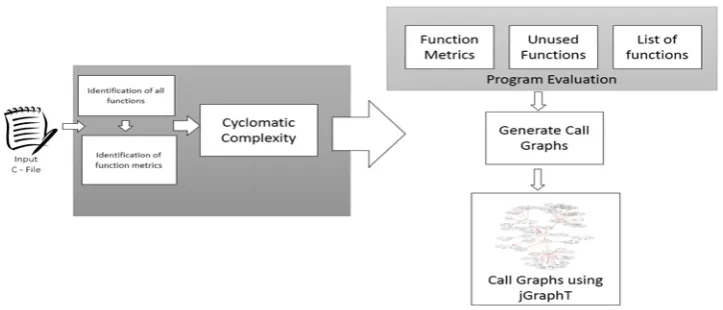
The Figure 1 illustrates input of source code files and how they are processed into three phases to get
cyclomatic complexity. Using these functions calculation of metrics, and other required measures are generated.
Fiannly , call graphs are generated using jGraphT API.
Figure 1 : Architecture diagram of optimizing programs using call graphs.
4. Implementation
The user will be prompted to select a ‘C’ file. Then the file is split into stream of tokens and the tokens are
passed into another file. Then these tokens are checked for function prototype. The functions obtained are
shown to the user for his confirmation. Then the function calls for each function is obtained and stored as
function objects [2]. The function objects have different set of parameters that are used to find the metrics for
each function. The metrics of every function is presented to the user in the graphical manner using tables .The
user has the option to print the data presented in the table for future verification. The call graph is generated
using jgrapht library package, where in the nodes of the graph indicates the functions and the links indicate the
function calls [3].” Custom Look And Feel” package is used for better presentation of the user interface. In the
system, data stream is first searched for function prototype, if found the function counter is incremented and
then function name is saved. This is done until end of the stream. If no function prototype is found then , it is
sent to further process or revert as per instructions.
5. Results
The system prompt the home page to initiate the task with option to read and select input file as shown in figure
2a, 2b 2c.
Figure 2 a, b, c: Basic Screen Snap shots for system interface.
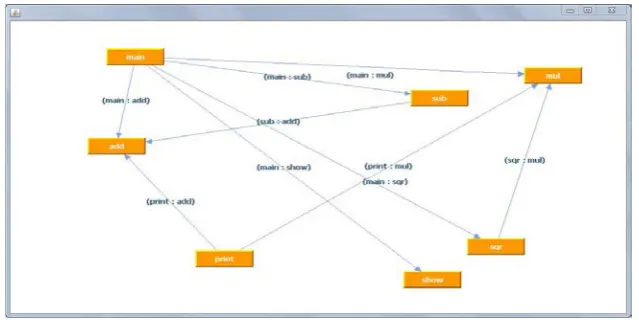
The following is the graph form representation of the input program shown in figure 3 with links and sub links.
Figure 3: Screen shot for the output for the generation of call graphs after computing all the values.
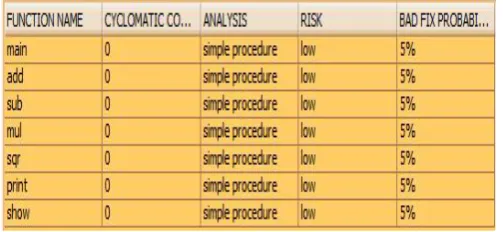
The functions metrics is calculated based on the graph form and metrics are generated in the list with details of
Function name, called function names and number of lines of code in each function as shown in figure 4. Table
I and II has showcased the analysis and table II states the procedure status, risk of function usage and bad fix
probability of the function.
Table 1. The results of the Cyclomatic Complexity for sample code
Table 2: Analysis of cyclomatic complexity values, its analysis, Risk and probability of bad fix
6. Conclusion
This paper summarizes the overall working of system focusing on assistance extend to the programmers during
large project coding. The problems encountered during the project development can be understood and shall be
modified through this method. The work done in this paper can be a vital software analytic tool, which helps in
understanding and analyzing the C program. This is a simple tool has no complexities which would assist the
programmer easily understand the functionalities of the program through call graphs. These graphs are helpful
while modifying, testing, documenting, explaining and maintaining the code with a facility of automatically
generated call graphs.
7. Limitations
• The call graph is static; any dynamic linking of function will not be depicted in graph.
• This will provide only the basic metrics of the program.
• If there is no main function it will show just an error message and terminates.
• The links will be increased when function calls are high. So there is a possibility for overlap. [9]
8. Future enhancements
The enhancements that can be made to the existing work are:
• Provision for identifying the unused variables in the program.
• A scrollable presentation of the Call Graph
• Self-organized graph can be developed.
• Dynamic call graph is more useful than static one.
• More metrics can be shown to the user.
References
[1]. Optimizing Programs Using Call Graphs by Pravin Kandala, Jasmeen Kaur and Prof. T. Venkant Narayana
Rao ,IJARES,April,2014.
[2] A J Sojev. "Basis Path Testing"
[3] John Sichi, JGraphT - Project Administrator.
[4] McCabe (December 1976). "A Complexity Measure". IEEE Transactions on Software Engineering: 315.
[5] McCabe, Watson (1996). "Structured Testing: A Testing Methodology Using the Cyclomatic Complexity
Metric".
[6] Diestel, Reinhard (2000). Graph theory. Graduate texts in mathematics 173 (2 ed.) New York: Springer.
ISBN 0-387-98976-5.
[7] Harrison (October 1984). "Applying Mccabe's complexity measure to multiple-exit programs". Software:
Practice and Experience (J Wiley & Sons).
[8] McCabe (December 1976). "A Complexity Measure". IEEE Transactions on Software Engineering: 308–
320. Template: Working link
[9] C grammar defintion for use with javaCC Contributed by Doug South.
AUTHORS BIOGRAPHIES
#1 Pravin Kandala is currently in his 4th year at the Guru Nanak Institutions Technical
Campus pursuing Bachelors in Computer Science and Engineering. And he is a Microsoft
Student Partner. Member at National App Review Board Microsoft. Holds Microsoft
Associate, Microsoft Certified Professional and Microsoft Certified Solution Developer on
Web platform and Windows store. Has developed apps on Windows 8, windows phone,
blackberry platforms. Over the past four years he has been actively participating in
projects, technical seminars and workshops. He avers Computer research oriented study
and has been working on Cloud computing, Mobile applications, algorithms, Augmented Reality, Artificial
Intelligence, Image processing. He can be reached at [email protected].
#2 Jasmeen Kaur is currently in her 4th year at the Guru Nanak Institutions Technical
campus pursuing Bachelors in Computer Science and Engineering. Over the past four
years she has been actively participating in several technical presentations, seminars &
workshops. Member and organizer at Hyderabad Youth Assembly. She holds
certifications for Microsoft technology associate and Microsoft certified solution developer. Has developed
Windows 8 apps. Her major interest of research lies in the areas of Computer and Developing, Network
Security, Computer vision, Theoretical Computer Science, Data Structures, Machine learning. She can be
reached at [email protected].
Professor T.Venkat Narayana Rao, received B.E in Computer Technology and
Engineering from Nagpur University, Nagpur, India, M.B.A (Systems), holds a M.Tech
in Computer Science from Jawaharlal Nehru Technological University, Hyderabad, A.P.,
India and a Research Scholar in JNTU. He has 21 years of vast experience in Computer
Science and Engineering areas pertaining to academics and industry related I.T issues. He
is presently working as Professor, Department of Computer Science and Engineering,
Guru Nanak Institutions Technical Campus, Ibrahimpatnam, R.R.Dist., A.P, INDIA. He
is nominated as an Editor and Reviewer to 38 International journals relating to Computer Science and
Information Technology and has published 61 papers in international journals. He is nominated as member on
international Advisory Committees of International Conferences and number of reputed professional bodies. He
is currently working on research areas, which include Digital Image Processing, Digital Watermarking, Data
Mining, Network Security and other emerging areas of Information Technology.