Original Research
Study of the structural properties of Co2YGe (Y=Sc, Ti, V, Cr, Mn, Fe)
by GGA method
D. P. Rai1*, A. Shankar1, Sandeep1, Rosangliana2 and R. K. Thapa1
1 Condensed Matter Theory Group, Department of Physics, Mizoram University, Aizawl 796 004, India 2 Department of Physics, Govt. Zirtiri Residential Science College, Aizawl 796 001, India
Received 2 February 2012 | Accepted 2 April 2012
ABSTRACT
The structural properties of Co2YGe, a Heusler alloy have been evaluated by first principles density functional theory through total energy calculations at 0 K by the full potential linearized augmented plane wave (FP-LAPW) method as implemented in WIEN2K code. The calculated results were com-pared with the previously reported results. Generalized gradient approximation (GGA) was used to study the structural properties of Co2YGe. The calculated values of lattice parameters were in quali-tative agreement with the previously reported results.
Key words: GGA; FP-LAPW; structural properties; Wien2k.
Corresponding author: D.P. Rai Phone:
E-mail: [email protected]
INTRODUCTION
Heusler alloys are the ternary intermetallic compounds with the composition X2YZ,
where X and Y are transition elements (Ni, Co, Fe, Mn, Cr, Ti, V etc.) and Z is III, IV or V group elements (Al, Ga, Ge, AS, Sn, In, etc.). One of the promising classes of materi-als is the half-metallic ferrimagnets, i.e. com-pounds for which only one spin channel pre-sents a gap at the Fermi level, while the other has a metallic character, leading to 100% car-rier spin polarization1 at E
F. After that,
half-metallicity attracted much attention,2 because
of its prospective applications in spintronics.3
The electronic and magnetic properties of Co2MnAl and Co2CrSi,4,5 using LSDA shows
the half-metallicity at the ground state. Rai and Thapa have also investigated the electronic structure and magnetic properties as well as structural properties of Like Co2
M-nGe, Co2MnSn, Co2CrAl and Co2CrGa
Heusler compounds by using a first principle study and reported HMFs.6,7 High pressure
research on structural or electronic phase transformations and behaviour of materials under compression based on their calculations or measurements have become quite interest-ing in the recent few years; as it provides in-sight into the nature of the solid state theo-ries, and determine the values of fundamental parameters8. In this paper, we have studied
earized augmented plane wave (FP-LAPW) method within GGA.
Heusler alloys9 are with chemical formula
X2YZ (X = Co, Y and Z = Ge) and the full
Heusler alloys crystallize in the cubic L21
structure (space group Fm-3-m). The X atoms are placed on 8a X (1/4,1/4,1/4), 4a Y (1/2,1/2,1/2) and 4b Z (0,0,0) positions. The cubic L21 crystal structure consists of four
inter-penetrating fcc sub-lattices, two of which are equally occupied by X. The two X fcc lattices combine to form a simple cubic sub-lattice. The Y and Z atoms occupy alterna-tively the center of the simple cubic X2
sub-lattice resulting in a CsCl type super struc-ture. The crystal structure of Co2YGe Heusler
compounds is illustrated in Figure 1.
THEORY AND COMPUTATIONAL DETAILS
The calculated total energies (E) within GGA as function of the volume (V) were used for determination of theoretical lattice con-stant and bulk modulus. Equilibrium lattice constant, isothermal bulk modulus, its pres-sure derivative are calculated by fitting the calculated total energy to the Murnaghan’s equation of state.10 A series of total energy
calculations as a function of volume can be
fitted to an equation of states according to Murnaghan.
(1)
where E0 is the minimum energy at T = 0K, B0 is the bulk modulus at the equilibrium
vol-ume and B'0 is pressure derivative of the bulk
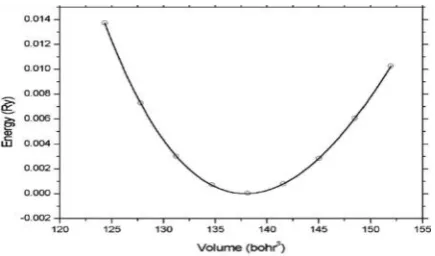
modulus at the equilibrium volume. The equi-librium volume is given by the corresponding total energy minimum as shown in Figure 2.11
Pressure,
Bulk modulus,
A computational code (WIEN2K)12 based
on FP-LAPW method was applied for struc-ture calculations of Co2YGe. GGA13 was used
for the exchange correlation potential. The multipole expansion of the crystal potential and the electron density within muffin tin (MT) spheres was cut at l =10. Nonspherical contributions to the charge density and poten-tial within the MT spheres were considered up to lmax=6. The cut-off parameter was RKmax=7. In the interstitial region the charge
density and the potential were expands as a Fourier series with wave vectors up to Figure 1. Co (red), Y (yellow) and Ge (blue).
Figure 2. Total energy of TiC as a function of vol-ume.10
'0
0 0 0
0 ' '
0 0
( ) 1
1 1
B
V V B V
E V E
B B
2
0 2
dP d E
B V V
dV dV
dE P
dV
RMT Compounds
(a. u) Co2ScGe Co2TiGe Co2VGe Co2CrGe Co2MnGe Co2FeGe
Co 2.43 2.39 2.36 2.35 2.34 2.34
Y 2.43 2.39 2.36 2.35 2.34 2.34
Ge 2.29 2.24 2.21 2.21 2.20 2.20
Table 1. Muffin Tin Radius (RMT).
Compounds Lattice Constants ao (Å) Bulk Modulus B(GPa) EquilibriumEnergy (Ry)
Previous Calculated Δ(ao)
Co2ScGe 5.953[14] 5.978 0.025 109.969 -11300.629
Co2TiGe 5.842[14] 5.867 0.025 200.378 -11479.814
Co2VGe 5.766[14] 5.792 0.026 202.158 -11670.736
Co2CrGe 5.740[14] 5.770 0.030 250.438 -11873.835
Co2MnGe 5.738[14] 5.749 0.011 219.479 -12089.405
Co2FeGe 5.739[14] 5.758 0.019 162.677 12317.674
Table 2. Lattice parameters and Bulk modulus.
Gmax=12 a.u-1. The Muffin Tin sphere radii
(RMT) are given in Table 1. The number of k-points used in the irreducible part of the bril-louin zone is 286.
RESULTS AND DISCUSSIONS
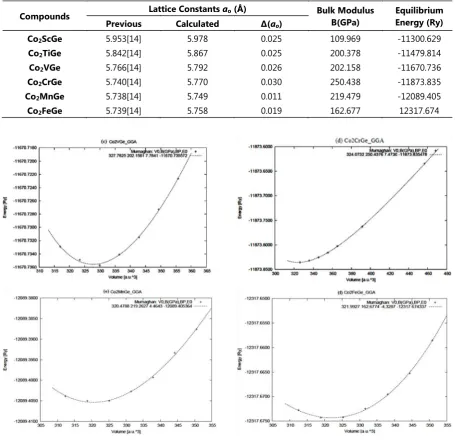
The calculated total energies within GGA as function of the volume were used for deter-mination of theoretical lattice constant and bulk modulus. Equilibrium lattice constant, isothermal bulk modulus, its pressure deriva-tive are calculated by fitting the calculated total energy to the Murnaghan’s equation of state given in Eq. (1). The plot of energy ver-sus volume is shown in Figure 3. The volume corresponds to the lowest energy is used to determination of equilibrium lattice constant. The calculated values of lattice constant and bulk modulus are presented in Table 2.
The change in the optimized lattice con-stant of Co2YGe with that of previous result
is given as Δ(ao). The enthalpy (H) of the sys-tem was calculated by using the Eq. (2),
(2)
where P is the bulk pressure, Vo is bulk vol-ume corresponds to minimum energy (Eo) of the system. The calculated enthalpy (H), pres-sure (P) and volume (Vo) is depicted in Table 3.
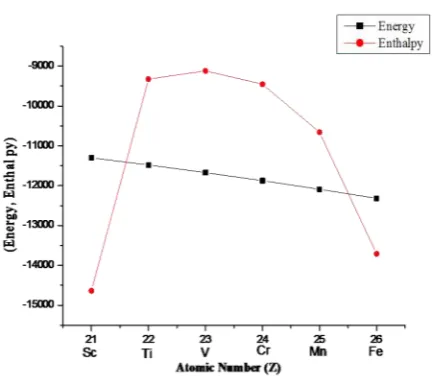
Kandpal et al. has reported the ferromag-netic configuration is lower in energy than the non-spinpolarized case.15 We have also found
the same trend where the energy is minimum for the highest ferromagnetic compound, i.e. Co2FeGe and the energy is maximum for
low-est ferromagntic compound Co2ScGe as
shown in Figure 4. The minimum of the total energies of the phases with E(Co2FeGe) < E
(Co2MnGe) < E(Co2CrGe) < (Co2VGe) < E
(Co2TiGe) < E(Co2ScGe) rank indicates that
Co2FeGe is the most stable structure as it was
reported in the case of ScN.16 According to
Figure 4, the lowest enthalpy is observed at the low ferromagnetic compound Co2ScGe as
well as in strong ferromagnetic compound
like Co2FeGe. It is also seen in Figure 4 that
there is a slow variation of enthalpy as we move from Co2TiGe to Co2MnGe which
pre-dicts the stability of bulk modulus shown in Table 2.
CONCLUSION
The ground state structural optimization was performed to obtain the equilibrium en-ergy. The optimize Lattice parameters of the full Heusler compounds Co2YGe, where Ge is
a sp atom belonging to the IVB column of the periodic table were compared with the previ-ously available results. The calculated values of lattice parameters were in qualitative agreement with the previously reported results.14 We have also calculated the
enthalpy (H) of the system. The sharp variation of enthalpy was noticed for high and low ferromagnetic compounds like Co2FeGe and Co2ScGe respectively. The
minimum of the total energies of the phases with E(Co2FeGe) < E(Co2MnGe) < E (Co2CrGe) < E(Co2VGe) < E(Co2TiGe) < E (Co2ScGe) rank indicates that Co2FeGe is the
most stable structure as it was reported in the case of ScN.16
Figure 4. Plot of energy and enthalpy against valence electron (Z).
0 0
ACKNOWLEDGEMENT
DPR acknowledges DST Inspire research fellowship, AS and RKT a research grant from UGC, (New Delhi, India).
References
1. de Boeck, van Roy W, Das J, Motsnyi V, Liu Z, Lagae L, Boeve H, Dessein K & Borghs G (2002). Technology and materials issues in semiconductor-based magnetoelec-tronics. Semicond Sci Technol,17, 342.
2. Katsnelson MI, Irkhin VY, Chioncel L, Lichtenstein AI & de Groot R A (2008). Half-metallic ferromagnets: From band structure to many-body effects. Rev Mod Phys,80, 315-378.
3. Zutic I, Fabian J & Sarma SD (2004). Spintronics: funda-mentals and applications. Rev Mod Phys,76, 323-410. 4. Rai DP, Hashemifar J, Jamal M, Lalmuanpuia, Ghimire MP,
Sandeep, Khathing DT, Patra PK, Sharma BI, Rosangliana & Thapa RK (2010). Study of Co2MnAl Heusler alloy as half metallic Ferromagnet. Indian J Phys,84, 593-595. 5. Rai DP, Sandeep, Ghimire MP & Thapa RK (2011). Study
of energy bands and magnetic properties of Co2CrSi Heusler alloy. Bull Mat Sci, 34,1219-1222.
6. Rai DP & Thapa RK (2012). Electronic structure and mag-netic properties of X2YZ (X=Co, Y=Mn, Z=Ge, Sn) type
Heusler compounds: A first Principle Study. J Phase tran-sition, iFirst, 1-11.
7. Rai DP, Shankar A, Sandeep, Ghimire MP & Thapa RK
(2012). Electronic structure and magnetic properties of Co2YZ (Y=Cr, V=Al, Ga) type Heusler compounds: A first
Principle Study. Int J Mod Phys B (Accepted).
8. Bouhemadou A & Khenata R (2007). Ab initio study of structural phase stability and elastic properties of ScSb and YSb under pressure effect. Phys Let A, 362, 476-479. 9. Heusler F (1903). Kristallstruktur und Ferromagnetismus
der Mangan-Aluminium-Kupferlegierungen. Verh Dtsch Phys Ges, 12, 219.
10. Murnaghan FD (1944).The Compressibility of media
un-der extreme pressures. Proc Natl Acad Sci USA, 30, 244.
11. Schwarz K & Blaha P (1903). Fifth World Congress on Computational Mechanics. Vienna, Austria.
12. Blaha P, Schwarz K, Madsen GKH, Kvasnicka D, Luitz J & Schwarz K (2008). Wien2K User’s Guide.Vienna University of Technology, Vienna, Austria.
13. Perdew JP, Burke S & Ernzerhof M (1996). Generalized gradient approximation made simple. Phys Rev Lett,77, 386.
14. Gilleßen M & Richard Dronskowski R (2009). A combina-torial study of inverse Heusler alloys by first-principles computational methods.J Comput Chem, 30, 1290-1299. 15. Kandpal HC (2006). Computational Studies on the
Structure and Stabilities of Magnetic Inter-metallic Compounds. Dissertation for the degree of Doktor der
Naturwissenschaften (Doctor of Natural Sciences), Institut fur Anorganische Chemie und Analytische Chemie, Mainz, Germany.
16. Mohammad R & Katırcıoglu S (2011). A comparative