INTRODUCTION
The History of spatial image data compression started probably about a half of century ago with the works on predictive coding and variable length codes. The technological breakthrough that took place in 60's, 70's and 80's resulted in efficient compression algorithms8,3 that have been standardized in early 1990's and currently are in common use together with the improvements achieved during the last decade. These advances have brought substantial increase in efficiency of ear lier basic techniques. Nevertheless, the last decade was also a period of strenuous search for new technologies of image data compression.
Optimized Binary Merge Coding for
Lossless Image Compression
N. SUBHASH CHANDRA
1, M. BALA RAJU
2,
S. MAHABOOB BASHA
3and A. GOVARDHAN
4¹,2,4Department of Computer Science and Technology, College of Engineering, JNTU, Hyderabad, (India).
³Department of Computer Science and Engg., Al –Habeeb College of Engineering, Chevella, Ranga Reddy Dt (India).
(Received: March 18, 2009; Accepted: May 03, 2009)
ABSTRACT
Digital Spatial Image Processing is a rapidly evolving field with growing applications in Science and Engineering. Spatial Image data requires considerable storage capacity and transmission bandwidth. Despite rapid progress in mass-storage density, processor speeds, and digital communication system performance, demand for data storage capacity and data-transmission bandwidth continues to outstrip the capabilities of available technologies. This is a crippling disadvantage during transmission & storage. So, there arises a need of efficient Image Compression Techniques for compression .
This paper deals with Optimized Binary Merge Coding for data compression, which is a modification to the Binary merge coding. Like in BMC the Optimized Binary Merge Coding uses Huffman coding after the modified Binary Merge Coding. The results of the Optimized Binary Merge Coding are compared with Binary Merge Coding and JPEG. An experimental result shows that Optimized Binary Merge Coding improves compression rate compared to Binary Merge coding. The same algorithm can be extended to color images.
Keywords: Binary Merge Coding, Optimized Binary merge coding, Huffman Coding Technique, JPEG, Bit Plane, Data Table.
In this paper the effect of using the some modification to the Binary Plane Technique2,5,4 is suggested to optimize the algorithm so the name Optimized Binary Plane Technique. This technique is spatial domain technique we found it better than the Binary Plane Technique.
The paper is organized as follows: the second and third sections are describes about the proposed Optimized Binary Merge Coding for encoding and Decoding. In the fourth section, we presented simulation results and finally the paper concludes with future work.
The Huffman coding6,8,9 is popular and very widely used techniques so that is not explained here. But the Optimized Binary Merge Coding which is new explained in detail.
Optimized Binary Merge Coding
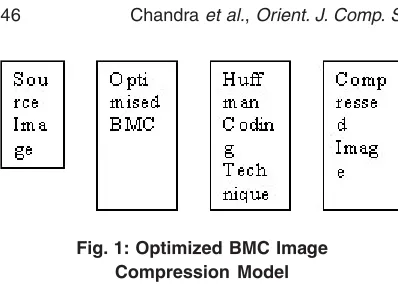
The Optimized BMC technique is used in the first stage. It is an improvement to BMC1. In both BMC and Optimized BMC two files namely bit plane and data table are created. The bit plane is collection of 1's and 0's to represent whether a pixel is repeated or not. The data table holds only the necessary pixel values. The bit plane and data table are later merged into one file.
On the data generated from OBMC, Huffman coding6,7 is applied to further compress.
The main objective of this technique is to take advantage of repeated values in consecutive pixels positions. For a set of repeated consecutive values only one value is retained.
In the Binary Merge Coding¹ the first part 'bit plane' holds the bit 0 for each a pixel similar to previous pixel and the bit 1 for each pixel different from previous pixel. The second part 'data table' holds only the necessary pixel values, i.e. for a set of consecutive repeated values; one value is stored in the data table. After merging the bit plane and data table Huffman coding6 is applied and final form of compressed file is generated.
The optimized binary merge coding like binary merge coding generates the 'bit plane' and 'data table'. But It is slightly different from binary merge coding. Instead of checking only for similar
values, it is also checked for two successive values with difference in the range -8 to +7 with respect to previous value. If so the differences of the two successive pixels with respect to previous pixel, are merged and stored in one byte only. But this requires more than two codes. So we used 1 for two dissimilar values with difference outside the range -8 to +7, 00 for similar values and 01 with dissimilar values with the difference in the range -8 to 7. Like the above technique the Huffman code follows the optimized bit plane to further compress the file.
Optimized Binary Merge ALGORITHM BEGIN
open raw image file open bitplane file open data table file cur_pixel=read (image) write cur_pixel to data table file append bit 1 to bit_plane prev_pixel=cur_pixel
while((cur_pixel=read(image))!=eof) Begin
/* if repeated consecutive pixel value append 00 to bit plane to
indicate that pixel duplicate so not retained */
if (cur_pixel = prev_pixel) then append bit 00 to bit_planee else
Begin
/*otherwise check whether the difference b/w two successive pixels is in the range -8 to 7 */ sec_pixel=read(image)
if (diff(cur_pixel,prev_pixel)>-8 and diff(cur_pixel,prev_pixel)<7) and
(diff(sec_pixel,prev_pixel)>-8 and diff(sec_pixel,prev_pixel)<7)
begin
append bit 01 to bit_plane
write merge(diff(cur_pixel,prev_pixel), merge(diff(cur_pixel,prev_pixel))
to datatable file end
else
append bit 01 to bit_plane write cur_pixel to datatable file unread(image,sec_pixel) Fig. 1: Optimized BMC Image
prev_pixel=cur_pixel end
End
if bit_plane is full then
write bit_plane to bitplane file End
if bit_plane not empty then write bit_plane to bitplane file close raw image file
close bitplane file close data table file END
Optimized Binary Merge Decoding
In the reconstruction of the image the Inverse Huffman Technique and Inverse Optimized BPT are applied on compressed file respectively as in the Fig. 2.
Inverse Optimized Binary Merge Coding In the Inverse Optimized Binary Merge Coding first the Bit Plane and Data Tables are extracted. Using the Data table and Bit Plane the source image is built as inverse of Optimized Binary Merge Coding algorithm.
Fig. 2: Reconstruction Model in Optimized BMC
RESULTS
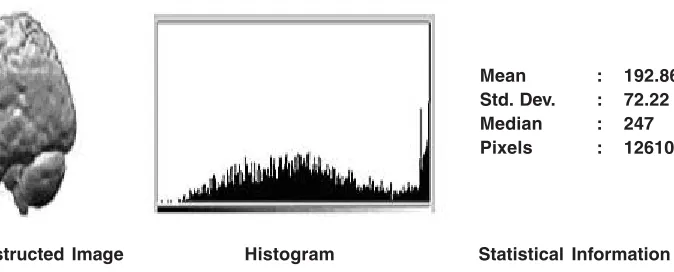
The brain image is taken as one of sample source images and applied with Optimized Binary Merge Coding to compress. The reconstructed image, its histogram and statistical information are as shown in the Fig. 3.
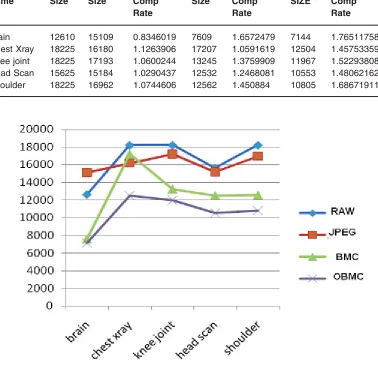
From the Table 1 which is generated from the results of the execution of the BMC and OBMC programs, It is clear that OBMC technique gives much better compression rate than BMC.
The memory requirement for both BMC & OBMC techniques is ver y less because the processing is done byte by byte. In case of the JPEG the entire image needs to be brought into memory.
As per as process complexity is concerned BMC and OBMC are simple to implement compared to JPEG. The graph in Fig. 4 is drawn based on the Table 1.
Fig. 3: Sample Image Brain with histograms
Reconstructed Image Histogram Statistical Information
Mean : 192.86
Std. Dev. : 72.22
Median : 247
CONCLUSIONS
The compression rate of BMC and OBMC is better than JPEG not necessarily in all cases. We have taken only the medical images where BMC & OBMC are better.
Table 1: Size and Compression rate between BMC vs OBMC vs JPEG
Image RAW JPEG BMC OBMC
Name Size Size Comp Size Comp SIZE Comp
Rate Rate Rate
Brain 12610 15109 0.8346019 7609 1.6572479 7144 1.76511758
Chest Xray 18225 16180 1.1263906 17207 1.0591619 12504 1.45753359
Knee joint 18225 17193 1.0600244 13245 1.3759909 11967 1.52293808
Head Scan 15625 15184 1.0290437 12532 1.2468081 10553 1.48062162
Shoulder 18225 16962 1.0744606 12562 1.450884 10805 1.68671911
Fig. 4: Graph for comparison between file sizes of different compression techniques
But in most of the cases the Optimized Binary Merge Coding is much better than Binary Merging Coding.
1. Subhash Chandra.N., An Hybrid approach Lossless compression for Color Images, Asian journal of information Technology, Medwell publishers, Vol.8, pp 472-472 (2009).
2. Skodras.A, Christopoulis.C, and Ebrahimi.E, "The JPEG2000 still image compression standard," IEEE Signal Processing Mag., vol. 18, no. 5, pp. 36-58, September (2001). 3. Wallace.G.K, " The JPEG still picture
compression standard." IEEE Trans. Consumer Electron, Vol 38, No 1, Feb (1992). 4. Jayant.N, " Signal Compression: technology targets and research directions," IEEE J. Select Areas Commun., Vol. 10, No.5, pp 796 - 818 , June (1992).
REFERENCES
5. Rafael C.Gonzalez, Richard E. Woods "Digital Image Processing " Second edition Pearson Education, Printice Hall.
6. Shannon,C.E." A Mathematical theory of communication". Bell.Sys.Tech. J. 27, 379-423.
7. Huffman,D.A."A Method for construction of min. redundancy Codes" Proc. IRE, 40(10): 1098-1101, (1951).
8. Abramson,N. "Infor mation theor y and coding",McGraw-Hill,New York.