1
http://ijcjournal.org/
A Study on Text Based Steganography Using Email
Platform and Color Mapping
Amanpreet Kaur
a*, Sukhvir Kaur
b, Gunjan Sethi
caResearch Scholar, Department of Computer Science Engineering, CT Group of institution, Shahpur,
Jalandhar, Punjab, India 144020
b,cAssistant Professor, Department of Computer Science Engineering, CT Group of institution, Shahpur,
Jalandhar, Punjab, India 144020
a
Email: [email protected]
b
Email: [email protected]
cEmail: [email protected]
Abstract
Steganography is the art of hiding of a message within another so that presence of hidden message is indistinguishable. The key concept behind steganography is that message to be transmitted is not detectable to the casual eye. This is also the advantage of steganography over cryptography. Modern digital steganography uses text, images, audio, video etc. as a cover medium. This paper presents a mechanism of storing the secret message using forward email platform and color mapping table. Various experiments have been conducted and the results are analyzed in this paper.
Keywords: Steganography; cryptography; plain text; encryption; decryption; cipher. 1.Introduction
Almost all computer users write and exchange documents written with applications using proprietary document formats such as Microsoft Office. Even though causes have not been addressed yet, it is well known among communities of expert computer users that unexpected information may hide into those documents and can be easily revealed. On the other hand, regular computer users are often unaware of the information leakage by their published documents. Classical steganography concerns itself with ways of embedding a secret message (which might be a copyright mark, or a covert communication, or a serial number) in a cover message (such as a video film, an audio recording, or computer code). The embedding is typically parameterized by a key; without knowledge of this key (or a related one) it is difficult for a third party to detect or remove the embedded material. Once the cover object has material embedded in it, it is called a stego object. Thus, for example, we might embed a mark in a cover text giving a stego text; or embed a text in a cover image giving a stego-image; and so on [14].
---
2
There has been a rapid growth of interest in this subject over the last two years, and for two main reasons. Firstly, the publishing and broadcasting industries have become interested in techniques for hiding encrypted copyright marks and serial numbers in digital films, audio recordings, books and multimedia products; an appreciation of new market opportunities created by digital distribution is coupled with a fear that digital works could be too easy to copy. Steganography can be defined as the art and science of hiding data so that no one knows about hidden data except the sender and receiver. It is used to hide data inside data. Steganography is not a new concept, it is in use since centuries and this technique has started as computer came into existence as different algorithms are used to hide data with different cover media [1][2]. The general specifications that must be kept in mind when implementing steganography are described below:
• The embedded data must not downgrade the quality of cover media. Quality of cover media should be such that it must look like original media. The media size should not increase tremendously as it can look suspicious to the casual viewer. It must have good Peak Signal to Noise Ratio.
• The data that is to be hidden should be embedded in the information part of cover media, not in the header. The data must be temper resistance to the attacks of the third party.
• Integrity of data should be maintained, it must be robust enough so that it must not be modified in between the way.
• A cover file must be of enough size so that it can hide a large amount of message.
• The message hidden must be invisible to the viewer.
• The hidden message must be undetectable during steganalysis process.
Figure 1: Features of a good Steganography [4]
1.1Types of Steganography
3
Figure 2: Types of Steganography [18]. The various techniques used in steganography are as follows:
1.1.1 Text Steganography
Text steganography [2,7] can be achieved by changing the text format, or by altering certain features of textual elements such as alphabets. The main goal is to develop such techniques that perform changes such that that original data must be reliably decodable yet largely invisible to the reader.
1.1.2 Image Steganography
To a computer, an image is a collection of numbers that constitute different light intensities in different areas of the image. The individual points are referred to as pixels.
1.1.3 Audio Steganography
Information hiding in audio is based on the interpretation of sound made by Human Auditory System.
1.1.4 Video Steganography
A video is a combination of audio and image. A continuous flow of image constitutes a video. Therefore, the techniques that can be applied on audio and image separately, they can be applied on video also.
4
2. Related Work5
3. MethodologyIn this work, capacity and security issues have been taken into account. The LZW algorithm is directly applied on the secret text and the obtained bit stream is hidden into email ids and in the message of the email. A color coding table is used to hide the secret data bits into the cover text of the email thus the notion of the content is not modified. The method discussed here increases the hiding capacity and also reduces computational complexity.
3.1 Embedding phase
Figure 4: Methodology for embedding phase [16]
Figure 4 shows the methodology used for embedding the secret message into the cover text. The embedding phase of proposed method is divided into two steps:
• Embed some bits of secret text into email ids.
• Embed remaining bits using color coding table.
Let S: secret message
T: Cover texts or message of email
K1: A set of email addresses shared between the sender and the receiver which plays the role of public stego-key. Embedding phase of secret text using email ids:
Step 1. Apply LZW algorithm on the secret message S.
6
Figure 5: Binary format of compressed secret message
Step 3. Fetch some bits from the bit stream of secret message and use it for embedding using email ids. Remaining bits of secret message will be used for color coding phase. In existing methodology, secret data is hidden into two parts:
• Using email ids
• Using colored cover message.
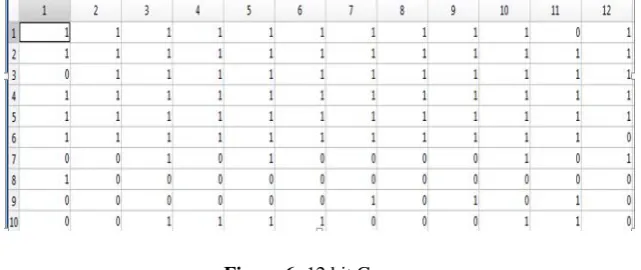
Step 4. Binary data of compressed secret message is divided into 2 parts. First Half bits of binary data will be used by Latin square table for encryption of email-id. Second half bits will be used by the color cover message Step 5. Select few bits of secret data from the bit stream and partition these bits stream into groups of 12 bits each. Divide each group into two groups of 9 bits and 3 bits each known as G1 and G2 respectively, and compute the value of x, y, and z
Figure 6: 12 bit Groups
Step 6. Compute x, y and z by using Latin square table. Convert the values of x and y to the textual elements using Latin square and also convert the value of z to email extension by employing A.
7
z= (G2)10Figure 7: Latin Square table Sample of K2 is specified as follows:
Figure 8: Encrypted email ids
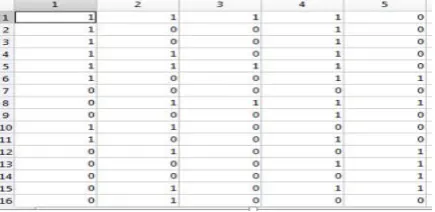
Step 7. Divide the remaining bit stream into five bit stream sets. If the number of bits in the bit stream is not a multiple of 5, then required number of bits as ‘0’ bit are added at the end of the bit stream.
Figure 9: Representation of remaining 5 bits.
8
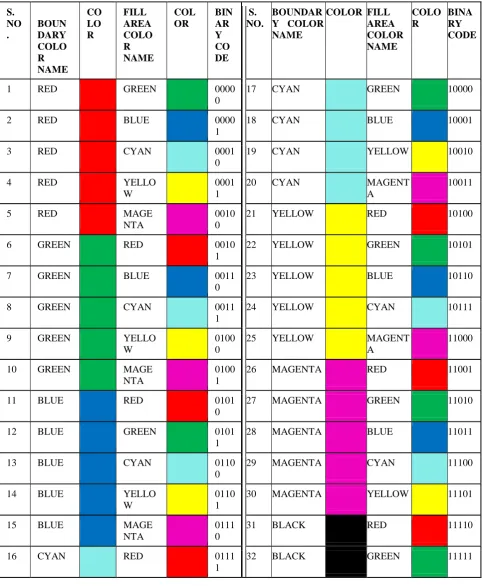
Table 1: Color mapping table
S. NO . BOUN DARY COLO R NAME CO LO R FILL AREA COLO R NAME COL OR BIN AR Y CO DE S. NO. BOUNDAR Y COLOR NAME COLOR FILL AREA COLOR NAME COLO R BINA RY CODE
1 RED GREEN 0000
0
17 CYAN GREEN 10000
2 RED BLUE 0000
1
18 CYAN BLUE 10001
3 RED CYAN 0001
0
19 CYAN YELLOW 10010
4 RED YELLO
W
0001 1
20 CYAN MAGENT
A
10011
5 RED MAGE
NTA
0010 0
21 YELLOW RED 10100
6 GREEN RED 0010
1
22 YELLOW GREEN 10101
7 GREEN BLUE 0011
0
23 YELLOW BLUE 10110
8 GREEN CYAN 0011
1
24 YELLOW CYAN 10111
9 GREEN YELLO
W
0100 0
25 YELLOW MAGENT
A
11000
10 GREEN MAGE
NTA
0100 1
26 MAGENTA RED 11001
11 BLUE RED 0101
0
27 MAGENTA GREEN 11010
12 BLUE GREEN 0101
1
28 MAGENTA BLUE 11011
13 BLUE CYAN 0110
0
29 MAGENTA CYAN 11100
14 BLUE YELLO
W
0110 1
30 MAGENTA YELLOW 11101
15 BLUE MAGE
NTA
0111 0
31 BLACK RED 11110
16 CYAN RED 0111
1
32 BLACK GREEN 11111
3.2 Extraction Phase
9
bits using the boundary color and filling color of the alphabet and stored inside A.
Step 2. Extract first two elements of K2 and convert them to numbers by employing Latin Square and also extract email address extension to obtain z. Thus, G1 and G2 are obtained
G1 = (x * 26 + y)2 G2 = (Z)2
Step 3. Concatenate G1 and G2 to obtain G.
Step 4. Append A and G together to obtain the secret message in compressed format.
Step 5. Apply the LZW to decompress the secret message to obtain the secret message in original format.
Figure 10: Methodology for extraction phase [16].
4. Experimental Analysis
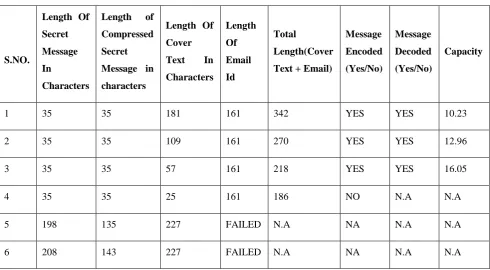
Multiple number of experiments have been conducted using different lengths of cover text and secret message. As we have studied that some bits of the message are stored inside email ids and remaining bits are stored using color mapping table. So we have used 2 approaches over here. For the experiments mentioned in table 2, the secret message is exactly divided into 2 parts which means 50% message is stored using email ids and remaining 50% is stored using color mapping table.
The experiments are carried out in Matlab environment and the results of the experiments are mentioned below in table 2 and table3. The secret message is compressed using LZW compression to increase the overall capacity. Capacity [16] is calculated using the given formula.
10
Table 2: Calculation of capacity (1:2)
S.NO. Length Of Secret Message In Characters Length of Compressed Secret Message in characters Length Of Cover Text In Characters Length Of Email Id Total Length(Cover
Text + Email)
Message Encoded (Yes/No) Message Decoded (Yes/No) Capacity
1 35 35 181 161 342 YES YES 10.23
2 35 35 109 161 270 YES YES 12.96
3 35 35 57 161 218 YES YES 16.05
4 35 35 25 161 186 NO N.A N.A
5 198 135 227 FAILED N.A NA N.A N.A
6 208 143 227 FAILED N.A NA N.A N.A
In table 2, we have divided the secret message into exactly 2 parts and results are mentioned. Out of 6 experiments, only 3 experiments have been conducted successfully. But for the experiments in table 3, 25% of the secret message is stored using email ids and remaining 75% is stored using color mapping table. Out of 6 experiments, 1 experiments failed to store the message whereas 5 experiments have completed successfully.
Table 3: Calculation of capacity (1: 4)
S.NO. Length Of Secret Message In Characters Length of Compressed Secret Message in characters Length Of Cover Text In Characters Length Of Email Id Total Length(Cover
Text + Email)
Message Encoded (Yes/No) Message Decoded (Yes/No) Capacity
1 35 35 181 85 266 YES YES 13.15
2 35 35 109 85 194 YES YES 18.04
3 35 35 57 85 142 YES YES 24.64
4 35 35 25 85 110 NO N.A N.A
5 198 135 227 427 654 YES YES 20.64
6
208 143 227 443 670 YES YES 21.34
11
table 2. It means when message is divided by 4 and is split into 25:75 ratio, it produces better results. Out of the total 6 experiments, only 5 experiments are conducted successfully and are able to store the secret message inside the cover text. Some experiments failed while encoding the email ids and other failed while color coding mapping.
5. Conclusion
In this research paper we have stored the secret message into the cove text using a hybrid version of email ids and color mapping technique. There are too many flaws in this technique. As it is evident from the results that this mechanism failed frequently and we need a cover text of appropriate size to store the secret message. We need some robust mechanism to store the secret message that should not fail too frequently. In the next work our main aim is to increase the capacity of this mechanism and decrease the failure ratio which will improve the overall performance and reliability of the mechanism.
References
[1] H.Kabetta, B.Y. Dwiandiyanta, Suyoto, “Information hiding in CSS: A secure scheme text-steganography using public key Cryptosystem”, IJCIS, Vol.1, No.1, pp. 13-22, December 2011. [2] M Garg,” A Novel Text Steganography Technique Based on Html Documents”, International Journal of
Advanced Science and Technology, Vol. 35, pp.129-138, October, 2011.
[3] W. Bender, D. Gruhl, N. Morimoto, and A. Lu, “Techniques for data hiding”, IBM Systems Journal, Vol. 35, No. 3&4, pp. 313-336, 1996.
[4] P.Singh, R.chaudhary and A.Agarwal,” A Novel Approach of Text Steganography based on null spaces”, IOSR Journal of Computer Engineering, Vol. 3, No. 4, pp. 11-17, July-Aug. 2012.
[5] M.S. Shahreza,” A New Method for Steganography in HTML Files”, Advances in Computer, Information, and Systems Sciences, and Engineering, pp. 247-251, 2007, Springer.
[6] R. Kumar, A. Malik, “A Space based reversible high capacity text steganography scheme using Font type and style”, International Conference on Computing, Communication and Automation, IEEE, 2016, pp.1090-1094.
[7] R. Saniei, K. Faez, “The Capacity of Arithmetic Compression Based Text Steganography Method”, Iranian Conference on Machine Vision and Image Processing, pp.38-42, 2013.
[8] H. Singh, P.K. Singh, K. Saroha, “A Survey on Text Based Steganography”, Proceedings of the 3rd National Conference; INDIACom-2009, 2009, pp. 26-27.
[9] J.A. Memon, K. Khowaja, and H. Kazi, “Evaluation of steganography for Urdu /Arabic text”, Journal of Theoretical and Applied Information Technology, Vol. 4,No. 3, pp. 232-237, 2008.
12
[11] S.H. Low, N.F. Maxemchuk, J.T. Brassil, and L. O'Gorman, “Document marking and identification using both line and word shifting”, Proceedings of the Fourteenth Annual Joint Conference of the IEEE Computer and Communications Societies (INFOCOM '95), Vol. 2, April 1995, pp. 853 – 860.
[12] A.M. Alattar, and O.M. Alattar, “Watermarking electronic text documents containing justified paragraphs and irregular line spacing”, Proceedings of SPIE -- Volume5306, Security, Steganography, and Watermarking of Multimedia Contents VI, pp. 685-695, June 2004.
[13] D. Huang, and H. Yan, “Inter word Distance Changes Represented by Sine Waves for Watermarking Text Images”, IEEE Transactions on Circuits and Systems for Video Technology, Vol. 11, no. 12, pp. 1237-1245, December 2001.
[14] Y.H. Yu, C.C. Chang, I.C. Lin,” A new steganographic method for color and grayscale image hiding”, Computer Vision and Image Understanding, Vol. 107, No. 3, pp. 183-194, 2007.
[15] M. H. Shirali-Shahreza, and S. Shirali-Shahreza, “A Robust Page Segmentation Method for Persian/Arabic Document”, WSEAS Transactions on Computers, Vol. 4, No. 11, pp. 1692-1698, Nov. 2005.
[16] A. Malik, G. Sikka and H. K. Verma, "A high capacity text steganography scheme based on LZW compression and color coding," Engineering Science and Technology, An International Journal, Vol.20, No. 1, pp. 72-79, 2017.
[17] S.D. Dickman,” An overview of steganography”, Department of Computer Science, James Madison University Infosec Techreport, 2007.
[18] A. Kumar, K. Pooja,” Steganography- A Data Hiding Technique”, International Journal of Computer Applications (0975 – 8887), Vol. 9, No.7, pp. 19-23, 2010.
[19] S Das, S Das, B Bandyopadhyay, S Sanyal,” Steganography and Steganalysis: different approaches”, arXiv preprint arXiv:1111.3758, 2011.
[20] J. Kaur and S. Kumar,” Study and Analysis of Various Image Steganography Techniques”, International Journal of Computer Science and Technology (IJCST), Vol.2, No.3, pp.535-539, 2011.
[21] S. Thilagamani, N. Shanthi,” A Survey on Image Segmentation Through Clustering”, International Journal of Research and Reviews in Information Sciences, Vol. 1, No. 1, pp.14-17, March 2011.
[22] K.K Kavitha, A Koshti, P Dunghav,” Steganography Using Least Signicant Bit Algorithm”, International Journal of Engineering Research and Applications (IJERA), Vol. 2, Issue 3, pp. 338-341, May-Jun 2012.
![Figure 1: Features of a good Steganography [4]](https://thumb-us.123doks.com/thumbv2/123dok_us/8398416.1685570/2.595.194.417.475.615/figure-features-good-steganography.webp)
![Figure 2: Types of Steganography [18].](https://thumb-us.123doks.com/thumbv2/123dok_us/8398416.1685570/3.595.162.436.607.701/figure-types-of-steganography.webp)
![Figure 4: Methodology for embedding phase [16]](https://thumb-us.123doks.com/thumbv2/123dok_us/8398416.1685570/5.595.116.475.207.419/figure-methodology-for-embedding-phase.webp)
![Figure 10: Methodology for extraction phase [16].](https://thumb-us.123doks.com/thumbv2/123dok_us/8398416.1685570/9.595.150.444.306.458/figure-methodology-for-extraction-phase.webp)