117 |
P a g e
e- ISSN 0976-0342 Print ISSN 2229-7456
International Journal of Pharmacy & Therapeutics
Journal homepage: www.ijptjournal.com
CO-MORBIDITIES AND UNDERLYING CONDITIONS ASSOCIATED
WITH HYPERKALAEMIA; EVALUATION FOR HOSPITALIZED
PATIENTS AT TERTIARY HOSPITAL IN SOUTH AUSTRALIA
Alosaimi Abdullah
1,3*, Alderman Chris
1,21School of Pharmacy and Medical sciences, University of South Australia. 2Pharmacy Department, Repatriation General Hospital, Daw Park South Arabia. 3 King Faisal Specialist Hospital and Research Centre, Saudi Arabia.
ABSTRACT
This research used qualitative and statistical analysis of clinical data and results from laboratory investigations to elucidate the underlying causes of hyperkalaemia amongst a small cohort of hospital inpatients at tertiary hospital in South Australia. The goal of this research study was to assess and document co-morbidities and underlying conditions associated with hyperkalaemia in admitted patients in a hospital setting. Fifty cases of hyperkalaemia were analysed. Common co-morbidities recorded included diabetes mellitus (40%), ischaemic heart disease (34%), and documented renal failure 44%. The duration of hyperkalaemia was significantly longer for patients who were treated with cation exchange resin (p=0.01), which was expected because more severe or refractory cases were most likely to be managed with resin. Similarly, the duration of hyperkalaemia was significantly longer for those treated with the combination of insulin/dextrose and resin, compared to those treated with resin only (p=0.04), which might reasonably be expected because that combination of medications tends to be used for resistant cases. Data analysis suggests that polypharmacy, advanced age, and multiple medical co-morbidities are risk factors for adverse outcomes from hospitalization. More extensive research using a design with a larger sample size and more detailed analysis is needed.
Key Words:- Polypharmacy, Hyperkalaemia, Ischaemic heart disease.
Access this article online
Home page:
http://ijptjournal.com/
DOI:
http://dx.doi.org/10.21276/ijpt.8.3.4
Quick Response code
Received:14.06.17 Revised:26.06.17 Accepted:09.07.17
Corresponding Author Alosaimi Abdullah
School of Pharmacy and Medical sciences, University of South Australia.
Email:- [email protected]
INTRODUCTION
Hyperkalaemia is a medical emergency requiring timely intervention. Where clinically indicated, corrective
measures must be initiated to manage hyperkalaemia, as well as any underlying disorder that might have contributed to the condition or that will interfere with its correction.
Hyperkalaemia is thought to occur in about 1–9% of inpatients (Moore ML and Bailey RR, 1989). Often, this is attributed to hyperglycemia, renal failure, or incorrect usage of potassium supplements. Hyperkalaemia is a common cause of morbidity. Significant hyperkalaemia interferes with cardiac function(Segura J & Ruilope LM, 2008). The rate of mortality may be as high as 67% if severe hyperkalaemia is not treated quickly(Weisberg LS, 2008).
The human body’s capacity to adjust efficiently to large loads of potassium usually prevents increases of serum potassium from exceeding the normal reference range’s upper limit. Therefore, to develop hyperkalaemia it is usually necessary for a defect to exist in one or more mechanisms that sustain potassium homeostasis. Factors that can affect these mechanisms are classifiable into three
118 |
P a g e
categories: a rise in potassium load; a decline in excretion of kidney potassium; and shifts in transcellular potassium.
The aim of this audit was to assess and document co-morbidities and underlying conditions associated with hyperkalaemiain admitted patients at Repatriation General Hospital in South Australia.
METHODS
This prospective, observational study was undertaken at Repatriation General Hospital (RGH). RGH is a 300-bed acute care general teaching hospital providing numerous medical services. Cases were identified using an automated notification system where the basic details of potentially eligible participants were sent directly to the investigators via email. (The system notifies staff on a daily basis about cases of significant abnormal electrolyte disturbances, including hyperkalaemia.) There was subsequent follow-up of participant information while the patient was in hospital. The case notes were the only source of information used. No participants were personally interviewed.
Normal concentrations of serum potassium range between 3.5 and 5 mmol/L (Kratz A, 2004), whereas the definition of hyperkalaemia is a concentration of potassium in plasma in excess of 5.5 mmol/L (Tran HA, 2005).
The reference ranges used by the South Path laboratory service at RGH are 3.2 to 4.3 mmol/L for plasma and 3.5 to 5.0 mmol/L for serum. Approximately 95% of potassium measurements at Repatriation General Hospital are plasma concentrations rather than serum concentrations.
Patients with a plasma potassium concentration higher than 5.5 mmol/L and who were 18 years of age or older and hospitalised during the study period were eligible for inclusion in the study. They were excluded if they were being treated with haemodialysis, or showed evidence of a haemolysed blood sample.
Medication data was recorded on the data collection sheet for the purpose of the study, and included documentation of details of agents associated with potential to cause hyperkalaemia. Doses and any changes to treatment with these drugs in the context of hyperkalaemia in the hospital were also recorded. Details of these medications were recorded from the patient’s case notes, and from the medication history completed by clinical pharmacists at the time of admission.
Ethical approval for the study was obtained from the Southern Adelaide Health Service / Flinders University Human Research Ethics Committee. All statistical analysis
was performed using Microsoft Excel® and
InstatGraphPad® software. A set of brief descriptive
coefficients was used to describe each data set. All categorical data was analysed using a contingency table and Fisher’s exact test. The student t-test was used when comparing means between two groups.
RESULTS
Patient Characteristics
The study cohort consisted of a convenience sample of 50 hospital inpatients admitted to the medical and surgical units of RGH. The demographic profiles and salient clinical features of these selected patients are summarised in Table 1.
An important part of the analysis conducted in this study related to the observations of co-morbidities and the possible effects of these upon patient outcomes. Of the 50patients in the cohort, 20 (40%)had a diagnosis of diabetes mellitus, with 17 documented to have type-II diabetes and three with type I. Various forms of cardiovascular disease were prominently represented amongst the study cohort, with 30patients affected overall. Of these, 17 had a documented diagnosis of ischemic heart disease; five had previous coronary artery bypass graft surgery; 13 had a diagnosis of atrial fibrillation;10 had congestive heart failure;and two had aortic stenosis.
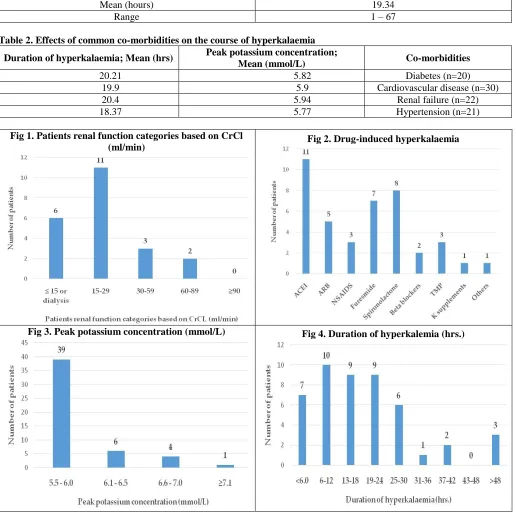
Six patients were documented in the admission history as having acute renal failure; eleven had a diagnosis of chronic renal failure; three had acute on chronic renal failure; and two patients were characterised as having ESRD. Of the 50 patients reviewed with hyperkalaemia the majority of patients (28, 56%) had an estimated CrCL in excess of 90ml/min, sixteen patients had an estimated CrCl of less than 30ml/min. A full breakdown of patients with hyperkalaemia based on estimated CrCl is displayed in Figure 1.
Of particular note is the finding that an estimated CrClof less than 30 ml/min was not significantly associated with a longer mean duration of hyperkalaemia (18.7 hours vs. 20.6 hours, p>0.5, student's t-test). Other common co-morbid disease states prevalent amongst the cohort included hypertension (n=21, 42%); malignant carcinoma (n=8, 16%); dyslipidemia (n=7, 14%); and gout (n=6). After conducting multiple analyses of categorical proportions using Fisher’s exact test, none of these co-morbidities was found to have any significant association with aspects of the course of hyperkalaemia, as reflected by variations in peak potassium concentration or overall duration of hyperkalaemia. These results are summarised in Table 2.
Drug induce hyperkalaemia
119 |
P a g e
prescribed medications contributing to hyperkalaemia were ACE inhibitors and the potassium-sparing diuretic spironolactone.
Findings on possible contribution of drugs to hyperkalaemia are presented in Figure 2. Most of the implicated drugs were ceased during the index admission as a part of the overall strategy to correct hyperkalaemia.
ACE inhibitors
Eighteen patients (36%) were being treated with angiotensin converting enzyme inhibitors. Thirteen were treated with perindopril, four with ramipril, and one with quinapril. Medical records indicate that amongst this group, 11 patients were thought to have developed hyperkalaemia related to use of ACE inhibitors, leading to cessation of these agents. Fisher’s exact test was used to test the hypothesis that the more severe cases of hyperkalaemia (serum potassium >6 mmol/L) were associated with ACE inhibitors, but no significant association was found (p=0.25). There was also no significant difference with respect to duration of
hyperkalaemia between ACE inhibitor-related
hyperkalaemia and hyperkalaemia believed to be unrelated to such treatment (duration 28.1 hours vs. 20.42, p=0.33, t-test). Regarding the effects of dosage intensity, treatment at an intensity of greater than one defined daily dose (DDD) in 24 hours was not significantly associated with higher peak potassium concentration (p=0.18, Fisher’s exact test).
Angiotensin II receptor antagonists
ARBs were used by eight patients in the cohort: five were treated with candesartan and three with irbesartan. Five patients treated with ARBs were thought to have hyperkalaemia associated with these drugs, leading to the discontinuation of these agents. No significant association was demonstrated between ARB-associated hyperkalaemia and higher peak serum potassium >6 mmol/L (p=0.1). The duration of hyperkalaemia was no different when ARB-related cases were compared to the overall cohort (27.6 hours vs. 18.4 hours, p=0.17, t-test). Treatment at a dosage intensity >1 DDD/24 hours was not associated with increased incidence of higher peak potassium concentrations (p=0.1, Fisher’s exact test).
Non-steroidal anti-inflammatory drugs (NSAIDs) and aspirin
Nearly half (n=21, 42%) of the patients in the cohort were treated with aspirin (ASA). In addition, one patient was treated with diclofenac. Amongst these, three were considered to have hyperkalaemia related to aspirin/NSAID treatment, and the drug was subsequently ceased. In common with other categories of medication, no significant relationship between ASA/NSAID use and higher peak serum potassium >6 mmol/L was demonstrable (p=0.185). Extended duration of hyperkalaemia was not significantly associated with ASA/NSAID treatment compared to hyperkalaemia observed amongst those not treated with ASA/NSAIDs (32.3 vs. 19.2, p=0.091, t-test). It is important to note that at low doses, aspirin may not exhibit effects characteristic of NSAID effects; and thus the high number of cases observed amongst patients treated with low doses of aspirin may be related to factors other than aspirin alone. The low prevalence of other NSAID use amongst the cohort may reflect a conservative approach to the use of these potentially toxic agents in a patient population characterised by extensive comorbidity and polypharmacy.
Spironolactone
Ten patients in the cohort were treated with spironolactone, an anti-androgen diuretic that has previously been associated with elevated serum potassium. In eight cases spironolactone was thought to have contributed to hyperkalaemia, and the drug was ceased for all of those patients. No significant association between spironolactone induced hyperkalaemia and increased peak serum potassium >6 mmol/L was observed (p=0.196, Fisher’s exact test). The mean duration of hyperkalaemia was not significantly longer for those treated with spironolactone (p=0.883, t-test).
Other drugs
This study cohort had three patients treated with digoxin. One receiving a potassium supplement (which was ceased), six were treated with allopurinol, and three patients received trimethoprim (all of these ceased).
Duration of hyperkalaemia
Summary data relating to the duration of hyperkalaemia and peak potassium concentrations are presented in Figure 3 and Figure 4.
Table1. Demographic and clinical features
Variable Cases (n=50)
Age (years) 78.5 ± 12.36
Range (years) 41 – 97
Gender: male / female 35 / 15
Mean weight (kg) 78.24 ± 34.51
Mean BMI (kg/m2) 31.62 ± 16.95
120 |
P a g e
Creatinine
Mean (micrmol/L) 203
Range 25-534
Peak potassium conc.
Mean (mmol/L) 5.87
Range 5.5 – 7.2
Length of hospital stay
Mean (days) 14.86
Range 1 – 120
Duration of hyperkalaemia
Mean (hours) 19.34
Range 1 – 67
Table 2. Effects of common co-morbidities on the course of hyperkalaemia
Duration of hyperkalaemia; Mean (hrs) Peak potassium concentration;
Mean (mmol/L) Co-morbidities
20.21 5.82 Diabetes (n=20)
19.9 5.9 Cardiovascular disease (n=30)
20.4 5.94 Renal failure (n=22)
18.37 5.77 Hypertension (n=21)
Fig 1. Patients renal function categories based on CrCl
(ml/min) Fig 2. Drug-induced hyperkalaemia
121 |
P a g e
DISCUSSION
Previous research has shown that elderly patients are at high risk of developing hyperkalaemia due to the presence of many factors such as diabetes, decreased renal function, and using drugs that interrupt potassium levels within the body6. Hollander-Rodriguez et al. obtained
results similar to those of the present study, and suggested that hyporeninemic hypoaldosteronism could cause hyperkalaemia in patients with diabetic nephropathy (Hollander JC & Calvert JF, 2006). Electrocardiographic alterations or a sudden elevation in serum potassium is an indication of life-threatening hyperkalaemia. It is important to obtain urine osmolarity, potassium, and creatinine in the initial stage of determining the cause of hyperkalaemiain order to guide continued treatment. In lowering the risk of arrhythmias and reversing electrocardiographic alterations, intravenous calcium is efficacious. However, intravenous calcium does not reduce serum potassium. The levels of serum potassium can be reduced with glucose and intravenous insulin, nebulized Beta2-agonists, or both. Therapy involving sodium polystyrene, at times accompanied by intravenous saline and frusemide, is then used to reduce total body load of potassium.
In the present study, 20 cases (40%) of hyperkalemia were observed in association with a diagnosis of diabetes mellitus; 30 cases (60%) had some form of cardiovascular disease; 22 patients (44%) were noted to have some form of renal impairment; and 21 patients (42%) had a documented diagnosis of hypertension. It is of interest that the majority of the observed hyperkalaemia cases in this study were associated with treatment with drugs that are implicated in the elevation of serum potassium concentration. Notwithstanding this, the duration of hyperkalaemia was not significantly longer for these cases relative to the small proportion not receiving these agents. Moreover, evidence-based guidelines suggest that patients with cardiac failure or diabetes mellitus should be treated with an ACE inhibitor, and that those with ischaemic heart disease should probably be routinely treated with low doses of aspirin.
The results here showed that about 7.8% of elderly inpatients had hyperkalaemia associated with the concomitant use of ACE inhibitors with potassium-sparing diuretics. There was a strong relationship between hyperkalaemia and ACE inhibitor treatment, and there is also a risk associated with using ACE inhibitors for
patients with renal failure. In this study, treatment with spironolactone was not found to be a significant independent risk factor for hyperkalaemia. Nonetheless, there are reports of elderly hyperkalemic patients being treated with a combination of spironolactone and trimethoprim-sulfamethoxazole. In one study, 60% of the hyperkalaemia cases in the elderly patients who received spironolactone and antibiotic treatment for urinary tract infections may have been avoided had there been no prescription of trimethoprim-sulfamethoxazole (Alappan R et al., 1996). Similarly, Antoniou et al. found a relationship between increased risk of hospital admission for hyperkalaemia and the use of spironolactone treatment with trimethoprim-sulfamethoxazole, and recommended that this combination of drugs be avoided whenever possible (Antoniou T et al., 2011).
CONCLUSION
Elderly patients are especially vulnerable because they are prone to various risk factors such as reduced renal function, diabetes mellitus, and the use of various medications that interfere with potassium homeostasis (ACE inhibitors, NSAIDs, spironolactone).
The study identified a need to consider including screening for hyperkalaemia symptoms and risk factors for all patients admitted to the hospital. Because the sample was small and specialised for the outcomes to be considered generalizable, more extensive research with a larger sample size with longer follow-up and more detailed analysis is required. If the outcomes can be disseminated and built upon, it is possible that some advances in the management of patients with hyperkalaemia might be realised, in turn allowing more favourable and efficient case management for hospitals and reducing risk in a vulnerable patient population.
Although there is considerable evidence to demonstrate the benefits of clinical pharmacy practice in the context of multidisciplinary patient management, specific research in the area of managing electrolyte disturbances such as hyperkalaemia is lacking. This presents an opportunity for future research.
ACKNOWLEDGEMENT Nil.
CONFLICT OF INTEREST None.
REFERENCES
Alappan R, Perazella MA, Buller GK. Hyperkalemia in hospitalized patients treated with trimethoprim-sulfamethoxazole. Ann Intern Med, 124(3), 1996, 316-20.
Antoniou T, Gomes T, Mamdani MM, Yao Z, Hellings C, Garg AX, et al. Trimethoprim-sulfamethoxazole induced hyperkalaemia in elderly patients receiving spironolactone: nested case-control study. BMJ, 343, 2011, d5228.
Hollander JC, Calvert JF. Hyperkalemia. Am Fam Physician, 73(2), 2006, 283-90.
122 |
P a g e
Moore ML, Bailey RR. Hyperkalaemia in patients in hospital. N Z Med J, 102(878), 1989, 557-8.
Segura J, Ruilope LM. Hyperkalemia risk and treatment of heart failure. Heart Fail Clin, 4(4), 2008, 455-64. Tran HA. Extreme hyperkalemia. South Med J, 98(7), 2005, 729-32.
Weisberg LS. Management of severe hyperkalemia. Crit Care Med, 36(12), 2008, 3246-51.
Cite this article:
Alosaimi Abdullah, Alderman Chris. Co-Morbidities and Underlying Conditions Associated with Hyperkalaemia; Evaluation for Hospitalized Patients At Tertiary Hospital In South Australia. International Journal of Pharmacy & Therapeutics, 8(3), 2017, 117-122. DOI: http://dx.doi.org/10.21276/ijpt.2016.8.3.4