Research Article
CODEN: IJPNL6
DEVELOPMENT AND VALIDATION OF RP-HPLC METHOD FOR
QUANTITATIVE ANALYSIS OF ETRAVIRINE IN PURE AND
PHARMACEUTICAL FORMULATIONS
G. Raveendra Babu
1, A. Lakshmana Rao
2* and J. Venkateswara Rao
31
D.C.R.M. Pharmacy College, Inkollu- 523 167, A.P., India
2
V.V. Institute of Pharmaceutical Sciences, Gudlavalleru- 521 356, A.P., India
3
Sultan-Ul-Uloom College of Pharmacy, Hyderabad- 500 034, A.P., India
*Corresponding author e-mail: [email protected]
ABSTRACT
A validated simple, sensitive, specific and precise RP-HPLC method was developed for the determination of Etravirine in pure and pharmaceutical formulations. Method was carried on Hypersil BDS C18 column (150 mm x
4.6 mm, 5 μ particle size) using phosphate buffer:acetontrile (35:65 v/v) as mobile phase. Detection was carried out by UV at 322 nm. The proposed method obeyed linearity in the range of 20-150 μg/mL and met all specifications as per ICH guidelines. Statistical analysis revealed that this method can be used in routine quality control studies of Etravirine in pure and its pharmaceutical formulations.
Keywords: Etravirine; HPLC; Formulation; Validation.
INTRODUCTION
Etravirine (Figure 1) is chemically 4-(6-amino-5- bromo-2-(4-cyanophenyl)aminopyrimidi-4-yl)oxy-3,5-dimethyl benzonitrile. Etravirine is a highly potent second generation non-nucleoside reverse transcriptase inhibitor act by binds directly to reverse transcriptase and blocks RNA- and DNA-dependent DNA polymerase activities by disrupting the enzyme's catalytic site [1]. Etravirine works by reducing the amount of HIV and increasing the number of CD4 or T cells in the blood. Unlike the currently available agents in the class, resistance to other NNRTIs does not seem to confer resistance to Etravirine [2].
Etravirine, in combination with other anti-retrovirals, is indicated for the treatment of human immunodeficiency virus type 1 (HIV-1) infection [3-5]. Literature survey revealed that few analytical methods such as IR [6], UV [7], HPLC [8-11], UPLC [12-14] and LC-MS [15-21] methods have been reported. Hence a new sensitive and efficient HPLC method was developed and validated as per ICH
guidelines for the assay of the drug Etravirine in tablet formulations.
EXPERIMENTAL
Instrumentation: To develop a high pressure liquid chromatographic method for quantitative estimation of Etravirine using Waters HPLC system on Hypersil BDS C18 column (150 mm x 4.6 mm, 5μ) was used.
The instrument is equipped with a LC 20AT pump for solvent delivery and variable wavelength programmable LC 7000 UV detector. A 10 μL Rheodyne injector port was used for injecting the samples. Data was analyzed by using Empower 2 software.
Chemicals and solvents: Etravirine was provided as
gift sample by Spectrum Labs, Hyderabad, India. All the chemicals potassium dihydrogen phosphate, orthophosphoric acid and triethylamine were of AR grade and acetonitrile of HPLC grade were purchased from Merck Specialities Pvt. Ltd., Mumbai, India. Commercial tablets of Etravirine were purchased
International Journal of Pharmacy
from local market. HPLC grade water obtained from Milli-Q water purification system was used throughout the study.
Preparation of phosphate buffer pH 3.8: 2.72
grams of potassium dihydrogen phosphate was accurately weighed into 1000 mL volumetric flask, added about 900 mL of Milli-Q water and sonicated to dissolve and make up to the final volume with Milli-Q water. 1 mL of triethylamine was added and then pH is adjusted to 3.8±0.5 with orthophosphoric acid solution.
Preparation of the mobile phase and diluent: 350
mL of phosphate buffer was mixed with 650 mL of acetonitrile was used as mobile phase. The solution was degassed in an ultrasonic water bath for 5 minutes and filtered through 0.45 µm filter under vacuum. The mobile phase was used as diluent.
Preparation of standard drug solution: 100 mg of
Etravirine was accurately weighed, transferred to 100 mL volumetric falsk and is dissolved in 70 mL of the mobile phase. Sonicated the solution for few minutes to dissolve the drug completely. Then it is filtered through 0.25 μm filter and the volume is made up to 100 mL with mobile phase to get a concentration of 1 mg/mL (free base) stock solution. This solution is further diluted with same solvent to obtain required working standard concentrations.
Preparation of sample solution: 20 commercial
tablets of Etravirine were finely powdered and the powder equivalent to 100 mg of Etravirine was accurately weighed and transferred to 100 mL volumetric flask and dissolved in 70 mL of mobile phase. The above solution was subjected to sonication for 15 min. After getting clear solution it is filtered through 0.25 μm filter and the solution is made up to 100 mL with mobile phase resulting in preparation of 1 mg/mL solution. This is further diluted so as to obtain required concentration of Etravirine in pharmaceutical dosage form.
Methodology: The HPLC system was stabilized for
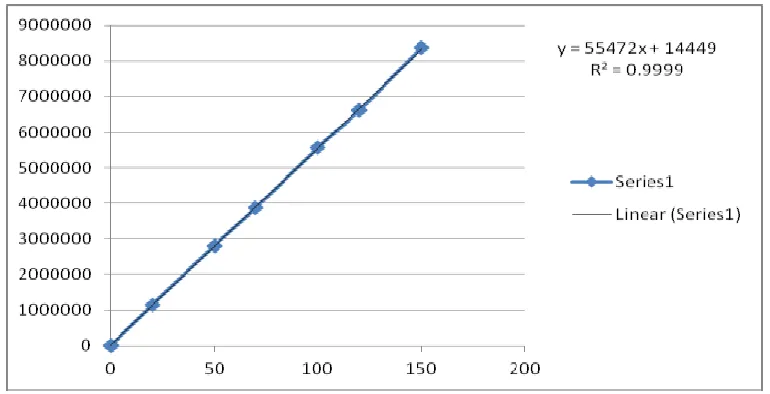
thirty minutes by passing mobile phase, detector was set at 322 nm, flow rate of 1.0 mL/min to get a stable base line. One blank followed by six replicates of a single standard solution was injected to check the system suitability. Six replicates of each standard solutions 20, 50, 70, 100, 120 and 150 μg/mL were injected. Calibration graph was plotted by concentration of Etravirine on X-axis and peak area on Y-axis and linearity curve was shown in Figure 2. The amount of drug present in sample was computed
in calibration graph. Chromatographic conditions for estimation of Etravirine were described in Table 1.
Pharmaceutical formulations: Prepared dilution of
pharmaceutical formulation is injected and the procedure described under bulk samples was followed. The amount of drug present in sample was computed in calibration graph. The assay results in commercial formulations of Etravirine were described in Table 2.
RESULTS AND DISCUSSION
The objective of the present work is to develop simple, precise and reliable HPLC method for the analysis of Etravirine in bulk and pharmaceutical dosage form. This is achieved by using the most commonly employed column Hypersil BDS C18
detection at 322 nm. The representative chromatogram indicating Etravirine is shown in Figure 3.
Parameter fixation: In developing this method, a
systemic study of effects of various parameters was under taken by varying one parameter at a time and controlling all other parameters. The following studies were conducted for this purpose.
Stationary phase characteristics: Based on nature
and solubility characteristics of Etravirine, reverse phase mode of HPLC was selected for chromatography. Among different RP-HPLC stationary phases tried Hypersil BDS C18 column was
found to be optimum.
Mobile phase characteristics: In order to get sharp peak with base line separation from interfering peaks carried out a number of experiments by varying the composition of solvents and mobile phase flow rate. To have an ideal separation of the drug under isocratic conditions, mixtures of solvents like acetonitrile, methanol with different buffers in different combinations were tested as mobile phase. A mixture of phosphate buffer:acetonitrile in the ratio 35:65 v/v was proved to be the most suitable of all the combinations, since the chromatographic peak obtained was better defined and resolved and almost free from tailing.
Linearity: The linearity range was found in the range
Precision: Precision is the degree of repeatability of an analytical method under normal operational conditions. Precision of the method was performed as intra-day precision and inter-day precision.
Intra-day precision: To study the intra-day
precision, six replicate standard solutions (100 ppm) of Etravirine were injected. The percent relative standard deviation (%RSD) was calculated and it was found to be 0.8 which are well within the acceptable criteria of not more than 2.0.
Inter-day precision: To study the inter-day
precision, six replicate standard solutions (100 ppm) of Etravirine were injected. The percent relative standard deviation (%RSD) was calculated and it was found to be 0.2 which are well within the acceptable criteria of not more than 2.0.
Specificity: The effect of wide range of excipients and other additives usually present in the formulation of Etravirine in the determinations under optimum conditions were investigated. Chromatographic parameters maintained are specific for Etravirine.
Ruggedness: The ruggedness of the method was
determined by carrying out the experiment on different instruments like Shimadzu HPLC, Agilent HPLC and Water’s Breeze HPLC by different operators using different columns of similar type like XDB C18, Hibar C18, Kromasil C18 and Hypersil BDS
C18 didn’t show any significant change.
Limit of detection and limit of quantification: A calibration curve was prepared using concentrations in the range of 20-150 μg/mL (expected detection limit range). The standard deviation of Y-intercepts of regression line was determined. The LOD and
LOQ of Etravirine was 0.143 and 0.436 µg/mL, respectively.
Accuracy: The accuracy of the method was
determined by standard addition method. A known amount of standard drug was added to the fixed amount of pre-analyzed standard solution. The standard addition method was performed at 50%, 100% and 150% level of 100 ppm. The solutions were analyzed in triplicate at each level as per the proposed method. The percent recovery and %RSD was calculated and results are presented in Table 4. Satisfactory recoveries ranging from 99% to 101.51% were obtained by the proposed method. This indicates that the proposed method was accurate.
Robustness: Robustness of the method was
determined by making slight changes in the chromatographic conditions. It was observed that there were no marked changes in the chromatograms, which demonstrated that the RP-HPLC method developed is robust.
System suitability: A system suitability test was
performed to evaluate the chromatographic parameters (number of theoretical plates, tailing of the peak) before the validation runs. The results of system suitability parameters were given in Table 5. The analytical method validation was carried out as per ICH method validation guidelines [22-23].
CONCLUSION
The proposed HPLC method is rapid, sensitive, precise and accurate for the estimation of Etravirine and can be reliably adopted for routine quality control analysis of Etravirine in its tablet dosage forms.
Figure 2: Linearity curve of Etravirine
Figure 3: Typical chromatogram of Etravirine
Table 1: Optimized chromatographic conditions of Etravirine
Parameter Condition
Mobile phase Phosphate buffer:acetonitrile (35:65 v/v)
pH 3.8
Diluent Acetonitrile
Column Hypersil BDS C18 column (150 mm x4.6 mm, 5μ)
Column temperature 30°C Wave length 322 nm Injection volume 10 µL
Table 2: Assay results of Etravirine
Formulation Label claim Amount found %Assay
INTELENCE 100 mg 99.49 mg 99.49%
Table 3: Linearity results of Etravirine
Concentration (μg/mL) Area
20 1147599 50 2806854 70 3877779 100 5571260 120 6614754 150 8373831
Table 4: Recovery results of Etravirine
Table 5: Validation parameters of Etravirine
System suitability Results
Linearity range (μg/mL) 20-150 Correlation coefficient 0.999
Theoretical plates (N) 5067 Tailing factor 1.37 LOD (μg/mL) 0.143 LOQ (μg/mL) 0.436
REFERENCES
1. K.K. Arien, M. Venkatraj, J. Michiels, J. Joossens, K. Vereecken, P.V. Veken, S. Abdellati, V. Cuylaerts, T. Crucitti, L. Heyndrickx, J. Heeres, K. Augustyns, P.J. Lewi, G. Vanham. Diaryltriazine non-nucleoside reverse transcriptase inhibitors are potent candidates for pre-exposure prophylaxis in the prevention of sexual HIV transmission. J. Antimicrob. Chemother., 2013; 68(9): 2038-2047.
2. B. Marta, J. Akil, L. Mohammed. Pharmacokinetics and safety of Etravirine administered once or twice daily after 2 weeks treatment with Efavirenz in healthy volunteers. Journal of Acquired Immune Deficiency Syndromes. 2009; 52(2): 222-227.
3. H.J. Stellbrink. Antiviral drugs in the treatment of AIDS: what is in the pipeline?. Eur. J. Med. Res., 2007; 12(9): 483-495.
4. Y.V. Herrewege, G. Vanham, J. Michiels, K. Fransen, L. Kestens, K. Andries, P. Janssen, P. Lewi. A series of diaryltriazines and diarylpyrimidines are highly potent nonnucleoside reverse transcriptase inhibitors with possible applications as microbicides. Antimicrob. Agents Chemother., 2004; 48(10): 3684-3689. 5. K. Das, A.D. Clark, P.J. Lewi, J. Heeres, M.R. De Jonge, L.M. Koymans, H.M. Vinkers, F. Daeyaert, D.W.
Ludovici, M.J. Kukla, B.D. Corte, R.W. Kavash, C.Y. Ho, H. Ye, M.A. Lichtenstein. Roles of conformational and positional adaptability in structure-based design of TMC125-R165335 (Etravirine) and related non-nucleoside reverse transcriptase inhibitors that are highly potent and effective against wild-type and drug-resistant HIV-1. J. Med. Chem., 2004; 47(10): 2550-2560.
Level Concentration
(μg/mL)
Concentration added (μg/mL)
Concentration
recovered (μg/mL) % Recovery
50%
100 50 50.75 101.52 100 50 49.74 99.49 100 50 50.63 101.27 100%
100 100 99.01 99.01 100 100 99.59 99.59 100 100 99.41 99.41 150%
6. C. Fang, J.D. Bauman, K. Das, A. Remorino, E. Arnold, R.M. Hochstrasser. Two-dimensional infrared spectra reveal relaxation of the nonnucleoside inhibitor TMC278 complexed with HIV-1 reverse transcriptase. Proceedings of the National Academy of Sciences of the United States of America. 2008; 105(5): 1472-1477.
7. C.V. Reddaiah, P. Rama Devi, K. Mukkanti, K. Srinivasa Rao. Estimation of Etravirine by UV-Visible spectroscopic method in tablet dosage form and its in vitro dissolution assessment. Int. J. Pharm. Res. Dev., 2012; 4(3): 287-295.
8. C. Runja, P.R. Kumar. Development and validation of a new RP-HPLC method for estimation of Etravirine in bulk and pharmaceutical dosage form. Int. J. Pharma Sci., 2013; 3(4): 291-294.
9. L. Satyanarayana, S.V. Naidu, M. Narasimha Rao, D. Pyiyadarshini. The estimation of Etravirine in tablet dosage form by RP-HPLC. Asian J. Res. Chem., 2011; 4(10): 1649-1651.
10. A. Hirano, M. Takahashi, E. Kinoshita, M. Shibata, T. Nomura, Y. Yokomaku, M. Himaguchi, W. Sugiura. High performance liquid chromatography using UV detection for the simultaneous quantification of the new non-nucleoside reverse transcriptase inhibitor Etravirine (TMC-125) and 4 protease inhibitors in human plasma. Biol. Pharm. Bull., 2010; 33(8): 1426-1429.
11. A. D’Avolio, L. Baietto, M. Siccardi, M. Sciandra, M. Simiele, V. Oddone, S. Bonora, G.D. Perri. An HPLC-PDA method for the simultaneous quantification of the HIV integrase inhibitor Raltegravir, the new nonnucleoside reverse transcriptase inhibitor Etravirine and 11 other antiretroviral agents in the plasma of HIV-infected patients. Ther. Drug Monit., 2008; 30(6): 662-669.
12. A. Aleem, G. Krishnamurthy, H.S. Bhojyanaik, S. Ramesh. Development and validation of stability indicating ultra performance liquid chromatographic method for Etravirine. Int. J. Pharm. Pharm. Sci., 2012; 4(1): 255-261.
13. C.M. Reddy, K.H. Reddy. A novel validated stability indicative UPLC method for Etravirine for the determination of process related and degradation impurities. Am. J. Anal. Chem., 2012; 3(12): 840-848. 14. Z. Djerada, C. Feliu, C. Tournois, D. Vautier, L. Binet, A. Robinet, H. Marty, C. Gozalo, D. Lamiable, H.
Millart. Validation of a fast method for quantitative analysis of Elvitegravir, Raltegravir, Maraviroc, Etravirine, Tenofovir, Boceprevir and 10 other antiretroviral agents in human plasma samples with a new UPLC-MS/MS technology. J. Pharm. Biomed. Anal., 2013; 86: 100-111.
15. A. D’Avolio, M. Simiele, M. Siccardi, L. Baietto, M. Sciandra, V. Oddone, F.R. Stefani, S. Agati, J. Cusato, S. Bonora, G.D. Perri. A HPLC-MS method for the simultaneous quantification of fourteen antiretroviral agents in peripheral blood mononuclear cell of HIV infected patients optimized using medium corpuscular volume evaluation. J. Pharm. Biomed. Anal., 2011; 54(4): 779-788.
16. C.V. Abobo, L. Wu, J. John, M.K. Joseph, T.R. Bates, D. Liang. LC-MS/MS determination of Etravirine in rat plasma and its application in pharmacokinetic studies. J. Chromatogr. B, 2010; 878(30): 3181-3186. 17. L. Else, V. Watson, J. Tjia, A. Hughes, M. Siccardi, S. Khoo, D. Back. Validation of a rapid and sensitive
high-performance liquid chromatography-tandem mass spectrometry (HPLC-MS/MS) assay for the simultaneous determination of existing and new antiretroviral compounds. J. Chromatogr. B, 2010; 878(19): 1455-1465.
18. A. D’Avolio, M. Simiele, M. Siccardi, L. Baietto, M. Sciandra, S. Bonora, G.D. Perri. HPLC-MS method for the quantification of nine anti-HIV drugs from dry plasma spot on glass filter and their long term stability in different conditions. J. Pharm. Biomed. Anal., 2010; 52(5): 774-780.
19. A. Fayet, A. Beguin, B. Zanolari, S. Cruchon, N. Guignard, A. Telenti, M. Cavassini, H.F. Gunthard, T. Buclin, J. Biollaz, B. Rochat, L.A. Decosterd. A LC-tandem MS assay for the simultaneous measurement of new antiretroviral agents: Raltegravir, Maraviroc, Darunavir and Etravirine. J. Chromatogr. B, 2009; 877(11-12): 1057-1069.
20. R. Heine, H. Rosing, E.C.M. Gorp, J.W. Mulder, J.H. Beijnen, A.D.R. Huitema. Quantification of Etravirine (TMC125) in plasma, dried blood spots and peripheral blood mononuclear cell lysate by liquid chromatography tandem mass spectrometry. J. Pharm. Biomed. Anal., 2009; 49(2): 393-400.
21. N.L. Rezk, N.R. White, S.H. Jennings, A.D.M. Kashuba. A novel LC-ESI-MS method for the simultaneous determination of Etravirine, Darunavir and Ritonavir in human blood plasma. Talanta, 2009; 79(5): 1372-1378.
22. ICH Validation of analytical procedures: Text and methodology, Q2(R1), International Conference on Harmonization, 2005; 1-13.