Abstract—The purpose of the paper is to examine the
importance of incorporating lean production (LEAN) in the Malaysian manufacturing industry. Lean production investigated in this paper consists of two important dimensions namely Just-In-Time and technology & innovation. This study utilizes two hundred and five manufacturing companies, selected randomly from the Federation of Malaysian Manufacturers Directory. The study measures senior production or lean managers’ perception of the lean production and the level of performances in their companies. Grounded by the Program Theory, this paper specifically investigates whether the length of lean adoption moderates the linkage between lean production and business performance using the hierarchical regression analysis. Pearson’s correlations exhibit significant correlations between the two lean practices and business performance measures. The result also provides evidence that the length of lean adoption moderates the linkage between technology & innovation and business performance (operationalized by ROS and ROI). Therefore, long term adopters of lean production would benefit in the long run. The findings of the study provide a striking demonstration of the importance of lean in enhancing the performances of the Malaysian manufacturing companies. The result indicates that manufacturing companies should emphasize greater attention to ‘new technology and innovation’ and ‘Just–in-Time’ as well as a greater degree of management support for lean production enhancement initiatives.
Index Terms—Lean production, business performance, JIT,
technology and innovation.
I. INTRODUCTION
The current business scenario colored by intense competition and alarming increment in the cost of raw materials, has alerted many manufacturing companies to pursue programs that would minimize waste and reduce manufacturing costs. Generally, manufacturing companies have to transform from a traditional mass production practice to a better and more efficient and flexible production method such as lean production ([1]-[5]). Lean production which is a manufacturing system that focus on two main issues namely the elimination of waste and respect for people; has received a lot of attention from manufacturing companies worldwide and academicians since 1980s ([6], [7], [1]-[4]). The core of lean production philosophy lies on the premise that it has brought changes in management practices by enhancing the production effectiveness and efficiency as well as improving business performance ([5], [8]). Specifically, lean production
requires less human effort in the factory, manufacturing space, investment tools, engineering hours and time to develop new products compared with the traditional mass production practices ([5], [7]).
Theoretically, many academicians have claimed that lean production can result in positive outcomes, but only a few empirical works have been performed on investigating the impact of lean production on business performance ([9], [10], [4]-[5]). Additionally, those studies produce mixed results. For example, several researchers [3], [4], [10], [11] claim that the implementation of lean production has resulted in better operational performance such as increasing production volume, reducing lead time, enhancing customer satisfaction and flexible production method. Consistent with this, Shah and Ward (2003) [4] assert that the implementation of lean production has shown a significant and positive relationship with operational performance. However, Lewis (2000) [9] argues that lean production does not directly improve business performance but moderated or intervened by other variables. Moreover, the author is not aware of any study that has examined how the length of lean adoption moderates the linkage between JIT or technology & innovation and business performance. Therefore, this study tries to address this gap by investigating whether the length of lean adoption moderates the relationship between these two lean production dimensions and business performance. Besides highlighting the importance of early implementations of lean production, this study also attempts to investigate the contribution of JIT and technology & innovation in lean production.
II. LEAN PRODUCTION (LITERATURE REVIEW)
Nowadays, many manufacturing companies have considered lean production to be central to their manufacturing strategies. Katayama and Bennett (1996) [1] describe lean production as a manufacturing system that use less resource input to produce a higher output performance which lead to customer satisfaction and gain larger market share than those of its competitors. Theoretically, Shahram (2008) [12] defines lean production “as a manufacturing system without waste” while waste is defined as “anything other than the minimum amount of equipment, materials, parts, and working time that is essential to production”. Conversely, Worley and Doolen (2006) [13] define lean production as “a systematic removal of waste by all members of the organization from all areas of the value stream”, whereby the value stream is defined as all activities that contribute to the transformation of a product from raw material to finished product. On the same note, Papadopoulou and Ozbayrak (2005) [14] define lean production as “an approach to manufacturing that is aimed at
Lean Production and Business Performance: The
Moderating Effect of the Length of Lean Adoption
Arawati Agus and Rosman Iteng, Member, IACSIT
Manuscript received February 6, 2013; revised April 10, 2013.
the elimination of waste while stressing the need for continuous improvement”.
Holistically, Sanchez and Perez (2001) [15] refer lean production as a conceptual framework based on a few established principles and techniques such as multi-functional teams, elimination of zero-value activities, continuous improvement and supplier integration to achieve production effectiveness and delivers just-in time. Likewise, Shah and Ward (2003) [4] define lean production as “a multi-dimensional approach that include several management practices such as just-in-time, quality system, works teams, cellular manufacturing, supplier management in an integrated system”. But Agus and Hajinoor ( 2012) [5], stress the importance of technology and innovation in lean production.
Today‟s era of global competition has created intense challenges for manufacturing companies. Manufacturing companies that do not keep up with lean production would lose out to competitors. Manufacturing companies do not only compete on prices but also on who would first introduce new technological, creative, innovative and high quality products to enable them to be market leaders and ultimately gain higher profits. Lean production has the potential to assist the organization in achieving both cost minimization and value maximization ([9] [10] [16][3] [5]). Many researchers claim that lean production can result in better performance ([9] [10] [4] [3]), but very few empirical studies have been conducted to investigate the impact of lean production on business performance. Most importantly, it is also interesting to investigate whether the length of lean adoption plays a significant moderating role in that relationship.
As for the Malaysians‟ manufacturers, the challenges are becoming more prominent nowadays [17]. Today, the cheaper made-in-China products are freely traded in the Malaysian open market. Therefore, the Malaysians‟ manufactures have to seek and adopt a better, cost-effective, and more efficient manufacturing approach such as lean production [17] [18]. In Malaysia, the idea of lean production has been brought into the country by the locally operated multinational foreign companies since early 1980s [17].
III. THE CONCEPTUAL FRAMEWORK:THE MODEL AND
HYPOTHESES
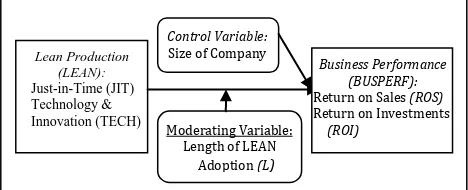
This section explores linkages between lean production and business performance within the context of the Malaysian manufacturing industry. The proposed model, as depicted in Fig. 1, is based on two main constructs- (i) Lean production (LEAN) and (ii) Business performance (BUSPERF). The framework consists of two manifest variables of lean production namely Just-in-time (JIT) and Technology and innovation (TECH) and two indicators of business performance specifically return on sales (ROS) and return on investment (ROI). In addition, the length of lean adoption (L) is incorporated in the model as the moderating variable and the size of the company (SIZE) as the control variable.
Incorporating ideas, theories and studies from the literature, the two main lean production practices included in the study are explained as follows:
1) Just-in-time (JIT): According to Liker (2004) [2], just-in-time (JIT) is a set of principles, tools and
techniques that allow a company to produce and deliver products in small quantities, with short lead times to meet specific customer needs. In other word, JIT delivers “the right items at the right time in the right amounts” to the customer [2]. The strength of JIT is that it allows a manufacturer to be flexible in catering changes demanded by the customers.
2) New Technology and Innovation (TECH): Tremendous change in the technological developments and globalization has formed significant impact on the nature of work where the advanced use of technology is a necessity in order to compete in the global arena (Singh & Singh, 2008) [19]. New technology and innovation in this study refers to the application of the latest engineering or manufacturing discoveries to the design of operations and production processes in lean production [20].
Fig. 1. The conceptual model showing the relationship between lean production and business performance and the moderating effect of the length
of lean adoption.
The dependent construct namely business performance is considered as a very important bottom-line outcome. In this study, it is operationalised by indicators namely „return on sales‟ and „return on investment‟[20], [21]. Return on Sales (ROS) is a measure of a company's profitability, equal to a fiscal year's pre-tax income divided by total sales. On the other hand, return on investment (ROI) is defined as the monetary benefits derived from having spent money on developing or revising a system. ROI is a measurement that evaluates the efficiency of a certain project. Lastly, the length of lean adoption (L) is derived by asking respondents the duration of the lean adoption of their companies.
In order to investigate the moderating effect of the length of lean production adoption on the linkage between lean production and business performance, this study proposes the following hypotheses:
A
H1 : The length of lean adoption moderates the linkage between Just-in-Time and Return on Sales (ROS). B
H1 : The length of lean adoption moderates the linkage between Technology& Innovation and Return on Sales (ROS).
C
H1 : The length of lean adoption moderates the linkage between Just-in-Time and Return on Investment (ROI).
D
H1 : The length of lean adoption moderates the linkage between Technology& Innovation and Return on Investment (ROI).
The underpinning theory that governs the theoretical framework of this paper is program theory [22]. Program theory links inputs (lean production) with activities to outcomes (business performance). Lean production creates value by focusing on key performance gap which in turn
Lean Production (LEAN):
Just-in-Time (JIT) Technology & Innovation (TECH)
Business Performance (BUSPERF): Return on Sales (ROS) Return on Investments
(ROI) Moderating Variable:
Length of LEAN Adoption (L) Control Variable: Size of Company
helps a company to identify new ideas and innovation in order to push the company ahead. Lean production improves processes and helps to meet customer expectation better, resulting in higher sales and return on investment [5].
IV. RESEARCH METHODOLOGY
The study was a quantitative, cross-sectional research utilizing primary data collection. The unit of analysis chosen for this study was company level and each company was represented by either senior operation or lean manager (as the respondent). The sampling frame was derived from the Federation of Malaysian Manufacturing Companies Directory. The samples were randomly selected using a simple random sampling method. Two hundred and five useable responses were analyzed using the SPSS package. The primary purpose of the research was to measure managers‟ perception of the lean production initiatives and to gain insight into the benefits of adopting lean production in the manufacturing companies. The goal was to understand and determine critical matters related to lean production that would enhance business performance.
The research instrument used in this study was a structured survey questionnaire, which was designed to assess the companies in term of the described dimensions. The survey instrument designed consisted of three major parts. The first part comprised several constructs measuring lean production practices, and the second part captured several performance measurements. The last part retrieved information about each company‟s profile. To enable respondents to indicate their answers, seven–point interval scales were used in measurement. The performance measure namely business performance also used a seven-point interval scale, representing a range of agreement with statements whether over the past three years these performances were high relative to competitors after implementing lean production. The primary data were collected through various means such as face-to-face interview, ordinary mail service, email, telephone call and fax.
Validity and reliability tests were used to select and assess the final items of the main constructs that were used for further statistical testing. The critical variables of lean production in this study had content validity because an extensive review of the literature was conducted in selecting the measurement items and the critical constructs; and all the items and factors had been evaluated and validated by professionals in the area of operation management or lean production (face-content validity). In addition, the draft questionnaire was pre-tested with academicians to check its content validity and terminology and modified accordingly. Before creating the final scales, the data were checked for normality and outliers; and were found to be satisfactory.
Since data for the study were generated using a multi-scaled responses, it was necessary to test for reliability and consistency [23] [20]. The alpha coefficients for lean production and business performance ranged between 0.763 and 0.822 after the alpha maximization process were carried out, indicating internal consistency. Statistically, the result of the collinearity test did not indicate any multicollinerity problem. Since none of the lean dimensions exhibited the values of VIF greater than 10.00, it is concluded that the
presence of multicollinearity in this study was not severe and therefore hierarchical multiple regression analysis was applied.
Before investigating the moderating effect of the length of lean production, the Pearson‟s correlation analysis was conducted (Table I). JIT had significant correlations with ROS (r = .247**) and ROI (r = .248**). Technology and innovation had significant correlations with ROS (r= .411**) and ROI (r= .401**). We concluded that manufacturing companies with higher JIT and technology & innovation were more likely to experience a better business performance. These findings were consistent with several previous studies that proclaimed better organizational transformations as a result of lean production initiatives [2]-[5].
TABLEI:PEARSON‟SCORRELATION BETWEEN LEAN PRODUCTION
PRACTICES AND BUSINESS PERFORMANCE
Lean Production practices and other variables
Business Performance Return on
Sales (ROS)
Return on Investments (ROI) 1 Just in time
(α= 0.763 ) .247** .248**
2 Technology &
Innovation (α=0.822 ) .411** .401** 3 Length of Lean Adoption .035 .019
4 Size of company .019 .055
Note: N=205. The coefficients are standardized β weights. Note: † if p < 0.10, * if p < 0.05; ** if p < 0.01; *** if p < 0.001
V. INVESTIGATING THE MODERATING EFFECT OF THE
LENGTH OF LEAN PRODUCTION IN THE LINKAGE BETWEEN
LEAN PRODUCTION AND BUSINESS PERFORMANCE :THE
HIERARCHICAL REGRESSION ANALYSES
This study utilized the hierarchical multiple regression analysis to test the moderating effects of the length of lean production in the linkages between the two important lean production practices namely JIT or technology & innovation, and business performance. In this analysis, the dependent variable was regressed on the independent, moderator and the cross products of both variables [24], [25].
Firstly, to test hypotheses H1AandH1B regarding the moderating effects of the length of lean adoption in the linkage between JIT or technology & innovation, and ROS, a multiple hierarchical regression analysis was conducted with JIT, technology & innovation, length of lean production, size and the cross products as predictor variables and ROS as dependent variable, respectively. The length of lean production acted as the moderating variable and the company size as the control variable. Hypotheses H1A and H1B
TABLEII:THE RESULT OF HIERARCHICAL REGRESSION ANALYSIS OF THE
MODERATING EFFECT OF LENGTH ON LEAN PRODUCTION AND RETURN ON
SALES (ROS)
Variable ROS
STEP 1 STEP2 STEP3 Company Size (control
variable) .103 .096 .060
Just in time (JIT) .062 .065 .091 Technology &
Innovation .400*** .403*** .315*** Length of Lean
Adoption .064 .064
JIT X Length of Lean
Adoption .134†
Technology & Innovation X Length of Lean Adoption
.286 ***
R Square .181 .185 .244
R square .004 .059
F 14.84*** 11.37*** 10.68***
Note: N=205. The coefficients are standardized β weights. Note: † if p < 0.10, * if p < 0.05; ** if p < 0.01; *** if p < 0.001
TABLEIII:THE RESULT OF HIERARCHICAL REGRESSION ANALYSIS OF THE
MODERATING EFFECT OF LENGTH ON LEAN PRODUCTION AND RETURN ON
INVESTMENT (ROI)
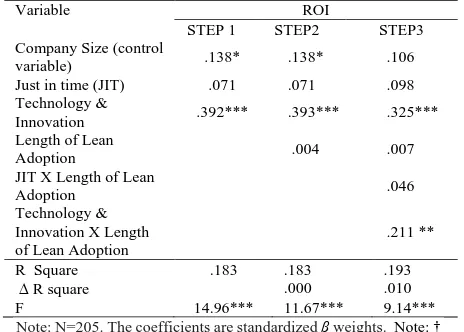
Variable ROI
STEP 1 STEP2 STEP3 Company Size (control
variable) .138* .138* .106
Just in time (JIT) .071 .071 .098 Technology &
Innovation .392*** .393*** .325*** Length of Lean
Adoption .004 .007
JIT X Length of Lean
Adoption .046
Technology & Innovation X Length of Lean Adoption
.211 **
R Square .183 .183 .193
R square .000 .010
F 14.96*** 11.67*** 9.14***
Note: N=205. The coefficients are standardized β weights. Note: † if p < 0.10, * if p < 0.05; ** if p < 0.01; *** if p < 0.001
Secondly, to test hypotheses H1CandH1D regarding the moderating effects of the length of lean adoption in the linkage between JIT or technology & innovation and ROI, another multiple hierarchical regression analysis was investigated with ROI as the dependent variable. The result (Table III, Step 3) demonstrated that the interaction term of JIT and the length of lean production was not significant (β=.046, ns). Therefore, hypothesis H1C was rejected. However, the result indicated that the interaction term of technology & innovation and the length of lean production was positive and significant (β=.211, p<0.01). Therefore, we had enough evidence to accept the hypothesis H1Cthat the length of lean adoption moderated the linkage between technology & innovation and ROI (H1D).
The simple slopes tests (Fig. 2) indicated that the linkages
between technology & innovation and business performance
were significant when the length of lean adoption was high (simple slope = 0.987*** when regressed on ROS; simple slope = 0.945*** when regressed on ROI) and were also significant when the length of lean adoption was low (simple slope = 0.795*** when regressed on ROS; simple slope = 0.679*** when regressed on ROI). The technology & innovation-business performance linkages became stronger as the length of lean production adoption increased
Since the overall interactions were significant, hypotheses
B
H1 andH1Dwere supported indicating that the length of
lean production moderated the relationships between
technology & innovation and business performance (ROS and ROI).
Fig. 2. Two simple slopes for the moderating effect of the length of lean adoption.
VI. CONCLUSION AND IMPLICATION
Although several researchers have provided empirical evidences of the importance of lean on performance, some might have overlooked that the length of lean production adoption would be a catalyst in enhancing this linkage. The initial statistical result indicates that JIT and technology & innovation have positive and significant correlations with ROS and ROI. This suggests that manufacturing companies with higher level of JIT and technology & innovation are more likely to experience a better business performance. Another important implication of the study is that the length of lean production adoption plays an important role in enhancing and describing how technology & innovation leads to both ROS and ROI. The linkages between
technology & innovation and business performance were
significant and positive when the length of lean production was high and low. Unfortunately, the study fails to support the assumption that the length of lean production moderates the linkage between JIT and business performance.
managers as it create awareness of the importance of minimizing waste and maximizing product value through lean production and also suggests what lean practices that should be emphasized or prioritized by manufacturing companies with their limited resources, in order to enhance performances.
ACKNOWLEDGMENT
The authors would like to thank the Graduate School of Business, Universiti Kebangsaan Malaysia for providing a conducive environment for graduate students to conduct their research.
REFERENCES
[1] H. Katayama and D. Bennett, “Lean production in a changing competitive world: a Japanese perspective,” International Journal of Operations & Production Management, vol. 16, no. 2, pp. 8-23, 1996.
[4] R. Shah and P. T. Ward, “Lean manufacturing: context, practice bundles, and performance,” Journal of Operations Management, vol. 21, no. 1, pp. 129–149, 2003.
[5] A. Agus and M. S. Hajinoor, “Lean production supply chain management as driver towards enhancing product quality and business performance: Case study of manufacturing companies in Malaysia,” International Journal of Quality and Reliability Management, (Emerald), vol. 29, no. 1, pp. 92-121, 2012.
[6] Y. Monden, “Smoothed production lets Toyota adapt to demand changes and reduce inventory,” Industrial Engineering,vol. 13, no. 8, pp. 42–51, 1981.
[7] J. Womack, D. Jones, and D. Roos, The Machine that Changed the World: The Story of Lean Production, Harper, New York, NY, 1990, ch. 1, pp. 15-17.
[8] F. Ferdousi and A. Ahmed, “An investigation of manufacturing performance improvement through lean production: A study on Bangladeshi garment firms,” International Journal of Business and Management,vol. 4, no. 9, pp. 106-116, 2009.
[9] M. A. Lewis, “Lean production and sustainable competitive advantage,” International Journal of Operations and Productions Management., vol. 20, no. 8, pp. 959-978, 2000.
[10] K. O. Cua, K. E. McKone, and R. G. Schroeder, “Relationships between implementation of TQM, JIT, and TPM and manufacturing performance,” Journal of Operations Management. vol. 19, no. 1, pp. 675-694, 2001.
[11] T. Kuo, J. P. Shen, and Y. M. Chen, “A study on relationship between lean production practices and manufacturing performance,” presented at the 2008 International Symposium of Quality Management, Kaohsiung, Taiwan, 8-9 November, 2008.
[12] T. Shahram, “Lean manufacturing performance in China: assessment of 65 manufacturing plants,” Journal of Manufacturing Technology Management, vol. 19, no. 2, pp. 217-234, 2008.
[13] J. M. Worley and T. L Doolen, “The role of communication and management support in a lean manufacturing implementation,” Management Decision, vol. 44, no. 2, pp. 228-245, 2006.
[14] T. C. Papadopoulou and M. Ozbayrak, “Leaness: experience from the journey to date,” Journal of Manufacturing Technology Management. vol. 16, no. 7, pp. 784-807, 2005.
[15] A. Sanchez and M. P. Perez, “Lean indicators and manufacturing strategies,” International Journal of Operations & Production Management, vol. 21, no. 11, pp. 1433-1451, 2001.
[16] R. Shah and P. T. Ward, “Defining and developing measures of lean production,” Journal of Operations Management, vol. 25, no. 1, pp. 785-805, 2007.
[17] Y. C. Wong, K. Y. Wong, and A. Ali, “A study on lean manufacturing implementation in the Malaysian electrical and electronics industry,” European Journal of Scientific Research, vol. 38, no. 4, pp. 521-535, 2009.
[18] Productivity Report, 17th Productivity Report, Malaysia Productivity
Corporation, pp. 20-30, 2009.
[19] G. K. G. Singh and S. K. G. Singh, “Malaysian graduates‟s employability skills,”UNITAR E-Journal, vol. 4, no. 1, pp. 15-45, 2008.
[20] A. Agus, “Supply chain management, Supply Chain Flexibility and Business,” Journal of Global Strategic Management, vol. 5, no. 1, pp. 134-145, 2011.
[21] Investorwords. (September 2010). Return on sales and Return on Investment [Online]. Available: http: //www.investorwords.com/5775/ ROS.html.
[22] C. H. Weiss, Evaluation, 2nd Ed., Englewood Cliffs, NJ: Prentice Hall, 1998, ch. 3, pp. 90-45.
[23] M. T. Frohlich and R. Westbrook, “Arcs of integration: an international study of supply chain strategies,” Journal of Operations Management, vol. 19, no. 1, pp. 185-200, 2001.
[24] S. A. Snell and J. W. Dean, “Integrated manufacturing and human resource management: A human capital perspective,” Academy of Management Journal, vol. 35, no. 30, pp. 467-504, 1992.
[25] A. Agus, “The importance of incorporating new technology and innovation in supply chain management (scm) processes in enhancing performance,” presented at the 16 th PBEAM 2008: Innovation For Sustainable Future, QUT, Brisbane, Australia, July 2-4, 2008.
Arawati Agus is a professor chain and quality management at the Graduate School of Business (GSB), Universiti Kebangsaan Malaysia (UKM). She received a Bachelor degree in Finance from Southern Illinois University (SIU, USA) and Master in Management Sciences from St. Louis University (SLU, USA). She earned her Ph.D. from Universiti Kebangsaan Malaysia (UKM). Her area of research includes Supply Chain Management, Quality Management, Service Quality, Operations Management, and Entrepreneurship. Her works have been published in Total Quality Management and Business Excellence Journal (Emerald, UK), Journal of Quality and Reliability (Emerald), International Journal of Production Economic (Elsevier), Singapore Management Review, International Journal of Business & Management Science, Journal of Global Strategic Management, International Journal of Trade, Economics and Finance, International Journal of Management, Malaysian Management Review and Management Journal (UKM) as well as in book chapters.
Dr. Agus is a member of several professional memberships such as Emerald Literati Network, International Association of Organizational Innovation (IAOI) and Academy of International Business (AIB). She has won several research awards and has among the highest citation index in the Graduate School of Business, Universiti Kebangsaan Malaysia.
[2] J. K. Liker,The Toyota Way - 14 Management Principles form the World’s Greatest Manufacturer, New York. NY: McGraw-Hill, 2004, ch. 2, pp. 40-45, 2004.
[3] S. Li, B. Ragu-Nathan, T. S. Ragu-Nathan, and S. S. Rao, “The impact of supply chain management practices on competitive advantage and organizational performance,” Omega, vol. 34, no. 2, pp. 107-124, 2006.