Interconnected Cloud Computing Environments: Challenges,
Taxonomy and Survey
ADEL NADJARAN TOOSI, RODRIGO N. CALHEIROS, and RAJKUMAR BUYYA, The University of Melbourne, Australia.
A brief review of the Internet history reveals the fact that the Internet evolved after the formation of primar-ily independent networks. Similarly, interconnected Clouds, also calledInter-Cloud, can be viewed as a nat-ural evolution of Cloud computing. Recent studies show the benefits in utilizing multiple Clouds and present attempts for the realization of Inter-Cloud or federated Cloud environment. However, Cloud vendors have not taken into account Cloud interoperability issues and each Cloud comes with its own solution and inter-faces for services. This survey initially discusses all the relevant aspects motivating Cloud interoperability. Furthermore, it categorizes and identifies possible Cloud interoperability scenarios and architectures. The spectrum of challenges and obstacles that the Inter-Cloud realization is faced with are covered, a taxonomy of them is provided and fitting enablers that tackle each challenge are identified. All these aspects require a comprehensive review of the state of the art, including ongoing projects and studies in the area. We conclude by discussing on future directions and trends towards the holistic approach in this regard.
Categories and Subject Descriptors: D.4.7 [OPERATING SYSTEMS]: Organization and Design— Distributed systems; D.2.12 [SOFTWARE ENGINEERING]: Interoperability; C.2.4 [ COMPUTER-COMMUNICATION NETWORKS]: Distributed Systems
General Terms: Design, Standardization
Additional Key Words and Phrases: Cloud Computing, Cloud Federation, Inter-Cloud, Multi-Cloud, Cross-Clouds, Utility Computing
ACM Reference Format:
Adel Nadjaran Toosi, Rodrigo N. Calheiros, and Rajkumar Buyya, 2013. Interconnected Cloud Computing Environments: Challenges, Taxonomy and Survey.ACM Comput. Surv.V, N, Article A (January YYYY), 47 pages.
DOI:http://dx.doi.org/10.1145/0000000.0000000
1. INTRODUCTION
Cloud computing is a term used to describe a paradigm for delivery of computing ser-vices to users on a pay-as-yo-go basis. In this paradigm, users utilize the Internet and remote data centers to run applications and store data. The Cloud technology allows more efficient computing by removing most of the upfront costs of setting up an IT infrastructure. It allows organizations to expand or reduce their computing facilities very quickly. There is an increasingly perceived vision that the birth of Cloud comput-ing is a big step towards the long-held dream of computcomput-ing as a utility [Buyya et al. 2010].
Author’s addresses: A. N. Toosi, R. N. Calheiros, and R. Buyya,Cloud Computing andDistributedSystems (CLOUDS) Laboratory, Department of Computing and Information Systems, The University of Melbourne, Parkville Campus, Melbourne, VIC 3010, Australia. R. Buyya also associated as a visiting professor for the University of Hyderabad, India; King Abdulaziz University, Saudi Arabia; and Tsinghua University, China. Permission to make digital or hard copies of part or all of this work for personal or classroom use is granted without fee provided that copies are not made or distributed for profit or commercial advantage and that copies show this notice on the first page or initial screen of a display along with the full citation. Copyrights for components of this work owned by others than ACM must be honored. Abstracting with credit is per-mitted. To copy otherwise, to republish, to post on servers, to redistribute to lists, or to use any component of this work in other works requires prior specific permission and/or a fee. Permissions may be requested from Publications Dept., ACM, Inc., 2 Penn Plaza, Suite 701, New York, NY 10121-0701 USA, fax+1 (212) 869-0481, or [email protected].
c
YYYY ACM 0360-0300/YYYY/01-ARTA $15.00
Interoperability Approaches
Motivations
Interconnection Scenarios Elements of Interconnected Clouds
Challenges (Components)
Fig. 1. Elements of interconnected Cloud environments
Over the years, several technologies such as Virtualization, Grid computing, and Service-Oriented Architecture (SOA) have matured and significantly contributed to make Cloud computing viable. However, Cloud computing is still in its early stage and suffers from lack of standardization. What actually happens is that most of new Cloud providers proposes its own solution and proprietary interfaces for access to re-sources and services. This heterogeneity is a crucial problem as it raises barriers to the path of the ubiquitous Cloud realization. The main barrier isvendor lock-inwhich is unavoidable at this stage [Rochwerger et al. 2009; Petcu 2011]; customers apply-ing Cloud solutions need to tailor their applications to fit the models and interfaces of the Cloud provider, which makes future relocation costly and difficult. Furthermore, Cloud computing, as a novel utility, requires ubiquitously interconnected infrastruc-ture like other utilities such as electricity and telephony. Accordingly, interoperability and portability across Clouds are important not only for protection of the user invest-ments but also for realization of computing as a utility.
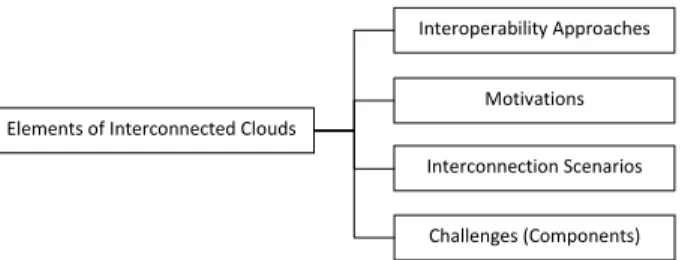
In this paper, we aim to cover various aspects of interconnected Cloud computing environments. Key elements of interconnected Clouds are provided and each one of them is classified in depth. Figure 1 shows the key elements of interconnected Clouds in our point of view.
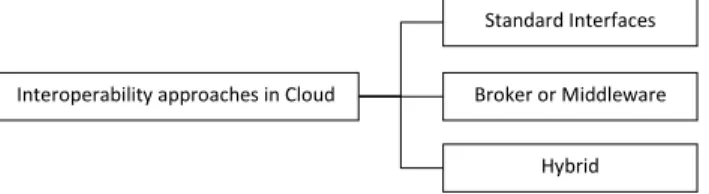
Firstly, we consider interoperability approaches. Cloud interoperability in practice can be obtained either through brokering or standard interfaces. By using a service broker, which translates messages between different Cloud interfaces, customers are able to switch between different Clouds and Cloud providers can interoperate. Stan-dardization of interfaces is another common method for realization of interoperability. Part of this study covers different standards and initiatives related to technologies to regulate the Inter-Cloud environment. However, one comprehensive set of standards is difficult to develop and hard to be adopted by all providers. A combination of the above approaches often occurs in practice.
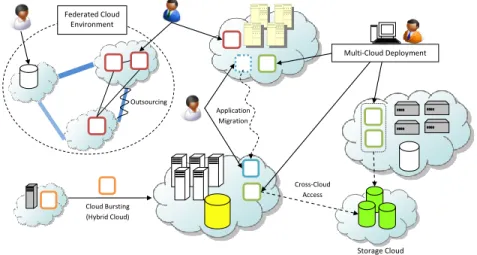
If Cloud interoperability happens, both Cloud providers and customers benefit from different possible Cloud scenarios as shown in Figure 2. Benefits of an interconnected Cloud environment for both Cloud providers and their clients are numerous and there are essential motivations for Cloud interoperability such as avoiding vendor lock-in, scalability, availability, low access latency, and energy efficiency and etc.
Cloud interoperability requires Cloud providers to adopt and implement standard interfaces, protocols, formats and architectural components that facilitate collabora-tion. Without theseprovider-centricchanges Cloud interoperability is hard to achieve. Among different provider-centric approaches Hybrid Cloud, Cloud federation and Inter-Cloudare the most prominent scenarios. A hybrid Cloud allows a private Cloud to form a partnership with a public Cloud, enabling the Cloud bursting application deployment model. Cloud bursting allows an application to run in a private data cen-ter and to burst into a public Cloud when the demand for computing capacity spikes. Cloud federation allows providers to share their resources through federation
regula-Federated Cloud Environment Outsourcing Multi-Cloud Deployment Cloud Bursting (Hybrid Cloud) Cross-Cloud Access Storage Cloud Application Migration
Fig. 2. Cloud interoperability and Inter-Cloud
tions. In this paradigm, providers aim to overcome resource limitation in their local infrastructure, which may result in rejection of customer requests, by outsourcing re-quests to other members of the federation. Moreover, Cloud federation allows providers operating at low utilization to lease part of their resources to other federation mem-bers in order to avoid wasting their non-storable compute resources. Last but not least is Inter-Cloud, in which all Clouds are globally interconnected, forming a worldwide Cloud federation. Inter-Cloud removes difficulties related to migration and supports dynamic scaling of applications across multiple Clouds.
Even if Cloud interoperability is not supported by Cloud providers, Cloud customers are still able to benefit fromclient-centric interoperability facilitated by user-side li-braries or third party brokers.Multi-cloudapplication deployment using adapter layer provides the flexibility to run applications on several Clouds and reduces the difficulty in migrating applications across Clouds.Aggregated Service by Broker, a third-party solution in this regard, offers an integrated service to users by coordinating access and utilization of multiple Cloud resources.
Cloud interoperability is a challenging issue and requires substantial efforts to over-come the existing obstacles. These include both functional and non-functional aspects. This study covers the spectrum of challenges in Cloud interoperability. These chal-lenges broadly covers security, Service Level Agreement (SLA), monitoring, virtualiza-tion, economy, networking, provisioning, and Autonomics.
There are various projects and studies to propose and prototype approaches to en-able interconnected Cloud environments. They vary in terms of architecture, facilities they provide, and challenges they address. Another aim of this study is to survey and classify these projects.
In summary, the contributions of this paper are:
— It introduces and analyzes the relevant aspects motivating Cloud interoperability; — It explores the spectrum of challenges and obstacles for Inter-Cloud realization and
identifies open challenges;
— It proposes a taxonomy of such challenges and obstacles and identifies enablers that tackle each of them;
— It presents a comprehensive review of the state of the art, including ongoing projects and research in the area;
— It discusses future directions and trends in the area.
This survey is organized as follows: In Section 2, we define and discuss several differ-ent terms and descriptions in the area of interconnected Cloud environmdiffer-ents to clarify the positioning of this work. In Section 3, we explore the motivation and benefits of interoperability between Clouds. Then, we introduce different possible architectures for multiple Cloud scenarios in Section 4. Classification of the challenges and potential enablers with respect to each challenge is provided in the Section 5. Successful realiza-tion of Cloud interoperarealiza-tion requires standards, so in Secrealiza-tion 6, we review the current standard protocols and interfaces that facilitate the realization of Cloud interopera-tion, including organizations and initiatives dealing with these standard technologies. In Section 7, we survey the state-of-the-art projects and developments in the area and fit them into taxonomies based on the characteristics and the challenges they address. We discuss about different tools and frameworks supporting interoperable cloud in-frastructure in Section 8. Finally, we conclude the study and provide a basis for future developments in this area.
2. TERMS, QUOTES AND DEFINITIONS
In view of the fact that integration and aggregation of Cloud services to achieve a seamless computing infrastructure has recently got attention and it is in early stage of development, several different terms and descriptions have been used in the scientific community to define it. Precise understanding of these terms and definitions including differences, similarities and experts’ comments clarify the current study and helps in future directions.
Inter-Cloud has been introduced by Cisco [Bernstein et al. 2009] as an intercon-nected global “Cloud of Clouds” that mimics the known term Internet, “network of net-works”. The Inter-Cloud refers to a mesh of Clouds that are unified based on open stan-dard protocols to provide a Cloud interoperability [Bernstein et al. 2009]. The main ob-jective of the Inter-Cloud is similar to the Internet model and telephone system, where everything is ubiquitously connected together in a multiple-provider infrastructure.
According Vint Cerf, vice president and chief Internet evangelist at Google, who is recognized as one of “the fathers of the Internet”1:
“... it’s time to start working on Inter-Cloud standards and protocols so your data doesn’t get trapped in one One of the problems with Cloud computing ...” and these standards and protocols “allow people to manage assets in multiple Clouds, and for Clouds to interact with each other.”
According to Gregory Ness, chief marketing officer at Vantage Data Centers, we can2:
“Think of the Inter-Cloud as an elastic mesh of on demand processing power deployed across multiple data centers. The payoff is massive scale, efficiency and flexibility.”
Global Inter-Cloud Technology Forum (GICTF), a Japanese organization which aims at promoting standardization of network protocols and interfaces through which Cloud systems interwork with each other, defines Inter-Cloud Computing as3:
1http://www.guardian.co.uk/technology/blog/2010/feb/05/google-Cloud-computing-interCloud-cerf. 2http://Cloudcomputing.sys-con.com/node/1009227.
3Use Cases and Functional Requirements for Inter-Cloud Computing: A white paper by Global Inter-Cloud Technology Forum (GICTF), http://www.gictf.jp/doc/GICTF Whitepaper 20100809.pdf.
“A Cloud model that, for the purpose of guaranteeing service quality, such as the performance and availability of each service, allows on-demand reas-signment of resources and transfer of workload through a [sic] interworking of Cloud systems of different Cloud providers based on coordination of each consumer’s requirements for service quality with each provider’s SLA and use of standard interfaces”.
The term Cloud federation, on the other hand, implies the creation of a group of ag-gregated providers that are mutually collaborating to share their resources in order to improve each other services [Kurze et al. 2011]. One definition of Cloud federation can be deduced from Rochwerger et al. [2011] where authors talk about the basic principles of Cloud Computing:
“... federations of providers such that they can collaborate and share their re-sources. ... Any federation of Cloud computing providers should allow virtual applications to be deployed across federated sites. Furthermore, virtual ap-plications need to be completely location free and allowed to migrate in part or as a whole between sites. At the same time, the security privacy and inde-pendence of the federation members must be maintained to allow computing providers to federate.”
Reuven Cohen, founder and CTO of Enomaly Inc4, defines Cloud federation as:
“Cloud federation manages consistency and access controls when two or more independent geographically distinct Clouds share either authentication, files, computing resources, command and control or access to storage resources.” Cloud federation and Inter-Cloud are relatively new in the Cloud computing area. According to the above arguments, different standards are firstly required before it can be defined and subsequently realized.
The terms Inter-Cloud and Cloud Federation are often used interchangeably in the literature. Similarly, we consider these as synonyms in this survey and contemplate Inter-cloud as a worldwide federation of the Clouds. However, some practitioners and experts prefer to give different definitions to these terms. According to Ellen Rubin, founder and VP of Products at CloudSwitch5, there are some key differences between
Inter-Cloud and Cloud Federation. The primary difference between the Inter-Cloud and federation is that the Inter-Cloud is based on the future standards and open in-terfaces, while federation uses a provider version of the interfaces. According to the discussion, Cloud Federation can be considered as a prerequisite towards the ultimate goal of the Inter-Cloud. With the Inter-Cloud vision, Clouds must federate and interop-erate and all would have a common perceptive of how applications should be deployed. In this model, interoperability of different Cloud platforms is achieved without explicit referencing by user.
According to Chen and Doumeingts [2003], there are two distinguished approaches to obtain interoperability in practice:
(1) Adhering to published interface standards,
(2) Developing a broker of services that can convert one product’s interface into an-other product’s interface “on the fly”.
Relevant example of the first approach is TCP/IP and the second kind of approach is Enterprise Application Integration approaches, the CORBA architecture, and its
4Enomaly, http://www.enomaly.com/.
Object Request Broker (ORB) [Chen and Doumeingts 2003]. Current Cloud Federation and Inter-Cloud projects, as expressed in Figure 3, follow either of the two methods or a combination of them. However, it seems that the Inter-Cloud concept is typically close to the former approach, while the Cloud Federation idea is mostly inspired by the latter.
Standard Interfaces
Broker or Middleware
Hybrid Interoperability approaches in Cloud
Fig. 3. Cloud interoperability approaches
There is another group of professionals who believe that the aforementioned form of interoperability is unlikely to happen. They think of Clouds integration as a completely separated layer that handles all the issues regarding aggregation and integration of the Clouds entirely detached from vendors and providers. We call this form of inte-gration asmultiple Cloud,multi-Cloud, orCross-Cloud. Aligning to this thought, Joe Skorupa, Gartner’s6vice president says7:
“even if an open Cloud standard should come to pass, every provider would still continue to implement its own proprietary enhancements to differentiate its wares from the competition. ... Vendors do not want Clouds to become commodity products because they do not want to compete on price alone.”
Interested readers can find a thorough survey and taxonomy of architectures and application brokering mechanisms across multiple Clouds in an article by Grozev and Buyya [2012]. Their work is mostly focused on application specific brokering mech-anisms and can be positioned as a part of a broader view of interconnected Cloud environments presented in this paper.
In this section, we provided different terms and definitions including experts’ quotes on interconnected Clouds. Although, there are different terms and titles, interoper-ability between Clouds is the main requirement for the realization of the above sce-narios. Therefore, in this study, our aim is to cover all aspects in this regard. However, some discussions are just applicable for special cases, for example Cloud federation or multi Clouds, which are clearly stated. In summary, we believe that transition to-wards Inter-Cloud has already started and it is an inevitable need for the future of Cloud computing. In this regard, we present supporting arguments and motivations for Cloud federation and interconnected Clouds in the next section.
3. MOTIVATIONS FOR CLOUD INTEROPERABILITY
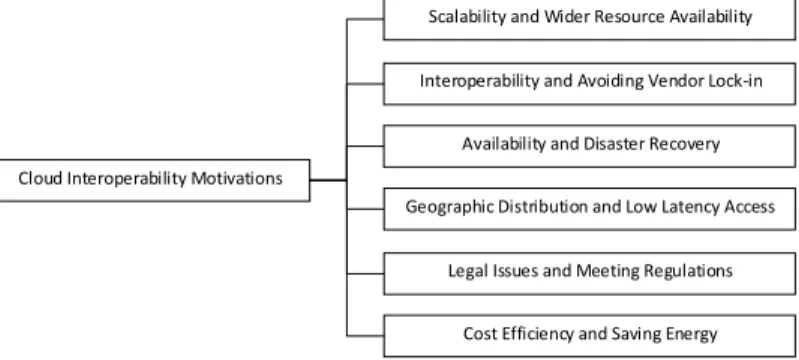
Cloud computing has already provided considerable capabilities for scalable, highly reliable, and easy to deploy environment for its clients. Nevertheless, the benefits of interconnected Cloud environments for both Cloud providers and their clients are nu-merous and there are essential motivations for Cloud interoperability, which will even-tually lead to the Inter-Cloud. In this section, key benefits of an Inter-Cloud environ-ment have been summarized as demonstrated in Figure 4.
6Gartner, http://www.gartner.com/.
Scalability and Wider Resource Availability
Interoperability and Avoiding Vendor Lock-in
Availability and Disaster Recovery Cloud Interoperability Motivations
Geographic Distribution and Low Latency Access
Legal Issues and Meeting Regulations
Cost Efficiency and Saving Energy
Fig. 4. Cloud Interoperability Motivations
3.1. Scalability and Wider Resource Availability
Even though one of the key features of Cloud Computing is the illusion of infinite re-sources, capacity in Cloud provider’s data centers are limited and eventually can be fully utilized [Calheiros et al. 2012a; Aoyama and Sakai 2011]. Growth in the scale of existing applications or surge in demand for a service may result in immediate need of additional capacity in the data center. Current service providers handle this issue by over-provisioning of data center capacity. That is, the average demand of the sys-tem is several times smaller than the capacity of their computing infrastructure. This strategy and the cost of its operation constitute a large expense for Cloud owners. Actual usage patterns of many real-world application services vary with time and most of the time in unpredictable ways. Therefore, as we stated earlier, unexpected loads can potentially overburden a single Cloud provider and lead to unreliable and interrupted services. It is overly restrictive in terms of small-size or private Clouds. If Cloud providers were able to dynamically scale up or down their data center capacity, they could save substantial amount of money and overcome the above issue. Scalable provisioning of application services under variable workload, resource, and network conditions is facilitated by interoperation of the Clouds [Buyya et al. 2010]. Cloud Fed-eration helps the peak-load handling capacity of every enterprise Cloud by resource sharing, without having the need to maintain or administer any additional computing nodes or servers [Rochwerger et al. 2009].
One may argue that public Cloud providers are outstandingly elastic, with the per-ception of unlimited resources, so providers never need immediate additional capacity in their data center and they never fit into the above scenario. However, this claim does not obviate the need for additional capacity by small size private Clouds and for those applications requiring expansion across geographically distributed resources to meet Quality of Service (QoS) requirements of their users [Buyya et al. 2010].
3.2. Interoperability and Avoiding Vendor Lock-in
In economics, vendor lock-in is a situation where a customer becomes dependent on a vendor for its products or services and cannot move to another vendor without consid-erable cost and technical effort. It is also perceived as one of the current drawbacks of Cloud computing [Armbrust et al. 2010]. With respect to Cloud computing, dor lock-in is the direct result of the current difference between the individual ven-dor paradigms based on non-compatible underlying technologies, and the implicit lack of interoperability. Contemporary Cloud technologies have not considered interoper-ability in design [Rochwerger et al. 2009; Bernstein et al. 2009]; hence, applications are usually restricted to a particular enterprise Cloud or a Cloud service provider.
By means of Cloud interoperability, Cloud application deployment no longer needs to be customized. Cloud Interoperability makes Cloud services capable of working to-gether and also develops the ability of multiple Clouds to support Cross-Cloud appli-cations [Bernstein et al. 2009].
3.3. Availability and Disaster Recovery
Although high availability is one of the fundamental design features for every Cloud service, failure is inevitable. For instance, recently Amazon Web Services suffered an outage, and as a result, a group of large customers dependent on Amazon affected se-riously8. Unexpected failures can easily impose service interruption on a single Cloud
system. Aoyama and Sakai [2011] look into an instance of a service failure in which a Cloud system witnesses a natural disaster. They identify the most important re-quirements for disaster recovery through Cloud federation. In order to enable Cloud providers to continue the delivery of guaranteed service levels even in such cases, a flexible mechanism is needed to relocate resources among the multiple Cloud systems. Moreover, highly-available Cloud applications can be constructed by multiple Cloud deployment to guarantee the required service quality, such as service availability and performance. Thus, Cloud systems complement each other by mutually requesting re-quired resources from their peers.
3.4. Geographic Distribution and Low Latency Access
It is highly unlikely that a single Cloud provider owns data centers in all geographic locations of the world to meet the low-latency access requirement of applications. More-over, existing systems do not support mechanisms to dynamically coordinate load dis-tribution among different Cloud data centers. Since predicting geographic disdis-tribution of users consuming a Cloud provider’s services is not trivial, the load coordination must happen automatically, and distribution of services must change in response to changes in the load [Buyya et al. 2010]. Utilizing multiple Clouds at the same time is the only solution for satisfying the requirements of the geographically-dispersed service con-sumers who require fast response time. Construction of a federated Cloud computing environment is necessary to facilitate provisioning of such application services. Con-sistent meeting of the QoS targets of applications under variable load, resource and network conditions is possible in such an environment.
3.5. Legal Issues and Meeting Regulations
Many Cloud customers have specific restrictions about the legal boundaries in which their data or application can be hosted [Schubert et al. 2010]. Supplying resources in specific geographic locations to meet regulations in place of those customers is an essential issue for a provider who wants to serve them. These regulations may be le-gal (e.g. an existing legislation specifying that public data must be in the geographic boundaries of a state or country) or defined by companies’ internal policies [Calheiros et al. 2012a]. Cloud interoperability provides an opportunity for the provider to iden-tify another provider able to meet the regulations due to the location of its data center.
3.6. Cost Efficiency and Saving Energy
The “Pay-as-you-go” feature of Cloud Computing directly awards economic benefits for customers by removing the cost of acquiring, provisioning, and operating their own infrastructures [Armbrust et al. 2010]. On the other hand, Cloud computing providers should avoid the problem of the idle capacity (where their in-house hardware is not
fully utilized all the time) and the problem ofpeaks in demand(where their own sys-tems would be overloaded for a period). As the average demand of the system is sev-eral times smaller than the peak demand [Armbrust et al. 2010], providers are able to lease part of their resources to others, in order to avoid wasting their unused re-sources. Moreover, they can manage peaks in demand by purchasing resources form other underutilized providers. Both strategies help them to gain economies of scale, an efficient use of their asset and enlargement of their capabilities through enhanced re-sources utilization [Celesti et al. 2010a]. Furthermore, this cooperation among Cloud providers lower the energy usage by promoting efficient utilization of the computing infrastructure.
In a recent study done by Le et al. [2011], the plausibility of reducing cost and en-ergy consumption by interconnecting Clouds data centers has been investigated. They present a scenario in which a provider is able to save money by placing and migrat-ing load across multiple geographically distributed data centers to take advantage of time-based differences in electricity prices. In addition, their policies reduce the re-quired cooling power considering data centers located in areas with widely different outside temperatures. In general, a unified interface that provides federated interop-eration between Clouds would help providers saving cost and also reducing carbon footprint by energy-efficient utilization of physical resources.
4. CLOUD INTEROPERABILITY SCENARIOS
“Cloud computing refers to both the applications delivered as services over the inter-net and the hardware and systems software in the data centers that provide those services” [Armbrust et al. 2010]. In this definition data center hardware and software is calledCloudand the services can be sold in low level abstraction like Amazon EC29
or higher level like Google AppEngine10. When a Cloud is available to the public in a
pay-as-you-go manner, it is calledpublicCloud and when a Cloud belongs to a business or an organization, not made available to the public, it is calledprivateCloud.
Cloud environments include multitude of independent, heterogeneous, private and public Clouds. Based on Celesti et al. [2010a], the evolution of Cloud computing can be hypothesized in three subsequent phases:Monolithic,Vertical Supply Chainand Hor-izontal Federation. In monolithic stage, Cloud providers are based on their own pro-prietary architectures that create islands of Cloud. Cloud services are delivered by dif-ferent providers in this stage. In the vertical supply chain stage, some Cloud providers leverage services from other providers. For example a SaaS provider deploys services of an IaaS provider to serve its own customers. In horizontal Federation, different size Cloud providers federate themselves to gain benefits of a Cloud federation. For exam-ple a fully utilized IaaS provider may use resources in an underutilized provider to accommodate more VM requests.
The main stakeholders in Cloud Computing scenarios are Cloud users andCloud providers(CPs). Cloud users can be either software/applicationservice providers(SPs) who have their service consumers orend userswho use the Cloud computing services directly. SPs offer economically efficient services using hardware resources provisioned by CPs, i.e. CPs offer utility computing service required by other parties. Different combinations of Cloud providers (CPs) and Cloud users (SPs or End-Users) give rise to a number of plausible scenarios between Clouds [Ferrer et al. 2012].
According to above discussion, if interconnection happens between Clouds at differ-ent levels of Cloud stack layer (Figure 5), for example a PaaS and IaaS provider, we call itdelegationorvertical federation. But if interconnection between Clouds happens
9Amazon EC2, http://aws.amazon.com/ec2/.
at same layer (e.g. IaaS to IaaS) we call it horizontal federation. Since the adoption of the later faces many more hurdles, in this paper we are mostly interested in the horizontal federation. Villegas et al. [2012] consider that a federated Cloud structure can be viewed as a vertical stack analogous to the layered Cloud service model. At each layer, a service request can be served either through local resources using delegation, or by a partner Cloud provider through federation.
SaaS (Software as a Service) PaaS (Platform as a Service) IaaS (Infrastructure as a Service) Resources (Compute, Storage, Network)
Fig. 5. Cloud service stack
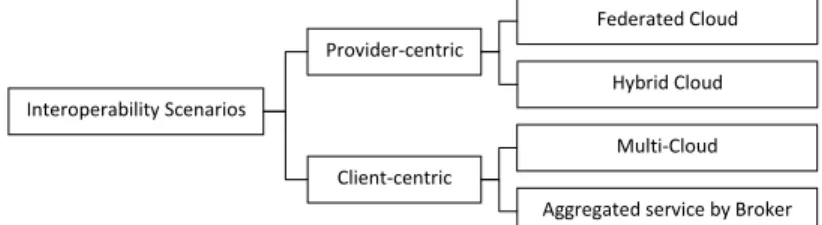
If Cloud interoperability requires Cloud providers to adopt and implement standard interfaces, protocols, formats and architectural components that facilitate collabora-tion, we call thatprovider-centricinteroperability. Provider-centric scenarios are cate-gorized asHybridandFederatedCloud scenarios. Inclient-centricinteroperability, in-teroperability is not supported by Cloud providers and Cloud customers are required to initiate it by themselves or via third party brokers. This kind of interoperability does not require prior business agreement among Cloud providers and it allows multiple Cloud scenarios without adoption of common interfaces and protocols or with minimal adoption of the same. We consider Multi-cloudand Aggregated Service by Brokeras client-centric interoperability scenarios. Figure 6 depicts the discussed classification and the remaining part of this section describe each scenario in detail.
Provider-centric Interoperability Scenarios Client-centric Federated Cloud Hybrid Cloud Multi-Cloud
Aggregated service by Broker
Fig. 6. Cloud Interoperability Scenarios
4.1. Federated Scenario
In this scenario, SP establishes a contract with CP that itself is a member of fed-eration. A group of Cloud providers are federated and trade their surplus resources amongst each other to gain economies of scale, efficient use of their assets, and ex-pansion of their capabilities [Celesti et al. 2010a], e.g. to overcome resource limitation during spike in demands. In this model, the computing utility service is delivered to SP using resources of either one CP, or combination of different Cloud providers. In such a scenario SP might be unaware of the federation and its contract is with a single Cloud provider (Figure 7).
SP/End-User Public Cloud Provider C Private Cloud Provider B Public Cloud Provider A
Fig. 7. Federated Cloud Scenario
4.2. Hybrid Cloud Scenario
In hybrid Cloud architecture, an organization that owns its private Cloud moves part of its operations to external CPs. The organization can also sell idle capacity to other providers during periods of low load. This extension of a private Cloud to combine local resources with resources from remote CPs is called hybrid Cloud. In this scenario, SP/end user application can scale out through both private and public Clouds when the local infrastructure is insufficient. Furthermore, this scenario can be extended if the organization offers capacity from its private Cloud to others when that capacity is not needed for internal operations (Figure 8).
SP/End-User
Public Cloud Provider Private Cloud
Provider
Fig. 8. Hybrid Cloud Scenario
4.3. Multi-Cloud Scenario
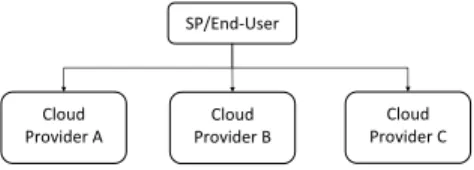
In this scenario, SP or end-users are responsible to manage resources across multiple Clouds. Service deployment, negotiating with each CP, and monitoring each CP during service operation are performed by the SP or end-user applications. In this case, the SP may require using an adapter layer with different APIs to run services on differ-ent Clouds or similarly end-user application needs a proper abstraction library. The important point about this scenario is that a separated layer handles all the issues re-garding aggregation and integration of the Clouds which is entirely apart from vendors and providers (Figure 9).
SP/End-User Cloud Provider C Cloud Provider B Cloud Provider A
Fig. 9. Multi-Cloud Scenario
4.4. Aggregated Service by Broker
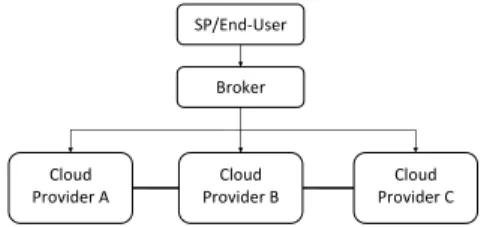
A new stakeholder, broker, aggregates services from multiple CPs and offers an inte-grated service to the SPs or end-users. The deployment and management of compo-nents has been abstracted by the third party broker. SPs or end-users benefit greatly from this model as the broker can provide a single entry point to multiple Clouds. In
this model, providers may also require to install some internal components to support aggregated services by a trusted broker (Figure 10).
Broker Cloud Provider C Cloud Provider B Cloud Provider A SP/End-User
Fig. 10. Aggregated Service Broker Scenario
5. INTER-CLOUD CHALLENGES AND ENABLING APPROACHES
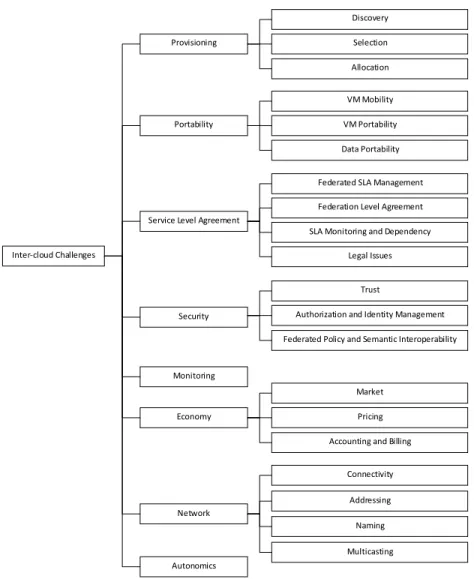
Inter-Cloud raises many more challenges than Cloud computing. In this section, the main challenges of Cloud interoperability will be examined as listed in Figure 11.
5.1. Provisioning
5.1.1. Discovery.Cloud Service discovery allows automatic detection of services and
resources offered by Cloud providers on the Internet. Since Cloud providers offer a va-riety of services and use different ways to describe them, a way to provide a common access to Cloud services and to discover and deploy them is necessary. Cloud customers require selection of the best possible application deployment in the Cloud according to their objectives and constraints for quality of service (QoS). Achieving this goal re-quires effective discovery of the available services and their characteristics. In general, even though there are various forms of Cloud services, discovery of services hosted in Clouds has not received enough attention yet. For instance, Google App Engine and Amazon EC2 do not offer discovery services, and Microsoft Azure and Force.com offer limited discovery capabilities [Goscinski and Brock 2010].
One of the main issues regarding service discovery in a multiple-Cloud deployment is the lack of an integrated repository of Cloud services. Ranjan and Zhao [2011] be-lieve that centralized approaches for integrated service catalog are not appropriate due to concerns of scalability, performance, and reliability arising from large volume of ser-vice requests. They present a peer-to-peer Cloud serser-vice discovery over a Distributed Hash Table (DHT) overlay network. In contrast, Bernstein and Vij [2010a] argue that a Point-to-Point discovery architecture result in then2 complexity problem, and they propose Intercloud Root InstancesandIntercloud Exchangesto solve the problem. In fact, Intercloud Root provides a service catalog, which is an abstracted view of the resources across disparate Cloud environments.
Another issue is that Cloud providers describe their services with diverse languages, terms, and names. Moreover, there is not a common understanding regarding service functionalities, their QoS, and metrics among providers and customers. In a hetero-geneous environment such as Inter-Cloud, it is difficult to enforce a standard syntax on service description or common metrics. Therefore, the use of syntactic-based ap-proaches such as Universal Description, Discovery and Integration (UDDI)11 is not
applicable. Moreover, the Web Service Description Language (WSDL) which is used by UDDI, does not support modeling of QoS properties and it is difficult to add them. According to several recent studies [Bernstein and Vij 2010a; Moscato et al. 2010], the
Network Economy Monitoring Security Provisioning Portability
Service Level Agreement
Inter-cloud Challenges Discovery Selection Allocation VM Mobility VM Portability
Federated SLA Management
Federation Level Agreement
SLA Monitoring and Dependency
Market
Pricing
Accounting and Billing
Connectivity Addressing Naming Multicasting Data Portability Legal Issues Autonomics Trust
Authorization and Identity Management
Federated Policy and Semantic Interoperability
Fig. 11. Taxonomy of Inter-Cloud challenges
solution that covers mentioned drawback is a semantic web service that can increase expressiveness, flexibility, and accuracy of the service discovery by the application of ontologies for representation of the service properties. However, a detailed discussion about ontology-based approaches in this regard falls outside the scope of this survey.
Finally, states of a large part of services in Clouds change constantly and are dy-namic in nature. The situation is even worse in interconnected Cloud environments. Consequently, dynamic attributes should be added to Cloud services and a web service based resources. A general framework for service and resource publication, discovery, and selection using dynamic attributes that expose current state and characteristics via web services has been proposed by Goscinski and Brock in [2010].
5.1.2. Selection.Optimal application deployment in Cloud requires an effective
selec-tion strategy that works based on QoS criteria such as reliability, cost, and security and returns the set of most suitable Cloud services for end customers. Cloud service
selection did not receive much attention in the literature mostly due to the lack of reliable data on Cloud services QoS criteria.
Currently, selection is performed manually by Cloud customers based on their re-quirements or through consultant companies. In multiple Cloud application deploy-ment scenarios, selection is not a trivial task due to the diversity of Cloud services characteristics and QoS. However, application deployment across multiple providers benefits from significant features such as the range of geographical locations, lower latency, higher reliability, lower deployment cost, higher failure resistance, and etc. Consequently, an automated selection approach for application deployment is well motivated to optimize different aspects such as latency, reliability, throughput, data transfer, and cost. In addition, such a selection approach must take into account dif-ferent constraints such as legal issues or security concerns.
The selection process can be performed based on either static information on the service quality provided by Cloud providers or through dynamic negotiation of SLAs. Limited support is currently available for dynamic negotiation of SLAs [Petcu et al. 2011]. In order to design an infrastructure for negotiation and management of SLA in Cloud, several issues need to be addressed. A few Cross-Cloud projects, e.g. mO-SAIC [Petcu et al. 2011], focus on agent-based dynamic negotiation for Cloud services. OPTIMIS, a toolkit proposed by Ferrer et al. [2012], focuses on Cloud service and infrastructure optimization throughout three phases of the service life cycle includ-ing construction, deployment, and execution. In its deployment engine component, the OPTIMIS risk assessor provides multiple-criteria evaluation of Cloud services using Dempster-Shafer Analytical Hierarchy Process (DS-AHP)12. The criteria that are used
for evaluation can be generally classified as: past performance, maintenance, security, customer support, and legal aspects. A value between 0 and 1 is computed for each of the criterion by evaluating a provider. These values are used as the basis for the final selection.
Another framework called CloudGenius has been introduced by Manzel and Ran-jan [2012]. The framework provides a web application migration process and decision support. Cloud customers are able to migrate Web applications to the Cloud along a process that suggests Cloud VM images and Cloud infrastructure services according to requirements and goals of the Cloud customer.
Han et al. [2009] present a Cloud service selection framework in the Cloud market that recommends best services from different Cloud providers that match user require-ments. Their framework ranks different services with providers and presents it to the user so that they can select the appropriate or optimal services.
Resources and services in Clouds can be represented by web services. There are considerable works in the context of SOA and Grid web service selection. As a result, their contribution can be shared to tackle selection problem in Clouds.
5.1.3. Allocation. Service selection in the customer’s side leads to resource allocation in
the provider’s side. Resource allocation is a challenging issue from the Cloud provider’s perspective. Cloud providers usually offer their virtualized resources based on differ-ent QoS levels, e.g. best effort and reserved. Physical resources in Clouds are shared between Cloud users. Therefore, allocation strategies are needed to allocate resources to the requests in a profitable manner while fulfilling requests’ QoS requirements.
As the number of resource consumers are increasing, Clouds need to share their resources with each other to improve their quality of service. In general, such a
collab-12The AHP is a structured technique for organizing and analyzing complex decisions and helps decision makers to find one that best suits their goal and their understanding of the problem. The DS theory is a mathematical theory that allows combining evidence from different sources to achieve a degree of belief.
orative Cloud computing system (e.g. Cloud federation) is prone to contention between user requests for accessing resources [Salehi et al. 2012]. Contention happens when a user request cannot be admitted or cannot acquire sufficient resources because re-sources are occupied by other requests (e.g. requests from federated Cloud Provider). We call this issue “resource contention” from here onwards.
Resource contention is not a new issue in federated environments. Various solutions have been proposed for the resource contention problem in federated Cloud environ-ments and other interconnected distributed computing systems [Salehi et al. 2012; Rochwerger et al. 2009; Toosi et al. 2011]. There is growing interest in the adop-tion of market-based approaches for allocaadop-tion of shared resources in computaadop-tional systems [Mihailescu and Teo 2010b]. Mihailescu and Teo [2010b] propose a dynamic pricing scheme for federated sharing of computing resources, where federation partic-ipants provide and use resources. They show that in their proposed dynamic scheme, the user welfare, the percentage of successful requests, and the percentage of allo-cated resources increase in comparison to the fixed pricing [Mihailescu and Teo 2010d]. Toosi et al. [2011] propose a model for trading of Cloud services based on compet-itive economic models. They consider circumstances in which Cloud providers offer on-demand and spot VMs while they participate in a federation13. The resource
man-ager unit evaluates the cost-benefit of outsourcing an on-demand request to a third party or allocating resources via termination of spot VMs. Their ultimate objective is to decrease the rejection rate and have access to seemingly unlimited resources for on-demand requests. Gomes et al. [2012] propose and investigate the application of market-oriented mechanisms based on the General Equilibrium Theory to coordinate the sharing of resources between Clouds in the federated Cloud. Goiri et al. [2011] propose an economic model that characterizes situations that assist decisions in a fed-erated Cloud, namely when to outsource resources to other providers, when to admit requests from other providers, and how much capacity contribute to the federation.
5.2. Portability
5.2.1. VM Mobility. The challenges regarding live Virtual Machine (VM) migration
be-tween physical nodes under the same administrative domain has been addressed pre-viously in both industry and academia. The main challenge in this regard is that VMs require storage and network services from their hosts and once a VM is live migrated from a host to another host, it still requires access to the storage and network ser-vices of the source host. Traditional support for live VM migration resolved this is-sue by a shared storage device and hosts which are connected to the same local area network (LAN) [Nagin et al. 2011]. However, storage and network environments of different Clouds are generally independent and are separated by firewalls.
VM Mobility is defined as the ability to move a running VM from one host to an-other without stopping it [Dowell et al. 2011]. In Inter-Cloud scenario, Cloud appli-cation might require VM mobility. Moreover, Inter-Cloud VM Mobility should not vi-olate the independence of the respective Clouds in terms of autonomy, privacy, and security. VM migration, from a source Cloud to a destination one over a Wide Area Network (WAN) constitutes transferring memory, status, and storage of the VM. Ac-cording to Nagin et al. [2011], Cross-Cloud VM migration requires the following: (1) Memory and state transfer between hosts residing in different data centers. (2) Same LAN access by VMs at the destination host, without two sites sharing LAN.
13Spot VMs are VMs that can be terminated by providers whenever the current value for running such VMs (defined by the provider) exceeds the value that the client is willing to pay for using such resource.
(3) Same storage access by VMs at the destination host, without two sites sharing storage.
VM Mobility requires a VM transfer form one physical machine to another without disrupting the network traffic flow. Some hypervisors allow a running VM to migrate from one physical Authorization and Identity Managementmachine when they are con-nected to the same local area network, e.g. XEN and KVM. However, long-distance VM Mobility between sites with separate LANs in federated Cloud environment, as we stated earlier, must ensure that migrated VM will have access to the same LAN at the destination host, without a sharing LAN between two sites.
The suggested approach is extending LANs between sites using Wide Area Network (WAN) encapsulation technologies, like F5, global traffic manager, by VMware14 or
VMware and Cisco Migration Solution15. However, such LAN extensions may violate
provider’s IT infrastructure autonomy, security, and privacy requirements. A virtual networking technology is needed that will allow VMs connected to the same virtual network to communicate with each other over a private and isolated virtual network within and across Clouds, systems like Vine [Keahey et al. 2009] and VNET [Sun-dararaj et al. 2004]. Regarding this issue, authors in [Nagin et al. 2011] propose proxy servers at the source and destination Clouds that communicate with each other while hiding the details of the source and destination hosts. In section 5.6, we discuss chal-lenges regarding the VM mobility in more detail.
5.2.2. Data portability. Users or applications that store data in Cloud, especially for
SaaS and PaaS applications, often require access to the data so that it can be used by services of other Cloud providers. Giving users control over their data is an important part of establishing trust and is paramount for creating interconnected Cloud environ-ments allowing users to easily move their data from one Cloud to another [Fitzpatrick and Lueck 2010]. If a Cloud provider stores data in their own proprietary format, then users cannot move their data to other vendors without considerable cost and technical effort. Therefore, industry standards and exporting tools or at the very least formats that are publicly documented are required to avoid data lock-in. Nowadays, data porta-bility is hindered by the lack of proper technology and standards and non-portaporta-bility of the applications and data, which is exploited by Cloud service providers for they own benefits [Petcu et al. 2013].
According to Hill and Humphrey [2010] solutions for avoiding data lock-in can be classified in following categories:
(1) Using APIs that have multiple independent implementations, for example Amazon EC2 APIs, which are used by several others such as Eucalyptus [Nurmi et al. 2009]; (2) Choosing a particular API that can run on multiple Clouds, e.g. MapReduce and
Hadoop;
(3) Manually decoupling the Cloud-specific code of the application designed for each Cloud provider from the application logic layer;
(4) Creation of widespread standards and APIs; and
(5) Utilization of vendor-independent Cloud abstraction layers such as Jcloud16 and
libcloud17.
In fact, the main obstacle for data movement in interconnected Cloud environments is the lack of standard metadata and data formats. To deal with this issue,
platform-14http://www.f5.com/pdf/solution-center/f5-for-virtualized-it-environments.pdf.
15http://www.cisco.com/en/US/solutions/collateral/ns340/ns517/ns224/ns836/white paper c11-557822.pdf. 16jclouds, http://code.google.com/p/jclouds/.
independent data representation and standardization of data import and export func-tionality between providers is needed [Petcu et al. 2013].
Google [Fitzpatrick and Lueck 2010] attempts to address this problem through its Data Liberation Front18, whose goal is to make it easier to move data in and out of
Google products. This is a step towards what is calledData liberationby Google and provides freedom of data movement between Clouds. The data liberation effort focuses specifically on tools and methods that allow users to export any data they create and import into another service or competing products.
CSAL [Hill and Humphrey 2010] is a Cloud Storage Abstraction Layer to enable portable Cloud applications and supports three storage abstractions: Blobs, Tables, and Queues. CSAL implementation provides a single unified view of Cloud storage across platforms, and manage the meta-data necessary for utilizing storage services across multiple Clouds.
Bernstein and Vij [2010c] proposed the Simple Storage Replication Protocol (SSRP) for a federated Cloud environment that facilitates distributed unstructured storage (e.g. Blobs) connectivity between Clouds in a point-to-point manner.
Petcu et al. [2013] proposed APIs for the mOSAIC project [Petcu et al. 2011] that provides portable Cloud application development solutions.
Bermbach et al. [Bermbach et al. 2011] presents MetaStorage, a federated Cloud storage system that replicates data on top of diverse storage services using scalable distributed hash-table.
5.3. Service Level Agreement
5.3.1. Federated SLA Management.Cloud providers define (or negotiate with customers)
a Service Level Agreement (SLA) to specify what they guarantee. In a simple defini-tion, SLA is a contract that describes a service, and most importantly, sets the expected service level objectives (QoS expectations). It can even encompass more details such as penalties applied to the provider if it does not deliver services according to the service level objectives. Implementation of SLA mechanisms on top of federated resources is still an open question. Being an area whose volume of ongoing works enables a survey of its own, we are not intended to cover all issues related to the SLA management in this paper.
In federated Cloud environments, it is expected that each participant Cloud provider has its own SLA management mechanisms. Since user applications in such an environ-ment exploit services and resources from different providers, one role of the federation is to setup and enforce a global SLA. By global SLA, we mean comprehensive SLAs between the user and the federation including all SLAs for each Cloud provider. The federation should monitor the application in order to verify that the SLA is met by providers and should react to SLA violations.
In federated Cloud environments, the entity that acts as a mediator between the Cloud consumer and interoperable Cloud providers must select services from different providers that better meet the user requirements. In such a dynamic environment, Cloud providers can offer or meet guarantees according to their resource situation at the time the service is requested. Moreover, the service provided for the user might be composed of services from different providers. Hence, methods and protocols for negotiation of dynamic and flexible SLAs is a must for dynamic environments such as Inter-cloud. This demands that agreements are established dynamically on the time the service is requested, rather than advertised as an invariant property of the service. A similar scenario happens when a broker of service acting on behalf of the user selects services among multiple Cloud providers. There are several proposals
ing the negotiation of dynamic and flexible SLAs in service oriented environments in-cludingWS-Agreement[Andrieux et al. 2004] andWS-Agreement Negotiation[Battr´e et al. 2010]. WS-Agreement provides a language and protocols for creation agree-ments based on offers and for monitoring of agreement compliance at runtime. WS-Agreement supports a one-round negotiation process, whereas WS-WS-Agreement Ne-gotiation can be used when a more flexible and dynamic neNe-gotiation process is re-quired. WS-Agreement Negotiation provides re-negotiation capabilities on top of the WS-Agreement specification.
Another important issue in federated Cloud environment is how SLAs can be en-forced in a federation where there are conflicting policies and goals of different mem-bers versus the objectives of the federation as a whole. For example, the federation layer can offer an SLA that promises highly reliable service, while none of the federa-tion members, which are self interested parties trying to maximize their revenue, are willing to offer such a service which is costly.
There are a few works in the literature Authorization and Identity Management-that addressed SLA management in the context of federated Cloud environment. Con-trail [Carlini et al. 2012] is a project that proposes a federated and integrated Cloud architecture. They provide extended SLA management functionalities by integrating the SLA management approach of the SLA@SOI19 project in the federation
architec-ture. The Contrail federation coordinates the SLA support of different Cloud providers. As Cloud providers in Cloud federation have their own SLA management mechanisms, Contrail tries to setup, coordinate, and enforce a federation-level SLA. In the context of the mOSAIC project [Petcu et al. 2011], there also exists facilities in order to offer user-oriented SLA services to final users [Amato et al. 2012]. Cuomo et al. [2013] pro-pose an SLA-based broker operating in a volunteer computing environment to discover the most suitable resources to a user when resources are not reliable and can provide QoS comparable to those offered by commercial Cloud providers.
5.3.2. Federation-Level Agreement. In addition to SLA, there can be a contract – so called
Federation Level Agreement (FLA) – which includes the set of rules and conditions that has to be signed by new providers once they join the federation [Toosi et al. 2011]. For example, a federation can set rules for minimum resources contributed to feder-ation or the set of QoS such as minimum expected availability. In a more complex scenario, federation can set different rules to have multiple pools of resources with different QoS guarantees.
5.3.3. SLA Monitoring and SLA Dependency. In federated Cloud environments where a
provider outsources its load to another provider, it expects a set of guaranteed QoS that is compatible to the promised QoS to end users. Therefore, either the federation has to provide a service to match end user QoS requirements, or Cloud providers have to do it on their own. In addition, in the Cloud Federation environment, there might be dependencies between performances of services provided by different providers. As explained in “practical guide to Cloud service level agreements by Cloud Standards Customer Council”20, there can be an environment where a Cloud user has a SLA
with a provider, and the Cloud provider by itself has SLAs with two Cloud providers and utilizes their resources to provide services to the end user. Therefore, quality of a service can be affected by external services. It means that if one of the lower-layer services (e.g. infrastructure layer) is not functioning properly, it can affect the
perfor-19SLA@SOI, http://sla-at-soi.eu/.
20Practical Guide to Cloud Service Level Agreements: A white paper by Cloud Standards Customer Council, http://www.cloudstandardscustomercouncil.org/2012 Practical Guide to Cloud SLAs.pdf.
mance of higher-layer services (e.g. Software layer). A practical approach is required to model the dependencies among services.
Winkler et al. [2010] propose an approach for automated management of SLAs to support composite services. In that approach, the explicit knowledge about a set of dependencies to automate the tasks of negotiation and renegotiation of SLAs, and the handling of Service Level Objective (SLO) violations are taken into account.
Bodenstaff et al. [2008] propose an approach called MoDe4SLA to monitor dependen-cies between SLAs when managing composite services. In that case, different types of dependencies between services and the impact that services have on each other are an-alyzed during the development phase. The approach has not provided an Inter-Cloud language to share common understanding regarding the QoS criteria and their mea-surement units.
Dastjerdi et al. [2012] show how dependency knowledge can be modeled using se-mantic technology, and how that knowledge can be used in discovery of monitoring services and SLA failure detection. The major contributions of the work are model-ing services performance inter-dependencies and elimination of SLA failure cascadmodel-ing effects on violation detection.
5.3.4. Legal Issues.Interconnected Cloud computing environments extricate
applica-tions from being confined to a single data center and open opportunities for globalizing and integrating services from multiple and disparate geographies. Besides technical complexities of interconnecting Clouds, legal issues might arise with the realization of Inter-cloud. Cloud computing by itself requires consideration of a broad set of legal issues such as privacy and security, contracting issues, issues related to location and ownership of data, and business considerations [Bowen 2010]. Inter-cloud makes ex-isting legal issues more complicated and also introduces new ones. Major part of these issues requires defining new laws and regulations beyond technical innovations and falls out of the scope of this survey. Readers who are interested in where legal issues might arise in Cloud federation are referred to [Kertesz and Varadi 2014].
When different organizations are involved in providing services for customers, one major issue is that it is difficult to guarantee confidentiality and privacy on data, espe-cially when data is located in different countries with different laws. Cloud providers in interconnected Cloud environments must provide mechanisms to guarantee the secu-rity and privacy on sensitive data within legal borders. For example, in a federated sce-nario that a Cloud provider leverage another provider’s services and customers might not generally have control on where the service they are leasing is operating, in case of failures in the service delivery it will be difficult for the Cloud user to identify the real causes. Moreover, legislation and laws concerning the privacy and security of data is different among different countries, and even different states within the same country. For instance, based on the European Union (EU) directive any personal data gener-ated within the EU is subject to the European law and data cannot leave EU unless it goes to a country that provides adequate level of protection [Bowen 2010]. The US PA-TRIOT act21allows U.S. government to gain access to personal financial information
and student information stored in electronic systems just by providing a governmental certificate that the information might be relevant to criminal activities [Bowen 2010]. From the technical point of view, in interconnected Cloud environments, applica-tion deployment requires that juridical and legislative restricapplica-tions to be considered. Therefore, Geo-location and legislation awareness policies must be imposed into the entity that acts as a mediator between the Cloud consumer and interoperable Cloud
21Uniting and Strengthening America by Providing Appropriate Tools Required to Intercept and Obstruct Terrorism Act of 2001 (USA PATRIOT Act).
providers (e.g. Broker or Federation Layer) [Grozev and Buyya 2012] and compliance with such policies and agreement must be enforced. For instance, as part of SLA man-agement system, services of specific vendors can be avoided or placing the data outside a given country can be prohibited.
Management of legal issues for Inter-cloud requires defining a comprehensive body of laws compliant with all the legislation of the countries involved in possible transac-tions among Cloud providers and users. This falls beyond technical aspects and con-stitutes efforts by legislatures to facilitate Inter-cloud by defining proper laws and regulations.
5.4. Security
5.4.1. Trust. In a social context, trust typically refers to a situation where one party is
willing to rely on the actions of another party. The control over the actions is abandoned by the former to the latter. Ultimately, there is an uncertainty if the trusted party will behave or deliver as promised.
In Cloud computing environment, customers must trust on a Cloud provider for the privacy and security of their assets, i.e. their data and processes. The degree of lost control over the data and processes depends on the Cloud service model. In Cloud com-puting, the risk of losing data confidentiality, integrity, and availability for customers is triggered by the lack of control over the data and processes [Khan and Malluhi 2010]. In interconnected Cloud environments, establishment of trust is even more impor-tant and complex [Bernstein and Vij 2010b] as besides the customers, Cloud providers must trust on each other. In Inter-Cloud scenario, trust and reputation of a Cloud provider affects other Cloud providers. Specifically, as Inter-Cloud computing con-stitutes collaboration between independently owned autonomous Clouds, and these providers peer with each other to outsource requests or data, there is a need for mech-anisms to evaluate the trustworthiness of a federation member [Abawajy 2009].
Apart from reputation-based trust, because of the criticality of many computing tasks and diversity and vastness of services in Inter-Cloud environments, formal trust mechanisms are required to help Inter-cloud entities i.e. providers and users to trust each other. A formal process for assessment of Cloud services and their providers in such a highly dynamic system requires independent third parties which is acceptable to all entities. The concept oftrust federationscan be used in this regard. Trust Federa-tion is a combinaFedera-tion of technology and policy infrastructure that allows organizaFedera-tions to trust each other’s verified users to enable the sharing of information, resources and services in a secure and distributed way.
The International Grid Trust Federation (IGTF)22 is a prominent example of trust
federation that can be leveraged for Inter-Cloud scheme as well. IGTF is an organiza-tion that fosters harmonizaorganiza-tion and synchronizaorganiza-tion policies with the goal of enhanc-ing establishment of cross domain trust relationships for inter-grid participants. Grid entities use X.509 certificates for authentication and authorization. These certificates are issued by the Certificate Authorities (CAs) that are part of IGTF. In order to ensure compliance with established policies and guidelines, these CAs should be externally audited periodically. The IGTF has established such sets of policies and guidelines and ensure compliance to them between its members.
If we assume that the challenges regarding the trust evaluation of an Inter-Cloud provider has been overcome and a provider is able to find a trustable party to peer with, we still face challenge of building a trusted context for interconnected providers. In this trusted context, providers must be able to access each other’s services while they still adhere to their internal security policies.
Currently, Public Key Infrastructure (PKI) is the common trust model in Cloud en-vironments [Bernstein and Vij 2010b]. A public key infrastructure (PKI) is a system that verifies a particular public key belongs to a certain entity. The process is done through the creation, storage, and distribution of digital certificates. The PKI creates digital certificates which map public keys to entities, stores these certificates in a cen-tral repository securely, and revokes them if needed.
The current PKI certificates-based trust model only checks if the entity is either trusted or non-trusted. However, all or nothing trust model is not appropriate for Inter-Cloud environment in which Inter-Cloud providers may have different levels of trust on each other [Bernstein and Vij 2010b]. Thus, they suggest a dynamic trust level model lay-ered on top of the PKI certificate based trust model. Trusted context has been previ-ously investigated in other collaborative environments. However, customized enabling technologies such as XACML23 and SAML24 were also proposed to build a trusted
context for Cross-Cloud federation [Celesti et al. 2010a]. Abawajy [2009] propose a distributed framework that enables parties to determine the trustworthiness of other entities. The proposed trust framework is a reputation-based trust management sys-tem that enables a service requester to obtain the trustworthiness of the service.
5.4.2. Authorization and Identity Management. Identity Management (IdM) is an
adminis-trative task that deals with authentication of individuals in a system and authoriza-tion to access resources of the system based on the associated rights and restricauthoriza-tions. In Cloud computing environments, identity management services are mainly respon-sible for supporting access control to services based on user attributes (e.g. IP address, user and group name) and resource attributes (e.g. availability periods).
Identity management systems, in federated Cloud environments, should allow iden-tification of users and resources in addition to support interoperability across multiple identity domains [N ´u ˜nez et al. 2011]. In such a scenario, users should be able to ac-cess various resources and services offered by different service providers, once they were successfully authenticated in the Inter-Cloud interface [N ´u ˜nez et al. 2011]. One of the problems related to this issue is how to free users from the burden of authenti-cating with resources from multiple Cloud providers. In other words, since each Cloud has its own authentication mechanism, a standard method that provides Single Sign-On (SSO) authentication within Inter-Cloud environments should be deployed. This must be applied both for customer-provider and provider-provider interactions.
In federated environment, SSO issue can be achieved through thedelegation of trust that allows an entity to act on another entity’s behalf. This is especially important when resources and services of different service providers are involved in serving an Inter-cloud application and it might be redundant or very expensive to authenticate each and every time a user or application requires to access the resource. Utilizing proxy certificates is a common way of delegating of trust that is successfully used in Grid computing and service computing. This method allows entities of a federated system to securely interact and might require multiple levels of delegation by estab-lishingchain of trustof proxy certificates. SSO can also be achieved through the use of a trusted third party who will certify credentials on behalf of all parties in the feder-ation. In fact, instead of knowing all possible entities, it is enough to be able to verify claims from the trusted third party.
Effective identity management in Inter-Cloud environments requires support for es-tablished standards such as X.509 certificates, SAML, and WS-Federation [Bernstein
23eXtensible Access Control Markup Language (XACML), OASIS, https://www.oasis-open.org/committees/ xacml/.
and Vij 2010b]. These standards use different “languages” to express the identity infor-mation. A thorough solution is required to deal with these incompatibilities. Moreover, to solve the problem of different formats, names, and meanings for identity attributes, identification of common attributes or use of ontology is also suggested [N ´u ˜nez et al. 2011]. Consequently, interoperability of identity management systems is a key issue that has to be taken into account.
Another issue which must be considered is how to manage the life-cycle of identities. Typically, in the Inter-Cloud environment, digital identity information is required in many directories and data stores, but it is hard to keep them synchronized with each other and remove or disable entries when required. In this direction, Service Provi-sioning Markup Language (SPML) proposed by OASIS is a possible solution [N ´u ˜nez et al. 2011].
Celesti et al. summarize the requirements of Inter-Cloud Identity Management in two categories [Celesti et al. 2010a]:
(1) Single Sign-On (SSO) authentication, where a Cloud must be able to authenticate itself to gain access to the resources provided by federated foreign Clouds belonging to the same trust context without further identity checks;
(2) Digital identities and third parties, where a Cloud has to be considered as a subject distinctively identified by credentials and each Cloud must be able to authenticate itself with foreign Clouds using its digital identity guaranteed by a third party. They propose an Inter-Cloud Identity Management Infrastructure according to the selected technologies ranging from XMPP, and XACML to SAML [Celesti et al. 2010c]. Support of XACML-compliant entitlement management is highly desirable for Inter-Cloud environment [Bernstein and Vij 2010b]. XACML provides a standardized lan-guage and method of access control and policy enforcement.
Another main problem that must be taken into account for Identity management in large interconnected Cloud environments isscalability. Performance of any IdM needs to be scalable and operation must be agile and quick. With the current technologies for IdMs, security must be compromised in favor of scalability. Methods such as PKI performs based on the top-downapproach where each entity starts out knowing the Root Certificate Authority (CA), and retrieves all the certificates from the Root down to their own key. Root CA is the only trusted body to certify name-to-key mappings. However, for scalability purposes we require a hierarchy of CAs to be used. Approach such asFriend-of-a-Friend (FoaF)25that does not rely on the root of trust can be helpful
in this regard. FoaF provides machine-readable ontology for describing persons, their activities and their relations to other people and objects and commonly used in social networks. Although methods like FoaF provides less strong security, they are highly scalable and obviates the need for a centralized database.
All in all, Federated Identity Management (FIM) is a critical step towards the real-ization Inter-cloud. Identity federation can be accomplished in number ways from use of formal Internet standards, such as SAML and XACML specifications, to open-source technologies or other openly published specifications such as OpenID26, OAuth27and
WebID28.
Cloud computing provides on-demand resource provisioning using vast amounts of data and computing resources in centralized data centers and it was not designed based on the idea of federating distributed computing resources in geographically
dis-25Friend-of-a-Friend (FoaF) project, http://www.foaf-project.org/. 26OpenID, http://openid.net/.
27OAuth, http://oauth.net/. 28WedID, http://webid.info/.