Corresponding Author E-mail: [email protected]
287 | Page http://www.ijabbr.com
Available online at
International journal of Advanced Biological and Biomedical Research
Volume 2, Issue 4(2), 2014: 287-296
Prediction of Antibiotics Residues in Raw Milk by Using Binary Logistic Regression
Model
H.Yarabbi 1*, S.A. Mortazavi 2, M. Shafafi Zenozian 3, M. Mehraban Sang atash4
1
Young Researchers and Elite Club, Sabzevar Branch, Islamic Azad University, Sabzevar, Iran
2
Professor, Department of Food Science and Technology, Ferdowsi University of Mashhad, Mashhad, Iran
3
Assistant Professor, Department of Food Science and Technology, Islamic Azad University, Sabzevar Branch, Sabzevar, Iran
4
Research Instructor, Department of Food Quality and Safety, Institute of Food Science and Technology ACECR, Iran
Abstract
medical compounds, especially antibiotics, in which remains in milk and dairy products on the one hand causes health problems such as allergic reactions and Development of bacterial resistance to antibiotics are a serious threat to the health of consumers , and on the other hand, industrial troubles such as failure to produce fermented products can cause the milk back to the rancher. The purpose of this study is to determine the presence of antibiotic residues in raw milk ,milk in a timely manner after receiving a detailed mathematical model. 120 samples of bulk tank milk were randomly selected from 10 collection centers and farms Industrial in the Province of Khorasan Razavi (Iran). The presence of antibiotic residues and microbial and physicochemical properties were evaluated. Then based on different variables , binary logistic regression model to predict the presence or absence of antibiotic residues in milk were determined using the software SPSS Statistics ver.22.0. Somatic cells and electrical conductivity was the main determined factor of model in summer season equation. Also in autumn season equation, somatic cells and acidity were the main factors. The results are indicative of the relationship between chemical and microbial antibiotic residues in milk.
Key words: Raw milk, Modeling, Antibiotic, Prediction. Introduction
288 | Page complications such as disruption in production of fermented dairy products can cause returning of milk to ranchers and its financial damages. All antibiotics which have been used appear in the milk after a while. So presence of antibiotics in raw milk should be controlled by dairy manufacturers (1). Antibiotics which are used to treat livestock include five main groups: Aminoglycosides (Gentamicin), Macrolides (Erythromycin), Quinolones, Sulfonamides (Trimethoprim), Penicillin and Cephalexin (â- lactam) (2, 3). According to a study by association of Illinois North West dairy farmers in America, it is clear that the lack of statistics and records about the treatment of clinical mastitis or inaccuracy of statistics, not observing of pouring milk away time after using antibiotics and also not observing medication instructions correctly are major reasons for existence of antibiotic in milk (4). The aim of this study is to determine the presence of antibiotic residues in raw milk in a short time after receiving milk by using precise mathematical models that leads to savings in expensive and time consuming microbiological tastings of quality control. In addition, such models can be very affordable and reasonable estimate of the quality of raw milk.
Materials and Methods
Sampling
According to the National Standards No. 326, 120 samples were randomly collected from 10 Khorasan Razavi milk centers and industrial farms in 4 repetitions and rate of 100 ml in the summer and fall (5). Random sampling was disciplined. Cold chain to preserve samples of raw milk and to avoid any changes in the measured parameters was applied during storage of raw milk to testing. In this study, it was tried to lower the time from sampling to testing.
Measuring Parameters
1. Measuring the somatic cells count
Somatic cell of whole samples were counted by fluoro opto electronic counters-Fossmatic 5000 basic, Denmark Foss Electric Company, based on the international standard Iso-13366 (6).
2. The total count of mesophilic microorganism
The total count of mesophilic microorganisms were measured based on 5484 national standards and according to international standard ISO 6610 (7).
3. Acidity
The acidity of raw milk was measured base on per grams of lactic acid percent according to the national standards NO.2852 (8).
4. PH
PH was measured by PH meter- model 720 inolab, made in Wilhelm of Germany at 20°c according to the national standard NO.2852 (8).
5. Electrical conductivity
289 | Page
6. Lactose
Polari metric assessment of raw milk lactose was done based on national standard NO.4449 (9).
7. Fat and Protein
Milk samples were evaluated in terms of protein and fat using Milk-scan Model 134 made in Foss Electric Company, Denmark, in accordance with ISO 1996: B 141IDF standards (10).
8. Identifying antibiotic residues
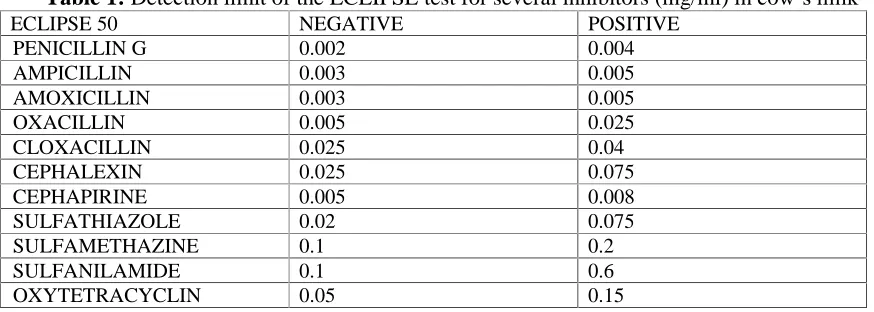
In this study, the test methods used for monitoring antibiotic residues in milk was Eclipse 50 kit which is made in Spain ZEU Company. This kit acts based on inhibiting the growth of microorganisms indicator of Bacillus stearothermophilus due to presence of antibiotics in milk. In the absence of antibiotics, after adding 50 ml of each sample to the kit and incubate in 65 ± 1 °C for 2.15 to 2.45 hours, Bacillus stearothermophilus grow by nutrients and with lactose fermentation and acid production in the presence of Bromocresol purple reagent causes a yellow color. While in the case of antibiotics, Bacillus stearothermophilus cannot grow and therefore the medium, without any changes in color, remains purple (Fig. 1, 2). According to the manufacturer's instructions of kits, formation of a yellow-violet indicates the presence of antibiotic residues in samples but inhibit microbial growth rate is less than the sensitivity of the kit (Table 1).
Fig. 1: Test Method Fig. 2: Antibiotics Kit in raw milk samples
Table 1: Detection limit of the ECLIPSE test for several inhibitors (mg/ml) in cow´s milk POSITIVE
NEGATIVE ECLIPSE 50
0.004 0.002
PENICILLIN G
0.005 0.003
AMPICILLIN
0.005 0.003
AMOXICILLIN
0.025 0.005
OXACILLIN
0.04 0.025
CLOXACILLIN
0.075 0.025
CEPHALEXIN
0.008 0.005
CEPHAPIRINE
0.075 0.02
SULFATHIAZOLE
0.2 0.1
SULFAMETHAZINE
0.6 0.1
SULFANILAMIDE
0.15 0.05
290 | Page 0.15 0.05 TETRACYCLIN 0.4 0.2 ERYTHROMYCIN 0.1 0.02 TYLOSIN 0.80 <0.500 NEOMYCIN Statistical Plan
After examination and getting results with 4 repetitions, possible regression equations between antibiotics residues parameters and chemical and microbial parameters of raw milk have been studied. The software SPSS Statistics ver.22.0 has been used to evaluate the regression equations and finding the best model, and drawing diagrams to predict.
Results
Achieving the best binary logistic regression model
After accomplishing of tests and collecting data in summer and autumn, binary logistic regression model has been chosen to describe and predict the presence or absence of antibiotic residues in raw milk and some tests have been done for achieving the best equation based on the dependent variable (antibiotic residues) and independent variables (somatic cell count, total count of mesophilic microorganisms, protein, fat, lactose, acidity, PH and electrical conductivity). In analysis by this regression, the code one means presence and the code zero means the absence of antibiotic residues in raw milk. One of the greatest methods to achieve the best logistic regression model is to use Backward Conditional Technique. The basis of this method is that with the help of software SPSS Statistics ver.22.0 once all the independent variables and their interactions with the dependent variable are considered as models. Then the software changes the variables from model based on probability ratio and this process goes on as far as the variables are not deleted because of the importance (Table 2). By using the mentioned technique, the following equations were obtained based on logistic regression, respectively, for summer and autumn:
Logit(ө) = -81.267 + (7.731 log Somatic cell) + (6.778 EC)
Logit(ө) = -3.868 + (6.719 log Somatic cell) - (245.439 Acidity)
Table 2. The variables in equations
95% C. I. for EXP(B) Exp(B) Sig. df Wald S.E. B Upper Lower 1356389.426 3.824 2277.317 .018 1 5.623 3.260 7.731 Log Somatic cell
Summer EC 6.778 3.691 3.373 1 .046 878.530 .634 1216988.365
.000 .011 1 6.411 32.096 -81.267 Constant 95451.644 7.189 828.397 .006 1 7.698 2.422 6.719 Log Somatic cell
Autumn Acidity -245.439 98.242 6.242 1 .012 .000 .000 .000
.021 .775 1 .082 13.534 -3.868 Constant
291 | Page Table 3. Summary of Model
Chi-square df -2 Log likelihood Cox & Snell R Square
Nagelkerke R Square
Summer 9.571 8 19.086 0.595 0.843
Autumn 9.580 8 19.468 0.492 0.777
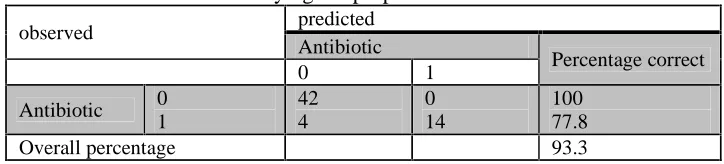
Base on models analysis, there are a similar variance about 3.84 and 77.7 percent between the independent variables and the dependent variable in the summer and autumn. Thus it can be argued that there is almost a good correlation between the independent variables and the dependent variable in two seasons. According to Table 4 in the summer, all 42 samples were not contaminated with antibiotic residues that were predicted correctly by the model. But among the 18 samples, only 14 were correctly predicted as contaminated with residues of antibiotics. In other words, predicting samples with no contamination and samples contaminated with antibiotic residues, is respectively, 100% and 77.8 percent. Overall, the model has predictive power about 3.93 percent.
Table 4. Classifying the proposed model in summer predicted
observed
Percentage correct Antibiotic
1 0
100 77.8 0
14 42
4 0
1 Antibiotic
93.3 Overall percentage
Table 5. Classifying the proposed model in autumn predicted
observed
Percentage correct Antibiotic
1 0
95.8 100 2
12 46
0 0
1 Antibiotic
96.7 Overall percentage
292 | Page Table 6. Case wise list of summer model
Case Selected Status a
Observed
Predicted Predicted Group
Temporary Variable
antibiotic Resid ZResid
23 S 1** .340 0 .660 1.392
30 S 1** .077 0 .923 3.470
31 S 1** .346 0 .654 1.374
54 S 1** .152 0 .842 2.317
Table 7. Case wise list of autumn model
Case Selected Status a
Observed
Predicted Predicted Group
Temporary Variable
antibiotic Resid ZResid
26 S 0** .938 1 -.638 -1.297
57 S 0** .725 1 -.838 -3.892
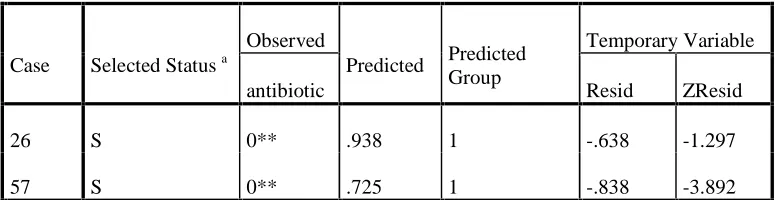
a. S = Selected, U = Unselected cases, and ** = Misclassified cases.
293 | Page Observed Groups and Predicted Probabilities (Summer)
32 + + I I I0 I F I0 I R 24 +0 + E I0 I Q I0 I U I0 I E 16 +0 + N I0 I C I0 I Y I0 I 8 +0 1+ I0 1I I0 1 11I I0 0 0 1 0 0 0 1 0 0 1 11I
Predicted ---+---+---+---+---+---+---+---+---+--- Prob: 0 .1 .2 .3 .4 .5 .6 .7 .8 .9 1
Group:
0000000000000000000000000000000000000000000000000011111111111111111111111111111111111111 111111111111
Each Symbol Represents 2 Cases.
Observed Groups and Predicted Probabilities (Autumn) 40 + + I I I0 I F I0 I R 30 +0 + E I0 I Q I0 I U I0 I E 20 +0 + N I0 I C I0 I Y I0 I 10 +0 + I0 I I0 0 I I00 0 0 0 1 1 11 1 1 0 I
Predicted ---+---+---+---+---+---+---+---+---+--- Prob: 0 .1 .2 .3 .4 .5 .6 .7 .8 .9 1
Group:
0000000000000000000000000000000000000000000000000011111111111111111111111111111111111111 111111111111
Predicted Probability is of Membership for 1.00
The Cut Value is .50 / Each Symbol Represents 2.5 Cases.
294 | Page Considering the presence of antibiotic residues in industrial farms and milk collection centers Statistical analysis showed that in the summer from the total samples, 70% were without contamination and 30% were with antibiotic residues. From 42 samples without contamination to antibiotics, 28 samples were related to industrial farms and 14 samples were related to the milk collection centers that the percentage of cases, respectively, were 66.67% and 33.33%. While from the 60 samples of raw milk in autumn, 80% (48 samples) were without contamination and 20% (12 samples) had antibiotic residues and all 12 samples contained residues of antibiotics have been related to milk collection centers. The study showed that the number of samples contaminated with antibiotic residues in autumn were 10% less than in summer (according to the results of Fig. 3).
Fig. 3: Comparison of healthy and antibiotic residues samples of milk in industrial farms and milk collection centers
Statistical analysis showed that among the samples of raw milk from industrial farms and province milk collection centers there are significant differences (P < 0/01) in term of contamination to antibiotics.
295 | Page Discussion
The amount of Nadgelkrke correlation coefficients obtained during the two studied seasons shows a good compatibility of predicted values and experimental observations. The results of this study indicate a relationship between chemical and microbial variables with antibiotic residues in raw milk. This correlation is so impressive that based on the variables and conditions on milk, prediction models of antibiotic residues can be generalized. The results of this study showed that the increase in the number of somatic cells in raw milk cause problems of antibiotic residues on more number of raw milk samples. Norberg and et al (2005) and Ogola and et al (2007) declared in their studies that by increasing somatic cells, changes in amount of mineral of raw milk occur. The changes will affect in the type and amount of milk minerals, acidity and electrical conductivity. So that by increasing sodium and chlorine and decreasing potassium and calcium, conductivity increases and acidity decreases to less than 0/14 percent. Due to the high correlation between these chemical variables and antibiotics residues in raw milk, based on those, the presence or absence of antibiotic residues in milk can be predictable (11, 12).
According to the obtained statistical results, it is shown that the rate of drug residues in raw milk of collection centers is more. In traditional farms, due to the absence of health authorities that should monitor health issues, disease prevention and treat sick animals, antibiotics are given to livestock inappropriately and do not observe waiting time for sure. Research results of Habibi (2010) also showed that antibiotic residues in milk of Sanandaj (City) industrial farms were more than semi-industrial farms and milk collection centers. The result was that 103 samples were negative and 64 samples were positive in terms of presence of antibiotic (13). Also Manafi and et al (2010) in a similar study for evaluation of antibiotic residues in raw and pasteurized milk in East Azarbayejan province, 20 samples of raw milk and 6 samples of pasteurized milk have been tested by Delvotest SP-NT method. 46% of raw milk samples and 30% of pasteurized milk samples were detected to contaminate with antibiotics.
Reference
Ortelli D, Cognard E, Jan P, Edder p. Comprehensive fast multiresidue screening of 150 veterinary drugs in milk by ultra-performance liquid chromatopraphy coupled to time of flight mass spectrometry. Journal of Chromatography B, 2009 877: 2363-2374.
Althaus R, Berruga MI, Montero A, Roca M, Molina MP. Evaluation of a microbiological multi-residue system on the detection of antibacterial substances in ewe milk. Analytica Chimica Acta, 2009 632: 156- 162.
Codex Alimentarius Commissions .Maximum Residue Limits for Vaterinare Drugs in foods updated as at the 32nd Session 2009.
www.yazd.ivo.ir/portal/File/ShowFile.aspx?ID=7b61412c-4875-4a1b-ae4a-25a350e74381 ISIRI 326. Milk and milk Products – Guidance on sampling, 2010, [Farsi].
ISIRI 5028-2. Milk– Enumeration of somatic cells of fluoro-opto-electronic counters, 2004, [Farsi]. ISIRI 5484. Milk and Milk products-Enumeration of colony-forming units of microorganisms-colony-count technique at 30 °c, 2002, [Farsi].
ISIRI 2852 Milk and milk products-Determination of titratable acidity and pH (Reference method), 2006, [Farsi].
296 | Page IDF. Whole milk: Determination of milk fat, protein and lactose content-guide for the operation of mid-infra-red instruments. IDF Standard 141 B. International Dairy Federation, Brussels, Belgium, 1996.
Norberg E. Electrical conductivity of milk as phenotypic and genetic indicator of bovine mastitis: A review. Livestock Production Science, 2005 96: 129-139.
Ogola H, Shitandi A, Nanua J. Effect of mastitis on raw milk compositional quality. Journal of Veterinary Science, 2007; 8(3):237-242.
Habibi N. Study of antibiotics residual in raw milk in Sanandaj. J Sanandaj univ Med Sci 2010; 4(11):57-62.
Manafi M, Hesari J, Rafat A. Monitoring of antibiotic residue in raw and pasteurized milk in East Azarbaijan of Iran by delvotest method. J Tabriz univ Med Sci 2011; 20/3(2):125-131.