THE SIMULATION OF EGG NUMBER OF
AEDES AEGYPTI
USING
STAGE-STRUCTURED MATRIX MODEL
Najir Tokachil1, Nuraini Yusoff 2, Abdullah Yahya3
1,3
Faculty of Computer and Mathematical Sciences Universiti Teknologi MARA Cawangan Negeri Sembilan,
Kampus Seremban, 70300, Negeri Sembilan, Malaysia
2
Faculty of Computer and Mathematical Sciences Universiti Teknologi MARA, 40450 Shah Alam, Malaysia
*Corresponding E-mail : [email protected]
Abstract
The distribution of rainfall is one of the factors which contribute to the development of Aedes aegypti life
cycle. The fluctuation of rainfall might influence the acceleration of Aedes aegypti growth and at same time
influence the increase of dengue cases. Many types of mosquitoes strictly need water to lay their eggs
therefore in this research, the egg number of Aedes aegypti mosquito was simulated by using
stage-structured matrix model. The development of egg numbers were associated with rainfall distribution and mosquito life cycle which consist of egg, larva, pupa, and adult. A stage-structured Lefkovitch matrix model was used for the simulation. An egg hatching function depends on rainfall was one significant parameter rate of matrix model which affect the whole mosquito life cycle. The graphical results were shown to illustrate the relationship between the rainfall and egg number. We found that there was a significant relation between the rainfall, and egg number. However, it is recommended to look for more possible factors such as size of opening container, humidity and temperature which contribute to the development of mosquito in order to acquire more accurate results.
Keywords: Aedes aegypti, Lefkovitch matrix, dengue
Received: January 16, 2018 Accepted: January 25, 2018 Published: February 15, 2018
1.0 Introduction
Dengue is an infectious tropical disease, a vector-borne viral disease transmitted by Aedes aegypti mosquito. There are two forms of dengue that are Dengue Fever (DF) or classic dengue and Dengue Hemorrhagic Fever (DHF). The DHF can evolve to severe form or death known as Dengue Shock Syndrome (DSS), (Rigau et al., 1998).
The history had revealed that Aedes aegypti mosquito mostly originated in Africa and the possibility that this vector exists in other countries might through global trade and shipping activities. They were recognized as a significant vector of dengue fever in the world. The infected female Aedes aegypti can spread dengue virus mainly through the bites (WHO, 2000). The infected female mosquito commonly gets the virus when they feed blood of people that had been infected by the virus (Eldridge, 2008). The infected female mosquitos also can spread the disease to their eggs which are their next generations (Murray et al, 2016). In most female mosquitoes, the mouth part will form proboscis which is it can penetrate the skin to consume blood. To form eggs, these female mosquitoes need a protein from blood. Meanwhile, male mosquitoes do not involve both transmitting virus and reproducing.
have stated that the factors of temperature and rainfall contribute to the increase of number of mosquito which the main vector of spreading dengue virus (Chien, 2014). However, in Malaysia
the temperature was recorded as almost unchanged compared than rainfall distribution. Therefore, the purpose of this study is to simulate the first stage of mosquito which is egg stage associated with rainfall distribution using Lefkovitch matrix model. A model proposed in previous research (Yusoff et al., 2012a; Tokachil et al., 2015) will be considered and discussed in order to achieve the objectives of this research. We focused on Shah Alam city since the reported cases of dengue are always high and only first three month in 2016 was considered because these months have high dengue cases compared to others period.
2.0
Methodology
The Lefkovitch matrix model is used to study the classification of population growth of Aedes aegypti because it best model to describe organism (Gotelli, 2001). The matrix population model is useful to know the changes in a population of an organism over a given period and it is classified the population based on the stage of life such as egg, larva, pupa and adult. The element of the Lefkovitch matrix are not proportional survivorships, but the probabilities of making the transition from one stage (or size) class to another are been considered projection matrix of Aedes aegypti.
2.1
Stage-Structured Matrix Model of
Aedes Aegypti
The Lefkovitch matrix model was considered which related to five stages of Aedes aegypti life cycle. The adult stage is parted into two stage which sub-adult and adult. The involved transition rates are Pi is a probability of mosquito to survive in same stage i. Meanwhile, Gi is a
probability of mosquito to remain and grow from current stage i to next stage(i1).The Fi is the
fecundity or fertility of stage i. The si is the survival rate of mosquito at a constant temperature
27.2º Celsius in stage i and di is the duration of mosquito to stay in stage i (Tokachil, 2015). Let
A be the stage class of the population matrix and consider that the N(k)be the population at any time k. The population Nk can be calculated by multiply matrix A and population at timek1.
) ( )
(k AN k1
N (1)
The Lefkovitch matrix associated with the five stages of Aedes aegypti mosquito life cycle can be illustrated in matrix (2), (Yusoff et al., 2012a; Tokachil et al., 2015).
(2) 0 0 0 0 0 0 0 0 0 0 0 0 5 4 4 3 3 2 2 1 5 4 3 2 1 P G P G P G P E F F F F P A
The formula of transition rate,Pi considered constant temperature can be described as follows,
) ( ) ( 3 1 1 1 i i d i d i i i s s s P
( ) (4) 1
1
i i
d i
i d i i
s s s G
The transition rate of the egg hatching E t1( ) was only associated with the water availability meanwhile other transition rates depend on a constant temperature, 27.2º Celsius.
2.2
Egg Hatching Function
The daily rainfall was considered as dependent variable which influences the population of Aedes aegypti. The formula of egg hatching transition rate was to simulate Aedes aegypti population if the rainfall is the main factor of producing the breeding sites for egg laying. The probability of surviving and growing from hatching stage was considered to change over the required period while all of another parameter remains unchanged and constant at fix temperature. The formula of egg hatching as given below,
( ) ( )max
5
1 2
1 1 1
c
wd t wd c s t
E
The parameter s1 is the survival rate for egg hatching stage, wd
t1 represents the water availability in an opening container at time t, andwdmaxis the maximum height of the openingcontainer. The parameter c1 refers to the probability of egg hatching and c2is the pattern of egg hatching (Yusoff et al., 2012b; Tokachil et al., 2015).
2.3 Simulation of
Aedes Aegypti
Population Based on Rainfall
The maximum heights of opening container,wdmax are considered in this simulation namely
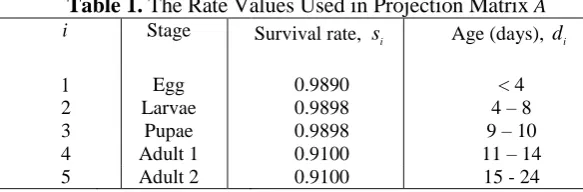
20mm, 25mm, 30mm and 35 mm. The water in the containers will overflow if exceed these maximum heights. The F2 and F3 are equal to zero because both larva and pupa do not produce egg (Yusoff, 2012b). Meanwhile, the value of transition rate, F4 and F5 are 8 and 16 respectively which obtained by considering the average number of eggs laid per oviposition and the duration for the egg remain in egg stage before it hatching. All transition rates of matrixAcan be computed by referring the information in Table 1(Yusoff et al., 2012b; Tokachil et al., 2015).
Table 1. The Rate Values Used in Projection MatrixA
The daily rainfall of January, February and March in year 2016 obtained from Meteorology Department, Malaysia was considered as the water depth of the opening container,
) 1 (t
wd , which measured in millimeter.
i Stage Survival rate,
i
s Age (days),di
1 Egg 0.9890 < 4
2 Larvae 0.9898 4 – 8
3 Pupae 0.9898 9 – 10
4 Adult 1 0.9100 11 – 14
3.0
Implementation
The population of Aedes aegypti was simulated based on the change of daily rainfall distribution. Therefore, the requirement needed is to assume the initial number for population,
) (0
N for each stage. The initial population was set by assuming that 1000 eggs consist in opening container of mosquitoes breeding site which denotes the initial number of egg in Aedes aegypti life cycle and meanwhile the other four stages are set as zero. The forecast of Aedes aegypti population,N(1)can be calculated by multiplying the matrix A and the initial population,N(0).
0 0 0 0 1000
1
A N()
The next simulation of population can be done by using the looping concept. The number of egg will change depend on rainfall distribution.
4.0
Result and Discussion
In this section, the results will be discussed and explained in detail. The results are illustrated based on graph to make some comparison between simulation of egg number of Aedes aegypti and rainfall distribution. In the previous section, we mentioned that month January, Febuary and March in 2016 are taking into account since the dengue cases were reported high in these months. The graphs showed in this section described the number of egg of Aedes aegypti influenced by rainfall distribution.
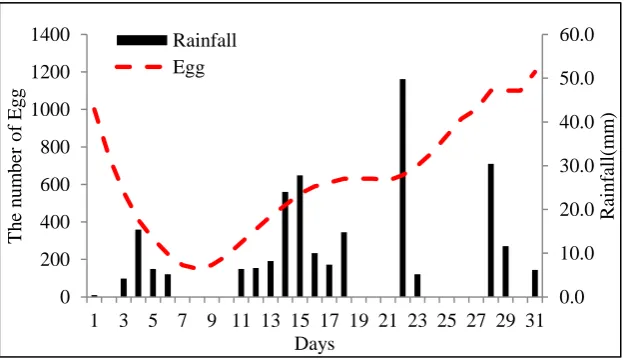
Figure 1: The Relationship of Egg Number and Rainfall Distribution on January 2016
Fig. 1 shows that the number of egg start decreased during day 2 to day 7 even there were rainfall on these days. However, the number starts increased during day 8 until the end of the month, even though the rainfall distributions did not occur in period day 19 to 21 and day 24 to 27. This situation might contribute to the large population of Aedes Aeypti mosquito because when the rainfall is slowing down, the water that stagnant in the container due to rain will not overflow or splash out (Foster, 1995) and this will make the eggs can survive and the population growth would be high. The population seems to decrease when the rainfall distribution at high phase.
0.0 10.0 20.0 30.0 40.0 50.0 60.0
0 200 400 600 800 1000 1200 1400
1 3 5 7 9 11 13 15 17 19 21 23 25 27 29 31
R
ain
fall(
m
m
)
T
h
e
n
u
m
b
er
o
f
E
g
g
Days Rainfall
This obtained result can be related to the statement made in (Dieng et al., 2012) which heavy rainfall might flush the immature larva out and prevent mosquitoes to lay eggs.
Figure 2: The Relationship of Egg Number and Rainfall Distribution on February 2016
Meanwhile, Fig. 2 describes the number of egg were high in the first week of February and start declined at day 8 and keep decreasing until day 24 before it increase significantly at day 25 until the end of the month. The numbers of days of receiving rains in this month were less than previous month which 240.0 millimeter in total and meanwhile only 68.8 millimeter rains received in February. We noticed that most of days in this month received medium rainfall which in the range between 10 to 20 millimeter (Tokachil et al., 2015). Referring to this situation, we might state that medium rainfall can provide a sufficient condition to the female mosquito to lay eggs because any exposed container can be filled with sufficient water which the possibility of the water to flow out is small. Hence, provide the mosquito breeding site to lay eggs.
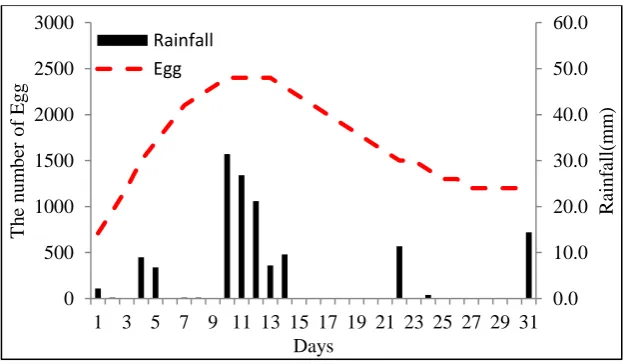
Figure 3: The Relationship of Egg Number and Rainfall Distribution on March 2016
Difference situation happened in March which the number of egg on the first week rose rapidly and suddenly dropped down during day 10 until day 31(referred Fig. 3). The scenario could be occurred due to five consecutive days of receiving high rainfall during day 10 until day 14. Mosquito breeding place such as opening containers are commonly described as small size for example abandoned tires, bottles, water contained in tree holes and other artificial containers. The
0.0 10.0 20.0 30.0 40.0 50.0 60.0
0 200 400 600 800 1000 1200 1400
1 3 5 7 9 11 13 15 17 19 21 23 25 27 29
R
ain
fall(
m
m
)
T
h
e
n
u
m
b
er
o
f
E
g
g
Days
Rainfall Egg
0.0 10.0 20.0 30.0 40.0 50.0 60.0
0 500 1000 1500 2000 2500 3000
1 3 5 7 9 11 13 15 17 19 21 23 25 27 29 31
R
ain
fall(
m
m
)
T
h
e
n
u
m
b
er
o
f
E
g
g
Days Rainfall
on the water surface will flow out from the containers (Choy et al. 2011). Hence, the numbers of egg decreases and directly interrupt the process of mosquito life cycle to complete.
5.0
Conclusion
In the result section, the simulation of egg number of Aedes aegypti associated with rainfall distribution has discussed in details. Even though, factor of temperature is highly likely to influence the dynamics of mosquito population but in this research the temperature was set as constants since in Malaysia, daily temperature are almost unchanged. Therefore, the factor of rainfall was considered as the main factor which influence the life cycle of mosquito particularly in Malaysia environments. The stage-structured matrix model which considered the life cycle of mosquito was taken into account and egg hatching function was used to observe the relationship between rainfalls and egg number of Aedes aegypti . Based on this research, we found out that the rainfall distribution significantly influence the development of egg number in certain period by providing breeding sites for mosquito to lay it egg and the acceleration of egg hatching might be assisted by the temperature by giving warm to the eggs. In addition, the mosquitos’ eggs in the container will survive if the rainfall distribution is low which cause the stagnant water in the container do not overflow or splash out. Hence, this will make the eggs can survive and the population growth would be high. The egg can be vanished or washing out from the container because of the strong water splash when heavy rain occur. However, other factors need to be considered so that accurate results will be obtained.
Acknowledgement
References
Chien, L. C., & Yu, H. L. (2014). Impact of Meteorological Factors on the Spatiotemporal Patterns of
Dengue Fever Incidence. Environ Int, 73, 46-56.
Choy, E. R., Elaine, M.K., Asmani, A., Mazrura, S., & Zainudin, M. (2011). Perubahan Cuacadan Penyakit
Denggi: Kajian Kes Di Daerah Seremban, Negeri Sembilan, Malaysia. Jurnal e-Bangi , 1, 38-48.
Dieng, H., Rahman, M.S, Hassan, A.A, Salmah, M.R, Satho, T., Miake, F., Boots, M., & Sazaly, A.B. (2012). The effects of simulated rainfall on immature population dynamics of Aedes albopictus and female oviposition. International Journal Biometeorology, 56, 113-120.
Eldridge, B. F. (2008). Biology and Control of Mosquitoes, University California Davis, California.
Foster, W. A. (1995). Mosquito sugar feeding and reproductive energetics. Annual Revision Entomology,
40, 443-74.
Gotelli, N. (2001). A primer of ecology, 3rd Edition. Sinauer Associates, Sunderland, Massachusetts, USA.
Murray, J.V., Jansen, C.C., & Baro, P. D. (2016). Risk Associated With the Release of
Wolbachia-infected Aedes Aegypti Mosquitoes into the Environment in an Effort to Control Dengue, 4, 1-12.
Rigau, J. G., Clark, G.G., Gubler, D.J., Reiter, P., Sanders, E.J., & Vorndam, A.V. (1998). Dengue and
Dengue Haemorrhagic fever,. Lancet, 352, 971–77.
Tokachil, N., & Yusoff, N. (2015). Effect of Rainfall on Population Dynamic. Mathematics and Statistics
Journal, 1(4), 17-23.
Yusoff, M. Budin, H., & Ismail, S. (2012a). Simulation of Population Dynamics of Aedes aegypti using
Climate Dependent Model World Academy of Science, Engineering and Technology, 478.
Yusoff, M. Budin, H., & Ismail, S. (2012b). Stage-Structured Population Dynamics of Aedes Aegypti.