Time Impact of Scheduling Simulation for High Rise Building
Asmadi Ismail1, Mohamad Ibrahim Mohamad2, Muhamad Azani Yahya*3
1,2,3Civil Engineering Faculty, Universiti Teknologi Malaysia, 81310 Johor, Malaysia
*Corresponding Email: [email protected]
ABSTRACT
Although the long-introduced Industrialised Building System (IBS) has promised to solve and improve the current construction method and scenario in our country, but the IBS method has not gained enough popularity. One of the reasons is due to lack of research works done to quantifying the benefit of IBS especially in construction time saving. In lieu with such scenario, this study conducted to quantify evidence of time saving in IBS application. The methodology adopted for this study is by modelling the construction process for high-rise residential building for both conventional and IBS with shared more a less the same nature and size of the structure. The model was developed using Primavera (P3) project planning software. The comparison was made by comparing selective building components for both method of construction. Different high-rise residential projects have been selected for this study. The result of the study clearly indicated that sufficient time saving can be archived. Also from this study shown not all IBS components can improved to the overall construction duration, however by adopting IBS components can improve and expedite the construction of 18 stories residential building from the point of departure of the project throughout of the whole of project’s with a total 405 days or 42% the time saving.
Keyword: Time impact, Schedule simulation, Industrialised Building System, Time saving.
1.0 INTRODUCTION
Time, cost, quality target and participation satisfaction have been identified as the main criteria for measuring the overall success of construction projects (Dissanayaka and Kumaraswamy, 1999). Of these, cost and time tend to be the most important and visible, always considered as very critical because of their direct economic implications if they are unnecessarily exceeded. This study to compare time performance of the conventional method of construction for high-rise residential and Industrial Building System (IBS) method by formulate benchmark measures of industry norms for overall construction period using ‘scheduling simulation modelling’ Such model development necessitated the enumeration of a group of significant variables affecting construction times by adopting IBS of public housing projects. Actual project schedule and project information from 15 case studies of conventional and IBS method of construction were collected from the client organization and their registered building contractors to develop the prediction model by using mean analysis. The derived model was verified and confirmed significant statistically. Both the client organization and the contracting firms could obtain many benefits from such improvements in their own in-house construction time planning and control systems.
2.0 OBJECTIVES
The aim of this study is to develop Scheduling Modelling that can be used to analyse time optimization using Industrialised Building System (IBS) components or products (off-site) compared with the conventional method usually adapted in-situ method. The study basically to analyse of improvement involves reducing the production time, identifying and eliminating unnecessary wet works, which is can optimize production line according to a specific layout. To achieve the above aim, the following objectives have been identified:
1. Develop scheduling modelling base on conventional and IBS practices for High-rise building;
2. Identifying IBS products/components that can optimize construction time;
3. Simulate scheduling modelling to proof time saving using IBS products for High-rise building; and
4. Propose planning & scheduling strategy from above scheduling simulation for High-rise building.
3.0 METHODOLOGHY
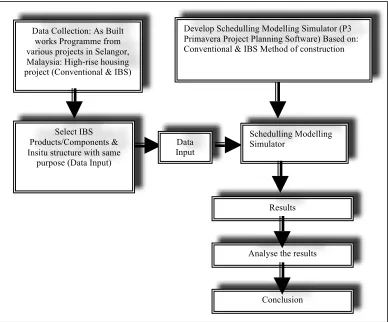
breakdown structure (WBS) between a typical high rise residential building construction using conventional construction method and the other using Industrialised Building System (IBS) components for the high-rise residential building been further analysed using Primavera (P3). Finally, a conclusion will be drawn out based on the results of the analysis obtained. Figure 1 show the flowchart of research methodology.
4.0 LITERATURE REVIEW
Construction industry in considered as fragmented industry, whereby policy, implementation guideline and practice within this industry are inconsistent among the players involved (CIDB, 2003). Less interaction among the project team also contributes to this problem. During design stage commonly, town planners, architects and designer’s work independently with little input and communication with each other, past experience from previous project is not considered during this stage. Therefore, revisions of plans and designs always occurred. The material supplier and transporters have their own agenda causing interruptions and abandoned schedules (CIDB, 2003). The consequences will affect the quality and efficiency in the conventional construction as well as those involving in IBS. The fragmented prefabricated construction approach and practices can be seen that every different manufacturer and applicator in the prefabricated construction has its own designs and construction method. This results in incompatibility of the components used among the manufacturers in terms of dimensioning and installation at site.
4.1 Conceptual of high-rise residential building
High-rise buildings began to appear around the 1880's (O'Hagan, 1977), and the first high-rise office building was constructed in the 1889 reaching a height of 309 feet. Since then, as this type of structure grew in popularity with the number and size of high-rise buildings or "skyscrapers" as they came to be called (Hall, 1991) increased rapidly. The Empire State Building, completed in 1931 at a height of 1,250 feet (The Skyscraper Museum), held the record for tallest building in the world until 1974, when it was surpassed in height by the Sears Tower at 1,450 feet (CTBUH, 1997). In 1975, the Confederation of Fire Protection Association-Europe (CFPAEurope) collected data on the heights that defined high-rise buildings based on the associated building codes of the eleven attending countries. The defining heights ranged from a building over approximately 72 feet to a building over approximately 164 feet for office buildings (CFPA, 1977). In 1977, another definition of a high-rise building was offered based on the lack of exterior access to the upper floors for fire fighting (O'Hagan, 1977). This definition referred to the approximate reach of the standard aerial ladder engine, which was 100 feet in height. Another, less quantitative, definition is provided by the General Services Administration (GSA) which in an international conference on fire safety in high-rise buildings held in 1971 in Warrenton, Virginia, stated that a high-rise building is one in which emergency evacuation is not practical and in which fires must be fought internally because of height. The usual characteristics of such buildings are it is beyond the reach of the fire brigade’s equipment, provides potential for significant stack effect and requires unreasonable evacuation time (GSA, 1971).
construction method has been known for its speed of construction benefit, high quality end products, and most importantly, it can help to solve the shortages crisis of high rise residential building in our country in a faster and efficient way (CIDB, 1998). This can further solve the problem haunting the construction of high rise residential building currently, which take years to complete the construction of the entire high-rise residential building. IBS components such as precast columns and beams are proposed in the construction of the conceptual high rise residential building. The use of precast columns and beams will enhance the speed of completion of the entire high rise residential building project. It is believed that with such implementation of IBS construction method not only can increase the speed of high rise residential building construction, but in other ways, it can also improve the aesthetic value of high rise residential building in our country (CIDB, 1998). Therefore, when IBS construction method is implemented in the construction process, it is important that the scheduling of the assembly and erection process is well taken care of, to ensure the proper coordination and efficient construction process. In order to prepare a good scheduling for IBS components used in the construction of the conceptual high rise residential building, several factors have to be taken into considerations. Such factors include production of IBS components at factory, transportation to site location, labour supply, may it be in terms of skilled and unskilled labourers, availability of components and lastly the erection and assembly of IBS components at site (Just et. al., 1994).
4.2 Sequence of Conventional Construction Method
of the construction project is essential to minimize any risk of increase in the construction cost of the entire project.
4.3 Sequence of Construction for Industrialised Building System (IBS) Method
Industrialised Building System (IBS) method is different from the conventional construction method. Known for its benefits in terms of shorter construction time, saving in labour, material saving, better quality control, immunity to weather changes and the cost factor, IBS method illustrates a different approach to the construction method commonly used (Warszawski, 1999). It offers an alternative to the existing conventional building system. Among one of the most important characteristics of IBS method is the components are prefabricated offsite. According to Chew and Michael (2001), prefabrication system of construction means breaking a whole housing unit into different components such as the floors, walls, columns, beams, roofs, etc. and having these components separately prefabricated or manufactured in modules or standard dimensions in a factory. IBS method emphasizes on prefabrication concept. Firstly, the design stage is carried out where the IBS components are designed according to specifications. Then, the components are prefabricated at factory, where components of IBS are manufactured according to specified dimensions and specifications. Quality-controlled and highly aesthetic end products through the processes of Quality-controlled pre-fabrication and simplified installations has maintained and ensured the quality of work in the construction industry. The IBS components are then transported to the site from the factory for assembling process. At site, the IBS components are assembled accordingly with the assistance of a crane. The reduction of construction waste with the usage of the standardized components and less in-site works provides a cleaner site due to lesser construction waste. Finally, the final unit of the building is finally assembled and ready for occupation. IBS method offers a new concept in terms of speed of construction, and it clearly shows many other benefits as compared to the conventional construction method (CIDB, 1998).
4.4 Scheduling Simulation Modelling
(Shi and AbouRiz, 1997). Planners who have the knowledge in constructing critical path network and bar charts could be able to use the simulation model. The constructing of simulation network for modelling is similar to the critical path network using the ‘activity on node’ format except that loops are allowed to show the re-cycling of resources. During the simulation process, the activities may either in an active if the constraints are met or otherwise in an idle mode. Currently, the most common technique used in practice for macro-level construction planning and scheduling is the critical path method (CPM), a network based project-scheduling technique. Many existing software products such as Primavera Project Planner and Microsoft Project use CPM techniques for project scheduling. CPM schedules are typically used to provide an overall view of the project, activity durations, sequences, milestones and criticality of activities. The CPM model contains activities and precedence relationships. The CPM algorithm defines the path(s) (sequence of activities) that provides the shortest project duration among all possible paths. The main outputs are the range of possible activity times, critical activities and floats (flexibility in performing activities), and cost and resource information related to activities. The CPM technique is mainly useful for master scheduling.
5.0 ANALYSIS
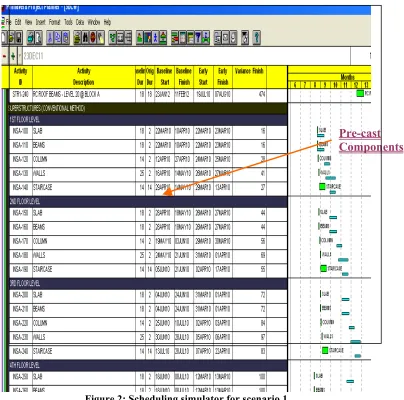
Study conducted to analyse how long does it takes to assemble the components at the site to produce the entire conceptual building of the high rise residential building. It is important also to determine whether it takes the same speed and time to install the Industrialised Building System (IBS) components compared to conventional cast-in-situ method. Scheduling of IBS components at site can also help to further determine the work duration of the entire project implementing IBS components, as compared to conventional methods. The assembly and erection of the conceptual high rise residential building have been modelled and analysed using computer software. More emphasize given on how the scheduling on assembly time is carried out efficiently at a site using IBS components for the high rise residential building. Therefore, a comparison between the work breakdown structure (WBS) between a typical high rise residential building construction using conventional construction method and the other using IBS components been further analysed. Primavera (P3) will be the scheduling software to be used for scheduling purposes, and the results generated by the software been carefully analysed at this stage. For the better result, scheduling simulation was done into 10 scenarios. In scenario one, an analysis was carried-out to determine the actual time required for both method of construction by incorporated all the data’s collected. As result, conventional method of construction required a total 912 days to construct 18 stories high-rise residential building, described in figure 2. While a total 529 days required for IBS method by adopted all the selected IBS components to develop the IBS scheduling simulator to complete the construction of the high-rise residential building. Based on this exercise, it proved to the industries, by adopting IBS components shall improved the construction time. As result from this exercise, a total of 383 days or 42% of saving to the construction industry if the construction players considered to adopted IBS component in the project. The same method was used to analyse for another 9 scenarios and the result shown in table 1.
Conclusions from the above table it shown that not all IBS components/ products can improve to the overall construction duration. However, by adopting IBS components can improved/ expedite the following activities:
ii. Minimized or eliminate mistake on height of each floor by standardized height of each components.
iii. Expedite the construction duration on each floor and overall construction duration.
iv. The major components that will improve the overall construction duration are slab, beam, and column.
This finding of the study gives an effective strategy to implement IBS in the current state of the construction industry.
6.0 CONCLUSION
This study compared time performance of the conventional method of construction for high-rise residential and Industrial Building System (IBS) method by formulate benchmark measures of industry norms for overall construction period using scheduling simulation modelling. The positive changes include creating a healthy working environment among those involved directly in the construction industry. The major players in the are architects, engineers, town planner, developer, contractor and the supplier or manufacturer have to play their roles in enhancing their working system, management and administration to enable the modernisation in the industry. Although the long-introduced IBS has promised to solve and improved the current construction method and scenario, but the IBS method has been low in gaining popularity, partly due to lack of awareness and coordination among the relevant parties. Currently, the level of IBS usage method is very low as compared to the conventional methods in building construction. In spite of its many benefits, the different perceptions among the construction players and practitioners towards its application in construction industry has led to the low usage of IBS components in the construction industry. Nonetheless, there are still some areas in the IBS management that can be look into to conduct a research which can be look into for further studies and further improvement can be made.
7.0 REFERENCES
[1] Bannet, J. and Grice, A., Procurement Systems for Building, Quantity Surveying Techniques, New Directions, United Kingdom: (ed P.S Brandon), BSD Professional Books, 1990, Oxford.
[2] Chew, Y.L., and Michael, Construction Technology for Tall Building. 2nd Edition, University Press and World Scientific Publishing Co. Pte. Ltd., 2001, Singapore.
[3] CIDB–Industrialised Building Systems (IBS) Roadmap 2003 – 2010, 2003, Malaysia. [4] CIDB (1998). Report on Colloquium on Industrialised Construction System, 1998, Malaysia. [5] Center of Fire Protection Agency, Fire Safety in High-Rise Buildings, London.
[6] Dissanayaka, S.M. and Kumaranwammy, M.M., Comparing Contributors to Time & Cost Performance in Building Projects: Building and Environment, 1999, 34(1), 31–42.
[7] Gil, N., Tommelein, D. I., Kirkendall, B., and Ballard, G., Lean Product-Process Development Process to Support Contractor Involvement During Design, 8th International Conference on Computing in Civil and Building Engineering, 2000, Stanford, 1086-1093.
[8] General Services Administration, Public Building Service International Conference on Fire-safety in High-Rise Buildings, 1971, Washington.
[9] Halpin, D. W., and Riggs, L. S., Planning and Analysis of Construction Operations, Wiley, 1992, New York.
[10] Hall, R. W., Queueing Methods for Services and Manufacturing, Prentice Hall, Englewood Cliffs, 1991, New Jersey.
[11] Halpin, D. W., Cyclone--Method for Modeling Job Site Processes, ASCE Journal of Construction Division, 1977, 489-499.
[13] Just, Michael, Murphy, James., The Effect of Resource Constraints On Project Schedules, Transaction of AACE International, 1994, Morgantown.
[14] Tommelein, I. D., Pull-driven Scheduling Techniques for Pipe-Spool Installation: Simulation of a Lean Construction Technique, Journal of Construction Engineering and Management, 1998, ASCE, 279-288. [15] O’Hagan, J. T., High Rise/Fire and Life Safety, Dun-Donnelley Publishing, 1977, New York.
[16] Shi, J., and AbouRizk, S., Resource-Based Modeling for Construction Simulation, Journal of Construction Engineering and Management, 1997, 26-33.
[17] Warszawski, A., Industrialized and Automated Building Systems, E & FN Spon, 1999, London.
Figure 1: Research methodology flow chart
Develop Schedulling Modelling Simulator (P3 Primavera Project Planning Software) Based on: Conventional & IBS Method of construction
Schedulling Modelling Simulator
Data Collection: As Built works Programme from various projects in Selangor, Malaysia: High-rise housing project (Conventional & IBS)
Select IBS Products/Components & Insitu structure with same
purpose (Data Input)
Data Input
Results
Analyse the results
Figure 2: Scheduling simulator for scenario 1
Table 1: Percentage of time saving using scheduling simulation for all scenarios.
Case Scenario Time Saving(%)
1 Adopted All Selected IBS Components 42 %
2 Pre-cast Slab, Beams, Column and Walls. 42%
3 Pre-cast Slab, Beams, Staircase and Walls 31%
4 Pre-cast Slab, Beams and Walls 31%
5 Pre-cast Column, Pre-cast Walls and Pre-cast Staircase
24%
6 Pre-cast Slab and Pre-cast Beams 31%
7 Pre-cast Column and Pre-cast Walls 22%
8 Pre-cast Column 21%
9 Pre-cast Slab 0%
10 Pre-cast Walls 0%