DOI: https://doi.org/10.30880/ijie.2018.10.08.002
74
Computational Study of Mortarless Masonry Block System
Under Uniaxial Compression Load
Mohamad Zulhairi Mohd Bosro
1, Abdul Aziz Abdul Samad
1,*, Noridah
Mohamad
1, Noorwirdawati Ali
1, Goh Wan Inn
1, Muhammad Afiq Tambichik
1,
Muhamad Afif Iman
11
Faculty of Civil and Environmental Engineering, Universiti Tun Hussein Onn Malaysia, 86400 Batu Pahat, Johor, Malaysia
Received 9 August 2018 ; accepted 11 December 2018 , available online 29 December 2018
1. Introduction
Massive migration and rapid growth of population in Malaysia has increasing the demand for affordable and quality housing. To realize this demand, Malaysian construction industry has been urged to change from the conventional construction system to a fast and economical industrialized building system (IBS). Past 50 years has seen the growth of using reinforce concrete frame structure and mortared brick masonry as its construction system. These conventional construction systems have meet with various problems such as its low quality and its dependency on unskilled workers.
Since 1980’s, interlocking masonry system was introduced as the alternative method to conventional masonry construction system. The revolution in the masonry system extends from the ordinary bricks till the mortarless masonry system [1]. The main feature of the mortarless masonry system is the elimination of its mortar layers and are connected through the provision of interlocking mechanism. The system does not require any formwork to maintain its shape during the concreting process. Due to the interlocking mechanism feature and the absence of mortar layer, it provides self-alignment
construction system and can reduce cost beside increasing the construction speed [2][3].
Passage of time has seen several attempts to develop these mortarless masonry system in various parts of the world. In Malaysia, the current invention of the mortarless masonry system was the PUTRA block system made from concrete [1]. The invention has been patented both in UK [7] and US [8] where it is one of the successful inventions has been made by Malaysia in mortarless masonry block industry. In general, the analytical studies on interlocking mortarless block systems are limited and depend mainly on the type of block used to assemble the walls [4][5]. According to George et al. [16], concrete is a complex mixture of cement, water and aggregates, which makes it being a heterogenous material in nature. The understanding of this quasi-brittle material is complicated in predicting its actual behaviour under static or cyclic loading. Moreover, the non-linearity of the masonry constituents as well as the interaction between grout and block in the advanced stage of loading are the principal parameters for predicting the failure mechanism of the masonry block system. The goals in the modelling of the masonry block system are to limit and save further experimental works Abstract: Presently, the development of mortarless masonry block system was seen slowly with the increasing demand of quality and affordable housing. Taken Malaysia as an example, the latest development of mortarless masonry block system is in year 2004 with PUTRA block system developed by Universiti Putra Malaysia (UPM). With the advancement of Finite Element Analysis (FEA) software for designing and simulation process, the development of the mortarless masonry block system will be continued. However, not so much information regarding the material properties of PUTRA block system in computational study that available in past research work. Due to heterogeneous and composite nature of masonry materials, its mechanical behaviour is complex to be applied in FEA studies. Thus, material model of masonry is needed and concrete damage plasticity (CDP) model is proposed. The objective of this study is to investigate the concrete damage plasticity (CDP) model proposed from past literature studies in predicting the behaviour of PUTRA block system. The computational approach is by simulating the PUTRA block prism as the masonry system and the proposed CDP model as the material in the FEA software. Through the results, it can be concluded that the proposed CDP model is able to simulate the PUTRA block prism with a good agreement of discussion compared with previous experimental work done on the PUTRA block prism.
Keywords: Finite Element Analysis, Mortarless Masonry, Concrete Damage Plasticity, PUTRA Block System Abstract: The increase in agricultural waste has been one of the main concerns today. Usually, the excessive waste is dumped in the landfill without any consideration to the environment. Previous research has found that waste containing highly reactive silica can react with calcium hydroxide in concrete resulting in a compact concrete microstructure. Hence, this paper focuses on the mechanical properties of concrete containing Palm Oil Fuel Ash (POFA) and Rice Husk Ash (RHA) as replacement of cement in concrete and also the combination of both materials as pozzolan in one concrete mix. Properties studied include its workability for fresh concrete, and compressive strength of hardened concrete. Replacement level for POFA and RHA was at 10%, 15%, 20%, 25%, and 30% by weight of Ordinary Portland Cement (OPC). Results show that the addition of 10% to 30% of POFA and RHA reduces concrete workability from 35 mm to 20 mm for POFA and 39 mm to 21mm for RHA. Replacement of POFA and RHA at 10% has the highest compressive strength compared to other replacement level. Finally, the optimum combination for POFA and RHA to achieve the targeted strength of 30 MPa was recorded at 10% POFA and 15% RHA.
75
and design relations for the system under different loading and conditions.
Hence, this paper is aiming to investigate the concrete damage plasticity (CDP) model proposed from past literature studies in predicting the behaviour of PUTRA block system under uniaxial compression load.
2.
PUTRA block masonry system
PUTRA block is a loadbearing masonry system invented by Housing Research Centre (HRC) at Universiti Putra Malaysia (UPM) in year 2004 [6]. PUTRA block system has been patented both in UK [7] and US [8] making it one of the best achievements for Malaysian in developing the mortarless masonry system for the alternative material in IBS industry [5][6]. The PUTRA block system consists of three typical units called as stretcher, corner and half block unit as in Fig. 1 [9].
Fig. 1 Typical unit of PUTRA block system [10]
Each block has different geometrical configuration and has specific function in order to construct the masonry structures conveniently. Generally, the stretcher block was considered as the main unit used in the construction of the masonry walls. Its main function is to providing the masonry wall system resistance under axial, lateral and flexural loads [10]. The corner block unit was used to fit at the junctions and at the end of the walls while the half block unit was used to complete the courses of the wall so that the vertical joint would be staggered [10].
The detail dimension, weight, solid volume and bearing area of PUTRA block system is as tabulated below.
Table 1 Physical properties of different block unit [10]
Block
Block dimension
(mm) Ave.
Weight (kg)
Solid Vol. (m3 x
10-3)
Bearing area (mm2)
L W H
Stretcher 300 150 200 13 5.72 24,000
Half 150 150 200 8 3.78 12,000
Corner 300 150 200 14 6.23 24,000
Note: L – Length, W – Width, H - Height
The PUTRA blocks density is approximately 2042.24 kg/m3 for the stretcher and 1936.66 kg/m3 for
the half block unit respectively [9]. It was produced by using a mix ratio of one part of ordinary Portland cement, four parts of fine aggregate (quarry dust) and one part of aggregates with 10 mm nominal maximum size giving an 10932 MPa values of modulus of elasticity. The water-cement ratio of 0.45 was used to produce a dry mix with zero slumps to achieve a smooth surface and sufficient strength [10].
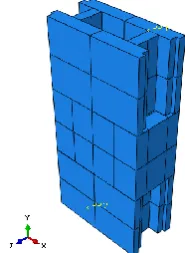
The PUTRA block was then tested in a three-course prism shape as in Fig. 2, to investigate the behaviour of interlocking mortarless hollow blocks for ungrouted prisms under uniaxial compression load. The experimental test set-ups are proposed to evaluate the contact behaviour of a dry joints, considering the geometric imperfections in the contacting faces.
Fig. 2 PUTRA block arrangement in prism shape [10]
The prism was then applied with uniaxial compression load and the result were tabulated as in Table 2.
Table 2 Experimental result of ungrouted prism in compression [11]
Specimen Max. load
(kN)
Compressive strength (N/mm2)
Prism 1 216.1 9.0
Prism 2 299.5 12.5
Prism 3 289.6 12.1
Average 268.4 11.2
3.
FEA modelling
76
quantitatively different type of materials. When it isloaded, it will exhibit different properties in terms of tension and compression.
The advancement in computing techniques and computational capabilities has led to a better study of the behaviour of concrete. But, the complex behaviour of concrete sets some limitations in implementing FEA studies. The structural mechanics of concrete structures is quite important and concrete identification parameters make the behaviour of concrete more complicated. The nonlinear finite element method has the potential to support the analysis process of concrete masonry system, because it is capable of producing detailed results which are difficult to extract from physical experiments. As such, constitutive model is proposed for this computational study and concrete damage plasticity (CDP) model is selected.
4.
Computational study of PUTRA block
system
In this studies, finite element package of ABAQUS 6.13 has been used to simulate the concrete damage plasticity (CDP) in PUTRA block system. PUTRA block system is simulated in a prism shape, consists of two stretcher blocks and two half blocks units, with 300 mm length x 150 mm width and 600 mm height as shown at Fig. 3. According to [14], the strength characteristics of masonry prism are used as the basis to give an indication about the behaviour of the masonry system instead of a large-scale wall.
Fig. 3 PUTRA block configuration in ABAQUS
Study conducted by [11] stated that the contact behaviour of mortarless joint is a complex property and becomes sophisticated with the unevenness of the contacted interfaces. It was called as geometric imperfection of the block bed causes by two factor which is the variation of regularity and roughness of the block bed interfaces and the variation of the height of the adjacent blocks. Therefore, a contact test has been conducted by [11] to study the geometric imperfection of the block bed arising from different sources. In this computational study, the interaction properties between the block bed contacted interfaced is equal to 0.603 as been stated by [15] for the mortarless masonry bed joints. In this paper, the PUTRA block prism was modelled by eight node linear brick elements with reduced
integration and hourglass control (C3D8R). The material used to develop PUTRA block system has been given from previous section by [10]. However, for the material properties in the simulation, material model such as concrete damage plasticity (CDP) model is proposed by [13] and has been tabulated in Table 3. The CDP model is controlled by two factor of concrete failure mechanism which is the cracking of the concrete in tension and the crushing of concrete in compression [20]. Experimental result for the cube compressive strength and cylinder splitting tensile strength from the study of [11] has resulted 23.4 MPa and 2.09 MPa respectively. Meanwhile, experimental result from [14] is 22 MPa and 1.8 MPa for cube and cylinder strength. Although the strength of the material is slightly difference for the computational study, it is still accepted as the concrete class strength is same which is still below than 30 MPa concrete class strength for both experimental studies.
Four key features including mesh convergence study, the ultimate load obtain from computational study, failure mechanism and stress distribution across height and cut section of the PUTRA blocks system, were analyse and compared with previous experimental work to investigating the behaviour of PUTRA block system in finite element studies.
Table 3 The proposed concrete damage plasticity (CDP) model [13]
5.
Result and Discussion
The result of the computational study of the PUTRA block prism in ABAQUS were discussed as follows:
5.1
Convergence study
The ABAQUS software is an analysis program that solving complex problems by disintegrated the rigid body of continuum element into a small discrete element. Arising of the discretization error in the analysis were indicated that the essential of convergence study is needed. The convergence study is conducted by varying the mesh size used in generating mesh for the PUTRA block prism. It was conducted to choose the optimum sizing of mesh due to its larger effects towards the output
Density
(kg/m3) 2000
The parameter of CDP model
Dilation angle, ψ 32
Concrete elasticity Eccentricity, ϵ 0.1
Elastic modulus, E
(GPa) 11
σb0/σc0 1.16
Kc 0.67
Poison ratio, υ 0.2 Viscosity, µ 0.001
Compressive behaviour from experiment
Tensile behaviour from experiment
16.96 0 0 1.8 0 0
21.24 0.0005078 0 1.5 0.0001 0.16667
22 0.0013542 0 1 0.0003 0.44444
16.96 0.0026122 0.2290909 0.7 0.0005 0.61111
9.5 0.0055439 0.5681818 0.5 0.0008 0.72222
5.2 0.0080831 0.7636363 0.2 0.0015 0.88889
2.5 0.0103684 0.8863636 - - -
77
result of ABAQUS software and the result is shown below.
Table 4 Convergence study of PUTRA block prism
Mesh size
Total element
Ultimate load, Pult
(kN) Percentage
difference (%)
Pult (fea)
Pult (exp)
[11]
GB 20 3834 123.4
299.5
58.80
GB 14 7408 212.2 29.15
GB 10 23088 260.3 13.09
GB 8 47022 275.6 7.98
GB 7 60138 280.4 6.38
GB 6 105586 297.3 0.73
GB 5 166000 297.8 0.57
In this study, result from experimental work done by [11] in Table 2 is used to validate the ultimate load obtained by computational study. As been observed in Fig. 4, increasing the number of elements will give a stable result with small percentage difference. It is illustrated that, when the finer mesh is used, the discretization error is reduced resulting a precise result.
Fig. 4 Result of ultimate load vs total element
At some point, further mesh refinement yields a little change and required a longer processing time. Referring Fig. 4, with 0.57% difference compared to experimental works, meshing size of 5 with 166000 are the nearest values of the ultimate load. However, considering the time taken to finish the simulation, meshing size of 6 with 105586 also give a better value of the ultimate load as it is still below than 1% difference. Hence, the optimum meshing size to investigating the behaviour of PUTRA block prism under uniaxial compression load is meshing size 6 with 0.73% difference of the ultimate loading.
5.2
Failure mechanism
The failure mechanism of the computational study is compared with the failure mechanism obtained from experimental work done by [11]. Based on the result, the failure mode obtained from the experimental work (Fig.
5) are quite similar compared with the computational study (Fig. 6).
Fig.5 Experimental failure mechanism [10]
Fig.6 Computational failure mechanism.
Both PUTRA block prism starts cracked at the middle before propagating to the side of the prism blocks web. The result is in line with the computational study conducted by [14] where the higher tensile stress is occurred at the face-shell of the block and higher compressive stress occurred at the block webs. Since the PUTRA block prism simulation in ABAQUS was modelled as the perfect geometry, it is slightly different from the actual experimental testing conducted at the laboratory.
5.3
Stress distribution of PUTRA block
prism
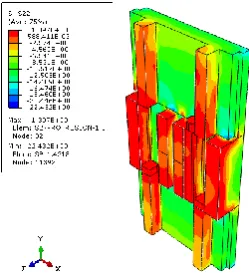
The stress distribution of prism is an important parameter that can be used to predict potential yielding of the PUTRA block prism under uniaxial compression load. As illustrated in Fig. 7, the stress distribution of the block was high at 200 mm and 400 mm prism height. Similar observation has been made by [14] whereas, the highest tensile stress is induced at the lower part of non-bearing webs in the middle course which may cause splitting of the web.
Fig. 7 Stress distribution across height of PUTRA block prism
78
web. This result agrees with the previous studies ofhollow block masonry which reported that the initial failure of walls was attributed to the splitting of the webs [17][18][19]. Red colour zone of stress contour as shown at the Fig. 8 represent the highest stress zone of a panel when it achieved ultimate load carrying capacity. The prism was failed through cracking at middle of the block web and web-shell intersection as evidenced by failure mode of PUTRA block prism in experimental study and computational study.
Fig. 8 Higher stress occurred on cut view along Z-plane of PUTRA block prism
Therefore, the stress distribution of the PUTRA block prism can be used to visualize the damage zone occurred at the prism.
6.
Summary and Conclusion
Based on the result mention above, it can be concluded that the computational study to investigate the mortarless masonry system under uniaxial compression load can be achieved through utilizing the finite element-based software such as ABAQUS. The reason was summarized as follows:
1. In this paper, meshing size of 7 with 60,138 total elements are the optimum meshing size of PUTRA block masonry prism.
2. Concrete damage plasticity (CDP) model offered in ABAQUS software is suitable in simulating the masonry system to represent any material behaviour. With suitable laboratory works, the study of the CDP model can be furthered.
3. A convergence study through meshing size variation is an important scope to predict the FEM output, as observed in section 5.1, where increasing of the elements resulted in a stable output of the prisms ultimate load.
4. The PUTRA block prism was successfully modelled by ABAQUS software to investigate the structural behaviour under uniaxial compression load. It was validated with previous experimental result and achieved almost 98% of accuracy level.
5. Higher compressive stress was observed at the face-shell of the block, but the highest tensile stress was occurring on the web. Stress distribution and load
deflection of prism permit the potential failure zone of PUTRA block prisms to be predicted accurately. 6. The failure of the prisms was due to tensile cracks
induced at the web-shell interaction and middle of the web.
Acknowledgements
The authors gratefully acknowledge the funds received from the Ministry of Higher Education Malaysia through the Fundamental Research Grant Scheme (FRGS), VOT No. 1573.
References
[1] Bosro, M. Z. M., Samad, A. A. A., Mohamad, N., Goh, W. I., Tambichik, M. A., & Iman, M. A. A review on past and present development on the interlocking loadbearing hollow block (ILHB) system. IOP Conference Series: Earth and Environmental Science, Volume 140, (2018). [2] Lee, Y. H., Shek, P. N., & Mohammad, S. (2017).
Structural performance of reinforced interlocking blocks column. Construction and Building Materials, Volume 142, (2017), pp. 469–481.
[3] Ramamurthy, K., & Kunhanandan Nambiar, E. K. Accelerated masonry construction review and future prospects. Progress in Structural Engineering and Materials, Volume 6, (2004), pp. 1–9.
[4] Thanoon, W. A., Alwathaf, A. H., & Jaafar, M. S. Finite-element analysis of an alternative masonry wall system. Structures & Buildings, Volume 168, (2015), pp. 237.
[5] Thanoon, W. A. M., Alwathaf, A. H., Noorzaei, J., Jaafar, M. S., & Abdulkadir, M. R. Finite element analysis of interlocking mortarless hollow block masonry prism. Computers and Structures, Volume 86, (2008), pp. 520–528.
[6] Thanoon, W. A., Jaafar, M. S., Abdul Kadir, M. R., Abang Ali, A. A., Trikha, D. N., & Najm, A. M. S. Development of an innovative interlocking load bearing hollow block system in Malaysia.
Construction and Building Materials, Volume 18, (2004), pp. 445–454.
[7] UK Patent, GB 2361254 A, Interlocking mortarless building block system, Published: October 17, (2001).
[8] US Patent, US 6907704 B2, Interlocking mortarless loadbearing building block system, Published: June 21, (2005).
[9] Safiee, N., Jaafar, M., Alwathaf, A., Noorzaei, J., & Abdulkadir, M. Structural Behavior of Mortarless Interlocking Load Bearing Hollow Block Wall Panel under Out-of-Plane Loading. Advances in Structural Engineering, Volume 14, (2011), pp. 1185–1196. [10]Jaafar, M. S., Thanoon, W. A., Najm, A. M. S.,
79
hollow block masonry. Construction and Building Materials, Volume 20, (2006), pp. 492–498.
[11]Jaafar, M. S., Alwathaf, A. H., Thanoon, W. A., Noorzaei, J., & Abdulkadir, M. R. Behavior of interlocking mortarless block masonry. Construction Materials, Volume 159, (2006), pp. 111–117.
[12]V.Chaudhari, S., & A. Chakrabarti, M. Modeling of Concrete for Nonlinear Analysis using Finite Element Code ABAQUS. International Journal of Computer Applications, Volume 44, (2012), pp. 14– 18.
[13]W.K. Pang, A.A. Abdul Samad, W.I. Goh, N. Mohamad, M.Z.M. Bosro & M.A. Tambichik, Structural behaviour of putra block under axial load using fem, The Journal of the Institution of Engineers, Malaysia, 79 1 (2018) 41-47
[14]Al-wathaf, A. H. A. 3D Finite Element Analysis of Hollow Concrete Block Masonry. Journal of Science and Technology, Volume 14, (2009), pp. 26-35. [15]Alwathaf A. H., Thanoon W. A., Jaafar M.S.,
Noorzaei J. and Kadir M. R. A. Shear characteristics of interlocking mortarless block masonry joints.
Masonry International, Journal of the British Masonry Society (UK), Volume 18, (2005), pp. 139-146.
[16]George, J., Kalyana Rama, J. S., Siva Kumar, M. V. N., and Vasan, A. Behavior of plain concrete beam subjected to three-point bending using concrete damaged plasticity (CDP) model. Materials Today: Proceedings, Volume 4, (2017), pp. 9742-9746. [17]Fattal, S. G., and Cattaneo, L. E. Structural
Performance of Masonry Walls Under Compression and Flexure. Building Science Series 73, National Bureau of Standards, (1976)
[18]Beccia, I. J. and Harris, H. G. Behavior of Hollow Concrete Masonry Prisms Under Axial Load and Bending. The Masonry Society Journal, Volume 2, (1983), pp. T1-T26.
[19]Hamed, A. A. and Chukwunenye, A. Effect of Type of Mortar Bedding on the Behaviour of Axially Loaded Hollow Block Masonry Prism. Proceedings. 3rd North American Masonry conference. (1985), pp. 1-11.
[20]Simulia Dassault systemes, Abaqus 6.13 online
documenta-tion, Available online:
![Fig. 2 PUTRA block arrangement in prism shape [10]](https://thumb-us.123doks.com/thumbv2/123dok_us/8437203.1699925/2.595.338.495.262.484/fig-putra-block-arrangement-prism-shape.webp)
![Fig.5 Experimental failure mechanism [10]](https://thumb-us.123doks.com/thumbv2/123dok_us/8437203.1699925/4.595.322.517.106.258/fig-experimental-failure-mechanism.webp)