Abstract
The existing literature suggests that under certain environmental conditions control systems such as budgets can be effective only if they are used interactively. However, empirical evidence to support such a proposition is scant. This study examines the moderating effect of strategic uncertainty on the effectiveness of budgets when used as (a) a diagnostic control system; and (b) an interactive control system. In examining these relationships, the intervening role of individual motivation is also considered. Findings based on the data gathered from a questionnaire survey of large and medium size public sector organisations in Australia confirm that while diagnostic use of budgets is more effective in motivating individual performance under low strategic uncertainty, interactive use of budgets is more effective when strategic uncertainty is high. This study contributes to both the theory and practice.
Keywords: Budgets, diagnostic and interactive uses, diagnostic control systems, interactive control systems, moderating effect, strategic uncertainty
DIAGNOSTIC AND INTERACTIVE USES
OF BUDGETS AND THE MODERATING
EFFECT OF STRATEGIC UNCERTAINTY
Sabrina Shi Qiong Shen
Enstar Group Limited, Sydney, Australia
Sujatha Perera
Introduction
There has been an increasing interest in recent times to understand different ways of using management control systems (MCS) in enhancing individual and organisational performance (Henri, 2006; Bisbe & Otley, 2004; Abernethy & Brownell, 1999). Simons (2000), for instance, suggests two different ways of using the same MCS, namely the diagnostic use and the interactive use of MCS. Simons (2000, p.209) defines diagnostic control systems as “the formal information systems that managers use to monitor organisational outcomes and correct deviations from preset standards of performance”. Accordingly, a diagnostic control system would typically be characterised by setting goals; measuring outputs; computing performance variances; using variance information as feedback to alter input and/or processes to bring performance back in line with pre-set goals and standards. When using management control systems diagnostically, their effectiveness would largely be dependent on how much attention has been paid in setting the targets, aligning performance measures, designing rewards, reviewing exception reports, and managing significant exceptions (Simons, 2000).
Interactive control systems on the other hand “are the formal information systems that managers use to personally involve themselves in the decision activities of subordinates” (Simons, 2000, p.216). A main feature of interactive control systems is the intensive and continuous involvement of senior managers in processing information for decision making and control purposes. When control systems are used interactively, managers at all levels engage in ongoing debates and dialogues to analyse new information before responding to such information.
business strategy is based’ (Simons, 2000, p. 215), under high level of strategic uncertainty, there will be a need, not only to reconsider the existing strategies, but also how to use control systems to communicate and implement new strategies. Although the notion of different uses of MCS to fit the level of strategic uncertainty is intuitively appealing, empirical research undertaken to test its validity is extremely limited. Such research could have significant implications for both theory and practice.
The purpose of this study is to examine the moderating effect of strategic uncertainty on the effectiveness of budgets when they are used as (a) a diagnostic control system; and (b) an interactive control system. Data gathered from public sector Organisations are used to examine these relationships as budgets play an important role in planning and control in those Organisations (Perera, 2004). Such Organisations use budgets widely and for various purposes including, to attract funding from the central government, and to justify the use of funding. With the emergence of the New Public Management (NPM) that claims objectives such as increased efficiency, quality, and competition for public sector services (Lane, 2000), public sector Organisations increasingly experience a high level of strategic uncertainty with implications for the use of budgets. Prior to the emergence of NPM budgets in the public sector, Organisations were more likely to use them as diagnostic tools, i.e. to set targets, compare with actuals, and take necessary actions in relation to variances. The increased strategic uncertainty resulting from the adoption of NPM concept could make the management of public sector Organisations use budgets more interactively, rather than adhering to the budgets set at the beginning of the budget period, making relevant adjustments resulting from constant discussions between superiors and subordinates. However, the literature on the effectiveness on the diagnostic and interactive uses of budgets in public sector context is extremely limited.
This study aims to make a contribution to the literature on MCS and performance measurement systems and on managerial controls in public sector Organisations. By examining the relationship between diagnostic and interactive uses of budgets and individual performance, particularly using motivation as an intervening variable and strategic uncertainty as a moderating variable, this study extends Abernethy & Brownell (1999) and Moulang (2006), and adds to the existing literature on different uses of MCS in general, and budgeting systems more specifically.
The remainder of the paper is organized as follows. Section two reviews the relevant literature and formulates the hypotheses. Section three outlines the research method. Section four presents the results followed by a discussion of the findings in section five. A summary of the study and areas for further research are presented in section six.
Literature Review and Development of Hypotheses
The existing literature on diagnostic and interactive uses of MCS constitutes a number of empirical studies that examine the impact of different uses of MCS on individual performance and their effects on various organizational performance dimensions. Moulang (2006), for example, empirically examines the relationship between diagnostic and interactive uses of performance measurement systems (PMS) and individual performance, and uses psychological empowerment and creativity to explain the proposed relationship. Although not examined in her study, she highlights motivation as an underlying driver for those two intervening variables.
While there has been a growing body of literature on diagnostic and interactive uses of management control systems, there are still issues in this area of research that need further investigation. For instance, although the existing literature suggests that the interactive use of controls is more effective in general (eg. Moulang, 2006), research into the factors that are likely to moderate the effectiveness of diagnostic and interactive uses of controls and the underlying drivers of the effective use of such controls is scant. Therefore, this study specifically focuses on the effectiveness of diagnostic and interactive uses of budgets on individual performance in public sector Organisations under different levels of strategic uncertainty.
Budgets as a MCS
A budget is “the quantitative expression of a proposed plan of action by management and is an aid to coordinating what needs to be done to implement that plan” (Horngren et al., 2006, p.7). Budgets are also used by Organisations as a planning tool to find the best way through which the efforts of the business could be directed in meeting its primary objective (Heckert & Willson, 1967). Further, as an accounting control system, budgets assist to perform other functions such as forecasting, communication, resource allocation, controlling profit and operations, performance evaluation, and provision of incentives (Langfield-Smith et al., 2006). As the most commonly used planning and control tool in Organisations, budgets are also used often to measure both individual and sub-unit performance in almost all types of Organisations irrespective of the size (small/large), type of activity performed (manufacturing/service) and ownership (public sector/private sector).
the degree of interaction among organizational members in setting and implementing budgets is highly likely to influence the effectiveness of budgets as a planning and control tool.
Traditionally, budgeting is seen as a linear process, taking place sequentially throughout a given period. For instance, budgets are set at the beginning of the budget cycle, actual performance for the period is compared with expected performance, and actions are taken based on the variations between actual and expected performance. Budgets have often been subject to criticisms because of the rigid adherence to such processes by Organisations. Consequently, it has been argued that traditional budgets are unable to meet the management control needs of contemporary Organisations which are subject to constant change (Hope & Fraser, 1999), and that in order to respond and adapt to changes in the environment, MCS including budgets, needs flexibility as well as adaptability (Otely, 1994).
Simons (2000) implies that budgets as a management and control tool could be used not only in the traditional way (i.e. in a linear manner, as a diagnostic tool), but also in a flexible manner as an interactive control tool. Depending on the conditions under which it is operating, an organization should choose the appropriate way of using budgets to accomplish its goals and objectives (Simons, 2000).
Diagnostic Use of Budgets (DUB) and Interactive Use of Budgets (IUB)
When budgets are used as a diagnostic control system, managers must fulfil five important conditions: setting the level of expected output as accurately as possible, measuring of the output, rewarding the achievement of expected results, reviewing exception reports, making adjustments to the objectives or goals (budgets) based on significant exceptions and taking actions if problems are identified (Simons, 2000). The diagnostic use of budgets (DUB) could be seen as a relatively linear process which does not require a high level of managerial intervention or much revision during the implementation stage.
information on the changing conditions faced by the organization should be available. Third, multiple levels of managers should be involved to enrich the interaction and discussions between subordinates. Fourth, new goals, plans and behaviour need to be formulated where necessary to adapt to the changing conditions. When used as an interactive control system, budgets could perform three functions, namely signalling, surveillance and decision ratification to intervene in ongoing discussions of subordinates (Simons, 1990).
The DUB and IUB differ in a number of ways. When budgets are used diagnostically, managers only need to pay attention to the exceptions; hence, managers’ time is conserved. When budgets are used interactively, managers are required to continuously engage in the budgeting process (i.e., setting, revising, resetting and implementing), and are required to communicate and discuss budgets with other members of the organization on an ongoing basis. As a result, the amount of time spent on budget implementation could be relatively high. Moreover, the DUB makes the organization work in a more rigid manner to diagnose, identify and understand the causes of deviations between the expected and actual performance. In comparison, the IUB is used in a more flexible and adaptive manner, and as a result demands managers’ personal involvement in setting and implementing budgets. Furthermore, under the DUB, responding to changes may be delayed until the following period, while the IUB requires prompt responses to changes.
Impact of DUB and IUB on Performance
Motivation as an Intervening Variable
The existing literature largely supports interactive use of MCS and, particularly where both interactive and diagnostic uses are examined, the findings revealed that interactive controls were more effective than diagnostic controls. These studies pay limited attention to explaining why such uses lead to the described effects. However, in Moulang’s (2006) study on the association between individual performance and psychological empowerment and creativity, she suggests individual motivation as a possible underlying driver of psychological empowerment and creativity. This suggestion also implies the possibility of motivation influencing the relationship between different uses of budgets and individual performance as an intervening variable.
Expectancy theory of motivation argues that individuals’ behaviour could be motivated by their expectation and perception of the actual outcomes as well as the satisfaction they derive from those outcomes (Ronen & Livingstone, 1975). More specifically, the literature suggests that there are three factors that affect individual motivation, namely intrinsic valences, extrinsic valences and expectancies of the outcomes (Connolly, 1976; Ronen & Livingstone, 1975; Lawler & Suttle, 1973). Intrinsic valences refer to individuals’ valences which are contingent on their feelings of satisfaction or competence. Various incentives they are likely to receive as a result of their goal-directed behaviour are referred to as extrinsic valences (Ronen & Livingstone, 1975). The likelihood of receiving intrinsic and extrinsic valences is argued to affect the degree of individual motivation. The degree of individual motivation is also affected by the expectations of outcomes from individual behaviour. Lawler (1971) makes a distinction between the expectancies that individuals’ efforts will lead to increased performance and the expectancies that this accomplishment of goals will produce satisfied outcomes or rewards.
diagnostic or an interactive tool) could affect the level of motivation of employees with implications on their performance. Merchant (1981), for instance, found that there is a positive relationship between motivation and individual performance. Accordingly, as the level of motivation increases (decreases), the level of individual performance is likely to increase (decrease). This study will further test the following hypotheses.
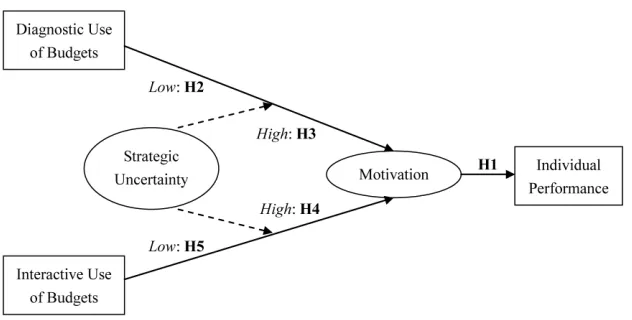
Hypothesis 1: Individual performance is positively associated with motivation.
Strategic Uncertainty as a Moderating Variable
Existing literature, in particular contingency literature, suggests that the association between different uses of budgets and individual motivation and performance could be moderated by strategic uncertainty. More specifically, the alternative uses of budgets can affect the level of individual motivation to different degrees under varying levels of strategic uncertainty (i.e. high and low). Consequently, DUB or IUB, under high or low levels of strategic uncertainty forms four scenarios (i.e., DUB in low strategic uncertainty, DUB in high strategic uncertainty, IUB in low strategic uncertainty, and IUB in high strategic uncertainty) which are likely to influence individual motivation and performance in different ways. The four scenarios are discussed below.
Diagnostic Use of Budgets when Strategic Uncertainty is Low
When strategic uncertainty experienced by the organization is low, the standards and budgets set at a point in time are likely to be still relevant at the time they would be used to evaluate performance. Employees would be able to follow the procedures which they are familiar with, and also would be able to aim to achieve the expected performance and attain such performance. Due to the high degree of stability in the areas that their performance is assessed, individuals are likely to consider budgets as attainable, and would be willing and motivated to provide the required effort so as to obtain the rewards provided for the satisfactory level of performance. Therefore, it could be argued that the DUB would be positively associated with motivation when strategic uncertainty is low. This argument leads to the following hypothesis:
Hypothesis 2: Diagnostic use of budgets will be positively associated with motivation when strategic uncertainty is low.
Diagnostic Use of Budgets when Strategic Uncertainty is High
instance, if used as a diagnostic control system, budgets would be seen as irrelevant to evaluate performance at the end of a period due to changes occurred throughout that period. Individuals will also be reluctant to take responsibility for any deviations from budgets as no attempt (or limited attempt) is made under DUB to take account of the impact of variations in the internal and external environments. Such use could also lead to job-related tension among employees which could in turn result in decreased performance (Lau & Tan, 2006; Hopwood, 1972). Dunk (1993) found that job-related tension was significantly and negatively associated with managerial performance. Hence, it could be argued that when strategic uncertainty is high, diagnostic use of budgets could have a negative effect on individual motivation, which in turn is likely to result in decreased performance. This argument leads to the following hypothesis:
Hypothesis 3: Diagnostic use of budgets will be negatively associated with motivation when strategic uncertainty is high.
Interactive Use of Budgets when Strategic Uncertainty is High
When strategic uncertainty is high, it would be important for managers at all levels to actively engage in ongoing debates and dialogues based on new information (Simons, 2000). Continuous interaction between managers enables them to gain an understanding of the most appropriate way to adapt to changes and make amendments in order to improve performance (Simons, 2000). A high degree of budget participation becomes a necessary feature of budgets when they are used as an interactive control system. When individuals are able to participate in budgeting, they are more likely to be motivated to engage in goal-directed behaviour (Brownell, 1982; 1981; Merchant, 1981). Participation not only enables managers to obtain relevant information to perform their job successfully (Hopwood, 1976), but also facilitates organizational learning (Van de Ven & Delbecq, 1974). Availability of job-relevant information improves individual performance (Kren, 1992). Additionally, budget participation could enhance budget goal acceptance and commitment of employees (Chong & Chong, 2002). Based on the above discussion, the following hypothesis is formulated.
Interactive Use of Budgets when Strategic Uncertainty is Low
When strategic uncertainty is low, budgets may not require any major changes during its implementation. Hence a high degree of interaction among managers through ongoing discussions would not be as important as when strategic uncertainty is high. On the one hand, under such conditions, ongoing discussions will be seen as unnecessary as they are not likely to add any new information to the budget implementation, and on the other hand, such interactions will be seen as a waste of managerial time. However, if managers are required to engage in such interactions, negative attitudes are likely to arise leading to diminishing levels of motivation. Based on the above argument, the following hypothesis is formulated.
Hypothesis 5: Interactive use of budgets will be negatively associated with motivation when strategic uncertainty is low.
The theoretical model depicted in Figure 1 demonstrates the relationships between different uses of budgets (i.e., diagnostic and interactive) and motivation of individuals under high and low levels of strategic uncertainty, and the effect of those relationships on individual performance.
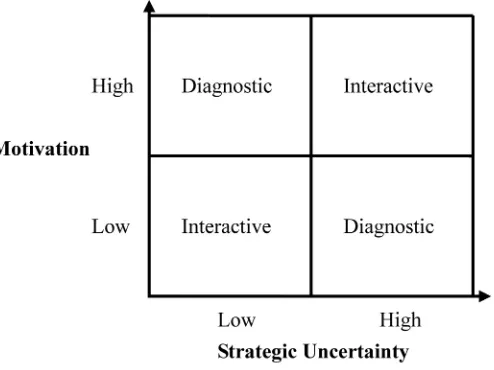
In summary, this study argues that while the use of diagnostic controls is likely to motivate a high level of performance when strategic uncertainty is low, the use of such controls is likely to motivate a low level of performance when strategic uncertainty is high. On the other hand, the use of interactive controls is likely to motivate a high level of performance when strategic uncertainty is high, while the use of such controls under low strategic uncertainty is likely to motivate a low level of performance. Figure 2 illustrates the predictions of different uses of budgets in motivating individual performance under different levels of strategic uncertainty.
Figure 2: The use of budgets under different levels of strategic uncertainty and their effect on motivation
Research Method
Sample
Three groups of public sector Organisations in Australia, namely government departments and agencies, local government councils, and government trading enterprises (GTE) were examined. The initial sample of Organisations was selected from two sources. The major source was a database developed for a previous study using the State Directories5. The first two groups of Organisations were randomly selected from that database. Since this database had only a limited number of GTEs, a list of monitored government trading enterprises provided by Australian Government Productivity Commission (2005) was used as a second data source. The initial list of Organisations compiled had a total of 492 public sector Organisations.
From each organization, a member of the senior level management (eg. Chief Executive Officers [CEO], directors, general managers, and Chief Financial Officers [CFO]) was identified for participation in the study. Such position holders were seen to have the relevant information and knowledge required to complete the survey questionnaire. The details of the 492 Organisations and the potential participants were obtained from a number of sources including the Australian Government Online Directory (2007) and websites of the relevant public sector Organisations. The respective web links were used to obtain such information for local government councils and GTEs.
Further checks undertaken via telephone led to the exclusion of 29 Organisations for reasons including inability to be contacted (e.g., wrong contact number, vacant position at the time), privatization, and not meeting the size criterion. The remaining 463 constituted 152 departments and agencies, 206 local government councils and 105 GTEs.
The Questionnaire Survey
The questionnaire survey used in this study was designed following Dillman’s (2000) Tailored Design Method, and it contained five sections (sections A-E). The instrument used to measure motivation was placed at the beginning of the questionnaire (Section A) as it was seen as an area that could attract the attention of the participants of the survey (Dillman,
1The State Directories, including NSW, VIC, QLD, SA, TAS and WA were
2000). The development of the instrument used to measure motivation was largely informed by the expectancy theory of motivation. A seven-point Likert scale ranging from “Strongly Disagree” to “Strongly Agree” was used to measure the ten items in this section.
Section B contained two instruments to measure the different uses of budgets. The measurement instrument used in Moulang (2006) was adopted in this study with minor variations. Of the two instruments in this section, one was a multi-item instrument with eight items and the other was a forced-choice instrument. For the multi-item instrument, a seven-point Likert scale ranging from “Strongly Disagree” to “Strongly Agree” was used. Section C of the questionnaire contained two sub-sections with four items in each section to measure the two components of strategic uncertainty namely competitive dynamics and internal competencies. This instrument used a seven-point Likert scale ranging from “Strongly Disagree” to “Strongly Agree”, and was to a large extent informed by Duncan (1972). The instrument in Section D was to measure individual performance. This section contained nine items. The instrument used to measure individual performance in Mahoney et al. (1965) was adopted in this study. Mahoney et al. (1965) is regarded as the most commonly used instrument to measure performance in management accounting research, especially those related to control systems (Chong & Chong, 2002; Chong, 1996; Kren, 1992; Brownell & McInnes, 1986). This instrument used a seven-point Likert scale ranging from “Well below average” to “Well above average”.
The final section (Section E) was designed to obtain relevant demographic details from the participants. Six demographic questions were included to confirm the criteria used to select the sample Organisations and the participants. The first three items were designed to obtain the background information, namely gender, age and qualification of the participants. The fourth item confirmed the positions held by the participants. The fifth item checks the period of employment in the organization to help identify those whose length of service was not too short to provide reliable information about their budgeting systems. The last item was to ensure that all Organisations in the sample had no less than twenty employees.
Organisations listed on the final database compiled for this study. With the survey questionnaire, each organization received a cover letter, a postcard, and a reply-paid self-addressed envelope. Respondents were requested to return the postcard separately after returning the completed questionnaire to prevent a reminder survey being sent to them. Three weeks after the initial mail-out of the survey questionnaire, a follow-up was sent to the non-respondents.
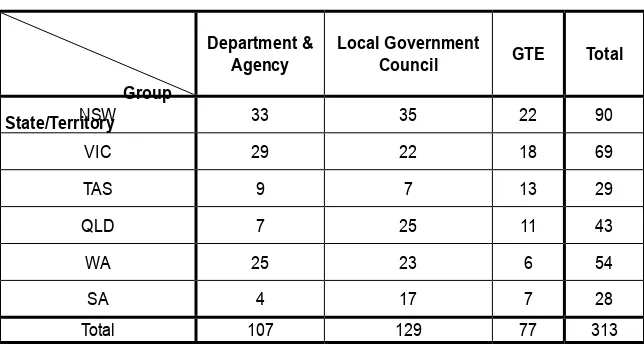
The first mail-out resulted in 212 responses, and 101 further responses were received after the second mail-out, resulting in a response rate of 67.6% (313 responses). The details of the participating Organisations are given in Table 1.
Table 1: Classification of Participating Organisations
Department &
Agency Local Government Council GTE Total
NSW 33 35 22 90
VIC 29 22 18 69
TAS 9 7 13 29
QLD 7 25 11 43
WA 25 23 6 54
SA 4 17 7 28
Total 107 129 77 313
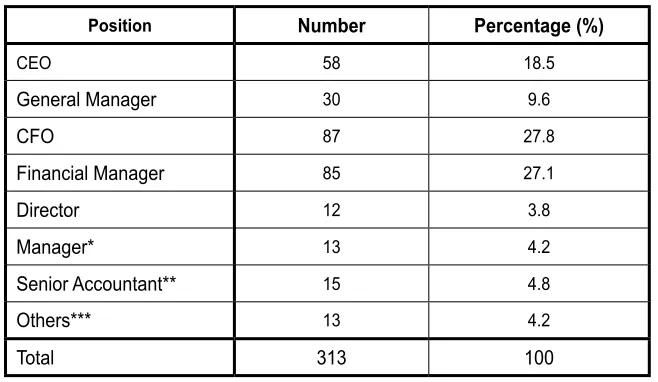
The early vs late test undertaken to check for non-response bias6 showed no difference between the means of early and late responses, suggesting that non-response bias is not an issue. As shown in Table 2 the participants of this study represent a wide range of senior managerial positions.
6One common method to check for non-response bias is to compare early respondents with the late respondents (Early versus Late Test) in order to check whether there is any systematic difference between the early and late responses (Roberts, 1999).
Table 2: Positions of the Respondents
Position Number Percentage (%)
CEO 58 18.5
General Manager 30 9.6
CFO 87 27.8
Financial Manager 85 27.1
Director 12 3.8
Manager* 13 4.2
Senior Accountant** 15 4.8
Others*** 13 4.2
Total 313 100
* The group of manager includes 5 corporate services managers, 3 quality managers, 2 human resource managers, 1 manager-business and information, 1 manager-commercial, 1 manager-administration, and 1 manager-strategic support.
** The group of senior accountants includes 6 management accountants, 1 corporate accountant, 1 system accountant, and 5 general accountants.
*** Others include deputy CEO, company secretary, planner, policy advisor and those unidentified.
Reliability and Validity of Measures
Table 3: Reliability Statistics
Variable Cronbach’s Alpha No. of Items
Use of Budgets .893 8
Motivation .903 10
Strategic Uncertainty .790 8
Individual Performance .789 8
To assess the content validity, the questionnaire was discussed (especially, the wording, meaningfulness of each item, and sequence of each instrument) with three researchers who had experience in designing questionnaires. Additionally, feedback received from a pilot study using five professional accountants, were also used in refining the questionnaire instrument. Factor analysis undertaken to test the construct validity for all four variables (uses of budgets, motivation, strategic uncertainty and individual performance) showed that the items used to measure each of them had individual loadings greater than 0.6, indicating all measures have the ability to capture the meaning of the concept and to apply the theory (Dillman, 2000). Hulland (1999) suggests a general rule of thumb to drop the items with loadings of less than 0.4.
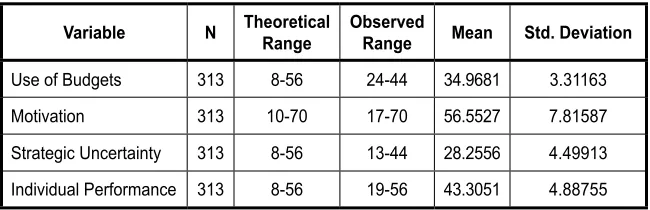
Table 4 presents the descriptive statistics for the four variables of interest in this study, namely uses of budgets, motivation, strategic uncertainty and individual performance.
Table 4: Descriptive Statistics
Variable N Theoretical Range Observed Range Mean Std. Deviation
Results
Regression analysis was used to test the five hypotheses developed in this study. The tests were undertaken in two stages. First, the relationship between individual performance and motivation was examined. Next the impact of strategic uncertainty on the relationship between different uses of budgets (i.e., DUB and IUB) and motivation was examined.
Individual Performance and Motivation
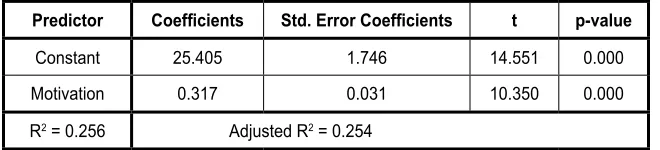
A simple linear regression analysis was conducted to test the relationship between individual performance and motivation, and the results of the analysis are presented in Table 5, showing a significantly positive relationship between individual performance and motivation (t = 10.350, p-value = 0.000, α1 = 0.317). Hence, Hypothesis 1 is strongly supported.7
Table 5: Relationship between motivation and individual performance
Predictor Coefficients Std. Error Coefficients t p-value
Constant 25.405 1.746 14.551 0.000
Motivation 0.317 0.031 10.350 0.000 R2 = 0.256 Adjusted R2 = 0.254
Strategic Uncertainty as a Moderating Variable
A multiple linear regression model was used to test Hypotheses 2, 3, 4 and 5. Recall that Hypothesis 2 states that DUB is positively related to motivation when strategic uncertainty is low; Hypothesis 3 states that DUB is negatively related to motivation when strategic uncertainty is high; Hypothesis 4 states that IUB is positively related to motivation when strategic uncertainty is high; Hypothesis 5 states that IUB is negatively related to motivation when strategic uncertainty is low. The following model was developed to test these four hypotheses.
Y = β0+ β1X + β2Z+ β3XZ+ ε
Where Y = motivation X = use of budgets Z = strategic uncertainty
βi = the coefficients of the population regression (i = 0, 1, 2, 3) XZ= the interaction between uses of budgets and strategic uncertainty
ε = the residuals of the observations to the population regression line
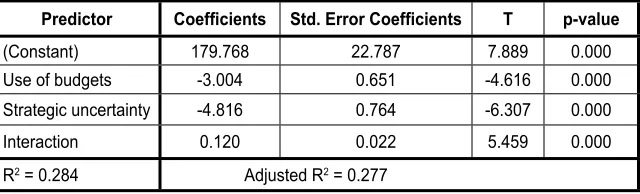
Table 6 presents the results of the analysis. It shows that motivation is affected by the combined effect of the use of budgets (X) (i.e., DUB, IUB) (t = -4.616, p-value = 0.000), strategic uncertainty (Z) (t = -6.307, p-value = 0.000), and the interaction between the use of budgets (X) and strategic uncertainty (Z) (t = 5.459, p-value = 0.000). The R-squared value for this multiple linear regression model is 0.284, indicating that approximately 28.4% of the variance in the level of motivation (Y) can be explained in terms of the three variables (i.e., X, Z, and XZ).
Table 6: Moderating effect of strategic uncertainty on the use of budgets
Predictor Coefficients Std. Error Coefficients T p-value
(Constant) 179.768 22.787 7.889 0.000 Use of budgets -3.004 0.651 -4.616 0.000 Strategic uncertainty -4.816 0.764 -6.307 0.000
Interaction 0.120 0.022 5.459 0.000
R2 = 0.284 Adjusted R2 = 0.277
Aiken and West (1991, p.13) suggests a guideline to “use the values ZM, ZH, ZL, corresponding to the mean of Z, one standard deviation above the mean of Z, and one standard deviation below the mean of Z” to represent the cut-offs and to generate a series of simple regression equations of motivation (Y) on the use of budgets (X) at specific values of strategic uncertainty (Z). As shown in Table 4, the mean value of strategic uncertainty is 28.26, and the standard deviation of strategic uncertainty is 4.50, hence the approximate score of strategic uncertainty was taken as ZM = 28, ZH = 33, ZL = 23. Subsequently, three simple regression lines were generated by substituting these values (i.e., 23, 28 and 33) into the regression model.
The results of the computations of simple regression equations for ZH, ZM and ZL are shown in Table 7. The simple regression equations indicate a positive regression of motivation (Y) on the use of budgets (X) for ZH, and a negative regression of motivation (Y) on the use of budgets (X) for ZL.
Table 7: Simple Regression Equations
In general: Ŷ = 179.768 – 3.004 X – 4.816 Z + 0.12 X Z
At ZH = 33: Ŷ = 0.956 X + 20.84
At ZM = 28: Ŷ = 0.356 X + 44.92
At ZL = 23: Ŷ = -0.244 X + 69
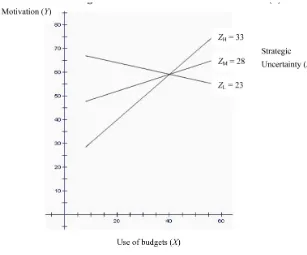
Figure 3 shows the patterns of the regressions of motivation (Y) on the use of budgets (X) depending upon the level of strategic uncertainty (Z). As can be seen in this interaction plot, motivation (Y) is related to the use of budgets (X) in different ways. If the strategic uncertainty is high (at ZH), motivation (Y) increases as the use of budgets (X) increases (i.e., more interactive). Hence, Hypothesis 4 is supported. Recall that an increase in IUB is regarded as equivalent to a decrease in DUB. An increase of motivation, therefore, can also result from a decrease in DUB. In other words, an increase in DUB results in a decrease in motivation when strategic uncertainty is high. Therefore, Hypothesis 3 is also supported.
decrease in the level of individual motivation. Therefore, Hypothesis 5 is supported. As an increase in IUB is regarded as a decrease in DUB, then, a decrease in DUB also results in a decrease of motivation. In other words, an increase in DUB leads to an increase in the level of individual motivation, when strategic uncertainty is low. Hence, Hypothesis 2 is also supported.
Figure 3: Interaction Plot for Motivation (Y)
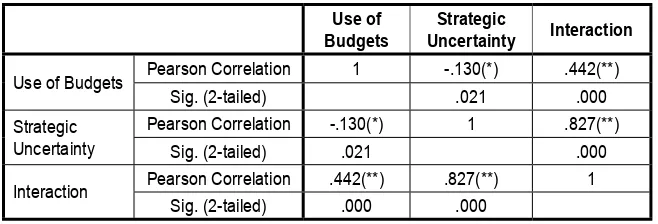
Multicollinearity
Table 8: Correlations between Independent Variables Use of
Budgets UncertaintyStrategic Interaction
Use of Budgets Pearson Correlation 1 -.130(*) .442(**)
Sig. (2-tailed) .021 .000
Strategic
Uncertainty Pearson CorrelationSig. (2-tailed) -.130(*).021 1 .827(**).000
Interaction Pearson Correlation .442(**) .827(**) 1 Sig. (2-tailed) .000 .000
* Correlation is significant at the 0.05 level (2-tailed). ** Correlation is significant at the 0.01 level (2-tailed).
Discussion
While the limited number of studies that examined diagnostic and interactive controls have found that the way in which a particular control system is used could lead to certain desired outcomes, no attempt has been made to systematically examine and explain why and/or how individual performance vary as a result of the way such controls are used. The current study fills this gap by empirically testing the effect of different uses of budgets on individual performance using motivation as an intervening variable and strategic uncertainty as a moderating variable. The study tested and found a significant positive relationship between motivation and individual performance which is consistent with the existing literature, in particular Merchant (1981). A positive association between a particular way of using budgets and individual motivation also means a positive association between the same use of budgets and individual performance. This finding helps to understand the relationship between uses of controls and individual performance.
decision making purposes as individuals find pre-set budgets as a relevant and suitable control tool for such purposes. The negative association found in this study between motivation and DUB when strategic uncertainty was high. It suggests that Organisations facing high levels of strategic uncertainty should minimise the use of budgets as a diagnostic control system because of the likely negative impact on performance due to diminished level of individual motivation.
Second, this study found a positive relationship between motivation and the IUB when strategic uncertainty was high. Accordingly, when Organisations are facing a high level of strategic uncertainty, the ongoing dialogues and discussions between individuals in setting and implementing budgets could effectively motivate individuals. Such positive effects on individuals’ motivation through the IUB could in turn affect their performance positively. This finding is consistent with that of Simons (2000), who suggests that as a control system budgets would be more effective when used interactively, particularly when continuous changes occur in relations to the organization’s internal competencies and competitive dynamics. This finding also provides empirical evidence on the effective way of using budgets under changing conditions. Consistent with the hypothesis, but in contrast to what was found in relation to DUB, this study found that IUB affected individual motivation negatively when strategic uncertainty was low. This finding provides new insights into Simons’ (2000) proposition that interactive controls are effective in general, and more specifically when strategic uncertainty is high.
Summary and Conclusions
This study examined the moderating effect of strategic uncertainty on the relationship between different uses of budgets (i.e., interactive and diagnostic uses) and individual performance using motivation as an intervening variable, and found that motivation and individual performance were positively and significantly related and also that strategic uncertainty moderated the relationship between different uses of budgets and individual performance.
The findings of the study provide useful insights in relation to the way in which budgets should be used in Organisations. First, it shows the importance of assessing the level of strategic uncertainty facing the organization when determining the way in which budget should be used. If managers consider the organization’s external dynamics and internal competencies to be stable and predictable, it would be more appropriate to use budgets as a diagnostic system since individual would be motivated to perform. On the other hand, when strategic uncertainty is high, managers may consider using budgets as an interactive system since more interactions under such conditions are likely to motivate individuals to perform.
Second, the findings of this study on the diagnostic use of budgets are consistent with those in the previous literature that suggests that such use is effective when Organisations are in a stable environment. Although, previous studies have often discussed interactive control systems as effective systems in general, this study found that the interactive use of budgets did not effectively motivate individuals when strategic uncertainty was low. Overall, the findings of the study suggest that MCS such as budgets could be more effective by varying the way in which they are used to match the level of strategic uncertainty experienced by the organization.
of a single control system within the same study. Hence it provides a more comprehensive analysis of the control system under varying conditions. Furthermore, the findings also highlights the importance of giving careful consideration to how a particular control system should be used as the decision has implications for motivation of individuals.
There are several areas for future research. Future researchers could replicate this study by using data from private sector Organisations. This study also could be extended by examining other control systems such as performance measurement systems. Future researchers may also consider using field study methods in conjunction with survey methods to further examine the research question and the issues raised in this study. Interviews, in particular, could provide more comprehensive information to undertake a more in-depth analysis of the relevant issues. Future studies could also be undertaken in an international setting particularly, to understand the impact of national culture on the effectiveness of diagnostic and interactive control systems. The two instruments developed in this study to measure motivation and strategic uncertainty may be further refined in future studies.
References
Abernethy, M. A. and Brownell, P. (1999). The Role of Budgets in Organisations Facing Strategic Change: An Exploratory Study,
Accounting, Organisations and Society, 24,3 :189-204.
Aiken, L. S. And West, S. G. (1991). Multiple Regression: Testing and
Interpreting Interactions. SAGE Publications.
Australian Bureau of Statistics. (2007). Year Book Australia (No. 1301.0).
Canberra, Australian Capital Territory: Dennis Trewin.
Australian Government Online Directory. (2007). http://www.directory. gov.au, Retrieved July 28, 2007.
Australian Government Productivity Commission. (2005). Financial
Performance of Government Trading Enterprises 1999-00 to 2003-04,
Baum, J. A. C.and Korn, H. J. (1996). Competitive Dynamics of Interfirm
Rivalry, The Academy of Management Journal, 39, 2 : 255-291.
Bisbe, J. and Otley, D. (2004). The Effects of The Interactive Use of
Management Control Systems on Product Innovation, Accounting,
Organisations and Society,29, 8 : 709-737.
Brownell, P. (1981). Participation in Budgeting, Locus of Control and
Organizational Effectiveness, The Accounting Review,56, 4: 844-860.
Brownell, P. (1982). A Field Study Examination of Budgetary Participation
and Locus of Control. The Accounting Review,57,4 :766-777.
Brownell, P. and McInnes, M. (1986). Budgetary Participation, Motivation
and Managerial Performance, The Accounting Review, 61,4 : 587-600.
Burns, T. and Stalker, G. M. (1961). The Management of Innovation,
London: Tavistock Publications.
Chong, V. K. (1996). Management Accounting Systems, Task Uncertainty
and Managerial Performance: A Research Note, Accounting,
Organisations and Society, 21, 5 : 415-421.
Chong, V. K. and Chong, K. M. (2002). Budget Goal Commitment and Informational Effects of Budget Participation on Performance: A
Structural Equation Modelling Approach, Behavioral Research in
Accounting, 14: 65-86.
Connolly, T. (1976). Some Conceptual and Methodological Issues in
Expectancy Models of Work Performance Motivation. The Academy
of Management Review, 1,4 : 37-47.
Dillman, D. A. (2000). Mail and Internet Surveys: The Tailored Design
Method (2nd ed.), New York: John Wiley and Sons, Inc.
Duncan, R. B. (1972). Characteristics of Organizational Environments and
Perceived Environmental University, Administrative Science Quarterly,
17,3 : 313-327.
Dunk, A. S. (1993). The Effect Of Budget Emphasis and Information Asymmetry on The Relation between Budgetary Participation and
Govindarajan, V. and Gupta, A. (1985). Linking Control Systems to Business
Unit Strategy: Impact on Performance, Accounting, Organisations and
Society,10, 1: 51-66.
Heckert, J. B. and Willson, J. D. (1967). Business Budgeting and Control
(3rd ed.), New York: Ronald Press Co.
Henri, J.-F. (2006). Management Control Systems and Strategy: A
Resource-Based Perspective, Accounting, Organisations and Society,
31, 6 :529-558.
Hope, J., & Fraser, R. (1999). Beyond Budgeting: Building A New
Management Model For The Information Age, Management Accounting:
Magazine for Chartered Management Accountants, 77,1 : 16-21.
Hopwood, A. G. (1972). An Empirical Study of the Role of Accounting
Data in Performance Evaluation, Empirical Research in Accounting,
Supplement to Journal of Accounting Research, 10 : 156-182.
Hopwood, A. G. (1976). Accounting and Human Behavior. Englewood
Cliffs, HJ: Prentice-Hall.
Horngren, C. T., Datar, S. M., and Foster, G. (2006). Cost Accounting: A
Managerial Emphasis (12th ed.). Pearson Prentice-Hall.
Hulland, J. (1999). Use of Partial Least Squares (PLS) in Strategic
Management Research: A Review of Four Recent Studies. Strategic
Management Journal, 20 : 195-204.
Hunt, B., & Ivergard, T. (2007). Organizational Climate and Workplace Efficiency: Learning from Performance Measurement in A
Public-Sector Cadre Organization, Public Management Review, 9, 1 : 27-47.
Kren, L. (1992). Budgetary Participation and Managerial Performance: The
Impact of Information and Environmental Volatility, The Accounting
Review, 67, 3 : 511-526.
Lane, J. E. (2000). New Public Management, Routledge, London.
Langfield-Smith, K., Thorne, H. and Hilton, R. W. (2006). Management
Accounting – Information for Managing and Creating Value (4th ed.),