The impact of Intellectual Capital on the
Organizational Citizenship Behavior (OCB) in
business organizations: Field Study on the
Jordanian industrial companies
Dr. Ghazy Albadayneh Al Tafila Technical University
Faculty of Business
Department of Business Administration P.O. Box 179
66110 Al Tafila
Dr .Eyad Taha AL-Rawashdeh Al Tafila Technical University
Faculty of Business
Department of Business Administration P.O. Box 179
66110 Al Tafila
Abstract
This study aimed to analyze the impact of Intellectual Capital to on the Organizational Citizenship Behavior in business organizations، and to achieve the objectives of the study questionnaire was developed and distributed to a sample which selected randomly of (310) Single، and represented a rate (50%) of the study population، were restored (305) questionnaire representing (96%) of the study sample. Been using Statistical Package for Social Sciences (Spss.17) (Statistical package For Social Sciences) to find averages، standard deviations، and multiple regression analysis، the study found the following results:
A. The perceptions of the respondents to the paragraphs of the independent variable Intellectual Capital to deport him (attracting capital، and stimulate capital، and Customer Care) came in high، and the perceptions of respondents about Organizational Citizenship Behavior dimensions (Civility، Altruism، Conscience) was high.
B. The presence of trace statistically significant independent variable Intellectual Capital to deport him (capital revitalization، and Customer Care) on the dependent variable Organizational Citizenship Behavior dimensions (Civility، Altruism، Conscience)، and the study showed that there was no effect statistically significant for attracting capital on Organizational Citizenship Behavior.
The study recommended the need for interest organizations Jordanian industrial companies to the concept of Intellectual Capital and takes the policies and procedures that increase the level of awareness of the employees about the importance of Intellectual Capital.
Key words: Intellectual Capital, Organizational Citizenship Behavior, Jordanian industrial companies.
INTRODUCTION
Intellectual Capital is deemed to be the key to the development of any organization. Therefore, it is important to pay attention to all its elements, especially the human element. Good preparation results in developing and enhancing the potentials of the remaining elements of Intellectual Capital easily and smoothly. However, lack of interest results in a gap between the Intellectual Capital and other kinds of capital, hence, problems can occur in the organization.
As to the motives behind my choice of this subject, they are represented in the great importance it acquired in the business organizations that are interested in the management of Intellectual Capital as a tool enhancing the Organizational Citizenship Behavior, and because the Intellectual Capital is considered the real capital upon which the success of any organization is based. Organizations depend on its ability to make an effective combination of various kinds of capitals within the organization.
Problems and Questions of the Study
Intellectual Capital is of a great importance for business organizations; it is the only controller of all resources of the organization. In addition, increased size of investments among business organizations as well as the increased size and intensity of competition are considered the main character of the economic environment in the light of the organizations' pursuit of competitive advantages that puts the organization in a superior business position among other similar organizations. These issues resulted in increased size of investments directed to the elements of Intellectual Capital. Organizations have realized the importance of Intellectual Capital and the need to work on its development as the key to solve any problem related to resource management. This in turn guarantees the ongoing ability to create added value for the organization and to achieve a powerful competitive position.
Accordingly, the problem of the study is represented in the following main question:
What is the impact of Intellectual Capital on the enhancement of Organizational Citizenship Behavior in Jordanian industrial companies?
Questions of the Study
This study seeks to answer the following main question:
What is the impact of Intellectual Capital on the enhancement of Organizational Citizenship Behavior in Jordanian industrial companies?
Form this question, the following sub-questions are derived:
1. What are the participants' conceptions of Intellectual Capital and its dimensions in the Jordanian industrial companies?
2. What are the participants' conceptions of the enhancement of Organizational Citizenship Behavior and its dimensions in Jordanian industrial companies?
3. Is there a statistically significant correlational relationship at the significance level of (α≤ 0.05) between the dimensions of Intellectual Capital and the dimensions of Organizational Citizenship Behavior?
Objectives of the Study
The main objective of this study is to analyze the impact of Intellectual Capital to on the Organizational Citizenship Behavior in Jordanian industrial companies. As to the secondary objectives, they are as follows:
1. Presentation of an integrated framework for all the variables of the study;
2. Identification of the participants' conceptions of Intellectual Capital as an independent variable as well as its dimensions (Intellectual Capital Attraction, activation of Intellectual Capital, and Customer Care); 3. Identification of the participants' conceptions of the dependent variable, enhancement of organizational
citizenship behaviours, and each of its dimensions (Civility, Altruism and Conscience);
4. Identification of the relationship between Intellectual Capital and achievement of competitive advantage in Jordanian industrial companies; and
5. Presentation of recommendations based on the results of study analysis.
Importance of the Study
Importance of this study lies in the following:
1. It is an academic attempt to spot the light on Intellectual Capital and its increasing importance for business and economic organizations in general, and how to improve and maintain it in order to achieve and s the competitive advantage;
2. The study directs the attention of leaders and workers alike to the difficulty for any organization to achieve its goals effectively without deep understanding of Intellectual Capital and its management; 3. The study shows the importance to maintain Intellectual Capital and methods of its investment in a way
that achieves the creative and innovative activities which in turn achieve and support competitive advantage; and
Hypotheses of the Study
The present study attempts to test the following hypotheses:
First main hypothesis: Intellectual Capital along with its dimensions (attraction of Intellectual Capital, activation of Intellectual Capital and customers care) has no statistically significant impact at the significance level of (α≤0.05) on the enhancement of Organizational Citizenship Behavior and its dimensions (Civility and Altruism) in Jordanian industrial companies.
From the above hypothesis, the following sub-hypotheses are derived:
The first sub-hypothesis: Intellectual Capital along with its dimensions (attraction of Intellectual Capital, activation of Intellectual Capital and Customer Care) have no statistically significant impact at the significance level of (α≤0.05) on Civility as a dimension of the dependent variable, enhancing the Organizational Citizenship Behavior in Jordanian industrial companies.
The second sub-hypothesis: Intellectual Capital along with its dimensions (attraction of Intellectual Capital, activation of Intellectual Capital and Customer Care) have no statistically significant impact at the significance level of (α≤0.05) on Altruism as a dimension of the dependent variable, enhancing the Organizational Citizenship Behavior in Jordanian industrial companies.
The concept of Intellectual Capital
Many labels are used to denote Intellectual Capital including the cognitive capital, intangible capital and intangible assets. Therefore, researchers have introduced various definitions to the Intellectual Capital, its components and dimensions such as the following:
"Intellectual Capital represents the all the knowledge that all the members of the organization have which helps the organization achieve a competitive advantage in the market, hence enabling the organization to face the intense market competition. In addition, it represents a group of skills available in the organization that include the wide knowledge that enables the organization to reach the global level through responding to customers' requirements (Thigel & Tabayibia, 2011)".
"It is the talent, skills, technical knowledge and relations, as well as the machines they embody, which can be used to build wealth. This definitions refers to Intellectual Capital as knowledge (skills, experiences, and cumulated education of the human element) which can be converted into value (Mezreiq & Qwidry, 2011)".
"Intellectual Capital expresses a group of skills availabl in the members of the organization who have wide knowledge that enables the organization to achieve a global position through responding to customers' requirements and the chances provided by technology (Abdulmonem, 2009)."
This study considers that definitions of Intellectual Capital are mainly based on human knowledge, creativity, experiences and skills that are used to create added value; therefore, Intellectual Capital is related to the creative potentials of the company's employees that can be applied. This suggests that the basis of Intellectual Capital is the human who works in the company, and that this process doesn't stop at a specific limit especially in the intellectual companies.
Components of Intellectual Capital
Intellectual Capital consists of a number of intangible components (Rawiya) as follows:
a. Human Assets including: knowledge, skills, creativity and experience. Human capital consists of skills, abilities and knowledge as well as previous experiences or experience acquired from work;
b. Intellectual Assets including: information, written memorandums, instructions and proclamations. Intellectual assets are composed once the information, knowledge, ideas and data are transferred from the Human Assets to be recorded in writing. They become definite and clearly known. Then, the organization can deal with these intellectual assets rather than with individuals. Intellectual assets include plans, engineering designs and computer programs.
c. Intellectual Property: it is the total rights protecting ideas and information that are of commercial value. Intellectual property grants its owner exclusive rights as a result of the information he generated that others may not use without permission. Leading industrial organizations work on the ownership of more and more intellectual properties in order to achieve a competitive advantage that enables them to face the intense market competition. Organizations attempt to develop an intellectual property portfolio (IP Portfolio) and to market these properties in accordance with preplanned management and exploitation of these portfolios.
d. Structural Assets including: culture, regulatory models and operations, procedures and distribution channels.
e. Relational capital: it reflects the relationship between the organization and its customers, suppliers, competitors and any third party that help develop and convert an idea into a product or service.
acquirement of knowledge. Those managers face a great challenge to improve the behaviours that appreciate Intellectual Capital, and then manage it as an asset. (Wiederhold, 2013).
In order to manage the intellectual assets effectively in order for the organization to achieve competitive advantage, there must be an awareness of the differences between the values of assets. Some assets require development and investment, while investing in other assets should be stopped since it may be of no value at all. This means that intellectual assets constitute a strong management tool. (Kok, 2007).
In addition, administrative programs that focus on the Intellectual Capital should be developed in order to collect the returns resulting from administrative positions. These business activities include legal, financial, human resources, and information systems fields. These fields should be redefined as a service provider that increased the added value. The challenge here is to find a method to achieve the competitive advantage through its basic potentials and knowledge (Saleh, 2009).
The Concept of Organizational Citizenship Behavior (OCB)
Interest in the concept of Organizational Citizenship Behavior has been increasing since it is related formally to the incentives system and evaluation of performance in organizations. It is an important behavior for all organizations; Turnley, et al (2003) indicated that organizations that depend only on formal behavior are considered fragile system that can be broken easily. In addition, organizations should leave a space for undetermined behaviors in order that individuals can behave freely to deal with unexpected situations which require a creative behavior by individuals.
Organizations cannot progress and improve unless its members behave in accordance with the good citizenship through involvement in all kinds of positive organizational behavior. OCB is defined as the functional behavior conducted voluntarily by individuals and goes beyond the limits of the functional duties. Individuals are not awarded for such behaviors by the formal incentives system in the organization (Organ, et al, 2006). OCB is also defined as the employee's feeling of responsibility and provision of constructive contributions for the progress and operation of the organization business, in addition to the employee's seeking to have ongoing presences in all events and to keep updated with the latest information in order to cope with the developments in his job (Burns & Carpenter, 2008)
Nielsen, et al (2010) have defined it as a functional behavior conducted voluntiraly and goes beyond the limits of functional duties. It is not awarded by the official incentives system in the organization.
Lee & Allen (2009) have defined it as the Extra-roles behavior that goes beyond the limits and requirements of the job.
This study defines OCB as the comprehensive attempt to understand the behaviors of all employees whether individuals, groups, or several individuals acting as one comprehensive integrated unit.
Importance of OCB
Studies have proven that the most successful organizations are the ones which employees practice high levels of citizenship behaviors. These organizations enjoy a positive climate full of cooperation and harmony (Chen & Chung, 2007). There is where employees seek to perform voluntary activities. They attend regularly extraordinarily (Yun, et al, 2007). Organizational citizenship increases the ability for optimal exploitation of available resources, increases the level of realized achievements, improves the organizational confidence, and gives the opportunity to work as a team and keep efficient skilled workers (Modassir & Singh, 2008). It helps provide assistance to new workers and employees, reduces work-related problems, develop the skills necessary to make changes and to adapt to these changes. This in turn increases the administrative efficacy through providing managers enough time to lead the organization rather than indulging in marginal administrative tasks (Fournier, 2008).
The importance of studying Organizational Citizenship Behavior lies in it contribution to improve the overall performance of the organization through managing the interrelations between employees in different departments and divisions. This contributes to increase the overall size of achieved outcomes. OCB helps the organization decrease the need to devote rare resources for maintenance jobs, maintains the unity and cohesion of the organization, helps the organization make use of its resources to increase the overall productivity, and contributes to improve managers and coworkers' abilities and performance through devoting much time for effective planning, business scheduling, problem solving, etc (Chen & Chung, 2007).
LITERATURE REVIEW:
the Laissez - faire Leadership, and then the autocratic leadership style. The Laissez - faire Leadership style had an impact on the OCB, while autocratic and democratic leadership styles had almost no impact on OCB. The study has made some recommendations. The most important recommendations are to enhance the democratic leadership style and to take corrective procedures for the autocratic and laissez-faire leadership styles.
As-Shanty (2015), The Role of Realized Organizational Support as an Intervening Variable in the Relationship between Organizational Justice and Organizational Citizenship Behavior. The study aimed to identify the level of OCB and to measure the level of Organizational justice as well as the relation between them. The study aimed also to verify the role of realized organizational support as an intervening variable in the relationship between organizational justice and Organizational Citizenship Behavior. The researcher used the descriptive analytical approach and questionnaire as a data-collecting tool. A sample of 240 employees working for the Ministry of Interiors, Civil Department in Gaza was selected. The sample was selected randomly. They study found out that the level of organizational justice was moderate, while the level of OCB was high. There was a positive statistically significant relation between organizational justice and OCB. The study made some recommendations most important of which are to increase workers' awareness of organizational justice, especially the interactional justice, and to include Organizational Citizenship Behaviors in the standards of performance evaluation.
Al Beshtawi (2014), The Impact of Intellectual Capital on the Improvement of the Profitability of Jordanian Pharmaceutical Companies. The study aimed to identify the impact of Intellectual Capital on the improvement of the profitability of Jordanian pharmaceutical companies. The subjects of the study were selected using the stratified sampling. The researchers prepared a questionnaire consisting of 38 paragraphs. Data was then analyzed using the Statistical Package for the Social Sciences (SPSS). The study concluded that Intellectual Capital with its three main components (human, structural, and customer capitals) play a great and effective role in the improvement of Jordanian pharmaceutical companies' profitability. The study made some recommendations including the necessity to invest in Intellectual Capital in order to obtain the cognitive resources, and to put a plan to maintain the Intellectual Capital through material and moral incentives, and to provide a suitable climate for attracting expertise, skills and competencies.
Taie, (2014), "The Effect of Intellectual Capital Management on Organizational Competitive Advantage in Egyptian Hospitals". The study aimed to test the effects of Intellectual Capital management on organizational competitive advantage in Egyptian hospitals. The study is an analytical cross-sectional study conducted in two hospitals, El Nozha International Hospital and Demerdash Hospital. The sample is composed of three levels of employees: administrative staff, nursing staff and physicians; 36 from El Nozha Hospital, and 70 from El Demerdash Hospital. Results have indicated that there was a positive relation between human capital and competitive advantage. Whereas there was a strong positive relation between human capital, structural capital and capital on one side and the competitive advantage on the other side respectively.
Yesuraja & Yesudian, (2013), A Study on Leadership Styles and Organizational Citizenship Behaviour among Supervisors. The study aimed to identify the leadership styles applied by supervisors including autocratic, democratic, Laissez – faire, and paternalistic leadership styles, the level of OCB as well as the relationship between them. The study used the descriptive approach and questionnaire as a data collection tool. The study found out that there's a positive relationship between the autocratic and democratic leadership styles and the OCB, while there was no relationship between age, expertise, and educational qualifications and the level of OCB. The study recommended that training courses for personal development of employees be held in order to increase their level of Organization citizenship behavior.
APPROACH OF THE STUDY
The study adopted the descriptive and analytical approaches as well as the field study. With respect to the descriptive study, the desk research was made and theoretical and field studies were reviewed in order to crystallize the principles and premises upon which the theoretical framework is build. Literature review was made to determine the most important studies which constitute a vital element for the study and its cognitive axes. With respect to the analytical field research, a comprehensive survey was carried out, all the data collected from the questionnaires were analyzed, suitable statistical methods were adopted, and the study applied the questionnaire developed by the researcher.
Population of the study
The population of the study includes all metal and chemical industries companies listed in Oman Stock Exchange that amount to 15 companies to apply this study because of the great importance of this sector represented as follows:
2. It is considered the biggest industrial sectors in terms of its size of exports; and
3. It provides high-quality products that it could enter many regional and international markets because of its conformity to the international standards.
Sample of the Study
The sample of the study includes 620 employee selected randomly as shown in table 1: Table 1 Distribution of subjects of the study
Company Name
Capital Year of
Establishment
Workers no.
Selected subjects
no.
Percent relative to
total
Arab Potash Co. Ltd JOD 83.4 Million 1956 145290 %25
Phosphate Mines Company JOD 75 Million 3301949 165 25%
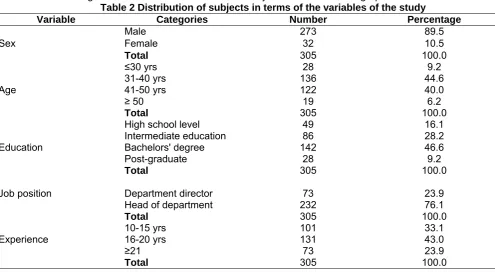
The following table shows the distribution of the subjects in terms of demographic variables
Table 2 Distribution of subjects in terms of the variables of the study
Variable Categories Number Percentage
Sex
Male 273 89.5
Female 32 10.5
Total 305 100.0
Age
≤30 yrs 28 9.2
31-40 yrs 136 44.6
41-50 yrs 122 40.0
≥ 50 19 6.2
Total 305 100.0
Education
High school level 49 16.1
Intermediate education 86 28.2
Bachelors' degree 142 46.6
Post-graduate 28 9.2
Total 305 100.0
Job position Department director 73 23.9
Head of department 232 76.1
Total 305 100.0
Experience 10-15 yrs 16-20 yrs 101 131 33.1 43.0
≥21 73 23.9
Total 305 100.0
Research tool
A questionnaire has been developed based on Linkert five-item Scale which consists of five options ranging from strongly agree to strongly disagree using a 1-to-5 rating scale. The questionnaire is divided into two main groups. The first group concerns the personal information about the subjects of the study, while the seconed is concerned with the subject-matter of study and includes a group of paragraphs relating to the main three axes of the independent variable; namely, the Intellectual Capital. The three axes are: attraction of Intellectual Capital, activation of Intellectual Capital, and Customer Care. It will include a number of paragraphs covering the dependent variable (citizenship behavior) as follows; namely, Civility and Altruism.
Validity of the tool:
The questionnaire was presented to a number of judges from the faculty members ensure the validity of the questionnaire. I've taken their comments into consideration, rephrased some paragraphs and made the required modifications to achieve the balance between the contents of the questionnaire and its paragraphs.
Statistical treatment:
In order to answer the questions of the study and to test the validity of its hypotheses, descriptive and analytical statistical methods were applied using the Statistical Package for Social Sciences (SPSS.16). Following are the statistical methods applied in this study:
Descriptive Statistic Measures to describe the characteristics of the sample based on the frequencies and percentages.
The allowable variance scale (Tolerance) to ensure that there's no Multicollinearity between the independent variables;
Skewness Scale to ensure that data are applying the Normal Distribution method;
Multiple Regression Analysis to test the validity of the study models and the impact of the independent variable and its dimensions on the dependent variable; and
Stepwise Multiple Regression Analysis to test the entry of independent variables in the dependent variable prediction equation.
Reliability:
The Internal Consistency Coefficient for the research tool was extracted using Cronbach’s Alpha for every variable of the study and its dimensions. Reliability Coefficient values were high indicating reliability and consistency between the paragraphs of the research tool. Table 4 shows the Reliability Coefficient Values.
Table 4 Cronbach’s Alpha Values for the Internal Consistency Coefficient for each dimension of the research variables
Variable
ParagraphsDimension Cronbach’s Alpha
Intellecual capital as an independent variable
Attraction of Intellectual Capital 1-2 0.76
Activation of Intellectual Capital 3-6 0.70
Customer Care 7-14 0.75
Organization citizenship behavior as a dependent
variable
Civility 15-22 0.73
Altruism 23-25 0.74
Conscience 26-27 0.76
1-2 0.76
The data shown in table 4 indicate that the reliability coefficient for the dimensions of Intellectual Capital ranged from (0.70- 0.76), whereas the Organizational Citizenship Behavior, the reliability coefficient ranged from (0.73- 0.76). These values are accepted for the purposes of the study.
Presentation of results:
Some tests were conducted before application of the Analysis of Variance to test the research hypotheses in order to ensure that the data are suitable for the hypotheses of the Analysis of Variance. Absence of multicollinearity was confirmed through the use of VIF (Variance Inflation Factory) and Tolerance Test applied to every research variable while taking into consideration that the VIF value is not greater than 10, and the allowable variability (Tolerance) is greater than 0.05. Application of Normal Distribution is also confirmed through the calculation of Skewness factor taking into consideration to apply the normal distribution if the Skewness value I approximates (0). Table 5 shows the results of these tests.
Table 5 Results of the Variance Inflation Factory, Tolerance, and Skewness Dimensions of the independent variable ToleranceVariance factory
Attraction of Capital 1.642 .609 0.372
Activation of Capital 1.681 .596 -1.702
Customer Care 1.369 .731 -1.673
We note that the values of VIF for all variables are less than 10 and rage from (1.369- 1.681). Values of the Tolerance test range from (0.596- 0.731) which are greater than 0.05. This is an indicator that there's no multicollinearity. The Skewnes Factory was calculated to ensure the application of Normal Distribution and the values were near 0, i.e. less than 1. Therefore, it can be asserted that there's no real problem concerning the normal distribution of the research data. In addition, validity of the model is confirmed for each single hypothesis. Table 6 shows the results.
Table 6 Analysis Of variance to ensure the validity of the model to test the research hypotheses
** Statistically significant at the value of (α≤ 0.01) Dimensions of the
dependent variable Source
Coefficient of determination
(R2)
Sum of squares
Mean squares
Calculated F value
F Value Significance
Civility regression 89.714Error 0.407 20.534 .29861.603 0.00**68.895
Table 6 indicates the validity of the model used to test the study hypotheses as indicated by the significance of calculated F value and the significance level at the value of (α≤ 0.01). the overall Intellectual Capital accounts for 54% of the variance in the dependent variable as a whole (Organizational Citizenship Behavior). It accounts also for 40.7% of variance of the Civility dimension, and 55.4% of variance of the Altruism Dimension. All these results confirm the impact of Intellectual Capital on the explanation of the sub-dimension; Organizational Citizenship Behavior. Accordingly, we can test the research hypotheses as follows:
The Main Hypothesis: Intellectual Capital along with its dimensions (attraction of Intellectual Capital, activation of Intellectual Capital and customers care) has no statistically significant impact at the significance level of (α≤0.05) on the enhancement of Organizational Citizenship Behavior and its dimensions (Civility and Altruism) in Jordanian industrial companies.
Table 7 Results of Multiple Regression Analysis to test the Impact of Intellectual Capital Dimensions as independent variable on the Competitive Advantage
* Statistically significant at the level of (0.05≥α) ** Not statistically significant
From the statistical results shown in table 7, and from the Beta and T-Test, it's clear that the sub-variables related to Activation of Capital and Customer Care all have an impact on the OCB in accordance with the Beta Coefficient Significance for these variables as shown in the table, and in accordance with the high significance of T-calculated value as compared to the T-tabulated value at the significance level of (0.05≥α). However, there was no statistically significant impact of the Capital Attraction dimension on the OCB.
From the above, we find out the following: the first main hypothesis stating that "Intellectual Capital along with its dimensions (attraction of Intellectual Capital, activation of Intellectual Capital and customers care) has no statistically significant impact at the significance level of (α≤0.05) on the enhancement of Organizational Citizenship Behavior and its dimensions (Civility and Altruism)" is rejected from the subjects of the sample's point of view. However, the partially alternative hypothesis which ensures that Intellectual Capital along with its dimensions (activation of Intellectual Capital and customers care) has statistically significant impact on the enhancement of Organizational Citizenship Behavior and its dimensions (Civility and Altruism) in Jordanian industrial companies is accepted from the point of view of the subjects of the study.
In order to determine the importance of each independent variable in the mathematical model, which represents the impact of Intellectual Capital and its dimensions (Capital Attraction, capital activation, and Customer Care) on the OCB, the Stepwise Multiple Regression analysis was conducted. Table 8 shows the results.
Table 8 Results of the Stepwise Multiple Regression Analysis to predict the OCB through the dimensions of Intellectual Capital as independent variables
Dimensions of Intellectual Capital
R2 value
Cumulative coefficient of determination
T-Calculated Value
T-Significance Level
Customer Care
0.573 9.791 0.000
Activation of Capital
0.579 6.446 0.015
* Statistically Significant at the level of (0.05≥α)
- The Stepwise Multiple Regression Equation has excluded one variable: theCapital Attraction dimension. Table 8 shows the order of independent variables entry in the regression equation. It shows that the Customer Care dimension occupies the first rank and accounts for 57.3% of the variance in the dependent variable followed by the dimension of Activation of Capital which accounts with the Customer Care dimension for 57.9% the dependent variable variance. It was excluded from the regression equation following the capital activation dimension because it is of no statistical significance.
From the above hypothesis, the following sub-hypotheses are derived:
The first sub-hypothesis: Intellectual Capital and its dimensions (attraction of Intellectual Capital, activation of Intellectual Capital and Customer Care) have no statistically significant impact at the significance level of (α≤0.05) on Civility as a dimension of the dependent variable, enhancing the Organizational Citizenship Behavior in Jordanian industrial companies.
Dimensions of
Intellectual Capital B
Standard
error Beta Calculated T value
T significance level
Attraction of Capital 0.023 0.050 0.043 1.883 0.348**
Activation of Capital 0.312 0.053 0.249 5.543 0.000*
Table 9 Results of the Multiple Regression Analysis to test the Impact of the dimensions of the Independent Variable, Intellectual Capital, on Civility as a dimension of OCB
Dimensions of
Intellectual Capital B
Standard
Error Beta T-Calculated Value
T-significance value
Capital Attraction 0.046 0.051 -0.051 -0.901 0.368**
Capital Activation 0.285 0.054 0.306 5.317 0.000*
Customer Care 0.557 0.062 0.465 8.963 0.000*
* Statistically significant at the level of (0.05≥α) ** Not statistically significant
From the statistical results included in table 9, and from the Beta coefficients and T-Test it is clear that The following sub-variables related to Activation of Capital and Customer Care all have an impact on the Civility as a dimension of OCB in accordance with the Beta Coefficient significance of these variables as indicated in the table, and in accordance with the significance of higher T-calculated values as compared to the T-tabulated values at the significance level of (0.05≥α). However, the sub-variable, Attraction of Capital, has no statistically significant impact on Civility as a dimension OCB.
From the above, it is indicated that the first sub-hypothesis stating that "Intellectual Capital with all its dimensions have no statistically significant impact at the significance level of (α≤0.05) on Civility as a dimension of the dependent variable, enhancing the Organizational Citizenship Behavior in Jordanian industrial companies, " is rejected, whereas the partially alternative hypothesis is accepted. Stepwise Multiple Regression Analysis was conducted to determine the importance of each independent variable in the mathematical model which represents the impact of Intellectual Capital; Attraction of Capital, Activation of Capital, and Customer Care, on Civility as a dimension of OCB. The results are shown in table 10.
Table 10 Results of Stepwise Multiple Regression Analysis to predict Civility dimension from the dimensions of Intellectual Capital as independent variables
Order of the independent variables entry into the
prediction equation
R2 value
Cumulative coefficient of determination
T-calculated value T-significance level
Customer Care 0.344 12.612 *0.000
Activation of Capital 0.406 5.578 *0.000
* Statistically significant at the level of (0.05≥α)
- the Regression Equation excluded the Attraction of Capital
Table 10 shows the order of independent variables entry into the regression equation and shows that the dimension of Customer Care occupies the first rank accounting for 34.4% of variance of the dependent variable, Civility, followed by the Activation of Capital which accounts with the Customer Care dimension for 40.6% of the dependent variable variance. The dimension of Capital Attraction was excluded from the equation.
The second sub-hypothesis: Intellectual Capital along with its dimensions (attraction of Intellectual Capital, activation of Intellectual Capital and Customer Care) have no statistically significant impact at the significance level of (α≤0.05) on Altruism as a dimension of the dependent variable, enhancing the Organizational Citizenship Behavior in Jordanian industrial companies.
Table 11 Results of the Multiple Regression Analysis to test the impact of the dimensions of the independent variable, Intellectual Capital, on Altruism as a dimension of OCB
Independent Variable
B Standard
Error
Beta T-Calculated Value
T-Significance Level
Attraction of Capital 0.089 0.038 0.116 2.341 *0.020
Activation of Capital 0.182 0.040 0.228 4.558 *0.000
Customer Care 0.548 0.046 0.535 11.873 *0.000
* Statistically significant at the level of (0.05≥α)
From the statistical results shown in table 11, and from the Beta coefficients and T-Test it is clear that the following sub-variables related to the Activation of Capital and Customer Care all have an impact on the Altruism as a dimension of OCB in accordance with the Beta Coefficient significance of these variables as indicated in the table, and in accordance with the significance of higher T-calculated values as compared to the T-tabulated values at the significance level of (0.05≥α)..
companies, " is rejected, whereas the alternative hypothesis is accepted. Stepwise Multiple Regression Analysis was conducted to determine the importance of each independent variable in the mathematical model which represents the impact of Intellectual Capital; Attraction of Capital, Activation of Capital, and Customer Care, on Civility as a dimension of OCB. The results are shown in table 12.
Table 12 Results of Stepwise Multiple Regression Analysis to predict the Altruism through the dimensions of Intellectual Capital as Independent Variables
* Statistically significant at the level of (0.05≥α)
Table 12 shows the order of independent variables entry into the regression equation, and shows that the dimension of Customer Care occupies the first rank accounting for 48.3% of variance of the dependent variable, Altruism, followed by the Activation of Capital which accounts with the Customer Care dimension for 54.5% of the dependent variable variance. It was entered into the equation thirdly after the Attraction of Capital. Attraction of Capital as well as Customer care and Activation of Capital accounts for 55.4% of the variance of the dependent variable, Altruism.
FINDINGS AND DISCUSSION:
1. Results have indicated that Intellectual Capital as a whole accounts for 54.0% kf the variance of the dependent variable, Organizational Citizenship Behavior, accounts for 40.3% of the variance of Civility, and accounts for 55.4% of the variance of Altruism. All this emphasizes the impact of Intellectual Capital on the explanation of the sub-dimensions of OCB.
2. The Conceptions of the subjects of the study about Intellectual Capital as an independent variable dimensions (Attraction of Capital, Customer Care, and Activation of Capital) were high. Their conceptions about the OCB and its dimensions, Civility and Altruism, were also high.
3. Results have shown that the sub-variables related to Customer Care and Activation of Capital have an impact on Civility as a dimension of OCB, whereas the sub-dimension Attraction of Capital has no statistically significant impact on Civility as a dimension of OCB.
4. Results have shown that the sub-variables related to Customer Care, Activation of Capital, and Attraction of Capital have an impact on Altruism as a dimension of OCB.
RECOMMENDATIONS In the light of these results, the study recommends as follows:
1. Industrial companies subject of this study should be more interested in the concept of Intellectual Capital and to put policies and procedures that would increase the level of workers' awareness of the importance of Intellectual Capital through holding training courses for them;
2. Educational seminars and programs should be prepared to clarify the methods to develop Intellectual Capital and its importance in the realization of Organizational Citizenship Behavior;
3. Conception of the employees and leaders alike should be developed about Organizational Citizenship Behavior. This concept should be made a priority of the Organizational business. Employees should be given the chance to take part in the administrative decision making, especially with respect to decisions related to their job in the company. This in turn would make them more accepting and responsive to these decisions, which in turn will be reflected on their organizational loyalty and performance of their duties;
4. Companies should evaluate its business strategies and mechanisms and create new mechanisms and tactics to enhance the Organizational Citizenship Behavior; and
5. Future researches should study other variables not addressed in this study such as the impact of work motivation on the enhancement of OCB, the Impact of empowerment on the OCB, as well as other issues related to the works of companies employees.
Order of the independent variables entry into the
prediction equation
R2 value
Cumulative coefficient of determination
T-calculated value T-significance level
Customer Care 16.8170.483 *0.000
Activation of Capital 6.4530.545 *0.000
REFERENCES
As-Shanty, Mahmoud (2015), The Role of Realized Organizational Support as an Intervening Variable in the Relationship between Justice and Organizational Citizenship Behavior, Islamic University Magazine, Vol. 23, Issue 2.
Tahtuh, Aliya Ibraheem (2016), The Impact of Leadership Styles on Organizational Citizenship Behavior, Masters' Degree Dissertation , King Abdulaziz University, Jeddah.
Thigel, Ali & Tabayibia, Salima (2011). The Role of Strategic Facilitation of Intellectual Capital in Supporting Organization's Sustainable Competitiveness in the Light of Knowledge Economy, a case study on Algeria Insurance Company, "the Fifth International Conference on Intellectual Capital in the Arab business organizations in the light of
Modern Economies", Faculty of Economics, Commerce and Management Sciences, Hassiba Ben Bouali Chlef
University, Algeria, 13-14 December.
Al Beshtawi, Soliman Hussein & Neni Taha, Ismail Ahmed (2014), The Impact of Intellectual Capital on the Improvement of the Profitability of Jordanian Pharmaceutical Companies, Jordan Journal of Business Administration, Vol. 10, 2nd Issue.
Rawiya Hassan, 2002, Strategic Approach to Human Resources Planning and Development, Alexandria, University Publishing house
Saleh, Rida Ibraheem (2009), Intellectual Capital and its Role in the Achievement of Competitive Advantage for
Organizations, the International Conference on Administrative Development titled "Toward a Distinguished
Performance in the Governmental Sector, General Administration Institute, Riadh, KSA, from 1-4 November.
Abdulonem, Usama (2009) Intellectual Capital and its Impact on Industrial Business Foundations, case study on Readymade Garment Jordanian Company.
Mezreiq, Ashour& Qwidry, Naema (2011), The Role of Intellectual Capital in the Achievement of Competitive Advantage for Business Organizations, "the Fifth International Conference on Intellectual Capital in the Arab business
organizations in the light of Modern Economies", Faculty of Economics, Commerce and Management Sciences,
Hassiba Ben Bouali Chlef University, Algeria, 13-14 December
Taie، E. (2014). The Effect of Intellectual Capital Management on Organizational CompetitiveAdvantage in Egyptian Hospitals. International Journal of Business and Social Science Vol. 5 No. 2; February.
Kok, A (2007) “Intellectual Capital Management as Part of Knowledge Management Initiatives at Institutions of Higher Learning” The Electronic Journal of Knowledge Management Volume 5 Issue 2, pp 181 - 192 , available online at www.ejkm.com Intellectual capital and relational capital: The role of sustainability in developing corporate reputation.
Burns, T. & Carpenter, J. ( 2008 ). Organizational Citizenship and Student Achievement. Journal of Cross-Disciplinary Perspectives in Education, 1(1), 51 – 58.
Chen, C. & Chung, R. (2007). The Effects of Leadership Styles of Principals in Senior Vocational High Schools for Teacher Organizational Citizenship Behavior and School Organizational Performance. Contemporary Educational Research Quarterly, 15(3), 69-114.
Fournier, H. (2008). Communication Satisfaction, Interactional Justice, and Organizational Citizenship Behaviors: Staff Perceptions in a University Environment. Unpublished doctoral dissertation. Ohio University.
Lee, K., & Allen, N. J. (2009). Organizational citizenship behavior and workplace deviance: The role of affect and cognitions.
Journal of Applied Psychology, 87: 131-142.
Modassir, A. & Singh, T. (2008). Relationship of Emotional Intelligence with Transformational Leadership and Organizational Citizenship Behavior. International Journal of Leadership Studies, 4 (1), 3-21.
Nielsen, T. M., Bachrach, D. G., Sundstrom, E., & Halfhill, T. R.(2010). Utility of OCB: Organizational citizenship behavior and group performance in a resource allocation framework. Journal of Management. doi: 10. 1177/ 01492 06309356326
Organ, D. W., Podsakoff, P. M., & MacKenzie, S. B. (2006). Organizational Citizenship Behavior: Its Nature,
Antecedents, And Consequences. London: Sage.
Turnley, W. H., Bolino, M. C., Lester, S. W., & Bloodgood, J. M. (2003). The impact of psychological contract fulfillment on the performance of in-role and organizational citizenship behaviors. Journal of Management, 29:187-206.