ISSN: 2395-3519
International Journal of Advanced Trends in
Computer Applications
www.ijatca.com
A NOVEL IMAGE ENHANCEMENT METHOD USING
GENETIC ALGORITHM AND NEURAL NETWORK
Lalit Mann Singh1, Rupinder Kaur2
1
Student, Department of CSE/IT, BBSBEC, Fatehgarh Sahib, Punjab, India
2
Assistant Professor, Department of CSE/IT, BBSBEC, Fatehgarh Sahib, Punjab, India
Abstract:
The processing of images to carry out specific features of an image is image enhancement. It is todevelop an image so that the result is more appropriate than the original in definite application. During image acquisition, images are frequently degraded with noise due to imperfections in the imaging system. Images may lose important information that is required to enhance the quality of a given image. It is becoming quite difficult to extract right information from noisy images. Resolution and contrast are decisive attributes of a digital image. Now the question arises how to enhance the quality of a digital image so that it looks more pleading? The previous work which has been taken into the consideration and thus the simple DWT-HAAR method of resolution enhancement of the image is used. In this research work we develop a unique method for the image enhancement which would be a combination of wavelet transformation followed by the Neural Network. Wavelet transformation would be a result of two combinations namely Daubechies and Symlet. Now once the Daubechies and Symlet is combined, Neural Network has to be trained and on the basis of the training provided to the neural network the result would be evaluated that how much erosion has to be done in the image to enhance it. The evaluation parameters would be as PSNR, MSE and SNR. The results shows that neural network works better as compared to genetic algorithm when compared by given parameters results. The whole stimulation will take place in MATLAB 7.10 environment.
Keywords:
Image enhancement, Discreet Wavelet Transform, Neural network, Genetic algorithm, Noise.1
INTRODUCTION
Image enhancement is among the smoothest and most promising areas of digital image processing. Basically, the concept afterwards enhancement processes is to bring out detail that is concealed, or simply to focus on certain features of interest in an image [1]. A well-known example of enhancement is when we increase the contrast of an image because it looks better [2]. It must be keep in mind that enhancement is a very subjective area of image processing [3] [4]. Image enhancement is a process that reduces noise, removing artefacts and preserve details in an image. Its purpose is to amplify certain image features for analysis, diagnosis and display [5-8]. This technique can be performed by either suppressing the noise or the image contrast.
The digital images corrupted by various types of noises is a considerable problem in DIP [9]. Images are often degraded with various types of noises during
ISSN: 2395-3519
The previous work which has been taken into the consideration is the simple DWT-HAAR method of resolution enhancement of the image [1] [3] [7] [8]. There are a lot of different wavelet transmission family members such as SYMLET, Daubechies etc. In the proposed work, we have used Daubechies to check the performance issue based on the PSNR and MSE of the resulting image.
2
PROPOSED WORK
This section is partitioned in two parts:
2.1 Simulation Work model
The following steps present the different stages that need to be accomplished in order to enhance the quality of the digital images.
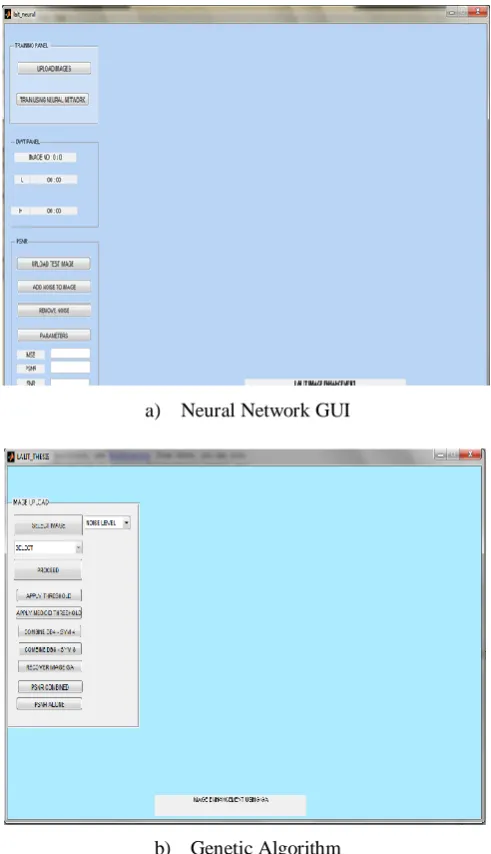
a) Neural Network GUI
b) Genetic Algorithm
Figure 1: Main GUI system of Neural Network and Genetic Algorithm
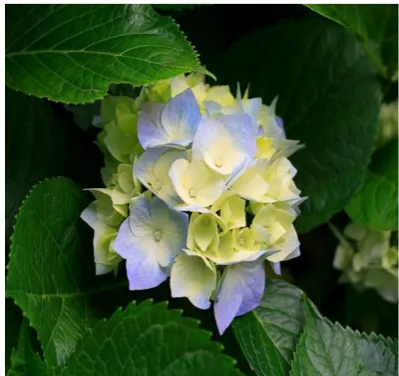
Step 1: In this step we upload the main test image.
Figure 2: Main Test Image
Step 2: Select noise level in the given image. Gaussian Noise is added in the original image. It represents statistical noise having normal distribution. It arises during the image acquisition process for example sensor noise due to poor illumination, bad weather conditions and so on.
Figure 3: Image with Noise
Step 3: Select DWT family to convert it into wave form.
On noisy image, two wavelet families are applied i.e. Symlet and Daubechies. Daubechies wavelet has a high frequency coefficient spectrum than the HAAR wavelet. Daubechies wavelet is (used in solving problems such as fractal problems, signal discontinuities etc. Symlet wavelets are enhanced versions of Daubechies wavelets. The operation for Daubechies and Symlet DWT is more effective than other wavelets of the wavelet family. It has been applied to images of multi resolution representation.
Main test image
ISSN: 2395-3519
Step 4: Calculate threshold value with average threshold rule.
Thresholding value is calculated with the help of average thresholding rule.
Average Thresholding rule =
Sum of all the pixels in the image No. of pixels in the image
Step 5: Implement image hybridization techniques for combining different DWT families.
Step 6: Implement neural network as well as genetic algorithm to get back enhanced image.
Figure 4: Filtered Image
Step 7: Calculate performance metrics such as PSNR, SNR and MSE of Neural Network and Genetic Algorithm. Then, compare the results to show which is better.
The PSNR and MSE values are calculated using equation (1) and (2). The Peak Signal-to-Noise Ratio (PSNR) is defined as [7,8]:
𝑃𝑆𝑁𝑅 = 10. 𝑙𝑜𝑔10 𝑀𝐴𝑋𝐼2
𝑀𝑆𝐸 eq.(1)
The mean-squared error (MSE) between two images I1(m,n) and I2(m,n) is
𝑀𝑆𝐸 = 𝑚 𝑛1 𝑛−1 𝐼 𝑖, 𝑗 − 𝐾 𝑖, 𝑗 2 𝑗 =0
𝑚−1
𝑖=0 eq.(2)
Where M and N are the number of rows and columns in the input images respectively.
In addition to this decryption time has also been calculated.
2.2 FLOWCHART
Figure 5: Flowchart of proposed work.
3
RESULTS
We have utilized two types of algorithms for image enhancement:
1) Neural Network Algorithm
ISSN: 2395-3519
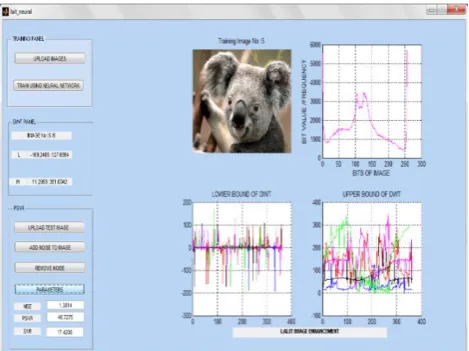
Above figures shows the uplodation of images. There are various buttons that has been shown in the above snapshot that are upload images,train using neural network, Upload test image, DWT panel. In DWT we found upper values and lower values.
Figure 7 Upload image for training
Above figures shows the uplodation of images. There are various buttons that has been shown in the above snapshot that are upload images, Upload test image, DWT panel. In DWT we found upper values and lower values. Next panel is for testing firstly upload the image for testing, merge image to image and find the parameters like(PSNR, SNR AND MSE).
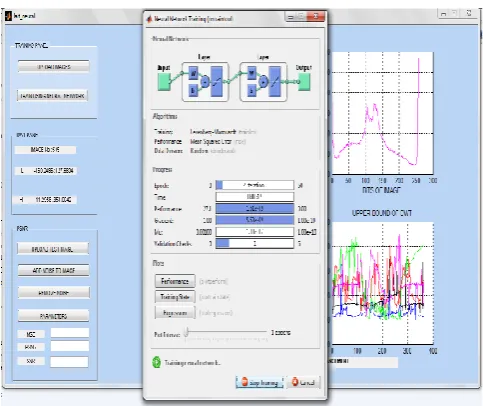
Figure 8 Training using neural network
In above figure we are performing training action using neural network. Above we have shown NN training flowchart then algorithms, progress and plots.
Figure 9 Training complete
In above figure it shows that the training of upper DWT set and lower DWT set, have been completed.
Figure 10 Uploading test image for processing
In above figure we add/ upload any random image for enhancement from database.
Figure 11 Main Test Image
ISSN: 2395-3519
Figure 12 Image with noise
In above figure we add noise to the uploaded test image. Gaussian Noise is added in the original image. It represents statistical noise having normal distribution.
Figure 13 Filtered Image
In above figure it shows the image which is filtered by removing noise from it.
Figure 14 Results of Neural Network
This figure shows the result of using Neural Network for image enhancement. These results are given through various parameters that are given as MSE- Mean Square Error, PSNR- Peak to Signal Noise Ratio, and SNR- Signal Noise Ratio.
PARAMETERS
Mean Square Error
(MSE)
Peak to Signal Noise Ratio
(PSNR)
Signal Noise Ratio
(SNR)
RESULTS 1.3814 46.7275 17.4208
Table 1 Results Parameter Table of Image Enhancement Using Neural Network
In above table we have shown value of various parameters used.
2) GENETIC ALGORITHM
Figure 15 Uploading Image for enhancement
ISSN: 2395-3519
Figure 16 Noise level and DWT that is db4 and db8 is added.
In above figure we add noise level as well as DWT wavelet family member in original image and then proceed. On selecting noise level 60 and db8 we plot dwt graph.
Figure 17 Noise level and DWT that is sym4 and sym8 is added
Above figure shows that we have added gaussian noise level i.e. 60 and also addded DWT sym4 and sym8.
Gaussian Noise is added in the original image. On noisy image, two wavelet families are applied i.e. Symlet and Daubechies Daubechies wavelet is (used in solving problems such as fractal problems, signal discontinuities etc. Symlet wavelets are enhanced versions of Daubechies wavelets.
Figure 18 Applying sym8 and thresholding
In this figure, we apply sym8 and thresholding with Gaussian noise of about 60%
Figure 19 Combined output of db4 and sym4
In above figure, we combined output of db4 and sym4.
Figure 20 Combined output of db8 and sym8
ISSN: 2395-3519
Figure 21 Recover image using genetic algorithm
In this figure, we have shown the recovered image by implementing Genetic Algorithm.
Figure 22 Results of Genetic algorithm
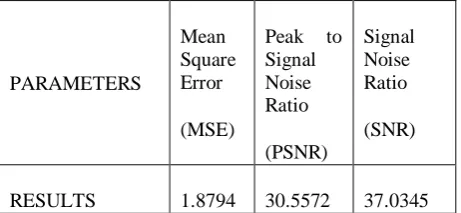
This figure shows the result of using Neural Network for image enhancement. These results are given through various parameters that are given as MSE- Mean Square Error, PSNR- Peak to Signal Noise Ratio, and SNR- Signal Noise Ratio.
PARAMETERS
Mean Square Error
(MSE)
Peak to Signal Noise Ratio (PSNR) Signal Noise Ratio (SNR)
RESULTS 1.8794 30.5572 37.0345
Table 2 Results Parameter Table of Image Enhancement Using Genetic Algorithm
In above table we have shown value of various parameters used.
Figure 23: Comparison graph between parameters defined (MSE, PSNR, and SNR) and results of Neural Network and
Genetic Algorithm
In above chart we have shown comparison on the basis of results obtained of various parameters such as MSE, PSNR and SNR in Neural network as compared to genetic algorithm. In this we get that neural network gives much better performance as compared to GA in terms of MSE, PSNR and SNR parameters.
4
CONCLUSION
For image enhancement, DWT for sampling is applied with Back Propagation Neural network for training the data which is used for conjunction and for evaluating the loss function for optimization. The DWT is an implementation of the wavelet transform using a discrete set of the wavelets scales for numerical analysis and functional analysis. Then, BPNN is compared with Genetic Algorithm for image enhancement by carrying out various wavelet transforms like Daubechies and Symlets. Genetic algorithms (GA's) are search algorithms that work basically for the optimal solutions via the process of natural selection. In Neural network, PSNR is used for bringing less error ratio. The results shows that neural network is far better than genetic algorithm in terms of PSNR, MSE and SNR.
In future, neural network can be used with Bacterial forging optimization Algorithm. The Bacterial Foraging Optimization Algorithm is motivated by the group foraging behavior of bacteria such as E.Coli and M.Xanthus. Explicitly, the BFOA is stimulated by the chemo taxis performance of bacteria that will recognize chemical gradients in the environment and move toward or away from specific signals. The BFO with NN can be used for the optimization results.
0 5 10 15 20 25 30 35 40 45 50
MSE PSNR SNR
R
es
ul
ts
Parameters Defined
Comparision Graph Between Neural Network And Genetic Algorithm
Neural Network
ISSN: 2395-3519
REFERENCES
[1] M. Vijay, Saranya devi, m. Shankaravadivu, m. Santhanamari, “image de-noising based on adaptive spatial and wavelet thresholding methods,” icaesm, pp. 161-166, march 2012.
[2] Amit kumar, geeta kaushik, “comparison of image enhancement using discrete and lifting wavelet transform, ” ijaet, vol. 2,pp. 329-332, july 2011.
[3] R.pushpavalli, a.sivaraman “image enhancement using adaptive neuro-fuzzy inference system,” ijstr, vol. 2, pp. 256-262, june 2013.
[4] Sunaya u.shirodkar, “image resolution enhancement using various wavelet transforms,” ijaset, vol. 1, pp. 1-3, jan 2014.
[5] Ganesh naga sai prasad. V, habibullah khan, ,bhavana.k ,muralidhar.ch ,tulasi sai kiran.ch, “image enhancement using wavelet transforms and svd,” ijest, vol. 4,pp.1080-1087 , march 2012.
[6] D. Heric, b. Potocnik, “image enhancement by using directional wavelet transform, ” cit, pp. 299-305, may 2006.
[7] Yashu rajput, vishwashvar singh rajput, anita thakur, garima vyas, “advanced image enhancement based on wavelet and histogram equilization for medical images,” iosrjece, vol. 2, pp. 12-16, sep. 2012.
[8] Bagawade ramdas p., bhagawat keshav s., patil pradeep m. “wavelet transforms techniques for image resolution enhancement,” ijetae, vol. 2,pp. 167-172, april 2012. [9] Muna f. Al-samaraie, nedhal abdul majied al saiyd,
“medical colored image enhancement using wavelet transform followed by image sharpening,” ubicc, vol. 6, pp. 1-8.
[10] Raman maini, himanshu aggarwal, “a comprehensive review of image enhancement techniques,” journal of computing, vol. 2, pp. 8-13, march 2010.
[11] Claudia nieuwenhuis, michelle yan “knowledge based image enhancement using neural networks,” ieee, 2006. [12] Qian wang, liya chen, dinggang shen “fast histogram
equalization for medical image enhancement,” ieee, pp. 2217-2220, aug. 2008.
[13] Ching-hsiung hsieh, wei-lung hung, chai-wei lan, “grey image enhancement with edge enhancement,” ieee, pp. 3272-3276, july 2008.
[14] Tanaya mandal, q. M. Jonathan wu “a small scale fingerprint matching scheme using digital curvelet transform,” ieee, pp.1534-1538, 2008.
[15] Siti arpah bt. Ahmad, mohd. Nasir taib, noor elaiza a. Khalid, rohana ahmad, hasilna taib, “the effect of sharp contrast limited adaptive histogram equilization,” ieee, pp. 400-405, nov. 2010.
[16] Miroslav vrankic, damir sersic, victor sucic, “adaptive 2-d wavelet transform based on the lifting scheme with preserved vanishing moments,” ieee, vol. 19, pp. 1987-2005, aug. 2010.
[17] Sara izadpanahi, hasan dimirel, “multi frame super resolution using edge directed interpolation and complex wavelet transform,” ieee, pp. 1-5, 2012.