IJSRSET1626152 | Received : 19 Dec. 2016 | Accepted : 26 Dec. 2016 | November-December-2016 [(2) 6: 576-580 ]
© 2016 IJSRSET | Volume 2 | Issue 6 | Print ISSN: 2395-1990 | Online ISSN : 2394-4099 Themed Section: Engineering and Technology
576
Improving PID Controller Using Neural Network Technique
Uchegbu C. E, Ekwuribe J. M, Ogbonnaya I. J
Department of Electrical and Electronic Engineering, Abia State Polytechnic, Aba, Nigeria
ABSTRACT
This research focuses on improving the quality of traditional Proportional integral derivative (PID) using neural network. A Reverence model approach was used to design a Neural Network NN controller and a proportional integral derivative PID controller. The purpose is to have a stable control systems in our industries that will help to improve and reduce waste during production in our industries that will be more flexible in the level of conversion, to be able to track set point change and reject load disturbance in our process industries. PID control scheme was used as a benchmark to study the performance of the PID controller at the same time with equivalent neural network. The proportional Integral derivative controller PID was modeled using Neural Network Technique NN and a MAT-LAB simulation was carried out and observation showed that there was a great improvement on the traditional PID controller as it started functioning like a digital controller. When connected to the Plant process control were all features of the traditional proportional integral derivative PID controller were retained and as well improved using Neural Network . The output was fantastic since the waste and loss encored by the process industries was drastically reduced to minimal.
Keywords : PID, NN, Simulation, MAT-LAB
I.
INTRODUCTION
The setback of the traditional PID controller has it that it cannot get satisfied degree-especially for the time-varying objects and non-linear systems. The traditional PID controllers can do nothing to non-linear systems-the NN PID controller has a good controller effect in systems-the non-line turning and optimizing. But the neural network PID controller can make both neural network and PID control into an organic which has the merit of any PID controller for its Simple construction and definite physical meaning of parameters, and also has the self-learning and adaptive functions of a neural network. This new NN PID controller has more advantage than the traditional one, such as more convenient in parameter regulating more independence and adaptability on the plant, etc. A neural auto tuner for PID controllers that is important for real-time plant operation applications achieved from this research. The neural auto tuner adaptive PID control scheme processes temporal patterns in real time and produces updated parameters for the PID controller. These and more are the main reasons why this research has been
undertaken. This will be implemented on the simulated system
II.
METHODS AND MATERIAL
1. Methodology, Design and Implementation
Design of PID Controller
process value is as close to the set point as possible. The PID control algorithm is used for the control of almost all loops in the process industries,
How A PID Controller Works
The PID controller’s job is to maintain the output at a level so that there is no difference (error) between the process variable (PV) and the set point (SP). In the diagram shown below are the structure of PID controller and A Modeled PID Controller. the valve could be controlling the gas going to a heater, the chilling of a cooler, the pressure in a pipe, the flow through a pipe, the level in a tank, or any other process control system.
Figure 1. A Block Diagram of A PID Controller
2. A PID Controller Using Neural Network NN
The controller then calculates the control input that will optimize plant performance over a specified future time horizon.
1 The first step in model predictive control is to determine the neural network plant model (system identification).
2 Next, the plant model is used by the controller to predict future performance. Documentation for complete coverage of the application of various model predictive control strategies to linear systems.)
Using neural network PID controller to replace the ordinary PID controllers can make the error between the system output and expected values minimum. The structure of PID control system based on neural network as shown in fig, while the Developed Model of PID controller based on Neural Network is shown in figure 1.
Figure 2. A structure of PID Controller Based on Neural Network
3. The Flow Charts
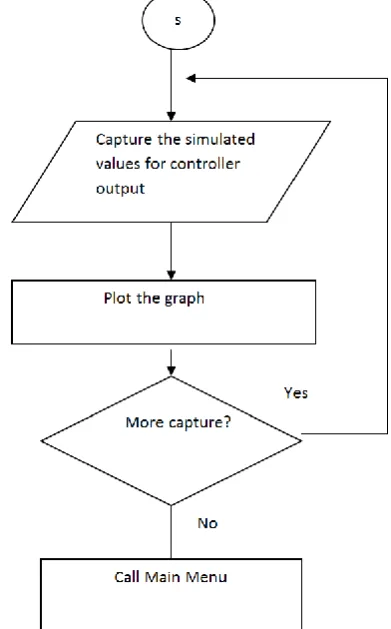
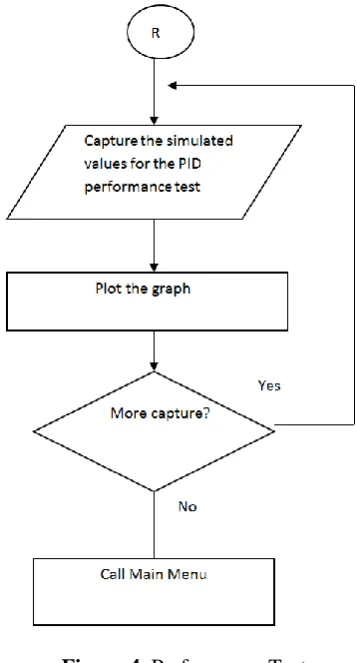
The specific implementation of PID control algorithm based on neural network is as shown on the following flow charts on the figures below which correspond to different simulated graphs shown
Figure 4. Performance Test
III.
RESULTS AND DISCUSSION
1. Data Presentation
T
he data used in this simulated work were sourced from Nigeria breweries PIC, Aba were it was implemented on the processing plant.
The table is a time off set against the control output
TABLE 1 : Time offset-Controller Output
S/N TIME
OFFSET (SEC)
CONTROLLER OUTPUT (SEC)
1 100 2 2 200 4 3 300 6 4 400 8 5 500 9 6 600 10 7 700 11 8 800 12 9 900 14
Figure 5. Time offset - Controller Output
The graph above represents a time offset of the control system. The system proceed in an arithmetical progression which shows that the system was properly controlled by NN programmed
Table 2. Performance Test Table
S/N TIME
OFFSET (SEC)
CONTROLLER OUTPUT (MS)
1 100 -1 2 200 -2 3 300 -3 4 400 -4 5 500 1 6 600 2 7 700 3 8 800 4 9 900 5
2. Analysis
The fig above shows performance test both ANN and PID controller which makes a system setting that gives the best performance of overshoot which is very high and small inverse response. Also involved in tracking problem the offset point allowed a change in random fashion.
IV.
CONCLUSION
The accuracy of PID controller was also improved by using a reasoning artificial intelligent (Neural Network). The flexibility offered by the neural network when the PID is remodeled was very great. Comparison of the operational characteristics between the PID and improved PID with neural network reviews the superiority of neural network controller. The neural network controller is more sensitive in equipment and the system parameters, unlike the conventional control design (PID) which often requires an improvement using artificial neural (ANN) for it to function effectively and start reasoning and waste incurred before reduced to the lowest minimum.
Finally, we will like to state that even though PID have a huge potential will get the best of them when they are integrated or improved with neural network control technology.
V.
REFERENCES
[1] A. J. Meade Jr. and A. A. Fernandez,( 1994). "The numerical solution of linear ordinary differential equations by feed forward neural networks," Mathematical and Computer Modeling, vol. 19, no. 12, pp. 1–25,
[2] A. J.Meade Jr. and A. A. Fernandez, (1994) "Solution of nonlinear ordinary Differential equations by feed forward neural networks," Mathematical and Computer Modelling, vol. 20, no. 9, pp. 19–44,.
[3] D. R. Parisi, M. C.Mariani, andM. A. Laborde, (2003) "Solving differential equations with unsupervised neural networks," Chemical Engineering and Processing, vol. 42, no. 8-9, pp. 715–721.
[4] Ebrahimi M, (2000) Analysis, modeling and simulation of stiffness in machine tool drive [J]. Computers&Industrial Engineering,
[5] G. C. Chen,, Zhang, L., & Hao, N.M. et al. (2003) Application of Neural network PID Controller in Constant Temperature and Constant Liquid-level System [J]. Micro-computer information, , 19(1): 23-24, 42.
[6] H. Lee and I. S. Kang, (1990). "Neural algorithm for solving differential equations," Journal of Computational Physics, vol. 91, no. 1, pp. 110– 131,
[7] I. E. Lagaris, A. C. Likas, and D. G. Papageorgiou, (2000) "Neural network method for boundary value problems with irregular Boundaries," IEEE Transactions on Neural Networks, vol. 11, no. 5, pp. 1041–1049,.
[8] J. M. Zurada, (1994). Introduction to Artificial Neural Network, West Publishing,
[9] K. S.McFall and J. R. Mahan, (2009). "Artificial neural network method for solution of boundary value problems with exact satisfaction of arbitrary boundary conditions," IEEE Transactions on NeuralNetworks, vol. 20, no. 8, pp. 1221–1233, [10] K. Narendra, Parthasarathy, K. (1990).
"Identification and Control of ynamical Systems using Neural Networks". IEEE Transactions on Neural Nerworks. Vol. 1, No. 1.
[11] L. Jianyu, L. Siwei, Q. Yingjian, and H. Yaping, (2003) "Numerical solution of elliptic partial differential equation using radial basis function neural networks," Neural Networks, vol. 16, no. 5-6, pp. 729–734,
[12] M. Suzuki,, Yamamoto, T., & Tsuji, T. (2004). A design of neural-net based PID controller with evolutionary computation. IEICE Trans. Fundamentals. VOL. E87-A, No. 10 October. [13] N. Smaoui and S. Al-Enezi, (2004) "Modelling
the dynamics of nonlinear partial differential equations using neural networks," Journal of Computational and Applied Mathematics, vol. 170, no. 1, pp. 27–58,
[14] N. Selvaraju and J. Abdul Samant, (2010). "Solution of matrix Riccati differential equation for nonlinear singular system using neural networks," International Journal of Computer Applications, vol. 29, pp. 48–54,
and Systems Conference, pp. 161-166, Dublin Institute of Technology.
[16] O. Dwyer, Aidan and Ringwood, John: July, (1999) A classification of techniques for the compensation of time delayed processes. Part 1: Parameter optimised controllers. Proceedings of the 3rd IMACS/IEEE International Multiconference on Circuits, Systems, Communications and Computers, Athens, Greece, [in Modern Applied `Mathematical
[17] Uchegbu C. E et al.: 2016 Remoldelling of PID Controller Based on an Artificial Intelligency (Neural Network) American Journal of Science, Engineering and Technology.