Available online on 15.07.2014 at http://jddtonline.info
Journal of Drug Delivery and Therapeutics
Open access to Pharmaceutical and Medical research
© 2014, publisher and licensee JDDT, This is an Open Access article which permits unrestricted noncommercial use, provided the original work is properly cited
RESEARCH ARTICLE
COMPARATIVE STUDY OF
Β-CYCLODEXTRIN
PRODUCTION FROM THE
CGTASE
PRODUCING NOVEL STRAINS- ITS CHARACTERIZATION AND HOST-GUEST
COMPLEX FORMATION
*Longjam Usharani1, Shyam Sundar1, Dr. K. Dhananjaya1, Dr. K.R. Ravikumar1, Tejaswini Prasad2 and Dr. H. Mallesha2
1 Research and Development Center, Robust Materials Technology Pvt. Ltd., Bengaluru, Karnataka, INDIA
2Research and Development Center, Robust Herbal Pvt. Ltd., Bengaluru, Karnataka, INDIA
*Corresponding Author’s Email: [email protected]
INTRODUCTION:
Cyclodextrins (CD’s) are closed-ring structures having
of 6, 7, or 8 ,α-1, 4 glucose units, respectively classified as α,β,γ 2
.An alkolophilic bacteria were the best producers of CGTase enzyme1. Cyclodextrin glucanotransferase (CGTase; EC 2.4.1.19) is a multifunctional enzyme which catalyzes four related reactions: cyclizing, coupling, disproportionation, and hydrolysis. By means of the cyclizing activity, CGTase is a unique enzyme capable of converting starch and related substrates into cyclodextrins (CDs). 5 Different CGTase enzymes produce a mixture of α- , β-, γ- CDs in different ratios. However most CGTase produce β- CD as the main product. In addition, the yield of β-CD from starch is usually higher than that of other CDs 1. The β – CD produced by CGTase depends on reactions conditions, substrate concentration, amount of enzyme and source of CGTase. 4
CDs are capable of association with wide varieties of molecules to form inclusion complexes because of their hydrophobicity in their internal cavity. These complexes have altered chemicals and physical properties that can introduce modified and often desirable properties, especially to the guest molecules such as altered solubility, volatility and chemical stability. These benefits have been used in a wide variety of applications in pharmaceuticals, chemical, analytical diagnostic, food, cosmetic and in other industrial area3. The inclusion complex of guest molecule with CD is prepared in the laboratory by wetting the physical mixture in a mortar
with a minimum volume of water and subsequently kneading thoroughly with a pestle-mortar to obtain a paste which is then dried under vacuum at room temperature and sieved through appropriate sieve and is stored in a desccicator until further evaluation. 12
MATERIALS AND METHODS:
Microorganisms: Soil sample from the cultivating field was collected in the harvesting season. The soil surrounding the roots of the plant was used for preparation of the inoculums (1g in 10ml distilled water). The soil sample was maintained in hydrated condition throughout to prevent inactivation of CGTase production organism. This was analyzed in order to isolate strains of CGTase producing bacteria. For thecomparative studies the standard bacterial culture: Bacillus licheniformis
strain was used.
Rapid screening: For the fast screening of CGTase test, Horikoshi medium was modified which contained: Soluble-starch 5% , Peptone 0.5%,Yeast extract 0.5%, MgSO4.7H2O 0.02%, K2HPO4 0.1%, Phenolphthalein 0.02%, Agar 1.5%., Na2CO3- 1% was separately autoclaved and added to the rest at the end. Nutrient agar components (pH 10) were mixed and autoclaved transferred to three different petriplates respectively and allowed to solidify and labeled.
Sample of 1g of soil was suspended in 10ml of sterile distilled water. After soil sedimentation, 0.1 ml of the
ABSTRACT:
The enzymatic synthesis of β-CD by CGTase produced from different strains of alkaliphilic bacterial culture which was isolated from the cultivated sugarcane fields and standard MTCC cultures using starch as substrate. Alkalophilic bacteria were grown for six days at static conditions at pH 10.5. The time course of CGTase activity was studied with the maximum activity observed on 6th day. The activity check and its confirmation were done by Dextrinising and Phenolphthalein assay. The soluble
starch was best substrate to produce the cyclodextrin. Extraction of β-CD was done using complexing agents, these agents binds only to β-CD and forms complex, the complex thus formed was recovered. The obtained β-CD was made inclusion complex with guest molecule and was further characterized using UV absorption spectrophotometer, FT-IR and melting point.
supernatant was spread using a sterile glass spreader on the surface of a plate containing culture media. The plates were incubated at 37°C (24-48h). Development of CGTase producing organism was confirmed by presence of a clear yellowish halo around the bacterial culture. 1. Bacterial colonies which produced the largest clear halo were selected for further studies. 9
Characterization and identification of bacteria:
The organisms were characterized based on morphological, physiological and biological tests and Bergey’s manual of determinative bacteriology 6.
Culture medium: Pure cultures of isolated bacteria from soil obtained by sub-culturing the selected colonies and standard (MTCC 3244) Bacillus licheniformis were inoculated into the sterilized fermentation Broth which contained: soluble starch 2%, Peptone 0.5%, Yeast Extract0.5%, MgSO4.7H2O0.1% .And the bacteria were grown for 6 days at pH 10 at static condition and kept it on the rotary shaker at 28°C 1.
Enzyme Assay: The bacterial broth of 6th day was centrifuged at 2000 rpm for 20 minutes this was done to separate bacterial cell mass and the clear supernatant that contained the enzyme was assayed.
Dextrinizing activity: This activity was assayed using soluble starch as substrate and by measurement of the decrease in iodine-staining power 7. The reaction medium contained 0.1 ml of the enzyme solution, 0.5 ml of 1% starch solution, 0.4 ml of 0.1 M phosphate buffer, pH 7.0, and incubated in a water-bath at 50 °C for 10 min. The reaction terminated with 0.5 ml of 1M HCl. 0.1 ml of 4 mM iodine in 30 mM potassium iodide was added and then diluted to 10 ml with water. The starch-iodine complex absorption was read at 620 nm. Further, the CGTase activity was confirmed to rule out other possible enzymes by Phenolphthalein assay 1.
Phenolphthalein assay: It was carried out using soluble starch as substrate and decrease in the intensity of pink colour of phenolphthalein was measured. Greater reduction in color is the direct indication of complex with phenolphthalein. The reaction medium contained 0.1 ml of the enzyme of the solution, 0.5 ml of 4% starch solution, 0.9 ml of 0.1M phosphate buffer, pH 7.0 and incubated at room temperature for 5min. It was then incubated in a water bath at 60°C for 15min. Immediately, 4 ml of 0.04mM phenolphthalein in sodium Carbonate solution was added. The absorption was read at 550 nm against a suitable blank. One unit of activity was defined as the amount of enzyme able to produce1 µmol of CD per minute under the corresponding conditions.8
PARAMETER:
Time Course of CGTase Production: The agar slant containing soluble starch, 0.5% yeast extract, 0.5% peptone and 2% agar was prepared and incubated the strains in two different tubes at 37°C for 48h. A loopful of cells from the above sub cultures was transferred into 50ml of the selective minimal fermentation broth medium and incubated at 37°C for 24h at 100rpm. This
culture was used as inoculums. A 1% (v/v) inoculums grown as described above was transferred in 250ml conical flasks and incubated in the same conditions which was used for time course of CGTase production. For every 48h CGTase activity was assayed.
Effect of pH on activity: The effect of pH on CGTase activity was studied calorimetrically. Starch was used as substrate to determine the optimum pH of CGTase. The pH optima was determined over a range of 3-10 using citrate buffer (3- 4) acetate (4.5-5.5) phosphate buffer (6-7) tris-buffer (7.5-8.5) and borate buffer (9-10) .The effect of pH on the activity of CGTase was measured by incubating 0.1 ml of enzyme and 1 ml buffers (pH 3, 5, 7, 8, 9 and 10), containing 4% soluble starch for 10 minutes and activity was determined by phenolphthalein assay 1,9.
Effect of temperature on activity: The influence of temperature on CGTase activity was studied calorimetrically. Starch was used as substrate to determine the optimum temperature of CGTase. The optimum temperature was determined over a range of 0-75°C using phosphate buffer of pH 7.0, 0.1 ml of partially purified enzyme and 0.5 ml of 4% starch, 4 ml of 0.04 mM phenolphthalein in sodium carbonate were used, the total reaction mixture being 5.5 ml in phosphate buffer of pH 7.0. The absorption was read at 550 nm against a suitable blank.1
EXTRACTION OF BETA CYCLODEXTRIN:
The broth culture on 6th day is considered for the extraction of Cyclodextrin.
Production of β- Cyclodextrin from toluene: Toluene is a complexing agent that forms a complex compound with β -Cyclodextrin. After the end point of the fermentation of bacterial broth (cultures of Bacillus sp isolates and MTCC no.3244, Bacillus licheniformis ) is determined, the mixture is agitated vigorously in the presence of the Toluene. Through liquid- liquid extraction, toluene layer is separated and evaporated using rotary vacuum evaporator recovering the solvent. The powder obtained is analyzed using FT-IR for confirmation of β-Cyclodextrin. Further purification is readily achieved by dissolving the product in water, and again precipitating crystalline complex compounds of β- Cyclodextrin and Toluene. Purity up to 98% to 99% β – Cyclodextrin can be obtained by this method. 10
Production of β-Cyclodextrin from Cyclohexane:
in water, and again precipitating crystalline complex compounds of β-Cyclodextrin and Cyclohexane.
Production of β-Cyclodextrin from trichloroethylene: The fermentation mixture (cultures of Bacillus sp. isolates and MTCC 3244, Bacillus licheniformis) is agitated vigorously in the presence of the trichloroethylene and cooled to a temperature of 5 ºC or less to precipitate crystals of the complex compound. The crystals are recovered by centrifuging, washed with water, and later decomposed by evaporating the trichloroethylene. The product was further characterized.
Formation of inclusion complex: Host- Guest complex was made by kneading method. Drug and metal ion were used as guest molecules to form the inclusion complex with obtained β –CD. Guest molecule was incorporated into the hydrophobic cavity of the β -CD in different molar ratios (i.e.1:1M, 1:2M). First β cyclodextrin is added to the mortar, small quantity of 50% ethanol is added while triturating to get slurry like consistency. Then slowly add guest molecule to the slurry and trituration is further continued for an hour. Slurry is then air dried at 25°C for 24 hours. 11
RESULTS:
Rapid screening of organisms producing CGTase enzyme: Selective medium are formulated to support the growth of one group of organisms which inhibit the growth of other organisms for study. Horikoshi medium is one of the selective medium for the CGTase producing organism. After incubation at 37°c for 24h, clear yellowish halo ring appearance with pink background on the phenolphthalein plates was found around the bacterial culture which was isolated from soil. This indicated the development of positive CGTase producing bacterial strain. The known MTCC culture was also screened for the specific confirmation and showed very good dextrinising activity as well CGTase activity. 1,9.
Due to the alkalophilic nature of strain, it was grown on alkaline medium with pH above 8.0. No growth was detected when grown in medium with pH lower than 7.0. The detail characteristics of unknown culture are listed in Table 1.It could be derived as belonging to the genus
Bacillus and henceforth it is designated as Bacillus sp. 9
Table 1: Biochemical characterization of screened soil isolates
BIOCHEMICAL TESTS
Screened culture (soil source)
Malonate -
VP -
Citrate -
ONPG -
Nitrate -
Catalase +
Arginine +
Sucrose Carbohydrate +
Mannitol Carbohydrate +
Glucose Carbohydrate +
Arabinose Carbohydrate -
Trehalose Carbohydrate +
The above characterization determines that the unknown isolated soil bacteria belongs to the alkalophilic Bacillus sp. 9
Optimum activity of CGTase determined by various parameters:
Time Course of CGTase Production: At different time interval (every 48h) CGTase activities was studied. Samples were removed periodically and CGTase activity, pH and temperature were determined. The maximum activity was observed on the 6th day by the enzymes produced by bacterial isolates from soil sample (SB) and MTCC culture. The CGTase activity was checked for every 48h (Fig 1)
Effect of pH on CGTase activity: Effect of pH on enzyme activity was measured by incubating reaction mixture at pH 3-10, under standard conditions. The CGTase activity of both Bacillus sp.(SB) and standard MTCC- 3244 cultures were found to be optimum at pH 9. But the enzyme activity declined sharply at pH above 9. The enzyme was active up to pH range from 4.5-9 (Fig 2)
Fig 1: Time Course of CGTase Production
Fig 2: Effect of pH on CGTase activity
Effect of temperature on CGTase activity: Effect of temperature on enzyme activity was measured by incubating reaction mixture at 0°C-60°C under standard conditions. The optimum was observed at 40°C and pH at 8.5. However the crude CGTase from Bacillus sp was found to be quite stable at temperature ranging between 20-60°c. Relative activity decreased at 80°c (Fig 3).
Extraction of beta cyclodextrin
β Cyclodextrin yield was maximum using Cyclohexane as complexing agent in both the Bacillus sp which was screened from soil source and Bacillus licheniformis.
Inclusion complex- Host: Guest complex (β cyclodextrin with Drug and metal ion) by Kneading method:
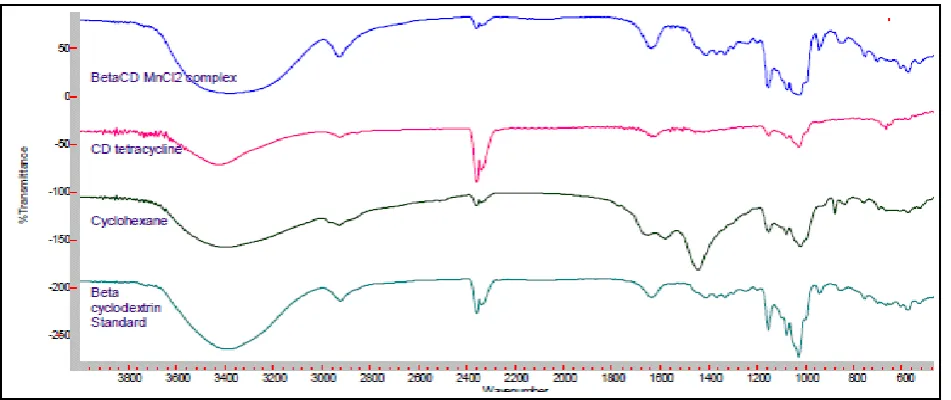
The infrared spectra of the complexes were analyzed and compared with the spectra of the pure compounds and their physical properties (such as melting point determination) respectively.Due to complexation of the host with the guest, shifts or changes in the spectrum.
Figure 4: FT-IR spectra of Standard Beta Cyclodextrin, of extracted β-CD and inclusion complex obtained by Kneading method: β-CD-tetracycline and β-CD Mn complex on 4000-400 cm-1 spectral domain
FT-IR spectra of Standard β-cyclodextrin and the extracted β-cyclodextrin was characterized by intense bands in 3550-3200 cm-1 region of stretching vibration of O-H bonds (free hydroxyl groups of β-cyclodextrin) and bands in 1440-1395 for C-O stretching . This confirms that the extracted β-cyclodextrin was same to that of standard. (Fig 4)
FT-IR spectra of β-cyclodextrin- tetracycline complex was characterized by intense bands near 3400 cm-1 but the associated NH- bands are weaker and frequently sharper than the corresponding OH- group. NH- bending vibration detected by intense band in 1650-1580 cm-1. This confirms that the extracted β-cyclodextrin was formed complex with the guest molecule-tetracycline. (Fig 4)
The absorbance IR peak of Metal/β–CD inclusion complexes could be seen in at 3394.301cm-1. These changes suggest Metal-CD complex formation. Shifts or changes in the spectrum occur due to the complexation. The FT-IR spectra of β-cyclodextrin and inclusion complexes Metal –CD.(Fig 4)
Atomic absorption spectroscopy:
Atomic absorption spectroscopy was performed on a Agilent technologies 200 series AA, Model type –
240FS AA using EPA Method 243.1 (for manganese). The detection limit for manganese at 0.02 µg/ml, with the working range of 0.02- 5 µg/ml at 279.5 nm. The final Manganese ion concentration in the Manganese incorporated into β- Cyclodextrin was found to be 16560.6 ppm (1.65%)
Melting point is one of the characterizations. The melting point of β-cyclodextrin extracted using different
complexing agents was found to be almost same for both
Bacillus sp isolated from soil and the Standard MTCC
cultures ranging between 259-264°C.
CONCLUSION:
We have successfully isolated and characterized CGTase producing microorganism as Bacillus sp. in our laboratory at Robust Materials Technology Pvt. Ltd. CGTase thus formed by the isolated bacteria could be effectively used for the conversion of raw starch into cyclodextrins in a alkaline pH. Isolation and characterization of β- cyclodextrin by the isolated
45°C respectively. Inclusion complex was made by kneading method using drug and metal ion with β-cyclodextrin. Finally we conclude saying, even though for all the parameter both the cultures showed same optimum conditions but the yield of β- cyclodextrin was found to be maximum in MTCC cultures-Bacillus licheniformis compared to that of isolated Bacillus sp. Extracted β-cyclodextrin and inclusion complexes thus formed was confirmed by characterizing using melting point and FT-IR.
The goal is to design a non viral vector with high efficiency and low toxicity.
ACKNOWLEDGEMENT:
Authors would like to thank the authorities of Research and Development Center, Robust Materials Technology Pvt. Ltd. and Robust Herbal Pvt. Ltd. Bengaluru, Karnataka for providing the facilities to carry out this work.
REFERENCES:
1. R. Geeta and Sunil S.More; Isolation and characterization of cyclodxtrin glucanotransferase from soil bacterium, Research Journals of Biological sciences. 2010: 5(10),699-707.
2. Boriana Yordanova Zhekova ;Investigation on Cyclodextrin Production with Cyclodextrin Glucanotransferase from
Bacillus megaterium. Biotechnol. 2008:46 (3) 328–334.
3. Cao et al., ; A novel CGTase from the alkalophilic bacillus species: Purification and classification. Food Res. Int. 2005:38: 309-314
4. Rha et al., ; Production of Cyclodextrins by poly lysine fused Bacillus macerans CGTase immobilized on cation exchanger. J. Mol. Catal.B: Enzym,2005:34:39-43
5. Marlene M Martínez Mora1, et al., ; Partial purification and properties of cyclodextrin glycosiltransferase (CGTase) from alkalophilic Bacillus species. SpringerPlus , 2012:1:61. 6. Higuti ; Isolation of Alkalophilic CGTase-Producing Bacteria
and Characterization of Cyclodextrin-Glycosyltransferase . 2003: 46(2 )183-186,
7. Salva et al.,; Screening of alkalophilic bacteria for CGTase production. Rev.Microbiol.1997:20:157-164
8. D. A. Volkova et al.; One-step affinity purification of cyclodextringlucanotransferase from Bacillus SP. 1070 ,
Biocatalysis 2000.
9. Rosli Md.Illias et al. ; Cyclodextrin Glucanotransferase Producing Alkalophilic Bacillus sp. G1: its cultural conditions and Partial characterization of the enzyme ; Pakistani Journal of Biological Sciences .2002:5(6): 688-692
10.
http://www.chemiedidaktik.uni-wuppertal.de/disido_cy/cyen/info/01_manufacture_cy.htm
11. Prabhakar Shirse et al. Formulation and evaluation of cyclodextrin inclusion complex tablets of water insoluble drug-glimipiride ; international journal of research in pharmacy and chemistry , 2012.