Original Research Article
The effect of spirituality assistance on improving life quality
in cancer children
Etik Pratiwi
1*, Giri Susilo Adi
2INTRODUCTION
Cancer is a disease with a high mortality rate.1 States that the death rate from cancer can reach 45% in 2007. Cancer deaths are predicted to increase to 12 million by 2030. Every year in the United States, around 12,400 individuals aged 0-20 years diagnosed with cancer. Around 2300 children and adolescents die each year from cancer, so cancer is the most prevalent cause in the age group 1-19.2,3
In Indonesia, childhood cancer can be found at the age of 0-17 years. Types of cancer that occur in childhood are different from adulthood. Carcinomas that develop in
solid organs are the most common cancers in adults, but are rarely found in individuals younger than 20 years. Acute lymphoblastic leukemia (LLA), non-Hodgkin's lymphoma, neuroblastoma, retinoblastoma, osteo-sarcoma, nasopharyngeal cancer and brain tumors are common cancers in children.4,5
Problems experienced by children with various cancers ranging from physical, psychological, and social problems associated with the length of the chemotherapy process that must be undertaken. Based on the data and the conditions indicate that supportive care for children with cancer is needed to improve the quality of life of patients during treatment and to survive. Health services provided outside the hospital can be carried out by health
ABSTRACT
Background: Cancer is a disease with a high mortality rate.1 States that the death rate from cancer can reach 45% in 2007. Emotional and spiritual dysfunction in children and adolescents can lead to symptoms of depression and is one of the risk factors for suicide.6
Methods: This research is a type of mixed research (mix method), with a sequential explanatory strategy. This strategy is a method of approach by conducting quantitative data collection as the main method then followed by qualitative data collection.
Results: There were 30 children who were used as respondents in this study, the majority of whom were male and aged over 13 years. The majority of children experience leukemia. The results of data analysis showed the influence of spirituality assistance on quality of life. The value of the total quality of life of the total respondents conducted by spirituality assistance increased in value by 8,962, from an average value of 75,055 to 84,017. The p value for total quality of life is 0,000.
Conclusions: There is an influence of spirituality accompaniment on the quality of life for children with cancer. Children can be invited to worship together with parents, this is an effective coping to motivate them to survive in carrying out their lives and activities everyday even in conditions of illness.
Keywords: Spirituality assistance, Quality of life, Child cancer
1Department of Pediatric Nursing, 2Department of Nursing, Manajemen, Notokusumo Nursing Academy, Yogyakarta,
Indonesia
Received: 08 August 2019
Revised: 13 August 2019
Accepted: 14 August 2019
*Correspondence:
Etik Pratiwi,
E-mail: [email protected]
Copyright: © the author(s), publisher and licensee Medip Academy. This is an open-access article distributed under the terms of the Creative Commons Attribution Non-Commercial License, which permits unrestricted non-commercial use, distribution, and reproduction in any medium, provided the original work is properly cited.
personnel which consists of examining all aspects of the individual physically, emotionally, psychosocially, and spiritually and is expected to be able to provide comprehensive care.6 According the quality of life of children with cancer is influenced by physical health, psychosocial health, emotional function, social function, and school function.7
Spiritual and child health services were developed by the Department of Pediatrics, Boston Medical Center and Medical Anthropology. The development of this service is a practice guideline that provides services, such as anticipation for patients who have spirituality concerns, the development of self-awareness of the spiritual, the development of resources in the form of local consultants in spirituality, and referral to patients who need spiritual care.6
Spirituality is an element that is increasing and is recognized by many patients who experience disease at an advanced stage. Patients more often prioritize their religious and spiritual aspects to deal with stress in their advanced diseases. Trust, value, and expression of spirituality expressed by children are an integral part of the child's development process.6
Emotional and spiritual dysfunction in children and adolescents can result in symptoms of depression and is one of the risk factors for suicide.6 Rumah bunda is one of the halfway houses to facilitate children who experience chronic diseases, especially cancer and blood disorders, almost all of the children who are at Rumah bunda have chemotherapy at the hospital. Dr. Sardjito Yogyakarta.
METHODS
Study design
This research is a type of mixed research (mix method), with a sequential explanatory strategy design. This design was a method of approach by conducting quantitative data collection as the main method then followed by qualitative data collection.8 Qualitative strategies are carried out by in-depth interviewing methods on spirituality and when intervening on spirituality assistance. The quantitative approach with the pre-test-post-test design is a type of quasi-experimental design. Quality of life for cancer children is measured first before spirituality assistance is carried out, then after spirituality mentoring the quality of life of children is measured to determine whether there is an increase or decrease or no increase.
Study place
The study was conducted in a community area namely children with cancer who were undergoing treatment and were in a halfway house in the Yogyakarta area called
“Rumah bunda”. Most of the children were out patient at Sarjito Central General Hospital Yogyakarta.
Period of the study
This study was held on July-September 2016.
Selection of the criteria of patient
The criteria of the sample of this study was divided into the inclusion criteria for the sample are as follows: the sample inclusion criteria for quantitative data collection in this study are children aged between 6 to 18 years, children can be invited to communicate both ways well.
Procedure of the study
The procedure of this study was first administrative procedures; this research will be conducted after obtaining permission for the implementation of research from the Director of Akper Notokusumo Yogyakarta. The Ethical Clearence Management is carried out by researchers at the Yogyakarta Health Politehnik Kesehatan. Second was technical procedures. The steps undertaken in the technical procedures for data collection in this study are: the researcher determines the research subject in accordance with the inclusion criteria and gives a brief explanation to the research subject about the aims and benefits of the study first and asks students or trainees to be research respondents and signs an informed consent sheet. Researchers conduct training in assisting spirituality with psychologists who are in halfway houses or homes of cancer children in the Yogyakarta area. Researchers who are assisted by assistants take measurements of the quality of life of cancer patients before mentoring. Spiritual assistance is carried out for 2 to 3 times which is done 1 time for 1 week so that the total implementation of spiritual assistance is done within 3 weeks.
Researchers assisted by assistants carry out data related to the quality of life of children with cancer after being carried out by research assistants and researchers themselves. Researchers compare quality of life scores before mentoring with quality of life after spirituality assistance.
Ethical approval
This research was approved from the Yogyakarta Health Ministry Health Ethics Research Commission for Health with No.LB.01.01 / KE / LII / 453/2016.
Statistical analysis
type of cancer, which are presented in tabular form and analyzed descriptively namely percentage, standard deviation and average. Data on the quality of life and spirituality of children will also be presented in tabular form and analyzed descriptively using averages.
Bivariate analysis, this analysis is to determine the relationship between the independent variables with the dependent variable, both the significance of differences, relationships, the influence of a variable on other variables. Paired comparative hypothesis test of paired categorical variables in this study used the paired sample T-test with a significance level of p<0.05.
Qualitative data analysis, the data that has been collected is processed by the stages of making interview transcripts in the in-depth interview process, which is when conducting spirituality assistance to cancer children, writing field notes, grouping and coding data, presenting data summaries to facilitate interpretation and make conclusions. Presentation of the data is done in a narrative manner and then grouped by category to get a conclusion so that it becomes a description. In this data analysis stage, quantitative data analysis is analyzed first and followed by qualitative analysis. The conclusions in this study were drawn based on the research hypothesis and qualitative results were used to strengthen the research conclusions.
RESULTS
Characteristics of research subjects
The study was conducted from August to September 2016 at a halfway house or in a community where there were cancer patients who were undergoing treatment in Yogyakarta. Description of characteristics of cancer survivors children (gender, age, type of cancer) are shown in Table 1.
Table 1: Characteristics of persons with childhood cancer.
Karakteristik N (%)
Sex Boy 22 (73.33)
Girl 8 (26.6)
Group of age (in years)
6-7 3 (10 )
8-12 12 (40)
13-18 15 (50)
Types of cancer
Leukemia 20 (66.6)
AML 3 (10)
Retinoblastoma 2 (6.6) Neuroblastoma 2 (6.6)
NHL 1 (2.4)
Table 1 show that there are differences in the proportion of sex, age group and type of cancer. In this study, the dominant sex group was boys, namely 22 children (73.33%) and women as many as 8 children (26.6%). In the age group, there were children aged 6-7 years as many as 3 children (10%), children aged 8-12 years as many as 12 children (12%), children aged 13-18 years as many as 15 children (50%). In this study the majority of children suffered from leukemia as many as 20 children (66.6%) and other cancer patients namely AML 3 children (10%), retinoblastoma 2 children (6.6%), neuroblastoma 2 children (6.6%), and Non-Hodgking lymphoma (NHL) 1 child (2.4%).
Overview of cancer domain quality score for children before being given spirituality assistance and after being given spiritual assistance.
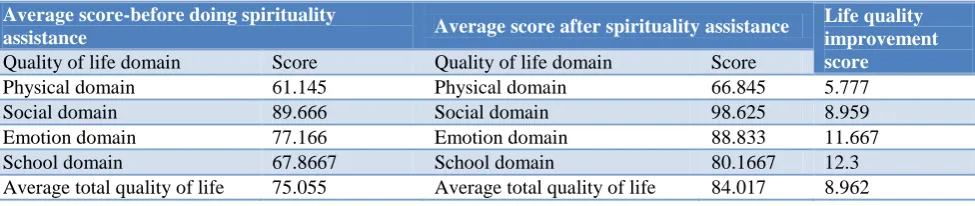
From the results of calculating the average value of quality of life obtained before spirituality assistance, the highest average quality of life quality domain is the social domain, which are 89.66.
Table 2: Average domains of quality of life quality of children of cancer before being given spirituality assistance and after being given spiritual assistance.
Average score-before doing spirituality
assistance Average score after spirituality assistance
Life quality improvement score
Quality of life domain Score Quality of life domain Score
Physical domain 61.145 Physical domain 66.845 5.777
Social domain 89.666 Social domain 98.625 8.959
Emotion domain 77.166 Emotion domain 88.833 11.667
School domain 67.8667 School domain 80.1667 12.3
Average total quality of life 75.055 Average total quality of life 84.017 8.962
The lowest domain average is the physical domain. From the results of Table 2, it shows that the social domain is the highest average domain, which is 98.625 after respondents were given spirituality assistance. The total quality of life of respondents conducted by spirituality assistance increased in value by 8.962, from an average value of 75.055 to 84.017.
Effect of spirituality on the quality of life of children with cancer
the quality of social domain quality, emotional domain, school domain, and total quality of life. The value of p value <0.05 indicates that there is an influence of spirituality assistance on the quality of life for children with cancer.
DISCUSSION
The results of this study indicate that spirituality assistance has an effect on the quality of life of cancer children which shows a value of p<0.05 for each quality of life domain. Spiritual accompaniment is carried out during the child care process at home or during the treatment process. Children are invited to pray together with their parents and given motivation to get sick. The house companion stopped stating that almost all Muslim religious children were devout. Children can be invited to pray 5 times. Parents also have good coping that is willing to invite their children to pray at any time, especially when the child feels sick. Parents state that even when treatment at the hospital nurses also provide spiritual assistance to children. The level of spirituality in children is at the third level, namely the level of discrimination. Children's awareness begins to categorize objects and events based on experience and understands the existence of intuition and other things that are not palpable by the senses.9 At this level spiritual awareness is considered to have begun to exist. Spirituality in children is an ability to get personal value through its relationship with others.8 Parents play an important role in the spiritual development of children. Parents can do education about God, religion to children. The family is the first world for children to get experiences about spiritual activities.10
Spirituality significantly helps clients and service providers to adapt to changes caused by chronic diseases. Clients who have an understanding of spiritual well-being, feel the relationship with the highest strength and others, and can find meaning and purpose in life, will be able to adapt better to the disease. This adaptation can help them improve their quality of life.1 Spirituality has a positive influence on coping and achieving adaptation.4 Aspects in a person's life are influenced by spiritual and religious beliefs that include relationships with others, daily habits, views on him and the outside world.11 Spirituality is related to higher welfare, this is because spirituality provides social support that can improve relationships, provide meaning in life, and reduce anxiety levels. Quality of life is a multidimensional construction consisting of patient perceptions about the effects of illness and therapy of their functions in all aspects of life that include physical, psychological, cultural, personal life purpose, value and social systems. Quality of life consists of broader aspects including environmental and social relations and spiritual health.12
Spirituality is a component that has been experienced by patients who experience disease at an advanced stage. For example, the majority of patients with advanced disease see spirituality as a significant component in their
experience of illness. Patients often depend on their belief in coping with their illness (religious coping). Furthermore, spirituality is also related to the better quality of life of patients.13 The literature review conducted shows that children and adolescents with cancer can express their spirituality in various ways. Spirituality has a positive impact on those who are in the process of being treated for cancer.3
The spiritual dimension in quality of life has been known to increase as a component in overall patient care in adults. Evaluation of the quality of life of patients is an important part of providing care to sick patients. Patients with cancer at an advanced stage more often experience mental and psychological problems.14 The committee on paliative end of life care for children and their families notes that there is still little research related to spirituality in sick children. This is important if we are able to understand the components of children's lives so that we can provide better support as their life goals.2
CONCLUSION
There is the influence of spiritual assistance on the quality of life in both physical, social, emotional, school, as well as the total quality of life for people with cancer. The influence of spirituality assistance has an impact on improving the quality of life for people with child cancer.
Recommendations
Spiritual assistance should be carried out continuously and gradually by parents, teachers, nurses and volunteers who accompany children.
Funding: No funding sources Conflict of interest: None declared
Ethical approval: The study was approved by the Institutional Ethics Committee
REFERENCES
1. Adegbolaa M. Spirituality and quality of life in chronic illness. J Theory Constr Test. 2006;10:42. 2. Kamper R, Cleve LV, Savedra. Children with
advance cancer: responses to a spiritual quality of live interview. J Spec Pediatr Nurs. 2010;15:301-6. 3. Carman K, Maternity and Pediatric Nursing. 2nd ed.
Philadelphia: Wolters Kluwer Health/Lippincott Williams and Wilkins; 2013.
4. Gamayanti IL. Stres, Koping, dan Pencapaian Adaptasi Anak Yang Menderita Leukemia Limfoblastik Akut. Doktor, Universitas Gadjah Mada; 2006.
5. McNeil SB. Spirituality in adolescents and young adults with cancer:a review of literature. J Pediatr Oncol Nurs. 2015:55-63.
belief. United States America: Elsevier; 2004: 481-487.
7. Sitaresmi MN, Mostert S, Gundy CM, Veerman SA. Health-related quality of Life assessment in Indonesia childhood acute lymphoblastic leukemia. J BioMed Central. 2008:6:2-8.
8. Creswell JW. Research Design Pendekatan Kualitatif, Kuantitatif, dan Mixed: Prosedur-Prosedur Metode Campuran. Yogyakarta: Pustaka Pelajar; 2012: 316-317.
9. David F. Psychology, Religion and Spirituality. In: Blackwell W, eds. British Psychological: Society and Blackwell Publishing; 2003.
10. Taylor C, Lilis C, LE M. Fundamental of Nursing: The Art and Science of Nursing Care. Philadelphia, New York: Lippincott; 1997.
11. Garssen B, Uwland-Sikkema NF, Visser A. How Spirituality Helps Cancer Patients with the
Adjustment to their Disease. J Relig Health. 2015;54(4):1249-65.
12. Varni JW, Limbers CA, Burwinkle TM. Parent proxy-report of their children's health-related quality of life:an analysis of using the PedsQL 4.0 Generic Core Scale. Health Qual Life Outcomes. 2007;5:2. 13. Ventegdot S, Merrick J, Andersen NJ. Quality of
life theory. The IQOL theory: an integrative theory of the global quality of life concept. Sci World J. 2003;3:1030-40.
14. Argiles JM. Cancer-associated malnutrition. Eur J Oncol Nurs. 2005;9:39-50.