Hard Turning with Wiper Ceramic Insert;
Parametric Analysis and Optimization with
Desirability Approach
K.Venkata Subbaiah1 Ch. Raju *2 R. S.Pawade3 Ch. Suresh4
1
Professor, Department of Mechanical Engineering, Andhra University, Visakhapatnam-530003, India.
2
Senior Lecturer, Department of Mechanical Engineering, Govt. Polytechnic, Narsipatnam- 531116, India.
3
Associate Professor, Department of Mechanical Engineering, DBATU, Lonere-402103, India.
4
Research Scholar, Department of Mechanical Engineering, Andhra University, Visakhapatnam- 530003, India.
Abstract
-
Hard turning with new advanced materials and new tool geometry nullify the gap between the turning and grinding in the surface quality issues. This paper deals the hard turning of AISI 4340 hardened steel (45, 50 and 55 HRC) with advanced cutting insert such as wiper ceramic insert. This study focuses on how the wiper geometry insert performs with varying workpiece hardness, cutting speed and feed rate in the view of surface roughness and tool wear. Box-BehnkenDesign was used for the experimental plan and Analysis of Variance was carried to identify the significance of the varying parameters on surface roughness and tool wear. Optimum cutting conditions are proposed for industrial production from multi-objective optimization with Desirability approaches.
Keywords-- Wiper Ceramic Insert, Box-Behnken Design, Surface Roughness, Tool Wear, Desirability Approach.
I. INTRODUCTION
In the modern manufacturing industry, hardened steel enhances its application range in tool making, heavy machine parts, and automobile components sectors. As the conventional machining method of hardened steels (45-65 HRC) is not suitable for present dynamic nature of the manufacturing industry, hard turning plays a vital role in machining due to minimum equipment costs, reduced setup time, lesser process steps and vital part geometry. At the same time, surface quality is essential for any hardened component as it provides a suitable condition for its long life at the minimum cost [1]. The economy of the manufacturing is very important and those mainly depend on the cost of tooling, hence the life of cutting tool in terms tool wear is also an important issue must be considered during manufacturing.
The selection of machining parameters and optimization of those parameters are essential to obtain good machining responses. J.S. Senthilkumar et al., [2] performed the full factorial design of experiments with Inconel 718, and Taguchi technique used for the optimization of cutting parameters in accordance with the Surface Roughness (Ra) and Flank Wear (Vb) , under dry
In few studies, hardness is considered as one of the machining parameters and estimated its influence on machining characteristics under varied conditions. Poulachon et al [9] examine the PCBN cutting inserts progressive tool flank wear behavior and explained how it is influenced by the hardened steel microstructure. Lima et al [10] Investigated the applicability of the multi-layer TiCN/Al2O3/TiN coated carbide inserts during the machining of hardened steel at different levels of hardness. Experimental results confirm that coated carbide tools were failed to machine, the materials which hardness exceeds 50 HRC, even at lower metal removal rates. Aouici et al [11] conducted a study to know the influence of workpiece hardness on surface finish characteristics during the hard turning of AISIH11steel with cubic boron nitride insert. Experimental results reveal that surface roughness is mostly influenced by both the workpiece hardness and feed rate and they show large statistical significance on the models. Lima [12] examined the machinability of AISI D2 tool steel at 58 HRC, AISI 4340 steel at 42 HRC and 48 HRC with ceramic insert, coated carbide insert and PCNB insert respectively. Experimental results demonstrate that the surface finish was amended as cutting speed increases and deteriorated with increase in feed rate. Mozammel Mia et al [13] develops the predictive models using Response Surface Methodology (RSM) and Artificial Neural Network (ANN) for average tool-workpiece interface temperature in hard turning of AISI 1060 steels by coated carbide insert in respect of cutting speed, feed rate and material hardness.
Recently, with the introduction of wiper inserts, the application of turning in the manufacturing industry is enhanced, because of its multi nose edge radius, lower values of surface roughness are achieved, which are very nearer to the convention grinding process. Grzesik et al. [14] reported that for the finish turning with wiper inserts can produce similar surface roughness values even at doubled feed rates as compared to the conventional inserts while machining the hardened AISI D2 steel at 60 HRC. Tugrul Ozel et al.[15] made a study on AISI D2 steel at 60 HRC with ceramic wiper inserts with lower feed rates and cutting speed and attained Ra is 0.18-0.20 µm at varied time formats, then formulated regression and neural network models based on the experimental data, to estimate the surface finish values and tool flank wear. Davim et al. [16]
reported that wiper inserts show better performance in deference to surface roughness and tool wear over the conventional inserts.
From the literature, it was found that many optimization techniques have been successfully utilized by researchers for modeling in hard turning. But no work is accounted to elevate the importance of workpiece hardness in addition to quality aspects associated with the use of wiper inserts during the Multi-objective optimization with RSM Desirability approaches. Present work was carried to in this line during the hard turning of AISI 4340 steel (45, 50, 55 HRC) with wiper ceramic insert.
II. EXPERIMENTAL DETAILS
A. Material and Cutting Inserts
AISI 4340 steel was chosen as the workpiece material for this study, which has a wide range of applications including automobile and manufacturing fields. The samples are in the form of round bars with 30 mm diameter and 150 mm cutting length. The workpieces were heat-treated at 830°C (1525°F) followed by quenching in oil in different conditions to obtain the required range of hardness values [17-18]. Wiper ceramic inserts were used in this experimental study was manufactured by Sandvik Company, with the ISO designation of CNGA120408S01525WH (ISO) and they were rigidly mounted with tool holder designated by PCLN L 2525 M12.
B. Cutting Conditions and Measurements
C. Experimental design
Response Surface Methodology (RSM) is referred as a collection of statistical and mathematical techniques which are very useful during to design the experiments; it's modelling; analysing the influence and significance of given parameters and their optimization [19]. In this study Box-Behnken Design (BBD) was used for the design of experiments. Table II shows the experimental layout plan as per BBD and the corresponding values of surface roughness and tool wear
Table I: MACHINING PARAMETERS AND THEIR SELECTED LEVELS
Parameter
Levels
1 2 3
Hardness 45 50 55
Cutting Speed 140 180 220
Feed 0.05 0.2 0.35
Table II: EXPERIMENTAL LAYOUT PLAN AS PER BBD AND THE CORRESPONDING VALUES OF SURFACE
ROUGHNESS AND TOOL WEAR
Run
Input parameters
Response parameters
H Vc f Ra Vb
HRC m/min mm/rev µm mm
1 55 180 0.05 0.38 0.044 2 55 140 0.2 0.48 0.035 3 50 180 0.2 0.57 0.041 4 45 180 0.05 0.35 0.028 5 50 180 0.2 0.54 0.045 6 50 180 0.2 0.53 0.043
7 55 180 0.35 0.69 0.08 8 50 220 0.05 0.23 0.047 9 50 140 0.05 0.31 0.025 10 45 180 0.35 0.61 0.035 11 45 220 0.2 0.45 0.035 12 45 140 0.2 0.46 0.025 13 50 220 0.35 0.59 0.075 14 55 220 0.2 0.45 0.088 15 50 140 0.35 0.54 0.043 16 50 180 0.2 0.54 0.048
17 50 180 0.2 0.54 0.049
III. RESULTS AND DISCUSSIONS
A. Analysis of Surface Roughness
ANOVA is a statistical technique used to identify the significance of the factor(s) or interaction factors on a particular response predicated on the experimental data. It regresses the total variability of the response into individual contributions of each of the factors and the error.
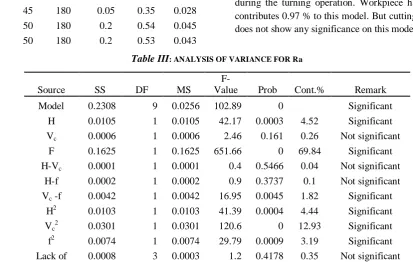
ANOVA results shown in Table III for the Surface roughness, that workpiece hardness (H) and feed rate (f); two-level interaction cutting speed and feed rate (Vc-f); products of Vc2 and f2, which all have the shows their significance on the surface roughness Ra. Feed rate is only the parameter remarkably shows its significance on Ra with a contribution of 80% to the model, because of this reason, the weak feed rate has to be employed during the turning operation. Workpiece hardness contributes 0.97 % to this model. But cutting speed does not show any significance on this model.
Table III: ANALYSIS OF VARIANCE FOR Ra
Source SS DF MS
F-Value Prob Cont.% Remark
Model 0.2308 9 0.0256 102.89 0 Significant H 0.0105 1 0.0105 42.17 0.0003 4.52 Significant Vc 0.0006 1 0.0006 2.46 0.161 0.26 Not significant
F 0.1625 1 0.1625 651.66 0 69.84 Significant H-Vc 0.0001 1 0.0001 0.4 0.5466 0.04 Not significant
H-f 0.0002 1 0.0002 0.9 0.3737 0.1 Not significant Vc -f 0.0042 1 0.0042 16.95 0.0045 1.82 Significant
Fit
Error 0.0009 4 0.0002 0.4
Total 0.2326 16
(a) (b)
(c)
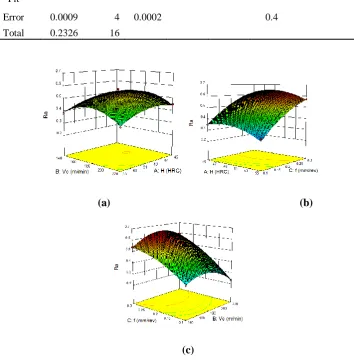
Fig. 1 Three Dimensional (3D) response surface graph for Surface roughness at varying (a) H &Vc (b) H & f and (c) f &Vc.
Some of the other researchers withal substantiate the homogeneous results; Thamizhmanii et al. [20] reported that the feed rate is the critical factor affecting surface roughness. Feng [21], additionally reported that both feed rate and workpiece hardness have a remarkable impact on surface roughness, which is evaluated with fractional factorial experimentation approach for experimental study. The cutting speed does not show any impact but workpiece hardness, feed rate and interaction effect of Vc-f and have a considerable influence noted on surface roughness [11].
Three-Dimensional (3D) response surface plots, predicated on the quadratic model were drawn to study the effect of the input machining parameter on output parameters. Fig. 1(a) displays the three-dimensional (3D) response surface of surface roughness, varying workpiece hardness, cutting speed and feed maintained at 0.2 mm/rev. It shows the tendency of surface roughness slightly
increase with the increase in workpiece hardness and up to the medium level of cutting speed. It is further noticed that surface roughness is recorded low even at higher levels of hardness with low feed rates. There is a remarkable rise in surface roughness is identified in Fig. 1(b) & (c), with an increase in feed rate, it is also revealed from the table 4, as the feed rate is the most significant factor for that model.
B. Analysis of Tool Wear
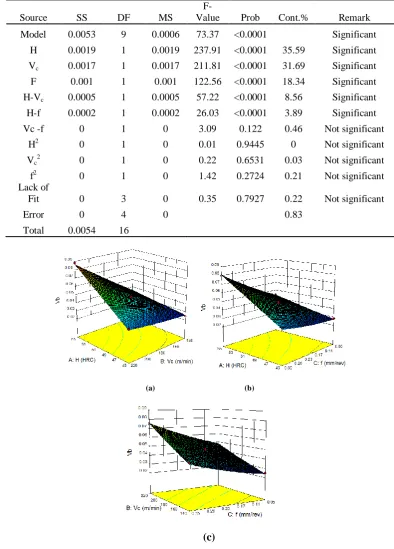
workpiece hardness and cutting speed. It observed that when workpiece hardness and cutting speed increases, the tool wear of the insert tends to increase noticeably, low tool wear rates are observed at lower Vc. Very high wear rates are observed on the response surfaces of tool wear with the combination of H and Vc at higher levels. This is also observed from the table 5, i.e. interaction
parameter H-Vc. A similar tendency is also observed in the Fig. 2(b), 3D response surface of tool wear at varying H and f. As per the table 5, the cutting speed is one of the most important significant parameter effects the tool wear, Fig. 2(c) reveals that Vc accelerate the tool wear when it increased to higher levels as compared to the feed rate.
TABLE IV: ANALYSIS OF VARIANCE FOR Vb
Source SS DF MS
F-Value Prob Cont.% Remark
Model 0.0053 9 0.0006 73.37 <0.0001 Significant
H 0.0019 1 0.0019 237.91 <0.0001 35.59 Significant Vc 0.0017 1 0.0017 211.81 <0.0001 31.69 Significant
F 0.001 1 0.001 122.56 <0.0001 18.34 Significant H-Vc 0.0005 1 0.0005 57.22 <0.0001 8.56 Significant
H-f 0.0002 1 0.0002 26.03 <0.0001 3.89 Significant
Vc -f 0 1 0 3.09 0.122 0.46 Not significant
H2 0 1 0 0.01 0.9445 0 Not significant
Vc2 0 1 0 0.22 0.6531 0.03 Not significant
f2 0 1 0 1.42 0.2724 0.21 Not significant Lack of
Fit 0 3 0 0.35 0.7927 0.22 Not significant
Error 0 4 0 0.83
Total 0.0054 16
(a) (b)
(c)
IV. MULTI-OBJECTIVE OPTIMIZATION OF
RESPONSE PARAMETERS WITH DESIRABILITY
APPROACH
One of the most important aims of this study is looking for the optimal machining conditions for the effective machining of hardened steel with wiper inserts. Desirability approach predicated on RSM is an ideal technique for searching the optimal machining condition when there are multi-objectives present and its value varies from 0 to 1. For this study optimal machining condition is filed in the view of minimization of both the objectives viz. surface
roughness and tool wear. If the desirability value obtained nearer to the unity, it indicates the predicted machining condition at this value are completely desirable and if its value nearer to zero indicate the predicted machining condition at this value is mostly undesirable [23]. Table V displays the goals and range of parameters for the optimization of machining conditions. From the analysis of the results in table VI, the optimal solution obtained for machining of is: workpiece hardness of 55HRC, cutting speed of 140 m/min and feed rate of 0.050 mm/rev which could result in a minimum surface roughness of 0.228 µm and tool wear of 0.022mm.
TABLE V: GOALS AND PARAMETER RANGES FOR OPTIMIZATION OF CUTTING CONDITIONS.
Condition Goal
Lower Limit
Upper Limit Workpiece hardness (H) Is in range 45 55
Cutting speed (Vc) Is in range 140 220 Feed(f) Is in range 0.05 0.35 Ra Minimize 0.23 0.69 Vb Minimize 0.025 0.088
TABLE VI:RESPONSE OPTIMIZATION FOR SURFACE PARAMETERS AND TOOL WEAR.
Test No H Vc f Ra Vb Desirability
1 55 140 0.05 0.228 0.022 0.939
2 55 140.325 0.05 0.229 0.022 0.937
3 55.05 140 0.051 0.23 0.022 0.936
V. CONCLUSIONS
1. It is evident that feed rate is the major cutting parameter affecting Ra with a contribution of 69.5%, whereas for tool wear, workpiece hardness (H) is the major influence parameter with the contribution of 19.7%.
2. For tool wear, the machined surface is a function of the workpiece hardness and cutting speed. With an increase in H and Vc, tool wear of the insert increases.
3. Wiper insert produces fine surfaces with the range of surface roughness values between 0.23 - 0.69 µm, even in hard turning with high feed rates.
4. This study confirms that workpiece hardness has significant statistical influences on both the surface roughness and tool wear hence the researchers should consider this for future investigations.
5. The multi-objective optimization using desirability approach proposes workpiece
hardness 55 HRC, cutting speed 140 m/min and feed rate 0.05 mm/rev for good surface roughness at minimum tool wear.
ACKNOWLEDGEMENTS
This experimental work was conveyed in advanced machining laboratory, Dr.Babasaheb Ambedkar Technological University, Lonere, India. The authors might want to thank to accountable for the research facility for offering labs for experimentation.
REFERENCES
[1] Manohar, Jomy Joseph, T. Selvaraj and D Sivakumar, "Application of Box-Behnken design to optimize the parameters for turning Inconel 718 using coated carbide tools", Int. J. of Scientific &Engineering Research., vol.4, pp. 620-641, 2013.
Journal for Engineering Research., vol.15, pp. 7-14, 2010,
[3] R.Quiza, L. Figueira and J.P. Davim, "Comparing statistical models and artificial networks on predicting the tool wear in hard machining D2 AISI steel", Int. J. Adv. Des. Manuf. Technol., vol.37, pp. 641–648, 2008. [4] T. Ozel, Y. Karpat, L. Figueira and J.P. Davim,
"Modelling of surface finish and tool flank wear in turning of AISI D2 steel with ceramic wiper inserts", J. Mater. Process. Technol., vol.189, pp. 92–98, 2007. [5] M. Kaladhar, K. Venkata Subbaiah and Ch. Srinivasa
Rao, "Determination of Optimum Process parameters during turning of AISI 304 Austenitic Stainless Steels using Taguchi method and ANOVA", International Journal of lean thinking., vol. 3, 2012.
[6] R. Suresh, S. Basavarajappa and G.L.Samuel, "Some studies on hard turning of AISI 4340 steel using multi-layer coated carbide tool", Measurement., vol. 45, pp. 1872–1884, 2012.
[7] R. Suresh, S. Basavarajappa, V.N.Gaitonde and G.L.Samuel, "Machinability investigations on hardened AISI 4340 steel using coated carbide insert", Int. J. Refract. Met. Hard Mater., vol. 33, pp. 75–86, 2012. [8] A.E.Diniz and A.J.Oliveira, "Hard turning of interrupted
surfaces using CBN tools", J. Mater. Process. Technol., vol. 95, pp. 275–281, 2008.
[9] G.Poulachon, B.P. Bandyopadhyay, I.S.Jawahir, S.Pheulpin and E.Seguin, "The influence of the microstructure of hardened tool steel workpiece on the wear of PCBN cutting tools", International Journal of Machine Tools and Manufacture., vol. 43, pp.139–144, (2003).
[10] J.G. Lima, R.F.Avila and A.M.Abrao, "Turning of hardened AISI 4340 steel using coated carbide inserts", J.Eng. Manuf., vol. 221, pp.1359–1366,(2007).
[11] H. Aouici, M.A.Yallese and K.Chaoui, "Analysis of surface roughness and cutting force components in hard turning with CBN tool: prediction model and cutting conditions optimization", Measurement., vol. 45, pp. 344–353,2012.
[12] J.G. Lima, R.F.Avila, A.M.Abrao and M.Faustino, "Hard turning: AISI 4340 high strength alloy steel and AISI D2 cold work tool steel", J. Mater. Process. Technol. , vol. 169, pp. 388–395, 2005.
[13] M. Mia and Nikhil R Dhar, "Response surface and neural network based predictive models of cutting temperature in hard turning", Journal of Advanced Research, vol.7, pp.1035–1044,2016.
[14] W Grzesik and T. Wanat, "Surface finish generated in hard turning of quenched alloy steel parts using conventional and wiper ceramic inserts", International Journal of Machine Tools and Manufacture., vol. 46 (15), pp. 1988–1995, (2006).
[15] Ozel T, Karpat Y, Figueira L and Davim JP, "Modelling of surface finish and tool flank wear in turning of AISI D2 steel with ceramic wiper inserts", J. Mater. Process. Technol., vol. 189, pp. 192–8,2007. [16] J.P. Davim and L. Figueira, "Comparative evaluation of
conventional and wiper ceramic tools on cutting forces, surface roughness and tool wear in hard turning AISI D2 steel", J.Eng. Manuf., vol. 221(4), pp. 625– 633, 2007. [17] S.Y. Luo , Y.S. Liao and Y.Y. Tsai , "Wear
characteristics in turning high hardness alloy steel by ceramic and CBN tools", J. Mater. Process. Technol., vol. 88, 114–121, 1999.
[18] Woei-Shyan Lee and Tzay-Tian Su, "Mechanical properties and microstructural features of AISI 4340 high-strength alloy steel under quenched and tempered conditions", J. Mater. Process. Technol., vol. 87, pp. 198–206, 1999.
[19] D.C. Montgomery and R.H. Myers, In Process and product optimization using designed experiments", 2nd ed. Wiley New York, 2002.
[20] S. Thamizhmanii, S. Saparudin and S. Hasan, "Analyses of surface roughness by turning process using Taguchi method", J. Ach. Mater. Manuf. Eng., vol.20, pp. 503– 506, 2007.
[21] C.X. Feng, "An experimental study of the impact of turning parameters on surface roughness", Proceedings of the Industrial Engineering Research Conference, , pp. 2036,2001.
[22] S.Chinchanikar and S.K.choudhury, "Investigations on machinability aspects of hardened AISI 4340 steel at different levels of hardness using coated carbide tools", Int. J. Refract. Met. Hard Mater., vol.38, pp. 124-133, 2013.