ABSTRACT: In this paper is analyzed situation in the world casting industry starting from the 2008 i.e. period of global economical crisis, trough recovery period untill the current time. The top leading countries in the world and their casting production is presented. Special attention is devoted do the products cost of castings, influence of casting production to the environment and perspective of casting as a industry branch are discused.
INTRODUCTION
The foundry industry is one of the fastest developing industries in the world in regards to production, modernity, and technological invention. Increase in the production of casting and its use in recent years has proven in significance of modern industry and world economy [1].
Castings are mainly used in automobiles, railways, pumps, compressors and valves, diesel engines, cement industry, electrical industry, textile machinery, sanitary pipes and fittings, power generation, construction, and many other specialized applications. About 32% global output of foundry industry goes to auto industries and the balance to other downstream engineering sectors [2]. After econonomical crisis in 2008 global casting production exceed prerecession levels. The United States., after retaking the secondspot in the world’s top 10 from India in 2011, strengthened its position by increasing production for 28%. After an impressive 15.1% boost in total production in 2012, the U.S. market increased at a more modest pace. The three largest casting producers in the world provided the most growth in the past four years, with China, United States and India Among the great world producer such situation was not characteristic in Brazil with 16,9% drop in volume
production 2012. In the beginning of 2013 casting was pretty was pretty low but at the end of the year situation became much better. Global casting production grew in 2013, but other than the large gains in China, total tonnage increase by less than half-milions metric tons. Total Chinesse production in 2013 was 44.5 million tons. Cast production in China has risen 3.5 times since 2010 and in India almost 3 times [3].
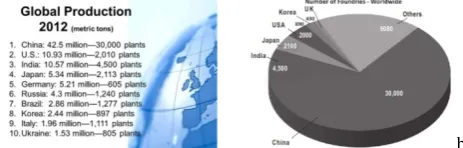
The most important casting producing country in the world China is the world leader in casting production followed by United States and India (figure 1a). Distribution of foundries accros the world is given in figure 1b. Production of casting per year of the top six countries is presented in figure 3. It is clear that only China has permanent increase inanual production. In production per plant, which means total production of castings divided by number of foundries, world leader is Germany and United states are on the second place. (figure 4). Only two of the top 10 nations reported growth in production per plant in 2012. The U.S. continued to increase production per plant in 2012, by 28%, with Korea improving 3% [4].
a b
Figure 1. (a and b) Global casting production (a) Distribution of foundries across the world (b)
China cover 43% world casting production [5]. Besides United States and India, European Union is the most important factor in the global casting market (figure 2).
Figure 3 Production of casting per year for top 6 countries Figure 4 Production of castings per plant
Germany is a leader in the world concerning relationship between casting production and number of employed, figure 5.
Figure 5 Top five casting producer (tons/empl.)
Production of castings from different raw materials, in period 2004-2012 can be seen in table 1. The most often used materials are grey iron, ductile iron and steel [6].
Table 1 Global prodaction of castings from different raw materials.
Globally, 46% of iron castings produced are in gray iron, compared to 25% produced in ductile iron. But this type of disparity is not present in every country. Austria, Denmark, Finland, France,
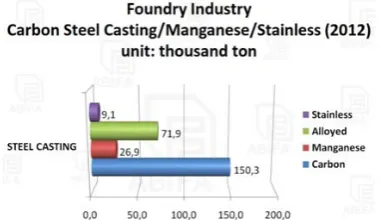
Norway, Spain, Switzerland, the U.K. and the U.S. produce more ductile iron than gray iron [7]. Production of castings from different steel types is presented in figure 6.
Figure 6 Production of casting from different types of steel
Figure 8 Main market server by the foundry industry
As an industry branch metal casting has strong influence to the country economy. The most significant influence of casting production to the GDP in te top leading countries can be seen in figure 9. The strongest influence of casting production to GDP is in the United States.
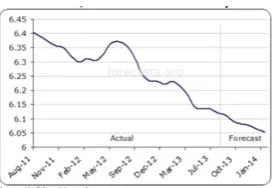
China is watching the yuan carefully and controlling it to maintain their own economy. As can be noticed from figure 10 chinese yuan is still positive but the rate of growth has slowed Because of that there is no great interest among Chinese casting companies for export in the US market. Current situation is successfully used by Mexico casting companies which increase export in United States [9].
Figure 9 Influence of metal casting production to the GDP in top 10 casting production leading countries
Figure 10 Chinese yuan to US dollar exchange currency rate
Metal casting industry has very important role in economy of the EU countries too. The leading country in the casting production is Germany. In the group of top 10 world countries besides Germany
are France and Italy. The biggest casting producers in EU are given in figure 11.
Figure 11 The most important countries in EU according casting production
EU countries have a significant production of ferrous and non ferrous castings. But, as can be seen from figure 12, in both cases
Figure 12 Customer structure for castings in EU countries
Energy consumption in casting production
It is well known thing that the great amount of energy is used for casting production, The foundry industry in the U.S. uses more than 485 billion kJ energy a year, from which around 346 billion kJ (71%) is used for metal casting. Most industrial energy (73%) comes from fossil fuels (83% gas, 16% coke, 1% other sources) [1].Considering the great amount of used energy in production of casting it is necessary to introduce a wide range of activities and conduct research into saving energy. Foundry industry depends on energy cost which, due to production costs and the condition energy plants, is becoming an increasingly expensive resource. Similar to
energy, there is a problem of emissions of greenhouse gases. European Union countries, have fixed limits for CO2 emission
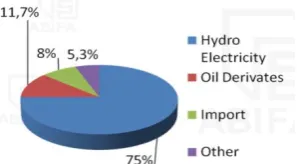
established by the European Committee. They are then shared by governments among different industries, including the foundry industry. Some counties , like Poland for example. From another point of view situation is quite different in Brasil. As can be seen from the figure about 73 percent of energy used for casting production is hydro electricity. What is the structure of production cost in casting production in different countries can be seen in figure 14
Figure 13 Different types of energy used for casting production in Brasil
Figure 14 Structure of production costs for casting productions in different countries
Influence of foundry industry on the environment - Castings are a very propulsive industry branch. - Foundry industry is the key factor in ferrous and non-ferrous metal recycling of waste, which can be re-melted into new products and used 100 %.[3] - Castings are intensive energy consumers. [4] - Intensive environmental pollutants of: soil, air, and water. [5]
Environmental influences of the casting processing are mainly related to waste gases, and for reuse or as disposal of mineral residues.
Due to stringent environmental pollution control norms in the developed countries and non availability of work force for working in trying conditions of foundries, western economy is procuring their casting requirement from BRIC countries.
Harmful emissions caused by casting melting and production are basically related to the use of additives and fuels or raw material impurities. The use of coke or oil might cause the emission of the product of burning. The use of additives in the process generates a reaction. The presence of impurities in waste that blend by melting may cause the formation of a product with incomplete combustion or a recombination and dust. Dust from the process might consist of metal and metal oxides. During the melting process, elements evaporate and tiny metal dust particles are released. Metal particles appear during the final processing [8].
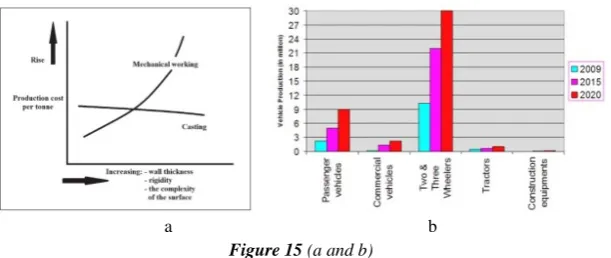
a b Figure 15 (a and b)
Production cost of casting and mechanically machined parts (a) Figure Forecast of vehicle production in India until 2020 (b)
Comparing production cost of casting and mechanically worked products it is obvious that as a production technique, casting has perspective in the future (Figure 15 a). Forecast for car production in India until 2020 is another proof for casting perpective, because many casted parts are build in the different types of vehicles [4].
CONCLUSIONS
Casting industry is perceived as old, dirty and dangerous. Therefore, there is a need for new and younger leadership to be involved in the developments, opportunities and marketing of the industry to provide employment opportunities for the younger generation.
Research directions leading to further development of the foundry industry
The most important research directions leading to further development of the foundry industry:
• development of new technologies and casting alloys,
• melting and liquid metal preparation, • manufacturing of moulds and cores,
• preparation of casting materials and composites,
• pouring, solidifying and cooling of casting,
• technological waste management,
• new production systems and quality control,
• sustainable development of foundry industry
LITERATURE
1. CAEF, The European Foundry Industry – Status Report,CEMAFON General Assembly Maranello, 20 June 2013
2. CAEF - The European Foundry Association, The European Foundry Industry
Structure, Key Figures, Forecasts and a brief Insight into Trends , IFF 2014 - Venice
3. M. HOLTZER, R. DANKO, S. ZYMANKOWSKA-KUMON, THE STATE OF ART AND
4. FORESIGHT OF WORLD’S CASTING PRODUCTION METALURGIJA 53 (2014) 4, 697-700
5. N. ŠEHIC-MUŠIC, Š. GOLETIC, D. PIHURA, L. MUŠIC, K. HASANOVIC, EFFECTS OF FOUNDRY INDUSTRY ON THE ENVIRONMENT, METALURGIJA 52 (2013) 4, 533-536
6. M. Muralidhar* and G. L. Datta, CASTING PRODUCTIVITY ANALYSIS OF GLOBAL FOUNDRY INDUSTRY, FOUNDRY MANAGEMENT, February 13-15, 2009, Kolkata, India 7. CEMAFON, Structure of CEMAFON exports of die
casting machinery by world regions 2010 / 2012
8. FOLKOGROUP, State of the Metal Casting Industry by Country www.folkgroup.com
9. Dr. Heinz-Jürgen Büchner , Changes in the global Foundry Industry and its Consequences on the Foundry Machinery Manufacturing , IKB, September 2014 10. 48th Census of World Casting Production,Steady Growth