Mining High Utility Pattern in One Phase
without Candidate Generation using up
Growth+ Algorithm
P.Sri Varshini
#1, N.Saranya.N
*2, Uma Maheswari
#3, Prof.R.Sujatha
#4#1B.E Department of Computer Science and Engineering, Sri Krishna College Of Technology, Kovaipudur,
Coimbatore, India-641042
*2B.E Department of Computer Science and Engineering, Sri Krishna College Of Technology, Kovaipudur,
Coimbatore, India-641042.
#3
B.E Department of Computer Science and Engineering, Sri Krishna College Of Technology, Kovaipudur, Coimbatore, India-641042.
#4Professor, Department of Computer Science and Engineering, Sri Krishna College Of Technology,
Kovaipudur, Coimbatore, India-641042.
Abstract—Utility mining developed to address the
limitation of frequent itemset mining by introducing interestingness measures that satisfies both the statistical significance and the user’s expectation. Existing high utility itemsets mining algorithms two steps: first, generate a large number of candidate itemsets and second, identify high utility itemsets from the candidates by an additional scan of the original transaction database. The performance holdup of these algorithms is the generate more no of candidates itemsets and increasing of the number of long transaction itemsets it cannot work minimum utility threshold, the situation may become worse and also creating more no tree. To overcome these problems, propose an efficient algorithm, namely UP-Growth (Utility Pattern Growth), for mining high utility itemsets with pruning techniques for pruning candidate itemsets. The information of high utility itemsets is stored in a special data structure named UP-Tree (Utility Pattern Tree) such that the candidate itemsets can be generated with only two scans of the database. The performance of UP growth+ was evaluated in comparison with the state-of-the-art algorithms on different types of datasets. The experimental results show that UP growth+ outperforms other algorithms in terms of both execution time and memory space under minimum utility threshold is, the more observable its advantage will be it can achieve the level of about two orders of magnitude faster than the state-of-the-art algorithms on dense dataset, and more than one order of magnitude on sparse datasets.
Keywords—Utility Pattern Growth, UP
Tree, High Utility mining, reducing search space, Pruning.
I. INTRODUCTION
Data mining is the process of extracting itemsets from the database that is useful for decision making process to increase awareness and market analysis. One of the
important tasks is high utility mining which refers to the discovery of more profitable things. Mining the high utility itemset from the transaction database when the utility of an item is greater than or equal to user specified minimum utility threshold then item is profitable.
ability to select the more profitable and cost saving products.
II. EXISTINGTECHNIQUE
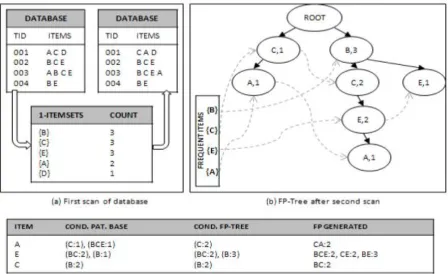
The FP-Growth method adopts a divide and conquers strategy as follows: compress the database representing frequent items into a frequent-pattern tree, but retain the item set association information, and then divide the compressed database into a set of condition databases, each associated with one frequent item, and mine each such databases.
Firstly, database is read and frequent items are found which are the items are occurring in transactions less than minimum support. Secondly database is read again to build FP-tree. After creating the root, every transaction is read in an ordered way and pattern of frequent items in the transaction is added to FP-tree and nodes are connected to frequent items list and each other. This interconnection makes frequent
pattern search faster avoiding the traversing of the entire tree. When considering the branch to be added for the transaction, the count of each and every node along the common prefix is incremented by 1. Nodes of same items are interconnected where most left one is connected to item in frequent items list. If the prefix of branch to be added does not exists then it is added as a new branch to root.
After constructing the tree mining proceeds as follows. Start from each frequent length 1 pattern, construct its conditional pattern base, then construct its conditional FP-tree and perform mining recursively on such tree. The support of a candidate (conditional) item set is counted traversing the tree thoroughly. The sum of count values at least frequent item‟s nodes i.e., base node gives the support value.
Figure 1.1 FP-Growth Example
III. LITERATUREREVIEW
In many existing algorithms that are often unclear and also inaccurate to find the high utility itemsets from long transaction itemsets. Fuzzy logic is supportive to real life datasets that deal with uncertainty as it gives a flexible method to form a high-level concept of given problem. Fuzzy logic and data mining together present a means for generating more conceptual utility mining at a higher level. Ferdinando et al.
presented a method for finding association rules from datasets based on fuzzy transforms technique. Apriori Gen algorithm [6] was used to extract fuzzy association rules represented in the form of linguistic terms. A pre-processing phase was used to determine the optimal fuzzy partitions of quantitative attribute domains.
Itemset Mining (HURI) is very useful in several real-life datasets. In Jyothi et al.presented a survey of different approaches and algorithms for mining the high-utility itemsets and rare itemset mining. Ashish et al [8] presented a fast and efficient fuzzy ARM algorithm on large datasets. The algorithm was 8 to 19 times faster than traditional fuzzy ARM on large standard datasets. In [2], unlike most two-phased ARM algorithms, the authors presented single itemset processing as opposite to concurrent itemset processing at each k no of level, recording some performance improvements.
In C. Saravanabhavan et al. proposed a tree based mining high utility itemsets. Firstly, the authors developed the utility frequent pattern tree structure to maintain the information of utility itemsets. Next the pattern growth methodology was used to mine the utility pattern sets entirely. Two algorithms, UP-Growth (Utility Pattern UP-Growth) and UP-Tree (Utility Pattern Tree) are proposed [14] for mining high utility itemsets. Also, a set of effective strategies are discussed by SadakMurali et al, proposed for precisely pruning candidate itemsets.
In Adinarayanareddy.B, was proposed a modified UP-Growth (IUPG) algorithm for high utility itemset mining. The authors conclude that IUPG algorithm performs better than UP-Growth algorithm for different threshold values and also IUPG algorithm is highly scalable. Ruchi Patel was proposed a parallel and distributed method for mining the high utility patterns from very large transaction databases. The method also prunes the low utility itemsets from transactions at the starting level by using downward closure property.
Koh et al was proposed a modified apriori inverse algorithm to generate rare itemsets of user interest. The high utility itemsets as a measure usefulness or profitability of an itemset [12].These authors paying attention on the measures used for mining the utility-based itemset. Utility utility-based measures uses the utilities of the patterns to reflect the user goals. The authors makes the official semantic meaning of utility measures and classify existing measures into one of the three categories: item level, transaction level and cell level. Existing system fused framework was proposed for incorporating utility based measures into the data mining process via a joined utility function.
One of the most needed areas of the application of fuzzy set theory is fuzzy rule-based systems [4]. These knowledge extraction tools discovers the essential associations contained in a database. Fuzzy techniques improves the understandability of buyer models. In Casillas et al presented a new approach for buyer behaviour modelling which is based on fuzzy association rules (FAS). A behavioural model was presented which cantered on consumer attitude towards shopping itemsets. The proposed algorithm efficiently finds the high utility itemsets and pruning
the lower utility itemset if used defined threshold value is low.paragraphs must be indented.
.
IV. TERMSANDDEFINITIONS
Let D = {T1, T2… Tn} be a transaction dataset which contains n transaction itemsets and m distinct items, i.e. I= {i1, i2… im}. Each transaction itemset is represented as {i1: p1, i2: p2… iv:pv}, where {i1, i2, …, iv} is a subset of I, and pu (1≤u≤v) is the existential probability of item iuin a transaction itemset. The size of dataset D is the number of transaction itemsets and is denoted as |D|. An itemset X = {i1, i2… ik}, which contains k dissimilar items, is called a k-itemset, and k is the length of the itemset X.
Definition 1: The support value (SV) of an itemset X in a transaction dataset is defined by number of transaction itemsets containing X in it.
Definition 2: The expected support value(expSV) of an itemset X in a transaction dataset is denoted as expSN(X) and is defined by
Definition 3: Given a dataset D, the minimum
expected support threshold is a predefined percentage of |D|; correspondingly, the minimum expected support value (minExpSV) is defined by
anitemset X is called a utility itemset if its expected support value is not less than the value minExpSV.
Definition 4: The minimum support threshold is a predefined percentage of |D|; correspondingly, the minimum support value (minSV) in a dataset D is defined by
Definition 5: The system mining high utility itemset and itemsets utility is equal to quantity value multiplied by profit. For example, item A occurs in different transaction T1 and T5. If the set of (A, T1) = {1/L, 0/M, 1/H} and (A, T5) = {0/L, 0/M, 1/H}. If their item utilities are obtaining by multiplying quantity with profit, item utilities of T1 and T5 will be same even though T5 defer a higher quantity value. The utility is defined as,
Where fq (ip,Tq, j ) is the value of region j and weight (j) is a variable parameter defined by the region. If a region is low, then the weight should be low when compared to the region middle and high. Particular weights are assigned for area low, medium and high.
Definition 7:The transaction utility can be defined as the sum of the utilities of item occurring in the transaction. The equation denoting transaction utility is
Definition 8: The transaction weighted utilityit is the sum of transaction utilities of item occurring in the particular transaction for an item. The equation denoting transaction weighted utility can be defined as,
V. PROPOSEDSYSTEM
To improve the mining performance and to avoid scanning original database repeatedly, we use a compact tree structure, named UP-Tree, and to maintain the information of transactions and high utility itemsets. Two strategies are used to minimize the overestimated utilities stored in the nodes of global Tree. In following sections, the elements of UP-Tree are first defined. Next, the two strategies are introduced.
A. The Elements in UP-Tree
Each node D consists of D.name, D.count, D.nu, D.parent, D.hlink and a set of child nodes. D.name is the item name of the node. D.count is the support count of that particular node. D.nu is the node utility, i.e., overestimated utility of the node. D.parent maintains the parent node of D. D.hlink is a node link which points to a node whose item name is the same as D.name. A table named header table is used to facilitate the traversal of UP-Tree. In header table, each entry stores an item name, an overestimated utility, and a link. The link points to the last occurrence of the node which has the same item as the entry. By following the links in header table and the nodes in UP-Tree, the nodes having the same name can be traversed in a better way.
B. Discarding Global Unpromising Items during Constructing a Global UP-Tree
The construction of a global UP-Tree can be done with two scans of the original database. In the first scan, TU of each transaction is calculated.
accumulated. By TWDC property, an item and its supersets are unpromising itemsets if its TWU is less than the minimum utility threshold. Such an item is called an unpromising item.
C. Discarding Global Unpromising Items during Constructing a Global UP-Tree
The construction of a global UP-Tree can be done with two scans of the original database. In the first scan, TU of each transaction is calculated. simultaneously, TWU of each single item is also accumulated. By TWDC property, an item and its supersets are unpromising itemsets if its TWU is less than the minimum utility threshold. Such an item is called an unpromising item.The tree-based framework for high utility itemset mining applies the divide-and-conquer technique in mining processes. Thus, the search space can be divided into smaller subspaces. By using strategy DGN, the utilities of the nodes that are closer to the root of a global UP-Tree are further decreased. DGN is suitable for the databases containing more number of long transactions. In other words, the more items a transaction has, the more utilities can be removed by DGN. On the other hand, traditional TWU mining strategy is not suitable for such databases since the more items a transaction contains, the higher TWU is.
D. Up Growth Plus Algorithm
UP-Growth is efficient than FP-Growth by using DLU and DLN to reduce overestimated utilities of itemsets. However, the overestimated utilities can be nearer to their actual utilities by eliminating the calculated utilities that are closer to the actual utilities of unpromising items. An improved method, named UP-Growth+, for reducing over estimated utilities more effectively is introduced. In UP-Growth, minimum item utility table is used to decrease the overestimated utilities. In UP-Growth+, minimal node utilities in each path are used to make estimated pruning values closer to real utility values of the pruned items.
After introducing the modification of global UP-Tree, the processes and two improved strategies of UP-Growth+, named DNU and DNN are performed. When a local UPTree is being constructed, minimal node utilities can also be mined by the same steps of global UP-Tree. In the mining process, when a path is retrieved, simultaneously minimal node utility of each node in the path is also retrieved.
Create Tree (D, )
INPUT: An uncertain dataset D consisting of n
transaction itemsets and a predefined user minimum expected support threshold .
Step 1: Calculate the minimum expected support value minExpSV, i.e. minExpSV=| D|× ; count the expected support value and support value of each transaction item by one scan of dataset.
Transaction utility can be defined as the sum of the utilities of item occurring in the transaction.
Transaction weighted utility it is the sum of transaction utilities of item occurring in the particular transaction for an item.
Step 2: place those items whose expected support
value are not less than minExpSVto a global header table, and sort the items in the header table according to the descending order of their support value.
Step 3: Initially set the root node of the Tree T as null.
Step 4: Remove the items that are not in the header
table from each transaction itemset, and sort the remaining items of each transaction itemset according to the order of the global header table, and get a sorted itemsetA.
Step 5: If the length of itemsetA is 0, process the next
transaction itemset; otherwise insert the itemsetA into the tail node tree T by the following steps:
a)Store the weight probability value of each item in itemsetA sequentially to a list; save the list to an array (which is denoted as ProArr); the equivalent series number of the list in the array is denoted as ID. b) If there has not been a tail node for the itemsetX, create a tail node N for this itemset, where
N.Tail_info.lenis the length of itemsetA, and
N.Tail_info.Arr_ind= (ID); otherwise, append the sequence number ID to N.Tail_info.Arr_ind.
Step 6: Process the next transaction itemset based on
above steps until meet all the transaction from transaction weight dataset.
E. Mining high utility itemsets from a global tail node tree
After a tail node tree is constructed, the algorithm tail node tree can directly mine high utility itemsets from the tree without additional scan of dataset. The details of the mining techniques are described below. The algorithm TN-Mine is similar to the algorithm UP growth: it creates and processes sub trees recursively.
Mining high utility (T, GH, minExpSV)
INPUT: An FTNT-Tree T, a global header table H,
and a Minimum expected support value minExpSV.
OUTPUT: The high utility itemsets (HUIs).
Step 1: find the high utility items from header table
one by one from the last item by the following steps.
Step 2: choose the current base-itemset(which is
initialized as null); each new base-itemsetis a high utility itemset.
Step 3: Example consider base item is “Z”LetZ.linksin
the header table H contain k nodes whose item name is
Z; we denote these k nodes as N1, N2, …, Nk; because
item Z is the last one in the header table, all these k
nodes are tail nodes, i.e., each of these nodes contains a Tail_info.The following sub steps.
a) Create a sub header table subHby scanning the k base item branches from these k nodes to the root. b) Suppose the sub header table is zero, go to Step 4.
c): Create sub Tree each and every base item subTree=
CreateSubTree (Z.link, subH).
Mining (subTree, subH, minExpSV).
Step 4: After find the high utility of that base item Z
and remove that item from header table.
Step 5: For each of these k nodes denote as ni≤N≤k),
modify itsTail_infoby the following sub steps:
a) Alter Ni.Tail_info.lenvalues: Ni.Tail_info.len=
Ni.Tail_info.len-1.
b) Move Ni.Tail_infoto the parent of node Ni.
Step 6: Process the next item of the header table H.
Subprograms:CreateSubTree(all_baseitem_link,
subH)
INPUT: A list link which records tree nodes with the
same item name, and a header table subH.
OUTPUT: A high utility itemsets from subT.
Step 1: Initially set the root node of the tree subTas
zero.
Step 2: Process each node Ni in the list link by the
following steps.
Step 3: Get the tail-node-itemsetof node Nifrom X item
sets.
Step 4: Remove those items that are not in the header
table subHfrom itemsetX, and sort the remaining items in itemsetX according to the order of the header table
subH.
Step 5: If the length of the sorted itemsetki is 0, process
the next node of the list link; otherwise insert the sorted itemsetX into the FT-Tree subTby the following sub steps:
a) Get the original sequential ID of each
item of the itemsetX in the corresponding list ofProArr: item_ind= {d1, d2, dk} where k is the length of itemsetX
b) Make a copy of N.Tail_info; denote the
copy as nTail_info.
b): Alter nTail_infoas the following:
(1) nTail_info.len= k.
(2) nTail_info. Item_ind= item_ind.
(3) if nTail_info.bpis null, set nTail_info.bp[j] to be the probability of item Z, i.e.
ProArr[nTail_info.Arr_ind[j]]; otherwise, set
nTail_info.bp[j] to be the product of nTail_info.bp[j] and the probability of item Z (1 ≤ j ≤ fuzzy_bp.size; the array ProArris created when the global tree is created.
VI.RESULT
FTNT is a new proposed algorithm. So compare UP growth plus-Mine with the algorithms FUF-Growth, UP-Mine and Fuzzy based UP growth plus on both types of datasets: Sparse transaction datasets and dense transaction datasets. All algorithms were written in java programming language. The configuration of the testing platform is as follows: Windows 7 32bit operating system, 4G Memory, Intel(R) Dual-Core CPU @ 2.60 GHz.
Table-1 Dataset Characteristics
Table 1 shows the characteristics of 4 datasets used in our experiments. „|D|‟ represents the total number of transactions; „|I|‟ represents the total number of distinct items; „I‟ represents the mean length of all transaction itemsets; „SD‟ represents the degree of sparsely or density. The synthetic dataset
T10I4d100kscame from the IBM Data Generator and
the datasets and mushroom were obtained from FIMI Repository. These four datasets originally do not provide probability values for each item of each.
Table 2. Comparison algorithm of usingT10I4d100k
Vs No tree created.
Algorithms No of Tree
0.04 0.05 0.06 0.07 0.08 0.09
UF-Growth +
369 115 39 17 8 4
UP Growth
410 232 101 52 43 21
FIG.1. COMPARISON OF DIFFERENT THRESHOLD VALUE WITH TREE
CREATION
Fig 1 and Table 1 Show the total number of tree nodes generated by UF-Growth and UP,
respectively, on the synthetic datasets.
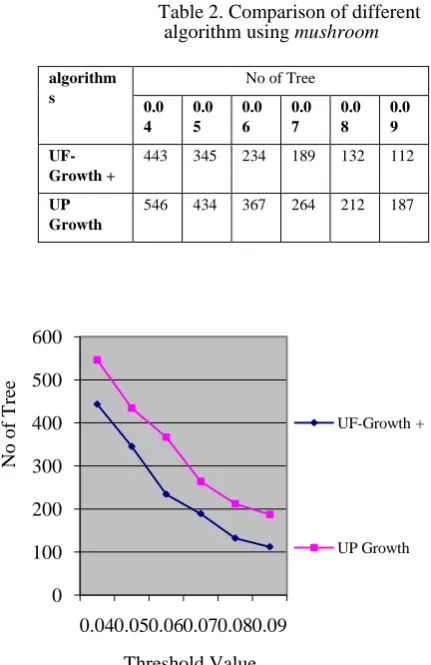
Table 2. Comparison of different algorithm using mushroom
algorithm s
No of Tree
0.0 4
0.0 5
0.0 6
0.0 7
0.0 8
0.0 9
UF-Growth +
443 345 234 189 132 112
UP Growth
546 434 367 264 212 187
Fig. 2. Comparison of different threshold value with tree creation
Fig 2 and Table 2 Show the total number of tree nodes generated by UF-Growth and UP, respectively, on the
synthetic datasets.
VII.CONCLUSION
The proposed two efficient algorithms named UP-Growth and UP-UP-Growth+ for mining high utility itemsets from transaction databases. A data structure named UP-Tree was used for maintaining the information of high utility itemsets. PHUIs can be efficiently constructed from UP-Tree with only two original database scans. Moreover, we developed several strategies to reduce the overestimated utility and improve the performance of utility mining. In the experiment, both real and synthetic data sets were used for performance evaluation. Results show that the strategies efficiently improved performance by reducing both the search space and the no of candidates. Moreover, the proposed algorithms, UP-Growth+, outperform the state-of-the-art algorithms substantially when databases contain lots of long transactions or a low minimum utility threshold is used.
0 50 100 150 200 250
0
.0
5
0
.0
6
0
.0
7
0
.0
8
0
.0
9
No
o
f
T
ree
Thrreshold
UF-Growth +
UP Growth
0 100 200 300 400 500 600
0.040.050.060.070.080.09
No
o
f
T
ree
Threshold Value
UF-Growth +
UP Growth
Dataset |D| T |I| Type
REFERENCES
[1] R.Agrawal, T. Imielinski, and A. Swami, “Mining association rules between sets of items in large databases,”
in Proc. ACM SIGMOD Int. Conf. Manage. Data, 1993, pp. 207– 216.
[2] C. F. Ahmed, S. K. Tanbeer, B.-S. Jeong, and Y.-K. Lee, “Efficient tree structures for high utility pattern mining in incremental databases,” IEEE Trans. Knowl. Data Eng., vol. 21, no. 12, pp. 1708– 1721, Dec. 2009.
[3] F. Bonchi, F. Giannotti, A. Mazzanti, and D. Pedreschi, “ExAnte: A preprocessing method for frequent-pattern mining,” IEEE Intell. Syst., vol. 20, no. 3, pp. 25–31, May/Jun. 2005.
[4] C. Bucila, J. Gehrke, D. Kifer, and W. M. White, “Dualminer: A dual-pruning algorithm for itemsetswith constraints,” DataMining Knowl. Discovery, vol. 7, no. 3, pp. 241–272, 2003.
[5] R. Chan, Q. Yang, and Y. Shen, “Mining high utility itemsets,” in Proc. Int. Conf. Data Mining, 2003, pp. 19–26.
[6] S. Dawar and V. Goyal, “UP-Hist tree: An efficient data structure for mining high utility patterns from transaction databases,” in Proc. 19th Int. Database Eng. Appl. Symp., 2015, pp. 56–61.
[7] P. Fournier-Viger, C.-W. Wu, S. Zida, and V. S. Tseng, “FHM: Faster high-utility itemset mining using estimated utility cooccurrence pruning,” in Proc. 21st Int. Symp. Found. Intell. Syst., 2014, pp. 83–92.
[8] S. Krishnamoorthy, “Pruning strategies for mining high utility itemsets,” Expert Syst. Appl., vol. 42, no. 5, pp. 2371–2381, 2015.
[9] Y.-C. Li, J.-S.Yeh, and C.-C. Chang, “Isolated items discarding strategy for discovering high utility itemsets,” Data Knowl.Eng., vol. 64, no. 1, pp. 198–217, 2008.
[10] M. Liu and J. Qu, “Mining high utility itemsets without candidate generation,” in Proc. ACMConf. Inf. Knowl.Manage., 2012, pp. 55–64.
[11] Y. Shen, Q. Yang, and Z. Zhang, “Objective-oriented utility-based association mining,” in Proc. IEEE Int. Conf. Data Mining, 2002, pp. 426–433.