114 | P a g e
SOIL QUALITY MEASUREMENT USING
WIRELESS COMMUNICATION
Tejal Barhate
1, Sakshi Chavanke
2, Aishwarya Korde
3, Harshala Badgujar
4Third Year Electrical Students and 4
thGuide
Department of Electrical Engineering, Guru Gobind Singh Polytechnic Nashik, Maharashtra (India)
ABSTRACT
The main objective of the present paper is to develop a smart wireless sensor network (WSN) for anagricultural
environment. Monitoring agricultural environment for various factors such as soil moisture,temperature and
humidity along with other factors can be of significance. A traditional approach to measurethese factors in an
agricultural environment meant individuals manually taking measurements andchecking them at various times. This
paper investigates a remote monitoring system using Zigbee. These nodessend data wirelessly to a central server,
which collects the data, stores it and will allow it to be analyzed thendisplayed as needed and can also be sent to the
client mobile.
Keywords
: Wireless Sensor Network , Zigbee, Avr, Soil Quality,
I INTRODUCTION
Agriculture is the foundation of Indian economy. Due to the expanding population growth, land deterioration and
raising demand for food, a viable and sustainable agricultural system has become a critical issue to achieve. So, in
order to overcome this critical problem, the Nations crop production must be increased effectively and efficiently.
Soil quality plays a major role in increasing the crop production. Plants obtain support for their growth from the soil,
which manages functions of portioning water and solute flow, maintaining biodiversity and productivity, buffering
and purifying and nutrient cycling which reflects the soil nature. Large impact on soil nature is maintenance of soil.
Three essential factors that plants require for their growth and reproduction are light, water and nutrients. However,
plants make use of sunlight which is naturally available for their growth and reproduction functions. But the major
focus is on water and nutrients which are available by soil to the plants. Sometimes nutrients loss occurs by the soil
due to runoff water, erosion and leaching, gaseous losses to the atmosphere and becomes unavailable for plant
uptake. The water and nutrients level vary depending upon the type of soil and plants. So, an efficient soil quality
115 | P a g e
Wireless technology using various sensors for precision agriculture has become a popular research with thegreenhouse effect. People are utilizing the merits of embedded system into monitoring and control system for
agriculture parameter. Monitoring parameters of temperature and humidity is an important means for obtaining
high-quality environment. Remote monitoring is an effective method in order to avoid interference environment and
improve efficiency. Today, Ethernet network, RF module and ZigBee wireless network are used to transmit data in
remote Monitoring System.
Why Do We Monitor Soils?
Regional Councils are charged with the responsibility for promoting the management of the natural and physical
resource of their region. Monitoring of these resources establishes the state of the environment and whether the
communities’ expectations are being met. The results of the monitoring provide information that can be used to
change or prioritise, the manner in which we manage the environment. The trends determined by the monitoring of
soils can be used to develop policies and rules that will protect the sustainability of our soils resources.
Analysis of soil quality
The soil quality monitoring programme undertaken since 1999 has involved the following:
1. Location of the high quality soils in the region;
2. identification of sites covering a range of landuses for each of the soiltypes;
3. undertaking site investigations to confirm the soil type; and
4. sampling of the identified sites.
II BLOCK DIAGRAM
116 | P a g e
III DESCRIPTION OF BLOCK DIAGRAM
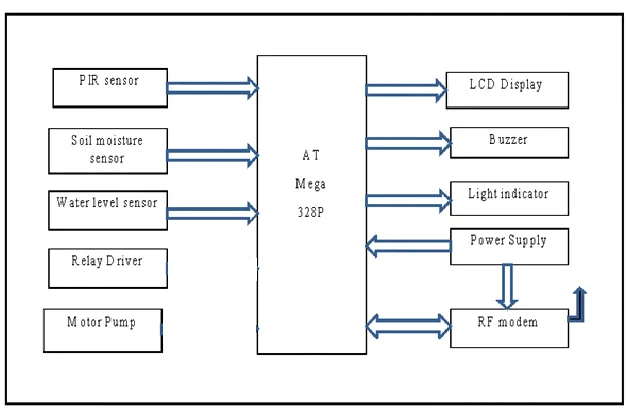
The proposed hardware of this system includes 8 bit AVR, PIR sensor, water level sensor, relay driver, motor pump,
soil moisture sensors, LCD and buzzer. The system is low cost & low power consuming so that anybody can afford
it. The data monitored is collected at the server. It can be used in precision farming. The system should be designed
in such a way that even illiterate villagers can operate it. They themselves can check different parameters of the soil
like salinity, acidity, moisture etc. from time to time. During irrigation period they have to monitor their distant
pump house throughout the night as the electricity supply is not consistent. The system can be installed at the pump
house located remotely from the village, it is interfaced with the pump starter & sensors are plugged at different
location in the field for data acquisition. Using this system they can switch on their pump from their home whenever
they want. In this fig all sensors are connected to AT mega 328P. RF modem is used for wireless communication.
All parameters value will be display on 16*2 LCD. When motion will detect the buzzer will be on as per program.
When water level goes below the limit motor will be on by relay driver circuit and when water level goes at low
level motor will be off.
IV SYSTEM DEVELOPEMENT
The proposed hardware of this system includes 8 bit AVR, Blue tooth module, Temperature, humidity and soil
moisture sensors, LCD. The system is low cost & low power consuming so that anybody can afford it. The data
monitored is collected at the server. It can be used in precision farming. The system should bedesigned in such a
way that even illiterate villagers can operate it. They themselves can check different parameters of the soil like
salinity, acidity, moisture etc. from time to time. During irrigation period they have to monitor their distant pump
house throughout the night as the electricity supply is not consistent. The system can be installed at the pump house
located remotely from the village, it is interfaced with acquisition. Using this system they can switch on their pump
from their home whenever they want.
A. Temperature Sensor
The LM35 series are precision integrated-circuittemperature sensors, whose output voltage is linearlyproportional to
the Celsius (Centigrade) temperature.
B. Humidity sensor
Humidity measurement instruments usually rely on measurements of some other quantity such as temperature ,
pressure, mass or a mechanical or electrical change in a substance as moisture is absorbed. By calibration and
calculation, the semeasured quantities can lead to a Measurement of humidity.
C.
Soil moisture sensor
The soil moisture sensor used is capacitive type. Thesensor gives analog output of zero volt when there is100%
117 | P a g e
Figure.2 Temperature Sensor Figure.3 Soil Moisture Sensor
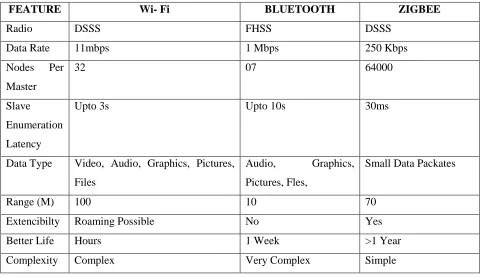
Table I: Comparison between Wi -Fi, Bluetooth and ZigBee
FEATURE
Wi- Fi
BLUETOOTH
ZIGBEE
Radio
DSSS
FHSS
DSSS
Data Rate
11mbps
1 Mbps
250 Kbps
Nodes
Per
Master
32
07
64000
Slave
Enumeration
Latency
Upto 3s
Upto 10s
30ms
Data Type
Video, Audio, Graphics, Pictures,
Files
Audio,
Graphics,
Pictures, Fles,
Small Data Packates
Range (M)
100
10
70
Extencibilty
Roaming Possible
No
Yes
Better Life
Hours
1 Week
>1 Year
Complexity
Complex
Very Complex
Simple
V FUTURE SCOPE
To minimize the efforts of Farmers, and to do effective croping by using different types of sensors which detect
118 | P a g e
V CONCLUSION
RF modem based agriculture monitoring system serves as a reliable and efficient system for monitoring agricultural
parameters. The corrective action can be taken. Wireless monitoring of field not only allows user to reduce the
human power, but it also allows user to see accurate changes in it. It is cheaper in cost and consumes less power.
Wireless monitoring of field not only allows user to reduce the human power, but it also allowsuser to see accurate
changes in it. It is cheaper in costand consumes less power.
REFERENCE
[1]Na Pang “Zigbee Mesh Network for Greenhouse Monitoring”; Proceedings of IEEE International Conference on
Mechatronic Science, Electric Engineering and Computer PP266-269 Aug 2011.
[2]R. Olawoyin, S. A. Oyewole, R. L. Grayson, (2012). Potential risk effect from elevated levels of soil heavy
metals on human health in the Niger delta, Ecotoxicol. Environ. Saf., Volume 85,
[3] “Web Based Water Quality Monitoring with Sensor Network: Employing ZigBee and WiMax Technologies” by
Steven Silva, Hoang N ghiaNguyen ,ValentinaTiporlini and Kamal Alameh, 978-1-4577-1169-5/11/$26.00 ©2011
IEEE