168 |
P a g e
DATA HIDING USING RC4 ALGORITHM IN IMAGE
FORM
Geetanjali N. Narhare
1, Savita R. Bhosale
21
PG Scholar, Computer Engineering, MGMCET Kamothe, Navi Mumbai (India)
2
AssistantProfessor, Electronics and Telecommunication, MGMCET Kamothe,
Navi Mumbai (India)
ABSTRACT
As we know that the improved technologies in communication, Security is very important in several fields. So we
should make an arrangement of security of our valuable data. Data contain different types of data that include
text, audio, video, graphics images. This paper enlighten the problem of transmitting redundant data over an
insecure, bandwidth-constrained communications channel. In this proposed system, secret messages are
encrypted before embedding it into the cover image which gets high security to secret data RC4 algorithm is
used to encrypt secret messages and Least Significant Bits (LSB) based data embedding technique is used to
high encrypted messages. To hide encrypted messages into BMP image file, pseudorandom sequences are used.
A content owner encrypts the original uncompressed image using an encryption key. After that, a data-hider
may compress the least significant bits (LSB) of the encrypted image using a data-hiding key to create a sparse
space to accommodate some additional data. If the receiver has both the data-hiding key and the encryption key,
the receiver can extract the additional data and the original image without any loss.
Keywords: Digital Image Processing, Image encryption, Image Recovery, RC4, Reversible Data
Hiding, Security
I. INTRODUCTION
It is important that the dada transmitting in high security which was not affected by visible loss of data. To hide
secret data in such manner that data can be reversed, Reversible Data Hiding (RDH) technique is used. Data can
be restored to its original manner without any loss and also without using any other information. This can be
termed as safe embedding. At the end of the receiver, hidden data is extracted and image is also restored in its
original form. This technique is more useful in applications in which original image should remain intact even
after data embedded is retrieved [1, 2]. Reversible data embedding can be viewed as an information carrier. It is
impossible for human eyes to distinguish between embedded image and original image. Because of this,
reversible data embedding can be thought as secret communication model. As an effective and standard means
for privacy protection, encryption converts the ordinary signal into unintelligible data, so that the traditional
signal processing usually takes place before encryption or after decryption [3, 4]. The traditional way of
transmitting redundant data is to first compress the data to reduce the redundancy, and then to encrypt the
compressed data to mask its meaning. The sender should encrypt the original data and the network provider tend
169 |
P a g e
side of receiver, a decoder integrating decompression and decryption functions for reconstructing the original
data [5,6].
II. PROCEDURE OF ENCRYPTION AND DECRYPTION WITH FLOW DIAGRAM
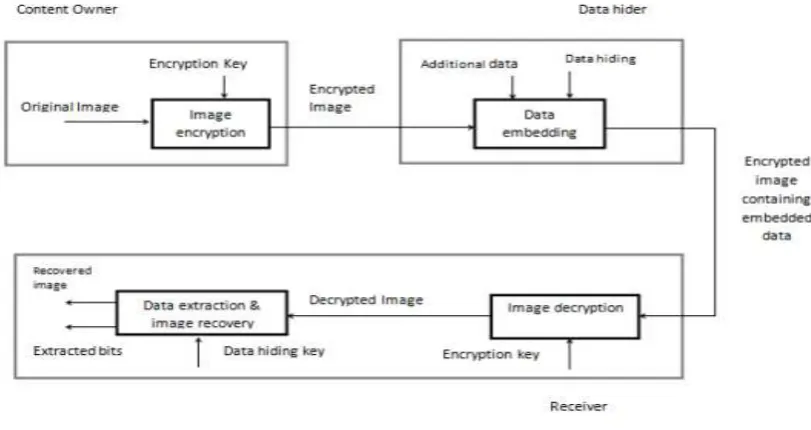
Fig. 1: Procedure of Encryption And Decryption
Normally cryptography starts with taking an image as an input after that applying the required algorithm
encrypting the image that is called encrypted image. But for selected image encryption first of all we have to
specify the regions we are going to encrypt. Then the encryption algorithm works. By using algorithm the
selected parts of the image is being encrypted and the other parts remains as it is. We got the encrypted image
after the end of this step. With the help of same algorithm we can decrypt the selected regions. We again got the
original image back, after the end of this process. The overall procedure is shown in Figure 1.
III. PROPOSED SYSTEM DESIGN
170 |
P a g e
A owner of content encrypts the original image using an encryption key, then a data-hider can embed additional
data into the encrypted image with the help of a data-hiding key though the receiver does not know the original
data. With an encrypted image containing additional data, a receiver may first decrypt it according to the
encryption key, and then recover the original image and extract the embedded data according to the data-hiding
key.
3.1 Image Encryption Types
Image encryption involves two types, generation of encryption key and generation of pseudo-random sequence.
3.1.1 Generation of Encryption Key
Encryption key is 128 bit value. By using the random function, encryption key generated randomly. The random
function generates the random key in an uniformly distributed function.
3.1.2 Generation of Pseudo-Random Sequence
It consists of random bits generated using the encryption key. In this paper, RC-4 algorithm is used to create the
pseudo-random sequence using the 128-bit encryption key. It is represented as sequence of bytes or an array of
bytes. The number of bytes generated should be equal to the number of pixels in the input image provided the
pixels are represented as 8-bit values. If the pixels are represented as 16-bit values then the number bytes in
pseudo-random sequence should be double the number of pixels.
IV. DATA EMBEDDING
In embedding, encrypted pixels are formed with the use of some parameters and LSB’s of other encrypted pixels
are compressed to create more space so that more data can be added. Data hider pseudo-randomly chooses Np
encrypted pixels that will be used to carry the parameters for data hiding according to a data-hiding key,. Here,
Np is a positive integer, for example, Np=20.The other (N-Np) encrypted pixels are pseudo-randomly permuted
and divided into a small number of groups. Each group contain L pixels. The permutation way is also
determined by the data-hiding key. For each pixel-group, collect the M least significant bits (LSB) of the L
pixels, and indicate them as B(k,1),B(k,2)…B(k, M. L)where k is a group index within[1,(N-Np)/L] and M is a
positive integer less than 5. The data-hider also produces a matrix G sized (M.L-S) × M.L, which is composed
of two parts.
G= [ IM.L-S Q] (1)
Data hiding key is used to derive pseudo binary matrix i.e. Q sized (M.L-S) × S which is right part, and left part
is (M.L-S) × (M.L-S) identity matrix. Where S is small positive integer. Then next procedure is embed all the
values of parameters M, L and S into LSB of NP. So, the rate is:
R = ((N-NP). (S/L) – NP) / N = S / L (2)
where, R is encrypted data embedded rate, N is Number of pixels present in the encrypted image, NP is Number
of pixels which carries the parameters, S is Small positive integer and L is Number of pixels in each pixels
group.
V. DATA
-EXTRACTION AND IMAGE-RECOVERY
Our proposed scheme contains image encryption, data embedding and data extraction phase. At encryption side,
171 |
P a g e
using a data-hiding key to create a sparse space to accommodate the additional data. At the second side,
embedded data can be easily retrieved from the encrypted image containing additional data according by using
data-hiding key. It affects only LSB, a decryption with the encryption key, the result is similar to the original
image. By using both encryption algorithms and data hiding keys we can effectively extract original image by
using spatial correlation in natural image. Fig. 3 shows the three cases at the receiver side.
Fig.3. Three Cases At Receiver Side of The Proposed Separable
In this phase, there are three cases that, in first case a receiver has only the data-hiding key, in second case only
the encryption key, and in third case both the data-hiding and encryption keys, respectively. If the receiver has
only the data-hiding key by using an encrypted image containing embedded data, , he may first acquire the
values of the parameters M, L and S from the LSB of the Np particular encrypted pixels. And then, the receiver
permutes and divides the other. (N-NP) pixels into (N-NP)/L groups and extracts the S embedded bits from the
M LSB-planes of each group. When consuming the total (N-NP).S/L extracted bits, then receiver can divide into
NP new LSB of certain encrypted pixels and (N-NP).S/L-NP additional bits.
Important thing is that because of selection and permutation of the pseudo-random pixel, any attacker without
helping the data-hiding key cannot obtain the parameter values and the pixel-groups, therefore the embedded
data cannot extract. Moreover, the receiver can successfully extract the embedded data by using data-hiding key.
Representing the bits of pixels in the encrypted image containing embedded data, the receiver can decrypt the
received data from the encrypted data in the M LSB-planes. Assuming that the original distribution of the data
in the M LSB planes is uniform, the alteration energy per each decrypted pixel is because the probability of this
case.
De = (3)
Here, the alteration in the NP selected pixels is also ignored since their number is significantly less than the
image size N. So, the value of PSNR in the directly decrypted image
PSNR = 10. log 10 ( AE ) (4)
Where AE is Average Energy. If the receiver has both the data-hiding and the encryption keys, receiver may
goal to the embedded data extract and original image recovery. According to the data-hiding key, the values of
M, L and S are the original LSB of the NP selected encrypted pixels, and the (N-NP).S/L-NP are additional bits
172 |
P a g e
locations, the encrypted data of the NP selected pixels are recovered, and their original gray values can be
properly decrypted using the encryption keys.
VI. RIVEST CIPHER 4 (RC4) ALGORITHM
This algorithm is developed by Ronald Rivest and thus, the name of the algorithm was put after Ronald’s Rivest
name. RC1, RC2, RC3, RC4, RC5 and RC6 is the series of RC algorithm.RC4 is symmetric key algorithm. It is
one of the algorithm which is used for both encryption and decryption as the data stream is simply XORed with
the generated key sequence. The key stream is completely independent of the plaintext used. It uses a flexible
length key from 1 to 256 bit to modify a 256-bit state table. The state table is used for consequent generation of
pseudo-random bits after that to generate a XORed pseudo-random stream with the plaintext to give the cipher
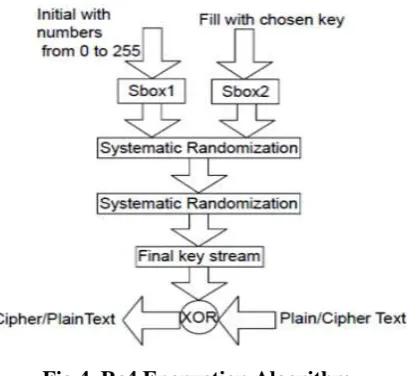
text. The algorithm can be divided into two stages: First stage is initialization, and other operation. In the first
stage the 256-bit state table, S is populated, using the key, K as a seed. Once the state table is setup, it continues
to be modified in a regular pattern as data is encrypted. The initialization process can be summarized by the
pseudo-code.
Fig 4. Rc4 Encryption Algorithm
This algorithm generates a pseudo-random stream values. XORed is the input value with these values, bit by bit.
The process of encryption and decryption is the same as the data stream is just XORed with the generated key
sequence. If it is fed in an encrypted message, it will produce the output of decrypted message, and if it is fed in
plain text message, the encrypted version will produce. The RC4encryption algorithm is shown in Fig.4.
VII. RESULTS AND DISCUSSIONS
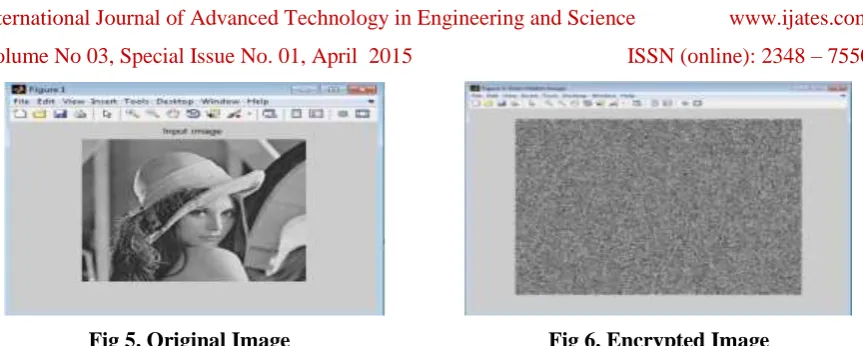
The test image Lena sized 512 ×512 is used as the original image in the experiment. After image encryption, the
173 |
P a g e
Fig 5. Original Image Fig 6. Encrypted Image
Let M=2, L=76 and S=1 to additional bits into the encrypted image. The encrypted image containing the
embedded data embedding rate R is 0.013158 bit per pixel (bpp). With an encrypted image containing
embedded data, we could extract the additional data using the data-hiding key. Then, embed the values of the
parameters M, L and S into the LSB of NP selected encrypted pixels.
Np = 20, N = 262144, M = 2, L = 76 and S = 1
Enter a maximum of 214 characters: Geetanjali
Data Embedded Rate = 0.013158 bpp
Fig.7. Data Hiding Image
Fig 8. Decrypted Image
When putting the value Np, N, M, L and S with the maximum characteristics value the correspond encrypted
image, data hiding image and decrypted images fallen one by one. If we directly decrypted the encrypted image
containing embedded data using the encryption key, the value of PSNR in the decrypted image was 40.0 dB,
which verifies the theoretical value 40.0 dB is calculated. PSNR of the decrypted image = 40.930937 dB
The recovered image and directly decrypted image are shown in Fig.9 and Fig.10 respectively. The image
recovered using RC4 algorithm is same as the original image.
174 |
P a g e
VIII. CONCLUSION
With the encryption key Pseudo random structure consists of random bits generated. In this paper to create
sequence of pseudo-random in the 128-bit encryption key by using RC-4 algorithm. With the parameters we can
additional data inserted in to an encrypted image. Additional data which is encrypted in image. With an
encrypted image containing additional data, with data-hiding key receiver can extract the additional data, or
using only the encryption key can obtain an image similar to the original one. When using both of the
encryption and data-hiding keys, the embedded additional data can be successfully extracted and the original
image can be perfectly recovered by exploiting the spatial correlation in natural image. Compared with the other
algorithms, the proposed system demonstrated successful accuracy in recovering the original images. In the
future, a comprehensive combination of image encryption and data hiding compatible with lossy compression
deserves further investigation.
IX. ACKNOWLEDGEMENT
I am Geetanjali Narhare, would like to thank Prof. S.R.Bhosale of Electronics and Telecommunication
Department, MGMCET Kamothe, Navi Mumbai, India, for her contribution to this work.
REFERENCES
[1]. X. Zhang, “Lossy compression and iterative reconstruction for encrypted image,” IEEE Trans. Inform.
Forensics Security, vol. 6, no. 1, pp. 53–58, Feb. 2011.
[2]. W. Liu, W. Zeng, L. Dong, and Q. Yao, “Efficient compression of encrypted grayscale images,” IEEE
Trans. Image Process., vol. 19, no. 4, pp. 1097–1102, Apr. 2010.
[3]. T. Bianchi, A. Piva, and M. Barni, “Composite signal representation for fast and storage-efficient
processing of encrypted signals,” IEEE Trans. Inform. Forensics Security, vol. 5, no. 1, pp. 180–
187,Feb.2010.
[4]. S. Lian, Z. Liu, Z. Ren, and H. Wang, “Commutative encryption and watermarking in video compression,”
IEEE Trans. Circuits Syst. VideoTechnol., vol. 17, no. 6, pp. 774–778, Jun. 2007.
[5]. Z. Ni, Y.-Q. Shi, N. Ansari, and W. Su, “Reversible data hiding,” IEEE Trans. Circuits Syst. Video
Technol., vol. 16, no. 3, pp. 354– 362, Mar.2006.
[6]. M. Johnson, P. Ishwar, V. M. Prabhakaran, D. Schonberg, and K. Ramchandran, “On compressing
encrypted data,” IEEE Trans. Signal Process., vol. 52, no. 10, pp. 2992–3006, Oct. 2004.
[7]. Glover, P. and M. Grant, Digital Communications, 2nd edition, Person Education, 2004.
[8]. M Joset Pieprzyk, et. al., Fundamentals of Computer Security, Springer, 2003.
[9]. M. Cancellaro, F. Battisti, M. Carli, G. Boato, F. G. B. Natale, and A Neri, “A commutative digital image
watermarking and encryption method in the tree structured Haar transform domain,” Signal Processing: