THE DEVELOPMENT AND VALIDATION OF A M A N UA L OF CHILD PSYCHOANALYSIS
JILL MARIE MILLER
Thesis submitted for degree o f Doctor o f Psychology University o f London
ProQuest Number: 10106856
All rights reserved
INFORMATION TO ALL USERS
The quality of this reproduction is dependent upon the quality of the copy submitted.
In the unlikely event that the author did not send a complete manuscript and there are missing pages, these will be noted. Also, if material had to be removed,
a note will indicate the deletion.
uest.
ProQuest 10106856
Published by ProQuest LLC(2016). Copyright of the Dissertation is held by the Author.
All rights reserved.
This work is protected against unauthorized copying under Title 17, United States Code. Microform Edition © ProQuest LLC.
ProQuest LLC
789 East Eisenhower Parkway P.O. Box 1346
TABLE OF CONTENTS
LIST OF FIGURES AND T A B L E S...4
A B ST R A C T ... 17
ACKNOW LEDGM ENTS...18
PART L THE THEORY AND TECHNIQUE OF CHILD PSYCHOANALYSIS Chapter 1. The historical roots o f child psychoanalysis... 19
Chapter 2. Anna Freud... 23
Chapter 3. Melanie Klein and Kleinian child psychoanalysis...52
Chapter 4 . Other contributions: 1 9 3 0 -1 9 9 0 ... 69
PART II. THEORY, PRACTICE A N D RESEARCH Chapter 5. The relationship between theory and practice...109
Chapter 6. M anualisation...121
PART III. EMPIRICAL INVESTIGATIONS Chapter 7 . A preliminary attempt at manualisation: Manual I ... 138
Chapter 8. Validation o f Manual I: Study 1 ...152
Chapter 9 . Classification o f child psychoanalytic material: Study 2 ...175
Chapter 10. A second attempt at manualisation: Manual II... 226
Chapter 11. Validation of Manual II: Study 3 ... 235
Chapter 12. Defining analytic concepts and techniques: Study 4 R esults... 300
12.1 Defence and resistance... 310
12.2 C onflict... 332
12.3 A ffe c ts ... 348
12.4 Transference...374
12.5 Object relations in the clinical co n text... 401
12.6 Interpretation... 425
TABLE OF CONTENTS continued
Chapter 13. Defining analytic concepts and techniques: Study 4
A proposed model... 472
PART IV. CONCLUSIONS Chapter 14. Final discussion and future directions... 518
REFERENCES... 525
APPENDICES 1. Manual 1 ... 542
2. Study 1: Instructions to judges, classifications and rating scales...622
3. Study 2 Results: Classification o f child psychoanalytic material... 637
4. Study 2 Results: Classification of child psychoanalytic material Activities of the analyst... 663
5. Manual II... 669
6. Study 3: Manual II chapters... 744
7. Study 4: Defence and resistance interview... 764
8. Study 4: Conflict interview...768
9. Study 4: Affects interview...772
10. Study 4: Transference interview... 776
11. Study 4: Object relations in the clinical context interview... 780
12. Study 4: Interpretation interview... 784
LIST OF FIGURES AND TABLES
Manual I
Table 7.1 Outline o f chapter 3 :
Arrangements for the treatment and its initial stages...142
Table 7.2 Outline o f chapter 4: The nature o f psychoanalytic material... 144
Table 7.3 Outline o f chapter 5: Therapeutic alliance...147
Table 7.4 Outline of chapter 6: Clarification and elaboration o f the material... 149
Validation o f Manual I: Study 1 Table 8.1 Sections and classifications...157
Table 8.2 Results of section 1: Therapeutic alliance...161
Table 8.3 Results o f section 2: Clarification... 162
Table 8.4 Results of section 3.1: The nature o f analytic material Modes o f expression... 163
Table 8.5 Results of section 3.2: The nature of analytic material Modes o f expression... 165
Table 8.6 Results o f section 4: The nature o f analytic material Aids to understanding... 166
Table 8.7 Results o f section 5.1: The nature o f analytic material Modes o f d isgu ise...168
Table 8.8 Results o f section 5.2: The nature o f analytic material Modes o f d isgu ise... 170
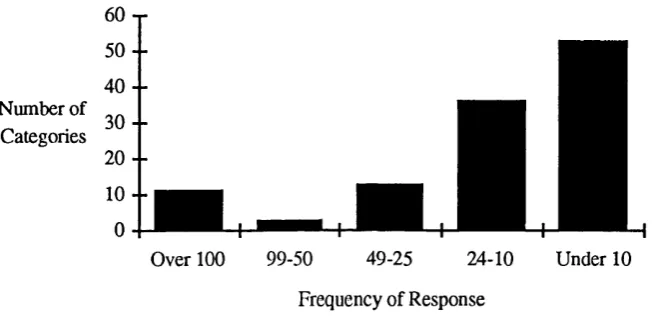
Classification o f Child Psychoanalytic Material: Study 2 Figure 9.1 Number o f categories within a range o f frequency... 180
Table 9.1 Classification o f child psychoanalytic material: Concepts and frequency o f response... 181
Figure 9.2 Defence: Categories... 183
Figure 9.3 Type of d efence... 184
Figure 9.5 Defence: Functions o f the analyst... 185
Figure 9.6 Defence: In relation to the patient...186
Figure 9.7 Defence: Quality o f defence...186
Figure 9.8 Affect: Categories...187
Figure 9.9 Type o f affect... 187
Figure 9.10 Affect directed toward... 188
Figure 9.11 Relationship between affect and patient...189
Figure 9.12 Analyst's response to affect... 189
Figure 9.13 Anxiety and Fear: Categories... 190
Figure 9.14 Type o f anxiety or fear... 191
Figure 9.15 Anxiety or fear of... 192
Figure 9.16 Patient's response to anxiety or fear...192
Figure 9.17 Analyst's response to anxiety or fear...193
Figure 9.18 Transference: Categories... 194
Figure 9.19 Type o f transference... 194
Figure 9.20 Transference o f ... 195
Figure 9.21 Relationship between patient and transference...196
Figure 9.22 Analyst's response to transference...197
Table 9.2 Classification of child psychoanalytic material Activities o f the Analyst - Concepts and frequency o f response 198 Figure 9.23 Activities o f the Analyst: Number of categories within a range o f frequency...199
Figure 9.24 Activities of the Analyst: Categories... 200
Figure 9.25 Activities o f the Analyst: Surface manifestations... 201
Figure 9.26 Activities o f the Analyst: Feeling states...202
Figure 9.27 Activities o f the Analyst: Containment... 202
Figure 9.28 Activities o f the Analyst: Categories o f child's unconscious creations...203
Figure 9.29 Activities o f the Analyst: I. Child's unconscious creations... 204
Figure 9.32 Activities o f the Analyst: Intrapsychic structures
Structural m odel... 206 Figure 9.33 Activities o f the Analyst: Intrapsychic structures
Self and object relationships... 208 Figure 9.34 Activities of the Analyst:
Categories o f relationship with analyst...208 Figure 9.35 Activities o f the Analyst: Relationship with analyst
Treatment alliance... 209 Figure 9.36 Activities o f the Analyst: Relationship with analyst
Analyst a s ... 209 Figure 9.37 Activities of the Analyst: Categories of other... 210 Figure 9.38 Activities of the Analyst: Not specified...212 Table 9.3 Classification of child psychoanalytic material:
Psychological processes... 215 Table 9.4 Classification o f child psychoanalytic material: Feeling states 217 Table 9.5 Classification of child psychoanalytic material:
Developmental considerations... 219 Table 9.6 Classification of child psychoanalytic material:
Intrapsychic structures... 221 Table 9.7 Classification of child psychoanalytic material:
Relationship with the analyst... 222 Table 9.8 Classification of child psychoanalytic material:
The analytic process... 223
Manual II
Table 10.1 Outline o f original chapters... :...229 Table 10.2 Outline o f revised chapters... 230
Validation o f Manual II: Study 3
Figure 1.3 Figure 1.4 Figure 1.5 Figure 1.6 Figure 1.7 Figure 1.8 Figure 1.9 Figure 1.10 Figure 1.11 Figure 1.12 Figure 1.13 Figure 1.14
Table 1 .3
Figure 2.1.1 Figure 2.1.2 Figure 2.1.3 Figure 2.1.4 Figure 2.1.5 Figure 2.1.6 Figure 2.1.7 Figure 2.1.8 Figure 2.1.9 Figure 2.1.10 Figure 2.1.11
Conflict: Level o f clarity and agreement... 246
Conflict: Number o f disagreements and additions...247
Affects: Level o f clarity and agreement... 251
Affects: Number o f disagreements and additions... 251
Transference: Level o f clarity and agreement... 260
Transference: Number o f disagreements and additions...260
Object relations in the clinical context: Level o f clarity and agreement... 266
Object relations in the clinical context: Number o f disagreements, additions, questions... 266
Interpretation: Level o f clarity and agreement... 270
Interpretation: Number of disagreements and additions... 270
The Psychoanalytic Understanding o f Childhood Psychological Disturbance: Level o f clarity and agreement... 276
The Psychoanalytic Understanding o f Childhood Psychological Disturbance: Number of disagreements, additions, com m ents 276 Overview of results... 287
Defining Analytic Concepts and Techniques: Study 4 Defence and Resistance Definition of defence... 310
Purpose o f defence...311
Alternative terminology to pathological defence...311
Result o f problematic defence...312
Defence directed toward... 313
Level o f defence... 314
Developmental line of defence...314
Relationship between defence and resistance... 316
Relationship between defence and resistance: Same, similar, different... 316
Figure 2.1.12 Reasons for resistance... ... 318
Figure 2.1.13 Resistance: To the analytic process... 318
Figure 2.1.14 Resistance: To self and object relationships... 319
Figure 2.1.15 Resistance: Other reasons... 319
Figure 2.1.16 Aim: Categories... 320
Figure 2.1.17 Aim: What is defended against... 321
Figure 2.1.18 Aim: Defence mechanism... 321
Figure 2.1.19 Aim: Solutions or adaptations... 322
Figure 2.1.20 Clues to defence... 323
Figure 2.1.21 Technique: Steps... 325
Figure 2.1.22 Technique: Characteristics o f interventions... 327
Figure 2.1.23 Other techniques... 327
Figure 2.1.24 Technique: Decisions concerning which defences to analyse 328 Figure 2.1.25 Technique: Influence o f developmental viewpoint... 329
Figure 2.1.26 Technique: Resistance... ... 330
Figure 2.1.27 Limitations: Factors or disturbances contributing... 331
Defining Analytic Concepts and Techniques: Study 4 Conflict Figure 12.2.1 Definition o f conflict...332
Figure 12.2.2 Contradicting or opposing components ojf con flict... 333
Figure 12.2.3 Conflict and structuralisation...333
Figure 12.2.4 Normal conflict...334
Figure 12.2.5 When conflict is problematic...334
Figure 12.2.6 Problematic conflict: Characteristics...335
Figure 12.2.7 Conflict and neurotic disturbance...335
Figure 12.2.8 Conflict and other disturbances... 336
Figure 12.2.9 Outcome aims: Solutions and their characteristics... 336
Figure 12.2.11 Technique: What analyst looks fo r ...338
Figure 12.2.12 Technique: What analyst d o e s...338
Figure 12.2.13 Clues to conflict: Relationships...339
Figure 12.2.14 Clues to conflict: General... 339
Figure 12.2.15 Technique: I. General... 340
Figure 12.2.16 Technique: II. General...340
Figure 12.2.17 Conflict and transference... 341
Figure 12.2.18 Interpretation: Involves conflict...342
Figure 12.2.19 Interpretation: Both sides of conflict... 342
Figure 12.2.20 Interpret one or both sides o f conflict: Contributing factors... 343
Figure 12.2.21 Interpretation: Emphasise one side of conflict over another Contributing factors... 343
Figure 12.2.22 Interpretation: Offering solutions to conflict...344
Figure 12.2.23 Technique: Not addressing conflict - Contributing factors...345
Figure 12.2.24 Limitations of conflict analysis... 345
Figure 12.2.25 Technique: Non-conflict based disturbance...346
Figure 12.2.26 Conflict and psychotherapy... 347
Defining Analytic Concepts and Techniques: Study 4 Affects Figure 12.3.1 Definition o f affect... 348
Figure 12.3.2 Unconscious a ffect... i... 349
Figure 12.3.3 Signal function o f affect...349
Figure 12.3.4 Function o f affect...350
Figure 12.3.5 Definition o f anxiety... 351
Figure 12.3.6 Definition of gu ilt... 351
Figure 12.3.7 Affect and developm ent... 352
Figure 12.3.8 Aims: General...353
Figure 12.3.9 Aims: Specific... 354
Figure 2.3.11 Monitoring o f and clues to affect: I. General... 356
Figure 2.3.12 Monitoring o f and clues to affect: II. General... 356
Figure 2.3.13 Monitoring of and clues to affect: Specific... 357
Figure 2.3.14 Technique: A process... 358
Figure 2.3.15 Technique: I. General... 359
Figure 2.3.16 Technique: II. General... 359
Figure 2.3.17 Technique: Analyst's questions... 360
Figure 2.3.18 Technique: Role o f analyst understanding affect... 361
Figure 2.3.19 Interpretation: Affect alone or in relation to something else 361 Figure 2.3.20 Interpretation: Emphasise containment or expression... 362
Figure 2.3.21 Interpretation: Affect always addressed... 363
Figure 2.3.22 Interpretation: Feelings of relief - Contributing factors... 364
Figure 2.3.23 Interpretation: Possible responses other than relief... 364
Figure 2.3.24 Interpretation: Address external or internal w orld... 364
Figure 2.3.25 Relationship between affect, development o f a relationship, and treatment alliance... ...365
Figure 2.3.26 Relationship between affect and development of transference 366 Figure 2.3.27 Affect and the relationship: Techniques contributing to development o f transference... 367
Figure 2.3.28 Affect and the relationship: When affects in the transference become problematic... 367
Figure 2.3.29 Affect and defence analysis... 368
Figure 2.3.30 Anxiety: Technique... ■... 369
Figure 2.3.31 Anxiety: As a guide to... 369
Figure 2.3.32 Guilt: Technique... 370
Figure 2.3.33 Guilt: As a guide to ... 370
Figure 2.3.34 I. Influence o f development and pathology on technique... 371
Figure 2.3.35
n.
Influence of development and pathology on technique: Borderline... ...372Defining Analytic Concepts and Techniques: Study 4 Transference
Figure 2.4.1 Transference: A universal phenomenon... 373
Figure 2.4.2 Analyst's metapsychological models o f transference... 375
Figure 2.4.3 Definition o f transference... 375
Figure 2.4.4 What is transferred... 376
Figure 2.4.5 Importance o f transference to analytic work... 377
Figure 2.4.6 I. Intermediary aims: Analyst's use o f transference... 378
Figure 2.4.7
n.
Intermediary aims... 378Figure 2.4.8 Outcome aims: Shifts in relationship to self and others... 379
Figure 2.4.9 Transference and the beginning o f analysis... 380
Figure 2.4.10 Transference and the beginning of analysis: Exceptions... 380
Figure 2.4.11 Distinguish transference from other aspects of the relationship 381 Figure 2.4.12 Distinguish transference from other aspects o f the relationship: Other components... 381
Figure 2.4.13 Habitual modes o f relating: Characteristics... 382
Figure 2.4.14 Habitual modes o f relating: Technique... ...
382
Figure 2.4.15 Analyst as a real object... 383
Figure 2.4.16 Clues to transference: I. Relationship and interaction with analyst... 384
Figure 2.4.17 Clues to transference:
n.
Relationship and interaction with analyst... 384Figure 2.4.18 Clues to transference: Other... i... 384
Figure 2.4.19 Facilitation o f transference... 385
Figure 2.4.20 Facilitation o f transference: Focus treatment on the transference... 386
Figure 2.4.21 Evidence transference has developed... 386
Figure 2.4.22 Technique: I. General... 387
Figure 2.4.23 Technique: H. General...
388
Figure 2.4.24 Technique: Resistance... 388
Figure 2.4.26 Technique: Transference sh ifts... 389
Figure 2.4.27 Technique: Affect... 390
Figure 2.4.28 Transference and the developmental level o f the child... 391
Figure 2.4.29 Transference and the under f iv e ... 391
Figure 2.4.30 Answering child's questions about the analyst... 392
Figure 2.4.31 Answering child's questions about the analyst: Analyst's approach... 392
Figure 2.4.32 Correcting child's distortions o f the analyst... 393
Figure 2.4.33 Clues to transference displacements... 394
Figure 2.4.34 Link transference to internal objects... 394
Figure 2.4.35 Link transference to external objects: Past or present... 395
Figure 2.4.36 Link transference to past by termination... 396
Figure 2.4.37 Resolution of transference... 396
Figure 2.4.38 Transference and termination... 397
Figure 2.4.39 Transference: Factors leading to variations in technique... 398
Figure 2.4.40 Transference not a primary tool: Examples... 399
Figure 2.4.41 Transference in psychotherapy vs. psychoanalysis: The analyst's technique... 400
Figure 2.4.42 Transference and psychotherapy: Contributing patient factors.... 400
Defining Analytic Concepts and Techniques: Study 4 Object Relations in the Clinical Context Figure 12.5.1 Definition: Object relations as internal, external, or both... 401
Figure 12.5.2 Definition: External object relations -Relationship with people in environment... 402
Figure 12.5.3 Definition: Internal object relations... 402
Figure 12.5.4 Relationship between internal and external object relations... 403
Figure 12.5.5 Development o f object relations: Origins... 403
Figure 12.5.6 Development o f object relations: The process... 404
Figure 2.5.9 Modification o f internal object relations
through the developmental process... 406
Figure 2.5.10 Modification of internal object relations through the developmental process: Contributing factors... 406
Figure 2.5.11 Relationship between fantasy and internal object relations... 407
Figure 2.5.12 Development o f conscience: Analyst's models o f internal structures... 408
Figure 2.5.13 Development o f conscience: Contribution o f internalisation... 408
Figure 2.5.14 Development o f conscience: Other contributions and processes., 409 Figure 2.5.15 Relationship between object relations and the development of conscience... 409
Figure 2.5.16 Function o f internal object relations... 410
Figure 2.5.17 Outcome aim s... 411
Figure 2.5.18 Intermediary aim s... 412
Figure 2.5.19 Clues to object relations: External sources... 413
Figure 2.5.20 Clues to object relations: Child's view of his relationship with others... 413
Figure 2.5.21 Clues to object relations: Child's view o f him self... 414
Figure 2.5.22 Clues to object relations: Relationship with analyst... 414
Figure 2.5.23 Clues to object relations: Other... 415
Figure 2.5.24 Clues to object relations: Analyst's developmental view point... 415
Figure 2.5.25 Technique: I. The process... 416
Figure 2.5.26 Technique: II. The process... 416
Figure 2.5.27 Technique: The analyst's wonderings and explorations... 417
Figure 2.5.28 Technique: The analyst points out or takes u p ... 417
Figure 2.5.29 Technique: The analyst works w ith... 418
Figure 2.5.30 Technique: The analyst links material... 419
Figure 2.5.31 Technique: Bring unconscious aspects to child's conscious awareness... 419
Figure 2.5.32 Technique: The analyst's developmental viewpoint... 420
Figure 2.5.33 Object relations and transference... 420
Figure 12.5.35 Interpretation: Primary techniques... 421
Figure 12.5.36 Interpretation: What is interpreted... 422
Figure 12.5.37 Interpretation: Methods of presenting the idea of internal self and object... 422
Figure 12.5.38 Object relations and limitations... 423
Figure 12.5.39 Object relations and psychotherapy... 424
Defining Analytic Concepts and Techniques: Study 4 Interpretation Figure 2.6.1 Definition o f interpretation
...
...425Figure 2.6.2 I. What interpretation addresses... ... 426
Figure 2.6.3 II. What interpretation addresses... ... 427
Figure 2.6.4 Interpretation as a process... ... 427
Figure 2.6.5 I. Complete interpretation... ...428
Figure 2.6.6
n.
Complete interpretation......
429Figure 2.6.7 Partial interpretation
...
... 429Figure 2.6.8 Verbalisation...
.
...... 430
Figure 2.6.9 Clarification... ... 430
Figure 2.6.10 I. A im
...
... 431Figure 2.6.11
n.
A im ... ...432Figure 2.6.12 I, What informs content o f interpretation... ... 433
Figure 2.6.13
n.
What informs content o f interpretatiqn... ...433Figure 2.6.14
m.
What informs content o f interpretation... ...
434Figure 2.6.15 What informs timing and wording o f interpretation...
...
435Figure 2.6.16 Timing and wording o f interpretation: Developmental considerations... ...435
Figure 2.6.17 I. What leads to an interpretation at a specific tim e... ... 436
Figure 2.6.18
n.
What leads to an interpretation at a specific tim e... ... 437Figure 12.6.20 Decisions about what to interpret:
Affect and anxiety as indicators... 438
Figure 12.6.21 Decisions about what to interpret: Child's level o f awareness as an indicator... 438
Figure 12.6.22 Decisions about what to interpret: Other indicators... 438
Figure 12.6.23 Method of interpretation: Characteristics... 439
Figure 12.6.24 Method o f interpretation: The process... 440
Figure 12.6.25 Method of interpretation... 441
Figure 12.6.26 Confirmation o f interpretation... 442
Figure 12.6.27 Confirmation of interpretation: Denial and negative reactions 442 Figure 12.6.28 Unhelpful or unnecessary interpretations... 443
Figure 12.6.29 Special considerations Narcissism and self esteem ... 444
Figure 12.6.30 Special considerations: Developmental Help - Signal anxiety 445 Figure 12.6.31 Special considerations: Developmental Help - Affect... 445
Figure 12.6.32 Special considerations: Developmental Help - Showing how , ,, 446 Figure 12.6.33 Special considerations: Developmental Help -Analyst as new object... 446
Figure 12.6.34 Special considerations: Developmental Help - Other... 447
Figure 12.6.35 Interpretation and psychotherapy... Defining Analytic Concepts and Techniques: Study 4 Developmental Disturbance 448 Figure 12.7.1 Patients presented classified by technique... 450
Figure 12.7.2 The disturbance and treatment o f ch o ice... 451
Figure 12.7.3 Patient demographics: Age and gender o f ch ild ... 452
Figure 12.7.4 Patient demographics: Neurological and physical problem s... 452
Figure 12.7.5 Patient demographics: Learning and intelligence... 453
Figure 12.7.6 Patient demographics: Family constellation... 453
Figure 12.7.7 Contributing environmental factors: Parent's relationship... 454
Figure 2.7.10 Contributing environmental factors: Parent's pathology... 455
Figure 2.7.11 Internal difficulties: Organisation... 456
Figure 2.7.12 Internal difficulties: Organisation and control o f impulses and w ish es... 457
Figure 2.7.13 Internal difficulties: Organisation and control o f affective mental states... 457
Figure 2.7.14 Internal difficulties: Organisation and control o f affective mental states - Defence organisation... 458
Figure 2.7.15 Difficulties: Object relationships... 458
Figure 2.7.16 Internal difficulties: Self representation... 459
Figure 2.7.17 Internal difficulties: Thinking... 459
Figure 2.7.18 Internal difficulties: Language, reality testing, synthesis, repression barrier... 460
Figure 2.7.19 Technique: I. Role o f the analyst and the setting... 461
Figure 2.7.20 Technique: II. Role o f the analyst and the setting... 462
Figure 2.7.21 Technique: Identification with the analyst... 463
Figure 2.7.22 Technique: Communication and thinking... 464
Figure 2.7.23 Technique: Internal disorganisation... 465
Figure 2.7.24 Technique: Internal organisation and control of anxiety... 466
Figure 2.7.25 Technique: Internal organisation and control o f affect... 466
Figure 2.7.26 Technique: Internal controls... 467
Figure 2.7.27 Technique: Object relations... 469
Figure 2.7.28 Technique: Self representation... :... 469
Figure 2.7.29 Technique: Self management... 470
Figure 2.7.30 Technique: Showing how... 470
ABSTRACT
Although manualisation o f psychotherapies is considered a precondition for system atic psychotherapy research, there has thus far been no attempt to manualise psychoanalytic treatment. The present study concerns the development o f a manual o f child psychoanalysis. It involves the investigation o f the explicit and implicit principles which guide the work of child psychoanalysts at the Anna Freud Centre.
In the first part o f the thesis a historical review o f the developm ent o f child psychoanalytic technique is reported. The comparison o f major contributions reveals that many ambiguities exist in the recommendations made for child psychoanalytic techniques and that actual practice can only be considered to be im plicitly guided by som e undetermined amalgam o f these recommendations. The relationship between theory and practice is explored, and the types of research usually found within child psychoanalysis are reviewed. These reviews highlight the need for manualisation which has the potential to clarify the necessary and sufficient components o f child analytic treatment techniques.
An initial attempt to manualise the key therapeutic ingredients, guidelines, and strategies o f child psychoanalysis is presented. This attempt at systemisation is described and the results o f a validation study are given. A further study is reported which attempted to validate a novel approach to the content analysis o f psychoanalytic material.
The validation o f a second attempt at manualisation, informed by the results and difficulties encountered in the previous studies, is reported. This study explores the face validity of definitions used in the new manual and results in a comparison with analyst's explicit working models. A further, large scale empirical study is reported which attempts to determine child psychoanalyst's implicit working definitions o f psychoanalytic concepts, as w ell as their technical means and aims. Findings indicate that systemisation o f treatment techniques may be possible on the basis o f this instrument.
ACK NO W LEDG EM ENTS
An em pirical investigation o f child psychoanalysis w ould not be possible without those analysts who agreed to participate in all o f the studies w hich constitute this thesis. I would like to thank the staff o f the Anna Freud Centre for their expressed interest and generosity in giving so much o f their valuable time and energy, and for their in-depth and honest discussions o f their clinical work and beliefs.
I am grateful to Dr. Victoria Hamilton for her careful reading o f the final drafts and for her organisational and editorial advice. The assistance o f Cynthia Carlson in coordinating the data from the interviews is especially appreciated. A special thanks also goes to Dr. George Moran who was instrumental in getting this project o ff the ground. I am deeply indebted to him for his guidance and encouragement.
The authors o f both manuals require special acknowledgem ent as it was their drafts w hich were exam ined in two o f the studies. They include R ose Edgcum be, Peter Fonagy, Hansi Kennedy, George Moran and Mary Target. W hilst the construction o f these manuals is the responsibility o f the authors, this research played in influential role. The problems with Manual I were delineated in the first study, which lead to recom m endations for a second attempt at m anualisation. T he con cep ts and classifications found in Manual II were informed by the second study.
PART I.
THE THEORY AND TECHNIQUE OF CHILD PSYCHOANALYSIS
Chapter 1. The historical roots o f child psychoanalysis
INTRODUCTION
The first four chapters o f this thesis discuss the developm ent o f the theory and technique o f child psychoanalysis. The path o f this historical exposé begins in the early 1900s when children were not considered to be candidates for analysis, and when they eventually were, it was concluded that they were unanalysable. The journey continues into the 1920s when the method o f child analysis was first conceived. The theories o f both Anna Freud and M elanie Klein are examined, as w ell as the controversies between these two schools of thought. The numerous contributions made to the theory by other authorities, through to contem porary child analysts seventy years later are also considered. The importance o f this historical journey is to highlight how analysts have thought about their approach and methods, to describe what they have conceptualised child analysis to be, and to delineate the points o f discord and debate. In this way the remainder o f the thesis can be placed within an historical context which serves to emphasise the need for manualisation.
THE HISTORICAL ROOTS OF CHILD PSYCHOANALYSIS
The first psychoanalytic therapy o f a child has been credited to Sigmund Freud (1909)^ with the young boy called Little Hans. Freud's purpose in undertaking this project was not to see whether analysis was possible with a child, but rather to check the correctness o f his theories which had their origins in the reconstruction o f adult patients. In 1905 he laid out his hypotheses o f infantile sexuality in "Three essays on the theory of sexuality"^, whilst wishing for more direct proof o f his theories.
In search for further evidence Freud gathered observations o f children's sexual life, collected by friends and students. Am ong these were reports he received at regular intervals from the Grafs about their young son Hans. Max Graf, a m usic critic and m usicologist, had been a follow er o f Freud's since 1900. He was a member o f Freud's
W ednesday E vening P sy ch o lo g ica l S o ciety and later a m em ber o f the V ienna Psychoanalytic S ociety. W hen Hans w as born both parents w ere im m ersed in psychoanalysis. In consultation with Freud they agreed to try and raise their child with enough coercion to maintain good behaviour, but not within the overly strict guidelines com m on in Vienna at the time. In Freud's evaluation o f the results o f this decision, "the child developed into a cheerful, good-natured and lively little boy, the experiment o f letting him grow up and exp ress h im self w ithout being intim idated w ent on satisfactorily"^. The Grafs observations o f Hans provided information for Freud's papers on children's sexual theories (1907)"^ and the sexual enlightenment o f children (1908)^.
When Hans was nearly five he developed a phobia o f horses at which time his parents consulted Freud for advice. Freud suggested that Hans' father treat him under Freud's supervision, sending reports as the treatment progressed. Thus, the case o f Little Hans was the analysis, once removed, o f a reconstructed child, as opposed to the direct analysis o f a child. Freud him self thought this work was a unique experience arising from scientific interest, not thinking children in their own right were possible candidates for analysis. However, the impact o f his work was enormous, yet difficult to understand eighty years later as what he discovered in 1909 is often now taken as a given. The work with Little Hans demonstrated what had previously only been theorised about and reconstructed from adult patients. As Anna Freud said:
What had been m erely guessed and inferred becam e a living, visible and demonstratable reality...the oedipus com plex was seen toward living parents in the external world as w ell as in ongoing fantasies and in the transference.^
Sandor Ferenczi (1913)^ was the first to attempt to treat a child directly with psychoanalysis. He concluded that he was unsuccessful in adapting the technique of adult analysis to children because the child refused to cooperate, only wanting to play. Freud and his contemporaries were used to dealing with adult patients and were not equipped to understand a child's language. N ow analysts would see a child's play as part o f analysis and as a mode o f communication.
^ Freud, S. (1909). Analysis o f a phobia in a five-year-old boy. S.E. 10, 6. ^ Freud, S. (1907). The sexual enlightenment of children. S.E. 9.
^ Freud, S. (1908). On the sexual theories o f children. S.E. 9.
^ Freud, A. (1970). Child analysis as a subspeciality o f psychoanalysis. In The Writings o f Anna Freud Vol. VII. New York: Int. Univ. Press, 1971, 210.
In the years that follow ed there were few developments regarding the field of direct child psychoanalysis. There were some attempts to apply psychoanalytic prin ciples to other areas connected with children. Siegfried Bernfeld (1925)^ used his psychoanalytic understanding and applied it to children in residential settings. August Aichhorn (1925)^ took psychoanalytic principles and used them in his attempts to understand and re-educate delinquents. Anna Freud (1931)^ ® is w ell known for her attempts to apply psychoanalysis to the education o f children by parents and teachers.
Hermine von Hug-Hellmuth was the first to undertake systematic analyses of children. Following her PhD studies in physics she became a teacher. Influenced by her friend, mentor, and analyst Isidor Sadger, Hug-Hellmuth began to write papers on analytically informed child observations. At some point, when exactly is unknown, she began to analyse children and was to eventually become a respected member o f the Vienna Psychoanalytic Society. She published a total o f thirty-five articles mostly on children and child analysis, but also on women and the family. Hug-Hellmuth’s papers on children contain an explanation o f the unconscious; a discussion o f sexual urges, including pre-oedipal and oedipal desires, and masturbation; a discussion o f curiosity and sexual education; descriptions o f anxiety, guilt, fantasies, narcissism, masochism, and primal scene experiences; as w ell as the technique o f child analysis. Young children, Hug-Hellmuth concluded, were not suitable for analysis without a concomitant educa tional influence. She said: “The curative and educative work o f the analyst does not consist only in freeing the young creature from his sufferings, it must also furnish him with moral and aesthetic values.”^ ^ Furthermore, as she thought the analysis o f a child should not penetrate too deeply, the analyst needed to be content with only partial success. Although skeptical about the feasibility o f such an endeavor, Hug-Hellmuth thought a child’s spontaneous play could be used to supplement or replace free association, the means of analysing an adult. This idea paved the way for understanding a child’s communication through actions.
In the twenties two young women who were exploring the treatment o f children entered the psychoanalytic scene, Anna Freud and Melanie Klein. Three schools of thought about child analysis began to develop headed by these two analysts and Hug-Hellmuth. Because of their interest in children, they were able to understand the child’s language and form of communication. Therefore, they were better able to adapt a psychoanalytic method to working with children than the adult analysts o f their time. Hug-Hellmuth thought that analysis had to be limited in accordance with the
develop-^ Bernfeld, S. (1925). Psychology o f the Infant. London: Kegan Paul, 1929. ^ Aichhom, A. (1925). Wayward Youth. London: Putnam, 1936.
Freud, A. (1931). Introduction to Psychoanalysis for Teachers and Parents. New York: Emerson, 1935. Hug-Hellmuth, H. yon (1921). On tlie technique of child-analysis. Int. J. Psycho-Anal.. 2, 287.
mental and cognitive capacities o f the child. With her death in 1924, the field became dominated by Melanie Klein and Anna Freud. Anna Freud had a strong developmental approach that took into account the child’s areas o f competence, whereas Melanie Klein was convinced that analysis similar to that o f adults was possible with c h i l d r e n . ^2
12 A s the first child analysts were women, and the field has traditionally been dominated by this gender, the analyst will be referred to as “she” or “her” throughout this thesis, except in direct quota tions when “he” is often used. The child patient will be referred to as “him”.
PARTI.
THE THEORY AND TECHNIQUE OF CHILD PSYCHOANALYSIS
Chapter 2 . Anna Freud
BACKGROUND
Anna Freud's background is one o f devotion to the field o f children, their development, and psychoanalysis. She began as a teacher, where her interest in child development grew, applying psychoanalytic principles to education. She created a network o f people devoted to work with children and also trained as an adult psychoanalyst. In 1937 she opened the Jackson Nursery in Vienna, a preschool setting providing day care for children one and a half through three years o f age. It was here that Anna Freud began her studies on separations and substitute caregivers, libidinal development, the impact o f the internal and external world on a child, child development, and the system atic use o f observations o f children. A year later the Jackson Nursery was closed as Hitler had marched into Austria requiring Anna Freud and her family to flee to London. Two years later she unpacked the materials from the Jackson Nursery and, along with Dorothy Burlingham, opened the Hampstead War Nurseries where they were able to continue their work.
V olum e III o f Anna Freud’s writings^ details fifty-six monthly reports on the activities o f the Hampstead War Nurseries and lays down the major scientific conclusions drawn from their work. These reports were the first studies o f children who had to go through their early years deprived o f family care. The interest o f others in the effects o f early loss and separation on fam ilies follow ed, in particular John B ow lby and Donald W innicott in London and later René Spitz in the United States. The war was the precipitating and aggravating agent for these studies, but the importance o f them is not the war itself. It is the effects o f the dissolution o f families and the impact o f residential care on children. Reviewing her work three decades later Anna Freud was "glad to note that during the last 30 years many o f the fmdings presented here as new have become familiar tenets on which a much more critical view o f residential upbringing and its consequences for personality development are based".^
In 1945 the War Nurseries closed. Anna Freud's concerns about and interest in child development, and the impact o f loss and separation, continued as her attention turned to children who were concentration camp survivors. This work provided the unrivaled opportunity to observe the developm ent of these young victim s after their liberation, especially in tenns of children's social relationships to each other. As Anna Freud said:
These children, who grew up oblivious o f the existence o f parents and without permanent ties to adult figures, demonstrated in pure culture what our separated war children had displayed, to us in approximation, mainly, the deviations in personality formation that arise if family ties are replaced by ties to a group o f peers, and the greater or lesser extent to which these latter can be utilized for satisfying an infant's need for emotional closeness to other human beings.^
Anna Freud's activities also focused on the training o f child psychoanalysts. The aftermath o f the war saw an increased interest in children and the need for child training and Child Guidance Centres throughout Britain. The end o f the war also brought renewed interest world wide in psychoanalysis. The Hampstead Child Therapy Training officially began in 1947, training candidates who had previously been workers in the War Nurseries. Three intakes were initiated prior to Anna Freud opening The Hampstead Clinic in 1952. In 1958 the Hampstead Nursery took its first preschool aged children. The name o f the clinic changed to the Anna Freud Centre after her death in 1982.
^ Freud, A, in collaboration with Burlingham, D. (1939-1945). Infants Without Families: Reports on the Hampstead Nurseries. The Writings o f Anna Freud Vol. III. 1939-1945. N ew York: Int. Univ. Press, 1973.
It is difficult to assess Anna Freud’s work without also seeing the teacher in her. Her interest was first in normality and only subsequently in the deviations from it which constitute pathology. Anna Freud maintained a strong tie between clinical material and theory throughout her life, integrating findings of clinical psychoanalysis and observational studies. These studies included infants and toddlers in residential care, her experiments in group upbringing with child survivors, and later, children from deprived hom es who were in daytime care at the Hampstead Nursery. Her theories were constantly developing to which the eight volum es o f her writings attest. In the last decade o f her life she said:
W e should gradually evolve a technique which fits the child
perfectly, whether it is similar to the adult technique or not...W e haven’t done so yet. W e are nearer than w e were twenty years ago, or even ten years ago, but we are still quite a long way off.^
THE EARLY YEARS
In 1926 Anna Freud wrote her Introductory Lectures on Child Analysis which outlined her early thinking. A s no model existed for child psychoanalysis, other than the applied work o f Bem feld and Aichhorn, Anna Freud formed a group o f interested analysts composed o f Marianne Kris, Hedwig and W illi Hoffer, Editha and Richard Sterba, and Jenny Waelder-Hall. The 1926 Introductory Lectures arose out o f the seminars Anna Freud gave to this small group o f pioneers, and were a response to Melanie K lein’s first paper which had been published a year earlier.
Basing her findings on the analysis o f ten latency age children, Anna Freud introduced what child analysis was and contrasted this to adult analysis. The child, she said, was different from the adult in many respects. This necessitated modifications in the technique which had been used for neurotic adults, the subjects upon which Freud based his technique. Unlike adults, children were immature and dependent creatures, and specific criteria for treatment found in adult cases were missing with children. Children came into treatment not o f their own choosing, lacked insight into their illness, and often lacked a wish to be cured.
The origins o f Anna Freud’s thinking about development, technique and the task o f child analysis can be found in these early papers. Although she found many similarities in comparing the analytic process with children and adults, she also found differences
which were to be the basis for the development o f a technique designed specifically for children. She had no qualms about modifying a technique developed for adults saying:
In my opinion, it is no reflection on the analytic method, designed as it is for a single particular object, the adult neurotic, if one seeks to apply it with modifications to other types o f objects. There is no harm in contriving to use it for other purposes. Only one should be at pains to know what one is doing.^
Her interest in what became known as the widening scope o f psychoanalysis, the application o f psychoanalysis to other than neurotic disorders, was to be seen in many years to come. This interest began with the development o f a technique particular to children.
However, Anna Freud also thought that her approach to working with children was not different from what was done in adult analysis in all respects. She said:
But I maintain that in order to suit a new situation I merely extended certain elements o f an attitude that you all show to your patients, though without especially stressing it.^
These elements which she thought everyone used, irrespective o f the age o f the patient, included: arousing the patient’s interest in and decision for analytic work; indicating that the analyst was there to help and support the patient; accepting the patient’s version o f his conflicts with his family and the external world; and making oneself interesting and useful to the patient.
Anna Freud suggested a preparatory period prior to the onset o f analysis, an idea which she later abandoned, but which contained the roots o f many commonly known techniques today.^ The task o f the preparatory period was to make the patient analysable, in other words, to induce in the child insight into his disturbance, impart confidence in the analyst, and to turn the decision for analysis into the child’s own. This phase, she thought, did not involve “real analytic work” in the sense o f making unconscious process conscious or analysing transference and resistance, rather the aim was “...to create a tie strong enough to sustain the later analysis”.^ She discussed that the aim was not to establish a positive transference, rather implied was the aim o f establishing a treatment alliance which could be maintained in the face o f resistance, a concept introduced much later.
^ Freud, A. (1927). Child analysis and the upbringing o f children. In Introduction to Psychoanalysis: Lectures for Child Analysts and Teachers 1922-1935. London: Hogarth Press, 1974, 69.
^ Freud, A. (1927). The methods o f child analysis. In Ibid.. 20.
^ Anna Freud always maintained that her ideas about a preparatory phase were misunderstood. What she had in mind was the making o f a relationship with a child prior to doing analysis. (Hansi Kennedy, 1990, personal communication)
The establishment o f the sort o f relationship Anna Freud was describing required follow ing the child and his material, as the child was a particularly difficult subject who "...requires that his own childish peculiarities be appropriately matched."^ Implied was the need to be able to step into the child's shoes and understand the world from his viewpoint, one which differs sharply from that o f an adult. In order to do this the child analyst needs to understand development and know how to talk in the language o f a child.
As it was thought children were often not as bothered by their symptoms as their parents or others, another aim initially allotted to the preparatory phase was making symptoms which are ego-syntonic dystonie. Here the roots o f what might now be called creating conflict can be seen.
The crux o f transference work with adults in 1926 involved the development o f a transference neurosis. Freud first introduced this concept, along with the compulsion to repeat, in 1914.^0 The compulsion to repeat referred to the patient's enactment o f his past within the transference relationship. A transference neurosis occurred once the patient's whole illness was concentrated upon a single point, his relation to the analyst. The analyst was now situated at the very centre o f the illness. Thus, in "place o f his patient's true illness there appears the artificially constructed transference illness, in place o f the various unreal objects o f the libido there appears a single, one more imaginary, object in the person o f the doctor" 1^. A s transference neurosis was the aim o f analysis with adiilts, and the primary vehicle for change, the question arose as to whether children developed a transference neurosis. At this time Anna Freud strongly believed they didn't. She defined the concept as follows:
He (the patient) gives up the old objects on which his fantasies where hitherto fixed, and centers his neurosis anew upon the person o f the analyst...he replaces his previous symptoms with transference symptoms, transposing his existing neurosis, or whatever kind, into a transference neurosis, and displays all his abnormal reactions in relation to the new transference person, the analyst.
However, in the case o f a child, thought Anna Freud, the original objects remained real and important figures in the child's life. Unlike the adult, the child was dependent on them in the present. Consequently, the original objects were never fully replaced by the analyst in the transference. Transference was still a feature in child analysis, although at this point she believed it involved only single episodes o f friendly and hostile im pulses. The negative
^ Freud, A. (1927), The methods o f child analysis. In Ibid., 50-51.
Freud, S. (1914). Remembering, repeating and working through. S.E. 12.
Freud, S. (1916-1917 [1915-1917]). Introductory lectures on psycho-analysis. Lecture X X V lll. Analytic dierapy. S.E. 16,454.
im pulses directed toward the analyst should be dealt with immediately as, thought Anna Freud, they disturbed the child greatly, could foster dangerous feelings, and could become feared tempters to the child to act upon them. It was in the positive transference that the fruitful work o f the analysis happened in that an affectionate attachment was a prerequisite for all later analytic work. At this point in the developm ent o f her theory Anna Freud believed that the transference to the child analyst did not readily lend itself to interpretation, a view she was later to change.
In 1926 m ost analysts thought their task was to raise conflicts between the instinctual unconscious, ego, and superego to a higher level, making what was unconscious conscious. O nce this w as accom plished, instinctual im pulses were removed from repression and made accessible to the influence o f the superego which would determine their fate. This applied to both children and adults, however with children there was one important difference. The outer world affected the mechanisms o f the infantile neurosis more deeply with the child as his investment and dependence on parental objects was greater, and necessary. This factor created two differences in the analysis o f children. Firstly, the child's superego was still in the process o f developing and needed the help o f people in the environment. Secondly, as the child's superego and ego were not yet sufficiently mature to reject some impulses, sublimate others, and allow gratification to still others, the responsibility for the fate o f these instinctual impulses remained with the parents. However, this created problems, as "the parents who are now called upon to help in the child's recovery are still the same people who let the child get ill in the first place" Consequently, it was up to the analyst to intervene in the child's development. Anna Freud said:
It seems to me that there remains but one solution to this difficult situation. The analyst must claim for him self the liberty to guide the child at this important point, in order to secure, to som e extent, the achievements o f analysis. Under his influence the child must learn how to deal with his instinctual life...^^ \
Anna Freud called this process educational, using the term in its w idest sense. As w ill be elaborated further, it is here that the roots o f what was later to be seen as the task o f child
analysis - restoring the child to the path of normal development - are found. It made the analyst's task a difficult one as she had to both analyse and educate in this sense.
The analyst accordingly combines in his own person two difficult and diametrically opposed functions: he has to analyze and educate, that is to say, in the same breath he must allow and forbid, loosen and bind again.
In order to accomplish this difficult task the analyst needed to assess not only the internal state o f the child, but also the external forces which contributed to the child's disturbance. Parents had to be able to support treatment and aid in the child's further development once analysis was completed. Here Anna Freud was alluding to the the idea that parents should be worked with as well. Due to the child's continuing development and the ongoing influence o f his environment, analysis was no guarantee that the child would not have difficulties in the future. Anna Freud always believed that what analysis could do w as restore the child to a path o f normal development, thus improving his chances in the future, but not necessarily protecting him from later problems.
The roots o f Anna Freud's theory of child analysis are found in these early papers. Over the years she expanded, altered and added to her original propositions.
A N N A FREUD'S DEVELOPMENTAL POINT OF VIEW
In her early papers Anna Freud said that the task o f child psychoanalysis was to both analyse and to educate. Implicitly she seem ed to suggest that what was meant by "educate" was intervening in a child's development. This meaning became explicit in later writings as she formulated what was to becom e the central focus o f her theory o f child analysis - a child's development.
The Search for Criteria for Child Analysis
Anna Freud struggled to identify what the criteria for analysis with children should be. Obviously, the criteria used for adults did not suffice. To begin with, the degree o f suffering was not adequate as an indicator. For example, it could be the environment which suffered rather than the child, or in severe cases a child's defences could be strong enough to prevent suffering although at a cost, and in less severe cases a child could be suffering far
more. Secondly, with a child a disturbance in the capacity to love and to work was hard to gage. The equivalent to a capacity to work was the capacity to play. A disturbance could manifest itself in an inability to play or in excessive imaginative play at the cost o f constructive play, however this was also not a sufficient criteria. Anna Freud concluded then that the criteria for child analysis were disturbances in a child’s development. The indications for treatment were not the neurotic manifestations themselves, but what bearing these had on the developmental process. She said:
...there is only one factor o f such central importance that its impair ment through a neurosis calls for immediate action; namely, the child’s ability to develop, not to remain fixated at som e stage o f development before the maturation process has been concluded.^ ^
Anna Freud’s developmental viewpoint was incorporated into her theory and technique, as w ell as in her thinking about assessment. This viewpoint ushered in the formation o f her Diagnostic Profile and the idea o f developmental lines. It was “...the essence o f this approach”, she said, “that developmental considerations take precedence over consideration o f symptomatology and manifest behavior” ^
Svmptoms
Overt symptomatology, said Anna Freud, could be deceiving. In children symptoms could be transitory and appear at a time in development when high demands were made on the child’s personality. When that time passed, the symptoms could disappear. This was not a sign o f pathology, rather a reaction to a stressor. However, symptoms could be lasting and regarded as the first sign o f permanent pathology. Symptoms could also shift, as when an anxiety moved from one important object to another or one com pulsion was substituted for another. The analytic stance has always been that symptoms them selves are no more than symbols. They are surface manifestations which indicate that som e mental turmoil is taking place beneath the surface within the child’s psychic world. Furthermore, the same symptom or behaviour exhibited by two children could have different roots and internal meaning. Thus, symptoms were not the key to understanding. Instead, Anna Freud believed the analyst needed to look to the nature o f the child’s internal world, to the level o f development reached, and to the organisation o f the child’s intrapsychic structures. The focus was the whole child, all elements o f his functioning and internal organisation, both healthy and disturbed. The
Freud, A. (1945). Indications for child analysis. In The Writings o f Anna Freud Vol. IV . New York: Int. Univ. Press, 1968,17.
emphasis was on the deviation from, and interferences with, normal personality develop ment.
The Diagnostic Profile
Anna Freud thought it was through a diagnostic assessment that the analyst could make a thorough investigation o f the child’s personality, making it possible to pinpoint the relevance o f a symptom to a particular child at a particular time. This involved assessment o f the developmental level, psychic structure, and dynamic significance. Her Diagnostic Profile was an attempt at such an assessment. It was a way to hypothesise the underlying metapsychological pathogens in order to ascertain the appropriate therapeutic intervention. It’s basis was a developmental viewpoint, and dynamic considerations instead o f descriptive ones. During an assessment, a multitude o f facts are gathered, but it was basic to Anna Freud’s analytic thinking that “the value o f no single item should be judged independently, i.e., not without the item seen within its setting”. 1 8 The Profile involved an external picture o f the child and proceeded to an internal picture containing “information about the structure o f his personality; the dynamic interplay within the structure; som e econom ic factors concerning drive activity and the relative strength o f id and ego forces; his adaptation to reality; and som e genetic assumptions”. ^ ^ The primary questions the Profile attempted to answer from a metapsychological perspective were: what level o f development has the child attained, is he where he needs to be, and what is holding him up? The diagnostician would then recommend the best way to help the child m ove forward.
The Concept o f Developmental Lines
By means o f the Diagnostic Profile, the state o f a child’s inner agencies, various functions, conflicts, attitudes, and achievements are fitted into a background o f a develop mental norm. But what is this developmental norm? Development had long been thought o f as passing through phases. Psychosexual phases (oral, anal, phallic, etc.) had their origins in the reconstruction o f adults rather than work with children, either therapeutically or through observations. In addition, all theories about phases were tied to particular areas o f interest; for example Freud and neurosis, Margaret Mahler and psychosis, or Erik Erikson