International Journal of Advanced Technology in Engineering and Science www.ijates.com
Volume No.02, Issue No. 07, July 2014 ISSN (online): 2348 – 7550
117 |
P a g e
EFFECT OF CONTACT TIME ON ADSORPTION OF
NITRATES AND PHOSPHATES
AkshayShende
1, J S Main
21
M-tech student, Environment Engineering Department,VJTI, Mumbai (India)
2
Associate professor, Civil & Environment Engineering Department, VJTI, Matunga, Mumbai (India)
ABSTRACT
Water pollution due to the excessive presence of nutrients (nitrogen and phosphorus) is a serious environmental worldwide problem, because both species are responsible for the eutrophication of receiving surface waters and elevated nitrate concentration in drinking water can be toxic to infants. Hence it is very necessary to remove these nutrients from the effluent stream. The study presented in this paper describes the adsorption capacity of an anion exchange resin Auchlite A101D for the removal of Nitrates and Phosphates from an aqueous solution. A series of batch experiments were carried out to determine the adsorption capacity of resin by varying the contact time. The tests were carried out on synthetic samples. Maximum adsorption capacity of the resin in case of Nitrates was 68.08 mg/gm and that for Phosphate was 50.8 mg/gm.
Keywords–
Auchlite A101 D, Adsorption Capacity, Nitrates, Phosphates, UV SprectophotometerI. INTRODUCTION
Although Nitrogen and phosphorous being essential elements for living organisms, their enormous volume of wastewater production containing nitrate and phosphate leads to the deterioration of natural water resources through eutrophication. The need to develop new technology for phosphate and nitrate removal from wastewater has become very important to conserve natural aquatic environment from eutrophication. The primary health hazards from drinking water with nitrate occurs when nitrate is transformed to nitrite in the digestive system which creates the condition known as methemoglobinemia which commonly observed among children [1]. According to environmental protection agency (EPA), the drinking water limit of nitrate is 45 mg/L [2] and the maximum permissible level of phosphates in water is 0.1 mg/L [3].
Nitrate is a common pollutant of groundwater in many regions around the world. Chemical fertilizer used in crop production and municipal or industrial wastewaters are characterized as the extensive source of nitrate in watersources[4].
International Journal of Advanced Technology in Engineering and Science www.ijates.com
Volume No.02, Issue No. 07, July 2014 ISSN (online): 2348 – 7550
118 |
P a g e
Nitrate and Phosphates removal can be carried out by adsorption, ion exchange, electrodialysis, reverse osmosis, microbiological treatment (denitrification), chemical treatment (coagulation), etc. Amongst them, adsorption is simpler and effective for nitrate removal. Adsorbent resins are considered to be highly stable and hence considered as one of most promising adsorbents. Resins are the polymer matrix structures having ions and a functional group along with alkyl chain present in it. Ion exchange resin has the characteristic of replacing ion with other substitute present in the aqueous solution [6]. Also the regeneration capacities of an Ion exchange resin makes them cost effective.II. EXPERIMENTAL
2.1 Materials
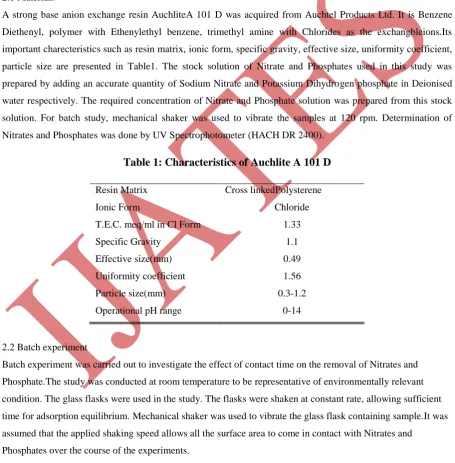
A strong base anion exchange resin AuchliteA 101 D was acquired from Auchtel Products Ltd. It is Benzene Diethenyl, polymer with Ethenylethyl benzene, trimethyl amine with Chlorides as the exchangbleions.Its important charecteristics such as resin matrix, ionic form, specific gravity, effective size, uniformity coefficient, particle size are presented in Table1. The stock solution of Nitrate and Phosphates used in this study was prepared by adding an accurate quantity of Sodium Nitrate and Potassium Dihydrogen phosphate in Deionised water respectively. The required concentration of Nitrate and Phosphate solution was prepared from this stock solution. For batch study, mechanical shaker was used to vibrate the samples at 120 rpm. Determination of Nitrates and Phosphates was done by UV Spectrophotometer (HACH DR 2400).
Table 1: Characteristics of Auchlite A 101 D
Resin Matrix Cross linkedPolysterene
Ionic Form Chloride
T.E.C. meq/ml in Cl Form 1.33
Specific Gravity 1.1
Effective size(mm) 0.49 Uniformity coefficient 1.56 Particle size(mm) 0.3-1.2 Operational pH range 0-14
2.2 Batch experiment
Batch experiment was carried out to investigate the effect of contact time on the removal of Nitrates and Phosphate.The study was conducted at room temperature to be representative of environmentally relevant condition. The glass flasks were used in the study. The flasks were shaken at constant rate, allowing sufficient time for adsorption equilibrium. Mechanical shaker was used to vibrate the glass flask containing sample.It was assumed that the applied shaking speed allows all the surface area to come in contact with Nitrates and
Phosphates over the course of the experiments.
The fundamental equation which is used in the adsorption studies is given below.
International Journal of Advanced Technology in Engineering and Science www.ijates.com
Volume No.02, Issue No. 07, July 2014 ISSN (online): 2348 – 7550
119 |
P a g e
Where,qt adsorption capacity of resin in mg/g at time t
Ci is the initial nitrate (or phosphate) concentration in mg/lit at the start of the experiment
Ct is concentration at any time t of the nitrate (or phosphate) is a solution in mg/lit
v is the volume of nitrate ( or phosphate )solution and
m is the mass (mg) of resin.
III. RESULTS AND DISCUSSION
3.1 effect of contact time on removal of Nitrate
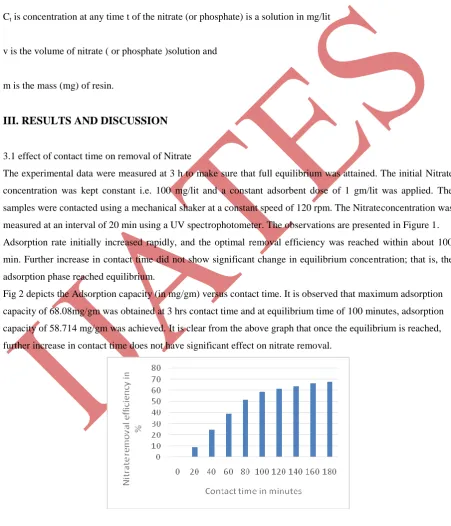
The experimental data were measured at 3 h to make sure that full equilibrium was attained. The initial Nitrate concentration was kept constant i.e. 100 mg/lit and a constant adsorbent dose of 1 gm/lit was applied. The samples were contacted using a mechanical shaker at a constant speed of 120 rpm. The Nitrateconcentration was measured at an interval of 20 min using a UV spectrophotometer. The observations are presented in Figure 1. Adsorption rate initially increased rapidly, and the optimal removal efficiency was reached within about 100 min. Further increase in contact time did not show significant change in equilibrium concentration; that is, the adsorption phase reached equilibrium.
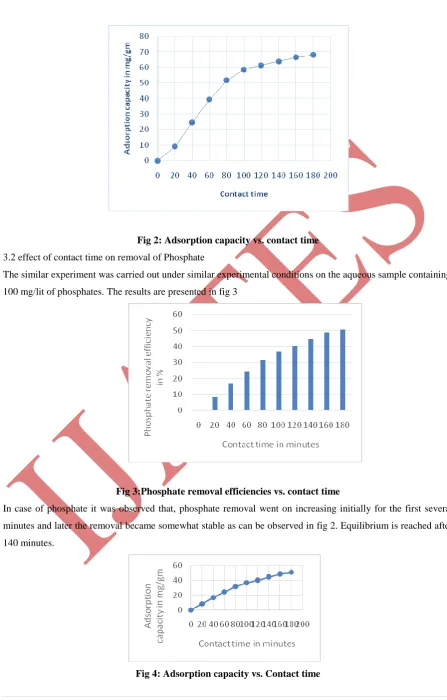
Fig 2 depicts the Adsorption capacity (in mg/gm) versus contact time. It is observed that maximum adsorption capacity of 68.08mg/gm was obtained at 3 hrs contact time and at equilibrium time of 100 minutes, adsorption capacity of 58.714 mg/gm was achieved. It is clear from the above graph that once the equilibrium is reached, further increase in contact time does not have significant effect on nitrate removal.
International Journal of Advanced Technology in Engineering and Science www.ijates.com
Volume No.02, Issue No. 07, July 2014 ISSN (online): 2348 – 7550
120 |
P a g e
Fig 2: Adsorption capacity vs. contact time
3.2 effect of contact time on removal of Phosphate
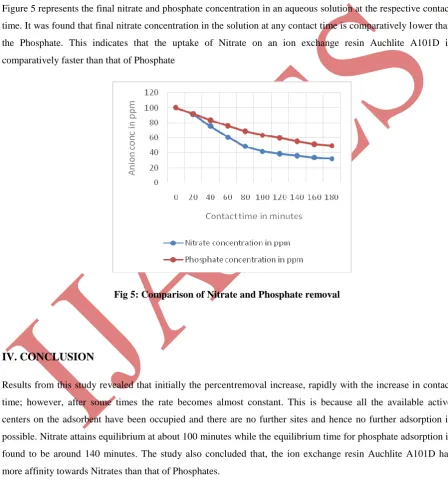
The similar experiment was carried out under similar experimental conditions on the aqueous sample containing 100 mg/lit of phosphates. The results are presented in fig 3
Fig 3:Phosphate removal efficiencies vs. contact time
In case of phosphate it was observed that, phosphate removal went on increasing initially for the first several minutes and later the removal became somewhat stable as can be observed in fig 2. Equilibrium is reached after 140 minutes.
International Journal of Advanced Technology in Engineering and Science www.ijates.com
Volume No.02, Issue No. 07, July 2014 ISSN (online): 2348 – 7550
121 |
P a g e
Adsorption capacity at the end of 3 Hr. contact time was 50.8 mg/gm and at the end of 140 minutes it was 44.8 mg/gm.3.3 Comparative study with Nitrates and Phosphates
Since the batch study was conducted independently on the aqueous sample containing nitrates and phosphates, an attempt was made to compare the removal effectiveness of an Ion exchange resin Auchlite A101D to remove nitrates and Phosphates. Figure 5 shows the comparisons made in this study.
Figure 5 represents the final nitrate and phosphate concentration in an aqueous solution at the respective contact time. It was found that final nitrate concentration in the solution at any contact time is comparatively lower than the Phosphate. This indicates that the uptake of Nitrate on an ion exchange resin Auchlite A101D is comparatively faster than that of Phosphate
Fig 5: Comparison of Nitrate and Phosphate removal
IV. CONCLUSION
International Journal of Advanced Technology in Engineering and Science www.ijates.com
Volume No.02, Issue No. 07, July 2014 ISSN (online): 2348 – 7550
122 |
P a g e
REFERENCES
[1] AppunniSowmya, SankaranMeenakshi “An efficient and regenerable quaternary amine modified chitosan beads for the removal of nitrate and phosphate anions”Journal of Environmental Chemical Engineering 2013 [2] M.H. Ward, T.M. deKok, P. Levallois, J. Brender, G. Gulis, B.T. Nolan, J.V. Derslice, Workgroup report: drinking-water nitrate and health – recent findings and research needs, Environmental Health Perspectives 113 (2005) 1607–1614.
[3] http://www.epa.gov/safewater/mcl.html.
A. A. Hekmatzadeh, A. Karimi-Jashani, and N. Talebbeydokhti “Mass Transfer Modeling of Nitrate in an Ion Exchange Selective Resin” World Academy of Science, Engineering and Technology, 61 (2012) 660-665 [4] Alicia Sendrowski, Treavor H. Boyer “Phosphate removal from urine using hybrid anion exchange resin”
Desalination 2013
[5] Sachin N. Milmile, Jayshri V. Pande, ShilpiKarmakar, AmitBansiwal, TapanChakrabarti, Rajesh B. Biniwale “Equilibrium isotherm and kinetic modeling of the adsorption of nitrates by anion exchange Indion NSSR resin”
[6] E.N. Peleka, E.A. Deliyanni “Adsorptive removal of phosphates from aqueous solutions” Desalination 2008 [7] Haiou Song, Yang Zhou, Aimin Li , Sandra Mueller “Selective removal of nitrate from water by a
macroporous strong basic anionexchange resin”. Desalination, 2012